Americans' love affair with big cars is killing them(economist.com) |
Americans' love affair with big cars is killing them(economist.com) |
Also it is sad to see the disappearance of wagons from the US market. There is no better family car than an E55 AMG.
1) it allowed them to bypass the 70's fuel economy regulations, which applied to cars but not trucks (nor SUVs)
2) their profit margin was higher on trucks than cars
e.g.. their love for humongous wide hard to maneuver fire fighting vehicles (and their over use in situations which shouldn't require a fire truck/engine) implicitly block a lot of improvements and often lead to forced wider lanes and other street design aspects which by now are well known to hugely contribute to more deadly accidents
1) Big cars are safer for their occupants
2) Nothing else matters more than that
(Unless you have some new secret scheme of extremely well-trained animals...? What kind?)
I went from NZ watching (medium sized, even!) utes climb literal mountains in rural areas to the literal flatland of London/Europe, watching people bound their way down narrow medieval lanes in a city in range rovers and defenders - 1 person per SUV.
We're so doomed, lmao.
It's disturbing to see comments that celebrate and excuse wallowing in that subculture.
Now imagine a testosterone filled teen driving it on the freeway after a couple of beers and wants to show off.
"People like grills" --> Flat two-dimensional decoration on the front surface --> How would that affect dead volume in the interior?
Your arguments aren't making sense to me.
The heaviest vehicles kill more people than they save: Analysis of crash data shows that for every life saved by the heaviest 1% of SUVs and trucks, more than a dozen lives are lost in other vehicles.
Weight advantages have changed little over time: Despite improvements in safety features, the weight advantage of heavier vehicles has remained relatively constant, with heavier vehicles still causing more fatalities in lighter vehicles.
Carmakers prioritize consumer preferences over safety: Manufacturers are producing increasingly heavier vehicles, driven by consumer demand for larger, more powerful cars, despite the safety risks to others.
Regulators are ill-equipped to address the issue: The National Highway Traffic Safety Administration's rating system focuses on occupant safety, not the safety of other road users, and tax policies subsidize heavier vehicles.
Public awareness and concern are growing: Surveys show increasing concern about the size and safety of SUVs and pickup trucks, with researchers and policymakers starting to take notice.
Electrification may exacerbate the problem: The shift towards electric vehicles, which tend to be heavier than their internal-combustion equivalents, may increase the weight of vehicles on the road, further amplifying the safety risks.
Cars, even big ones, are negligible compared to the fourth power of bus weight.
I'm actually curious how much of this danger is primarily to pedestrians and cyclists. On the margins, I'd expect in a crash a 6000lb vehicle with modern safety equipment to be safer than a 3000lb vehicle with modern safety equipment, but folks have crashed modern sports cars at triple-digit speeds and (literally) walked away.
For a pedestrian or cyclist, though, getting hit by a large truck or SUV is a different story, primarily because the shape and frontal area are so much larger, and the collision rates are higher because visibility and vehicle control are much worse than smaller cars.
I'm also curious how much of the perceived safety benefit of larger cars is offset by the reduced ability to control the vehicle - in other words, I'm curious what the per-capita crash rates are in SUVs compared to normal cars.
The pickups are less safe for all stakeholders and are a dominant category. They have poor safety features, handle poorly and have comically bad visibility.
That plus the abandonment of speed enforcement drives death. 2000lb or 8000lb car, if you get hit at 45mph, you’re dead. Velocity is exponentially more important than mass.
Especially if they have raised it, which seems very common in places like Florida.
Ill-equipped, or asleep at the wheel? NHTSA could extend their rating system to incorporate the safety of people outside the tested vehicle, but have failed to.
If you tried to force it into a combined rating you'd probably make the problem worse because then people would know that large vehicles are being punished in safety ratings and refuse to buy small vehicles even more than they do now because they can't distinguish whether a good safety rating is from occupant or pedestrian safety.
In a high speed collision between two cars I can see how a weight difference could greatly increase the danger in the lighter vehicle.
In a collision between a car and a pedestrian I don't see how weight could make much of a difference.
Yes, I know that if car A weighs 50% more than car B then at a given speed A will have 1.5 times as much momentum and 2.5 times as much kinetic energy as car B, but when there is a large mass difference between the thing doing the hitting (the car in this case) and the thing being hit (a pedestrian) momentum and kinetic energy don't really matter.
Think of it this way. A large freight train moving at 1 km/hr will have way more momentum and kinetic energy than a Ford F-150 moving at 80 km/hr, but getting hit by the freight train probably wouldn't seriously hurt you (unless you happened to fall and it ran over you) whereas an 80 km/hr F-150 would very likely kill you on impact.
From what I've read the problem with these vehicles in pedestrian collisions is with the shape of the front of them. They tend to have high, fairly vertical, front ends which can sweep you up so you are rapidly accelerated to the velocity of that car. Damage would be similar to what you'd get if you fell at the velocity of the car onto a rigid surface. Cars with lower, most slanted, front ends toss you onto the hood and over the car, which is much less likely to kill you.
That is prioritizing safety - of the very customers themselves, whose preferences very much do include safety! Sounds like the market functioning exactly as designed. And sounds like we need regulation here.
We desperately need regulation. The market won't turn itself around, it'll just ensure the ones that are helping are killed the quickest.
US cars high clearance (and I don't want to be inflammatory, but poor average driver skills) do not help them stay on the road. I'm not sure safety is increased overall Tbf.
In the US.
In Europe pedestrian crash safety is a BIG deal.
I live in Denmark, where this problem is yet very much in its infancy, but it's a clear trend. I hope regulation catches up. Some kind of bounding-box volume and weight restriction would be nice.
https://www2.census.gov/programs-surveys/commuting/guidance/...
Only if the other vehicle is smaller/lighter. SUVs were relatively uncommon when this perception of safety was established. Its now just something people like to tell themselves as justification for buying an even bigger car.
Part of the problem is that carmakers refuse to sell small cars. If you don’t believe me try to buy a small car at a car dealership in America.
Consumers are angry about rising costs, particularly for automobiles, and having a choice to buy an affordable vehicle could be surprisingly popular.
For instance I think electric vehicle adoption is stalled because there aren’t many people who can afford a $105k pickup truck with limited range while towing (e.g. you might really need a big-ass vehicle if you trailer your horse to Ocala, FL every year, but no way you are going to make your animals sit through 20-30 charging stops). A $20k electric with (say) a 60 mile range would get me to and from work and able to do shopping and would be a great second or third car for many households.
All it takes is asking BYD what they need to enter the market.
Interesting post. Can I ask you/somebody to expand a bit on the quote above please?
Sociopathic. Regulations and safety standards should be updated to consider both occupants' and others' safety.
The auto manufacturers won't like this, because they are cheap and greedy.
Why can I take my eyes off the road with FSD off and not with it on? They should mandate driver monitoring in every car when you're not driving with an autonomous system. As a motorcycle rider also, I'm telling you that everyone is literally on their phone when driving. I can see it all because I sit higher than everyone else. That's what the NHTSA should focus on.
c.f. The Onion in 2020: https://theonion.com/conscientious-suv-shopper-just-wants-so...
See how deranged this line of escalation is? How sick in the soul I would have to be to choose to harm your family to increase the safety of mine? Can you see what kind of world you're building when you advocate this?
Or do you not allow your kids outside either, because you bought a big house with a small yard because that is optimally safe?
I think it's worth flagging, but also worth noting the issues in case it wasn't intentional.
It's not to say that we don't like big cars because we do, but walk into a car dealership looking for a small car and they will tell you they are out of stock of new ones of the model you want because the factory washed out in a flood but then they have 100 SUVs in a row unsold that nobody wants to buy made in the same factory. Your only choice is a used return that somebody sold back to them yesterday afternoon.
Go into a dealership looking for an S car and they will try to sell you an L, go in looking for an M and get an XL and so forth. If you drive out with a $25,000 car when you could could of driven out with a $50,000 car they perceive it as a $25,000 loss! No wonder mainstream car brands can't sell electrics.
1. CAFE standards use different rules for cars and light trucks. It’s a protectionist move that strongly pushes manufacturers to find ways to get CUV’s on the road instead of hatch backs and sedans. 2. And CAFE uses a “footprint formula” that relaxes standards for larger vehicles. 3. Compound that with a side impact test that started at 3,015 lbs (high) and then was amplified by the (private) IIHS test raising their sled weight (4,200 lbs?) to reflect average fleet weight, which turns into an arms race.
In the end, people respond to incentives, and we get the cars we regulated for.
You pay an annual registration fee for your vehicle. Make that fee go up dramatically for heavier vehicles. If you pay, say, $100 for a car under a ton, make it $1k for up to two tons, $10k for 3 tons, etc..
It wont penalise EVs while also encouraging people and makers to produce less ridiculous cars. You dont need a 5.3l V8 which does 16 miles to the Gallon to sit in freeway traffic.
Usually, these heavier vehicles also pay higher toll fees on toll roads like in France, Spain, Austria, Italy, etc. In Austria higher engine power vehicles also cost more on a monthly basis, while registration is a 150€ one time fee, monthly insurance and tax can be around 150€ for a 200hp ice vehicle, even just a Ford Fiesta.
Moreover, this chemical has been accumulating in the environment, and making its way into food, so we're not just breathing it, but eating it too. Refer to DOI 10.3389/fenvs.2024.1384506
Yep. To the 3rd or 4th power, depending on where exactly you measure it.
  - Compact cars (rare) - <3K LBs
  - Sedans / cross-over SUVs (RAV4, Crosstrek) - 3-4K LBs
  - Small 3 row SUVs (Pilot) / real SUVs (Explorer / Jeep) - 4-5K LBs
- Big SUVs (Expedition) / Trucks - 5K+ LBsI saw an old Hummer H2 on the road the other day. They used to appear gargantuan to me. This time, what struck me was that it no longer looks shockingly larger than anything else on the road.
There’s a real boiling frog vibe to inner city traffic. It’s so bad - so jammed up and so dirty - but we’re completely inured to it. It’s my fervent hope that the next generation - or perhaps the one after that - will think it very weird indeed to live and work alongside the byproduct of hydrocarbon combustion.
When I was younger and regularly getting around on a bike, I used to view people in large, high vehicles with contempt. I don't anymore. I see them as victims of an industry that lacks moral responsibility.
A quote from a GMC designer around the time this ridiculous SUV mania was taking hold:
"I remember wanting it to feel very locomotive - like a massive fist moving through the air"
It might not be obvious to Americans, but I find it very telling that American made vehicles are almost always the most 'aggressive', and often marketed that way. Why is that?
Have a law, define a target weight + speed and then make it REALLY expensive to insure or kill people with your car.
Also in the law: if you drive around without insurance, the car is instantly taken away from you, as it is a weapon to conduct a crime :-)
Still people will drive big cars around, but the market will limit the number of people who can pay for it. And of course: new cars only and when ownership is transferred. No additional tax for existing owners.
The market would solve this problem VERY VERY quickly.
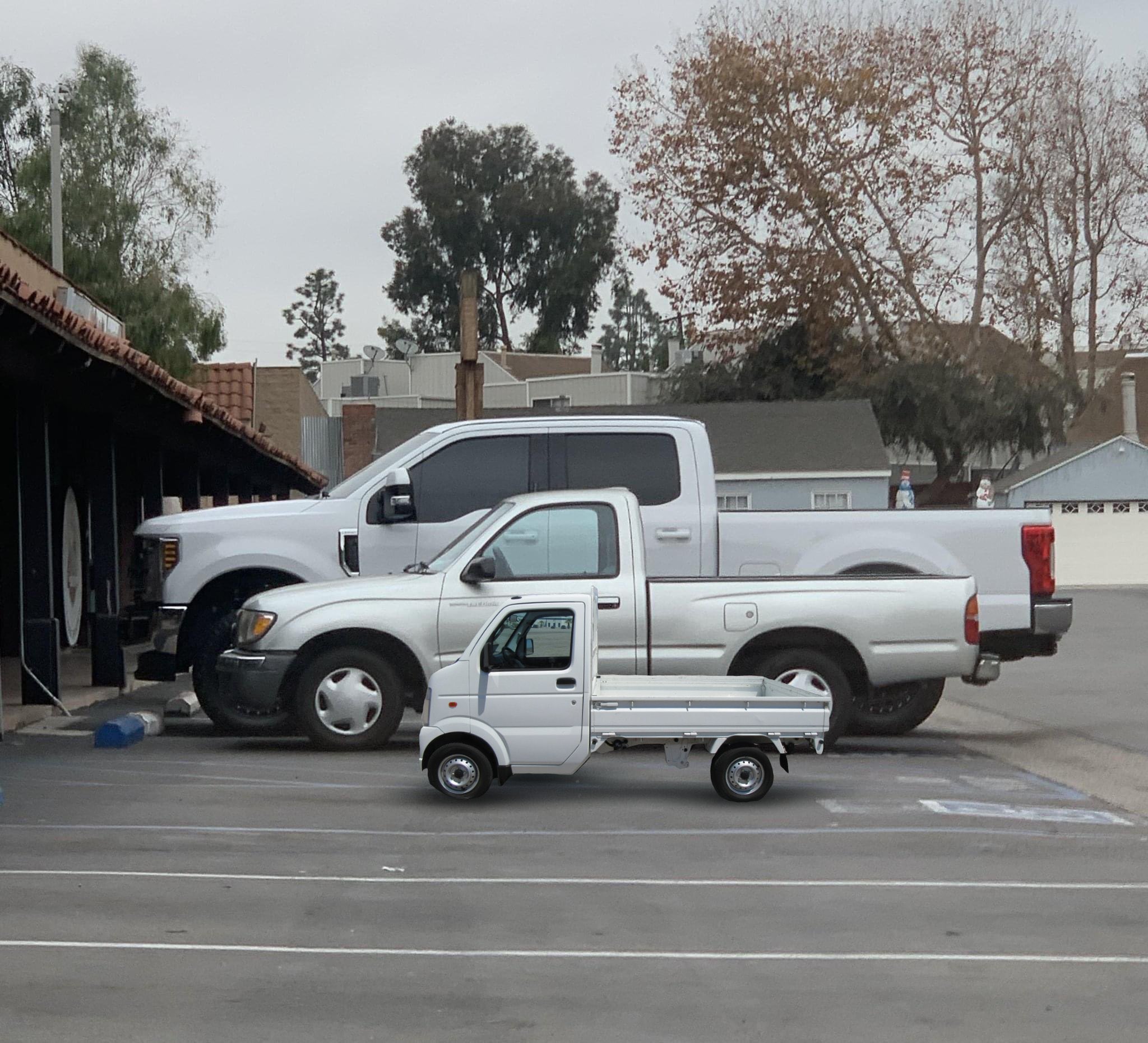
These two have the same bed length: https://www.the-sun.com/wp-content/uploads/sites/6/2023/06/E...
I own a 2020 F150 and I hate how big it is. Turning radius is pathetic. You have to climb into the bed like you're scaling a mountain. There's two sets of steps to get into the front seat (which is gigantic, like it's made for someone 300lbs). I can't see what I'm backing up to. God help any little kid or animal in front of my truck, I'm not seeing 'em. Literally all I wanted was 2000+lbs payload and 4x4, and this was the best option.
I'm fairly sure that image is rather heavily manipulated.
NotJustBikes: These Stupid Trucks are Literally Killing Us
A great source of data for this topic is the Fatality and Injury Reporting System Tool (FIRST) [a National Highway Traffic Safety Administration product]. Link: https://cdan.dot.gov/query
It has more data (covers all states) although VIN numbers do not appear to be in the dataset.
A potential solution would be to give heavier cars worse crash ratings. This approach would take into account not only the safety of the occupants of the car but also the occupants of other vehicles.
And the key word is "real investment". not the ones for California to build its high-speed railway, 7 EV charge stations for 7.5 billion dollars, or $300M for high-speed internet yet no family has got it
I look under the hood of "large" trucks and sometimes it's a lot of empty space. It looks like a paper tiger- it's fake big. I've also read somewhere that taller vehicles have a higher chance of rollover which could make them less safe than advertised.
Ford has no compact hatchback or sedan in the U.S., only the Brazilian built EcoSport. They killed all their cars in favour of CUVs and SUVs. Chevrolet no longer has the Sonic, having nixed those in 2022. Honda no longer has the Fit as of two years ago. Mitsubishi no longer sells the Mirage as of last month. Dodge hasn't had anything since the Dart died in 2016. The Jeep Renegade's gone as of October of last year. Hyundai had the Veloster, but those are all sold as top trim Veloster Turbo Premiums or Ns even when they were being sold. The current Hyundai Ioniq 5 is more of a mid-size and is also expensive for the size. Kia has the Forte, but it's dragging out a slow death this year. Toyota has the Yaris and Prius C, but the Yaris has grown quite large, and the Prius C is quite high priced. Nissan killed the Versa Note in 2022, so you can't get those either.
It's all been replaced with "compact" CUVs that have the exterior dimensions of a mid-size hatchback.
https://www.ford.com/cars/fusion/
The "Explore All Sedan Vehicles" button links to the "Ford SUVs" section.
Have I got some bad news for you... It seems the EcoSport is also dead ( https://www.ford.com/suvs-crossovers/ecosport/ )
Hatchback, universal, minivan, suvs are much more practical.
They still sell one car -- the Mustang.
I want basically an electric Miata for around town, can't get one.
I also want an actual utility vehicle with a long, solid, roof rack to haul a canoe or sheet of plywood. SUV roof racks are usually token, if at all. A plain old "station wagon" that's not 6 feet tall would be just fine but they don't make those any more. I settle for an Outback but it's not ideal.
So neither of my two usecases are served at all.
You just don't want them.
I have a Fiat Spider for fun, and a Volvo V60 wagon for utility. My wife is 5'3" and is taller, barely, than the V60.
The Spider is dead and the Miata is dying because global sales have tanked and Mazda's only selling 6-8,000 per year in the US.
The V60 is dying because almost everyone who says they want a station wagon is lying, either outright or to themselves, and they buy a compact SUV instead. Commenters will shout in all caps on the internet that NOBODY MAKES A STATION WAGON ANYMORE, walk onto a Volvo lot, right past the V60 and drive off in an XC60.
I imagine the A4 Allroad (also a station wagon that doesn't exist!) is also on life support.
And before you go on about price, Mazda, Honda, and Toyota all sold inexpensive wagons in the US until past the point that it became financially negligent for them to do so anymore.
Nobody wanted them.
Consumers weren't tricked, brainwashed, hoodwinked, scammed, or flabbergasted-- customers did not want them so they didn't buy them so manufacturers stopped selling them-- in the US at least, you can still buy inexpensive wagons, with manual transmissions, all over the rest of the world.
There are still a few EVs models available in the US that are relatively light compared to the mainstream models, and most are going to be old/used models.
e.g. Nissan Leaf, Chevy Bolt, Fiat 500E, BMW i3, Volkswagen eGolf.
None of the above will be in the low 2000 lbs curb weight territory that is part of the Miata driving feel, but they are the closest you can practically find.
All of the arguments from car manufacturers that they're just "answering consumer demand" ignores the point that they manufactured that demand. Change the tax structures and incentives, make trucks as expensive for the manufacturer as they are for society, and you'll see a renaissance of small cars, advertising extolling the virtues of small cars, and a societal shift towards small cars.
The second problem is that the footprint-based formulas used within a category do not reflect the practical utility of the vehicles and let larger cars off easier.
A high-roof compact car like the Honda Fit can comfortably carry 5 people and opens up quite well for transporting a lot of stuff. Because it's small and light, it gets great gas mileage especially on the highway. Yet it's penalized by CAFE because it has a small footprint and so is expected to get unrealistically high fuel economy.
Whereas, a larger sedan like the Honda Civic can also carry 5 people (with some more amenities) but has a paltry trunk that can't be used to transport much more than grocery bags. Even as a hatchback, the roof is a lot lower than in the Fit, so it can transport larger items like furniture, but only if they're flat. Yet it scores better on CAFE because its larger footprint allows it to have more realistic fuel economy.
I think car-buyers are often under an illusion that an suv is "more car" when actually it's exact same components and just a larger frame. They'd much prefer to sell you the high-margin product and pocket the difference.
The big thing to me is that I drive a 10+ year old station wagon, and I seem to have more cargo space than many of these MUCH larger vehicles.
I only have two kids. I have room for the dog. I put the bikes on the roof.
What would a SUV do for me?
An extra couple inches of ground clearance.
Increased towing capacity.
Rarely needed those.
Over here: small is anything from a Smart to a Renault Twingo/Ford Fiesta/VW Polo.
Medium: VW Golf, Ford Focus.
Large: anything bigger than medium.
The obvious answer to the entire scenario. There's no reason to go looking for hidden reasons: it's in plain sight.
1. Lawmakers put an import tax on trucks, and (perhaps not entirely intentionally) made emission standards for SUVs lower than those for cars.
2. US automakers were getting their ass kicked by foreign imports that were much better made in the car segment, but not in the SUV and truck segment.
3. US automakers decided to heavily promote trucks and SUVs, the segments they were most competitive in. You know, pay to make sure all the characters in that TV show are driving SUVs and whatnot.
4. Lawmakers decided to maintain the state of affairs from 1 because they like US automakers.
That's widely known, and for a very long time already.
Are you making this up?
Post-COVID especially car dealers will make up all sorts of nonsense. Try to buy a base Civic or Corolla. They’ll literally run off and hide.
Relatedly, it’s infuriating that American manufacturers are only interested in developing expensive, large, luxury EVs. We slapped a 100% tariff on cheap Chinese EVs… but our domestic companies refuse to develop a $20,000 compact EV!
The cost of new cars in the US is insane. As is the protectionism of the industry. Give me cheap Japanese/Korean cars plzkthx.
Of course there are several laws and policies on national and statewide levels enshrining the current anti-consumer model because it "creates jobs".
The mere idea of having to negotiate prices like in an flea market is disturbing and disgusting to me.
I want to be treated fairly and as well as the next guy.
Fixed & open construtor prices and warranties, online customisation and ordering should be the only norm.
Many drivers there seem to focus primarily on their perceived right to drive as fast as they want, often creating dangerous situations for others who may be able to or want to drive as fast and thus often not have time to react. I've witnessed numerous close calls and risky maneuvers that don't align with the idealized view of German driving discipline.
That said, the significant difference in road fatality rates between Germany and the US suggests there are indeed factors contributing to safer roads in Germany. However, from my experience, it's not simply due to more careful drivers across the board. Other elements like road design, vehicle safety standards, strict enforcement of traffic laws, and comprehensive driver education systems likely play crucial roles, see the pathway to a german drivers license which includes about 9 hours of practice training with a driving instructor.
Rather than looking abroad for examples of driver behavior, it might be more productive for the US to focus on improving road safety through comprehensive measures. This could include enhancing driver education, implementing stricter enforcement of existing traffic laws, and investing in safer road infrastructure.
The goal should be to create a system that encourages and facilitates safer driving for everyone, regardless of individual driver attitudes. While there's certainly room for improvement in American driving habits, the solution likely lies in systemic changes rather than simply emulating perceived behaviors from other countries.
Broken down by state, I’m sure there are states that are safer than Germany.
I’ve been to the US and Germany only once. In Berlin I didn’t drive, but saw the weirdest thing multiple times: when the traffic lights turned green sometimes the drivers of the cars up front would just go flat out, tyre screching and all, only to stop at the next traffic light 100 meters away. Really odd.
On the other hand I had to drive many kilometers (sorry, miles) in the US and thought everyone was well behaved, didn’t experience any tailgating, reckless driving etc.
[1]: https://frontiergroup.org/resources/fact-file-americans-driv...
https://en.wikipedia.org/wiki/List_of_countries_by_traffic-r...
NHTSA would be better off at having a visibility requirement for 5th and 95th percentile men/women. I’d allow cameras to play a part, but if used, everything in the system has to be warrantied for 10 years/100k miles (similar to emissions equipment).
Driving in older cars is way easier apart from power steering. The rest are luxuries like air con, entertainment. Even cabin space in older cars was vastly larger than new cars and the exteriors of new cars are vastly larger now than before.. thanks (but no thanks) to safety measures.
I don't think they need enforcement as much as traffic calming features. It simply shouldn't be possible to speed as much as people do... I live between a middle school, a special ed school and a bus stop, on a 30mph road which is 43ft wide. Basically this is what it looks like: https://streetmix.net/-/2685748 and this is probably what it should look like to reduce average speeds: https://streetmix.net/-/2685753. There are children walking and biking along this road all day. I frequently see people speeding, easily going 40, 50 even 60mph. Note that this isn't a very high traffic road either, I just looked up the average traffic counts and it gets 8-12k of vehicles in both directions PER DAY, so traffic calming would barely have an impact. If anything it might drive more people to take the highway or one of the other high-speed roads nearby instead, which would be a good thing too.
The other problem is people coming out of cross streets, and immediately pulling forward as much as possible without looking. You have a kid crossing the street who maybe doesn't know any better, or is distracted because they are on their phone or chatting with their friends, and you got a perfect recipe for an "accident" right there ... I've also watched close calls like that so many times in this area. You simply can't put a cop on every corner to do enforcement of that - maybe some automated camera systems would do it, but so does daylighting the intersections like they do in Hoboken.
And the other problem is that any time you do something that even vaguely could cause an increase in driving time, people will rage. I've seen public comment sessions where the planners literally showed the data that adding a bike lane wouldn't increase travel times during peak and actually decrease traffic and people were like "well, I don't believe it, my commute is going to slow down for sure". Same with even simpler things like speed cameras ("cash grab"), heck even increased police activity (also "cash grab"). You can show data that it will save people's lives, even children's lives, and people (even on HN) will say "but the economy... and efficiency...".
Can't tell if this is nerd ragebait or just a confused person
For HPV for example, the reason there's a period when it was given to girls not boys is that the evidence wasn't available to show a benefit for the boys. Obviously vaccinating boys means they're less likely to give the disease to anybody they have sex with, but that's not a personal benefit and so it's not an ethical reason to recommend vaccinating boys. The evidence that they wouldn't get a bunch of other rarer cancers caused by HPV was enough reason to vaccinate boys, and that arrived later.
That ethical dilemma about sacrificing one patient to save more? That's not a thing.
This is a pretty bad argument, the extreme doesn't necessarily define the middle. The extreme version of free speech is a world where fraud is legal. The extreme version of fire safety is a building with openings everywhere so there's no need for doors. The extreme version of policing is having cops follow you everywhere, including into your house. You can't just reason like that.
To be fair to your argument, you _are_ talking about a “line of escalation” and an issue with a lot of moral complexity. I’m not even saying you’re wrong, rather just that I think you can’t view it so simply. Do you have kids or a husband or a wife? Could you _really_ put their own lives before strangers, or do you just want to see a world where people give more compassion to their fellow human? Because I want that too; I’m just not willing to sacrifice my loved ones for it.
I wouldn't throw stones, we all live in glass houses. Pedestrians (and cyclists, etc.) could say the exact same thing about car drivers - they're putting their lives at much higher risk by not biking (or using a motorcycle, or public transportation, etc.). Heck, drivers are also endangering pedestrians' children through global warming. If you really tried you could probably name a dozen more examples of ordinary people like yourself putting others at risk for their own benefits.
This isn't to say the parent's decision is great, but that this sort of counterargument isn't all that strong, either.
First of all, this is human nature 101. Secondly, simply owning a large vehicle does not equate to 'harming your family'. Bad/impaired drivers are responsible for that. Any other inanimate objects people shouldn't own because you don't like them? People aren't going to simply put their families in Fiat's with Escalade's on the road to show solidarity with the "we need smaller cars" movement.
otherwise in 50 years everyone will be driving around an ex-army abrams
Maybe I'm naive, but I think most people buying large vehicles aren't selfish, they're ill-informed and susceptible to social pressure and advertising.
The only reason I say this is because most people have big cars in the US now. But they're also objectively worse for most commuters. It doesn't add up.
Hey, do you eat; do you at least every now and then want food? Do you ever wash; do you at least occasionally want soap? But wait, food isn't soap and soap isn't food -- if you want both, you must need medication for your multiple personalities!
See how ridiculous that was?
So you need some way to distinguish the people buying large SUVs for these reasons from the people buying them out of schlong insufficiency, but nobody seems to have a good way to do that.
This is not distinguishing between them at all, it's just adding a new tax that makes everything cost more.
> And maybe we can even have waivers or something for small businesses, or non-profits, or households with 4+ kids.
At which point everyone claims to be a small business. Also, if someone has one child rather than four, that doesn't mean they aren't regularly transporting that child's entire sports/drama/music group to events.
>Consumers are angry about rising costs, particularly for automobiles, and having a choice to buy an affordable vehicle could be surprisingly popular.
Consumers may claim they care about rising costs, but the fact that more expensive SUVs are outselling sedans makes me think it's the consumers who are refusing to buy small cars, rather than carmakers refusing to sell them.
Related discussion: https://news.ycombinator.com/item?id=39731164
Dan Gillmor's thoughts: https://mastodon.social/@dangillmor/112102491028919681
THIS is why we need Chinese automakers to keep the pressure on these US and EU automakers to produce cheaper cars again.
I think it's more complicated. Consumers are stupid, or rather, easily manipulated.
SUVs and Trucks have much higher margins than sedans and other small cars. It is advantage to any car manufacturer to sell mostly SUVs and Trucks because you get more money per unit of work. Essentially, you do 110% of the work of a sedan but charge 150%-200% as much. It's a no brainer.
So of course the advertisements primarily focus on SUVs and Trucks. I don't know how much free will consumers truly have in a system with such intense advertising.
Poor people would like smaller cars, but they buy used cars, not new cars. Affluent people buy new cars and want big SUVs. Of course, then that's what ends up on the used market after a few years.
They did it to my dad when he tried to buy a small car in he 1970s and it was a policy of American car dealers except around a short period after he 2008 financial crisis. What is relatively new is that Japanese car dealers started doing the same after the 2008 crisis abated.
>They did it to my dad when he tried to buy a small car in he 1970s and it was a policy of American car dealers except around a short period after he 2008 financial crisis.
What you said about sedans being hard to procure might be true today, but there's no way it was an issue back in the 70s. Eyeballing the chart in the article[1], 3 in 4 cars produced were sedans. It strains credibility to claim that it was hard to buy a sedan. Even today, sedans account for 1 in 4 cars produced. That's a huge drop, but there's no way that the buying experience is as difficult as you make it out to be.
[1] https://www.economist.com/interactive/united-states/2024/08/...
This bit of American instant-gratification-addiction has always felt weird to me, and I think most Europeans (at least those who even know of this difference). Like, a new car is a pretty huge purchase. Why would you ever buy one that isn't exactly the way you want it, when all you have to do is order it with the exact options you want and then wait a few weeks?
Weird. Again.
There's no way that BYD will be allowed to sell many cars in the USA regardless of potential benefits to consumers. It's too risky to increase our economic dependence on a country which is at best a strategic competitor and at worst perhaps an adversary. Both of our main political parties are now generally aligned to that viewpoint and it won't change at least as long as Chairman Xi remains in power.
Driving a small compact car on an American freeway would be terrifying. I have a small (by US standards) car at home, but I hired a big (by European standards) car when holidaying in the US.
It is notieable that there are more and more huge SUVs and pickups appearing in the UK, even though our roads and parking spaces are not designed for them.
Consumers were marketed to -- i.e. tricked, brainwashed, hoodwinked, and scammed[1] -- into not wanting them so manufacturers could stop selling them and sell them SUVs in stead.
___
[1]: Not flabbergasted, though; that means something else.
Also, it was not a good car.
$100k in 2008 is $150k today.
I amend my estimate to be $150k.
Nobody’s paying $150k for a Mazda.
The new Tesla roadster is expected to start at $200k.
Yeah, this is how you discourage people. The license on top is super inconvenient too. I mean, who wants to go to the DMV and take a special test just for their ego booster?
> At which point everyone claims to be a small business
I imagine you have hard requirements, it's not like anyone can just say so.
> Also, if someone has one child rather than four, that doesn't mean they aren't regularly transporting that child's entire sports/drama/music group to events.
Okay. But are they? Because the situation we're in right now, currently, that we're trying to solve is that the average number of passengers in a vehicle is 1.5 and the majority of vehicles are SUVs and trucks.
I don't know, I guess those people can just pay the tax. Or, better yet, don't buy a vehicle to optimize for 1% of your driving time.
If this discourages car pooling, I say "meh". Car pooling is already basically not a thing, and pretty much all trucks can only hold 5 people. You know... the same amount of people as a compact sedan.
Big american SUVs are not only big. They are also just badly designed.
It's really trucks that have gotten stupidly big these days.
The US spent $2T on the gulf wars to secure this, and globally spend at least $7T a year on fossil subsidies. This needs to end immediately.
https://www.imf.org/en/Publications/WP/Issues/2023/08/22/IMF...
You want to get rid of bad regulations, obviously. You really don’t want to get rid of all regulations.
I don't know if this is an economic concept that exists, but I'd call it an "accidental cartel." Corporations noticed that serving a particular customer base was less profitable than giving customers fewer, more expensive choices, so the market participants aligned themselves around this strategy until there are no cheaper, lower margin options left. In theory, that leaves an open market for a competitor, but to occupy that niche would be to spend resources on attracting a lower-quality customer (one who is less able to pay more, less interested in paying more, less susceptible to marketing, etc).
There really is no advantage to independently-owned dealerships, except maybe in bribes to local politicians.
In Ireland, displacement-based taxes were replaced by emission taxes 14 years ago. I think most countries have followed suite.
Some of my cars over the years:
Mini: 600 kg, 850 cc
Rover 75: 1 700 kg, 2 500 cc
Chevy Van: 2500 kg, 5 000 cc
This isn't even a good approximation because turbochargers (which nearly all heavy, diesel vehicles have) significantly increase power at the same displacement. The 5 liter Mustang weighs less than 4000 pounds. Here's a >10,000 pound bus with a 3.2L diesel engine:
Dealer-added options aren't added at a factory, they're added at the dealership, solely for the reason of inflating profit and convincing customers to roll the cost into their loan.
When I had my first son, we upgraded from a Chevy Aveo5 to a Ford Focus.
Everybody told me it was still much too small for a couple with a child.
It’s a family sedan anywhere except North America. Go away.
Now people think they need some ridiculous GMC Yukon for their one kid they sometimes have in the car, though 90% of the time they're just commuting by themselves. Then they whine about gas prices.
If your family requires more than 4 seats on a regular basis, sure, get a minivan; but I don't understand the appeal of an F150 or other large vehicle as a "family commuter" for, we'll say, the family of median size.
Two children fit in the back of the Focus until we got rid of it. They were 6 and 9. By that point it got leas squishy because the car seats get smaller with age.
Littlest kid went behind the driver because it was stick.
Sometimes!
I'm 6'3", so it only fits on the passenger side.
3 inches longer than a Camry
One is separation of the passenger cabin from the cargo area. More than once I've accidentally bonked someone in the head putting something in the hatch or have had a dog escape because they managed to leap over the seat and get out through the open hatch. It's also easier to hide valuables in the trunk, as there's no indication anything's in there unlike the open rear deck of a hatchback you can see through the windows.
Another is lower center of gravity. There's not a large chunk of metal and glass above the beltline. This helps handling characteristics and makes it easier to engineer predictable patterns for the suspension. It also helps tire wear as there's less lateral force on the sidewall from the lowered center of gravity.
There's also the structural rigidity. Sedans have a slightly higher structural rigidity to them than hatchbacks due to the three box shape creating cross bracing. It makes it easier to engineer them to survive a crash without harming the occupants.
And lastly there's aerodynamics. Many hatchback designs in the modern era are extremely rounded for stylistic reasons. This is terrible for aerodynamic efficiency compared to a proper Kammback rear design. A sedan with a properly designed rear windshield and trunk actually has far less parasitic drag because it creates a much smaller area of low pressure air directly at the farthest rear edge of the vehicle. Unless you drive a Ford Fiesta sedan, in which case you're getting the worst of everything. If you've ever seen those monstrosities that BMW calls an "X5 Coupe" this is them trying and failing to apply the Kammback aerodynamics of a modern sedan to an SUV.
There a basic nets and if one is extreme cages which separate the boot from the second row.
> It's also easier to hide valuables in the trunk, as there's no indication anything's in there unlike the open rear deck of a hatchback you can see through the windows.
Pretty much every hatchback I've seen in the last 20 years here in Europe has a removable cover.
Based on fatalities per 100k persons (not a great statistic but the one quoted in this thread), and 2022 data, then nope. Every single state is worse than Germany.
Even District of Columbia - basically a city with much less reason to drive - manages a worse score than Germany as a whole.
https://www.iihs.org/topics/fatality-statistics/detail/state...
My experience is that it depends on where in Germany you are. I drove from France to Norway this week so I went through northern Germany and the autobahn was great, where it wasn't restricted because of the more or less permanent roadworks that is. I drive on Tesla Autopilot when I can which has a maximum speed of 150 kph and only once in the 600 km from Venlo to Flensburg did I notice someone get too close behind me even though many were travelling considerably faster.
It's a different story further south around Munich for instance.
I agree though that road safety in Europe has a lot to do with road design, vehicle standards, maintenance, driver education, etc.
I would think elements like strict enforcement of traffic laws and comprehensive driver education systems likely play crucial roles by... leading to more careful drivers across the board.
What are they learning, other than (at least partly) discipline and ways to be safer?
But for a specific example, many Americans are let loose with a driver's license but scared of entering or exiting a freeway. When it's just about impossible to drive in the US without using freeways. (They are scared for good reason considering their lack of practice and understanding of how that works.)
Japanese FF sedans and hatchbacks were a breath of fresh air because they fixed all those problems. Volkswagen also made RR vehicles like the bug that were radically simple, affordable and reliable but never made the investment to make the comply with new emissions regulation and instead they came out with the Rabbit which was initially OK but the price went up and quality went down and now you have the Golf which appeals to people hypnotized by the German nameplate.
Myself it’s not a sedan that I want but a hatchback. I currently drive a Fit, but since they quit making it I will think more than twice before getting another Honda.
I always disliked the crosstrek since it’s a heavier Impreza on an already dogged engine but they are/were the only manual version so some people were buying them for that.
I can think of worse things for a crossover to share an engine with.
but maybe this would just incentivise the sort of person that buys an F150 to drive to the shops to simply to upgrade to a big rig (for the tax saving?!)
No, you just have to charge in proportion to damage done and let the economics work out how they will.
Massive increase in the cost of public transport as buses pass their tax costs onto users.
Massive increase in the cost of freight shipping, which would be passed on to consumers, i.e. everybody, since virtually every part of the economy depends indirectly on freight transport.
It would amount to everybody paying, and thus being more or less equivalent to public funding of roads.
Public Transport -- If tax payers are currently paying for the external costs of public transportation (via taxes to repair roads) then it won't cost anymore public money if taxpayers continue to cover that cost. For private busses this is a case of tax payers unfairly subsiding their external costs.
You could obviously tweak legislation to treat such vehicles differently if you wanted. I was just getting the core idea across, not suggesting my comment should be copy-pasted verbatim into the next bill Congress is passing.
That’s an oversimplification, but it doesn’t really matter if it’s 99.9% or 95% of the damage ware is still absolutely dominated by heavy vehicles.
And it could be a lot more negligible, if that mostly drive alone, drove a car with half the weight.
It's not like they're the sum of all evil, they have a small impact on the size of these things, but bringing the sizes down will help on the pathway to lowering the size of everything.
The fuel trucks aren't going to change in size, they're going to come more often. Also, oil is typically distributed in pipelines or on ships rather than trucks until the last mile. Meanwhile a fuel tanker holds some 10,000 gallons of fuel, i.e. enough for "large" 20 MPG SUVs to go 200,000 miles. Meanwhile the tanker is generally transporting the fuel less than 100 miles, so this is diluted by a factor of 2000. Because of the 4th power law, this still causes nearly as much damage as the SUVs themselves, but they're both still negligible compared to all of the other commercial trucks transporting everything else.
Obviously this doesn't even apply to electric vehicles.
> They use more materials to make, require bigger places to store/maintain them and go through bigger consumables ie tires -> bigger lorries.
This is an even smaller effect than the fuel.
The US sells on the order of 4M domestically produced pickups and SUVs per year and produces 1.8MT of steel. If we, conservatively, reduced the weight of all of those cars by half or 1T ea (they're often 3x the weight of a sanely sized vehicle) we quickly eclipse US steel production, even if we exclude some parts as non-steel. That multiplies by 1.6x when you think in terms of iron ore (though most is recycled from scrap).
TLDR: go play factorio
One of the roads up the mountain has switchbacks near the top that are so tight that nothing longer than 18 feet is allowed up, but at least 2x a week a box truck gets stuck.
Heavy cars have many negative impacts but road maintenance isn’t one worth worrying about.
None of those drive on small local roads, but mom trucks do.
A full sized school bus will regularly drive on just about any road. Fully loaded they’ll do 1000x as much damage as a large SUV.
Fire trucks, septic tank pump trucks, big furniture delivery trucks, landscaping trucks, motor homes etc… will also drive on pretty much every small local road.
And much bigger commercial trucks drive on very small local roads enough to dwarf the damage of a large SUV. My neighbor just had a foundation for an addition poured. 3 cement trucks came out. 3 fully loaded cement trucks would cause something like 20,000 times as much damage as a large suv.
I’d need to drive on my street once a day for 50 years in an enormous suv cause as much damage.
Given normal weathering and damage caused by frequent or even infrequent large commercial vehicles, larger local passenger vehicles aren’t going to increase maintenance costs.
Last mile I will give you. Those shippers use trailers and containers on railroad cars, and trucks do the last mile delivery.
I'm sure it's pure coincidence that many cities already have rail lines going down roads in city centers. They probably just built the city around a historical freight line, and haven't bothered to remove it.
But you want to optimize the thing where you get the most bang for your buck.
The heavy side of the most popular SUVs aren't based on the F-350, they generally weigh around 4500 pounds vs. 3500 pounds for the lighter end, the latter being around the same as the average mid-sized sedan. Cutting 30% off of a one-time cost for something that will have a 20-year lifespan is generally not going to be the best place to optimize.
Compare this to, say, introducing mixed-use zoning so people can live closer to their jobs and drive fewer miles. This not only reduces fuel consumption on an ongoing basis, it makes cars last longer because they have fewer miles on them and then you don't need to manufacture as many, and it has direct human benefits because people spend less time stuck in traffic and drive fewer miles with risk of traffic fatalities.
I used 4,000lb for the car, a 2024 Chevrolet Suburban which is huge only clocks in at a 5,824 lbs. Load another 1,000lb for passengers etc and (6,824/4000) ^ 4 = 8.5x a car or 0.5% what I calculated for a full 18 wheeler.
Sure there’s more cars than 18 wheelers but 7,000lb is a rather extreme outlier in terms of SUV weight.
And it's probably heavier than most cars around here, because most cars are not 7 seaters, but 4/5 seat hatches.
US SUVs and pickup trucks wouldn't fit most parking lots around here (to tall, to wide to even get in), but somehow the problem is never the size/weight of cars people got used to drive.
At the extreme end, imagine a railroad bridge. We don’t care about how fat the mice that regularly cross it are.
This. Is a very out of touch opinion. I could write 20 paragraphs disagreeing, but I doubt it is worth my time to write or anyone else’s to read.
Not every person is able-bodied enough to walk and bike. Also, people happen to need to get from A to B when it is cold, dark, raining, extremely hot, snowing, or just some kind of shitty outside. People need to drive to a store for food or supplies that cannot be carried or biked back to the destination. People have multiple children that simply cannot walk or bike. Old people cannot simply walk or bike.
This concept of a car-less world is just so completely out of touch with reality, saying it louder isn’t going to change anything.
>Not every person is able-bodied enough to walk and bike
And the same goes for cars, except kids can ride bikes, so car accessibility is actually just worse.
>Also, people happen to need to get from A to B when it is cold, dark, raining, extremely hot, snowing, or just some kind of shitty outside
You can walk or cycle in all of those conditions. In fact, I have walked or cycled in all of those conditions in the past 6 months.
>People need to drive to a store for food or supplies that cannot be carried or biked back to the destination
There's very little that can't be carried on a bike or public transport, but you can always rent a car for a couple hours if needed. Let's be real, that's not why 99.9% of people are driving cars.
>People have multiple children that simply cannot walk or bike
Where I live it's common to see mothers cycle with their kids on child seats in their bikes.
>Old people cannot simply walk or bike.
And a lot of them can't drive either.
YOU can do that, sure. You need to look past your own nose to objectively weigh in on these topics.
This is true, but it also true that not every person is able to drive a car. In fact the inability to drive is way more common than the inability to walk.
As for cold, dark, raining. Boo fucking hoo. If you had to go somewhere you'd deal with it. Cars have made people into weak, incapable little creatures. It's honestly pathetic.
I cycle with food and supplies in my panniers all the time. What exactly are you buying every week that can't be transported back without fossil fuel assistance?
You don't think children can walk or bike? Are you crazy? A healthy child doesn't want to sit still. They're capable of locomotion from about age 3.
Old people can get around too. Sure there are some who can't but it's not a majority. Again, cars have taught us this helplessness.
I just wish I could take car people outside of their reality for just a week or so. Once you see it from the outside it's so apparent. But I guess some people aren't ready to leave the Matrix. And some will fight to protect it.
You clearly have no respect for Mother Nature if this is your stance. Take care.
But the US has very few cities proper (mostly those which grew big before that advent of the car), and even those have uneven density and thus efficiency of walking or taking a bus.
A ton of what the US taste call cities is sprawling low-density almost-suburbia surrounding a few high-density "downtown" areas. See Houston, TX for an impressive example. Biking in such places is possible but tiring, walking is mostly pointless unless you visit your neighbor or a park, and running a subway is uneconomical.
Hence, they resort to cars.
Cycling simply isn’t viable to large swaths of the US. There isn’t an easy answer to this either, given that you’d probably need to tear down entire neighborhoods and rebuild a more dense town
It is not the responsibility of the citizens of the central city to accommodate suburban drivers.
Driving in and around the suburbs is what I was talking about.
The only people who live in Cities that should be allowed to use cars are the ones with very real health issues and businesses that transport real physical products to heavy or large to carry.
Plus, no Trucks with trailers should be allowed in any city.
Often times in HN you get the impression like americans are the only ones using cars to get around, but at least where I live (Finland) families generally own at least one car even if good public transportation is available. In 2021, 89% of adult men and 76% of women had a drivers license and I would say that commuting to work with a car is more common than with public transport. Despite having decent public transportation, it is just seen more convenient to use the car.
Maybe your issue is reading comprehension. I never suggested anything about anyone getting fucking stranded, stop putting words in my mouth.
In cities that aren't completely car-centric and have mixed-use development, you don't need a car to get groceries, because everything is close enough to walk. Again, plenty of countries do this just fine, proving it is not impossible.
It’s not the reality that we live in. Most of the world is not a town or city of temperate climate where everything is within a half hour walk or bike ride.
I will never understand how this point is just glossed over and excused away. Ignoring the boundaries of reality doesn’t make said boundaries magically go away.
Going to a grocery store a few times a week is not a lot of effort. Urban grocery stores are nearby, they are optimized for quick visits, and you can often buy groceries when returning from somewhere else.
You should have emergency food at home, but many kinds of fresh foods are best eaten within a day or two. If you only go to a grocery store once a week, the quality of the food you eat is worse.
In bags, duh.
(Or a backpack.)
I think it means "The vast majority of trips are taken by foot or bicycle where I am." Which was, from another (very) nearby comment, Tokyo.
> Your anecdote of 1 does not a statistic make.
No, but the vast majority of trips in Tokyo does.
Second,I live in Tokyo, where the summer has been miserable with average temperatures of 32C, with regular highs of 36+ with 80% humidity. And yet I walked and biked everywhere and was just fine, and that's true for most of the 40M people that live here as well.
Third, it sounds like you live in a place that's not suitable for humans, you should probably move instead of making the planet even hotter for everyone else by living in your steel boxes with AC.
I dunno about 3 months exactly, but some areas of India are pretty close. And Delhi has 15-30 million people, depending on how you count
And would you mind not being a condescending prick? If you had taken a second to google you would know Tokyo had highs of 40+ this summer.
Sounds like you're just trying to make excuses for your awful city.
If you can't even figure out how to look up _anything_ about how to implement your plan, how the fuck do you expect it to ever become a reality?
This is nonsense. It will not happen.
Car culture is not a foregone conclusion. Claiming 100% of the world has to be converted to Tokyo and if that is not possible then we should give up is hilarious. What an illogical, sad and pitiful argument/attitude. Cities are being changed every day, and those ongoing investments can be made to make cities more car dependent or not.
Not to mention there are A Lot of cities more dependent on cars than lots of other cities many with nearly identical climates. Tokyo isn’t the only one lol. It’s not some magical unicorn.
Someone else said this. This isn't possible. Stop.