NYC Congestion Pricing Tracker(congestion-pricing-tracker.com) |
NYC Congestion Pricing Tracker(congestion-pricing-tracker.com) |
2. Congestion pricing, more generally, is ivory tower social engineering (economic discrimination like toll lanes) and a disproportionate tax on the working poor. It would be fairer if it were progressively taxed based on income.
The kicker: I'm not even in a suburb, I live in SF!
All we do in SF is make car driving worse, we almost never make public transit better. At least NYC has a plenty good enough train system.
I end up WFH anyway, largely because it's annoying to get to an office downtown every day.
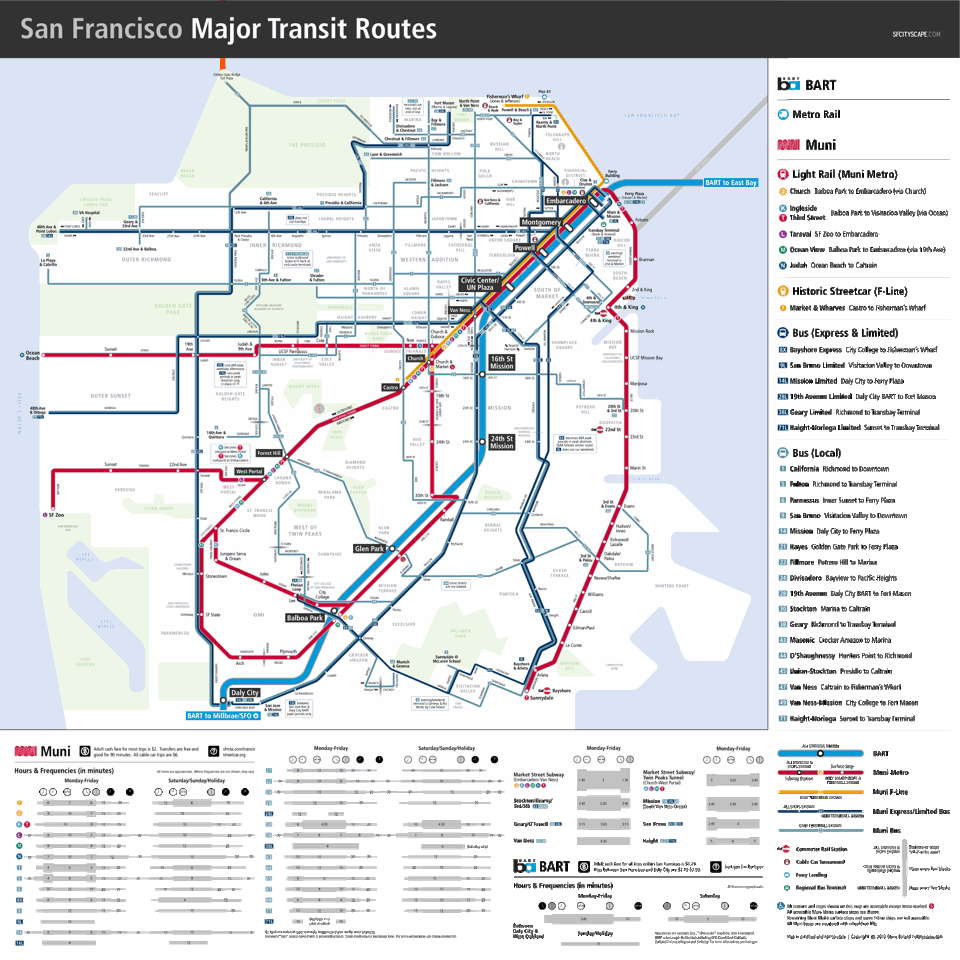
In the last half decade we've seen the opening of the Salesforce transit center, the Chinatown subway station, the Van Ness BRT, the Caltrain Electrification Project, BART expansion to Berryessa, 800 new BART cars, and hundreds of smaller projects.
You can see a full list of SFMTA projects at https://www.sfmta.com/sfmta-projects
The better question is, have you ever seen a kid crying in the back of a bike?
They do that really well here in Barcelona. 21€ a month and you can use all the transport you want in the city, all modes. Why would i want a car what's expensive to own, park and maintain and I can only just it when I've not been drinking?
Problem is, making transport good costs money and a lot of effort. Taxing cars is easy and brings money in.
Well, congestion pricing would make driving better. (And perhaps make busses better, too, since they use the same roads.)
Except that SF public transit is actually pretty good. East-West transit works extremely well via buses and MUNI depending on whether you live in the northern or southern part of the city. Bay Wheels is extremely affordable and makes a lot of sense for short trips in a city of SF’s size. BART has its limitations but it also generally pretty good. Sure, SF public transit could be better, but I’d actually argue the problem is that driving in SF isn’t hard enough - many people have great public transit options but refuse to use them because we haven’t forced them to reprogram their car-brains.
Same happening here in my smallish (~300k peeople) capital of a small eu country...
Too many cars? More expensive parking! Less parking! More expensive parking! Less parking! More pedestrian-only streets, and even more cars around that...
And the buses? They suck. The city is roughly star-shaped.. want to go from one leg to another? Well, you have to cross the city center. Sunday? Half of the buses don't drive then. Something happening in the city center? Good luck with getting on the last bus after the event is over, and no extra buses added. Dog? Not during "rush hours" (6.30-9:30 and 13-17h). AC? Barely any. Two buses needed? No time sinchronization at all. Train-bus time sychronization? haha good luck. Need to go just a stop or two? It's expensive. Need to go across the whole town? It's slow, even with empty streets.
But hey, parking will be made even more expensive!
edit: also, a student? You get cheaper transport! Here's a line for you to wait to get the transport card: https://www.zurnal24.si/slovenija/pred-okenci-prevoznikov-pr...
By moving out of crappy overpriced cities?
https://www.sfmta.com/reports/average-daily-muni-boardings-r...
Then use tolls to improve and expand the mass transit services instead of only ever catering to the single-person-car-commuters.
(ofc it takes more than ontime performance to sell people on mass transit, needs to be a safe environment at all hours of the day -- even if I can take BART into the city in the afternoon, if I don't feel safe taking it back at 10PM then I'm just going to drive both ways, to say nothing of the choice to stop running trains at midnight)
https://en.m.wikipedia.org/wiki/List_of_United_States_rapid_...
I live in Boston and I could see it working here, now that the T is on a path to reliability.
While it would be great if money wasn’t a concern, you don’t need to plaster the city in a grid of metro lines. Careful usage of bus only lanes has really made a difference in some areas of Boston that I frequent.
Edit: The link above is only for heavy rail - Boston’s numbers are better if you also include light rail, which is a significant part of the system:
https://en.m.wikipedia.org/wiki/List_of_United_States_light_...
"The issue arises from a 1977 agreement between then-U.S. Secretary of Transportation William T. Coleman Jr. and the state of Virginia. In the so-called Coleman Decision, Arlington agreed to drop its opposition to the construction of I-66 in exchange for certain promises, including a four-lane limit, sound barriers, and truck and car-pool restrictions."
https://www.arlingtontransportationpartners.com/services/i-6...
https://www.arlingtonmagazine.com/i-66-construction-protests...
A Long Road Bitter Fight Against I-66 Now History https://archive.is/oo06a
Arlington Board United In Opposing Wider I-66 https://archive.is/NMhbH
Got to make sure the multibillion dollar oil companies, executives, and shareholders get their fucking nut.
There's an easy solution to this: have ticket writers waiting at intersections to paper all the cars who do it. It's not like they can drive away. NYC used to be really good about enforcement, and it worked extremely well.
It doesn't solve traffic, but it does help stave off gridlock and keep intersections free for bus lanes to operate normally.
Meanwhile everyone blocks the box and there are cars without even plates on them.
As someone who doesn't live in Manhattan I wish there was a better way to go basically anywhere in New York without entering Manhattan. Every single road, bus, and subway goes through this super dense area.
Like why do I need to go through Manhattan to get from Newark Airport to Flatbush? (Unless I have a car, then I can go over the Verazzano, but in a bus/subway/train? It's all via Manhattan.
when the vast majority of daily trips are into and out of that dense core, that defines the most economic routes for building transit. beltways/bypasses exist to relieve the already saturated surface roads of the core. you don't see the same thing with trains because it's not necessary. it sucks for the passenger to transfer between three or four different trains to get from EWR to flatbush, but the rail infrastructure has plenty of capacity to accommodate a few extra pax on that route.
I think it would be a lot nicer to have urban life/transit built around many smaller cores with everyone living much closer to work. but in aggregate, businesses want the largest hiring base, and people want the best jobs they can get in the area.
IMHO, they would need to push higher than $50 to get drivers to blink.
So you need pricing which will make a few people reconsider driving, who were on the edge of using public transit anyway.
Personally I find it weird that SF’s public transit is so under water it needs bail outs from car drivers. Yet it also doesn’t serve the car drivers with any compelling equivalent.
i got a fine in London for doing this by mistake. i didn’t even block traffic, i just went into the intersection without the cars in front moving. bam, fine. lesson learned.
It's better this way that the law penalizes what you can control (your own vehicle movement) as opposed to what you can't (the cars in front of you)
Maybe it will work in NYC, but in the Bay Area I can’t help but feel like it’s a regressive tax because people who already have the money will continue their ways and pay but people who are on a budget now have to wait longer to get anywhere in the peninsula.
SF has a ton of folk coming from quite a ways away and it can easily take 2x the time if using public transit. Outside of rush hour Caltrain can take 1.5-2h, and Bart from Berryessa isn’t quick (plus contending with BART delays).
Sure, we could means test every toll and fee, but there's a different solution for that already - taxation.
There's a secret third option to congestion, which is you disallow some number of people at a time from using the facility, and people really don't like that one.
Dig deeper and you find it's a housing problem anyway. People can't afford to house themselves/their families in the cities they toil in. Build housing near jobs and there's less need to commute in from Tracy.
That’s exactly what it is. The richer you are, the better it is. Now people on a budget will pay taxes to subsidize infrastructure that’s only accessible to the wealthy. It’s a massive scam perpetrated by the rich for the rich.
Why stop with roads? Why not have congestion pricing for schools or hospitals or access to water? That way we only have to build enough infrastructure to serve the wealthiest half of society.
Define "pays off". Who benefits, who suffers?
- watching people have to squeeze between stopped (mostly single-occupant) cars blocking sidewalks on Broome or Canal on their own pedestrian light at rush hour, and realizing that it would be impossible for someone with a stroller or mobility aid.
- seeing packed busses miss light cycles because the intersection is blocked
- seeing ambulances or fire trucks with sirens blaring stuck in gridlock
“Pays off” to me means that transit users and pedestrians are no longer regularly inconvenienced by the fact that more people choose to drive than there is frankly room for.
But somewhere like Atlanta, Dallas, etc.? Absolutely not. It's just a vice tax levied on poor people who are already not happy about having to commute long drives into the city center to find work. They have no alternative. They can't spend 3 hours each way on buses. They can't afford to live in the the handful of walkable blocks in the city with $3k+ rent that effectively serve as a little Disneyland for affluent residents who want to larp like they live in Brooklyn.
Build the public transit BEFORE you hit the poors with a giant stick. Because I guarantee you that hitting them with that stick is not going to effect change in any way, as these people have next to no influence on policymakers already.
Then stop digging deeper and improve the car infrastructure instead of sabotaging it.
But SF doesn't have public transport. This just makes driving expensive, without any real benefit. We already do this on 101.
https://www.iliveinthebayarea.com/wp-content/uploads/2012/12...
At minimum, all MTA executives should be payed off before any such measures can be considered.
That may be because NY/NJ have bridge tolls into the city that are often much higher than those in SF.
This falls solidly in the "it sounds good but causes significant negative unintended consequences" bucket of regulation, like the rest of NYC's many regulations that led up to this point.
Congestion pricing is a way to price an externality, which is usually a good thing compared to externalities being free.
We need a small business revolution in this country.
Side note: An economy made up of small businesses was Adam Smith's original vision (the godfather of capitalism). He also hated the idea of a corporation. What we have today really is very far from Adam Smith capitalism.
If the guy got shot visiting relatives in Park City, would you suggest that any contemporary public policy in Utah was bad?
/sarcasm
Poor people aren’t commuting into lower Manhattan by car.
Congestion pricing is a luxury tax. The only downside is tradies who need to move their heavy equipment around the city, except this might be a net-benefit for them because getting stuck in traffic costs them more money in the form of longer turnaround times.
Expresslanes made commute times worse . Little of the revenue went to the roads . Few of the roads were fixed .
FIFY. It's all the rage, you know ...
Tbh, most so-called "rational thinkers" are as emotional as "mouth breathers" if prodded sufficiently.
Isn't this a step backwards for social justice?
It's not "having a lot of money". It's actually "having a lot of options".
By definition, rich people will have more ways to get around than poor people. The rich can hire a limo, hop in a helicopter, and even take a trip to space.
Is it a social injustice that not everyone can afford a limo, helicopter, or spaceship?
I do not think it's bad to take steps to make driving an activity for richer people, to make it a luxury that it initially was when cars were invented.
On the flip side of things, look at what the dream of mass-market affordable cars, free highways, and free parking have done to society: Swathes of land wasted for parking, low density cities that kill walking/cycling/transit, millions of people dying in car crashes, endless congestion and lane-widening.
A serious question that you immediately proceed to answer, with rhetoric that it's preferable for there to be only the relative few rich elite, who implicitly should enjoy all the luxuries possible in the world, but there should not be these luxuries for the lesser people, since our experiments in permitting the peasants to enjoy small amounts of society's wealth has been a disaster, encroaching upon the enjoyment of the rich, and making the poors uppity?
(This assumes that the mass transit options are invested in, rather than overrun by people switching.)
Where is the congestion pricing tracker that measures the higher cost of groceries to working-class lower Manhattan residents?
New York City is filled with small businesses. When walking distance puts you in range of entire towns’ populations, that becomes much easier. Emphasis, there, on both the distance and walking. Someone who drives into New York to go to a destination doesn’t pass as many small businesses as someone who takes transit.
Is there a large cohesive logistical operation even present? It seems to me the city is divided into boroughs, precincts and "special offices" all with their own individual mandates and approaches due to the complications inherent in large organizations.
> Especially if it has coherent and well-run transit
Well run? Compared to what?
> such as garbage/sewer/power/water.
The municipality does offer these services but you can arrange to have them handled privately if you want. They still have to follow the law but they're allowed to operate in the cities "territory." If the city was such a logistical juggernaut then why would these options even be necessary or utilized? If the city stopped providing these services and turned it over entirely to private business would the city stop existing?
I am going to assume that the most people who live in NYC are there exactly because they want big city (with correspondingly big government).
People could try actually reading what he wrote for once.
All the "the subways are too crime ridden to use" shouts are pure propaganda. If millions of New Yorkers can survive, so can you.
Counterpoint, this poor soul who was literally burned to death: https://nypost.com/2024/12/31/us-news/mystery-woman-torched-...
The subway is worse than it was pre-Covid. Congestion pricing will not address that.
"Suck it up cowards" is hardly good public policy.
-- making the cost of employing a good staffing level of police more affordable (so that we can have more, everyday police doing a job as a neighborhood force and seen as a reliable presence against crime)
-- more certain prosecution and penalties for quality of life crimes that we all pay for in seeing petty but significantly confidence-decreasing incidents that reduce our willingness to take public transport
-- reducing the cost / increasing the frequency and usefulness of public transport services where you regard it equally as convenient as private vehicles
You go to some other countries (less rich ones particularly) and buses have 2 crew, trains have multiple staff, taking fares, making sure rules are obeyed. Giving people confidence that this is something they want to ride on. Not a system where it looks like the station is half abandoned, was last cleaned about 2 years ago, and if you were mugged or even just reported a crazy ranting homeless person, they would shrug and tell you to phone it in.
Why is it that where I live all the tech companies built their own transit system just for their employees? Because they can control the experience and prevent the problems that turn people away from public transit. Either public transit is for the quiet people who are just trying to get somewhere or it can be for the nuisance types. They're incompatible.
Mind elaborating on how this is a "moral issue"? Public transit is funded by "everyone's taxes" as well, but you still have to pay a fare to use it. Do you get similarly aggrieved?
>Around the time the charge was starting it was easy to find supporters for it on tv chat shows but I never met one in real life.
It's trivial to find polls that show a non-negligible level of support for the charge. eg. https://www.theguardian.com/politics/gla/page/0,9067,897312,... or https://www.vitalcitynyc.org/articles/how-london-and-stockho.... Just because your small circle of friends don't support it, doesn't mean they don't exist.
I cringe when I see parents with their kids on the back of their bikes. Super dangerous.
If you don't understand working poverty, you won't understand how devastating only $3kpa really looks like on a low wage. Lot's of people right now can't afford that, so cost-neutral alternatives have to exist or you price people out.
If you removed all the through traffic, leaving just people who want to stop there, that change alone, would improve things dramatically.
Driving for a commute isn't really possible in Manhattan unless the company provides parking. And those parking spots are reserved for executives. This group of people are price insensitive.
Passing through Manhattan can frequently save an hour of time in traffic elsewhere, those commuters will just see the fee as a higher toll.
All three major airports never tied directly to a subway, opting instead for airtran systems which create complexity and cost time. I suspect this causes a base level of traffic.
How many people do you think the scenario above applies to, in the real world?
But you're asking for the local employees to have their entirely variable commute costs covered. That's very different. If I want to helicopter to work for $2k a day, should work cover it? If not, why is wanting to drive in a city with robust public transit options any different?
People leaving work early is a fixable discipline issue.
Would also note that the shooter you’re referring to crossed into Manhattan with a gun purchased in another jurisdiction. This is a problem of other areas’ lawlessness crossing into New York as much as it’s a fantasy about cops being expected to thwart an active shooter on the spot.
It feels like you're being dense on purpose.
The Subway, buses, trams, etc, etc are all way better for passenger density.
Instead the city added a per-ride fee, which will be covered by Uber/Lyft, making it useless as an incentive for ride reduction, https://archive.is/MtRgo
> Riding in a taxi, green cab or black car will now cost passengers an extra 75 cents in the congestion zone... The surcharge for an Uber or Lyft will be $1.50 per trip... cars for services like Uber and Lyft make fewer trips and are more likely to idle in the zone. In 2023, taxis made an average of 12 daily trips, while ride-hail vehicles made an average of six.
It's like those pictures of Luigi Mangione being perp walked in Manhattan with 20 cops and FBI agents behind him. Imagine if those officers were on the beat or enforcing traffic laws instead. That would make more of a difference in our communities than a photo op ever will.
They just don't do anything like that in socal. I've not once seen a cop take radar in socal. Not once. I can't even remember the last time I've seen someone pulled over in socal but it happens probably three times in my view whenever I go elsewhere to visit.
It's an unnecessary conflict - just add some transit that doesn't revolve around the city center. This reduces the number of people just passing through the center and creating unnecessary stress, and it make transit possible for more people.
Manhattan is like a black hole - it sucks in every single transit from as far away as Massachusetts. Try to travel by public transportation from virtually anywhere nearby without going through Manhattan. You can't and it's unnecessary traffic.
I think that this is prevented in large part by local capture of state politics by leading cities. NYC money basically owns NY politics so NY will never neglect let alone screw NYC to the benefit of Buffalo and Albany and whatnot. Repeat for other states that have one or two big urban economic wells that run everything.
investing more into cities like buffalo would also be great, but I don’t think they could realistically become a first choice for people who enjoy the benefits of a large metro area.
What about on-street parking or municipal parking lots? Given how cheap they are to construct it's questionable to claim that the fees collected are needed to fund their construction.
>I have more of a problem with someone demanding money for nothing. [...] To my knowledge the main justification has always been that the charge funds the payer's behavior modification. Is it for the payer's own good? Is it for the greater good? You may well differ, but something about that doesn't sit right with me however noble, especially when it pertains to law abiding citizens acting within their rights.
How do you think most other taxes (eg. income tax, VAT, corporation tax) work? If you argument is that congestion charge is bad because "demanding money for nothing" and "something about that doesn't sit right with me however noble", then you should be rallying even harder against those sort of taxes. At least with congestion charge you can argue it's in exchange for the ability to drive, and unlike income tax, most can agree congestion is a bad thing, unlike people getting a salary (income) or businesses making/selling stuff (VAT). What is the government providing in exchange you paying income tax? Not getting a visit from the tax collectors? If it's something vague like "roads and schools", why can't the same justification be used for congestion charge?
Huh? The revenue from congestion pricing is used to pay for public transit. The rich people pay extra to subsidize transit for everyone else, which is exactly how things should work.
I prefer the framing that drivers should fund transit because drivers do use transit: NYC would be complete gridlock if transit went into a death spiral and straphangers switched to cars. Even if they never set foot on the MTA, drivers see a lot of the benefit of it existing.
Cars blocking intersections and/or sidewalks can easily be solved with automated traffic fines - that's how Zurich and London does it (the former without any congestion pricing!)
Many cities also have special lanes only useable by some classes of vehicles - e.g. busses (or sometimes taxis as well) - I guess ambulances could also use those.
In fact, congestion pricing doesn't solve any of those problems, it's just an irrelevant (as in, it doesn't solve any specific problem directly) regressive tax to "drive less".
Rush hour traffic is so gridlocked that cars often can’t know if they will clear a light cycle, so fining would effectively just reduce to a stochastic congestion tax.
NYC does have some dedicated bus lanes, but adding more means reallocating more space from cars which is a political no-go without reducing the number of cars first. That’s what congestion pricing aims to do.
Fining for blocking intersection isn't stochastic. You simply don't enter the intersection if you're not sure you'll be able to exit it. You wait at green light. Simple. That's how people in London and Zurich drive.
Congestion automatically reduces the number of cars (because they literally can't get into the city!), without congestion pricing. If you reduce 3 lanes to 2, then... 2 lanes will be blocked, instead of 3, so there will be complete gridlock & congestion - for cars. But not for busses! So public transport will work, even thought private is gridlocked. Combine this with (1) - empty intersections - and busses can drive very well!
It's not actually that hard. You fund them through general taxes rather than fares. Then how much you pay is proportional to how much money you make -- even a flat tax does at least that -- as opposed to the largely fixed amount that corresponds to the amount the average person has to move around in order to live an ordinary life, which is approximately a head tax.
Congestion pricing, like many fees and regulations, is a regressive tax, because the overhead seeps into all goods and services and it impacts the poor most of all and the rich not at all.
[1] https://blog.tstc.org/wp-content/uploads/2017/04/how-car-fre...
17$/hr * 50hrs/week * 52weeks/year * 2 earners = 88.5k/year
We have always paid a congestion tax on goods and services, it’s just been in the form of paying workers to sit in traffic.
Not to be that guy, but from a European standpoint the clear answer is: If you make driving cars into the big city expensive, if you still wanna get people there you need to give them other, cheap, more space-efficient ways of getting there. Public transport, bus lines, trains, stuff that Asian megacities do as well.
Or you can build even more lanes and parking lots, because that worked out great and was without any consequences so far /s
I am not saying I trust in the success of NY congestion pricing, but that has nothing to do with the measure (it is fine) and everything to do with how how half-assed it might be implemented. But elsewhere similar concepts work just fine. But hey, so does healthcare..
So yes technically less traffic, but not really enough to make any meaningful difference IMO. It is still noisy, it is still congested, it is still polluted, it is still hard to cross roads, it is still hard to get anywhere on a bus in a predictable time, it is still very frightening to be a cyclist (and indeed it is still common for cyclists to get killed or badly injured), and it is still better to get the tube.
I view it more as a toll now really, rather than an attempt to dissuade people from driving in. If they were really serious about trying to stop people driving in, the price would not be £15/day but it would be £500/day or more.
As it stands at the moment, even on the weekend (yes, it runs on the weekend even though there is not much congestion e.g. on a sunday afternoon) if I want to go to central London with the family I will drive. It costs £15, but the price of a return tube ticket is £6, so x2 for me and the wife and it is already £12, then add in £1.75 for the bus tickets to-and-from the tube station (so £3.50 per adult return = £7), and you are already at £19 to use public transport, vs £15 for the congestion charge.
So it is approx 20% cheaper to drive, AND it is more convenient, AND it is quicker, AND it is more comfortable.
Like I said, if they were serious about it being a deterrent they'd price it way, way higher than £15. But actually they want to make cheap enough so that people pay it, and they get money for me using my own private transport and fuel to travel around, and don't have to pay for the running costs of more tubes/buses etc.
At least this study [1] suggests a mild improvement but interestingly replacing one pollutant with another (due to diesel exemptions).
In my opinion, we should primary focus on improving the standards of public transport. Safety, cleanliness, punctuality and price. I'm a car owner living 15mins drive from downtown of a European capital city, and I refuse to drive near the city because the parking is expensive, there's always roadworks but primarily the public transport is excellent and comfortable.
[1] https://www.sciencedirect.com/science/article/abs/pii/S01660...
https://content.tfl.gov.uk/technical-note-02-what-are-the-ma...
Pedestrians get killed by car crashes all the time, and they never accepted that baseline danger of driving.
It’s a bit like saying “sure, a cinema that refuses to sell more tickets than it has seats leads to a better cinema viewing experience, but only if you remove price from the equation!”
Cost is explicitly being traded away here to facilitate improvement in other areas. That's the whole point of implementing the toll/tax!!!!!
The latter in this context would be to e.g. build higher density housing so more people can feasibly take mass transit, as opposed to congestion pricing which is just a tax on people who can't afford the artificially scarce housing in the areas where mass transit use is feasible already.
there are some who the charge would be significant (long paid off reliable used car) while others who it is a drop compared to the othes costs (new luxury car)
The dashboard is based off of Google Maps travel time data which I'm unsure of the exact accuracy. I imagine the city might also have other more direct metrics that can be used, such as the count of vehicles passing through the tunnels into the congestion zone.
Also, while simple metrics are cool, what commuters really care is how long it took to get from point A to point B, which is what this shows...
I love congestion pricing, I will gladly pay $9 if it lowers traffic during peak hours. I also try to plan trips in the offpeak hours anyway. If you leave at 11pm you can get from shea stadium to Philly in an hour forty-five.
The social media response has been particularly interesting. Predictably, there are a lot of non-NYCers who simply object to the slightest inconvenience to driving in any form. These can be ignored.
What's more interesting are how many native (or at least resident) New Yorkers who are against this. They tend to dress up the reasons for this (as people do) because it basically comes down to "I like to drive from Queens/Brooklyn into Manhattan". There's almost no reason for anyone to have to drive into Manhattan. It's almost all pure convenience.
The funniest argument against this is "safety", the idea that the Subway is particularly unsafe. You know what's unsafe? Driving.
Another complaint: drivers are paying for the roads. This is untrue anywhere in the US. Drivers only partially subsidize roads everywhere.
And if we're going to talk about subsidies, how about free street parking... in Manhattan. Each parking space is like $500k-$1M on real estate. In a just world, a street parking pass would cost $500/month.
The second interesting aspect is how long it takes to bring in something like this. In the modern form, it's been on the cards for what? A decade? Longer? Court challenges? A complicit governor blocking implementation? That resistance only ever goes in one direction.
My only complaint is that the MTA should be free. Replace the $20 billion (or whatever it is) in fares with $20 billion in taxes on those earning $100k+ and on airport taxes. Save the cost of ticketing and enforcement. Stop spending $100M on deploying the National Guard (to recover $100k in fares).
Public transit fares (that are going up to $3 this year) are a regressive tax on the people that the city cannot run without.
An MTA monthly pass is 130$. That's the price of a single uber round-trip to JFK. NYC also allows employers to provide commuter benefits tax-free.
It's cheap enough.
While small, Luxembourg is still considered a country. And their public transit is both free, and fantastic
Also, as you so eloquently put it, it isn't clear that the cost for issuing and checking tickets is covered by the income from the tickets, and there are reasons why MTA tickets cannot be priced at the actual cost to cover the ticket compliance infrastructure -- with a nice analogy to the cost of parking vs value of parking real estate. What justifies the subsidy for on-street parking?
This is one of the main criticisms of free fares: in reality the revenue stream from fares is never actually fully replaced, so it just results in the transit agency becoming underfunded. This makes transit worse for existing users who are already paying. The new users you get because of free fares are mostly casual users like tourists who have alternate options, so serving them isn’t that useful and not worth the negative impact on existing users.
I agree with pretty much everything else you wrote, but this it needs to be noted that most road damage is done by weather and heavyweight vehicles like semis/trash/buses/delivery vehicles etc., not regular passenger vehicles.
Semis et al. definitely do not pay taxes proportionate with the damage they cause to the roads, but then again we all need them even if we don't drive.
This is still a small portion of overall road damage, but it matters in places like NYC. In particular it matters on our bridges and cantilevered highways, where passenger traffic can't be easily filtered away from weight-sensitive areas like commercial traffic can.
I don't think there would be much point. At the end of the day we'd all pay it because we all consume the goods they deliver or transport during intermediary steps in the supply chain.
I guess you could argue that the status quo is somewhat of a tax incentive that favors local manufacturing (i.e they use the roads for every step of the chain vs imported goods which only use it for delivery). I don't take much issue with that.
Then the space taken up by unnecessarily big roads and parking lots further stretches distances between destinations out, leading to... more roads required.
Should the rate be higher? Perhaps. But it's already a bit slanted towards vehicle weight based on fuel type and consumption.
Electric vehicles, and especially electric shipping trucks, are going to require finding new taxation sources.
There has to be another, more sustainable way for a rich city like NYC to make a service truly accessible and free without another tax. It’s like how the Bay Area bridge tolls have increased by $1 this year to fund the BART system => we still don’t know what was done with the last increase in tolls, yet we have to pony up the extra cash this year.
Smarter folks than me on HN might have an idea other than, “let’s tax folks who make more than an arbitrary dollar amount annually” that has worked in other large metropolitan areas.
@gotmedium, would you consider integrating:
1. MTA's Bus Time feed: https://bustime.mta.info/wiki/Developers/Index and 2. MTA bus/MNRR/LIRR/Access-A-Ride ridership feed: https://data.ny.gov/Transportation/MTA-Daily-Ridership-Data-... 3. Equivalent feeds for city-connected NJ transit services.
The biggest policy failure of CP though to me is that they left taxi/uber relatively unscathed. Often the majority of traffic is taxi/uber, so make the surcharge on them a fraction of what individual drivers pay is kind of nonsensical.
Are we trying to minimize traffic (so tax call cars) or parking (so tax taxi/uber less since they don't have to park in Manhattan?). It smells of lobbying mostly.
I will say, being in Manhattan, their seems to be less traffic on the road. I wonder if Google Maps traffic data is using a rolling average of ~7 days or something
Something like "Congestion Pricing Impact Tracker" would be clearer.
2. So the success of this policy really depends on how much additional revenue it's bringing in for the city and the MTA. The $9 increase needs to significantly offset the loss in toll revenue from the decrease in drivers.
3. There are so many other simple policies that would benefit quality of life in NYC:
- Daylighting — Don't allow cars and trucks to park at the corners of intersections. Huge safety benefits.
- Metered parking everywhere. Why is NYC giving away the most valuable real estate in the world for free? Would be a huge revenue stream while discouraging car ownership in Manhattan.
- Close more streets to car traffic. This is already true on 14th street and it's fantastic. Close Houston, 34th, 42nd, 59th, 125th. This would make buses much more efficient and further discourage passenger car usage
Do that and NYC will be a much, much nicer city to live in.
You need ~35% just to keep the system running functioning (which does not include operations - like the actual drivers).
That's only going to leave you ~25% leftover for everything else - and a non-trivial percentage of that comes from the Federal Government - which may not be there in the future (when all of their money is going to pensions and healthcare).
Until they can start using their enormous existing budget wisely I don't see any reason they should be given more money.
https://www.strongtowns.org/journal/2021/3/3/the-fundamental...
HN's takes on cars are shockingly bad. For a community as thoughtful as HN, their responses are (to use an insult provocatively) car brained.
It's as if cities don't exist outside the US. The US is decades behind on urban infrastructure and governance. This means their policy debates in 2025 have been globally settled issues for decades with outcomes to back it up. Conjecture can't be an effective rebuttal to evidence.
Hm, as a big public-transit advocate coming here 5 hours after your comment, I actually thought the discussion is in pretty good shape. There's a handful of "cars only!" nuts, but they're a small minority. It seems the vibes around this topic are fairly positive, with lots of support for funding better public transit.
It is also important to note that induced demand is not infinite. There is a point when there aren’t more drivers to actually get on the roads. We see this in some midwestern cities that had their full freeway plans built and didn’t experience significant growth after those plans were made. Those are “20 miles in 20 minutes” places any time of day for the most part.
I personally took a cab from Newark to Laguardia at MIDNIGHT and it took 40 min to cross into Manhattan to get to the Queens-Midtown tunnel. Just a new level of traffic. Was fun going in the MIB tunnel.
An important piece of context is that NYC has some of the US's best suburban transit, including three different suburban rail systems (NJT, MNRR, LIRR) and one non-subway interurban rapid transit system (PATH).
I don't understand why anyone would ever attempt to do this. Was it truly the only option?
It was not. Public transit pricing is completely independent and did not change with the implementation of congestion pricing.
> I don't think transit officials are acting in good faith when it comes to their moral arguments and just want to justify raising taxes for the poor.
The only person who has acted in bad faith is Kathy Hochul, who bent over backwards to water down the policy by having poorer people subsidize wealthy car commuters.
Are there are cameras inside the zone tracking cars to bill them if you are already in the zone, or if cameras only track entry to the zone? (i.e. cameras only on the border). If someone happens to evade the cameras, do they catch them eventually just by traveling within the zone? I believe London for example has internal zone cameras.
The purpose being, first of all, to ensure that people do not somehow evade paying just by operating solely within the zone, defeating the purpose of reducing traffic. And secondly, to stop people from engaging in loophole seeking behavior.
I hope that loopholes and people defrauding the system (license plate obscuration, etc) are quickly caught and penalized. You would hope that if a car enters or is detected with invalid plates, it triggers an automatic report to police nearby to follow up. Otherwise, like so many things (it seems now) we just throw our hands up at people who evade the rules and charge those who follow them. (my comment spurred by an NYT article about how people might scam the system)
Maybe it's the cost of the cameras to be installed.
What would worry me is if it leads to more license plate theft. Criminals get to ride for free, while legally registered owners have to fight the fines and clear their name in NYCs byzantine government.
Originally it was meant to be $15, but was ultimately lowered to $9.
That doesn't make sense, because $15 was already the lower price that she fought for.
It was originally supposed to be $27. $15 was the lower price that Hochul fought for and issued a press release boasting that it was the correct price.
Then she just unilaterally decided to cancel the entire program before bringing it back at $9.
NYC Congestion Pricing Set to Take Effect After Years of Delays
I am also wondering if other Cities will adopt this. Eventually I can see this or something like it be rolled out nationwide as EVs become more popular.
It could have been separated into two very normal things: tolls and parking fees. Every city has those. NYC could have played with those knobs until they got mostly the same effect but there would have never been any nonsense about it being illegal or unconstitutional or whatever car advocates are saying.
Even if this works, it will always be hated and fought by a large minority.
Just rip the bandage off already.
I think its attributed to the fact that it was a weekday and the weather was worse, however I would like to think the pricing had some effect.
Time will tell!
There isn't space in the current design. That's the thing you spend money to fix. Build subways in high traffic areas -- the ones where there is currently congestion -- and make them completely free to encourage people to use them (and eliminate the administrative cost of fare collection to both riders and government). Build more dense housing near the subway stops so people are traveling fewer miles, removing traffic from the roads -- this one doesn't even cost money, just stop prohibiting people from doing it with zoning. Build pedestrian catwalks or tunnels in high traffic areas to prevent crossings from congesting the roads and road traffic from killing the pedestrians. And yes, you can even add more travel lanes -- it's not always the thing you need but it sometimes is.
You don't have to rate limit the resource when you actually build enough of it to satisfy the demand. There exist roads that aren't congested, the demand for them isn't infinite.
Overall, London's example shows that congestion pricing works as advertised.
PDF Source, page 9: https://www.osc.ny.gov/files/reports/osdc/pdf/report-17-2025...
It should be noted that the MTA has made at least some pension reforms so that current and future employees won't be as costly. Employee contributions are increased as well as the retirement age.
Why should it be cheaper to be chauffeured?
Also your average Taxi may not even cross into the CPZ 12x per day, so unclear we are making it up on volume either.
The fee for cabs was actually set by dividing the regular fee for private cars by the average number of trips cabs make into the Congestion Relief Zone per day (because the fee is only paid once per day for private cars, but per trip for cabs)
Or toll beating. An old trick is taking a tractor trailer (or any big truck with more than a few axles) from LI to mainland without paying tolls: take the 59th st bridge, left onto 2nd, left onto 59th, left onto 1st and strait up to Willis bridge which leads strait into the Deegan.
This ends up being a little awkward since Uber charges market prices, so what happens when the number of Uber drivers is capped is _Uber_ pockets the congestion fee instead of the city. But the taxi lobby is strong and we can't fix everything at once
In the case of a regular driver you you have someone paying $9 to bring a car into the congested area, probably serving one trip by one person.
In the case of a TLC driver you'll have them paying probably well over $100 a day (assuming the $2.75 charge x 4-5 trips an hour give or take) and aiding in the transport of probably dozens of people to their destination.
It seems completely obvious why this is a better approach to relieving congestion while still preserving the ability of people to get around.
This is completely wrong.
First, the fee for cabs is different from the fee for private cars, and in fact, it was set at the value which is the private car fee divided by the average number of trips into the Congestion Relief Zone that cabs make each day.
Second, passengers are the ones paying the fee, not cab drivers. It's one of the fees tacked on to your receipt.
Third, this fee has already been charged on cab fares since 2019. The only difference is it's now being applied to all vehicles except taxis/FHVs. For cab drivers, there's no difference - it was the one part of the program that has already been in effect for years!
So I was previously comparing: $0 car toll + $20-50 parking vs $0 car toll + $50 Taxi/Uber fare
Now I am comparing: $9 car toll + $20-50 parking vs $1.50 Uber toll + $50 Uber fare
That is - the fee is being passed onto riders anyway, so why should I pay a lower toll sitting in the back of an Uber than when driving myself across the bridge?
This is where some of the concerns about classism come into play. I'm already paying more to be driven around in an Uber vs drive myself. Why should I be given a toll discount?
I thought the point of the policy is to get people to use the train instead of cars, freeing up the roads for people that actually need it?
> 1. The data is obviously flawed, but if there's anything to speculate from it, it's that the actual congestion in lower Manhattan isn't affected that much.
I'm not saying that's correct or incorrect, but the person you replied to already considered what you brought up and responded to it. The primary "point" seems not to have worked, so the in-practice reason to keep the policy becomes other benefits, which for the city would include revenue being raised. (I guess you can argue it's not a "success" if the main point wasn't achieved, but good luck convincing the city to give up the additional revenue.)
Many of the entries in question are not tolled: the Brooklyn/Manhattan/Williamsburg/QBB are all toll-free, but are included in congestion pricing. Similarly, the street-level entries to the congestion zone were never tolled. I think the state's calculations probably conclude that these more than offset the drop in toll revenue.
(Or, more nuanced: much of the previous toll revenue went to PANYNJ, whereas congestion pricing funds go directly to the MTA/NYCT.)
If you want congestion to go down, keep raising the price. It will eventually go down and revenue could go up a lot.
There isn't all that much free parking left in Manhattan south of 60th street.
Not saying it doesn't exist, there still are alternate side streets for sure, but it's a rapidly dwindling thing.
Agree that it should be almost nonexistent though for the most part.
Also the cost of metered parking in most of the city these days is similar to garage parking pricing.
Here in Singapore, the congestion charging pioneer, we adjust the fee dynamically to keep traffic flowing.
Yeah, I'm not sure what to make of that either but it'll be interesting to see when more/better data comes available. Maybe car traffic getting to Manhattan is reduced but those people are using more taxis and Ubers to get around once they're in
Please no. Just tax me at the end of the year if you really need more money. Stop paywalling everything.
But even as a driver I prefer when cities place an efficient price on parking. Otherwise, if parking is too cheap compared to demand it costs time and stress circling the block to find a place to park. Market pricing, where the city sets whatever prices are necessary to maintain an empty spot or two on each block, seems more fair, efficient, and pleasant.
With crazies it's not that bad. I remember the bus getting pulled over once by a car with people with pipes/bats who beat a grandpa for getting in an argument with one of the guys prior. That was the only actually violent occurance over thousands of rides, however I still have yet to feel as threatened with a personal vehicle. With a car I could have rammed the fuck out of them or ran them over, with a bike I could have been gone in a second, when the bus driver stops and opens the front door you're just stuck. Again, realistically it's mostly crazy homeless people who pose no threat but I prefer to have some control at least.
My issue with electric bicycles is:
If limited they don't fit with pedestrians or cars so you need to complicate infrastructure. Good for going to the post office but not as a daily since they're just not fast enough. Lovely for old people and to an extent kids.
If not limited they are less tested motorcycles with usually shitty tires and brakes, no ABS, TC, etc with pedals to fulful some potentially existing legal loophole since there's no way you're doing anything close to the motor output manually yet since you feel inclined to pedal gear becomes problematic.
I still have yet to try an electric motorcycle but I'd guess the little electric scooters would be great for commuting. I'm guessing an electric scooter that can do 100-140kmh would be the utility sweet spot. You'd be able to go everywhere and charge for pennies with minimal maintenance. You'd also get the scooter benefits of improved road muck/weather protection and actual underseat storage.
The amount of crazy people on there is a lot too. Every friend has some story of some person assaulting or nearly assaulting them on the subway. No one truly feels safe on it.
Motorcycles are definitely not the solution. Motorcycle usage in NYC has skyrocketed since 2020 and as a result the streets are far noisier, more chaotic, and more dangerous, especially for pedestrians and cyclists.
And there are scooters and commuter bikes which are tamer, even electric ones. I'm not saying everyone should get sports bikes with 16 Rs in the name and a straight pipe or a Harley Tractor.
Out of curiosity, are motorcycles actually more dangerous for pedestrians and cyclists than cars? Couldn't find anything quick enough.
I'm not sure how well 1 and 2 could generalize from Germany to America. You'd need Harberger Taxes or liberal use of Eminent Domain to put rail networks into a city. You'd need competent and well-funded law enforcement to curtail the crazies.
#3 we could fix in either area with UVC and filtered air circulation; or I could just get comfortable with being the weirdo wearing an N95 mask every day
I have also commuted by motorcycle for around 30k miles. It does save a lot of money, but it's not much faster than cars if you're strictly following the law in the 49 states where lane splitting isn't fully legal. You also have 90 times the risk of death per mile travelled, compared to a car, which balances the increased disease risk on a train.
Will never happen. Too 3rd worldy for many of the demographics that tend to drive policy on transit matters.
Could raise a fortune for public transit if we enforced traffic laws and used that money.
Can we compromise at some number greater than 0? I've lived here for more than a decade and don't remember seeing anyone getting pulled over by SFPD.
They don't have to be everywhere. They have to be at least _somewhere_ and start visible enforcing. People need to know that they might get away with running a red light a couple of times, but they WILL be caught eventually, and there WILL be consequences.
> and there's research that shows that removing parking around intersections reduces pedestrian fatalities.
I read a lot of the urbanist propaganda research, and most of it is pure crap. Bad statistical methods, poor significance, P-hacking, biased tests, you name it.
If you consistently enforce the law then the fine revenue falls below even its current level because consistent enforcement reduces violations, meanwhile costs go up because the additional enforcement has to be paid for.
The existing system is the one cultivated to maximize revenue by setting speed limits below the median traffic speed so that cops can "efficiently" issue citations one after another as long as there isn't enough enforcement to induce widespread compliance. This is, of course, dumb, but the alternatives generate less net profit for the government.
This is called daylighting, and it’s a very good idea. The rest of your comment was just snark, and I assume you know that road improvements don’t have anything to do with law enforcement, but I just want to emphasize that daylighting is going to be a huge positive for the city.
Second, implementing safety by modifying the physical environment is vastly superior to anything else because it scales. There's no longer a need to educate every single person who will use every intersection in the city every day on how to do it safely, nor a need to ensure x police officers are present. The physical design creates an environment that is safe by default.
Likely it’d not raise a fortune and the ticketing revenue would mostly offset the cost of enforcement.
I can't control if some batshit crazy tries to set me on fire, aside from riding the subway less.
I do ride the subway, BTW. But I definitely do not habitually walk as close to the platform edge as I used to given how public safety has slide the last handful of years. I blame, of course, de Blasio.
I would note that people can falsely believe things about how much agency they really have, and that this seems to be the case with cars vs. public transit.
But again, dismissing the improvements because costs go up is like dismissing the reduction of water pollution because “now only people who can afford chemical disposal can operate a tannery next to the river.”
I was turning from a major road into a minor road, a car was stopped at the exit to that minor road, but they failed to look in my direction, and pulled out into me.
My bike was a write-off, fortunately I was uninjured — they had started from stationary, so probably less than 10 mph when they hit me, and I always wear a helmet.
Most normal New Yorkers use the subway
This road right here in a west coast US city used to be four lanes of car traffic (two in each direction), but two (one in each direction) were taken out and dedicated for bus service.
They're building up more and more Bus-Only lanes here in the Twin Cities, and as a daily bus commuter, the change has been fantastic. Really makes a big difference in speed & reliable bus timings when the bus gets its own space to operate.
Transit can never compete with cars on speed in well-designed cities.
Cars are the least efficient form of mass transit yet devised. They take up inordinate amounts of space to move very few people. This creates unavoidable congestion problems at very realistic levels of urban density, problems which are only solvable by enabling people to use viable alternatives.
This is why the subway and buses in Manhattan move 5x and 2x more people respectively per day than cars. (https://new.mta.info/agency/new-york-city-transit/subway-bus...) (https://www.reuters.com/world/us/manhattan-drivers-face-9-fe...)
Speaking of "wasting life in buses", did you know that the average LA / Chicago / NYC driver spends 85 to 100 hours a year just sitting in traffic? Food for thought (https://inrix.com/scorecard/)
For certain high frequency routes in Chicago, I never minded sitting on the bus to get across town. At least once I got off I didn't have to find a parking spot. Now wasting life waiting for a bus is another story.
And that’s leaving aside all the issues with our of control transit budgets or crime on public transit in many cities.
As it stands they're already maxing out and exceeding (when they're late) the max speed for the class of rail they have.
Some of the inner stops might get a few seconds faster with better acceleration but that's about it.
The grade crossings are also kinda f'd. At full speed you can be in the middle of the train and see the arms still be in the process of lowering at certain crossings. That ain't safe. Faster won't make that better.
Which is the same reason housing in places like SF is so expensive. Artificial scarcity as a result of zoning rules that make construction prohibitively expensive or otherwise inhibit it from increasing the housing supply.
Houston metro has more people than SF metro, so why does housing cost more in SF? Because there is less of it.
trains would be even better, but people don't like to see the price tag.
almost not worth discussing honestly. this has become yet another factionalized holy war over the last decade.
I’m all for public transit myself, but after 25 years in San Francisco, I’ve only seen it decline. That sentiment isn’t just mine—many longtime SF residents share this cynicism.
As a consolation, I must say that e.g. NYC was also handled miserably, say, in 1980s. Despite that, it rose from the filth, and is now fine, even outright enjoyable here and there.
I think that SF will also shake off its current insanity, and will turn back into a flourishing, living, and thus changing city.
It takes time, thoughtful voting (of many, many people), and likely a bit of luck.
This is not true at all. Some ways of increasing throughput for both: Build higher density housing which allows more people to take the bus/train and reduces congestion even for the people who still have to drive, add more lanes that either can use (e.g. by building parking garages and then converting street parking to travel lanes), make streets one-way on alternating blocks (reduces congestion at intersections), build pedestrian catwalks above busy intersections to reduce pedestrian-induced congestion and keep pedestrians safer, etc.
> but many more people can be moved with a bus.
The "can" is really the problem. If you do the numbers for a full bus the bus seems very attractive, but then to run buses to everywhere that everyone travels in cars without an impractical amount of latency, many of the buses would end up having only one or two passengers -- and sometimes none -- while still requiring three times the space and fuel of a car and on top of that requiring a separate driver at significant expense.
So instead there is no bus that goes to those places at those times. And since you can't get those people on a bus, they're reasonably going to demand a solution that doesn't make their life miserable when they have to drive a car.
> trains would be even better, but people don't like to see the price tag.
Trains (especially subways) work great in the areas with the population density to justify them. But now you're back to needing higher density housing.
Imagine a group of non-rich people who decide to carpool because of congestion pricing and end up spending half the time in traffic every day and as a result get more leisure time.
Considering that a parking spot in Mahnattan costs close to $1K per month, most of the cars are driven by people who are not poor.
And spy on everyone, all the time, because now it “““has to””” track every vehicle's every move — Total Information Awareness
On average, personal drivers on NYC roads skew towards wealthier and suburban, whereas city dwellers of all demographics broadly ride the subway and other mass transit. Congestion pricing will certainly represent a cost for poorer New Yorkers, but it will disproportionately be shouldered by wealthier demographics that are often on the road by choice (e.g. choosing to commute by car from Long Island because the city has inadvertently subsidized doing so with free parking.)
The only people in the projects who have a car work in the trades. They’re largely not paying this charge and/or adding it as a line item to their customers’ bills. A car in Manhattan is an absolute luxury.
I think you're just making that up. Do you have a source?
They’re not paying this.
In a private car? Where they aren’t eligible for the low-income discounts?
More specifically, lower income housing is often very far from subway stops. Often in outer boroughs!
Chinatown subway station is great. Better connects SF residents and it's exactly what I want to see more of in SF.
- Van Ness BRT? That project started in 2003. It took 20 years to complete. Not exactly the poster child of solid transit improvements in SF, except if you ignore how it got there.
- The Caltrain electrification project is great for the environment, but doesn't help SF much as far as improving transit availability. It's slightly faster, at least.
- BART expansion to Berryessa is a bit separate from SF transit improvements, which is what I'm talking about.
- Salesforce transit center is fine and has good vision, like expanding caltrain downtown. But doesn't add a massive amount of transit availability that wasn't already nearby (yet).
I live in the Richmond, so I've been positively affected by the improvements to the 38/38R (although I still would strongly prefer a BRT system) and the new-ish-but-not-really 1X. In the next year I can expect transit improvements to the 1 and the 5/5R. Pretty much every bus I take on a weekly basis has seen transit improvements since I've first moved here.
But wait, I have to ask: why do you live in SF?
Practically anywhere else in the US is cheaper and better for people who want to drive.
Very few other US cities are better for people who want to get around by other means.
But my comment was a bit tongue in cheek - it is mostly political dysfunction. Of course the US could find people willing to work for less than $400/hr or whatever, but there is an incentive disalignment.
Hochul won NY by a fairly narrow margin historically for the state against a pretty MAGA GOP guy. It's entirely possible some more normal blue state GOP type runs against her, wins and reduces the fee further.
It goes in the bond indenture. State can’t revoke the charge whose revenues it has already sold without defaulting.
Why not?
IMO, ideally:
- Some people work from home or drive elsewhere
- Others take transit instead of driving
- The remainder pay a fee that they didn't previously, which can fund more transit
Anecdote, paid $15 x 2 to take two citi bikes across Brooklyn to avoid a two-leg l-shaped subway ride. Coming home took a $25 uber. The bike trip was ~30% faster. It sucked having to navigate around all the delivery trucks and random private cars parked in the bike lane.
$15 seems too much to me for the citi bike for a 25 minute ride. But I'd do it again to save 10 minutes sitting in traffic in an uber.
Oh and the next day we did the same journey via l-shaped subway ride. It took about 10 minutes more than the bike ride, and included an awkward street-level and overpass transition between the two subway lines. Much much cheaper than uber or bike.
My take is there are a variety of crappy options to get around Brooklyn.
One does need to know where one is going to service it, though, because they can sometimes have stupid electrical issues which are objectively easy to fix but hard for you to fix on your own cause you don't know which wire goes where.
There's an old saying that if you can't spot the sucker at the poker table, you're the sucker.
If you've never felt threatened while driving a personal vehicle by all the road-raging, speeding, tailgating assholes--
One interesting finding from the initial research reports was that it achieved the goal of improving availability while at the same time lowering the average meter price, which is nice because it drives home that the purpose is maximizing efficiency, not revenue.
And despite my using it as an example above, Midtown Manhattan actually does this reasonably well, especially in contrast with trying to park in the Upper East/West Side or Harlem.
It's not. 85% of Manhattan households don't own a car at all. The number is even higher inside the Congestion and Relief Zone. Almost all car traffic within the zone is from people who do not live within the zone.
There's no real way to get reliable numbers on this, but I would estimate that >70% of people who live in the Congestion Relief Zone and own a car use it primarily as a way to access their second home in the Hudson Valley.
I would have said that in 2019, but the testimony from congestion pricing opponents during the multiple rounds of public hearings that we've had since then only further corroborate that impression.
It's like all the efforts to drug test people on welfare, they cost vastly more than they save/recover.
I think people misinterpreted the point. Saying 'there are no poor people driving and parking in NYC' in an asinine statement when the data clear show that 30% of the drivers into congestion zone are lower income. Whether or not they should, are shouldering more or less of burden, and all of this other nonsense is extraneous.
You literally lived in the greatest city in the history of world civilization.
Sorry it didn't work out for you.
1) Built at least 100 years ago. De-facto relics of a government and society that no longer exists.
2) Things built by the people in spite, not because, of its public policy and government.
If anything, what interests me about NYC is “why isn’t worse?”. There is something amazing about NYC: how a city and civilization can be so successful in the face of government incompetence and public policy failures at every level.
But I agree, I’m scratching my head whenever I hear that statement. It’s definitely the best city in USA though, as there are about 3 real cities in the country.
Shortly after, the middle lane of each direction became a bus-only lane, but this was implemented with temporary road modifications. (So each direction has 1 bus lane and 2 car lanes.) The middle part of the road was rebuilt from 2019 to 2020, making this feature permanent.
Politics is tricky, don't take so much you make people affected mad enough to undo what you wanted.
It’s also nyc primarily in charge of it and nyc constituents probably are in favor of less congestion and more money.
You know what's more dangerous than riding the subway? Driving in a car.
https://www.chopranocerino.com/blog/new-york-accident-statis....
> There were 5,809 crashes on the busy streets of Manhattan in 2023. The borough reported 34 deaths (19 pedestrians, 11 motorists, and 4 cyclists). In total, there were 7,253 injuries.
https://www.vitalcitynyc.org/articles/how-rare-is-crime-on-t...
> ...there were 1,120 violent index crimes reported as occurring on the subway in 2023, compared to 935 in 2019
Even comparing just Manhattan to the subway system as a whole, driving is more likely to result in an injury by a factor of 7x.
Dangerous to who? Cause you seem to forget about the people outside of the car.
- Stops moving after the light mean Transit Signal Priority works better. GPS on the bus can "hold" the green light for longer - https://www.sfmta.com/blog/green-lights-muni
- Red painted lanes decrease private car use in bus lane, so bus can go faster
- Speeding fell by 80%, so fewer accidents mean transit is more reliable
There have been a few different projects on different sections of Geary over the years. The bus now runs 10-20% faster depending on direction and variability decreased by 25-40%.
Check out pages 15-19 of https://www.sfmta.com/sites/default/files/reports-and-docume...
[1]: https://nyc.streetsblog.org/2024/12/18/nj-refusing-generous-...
It would be a completely ok thing for NYS to tell NJ $0 get bent, NJ coulda spent turnpike widening money on transit instead of begging from NYS
(To my understanding, NJ gives every resident an equivalent income tax credit for the taxes they pay in NY. Given that they can't stop NY from taxing its own employees, this would mean they'd effectively need to double income taxes for NJ residents.)
NJ has had many opportunities to do so over the years and consistently chooses not to.
Congestion pricing isn't some kind of new punishment. It's a bill, long overdue, finally getting paid (and only partially).
I'm also pretty far out and not all the trains run that far.
Edit - I see you've changed your message. How does a bridge over water add road capacity to a peninsula?
The policy goal is to reduce congestion by discouraging personal vehicles in the zone and generate revenue for transportation as a whole, not to turn the city into a pedestrian park. The state took an approach that does that without nuking the city.
Based on the fact that nobody seems to be giddy about this, I’d say they did a decent job at that. If the crazy transit nuts are happy and the angry Jersey people are happy, something went wrong.
The current pricing model encourages resource sharing (this was true before congestion pricing as well), and the choice of whether or not you take a car or a cab is a function of the amortized cost of use per unit time. So yeah, just in terms of congestion fee it's a little bit cheaper to take an Uber for a single trip, but if you ride around in an Uber all day long, it's way, way less cost efficient than driving your own car.
Yup. Wide roads, plenty of parking, distributed industry and office space, low density.
> That's not what well designed looks like.
It is more flexible, people-friendly, enables better living. So yeah, "well designed".
> being in a pod with a hundred people you don't know and who have not been screened for insanity, excessive odor, sickness and general obnoxiousness.
These events do happen, but they're pretty rare. For the most part, people on the bus are just people, who happen to be on a bus. Just like there are crazy drivers, there are sometimes crazy bus passengers. At least the crazy bus passengers aren't piloting 4000 lbs of steel :)
And the real danger of motorcycles is to yourself. You could end up living with a feeding tube slipping in a shower let alone a minor scuff at 25mph.
And SF's public transit is worse (both less useful and less comfortable) compared to NYC, many European cities, and any Japanese or Chinese megacity. I still find it perfectly fine, and preferable to dealing with a car.
"Stroad" is a term invented, I believe, by those crazy folks over at "Strong Towns", who probably also have things to say about congestion pricing, and why it's taken so very bloody long to implement it in a supposedly modern and advanced nation.
I favor public transit, or ideally walking (problematic) or bicycling (even more problematic). Bicycling can be very problematic in America, to the point that a tourist from Florida in downtown Seattle once remarked "wow, the cars here aren't trying to kill me!" as we sat at some stinky car-strewn intersection. Basically you're a second class citizen if you walk or bicycle. Folks in cars will yell at you or throw things sometimes, and I have the correct skin color and sex, so it's strictly worse for others.
Buses? Sure, you can find the spicy runs with all the homeless (why are there so many homeless in America? Money out the ass and yet a nation so poor …), but I've had a lot more and a lot worse direct problems with folks who sit in cars, not counting indirect problems such as the noise, air, and real estate pollution (sometimes called "the high cost of free parking"). Usually the bus crazy will do something evil like offer you a joint, or wacky conversation, and will not do something upstanding like to change into the lane that you are bicycling in, forcing you off the road.
Diesel-electric trains take a LOT longer to accelerate compared to a modern EMU, so much so that Caltrain's electrification project shaved 23 minutes off the SF to San Jose local trip, from 100 to 77 minutes.
Videos [0] [1] make the acceleration improvement pretty clear.
There will definitely be some improvement from electrification but I don't think it will affect median travel times much and the affect on average will mostly be from reliability.
People underestimate how new much of the Western US is. For example, Dallas only began expanding in 1891 after the railways were built, LA was a small town until the 1910s-30s era expansion, modern San Jose only formed in the 1960s-70s after absorbing dozens of farming towns like Alviso and Berryessa, Seattle was mostly sand dunes until they were leveled in the 1900s-30s).
Because of how new it was, most of the cities are planned primarily with cars in mind - especially after the 1930s era Dust Bowl Migration and the 1940s-60s era economic migration. Same thing in much of Canada and Australia as well, which saw a similar postwar expansion.
> before the NIMBYists stepped in
NIMBYism in SF only really began in the 1970s onwards.
While NIMBYism is now elitist, it initially started out as part of the civil rights movement ("urban redevelopment" was often a guise for razing historically Black, Hispanic, and Asian neighborhoods in that era - for example much of Japantown/Fillmore) as well as the early environmental movement (eg. Sierra Movement, Greenpeace), which was opposed to profit motive compared to modern YIMBY+Greentech model.
Well, except for the people being pushing in front of subways to their death, or lit on fire in stations. The subways stations are getting dangerous enough, even in "not bad" areas, that people are avoiding them.
And banning cares from the city completely would be moronic, causing incredible harm to pretty much every aspect of it. I'm not "so worried about safety" that I would want to destroy the city, and your putting forth a strawman argument implying I am adds nothing to the discussion.
It isn't. It's vastly more expensive to ride in a taxi when you include the fare.
Plus the apps are kicking drivers out at various quiet periods of the day in order to avoid paying them minimum wage. So true empty time is higher.
Again I'm not arguing for better treatment for personal vehicles. I'm arguing all the fees are too low, and the ride hail fee egregiously so.
Only partially right? Tax incidence depends on the price elasticity of demand and price elasticity of supply.
You can also create more housing, so people are closer to their jobs and have to travel fewer miles. Manhattan has higher density than most places, but it also has more people, and would you be surprised to learn that the zoning in most of NYC no longer allows the buildings that are currently in Manhattan to be built almost anywhere? So as a result you can't create more of them and people who might like to live in Manhattan instead live in the suburbs around the city and drive into the city in a car.
You can also create things that aren't roads, like subways, which then allow you to remove cars and buses (and bus lanes) from the roads when it becomes viable for more people to take the subway, which reduces road congestion.
Getting rid of cars entirely may not be practical, but it is objectively true that many more people are killed and injured in car accidents in the same area over any particular length of time you could name compared to subway crime. What is the objective reason why subways are "scary" but cars aren't?
For that matter, what is the objective source for such statements as that stations are "getting dangerous enough" or that "people are avoiding them"? Is any of that backed up by actual crime statistics or ridership numbers, or just sensationalized headlines?
No comparable European city is even close to Houston in average commute time. Go on, fact check me.
> This is why the subway and buses in Manhattan move 5x and 2x more people respectively per day than cars.
Manhattan is a hellscape that needs to be de-densified (with some neighborhoods preserved as museums of human folly).
Even if that is true, average commute time is just a single factor. There's also health, cost, comfort, the environment, safety. Comparisons using a single metric are simply invalid.
> Go on, fact check me.
Ok.
Couldn't find any reliable data, could you cite your sources? What I have found is a few sources with wildly different data, e.g.:
- [1] puts Houston at 42 minutes, very different from your claim of 28 minutes.
- [2] claims the average time for the EU is 25 minutes.
Most of the sources I've found are based on self-reported data (surveys) so I do not put much weight on them. Do you have any sources that provide reliable data?
[1]: https://www.theworldranking.com/statistics/125/traffic-commu...
[2]: https://ec.europa.eu/eurostat/web/products-eurostat-news/-/d...
Houston is 28 minutes. So an average Houston citizen gets 20 more minutes every day. In reality, it's even more because Houston is way better designed for daily chores: buying groceries, getting kids to chess clubs, etc.
It can work out to a whole _hour_ a day of extra time compared to London.
And they will live in FAR FAR FAR better conditions. In their own house, with plenty of space.
So yep, dense cities are a folly and need to be refactored (by demolishing).
NYC in general also have plenty of different neighborhoods with very different lifestyles and vibes.
Or maybe people will drive at 99 mph to get the best value.
This is transit 101 level stuff.
It's one of those things about the way Americans think about transit that makes me insane, they try to assess the ROI of every single individual leg of a transit system rather than assess the system as a whole.
For example they'll cancel late night bus service because very few people use it. Except that the people who do, are people who occasionally are forced to stay late at their job and rely on the bus running late. Once it's cancelled they have to drive to work every single day since they're not sure they won't be stranded. The 3-4 bus rides a month they used to take are exchanged for 22 private car trips because you cut back service.
That's just one example. Here's another more suited to your example. What if you generally switch to taking transit into the city, and only take an uber when it's raining or you have something heavy to carry?
If I allow there to be a robust market for Ubers in the city then that's possible. If I aggressively charge Ubers then you can't do that, and you're back to driving every day.
There's plenty of examples. But in short it's clear that private cars are by a mile the worst and most inefficient thing occupying the roads. That's what we want to have the strongest incentives against.
That's a cute anecdote but is there any empirical evidence behind this? I'd imagine the people who commute downtown, stay late often enough that this is a concern, is willing to take the bus even though they have a car and can otherwise afford daily commute downtown (gas/parking), but at the same time can't pay for an uber on those late nights, is approximately zero.
I'm being somewhat argumentative on purpose but the concept I'm explaining actually is important. There's something similar to a phase change when a city/area becomes sufficiently well connected so that transit can basically solve every problem.
You go to somewhere like Switzerland and it just jumps out at you. There's a fundamental approach that everywhere someone wants to go should be accessible by transit in a way that's workable. There's also a fundamental decision that being able to bring a car somewhere isn't necessarily something that has to be supported.
It's just a different way of looking at things.
Can you envision an American town that literally does not allow cars anywhere near the actual town, like at all?
If that seems utterly impossible to visualize then you're starting to see what I mean. Now try to visualize a Swiss town that literally has no ability to connect to the broader transit system.
So what do you do? You drive to work every day and pay the parking costs, because it's preferable to ending up stuck downtown with everything closed for several hours while you're exhausted from working a double.
This problem with public transit is the single biggest reason people who work at restaurants have to always drive to work. It's exactly as the comment you're replying to put it.
I can see by your example how over the course of the day the taxi/uber collects a lot of CPZ fees for the city, I just don't see the fee reducing anyone at the margin from using taxi/uber.
At the end of the day I'd love to see transit improve, and if all this does is reduce traffic for the well heeled who already are taking taxi/ubers.. I mean I win there too, but it doesn't feel great.
For the record when I commute it's always by transit, the problem is weekend/night service has degraded to the point that I feel forced to take taxi/uber quite often. I've lived in NYC nearly 20 years and have found, if anything, night/weekend service to be less predictable and more perplexing. This again harms the less well off even more, as they are more likely to be doing shift work / non-traditional workdays than your M-F 9-5er.
Just this weekend, yet again, I was trying to get around midtown and Apple kept telling me what should be a 6min trip would take 30min by train even though I was 5 seconds from subway entrance. I couldn't understand why, and went to MTA website and saw no alerts for the 6th ave line. Then I went to the live train time page and realized the problem - the 6th Ave line was running at 15min headways, so Apple had me walking 2 blocks to 8th Ave then to wait 15min for the train (possibly 30min if its a B/D and I needed an F/M). This was Saturday around dinner time. Just awful service.
It's not obvious that Uber is exclusively the higher-class option. Someone could easily make the same calculation you just did and decide that for them even owning a car wouldn't be worth it, they'll just do Uber every time they need to. You can afford to own a car and do Uber anyway, others can only afford to Uber occasionally when needed.
I don't have data to back it up, but I would actually be surprised if the average Uber customer in NYC owns a car at all.
This isn't really a different class.
The other class is the people who can't afford a car or Uber and can barely afford the MTA.
But cabs are important! This past august, I bought a new desktop PC (I did not want to build it myself for various reasons). I took it home in an Uber. Trying to walk to the subway with that giant box would have been virtually impossible.
```
Manhattan's Congestion Relief Zone starts at 60th Street and heads south to include the Lincoln, Holland and Hugh L. Carey tunnels on the Hudson River side, and the Queensboro Bridge, Queens Midtown Tunnel, Williamsburg Bridge, Manhattan Bridge and Brooklyn Bridge on the East Side.
Drivers will be charged when they enter the Congestion Relief Zone using the Brooklyn, Manhattan, Queensboro or Williamsburg Bridges, or the Holland, Hugh L. Carey, Lincoln or Queens-Midtown tunnels.
Drivers coming from the Bronx or Upper Manhattan will be charged once they reach 60th Street.
```
Incorrect--if you take one of those bridges/tunnels below 60th street, then stay on FDR or West Side Highway to travel to a different part of NYC (i.e. you never enter the interior surface streets below 60th), then you don't pay the congestion fee.
"The Congestion Relief Zone includes local streets and avenues in Manhattan south of and including 60 Street, excluding the FDR Drive, West Side Highway/Route 9A, and the Hugh L. Carey Tunnel connections to West Street."
It’s only the densest transit zone in the US. Many international locales are denser and measurably better.
This issue highlights that people take for granted that things are permanent and people will accept anything. This is great for me — I’ll happily pay the toll to move faster when I’m in the city. But my guess is my customers will start melting away faster and I’ll be spending quality time in Jersey. That was happening even before COVID and I think will accelerate.
They would have been smarter to hold out for a few years and add a surcharge to the road mileage tax that’s coming.
I live in nyc today and whenever I hear people say that , it turns out they mean “New York City is the greatest city in the world of New York City and Waterloo, Wisconsin.”
And even then , I’ve seen photos of Waterloo… looks like the air is nice and breathable there. And apparently you can afford to rent a place on a normal salary.
You don’t have to agree but at least try and get out of your bubble. You don’t even know enough different people in New York City itself to support that claim, apparently.
Here's an easy test. Think of the city you currently live in. Ask people where you live if they think this city you're living in is better than New York. They'll have a lot to say about it.
If you ask people in New York if the place you live is better than New York they'll say "Huh, where is that?"
This means that a single bus lane has as much transport capacity as 4-5 car lanes. A single light rail track as much as 10 or more car lanes. It’s just physically impossible to fit all the lanes for cars. The correct answer to congestion is not to build a second lane. It is to add a bike lane and a bus lane, and if the bus lane is full - upgrade to tram.
(Corollary: this is also why bike lanes always look empty. A full bike line would be equivalent to seven lanes of cars. At an equivalent of 3 full lanes of cars, the bike lane is half-empty)
Bullshit. You are a victim of propaganda.
In reality, a car lane can carry 2000 people per hour with an average car load. With mild car-pooling, it's easy to increase it to 6000 people per hour.
A bus in the US has an average load of just 18 people. So with 10 buses per hour, you get just 180 people per lane per hour. Even at peak loads (200 people per bus) and a bus every 2 minutes, you get 6000 people per lane per hour.
Transit sucks and will always suck. It's pure math. Transit slowly consumes lives and increases misery. All it's good for is to move people to "misery centrals" (downtowns) where pretty much nobody really wants/can live in comfort.
The average car occupancy in the US seems to be around 1.5. How would increasing that be easy? You would have to somehow convince the majority of the population to change their habits, that does not sound easy in any way.
> A bus in the US has an average load of just 18 people.
In the US, a country that has invested heavily into car infrastructure at the expense of public transport. All you're saying is the underfunded public transport in the US sucks. We all know this, but it has no relevance to public transport in general.
> Transit sucks and will always suck. It's pure math.
The simple math here is the number of cars goes up linearly as population increases, which is unsustainable. Meanwhile, public transport only gets more and more efficient.
What would buy you much is mixed neighborhoods (aka: the 15 minute city - everything you need for your daily life is within 15 minutes walking distance), because this will eliminate many trips. But mixed neighborhoods work better with higher density - because a supermarket in a low density place cannot be within 15 minutes walking distance.
Also: This is about NYC. How would you even go about reducing Manhattens density to a level where no road is used by less than 2000 (or 4000) people per hour during rush hour?
So for spread out places with lost of space cars will usually be the fastest.
However if we look at dense city centres you have a lot of people competing for parking and a lot of people competing for road throughput.
Say we want to move from A to B, assuming infinite throughput the car is fastest. Take the same route, but it can handle only 200 cars/hour and 10000 people want to take it, we end up with a lot of cars waiting for each other. In this case, slower but more efficient modes of travel will be faster at getting all these people to their destination.
This leads us nicely to the Downs–Thomson paradox. When people in the above scenario start to take other modes of transport it reduces the load on our bottleneck. Eventually reaching an equilibrium where the speed of different modes of transport balances out (as people stop switching from one mode to the other)
The hate for traffic calming is an interesting point, as it assumes cars are the only thing that exists. Unfortunately our cars don't exist in a vacuum, but interact with other object in the world like buildings, and people. The goal of traffic calming is to make it so that other things are protected from cars. (mainly by lowering speed in places where there is lots of other stuff, you wont see traffic calming on a highway)
If that increased to 100%, you wouldn't be able to park anywhere without paying a lot, and getting anywhere would be super slow.
It might make sense on a per-individual or per-trip basis to say that you prefer using a car, but if everyone makes that choice (old used cars are fairly cheap), it's a problem.
A classic case of the https://en.wikipedia.org/wiki/Prisoner%27s_dilemma .
I think they're intended to be anti-"getting killed by a car" measures. Traffic fatality statistics speak for themselves.
The premise here is that travel time can be the only trade off, but suppose we make a different one: Stop charging fares for mass transit. Then more people take it because it costs less rather than because it's faster and it can be less expensive (and only slightly slower) even when the roads are minimally congested.
The problem is that transportation system quality matters more for a lot of people. The problem ends up as people owning a car for the last mile - that is from the rapid transit to their porch. And once they own a car, the calculus changes - you already incure the cost for the car.
So what you need is a reliable way to get door to door - and that requires more than slapping down a few light rail tracks. It requires connections that cover the last bit as well - and they will often run unprofitable. In the end, building such a system requires the (political) will to regard public transport as a common good infrastructure like road that gets paid from taxes and is not considered an enterprise that (could potentially) make money. In the end, this could also be made free, but free alone will not make that happen.
Waymo taxis deserve the same level of subsidies. It won't be happening any time soon because it'll be a death knell for transit, and will leave thousands of city employees without work.
> And the way population is distributed, most people live in comparatively dense population centers, across the world.
Yeah. And it sucks. The distributed nature of the US cities gave people far more economic opportunities than in Europe. This resulted in faster economic growth (and still does).
No, that's called "lying by omission". A person working in an office park doesn't live in one particular housing area assigned to it. So you get a distributed flow instead.
And it's also why transit sucks (sucked, and will always suck): it's unlikely that there's a direct fast transit route between your house and your job. And each connection adds around 10 minutes on average to the commute.
> Also: This is about NYC. How would you even go about reducing Manhattens density to a level where no road is used by less than 2000 (or 4000) people per hour during rush hour?
Tax the dense office space like it's an industrial pollution.
This is on top of the rather fundamental geometry problem that cars present.
> This is on top of the rather fundamental geometry problem that cars present.
Yeah. They are waaaaay too good at allowing people to move, so urbanists wage an all-out war on them.
Transit has this inherent problem: it HAS to suck. You can't realistically build a fast public transit network allowing easy arbitrary point-to-point trips. It's just mathematically impossible. So transit does what it can only kinda-sorta do well: move people to Downtowns from dense living residential areas.
This is not a binary distinction. If you save $0.20 by taking public transport but it takes an hour longer, of course people drive. If you save $3 by taking public transport and it only costs you five minutes, that's different math.
> You can get anywhere in Germany with this, and 58 EUR is not even remotely achievable as monthly cost for a car.
When most people have a car you have to compare it not to the amortized cost of owning a car but the marginal cost of driving one you already have.
The majority of trips might be suitable for public transport but then people have a car because it's such an inconvenience to go to Costco and carry back everything you buy there on a bus, or they occasionally go somewhere the bus doesn't. So they get a car and then the insurance, tax, depreciation, etc. are all sunk costs and to get them to take the bus instead of driving themselves it has to beat the cost of gas.
Which it can, if you make it zero. Which in turn increases ridership, allowing you to justify more routes, which reduces latency, which causes even more people to take mass transit. By making mass transit more attractive instead of making driving less attractive.
> It requires connections that cover the last bit as well - and they will often run unprofitable.
Or you can just handle 85% of the cases that would have a justifiable amount of ridership and then let people drive a car or get an Uber in the 15% that would be mostly disused, instead of leaving it how it is now where people drive the majority of the time.
But you can't. Transit costs A LOT, its costs are just pushed onto car owners.
Instead, we should be honest and price it at the full 100% recovery rate, with 100% capital cost return. People will then start to think: "Should I continue paying that $20 per trip on a light rail, or should I get a car?"
"bUT poOR peoPLE@@!!!" - poor people also deserve comfort. I'm all for sponsoring car purchases for poor people and/or giving them money to buy transit passes at full cost.
Well sure you can. We know how much it costs, the budgets are public. Completely zeroing out fares would be a single-digit percentage of the government budget. Meanwhile it would save the public money on net, because collecting the cost as taxes has lower overhead than operating a parallel fare collections infrastructure. And it benefits drivers by giving them exactly what they've always wanted -- an incentive for other people to use mass transit:
https://theonion.com/report-98-percent-of-u-s-commuters-favo...
> Instead, we should be honest and price it at the full 100% recovery rate, with 100% capital cost return. People will then start to think: "Should I continue paying that $20 per trip on a light rail, or should I get a car?"
Which is exactly the problem with your plan. If you build a rail line and set the price at $20/trip then people don't use it, so the amortized cost of the rail line becomes $30/trip because you have to pay for all the same fixed costs with fewer riders. But a $30 fare reduces ridership even more and soon there is no mass transit which in turn makes it suck to drive because there are too many people in cars and your commute is 20 miles in two hours.
Whereas if you set the price to zero, the actual cost per trip which is now being covered by taxes comes out to $4/trip, because at lower cost you get higher ridership and more usage to spread the fixed costs over. Which in turn means less traffic congestion on the roads for the people in cars.
> I'm all for sponsoring car purchases for poor people and/or giving them money to buy transit passes at full cost.
You're all for subsidies as long as they're paying the full cost? Subsidies are the thing where they're not paying the full cost.
Moreover, you want the same incentive for everyone -- if a free fare would get someone at the 70th percentile income to take the subway instead of a car, give it to them so they do that.
The converse where you use means testing is not only bringing in high administrative costs, it creates a poverty trap where making a little more money causes you to lose the subsidy and thereby removes your incentive to do it. Means testing is effectively a scheme to impose high marginal tax rates on the poor.
Nope. A realistic public transit network can NEVER be as efficient as a car network in a city. It's mathematically impossible, unless you sabotage your city so much, it's a hellscape (e.g. Manhattan).
> Completely zeroing out fares would be a single-digit percentage of the government budget.
So would be giving everyone a (cheap) car.
> Which is exactly the problem with your plan. If you build a rail line and set the price at $20/trip then people don't use it
Good, then don't build it! Easy peasy. Price is a GREAT signal. Subsidies, hidden fees, misplaced incentives and other crap lead to suboptimal outcomes.
You basically have a circular argument: transit is needed because it allows density, and density is good because it allows transit. And since we need transit, it must be cheap.
> But a $30 fare reduces ridership even more and soon there is no mass transit
Great, we need exactly that.
> which in turn makes it suck to drive because there are too many people in cars and your commute is 20 miles in two hours.
Nope. People will adapt and start to move out office space out of Downtowns.
And yes, this can work even at a gargantuan scale. Greater Houston Area has comparable population to New York City, yet it has faster commutes and far better living conditions.
Ideally, though, cities should stay reasonably small. 300k seems to be the sweet spot from the efficiency standpoint.
> Which in turn means less traffic congestion on the roads for the people in cars.
Nope. It just doesn't. Research shows that more transit use does NOT decrease traffic, except in very narrow cases (on arterials immediately parrallel to fast transit). Moreover, over time it leads to MORE traffic, as transit brings in density, and density results in more traffic.
> You're all for subsidies as long as they're paying the full cost?
I'm OK with giving poor people money so they can THEMSELVES decide on what they can use it, instead of trying to social engineer them by giving them "free" rides. When each ride costs $20 just in op-ex (true cost for Seattle, btw).
Richer people should pay the full cost of rides. This also applies to cars (although in my state car user fees already pay for 98% of all road maintenance and construction).
> The converse where you use means testing is not only bringing in high administrative costs, it creates a poverty trap where making a little more money causes you to lose the subsidy and thereby removes your incentive to do it.
That's exactly what transit is achieving. It keeps people trapped in poverty, by reducing their economic choices.
If you have a city without any mass transit, there will be traffic congestion. Beating the "stuck in traffic" time for a car is not hard at all. Beating the car's time when there is no traffic is harder, but an express train can certainly match it, and anyway how do you intend on preventing traffic congestion in a city with no mass transit?
> Price is a GREAT signal.
Price is a great signal for incremental costs. If you're going to burn a gallon of gas, another gallon of gas has to be produced, so you only want it to happen if someone is willing to pay the incremental cost.
It works poorly for fixed costs, because the price then deters usage even though the fixed cost is fixed and deterring usage saves nothing. This is why you should charge for gas but not for roads or for occupying otherwise-empty space on a subway car.
> You basically have a circular argument: transit is needed because it allows density, and density is good because it allows transit. And since we need transit, it must be cheap.
The argument is that transit is good because it allows density and density is good because it makes more efficient use of a scarce resource (land).
> People will adapt and start to move out office space out of Downtowns.
The buildings in the downtowns are not going to cease to exist. Something is going to be in them.
> And yes, this can work even at a gargantuan scale. Greater Houston Area has comparable population to New York City, yet it has faster commutes and far better living conditions.
Houston Metro has a population around 8M. NYC metro is 20M, is the largest in the US, and the NYC government has been corrupt and incompetent for decades.
In particular, one of the things Houston does well is to have less restrictive zoning than most other cities, which allows for mixed-use construction that in turn lets people live closer to where they work. But that's something that helps regardless of what you're using for transit.
Moreover, the level of traffic in Houston is not good. In spite of their zoning advantage their average commute is worse than the national average.
> Ideally, though, cities should stay reasonably small. 300k seems to be the sweet spot from the efficiency standpoint.
There is nobody dictating how many people will live in a city nor should there be. You can tell from the geography of the continent that a city in the position of New York is going to be a massive port, and so it is. Houston, Los Angeles, San Francisco and Chicago are big cities for the same reason. Nevada is mostly desert so Nevada is mostly empty; Las Vegas metro was created from the combination of cheap power from Hoover Dam and proximity to California with legal gambling and it's three quarters of the state population. Inland states are disproportionately farmland.
You don't get to decide where the beachfront property is. The question is only, given that 38M people live in California, how are they supposed to get around?
> Research shows that more transit use does NOT decrease traffic, except in very narrow cases (on arterials immediately parrallel to fast transit).
That's where the traffic congestion is!
> Moreover, over time it leads to MORE traffic, as transit brings in density, and density results in more traffic.
This is the BS "induced demand" theory. What it's really describing is that if you have an otherwise desirable area (e.g. it's within an hour of the ocean) but the local government is mismanaging the area so it's full of traffic congestion or crime or excessive bureaucracy or whatever else, and you do anything whatsoever to make it not suck as much, more people are going to move there.
Fixing the problem doesn't induce demand, the demand was there the whole time and was being suppressed by mismanagement. And you get the same result from anything that fixes the problem. The only way to prevent more people from moving in there is to keep the place a hellscape so people don't want to move in.
Compare this to building a subway in Wyoming where nobody lives and the presence of a subway is obviously not going to cause a population boom there, which is what would happen if "induced demand" was actually a thing.
> I'm OK with giving poor people money so they can THEMSELVES decide on what they can use it, instead of trying to social engineer them by giving them "free" rides. When each ride costs $20 just in op-ex (true cost for Seattle, btw).
The issue is that $20 is the amortized cost, not the incremental cost. The bus costs the same to run whether it has 5 people on it or 40, but if it has 40 then the cost per passenger is 8 times less. And if it currently has 10, the incremental cost of making it 11 -- or 30 -- is zero, so that's what you want the fare to be. Which would in turn cause more people to take the bus and lower the cost per passenger.
> Richer people should pay the full cost of rides.
The incremental cost is still zero regardless of your income level.
> This also applies to cars (although in my state car user fees already pay for 98% of all road maintenance and construction).
It does also apply to cars, but we usually get it right for cars -- the roads (i.e. the fixed cost) are free but you pay for your own gas.
> That's exactly what transit is achieving. It keeps people trapped in poverty, by reducing their economic choices.
The proposal is that you'd have free mass transit, paid for by taxes, which are predominantly paid by rich people. There is nothing prohibiting you from buying a car, which would cost the same as it does now, all it does is make one of your options less expensive than it is now.
Reducing your choices can only come from making one worse than it is now, so that it takes that option off the table. Making an alternative cheaper or more convenient can't do that -- you still have the option to do the other thing and then only reason you wouldn't is if the new option is going to make you better off than the status quo which is still available.
By geometry problem, what I mean is that an individual car just takes up far too much space (both while moving and while parked) to be compatible with even a moderately dense environment. You need some kind of rationing or metering.
The presence of cars alters the built world in a direction which favors more cars. There are more parking lots, which means less density, which means fewer people can choose to live closer to work, which means more cars, and so on. (Transit does the same in its own favor, of course. Transportation is quite fundamental.)
It is true that transit doesn't work as well with how post-war American suburbs are typically laid out. But it works quite well with the levels of density in pre-war "streetcar suburbs", like those built around the Key System in Oakland. I think the most reasonable solution for post-war suburbs is transit most of the way, and cars (robotic or otherwise) for the last mile.
And? Buses also take a lot of space. A road footprint of a bus is equivalent to about 15-20 cars (because it has to stop often). It pays off when the bus is fully occupied, but outside of rush hours, cars are a more _efficient_ way to use the road space.
Cars force city designers to build in a people-oriented way, rather than optimize for bike lanes.
> The presence of cars alters the built world in a direction which favors more cars
Yes, and that's great. The world where people are free to move is so much better than Soviet-style arrangements where you have to live in your factory's provided units. With great transit, sure.
> It is true that transit doesn't work as well with how post-war American suburbs are typically laid out
It works nowhere. And yes, I lived in very dense areas (Amsterdam, NYC, Moscow).
> Yes, and that's great. The world where people are free to move is so much better than Soviet-style arrangements where you have to live in your factory's provided units. With great transit, sure.
I appreciate the value in being able to move freely, but cars also constrain in many ways. They force more building to happen at the wildland-urban interface, to devastating effect as seen in the Palisades fire.
More importantly, current zoning and parking regulations make modern America very far from a free market. Not as far away as the Soviets were, but definitely nowhere close to reflecting people's true preferences once all benefits and costs are factored in. I doubt cars would be nearly as central in a market where single-family zoning was abolished and the full externalities of driving were captured.