Canon EF and RF Lenses – All Autofocus Motors(exclusivearchitecture.com) Hi there! I have written an e-book about all autofocus motor types used in Canon EF & RF lenses from the past 40 years. |
Canon EF and RF Lenses – All Autofocus Motors(exclusivearchitecture.com) Hi there! I have written an e-book about all autofocus motor types used in Canon EF & RF lenses from the past 40 years. |
I can't imagine how long this post took to make, let alone trying to do animations.
    html.disable--interaction.show--consent, html.disable--
    interaction.show--consent body {
      height: auto !important;
      overflow: hidden !important;

}Sony seems to be the first choice for indie filmmakers and youtubers right now.
L-mount and M43 also seem to have great potential as Panasonic supports Phase Detection Autofocus.
edit:
There is no need to be cynical here. Market figures are cruel. I hope they are all good. Competition is the best. I should also mention the return of Nikon. The patent threshold of RAW such as RED is what we need to oppose.
Jokes aside Sony glass really isn’t all that much cheaper.
We used to joke about the B&H rental by taking full advantage of the 30-day return policy. Even Amazon's return policy qualifies now. You just need to the up front funds available and hope that wear&tear is not noticeable to make the return acceptable. It's hard for local shops to keep up with that.
let me put it this way - i never even thought of using amazon as a rental service. even though amazon loves me, and i could get away with it, my brain doesn't spend time thinking about unethical things to do.
read this as: "Someone should have gotten upset before the deposit went up from jerks either breaking or stealing the rental equipment" - as my sibling says, this is why we can't have nice things.
I was hoping for the new Sigma BF camera, simple and elegant. Unfortunately no Bluetooth, which is a deal breaker for me.
We did initially wonder if it was some psychological effect of pointing a camera at him, but one night I hid behind a curtain and used the AF motor and he still shot out of the room.
Subsequent USM AF motors were silent to him and he was then content to have his photo taken.
Some animals just know and some like being the center of such attention. Others just don’t.
In case anyone else was looking for it, this article from the same author covers the more algorithm-y question of how a camera body decides to actually use these motors when you press the "focus" button: https://exclusivearchitecture.com/03-technical-articles-DSLR...
I can't find any articles on how a camera body decides what is and isn't a desired subject. I'm guessing there's some amount of machine learning-type stuff involved in that, seeing as how they can detect human (and bird?) faces?
Edit: Wow - there's a whole collection of Canon lens technology articles there: https://exclusivearchitecture.com/03-technical-articles-CLT-...
I have been aggravated by (and bellyaching about) the ridiculous lack of a way to control the focusing motors in these lenses directly when shooting video, using a follow-focus wheel.
Video shooters are still strapping janky gear-tooth strips onto these lenses, and then bolting bulky mechanical follow-focus mechanisms on the OUTSIDE of lenses that have focusing motors already built in.
I can only imagine that manufacturers refuse to make direct control available in order to protect their "cinema" lens lines, where a manual normal lens sells for thousands of dollars. And yet they sell some falsely-named "hybrid" lenses that are supposedly somehow better for video... despite lacking even geared focusing rings that are compatible with follow-focus units... let alone a control port that could be used for a focusing wheel to use the autofocus motors.
I looked at the Canon camera-control SDK, and sure enough... focus control is omitted from their entire line, except for two PTZ cameras that aren't suitable for cine use.
https://www.nikon.com/company/news/2025/0213_imaging_02.html
It took me a while to find the API; Sony made one then pretty much scrubbed it from the internet and has ignored my emails asking for one :-)
But even with the API, achieving results are tricky. Whether or not the focus motor steps properly seems to be based on how busy the camera is at the time... I'm trying various combinations of [shoot] - [sleep] - [step the focus] - [sleep] - [shoot] but the exactly which of these steps actually succeeds just seems so damn random.
Somebody did in fact create a control board with a knob to control lens focus through this thing. It can be done. The manufacturers just refuse to do it.
I still have several lenses with autofocus that don't have an AF motor in it at all, the motor is in the camera body instead there's a tiny screw on the lens mount that transfers the motor rotation to the autofocus parts in the lense. This was very slow and noisy though on my cameras.
Here's a video showing the mechanism:
https://www.youtube.com/watch?v=7iHL4ZCkCKc
And here's a video showing such a motor at full speed:
This is why camera calibration can be tricky, and you often don't want to touch the cameras after you've done a calibration pass.
I’m not making this up, camera manufacturers have told me to my face that focus is open loop, period. They can’t guarantee repeatable focus.
Notably the measurement isn’t of the state of the motor/gearing. Furthermore, being “in focus” means the subject matter’s out of focus blur is below some threshold; there is a range of focus states that qualifies — but those seemingly small differences can affect camera calibration, with >pixel-level differences in effective focal lengths.
It’s open loop.
I have a question I’m hoping you can answer.
I have an EF 400mm f2.8 (2nd gen) lens. This thing focuses significantly faster with my old 7Dmk2 than my very new R6Mk2. With all other lenses it’s the opposite. Why does this happen?
I have been told that this might be due to the old 7D and 1D bodies sending more power to the AF motors, but haven’t seen this corroborated anywhere.
I haven't heard of this issue before, but a quick research showed me that other people have (similar) AF problems with longer lenses on an R6 II. See here https://community.usa.canon.com/t5/EOS-DSLR-Mirrorless-Camer...
Sorry for not providing an explanation, perhaps I can find some time to look deeper into this - but I can't promise.
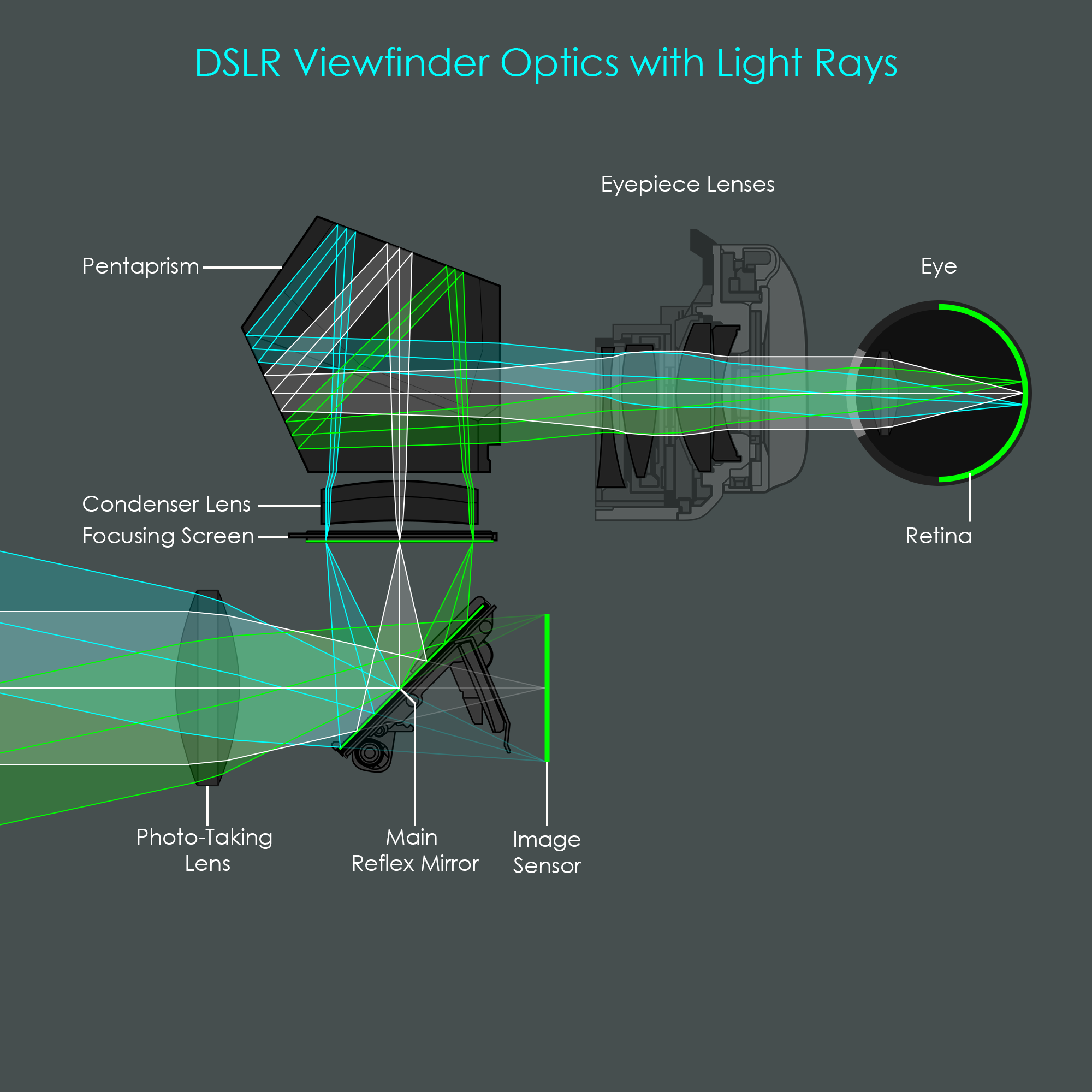
Do you blog about how you go about creating these graphics? For example, this view finder image: https://exclusivearchitecture.com/images/technical-articles/... looks very impressive!
How do you simulate the rays+eye?
> The following comparison chart shows all of the autofocus drive types that have ever been used in Canon's EF, EF-S, RF, and RF-S lenses.
They missed mentioning EF-M, Canon's foray into mirrorless interchangeable-lens cameras.
> Although the ultrasonic noise cannot be perceived by the human ear, it can be picked up by sensitive microphones which can be problematic during video shootings.
I used several Ring USM lenses and can hear the noise when focusing. It's a soft swishy kind of white noise, not harmonic. The Ring USM definitely generates noise in the audible range, not only ultrasonic.
> The latest types of autofocus drives, including the Stepper Motor, Nano USM, and Voice Coil Motor, offer focus-by-wire.
Though I have nothing against focus-by-wire on principle, the implementations have not been good. Having used several EF-M (all STM) and RF (some STM and some Nano USM) lenses that have focus-by-wire, I find that the motor actuation significantly lags behind the user turning the focus ring (which is a digital encoder), and the granularity of the focus steps are visible.
Meanwhile, the old EF Ring USM's full-time manual (FTM) was really good by comparison; it didn't take much force, was fully responsive with no lag, and was fully analog when turned by hand and had no discrete steps. I miss that, as new lenses don't use this design.
> Canon EF 15mm F2.8 Fisheye (et cetera)
Please change the syntax to "f/2.8"; this is even in Canon's official pages. https://global.canon/en/c-museum/product/ef263.html
Why? Because f is actually a lowercase italic variable that denotes the focal length (15 mm in this case), and "/" (slash) really means division. The size of the aperture is (15 mm / 2.8) = 5.4 mm; that is the real diameter of the hole that light passes through. The absolute aperture is 5.4 mm and the relative aperture is f/2.8. https://en.wikipedia.org/wiki/F-number
I guess the camera and lens manufacturer wants their lenses to be used with their cameras and to have better results than other manufacturers, whereas random companies want to clone the interface and sell cheaper lenses that also work with the cameras. Realising how awesome the lenses are, the students want an array of them, however they don't have the budget to buy a similar array of top end manufacturers' cameras.
In Sydney they have interesting viewing nights at https://www.mq.edu.au/faculty-of-science-and-engineering/dep...
If you want a computer-controlled lens, one of the cheapest options is to use Blackmagic cameras that support SDI and/or USB control. You can then control either native M4/3 active lenses (focus, aperture, zoom) or supported EF-mount lenses if you use one of the EF->M4/3 active adapters.
https://photo.stackexchange.com/questions/15613/what-is-cla-...
https://markorussa.wordpress.com/2015/08/31/general-instruct...
Traditionally, cameras would just focus using the single focus point the photographer has selected, or if they have selected a larger area focusing mode, the camera would typically pick the closest point of a group of points, assuming that that's usually what the photographer is interested in. (Remember that traditional (D)SLRs have a discrete AF sensor with at most a few dozen focusing points to choose from!)
In tracking AF modes (eg. Canon's Servo AF), depending on settings, the camera tries to avoid sudden shifts in focus even if a foreground object momentarily occludes the original target. Tracking AF also has to predict the subject's motion to prevent the focus from lagging behind a fast-moving subject. Higher-end cameras allow configuring the AF behavior in terms of how reactive vs "sticky" it should be when tracking a subject, and how linear the subject's motion is expected to be.
[1] https://www.canon.com.hk/cpx/en/technical/pa_Overview_of_65-...
[1] https://cam.start.canon/en/C017/manual/html/UG-04_AF-Drive_0... [2] https://cam.start.canon/en/C017/manual/html/UG-04_AF-Drive_0... [3] https://cam.start.canon/en/C017/manual/html/UG-04_AF-Drive_0...
I have no idea how this worked, but would have loved to see the photos they used for “training” this system 25 years ago.
Whereas I think "no metering" is never a problem on Canon.
Over the decades as a DSLR shooter (on Canon), I even saw Nikon shoot themselves in the foot not once but twice.
* When Nikon introduced "E" lenses (electronic aperture, like Canon and all modern designs), very few bodies were compatible with it. They didn't have the foresight to introduce compatible bodies before any lenses with E were released. For example, this was released in 2008 ( https://www.kenrockwell.com/nikon/24mm-pc.htm ), and the earliest compatible body is from 2007. It doesn't work with tons of crop (DX) bodies like the D90, as well as any film camera.
* When Nikon introduced "AF-P" (stepper motor) lenses in 2016, there were no compatible bodies before 2013. Again, not enough future-proofing.
Meanwhile, Canon took a different approach. They pissed off users twice - when transition from the FL mount (1964) to FD (1971), and FD to EF (1987). They basically got it all right with EF - fully electronic, no aperture slider, no focus screw, big diameter.
I have even successfully used a year-2017 Canon lens with Ring USM AF and IS on an original EOS 650 film body (released in 1987), and both AF and IS work perfectly. Mind you, both of those features did not even exist at the birth of EOS. Presumably the AF electronic protocol is agnostic of what motor technology is in the lens, and IS can be a lens-only thing without the body knowing.
Nikon's compatibility gotchas don't hold a candle to Canon's excellent (albeit imperfect) compatibility. Nikon keeps making the same mistakes over and over again, such as not having a screw-drive motor in the F to Z mount adapter; the company really seems to hate people with old lenses and bodies. Oh and this is not new either; Nikon's F to 1 adapter (does anyone remember that highly cropped mirrorless camera?) also lacked certain features.
https://nikonrumors.com/2025/02/28/monsteradapter-la-fz1-off...
I've been using my old 85mm f1.4 "D screwdriver" lens and others in manual focus mode on my Z8 and Z5.
Wave motor = AF-S (1998)
Stepper motor = AF-P (2016)
Voice coil motor = SSVCM (2022)
Nikon has a complex ecosystem keeping generally the same mount for many decades and general support for it, where others developed a specific autofocus mount when they moved towards those systems.
Thanks for pointing out the missing EF-M, I am going to add that during the next polishing round. With regards to USM noise, the ultrasonic whine can be picked up by very good ears. I think the Nano USM is excited in the range of 60+ kHz, so at least that type of USM motor is absolutely inaudible.
Syntax-wise with F2.8, you got me. I know it's not 100% correct, but it was a deliberate choice that I made. Historically, there is either 1:2.8 or f/2.8 which will always be correct representments of the aperture (exit pupil) diameter. However, pursuing a cleaner look, I avoided the division or slash characters because the relation between the focal length and the f-number is known by every photographer. This is why Canon has also made the transition to the syntax "F2.8" in all their RF and RF-S-lenses - at least their product names and labels printed on the lens barrels. (The same is true with the focal length where Canon doesn't print "mm" on the barrel - to achieve a cleaner less mathematical look). So I believe what I did here was just go with the trend :-)
Here is a video showing the "whooshing" noise of Ring USM, and it is clearly in the audible range (not ultrasonic): https://imgur.com/a/canon-ring-usm-autofocus-sound-YCrV1CR
> the relation between the focal length and the f-number is known by every photographer
I'm going to disagree with this. I think very few photographers understand what an absolute aperture size is. Here's a good test: If you take a "constant (relative) aperture" zoom lens like a 24-70mm f/2.8, what happens if you keep the aperture "constant" at f/2.8 and zoom the lens in and out? I think the answer will surprise many people.
I think most people don't even know that the f (or incorrectly "F") refers to the focal length; I think the vast majority of photography education just treats "F" or "f/" as some piece of fixed notation or incantation without explaining what it means. (Kind of like if I asked you, what does the "degree" in "degree Celsius" mean?)
> Canon has also made the transition to the syntax "F2.8" in all their RF and RF-S-lenses - at least their product names and labels printed on the lens barrels
Oh wow, I didn't notice this one. Your observation is correct; Canon did change their official naming of RF lenses to use the "F2.8" syntax instead of the previous "f/2.8". Oh well, I still disagree with it because it is bad mathematical syntax and spits in the face of tradition.
> The same is true with the focal length where Canon doesn't print "mm" on the barrel - to achieve a cleaner less mathematical look
True, and I have subconsciously noticed this.
> So I believe what I did here was just go with the trend :-)
Please don't change the naming of old lenses. Also, I would prefer new lenses to be hammered back into the old naming scheme, but that's more open to debate. Curiously, the camera shop Vistek sometimes uses old naming for RF lenses: https://www.vistek.ca/store/434924/canon-rf-1535mm-f28l-usm-... "Canon RF 15-35mm f/2.8L IS USM Lens"
Canon's foray into SMALL mirrorless interchangeable-lens cameras.
The R series are mirrorless, but not that small. too bad.
https://www.discoverdigitalphotography.com/2012/lens-mounts-...
The "AF-D" lenses have contacts back to the camera body that communicate distance information (that is in turn used by the camera body to calculate flash power).
The G mount lenses remove the manual coupling for the f/stop which means that only bodies that can control the aperture from the body can use them. My FM3A has no aperture control on the body and so with that camera, I unlock the aperture ring.
The AF-S camera lenses have the focusing motor in the body.
VR in Nikon is done in lens. https://kenrockwell.com/nikon/80400vr.htm It needs to - you can't jiggle the film around to keep it in the same place.
---
The impressive part of Nikon's compatibility isn't only the "you can use an AI-S lens on a modern (professional) body, but also "you can use any of the F mount lenses on an old body" (the G lenses don't have the f/stop ring and the E lenses have the focus motor in the lens).
While it appears that Nikon has mostly shifted to E and G mount, third party lenses are still being manufactured for the F mount.
https://www.bhphotovideo.com/c/product/1519140-REG/tokina_at... - and you can see all the parts of the F mount, manual aperture ring control, 5 pins for distance, '-' slotted screw for focus.
Their f mount autofocus lenses are a variety of standards that are not at all backwards compatible across eras.
The AF settings, except those related to face/object recognition, haven't actually changed that much since the 7D Mk II days. The preset system is more general now and allows you to store and recall all AF settings rather than just the three tracking-related variables. The high-end DSLRs used to have six cases for different types of sports that you could modify but not rename.
They ended up with all electronic contacts when they switched lens mounts for the “eos” series cameras though at the expense of not having backward compatable lenses. (I had a bunch of manual focus lenses at the time…) They had one “auto focus” camera for the old lenses the t80. (https://global.canon/en/c-museum/product/film115.html) but almost no lenses supported autofocus.
I think most of settings the camera sent to the older lenses (aperture primarily) was done mechanically.
The way these old cameras autofocused was pretty interesting. With some light passing through a semi transparent mirror onto different sensors.
Edit: this site has another page about autofocus. Quite extensive.
https://exclusivearchitecture.com/03-technical-articles-DSLR...
Shorter canon article: https://support.usa.canon.com/kb/s/article/ART170280
I have one of those mirrorless slrs now. The focus is amazingly good. Lots of software (eye detect etc). The focus sensors are integrated into the image sensor I believe.
I have checked the video you've linked. My suggestion would be that this whooshing noise is not generated by the piezoelectric part but rather from the connected focusing mechanism (especially the helical focusing barrel which turns, and the focusing lens cell which slides back and forth. These parts sit inside the stationary lens barrel, and so a bit of friction is unavoidable. Just my guess.)
Syntax-wise, I will have to think about it. As with all my other articles, I like being very precise with physical formulas and mathematical expressions. But here is my point: These values in photography are not pinpoint precise anyway. When optical engineers come up with lens designs, the precisely calculated values for the aperture are something like f/4.63 which is then simply rounded to the next possible f-value specified on the lens barrel, and calculated focal length is often 25-49mm and Canon simply names that lens 24-50mm on the barrel (other manufacturers do that in a similar way). So, this is just my personal opinion, but it appears to me that in the context of photography, these values are just halfway decent guide values, almost like approximate descriptions of the lens behaviour. For that reason, I do understand why lens manufacturers move away from the precise syntax, and treat these values more like an abstract product description. Of course, if used in a strictly scientific context, I would rather prefer to use f/4.5. But I might be pretty alone with this view.
PS: I have planned a new chapter explaining all this, including the interesting fact that you've mentioned, where the diameter of the exit pupil actually changes according to the focal length, even with a constant aperture lens. But it will probably be end of summer when this is going online.
Indeed. I never implied that the piezoelectric part makes an audible whooshing noise. I only meant to say that the entire Ring USM system makes that noise, and so it will affect audio recorded on the camera's on-board microphone. Either way, that noise explains the motivation for the development of STM AF and I guess Nano USM.
Agreed with everything else you said. Thanks again for your fantastic articles and replies!
Lens-to-lens it's definitely not consistent. Step 142 on two different lenses will have a different focal depth. We calibrate each lens ourselves (thankfully you can read the serial number through the EF mount) and then still have to do closed-loop image-based sharpness estimation to guarantee that things are as good as we can get.
I used to have two Ultrasonic lenses, the 17-40/4L and the 17-55/2.8. They both had distance scales which would move around as the lens focused.
My current Olympus lenses have a focus-by-wire manual mode, with a distance scale on the barrel. The camera also reports the focus distance in the EXIF. Are these just vague ballparks?
For the current Olympus ones, I think there's a broadly similar encoder on the ones with proper manual focus scales, and the pure fly-by-wire ones reset focus at connection so the camera can work it out.
There's a list of the EF lenses and which forms of distance information they provide here: https://web.archive.org/web/20130425064359/http://www.lenspl...
Once we did the per-lens calibration curve we didn’t have to do it again. I’m assuming the small differences are just manufacturing tolerance and they’re relying on the focus/phase sensors to get it the rest of the way.
The G type lenses have an aperture tab for diaphrapham control as dictated by the camera body, the E-type lenses leave this to being controlled by the camera electronically.
Contax had an AF solution (Contax AX) that actually moved the entire film plane to focus. I suppose that the same thing could be done in other axises, but I also suppose that there is a reason that only one manufacturer tried it.
https://www.canon.com.cy/pro/infobank/image-stabilisation-le...
> Optical Image Stabilisation is effective with movement across a range of frequencies, so it can cope not only with simple camera shake (0.5Hz to 3Hz), but also with the engine vibrations encountered when shooting from a moving vehicle or helicopter (10Hz to 20Hz).
The Z lenses are for the mirrorless bodies and only work on the mirrorless bodies. https://www.nikonusa.com/c/lenses/mirrorless-lenses/overview
As long as SLR bodies are produced, Nikon will continue to make SLR lenses (and probably for a while afterwards)
https://en.wikipedia.org/wiki/Nikon_D6 was released in 2020.
The Z8 has a whole separate processor dedicated to autofocus and the viewfinder which, in practice, means it can shoot 20 FPS full quality 45 megapixel RAW files with continuous 120fps autofocus without blacking out the viewfinder for each shot, which is absolutely insane.