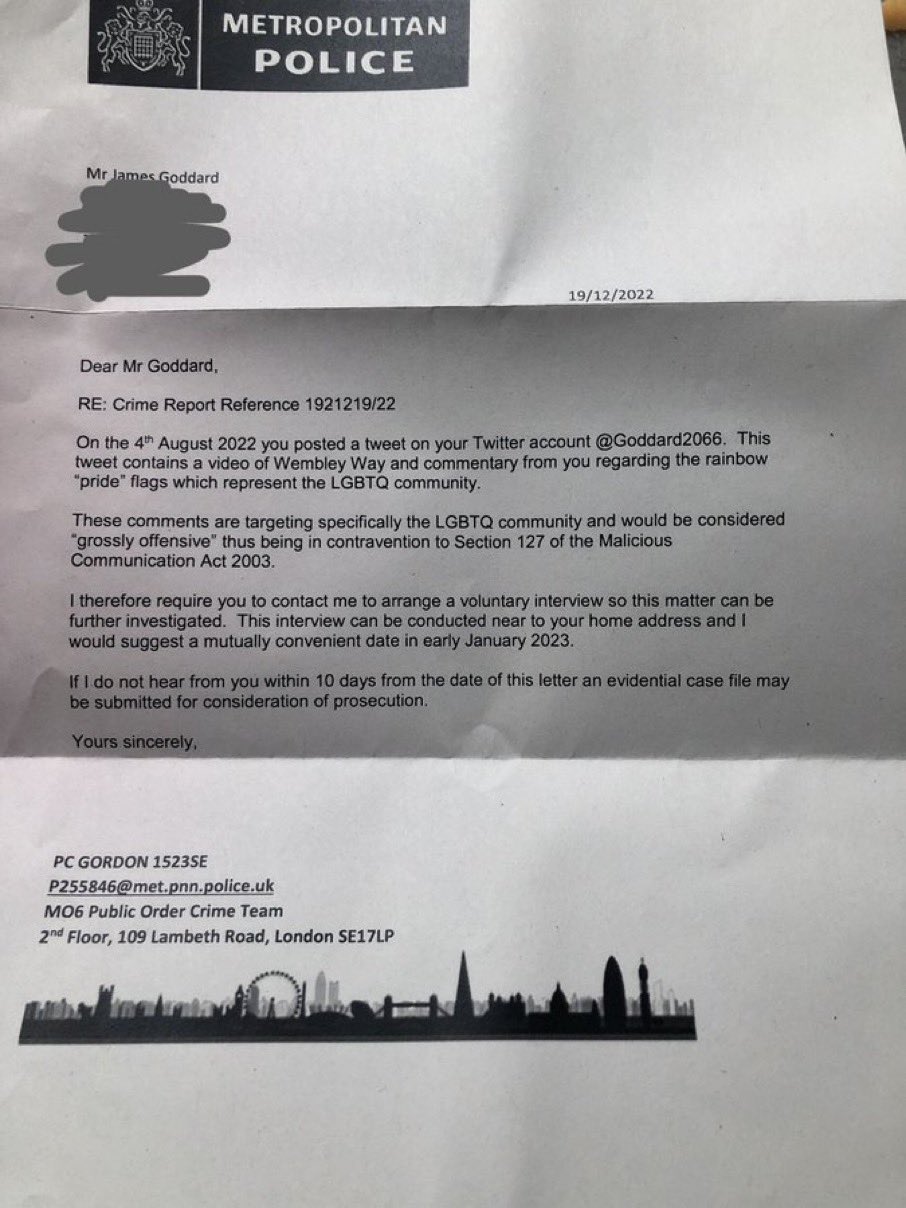
Britain's police are restricting speech in worrying ways(economist.com) |
Britain's police are restricting speech in worrying ways(economist.com) |
The problem is that this act is also the way to prosecute death threats.
In the UK its generally frowned on to send threats of violence. Given that we also have a much lower homicide rate, I'd say thats a fair exchange. even if the act causes aberrations.
The article would be more convincing if it talked about the pub order act 2023, which allows the police to do this: https://www.bbc.com/news/articles/cj3x5j6g30ro
But as thats protest law, it appears that it doesn't count as free speech.
Now the bits that are concerning are that the courts system is so underfunded that there is no legal support for defendants. Proper representation would help eliminate a large number of the stupid and frivolous cases. This is why legal aid needs to be for everyone. ITs not down to funding to determine guilt, its the courts.
The point about magistrates being untrained is bollocks. They are "lay" for a reason. Thats the bedrock of common law.
In dicatorships there is no opportunity to speak out.
I get why democracy has to be indirect when it comes to many complicated, interconnected issues but things like free speech laws, abortion laws, public decency laws, smoking bans etc. should all be decided in a direct vote (repeated every N years). As it is we often have a situation where significant majority have a different view but a small strong group is able to influence the law. It's not a democracy but a farce in my view.
Wikileaks' Julian Assange is perhaps the archetypal recent example, but there are others.
Westminster has undergone a violent authoritarian shift in recent decades. Stating that clearly is a prerequisite to beginning a fight for "democracy", as you put it.
There is always opportunity to speak out.
In dictatorships, it usually costs more energy, money and sometimes lives. It tends to culminate in revolutions, and then the system changes.
In censored quasi-democracies like what we see in "the west", it tends to culminate in being ignored and the status quo being maintained or gradually worsened. Alternatively, you may become a pariah and either have to self-exile [0] or suffer years of isolation and torture [1].
[0] https://en.wikipedia.org/wiki/Edward_Snowden#Asylum_applicat...
[1] https://en.wikipedia.org/wiki/Julian_Assange#Imprisonment_in...
There is no switch front democracy to dictatorship, there is a transition.
There isn't a singular "western" democracy. Different countries have varying levels of (dis)functional democracies and freedoms, and choose different tradeoffs. E.g there are more hate speech restrictions in countries like Germany and France that literally saw what happens when evil is left unchallenged and many innocent paid with their lives; Germany has a federal state against too much power centralisation, France does the opposite due to absurd failures of governance in the past.
None of the various failures or wins of democracy in "the West" are inducement of "western democracy".
People can vote for less freedom
Just generally, this model doesn't apply to the UK. There is an extremely long history of people voting one way and the government doing something else. This is because the country is led by people whose views are shared by no-one, and the tremendous power of the Civil Service (elected officials have limited powers to direct civil servants and cannot remove all but a handful of civil servants...there was an example recently of a senior civil servant giving incorrect information to a minister, the minister was forced to resign, that senior civil servant stayed in for several years, another minister attempted to remove them, the civil servant sued and won a substantial settlement then chose to retire early on a full pension...he was responsible for several massive issues in his department too, Windrush was one, there were many others).
A more nefarious factor is that turnout has collapsed because voters, correctly, understand that their vote doesn't actually matter. The government is unable to do things so why bother voting. Turnout is significantly higher in Russia presidential elections.
To give you an example, the current level of immigration is supported by ~3% of the population. No-one supports this. The government knows no-one supports this. Immigration has stayed high for multiple years, we have had elections, it doesn't matter. If we elected someone to fix it, they would be unable to fix it. Labour have tried to fix it...they spent years in opposition saying the Tories couldn't fix it with their policies...they get into government, within a year they are now trying the exact same policies...because Parliament has no real control, whether in theory or in reality, to change anything, the government gets in, the civil service present the same choices that won't work...you have to be actually mad to think voting makes a difference. The idea that you can fix things by voting is the reason why things are stagnating.
- the worst democracy is better than the best dictatorship (we are not the worst, others could be worse)
- the system is good and perfect, it's just a few bad actors ruining it (we can fix it as long as we fix these certain bad actors)
But so does America. Quite a few people (non citizens so far), have been arrested for criticising the actions of the current Israeli government.
Well, what is the content of those e-mails?
Dear The Economist, your story is not worth the paper it isn't printed on without the goddamned specifics.
The content of those communications could well be reasonably actionable by police. Of course, those who were paid a visit by police will claim that they made nothing but some disparaging remarks.
It is an extraordinary claim that a school called the police over mere disparaging remarks, and that the police subsequently arrested someone on specific charges. Extraordinary claims require backing evidence.
A BBC story says that: "Maxie Allen and his partner Rosalind Levine, from Borehamwood, told The Times they were held for 11 hours on suspicion of harassment, malicious communications, and causing a nuisance on school property." It's possible that the school simply distorted the facts to bring about an arrest, dragging the police into it.
That same county's own PCC (Police and Crime Commissioner) made these decent statements:
"There has clearly been a fundamental breakdown in relationships between a school and parents that shouldn't have become a police matter."
and
"While people should be courteous and go through the proper channels when raising concerns about a public service, the public should be able to express their views without worrying they'll get a knock at the door from the police."
So The Economist simply made up this stuff about someone arrested over "disparaging remarks". There were allegations of harrassment and causing a nuisance. Maybe the police went a bit overboard, but they can't just ignore such allegations either. That's why the prank known as swatting works.
> Another man criticised pro-Palestine protesters, tweeting: “One step away from storming Heathrow looking for Jewish arrivals.
That sounds like a legitimate target for investigation by police; it can be reasonably interpreted as a threat to carry out some action. If that individual did storm Heathrow and cause a violent incident, and it came to light that the police had known about his plan from an online posting, they would face heat.
Nothing here but rage clickbait.
I mean, maybe it's worth a look anyway, but not directly for the reason you stated.
The rest of your post I agree with.
I'd offer yet another explanation: laziness.
For burglaries, you have to get out of your chair, go out into the community, interview witnesses, search for evidence, and maybe wander into dangerous areas to find and arrest potentially violent suspects.
For internet thought crimes, you can sit in the comfort of your own chair, getting paid to surf the internet, and declare enough posts "offensive" to look productive. When you do show up to arrest someone, they're highly unlikely to be violent. It's a lot easier and safer than investigating burglaries.
But more seriously, society has dealt with misinformation and disinformation for millenia and collectively decided that freedom of speech and the press were key factors in keeping democracy, and were a more vital concern than the threat of misinformation. To me, government deciding what is or isn't misinformation is a step away from democracy and towards tyranny. But I do understand that reasonable people can disagree about where to draw the fine lines of freedom of speech.
It's pretty crucial to find out how these ended up with the police.
Did these people send Whatsapp messages to someone who didn't like the messages and this person then went to the police? In that case, it's back to the article and lack of definition within these laws.
If, however, the police got the whatsapp messages via some kind of mass-surveillance programme, then we have a big problem...
It is also worth understanding that in the UK, the security services use specific events to push politicians (with the help of the media) into passing these laws. The Online Safety Act is a recent example, the media campaign was orchestrated by the media/police/security services, and there was a similar campaign behind the 2003 Act...every time. To imply that the laws are there to do anything other than reduce freedom is the wrong starting point.
How does the law in the US treat incitement to violence, as shown by some of the cases described, e.g. Among them were people who said things like “blow the mosque up” and “set fire to all the fucking hotels full of the bastards”. That probably would have been legal in America, says Gavin Phillipson of Bristol University, since it falls short of presenting a clear and imminent danger.
What would constitute "clear and imminent danger" in a online posting?
i honestly don’t know - making people think twice about what they post is a social good and maybe we should keep the law simple and let the courts drive through this new harsh application
The government will always be more interested in suppression of media and speech because that allows them to protect themselves.
I think the uk needs much more freedom of speech, both at a legal level and culturally (I am a Brit)
But the articles arguments are weak:
Someone calling for violent disorder during a riot probably should face prosecution. The fact the US constitution might protect such speech is irrelevant.
Similarly you can make a good argument that incitement of racial (religious etc) hatred should not be protected either. If you want to critique Islam or Israel go for it. But calling all Muslims or Jews or all women or gays or whatever other group names is likely to cause arguments and disturb the peace.
The article also focuses way too much on the USAs approach. This seems to me to have failed: on one hand the us is knee deep in conspiracy theories and far right rhetoric, and on the other people self censor endlessly (or face the consequences on an arbitrary and capricious basis).
If you’re going to argue for free speech, do it based on the inherent dangers of letting any one group decide what is banned, do it on the necessity of having clear quick communication of social changes and do it on the basis of the fastest correction of error. Not “because someone wrote down congress shall pass no law” and then a long list of judge’s arbitrarily decided what that did or didn’t protect over the next 200 years.
https://reason.com/2024/10/17/british-man-convicted-of-crimi...
> On the day, he was asked to leave the area by a community officer who spoke to him for an hour and 40 minutes - but he refused.
Truth is a _defence_ against libel.
Do go have a quick conversation with your favorite AI about this. Ask if anyone in the UK has ever been punished for saying a true thing, and whether the cost on the defendant to prove innocence is not so exorbitant as to allow libel to be weaponized by the wealthy against their critics.
Does the editorial team of the Economist want to imply that only right-leaning members of the British public are experiencing this?
They also used it against people opposing draconian covid policies or protesting for Assange and neither of those are partisan views, no matter how much some might want to pretend they are.
These claim that their views would be more widely accepted if it were not for restrictions on freedom of speech.
those laws require due process. the american immigration "charges" are not tested by courts. They are executive actions, that might be challenged if you are rich enough.
The UK does not have "hate speech" laws. It never had, anyone who tells you otherwise is pulling your leg. What can happen is you can ask for a more harsh sentence if there is "hate" involved. Yes, you will have heard of cases where someone was simple "just a bit racist" but thats moreoften than not an aggravating factor.
That is a very good point. The evidence is right there literally in black and white.
And they can easily get there conviction rates up, which probably matters.
How far do they go? Will they subpeona twitter if you have pseudonym and track down your ip address? How about tor and vpn, will they actually go thru four letter agencies to track you down?
Second: You are responsible for your actions, even if you're just following orders.
One San Francisco flavor of this to get charged for bribing officials to do their jobs.
https://www.justice.gov/usao-ndca/pr/three-construction-plan...
Over here we've seen this with various jurisdictions decriminalizing marijuana and other drugs by simply not policing it.
The tweets appeared during an attempt to set off race riots in the UK, which was partly being organised on Twitter.
And some people had indeed tried to set fire to hotels.
https://www.theguardian.com/uk-news/2024/dec/12/rotherham-ri...
So this wasn't random online muttering. It was a clear statement of encouragement and intent.
Compare with the much larger number of people who have been jailed for discussing peaceful protests against fossil fuels.
And the number of people - zero - who have been jailed for high profile disruptive protests against... changes to inheritance tax.
(What some people may not understand: UK police are running a dragnet online now, it is unclear when this started but was in full force after Covid, you can post and immediately delete, you can post with five followers...they will find it, and will attempt to prosecute. People on here go mad when police in the US pick up drug addicts, the UK has a China-style operation aimed at the public, they are making 200-300 arrests a week, it is complete insanity).
Now compare this to what else people are seeing. Some people in the UK (I cannot say which ones) are subject to rules: benefit fraud, tax evasion, public disturbances everywhere..."community policing" so these laws are not enforced. A well-known paedophile politician was recently convicted for attempted rape and sexual assault, they got a sentence shorter than the person you are referring to above...a convicted paedophile. Some parts of the UK have given prosecutors guidelines not to give a custodial sentence to paedophiles. During the riots, whilst people were being arrested for tweeting, there was a video online of a policeman asking attendees of a local mosque to put their weapons back in the mosque...no arrests made. For people in the UK, the problem is not the danger of things being said online, the danger is things going on in the physical world around them. I don't think a reasonable person can fail to connect these two things, there is a reason why the police go after the innocent online rather than criminals.
This is incorrect.
"At the time she had about 9,000 followers on X. Her message was reposted 940 times and viewed 310,000 times, before she deleted it three and a half hours later. " - https://www.bbc.com/news/articles/cp3nn60wyr6o
>you can post and immediately delete, you can post with five followers...they will find it, and will attempt to prosecute
Examples of this happening please?
So, assuming the posting was as written, would it fall under the "clear and imminent" criteria apparently used in the US?
> That has allowed the police to take a draconian approach to pro-Gaza protests
Generally pro-Gaza is more associated with left wing.
Arrests made _at a Quaker meeting house_, not _of Quakers_ (or at least not for _being_ Quakers).
https://www.bbc.co.uk/news/articles/cj3x5j6g30ro
> The Metropolitan Police said six people had been arrested on Thursday evening at the Westminster Meeting House on suspicion of conspiracy to cause a public nuisance.
> The force said the arrests had come amid concerns about plans to "shut down" London next month using tactics such as road blocks.
I would imagine your example of "anti-hunting activists" would likely also be people planning to do something to break the law - not purely for online comments.
I especially like Nevada's -- a majority in two successive general elections.
Sustainable democracy needs a jury nullification-like direct popular escape catch to solve legislatively-intractable issues (term limits, party primaries, redistricting, etc).
[0] https://ballotpedia.org/Initiated_constitutional_amendment
Foundational freedoms sounds like a fixed definition of freedoms but history showed it’s highly subjective and selective by culture and country.
Not all cultures value individual freedoms like western culture does, and few cultures grant all their freedoms to people outside their culture or country.
Societies always have to balance between what’s good for all, most, some and one.
Much of the Western world only saw a shift to Liberal Democracy (as in the enshrinement of civil liberties and limits to majoritarianism) in the 1960s to 1990s.
Liberal Democracy can be protected only if it's norms are enshrined in jurisprudence, and a lot of Liberal Democracies like the UK didn't do so.
Many people are arrested every day. Some are for justified reasons and some are not. "The result is identical." Intent and rationale matter.
But Julian Assange is not a good example, for many reasons. He didn't just criticise the government. He broke laws. Maybe for good reason.
Are there any examples in the UK of people being jailed for simply criticising the government? Excluding hate speech and civil disobedience?
Why would you exclude civil disobedience, one of the primary means by which you protest government?
> Democracy requires that we fight for it. Otherwise it will disappear.
You are commenting on an article which critiques these laws. It's not the first either. So what you're saying is demonstrably nonsense.
If his message to the council said he’d be standing there reading the newspaper, would the arrest and conviction have been made?
https://www.bbc.co.uk/news/uk-england-leeds-66462895
No muddling of the law here, just pure police overreach.
Either way tit for tat examples help nothing.
Fact is, police are damned if they do and damned if they don't. Plus it's good to just blame them for things they aren't in control of.
JK Rowling, CH OBE FRSL is an author whose corpus of speech is mainly her novel-writing. Now how did nine letters come to be placed after her name, even as she shortened her first two initials? Because her writing (speech) has been in exemplary service and support of the Crown and the British Empire.
So why would police arrest JK Rowling for pushing back against one wedge-issue in the culture war?
The 70-year-old Guy being arrested outside the abortion clinic for holding a rosary and praying, is that the singular offence he committed? Possession of a phoenix feather? Did he rescue Tom Marvolo Riddle's mother? I don't know. Neither do you.
First, I don't really consider what exists in "the west" as actual democracies. They are oligarchies or autocracies disguised as democracies instead. They've always been that, only now it's becoming more obvious.
> the dictatorship is then better
No, not at all. But it does have a clear path toward something better. This doesn't make it better, but it is a silver lining.
> Why couldn't then a democracy have a revolution as well
It could, but more frequently what happens are coups - and they descent into authoritarianism. Or the authoritarians get elected.
> And how's all this black and white thinking, like because democracy is not perfect, dictatorship becomes suddenly acceptable???
I definitely didn't say or think that.
The evidence to the contrary is overwhelming.
But they were not prosecuted for voicing their opinions.
A similar case happened in Central Illinois a couple years ago, where threats were posted but arrests were not made until the threats moved to actual action.
Are you arguing that the fault for being on the wrong side of the powerful lies with the people who could have just decided not to be on the wrong side of the powerful?
We're discussing here laws where someone, whether the police or some other authority figure, is going to be deciding whether you're subject to them based not on plain and objective facts, but on subjective criteria - which inevitably, and unaccountably, will include your other activities. They're designed to offer a fig leaf so that you can be prosecuted for something whose punishment is comparatively palatable, without having to acknowledge the actual cause for offense.
Of course one can argue whether any particular law falls in this category, but I think it's difficult to argue that the designed consequences of such laws are the fault of the person subject to them.
No.
I saying that people are responsible for their actions.
In western society (democratic) laws are implemented by people put in a position of authority by the very people those laws apply to.
I'm not really sure I understand the rest of what you're talking about, so I do t want to assume anything, but it sounds like you're after perfects laws no one can misinterprete? I don't think that's possible. Bug free software will likely come first.
Either way the conversation about power and who has it and who doesn't doesn't strike me as helpful.
> In western society (democratic) laws are implemented by people put in a position of authority by the very people those laws apply to.
Right (although I think that the latter sentence is, first, not limited to western societies, and, second, not ubiquitous in them), but the issue here is not whether people should escape consequences for actions that have been democratically deemed unacceptable (through direct democracy, or through people electing representatives who make the relevant laws). Rather it is, I think, the danger of using the cover of one action, that people have democratically agreed is unacceptable but that the makers or enforcers of law are not actually seeking to curtail, to regulate another action, that has not been democratically agreed to be unacceptable, and might actually be professed to be allowed or desirable while being indirectly and sometimes covertly suppressed.
> Either way the conversation about power and who has it and who doesn't doesn't strike me as helpful.
No matter what your philosophy of society and the role of law, it strikes me as hard to have such a philosophy that is of any use in actually helping to govern a society without paying attention to power, who has it, and who doesn't.
I do! I wish more people would.
The Communications Act prohibits what are at best vaguely-defined "offensive communications" and created Ofcom.
Because of this ridiculous violation of inalienable rights, in 2016, almost 9 people every day were detained and questioned for online speech and almost half of those were prosecuted.
Britons have been jailed for posting emojis of an ethnic minority with an emoji of a gun. Or for saying illegals should be mass-deported. They have also been jailed for things that probably are closer to hate speech but that is just as bad.
Let's not pretend "due process" is worth a damn when such a basically unjust law is allowed to stand.
The UK doesn't follow the American declaration of independence...
In UK law such "inalienable rights" are found within the Human Rights Act, 1998 [0], itself based largely on the European Convention on Human Rights [1]. Both are famously disparaged by the political right.
is a different body and has different laws to England.
The Communications Act prohibits what are at best vaguely-defined "offensive communications"
Actually is gross offense.
> speech and almost half of those were prosecuted.
For gross offense, or threatening communications? Because there is a world of difference. Its the same act that is used to procecute someone sending death threats as it is for "gross offense"
> jailed for posting emojis of an ethnic minority with an emoji of a gun.
yeah but you missed out the other bits. Like the photo it was attached to, the other words he wrote, and _when_ he wrote it
> for saying illegals should be mass-deported
yeah I couldnt find that one.
> Let's not pretend "due process" is worth a damn
It is worth a dam, because thats how law works.
"Offending someone" being a crime is basically immoral.
Lucy Connolly, the wife of a Conservative Party councilor, was the one jailed for her comments around mass deportation. 31 months. These statements wouldn't get someone investigated, let alone jailed, in America.
Due process isn't worth a damn morally if we are discussing unjust laws. Saying "but he got due process" doesn't matter if the law that is being applied is deeply, fundamentally, and inexcusably reprehensible.
Power balances or plays in any society are inevitable. I just don't see it as relevant in this scenario. Certainly it's fashionable today to demonstrate how hard done by you are but in this context the people affected in the article are certainly inconvenienced by police at their door but hardly any of them that I can see were powerless and suffered because if it. Everyone can have their day in court. It's the courts that decide whether you're guilty, whether the police were over reaching; case law is full of such things.
The PSPO specifically prohibited activity in favour or against abortion services, including protests, harassment and vigils. He was blatantly holding a vigil and even then, I expect he could have just moved on when asked and faced no charges. Reading a newspaper would be fine, obviously, unless he specifically concocted his own newspaper with slogans on it which would then surely be a protest of some kind.
It's not a difficult concept to understand and nothing to do with trying to police people's thought, but merely stopping the harassment that would otherwise take place. This particular incident would not have happened if the individual was praying somewhere else or not making a particular point about praying exactly where it would harass people using the clinic.
It's fine to have religious beliefs, but it's not fine to go around imposing those beliefs on others - that's how a lot of wars get started.
>Sweeney wrote: "It’s absolutely ridiculous. Don’t protect the mosque. Blow the mosque up with the adults in it."
American jurisprudence on speech leans towards Free Speech Absolutism [0] due to jurisprudence from the 1970s-2000s, and the test for "clear and imminent danger" is extremely high.
Even though the US and the rest of the Anglophone speak English, America jurisprudence is extremely distinct from the rest of the Anglophone (and vice versa), and IMO it doesn't make sense to compare one with the other due to these significant differences.
For example, the UK dealt with the Troubles into the late 1990s, and the US never had a similar insurgency since the 1950s in Puerto Rico, so there is a hardening in NatSec laws in the UK compared to the US.
This is why the US often leverages allied states to help with this kind of monitoring to sidestep some of the legal implications domestically.
That said, I agree with your point to a certain extent, the issue is the US and other Anglophone countries have a different relation with speech and civil liberties. It doesn't make sense to compare the US with the UK or EU and vice versa.
[0] - https://legal-forum.uchicago.edu/print-archive/free-speech-o...
Was Connolley a major instigator of these riots? No.
The judge's sentencing remarks are below, the key part being:
>6. When you published those words you were well aware of how volatile the situation was. As everyone is aware, that volatility led to serious disorder in a number of areas of the country where mindless violence was used to cause injury and damage to wholly innocent members of the public and to their properties.
https://crimeline.co.uk/lucy-connolly-sentencing-remarks-17-...
But as they chose not to arrest her, this shields every other woman who might want to say similar. The argument being: if JKR can say a man is a man with impunity, then why can't anyone else?
So her making these statements of truth was a win either way. But being able to mount a solid defence in court, if needed, was essential to this strategy working.
The people who wanted JK Rowling arrested knew her views and comments are legal. If the police arrested her and she won in court, that would set a precedent and invalidate any attempt to use that legislation to prosecute people with similar views, which activists were hoping to use it for.
But also, her not getting arrested does the same.
So she was in a win-win position.
But yes I get and agree with your point. And it also highlights an important aspect often ignored in all this. The courts decide a person's guilt irrespective of police action, case law builds up around laws that are broad and easy to misinterprete.
Rights are simply the expression of the interests of certain classes at a certain point in time.
That said, I struggle to find "free speech" a compelling inalienable right when it's what has directly led to the disaster befalling the Americas in this very moment. Especially since the American conception of "free speech" isn't just to be able to express oneself, but to actually have one's words be accepted no matter what.
The current law surrounding "inalienable rights" in the UK is based on the ECHR that I linked to.
The one that fanned huge fucking protests, the one that caused a massive spike in violence, many hundreds of thousands of pounds worth of damage? That old poor innocent councillors wife?
Britain and the US are very different. In the same way that a lot of americans think that school shootings are a fair exchange for second amendment rights, this is a fair exchange for not having shitstirring fucks whip up tensions.
Look, you're not going to be convinced by any of this, because of where (I assume) you grew up. But think of it this way, how many of those constitutional protections Americans have now, have been broken by the current executive branch of the USA? what practical constitutional checks and balances have actually worked when they are being tested?
The 6th amendment appears to not hold with anyone who ICE touches. Personally I'd be much more excised about the USA right now, given that it cant even practice what it's currently trying to preach.
Also, if you want analysis of why Connolly got that sentence: https://davidallengreen.com/2025/05/explaining-a-31-month-se...
All that aside, can you explain the other 29 arrests that day so well? https://www.economist.com/britain/2025/05/15/britains-police...
This is from The Economist of all places not some right-wing rag. Please do not stick your head in the sand on this to "own the rightoids" or whatever. If you're a lefty oppose it on grounds of how it's used against the pro-palestinians.
P.S. I don't see why you're bringing up the trump admin's actions like one bad thing existing means another can't. Both things can be bad. We can oppose both things. It's not that hard.
No because I'm trying to find where that stat comes from. Also as I've pointed out, gross offence is only one offence, the communications act also covered fraud and a whole bunch of other things that are much less contentious.
> own the rightoids"
The extremes don't care about justice, only logical fallacies and being technically correct in the eyes of their peers.
"Fixing" that is an awfully slippery slope towards dictatorship though.
The entire reason that system exists -- to preserve competence and skills in government despite political leadership change and to provide independent checks on elected officials' power -- is because of historical abuses by elected officials.
Ergo, I'm enormously suspicious of suggestions about tearing down the barriers to change...
... because those barriers exist for a damned good reason.
Imho, people should talk more about adjusting the balance in the system, but preserving all the independent components, and less about vilifying specific pieces of the balance of power.
By most standards, the British political tradition has remained paternalistic in it's mindset, and a lot of the shifts in civil liberties happened fairly late (1980s-90s) and without the requisite judicial scaffolding being built in place.
Furthermore, a lot of the same powers and institutions used for internal security during the Troubles were redeployed during the GWOT and never pushed back against legally speaking.
For example, London was the first major city to deploy centralized CCTV surveillance en masse.
And this isn't a UK only thing - across Europe, mass surveillance laws and government perogative are much stronger than their equivalents in the US, and given tensions on the eastern border of EU+ due to a belligerent neighbor like Russia and Azerbaijan using grey zone tactics, I think we might see a further regression on this front, because NatSec will always trump liberties.
By most standards, we're in an interregnum period similar to the 1930s, the "Dreadnought Wars" (1906-1914), or the 1950s that can spill over.
Online Safety Act was an example, there was a massive media campaign over multiple years. I believe the case that caused it happened nearly ten years ago now, it went quiet for years and then suddenly sparked back up again, parents put out in front of the media...every time.
And it is a legacy of things like the Troubles where you have massive internal political instability and these kind of things become normal. These powers aren't formal though, it is all informal. If we are talking about Europe, you see the same thing in Germany (to an extent, in Germany there is a paranoia about political parties, different but historical context).
That's actually a bit of a dumber story than that.
Basically, a well connected and knighted documentary maker (Beeban Kidron) made pornography regulation her sole personal mission after she became a mother.
The UK being a fairly small political playground and her significant network thanks to Miramax made it easy for her to lobby and get private and public support in the UK and California.
Once she was inducted in the House of Lords in 2012, she went gung ho lobbying for it.
> informal. If we are talking about Europe, you see the same thing in Germany (to an extent, in Germany there is a paranoia about political parties, different but historical context).
Yep. A lot of the Cold War era rules and regulations remain in place
I'd like to smash every tooth in your head.
Sweetness, sweetness, I was only joking when I said
By rights, you should be bludgeoned in your bed.
https://music.youtube.com/watch?v=u-JDl5IeDIY&si=9ibHizB9IqD...
The UK has free(ish) speech, that usually works well enough in practice, for most things.
But at the end of the day if the UK government and/or security services and/or wealthy people want to really put their foot on suppressing speech... they have legal tools to do so.
The UK has never really squared the circle on free speech even and especially when it's inconvenient to power.
That's a binary right. Either you have it, or you don't.
On the other hand politicians frequently blame the civil servants as well.
In reality, parliament is sovereign, if they really wanted to reform the civil service they could do it via changing the laws.
Parliament is not sovereign because this is an administrative issue. As I explained, elected officials have limited direct control over ministries. And an even bigger issue is that the Civil Service is unionized, so if you were actually looking to reform it wholesale then you would have to shut down government for months with irreparable damage done in the media by civil servants briefing daily against you...so I am not aware of a way to do this. You can't reform ministries, you can't reform the whole thing...so what is the solution?
The reason why politicians blame the civil servants is because they are bad. No-one thinks otherwise. The past three heads of the civil service have acknowledged there are massive issues with competence at every level, this is not new. But it isn't possible to reform.
I am not sure how anyone can think Parliament is sovereign in this matter either. It makes no sense based on the evidence of repeated issues with competence and multiple governments being unable to fix that.
However, recent attacks on the civil service from the political right are almost always a consequence of reality colliding with politics, i.e. the civil service pointing out that ministerial decisions may be unlawful, etc. There are legions of examples of this conflict arising under the previous Tory government.
As such, it is indeed within the power of parliament to change the law so that their political objectives may be met. It is not up to the civil service to break the law when that is convenient to ministers.
> Windrush was one, there were many others
mate, windrush was down to May and her spads. They knew the problems, but decided that the press was worth it.
> the current level of immigration is supported by ~3% of the population
Immigration has halved this year.
The problem is that has tradeoffs, like social care isn't going work anymore.
I understand your frustrations. I hate that no matter who I vote for I seem to get reform-lite dipshits.
Thats not the fault of the civil service (although there is an entire subject in it's self) thats the fault of the press and political class being too close.
I would read about what actually happened. There were multiple failures in the Home Office, in particular some statistics were incorrectly reported by the Rudd (I am not sure why you are talking about May) based on figures she was told by civil servants, she then had to resign. Not only that but the correct figures were actually leaked to the press shortly after (this is something that has happened in the Home Office before).
Okay, and it has halved to the highest level ever. If you want to have ones of these interminable discussions about your favourite politicians, please stop. I am not interested in hearing which colour rosette you prefer, and how everything is the fault of the other guys. It is complete and total nonsense. The reason why we have the system we have is because it is too easy for a politician to claim they will fix everything (the drop in immigration is nothing to do with Starmer either, it was to do with the Tories whose legacy on immigration is unspeakable, it has halved to a level that is unbelievably high).
Yes, it is the fault of the civil service because, as I assume you don't understand, ministers legally have a limited set of options when they are making policy (this was one of the issues the Tories faced, Rwanda was a variation of a policy that had been explored since the early 2000s...it wasn't a new policy, which is why Labour are now going down the same route...we had an election, same policies). They come into office, explain to the civil servants what they want to do, and then they are given a choice of policies...if a minister chooses not to one of these things then the policy can later be challenged in the courts, and legal discovery can be used to overturn the policy if there is no legal basis for it (essentially, whether it was approved by the civil service).
Every new government comes in finding the same thing. You are already seeing people in Labour complain about Reeves...well, guess what? There are no alternatives. Your comment about Reform-lite is ridiculous, every party is Reform, every party is Labour, every party is the Tories. The game continues as long as people like you give it credibility by suggesting that voting has any impact and will change anything...it won't. A lot of the briefing that the press get is from the civil service too...I can't understand how you can talk about immigration and then complain about the press...why do you think Johnson increased immigration? The press, relentless briefing from lobbyists, relentless pressure from civil servants in the Home Office briefing against the government (the Home Office is notorious for this btw, as I just explained above, I remember Charles Clarke complaining about this...unbelivable).
Yes, they have to make decisions that conform to UK laws. Rwanda is/was such a stupid idea that even if ministers had removed the relevant laws preventing them from implementing it, it would have cost hundreds of thousands per person, and not solved the issues it was supposed to.
The initial idea was, instantly deport as many people as possible (without due process, basically anyone who arrives without a visa is instantly classed as an illegal migrant, regardless of circumstances, and sent back to country of origin, even if that means death), and those that somehow do manage to claim asylum, send them to rwanda.
The policy then was "honed" as follows, so that it was actually legal, but no less stupid:
1) make it effectively illegal to claim asylum
2) buy housing in rwanda to house all successful asylum seekers, but only upto low thousands
2.1) pay over inflated costs to keep those people there for ever. They can't work there, so we have to pay them for ever.
3) make it effectively impossible to process any asylum claims.
4) because its impossible to process claims, you cant deport failed claimants, because they've not been processed
5) exhaust all short term housing in the UK for claimants, because they can't be processed and deported.
6) pay ever increasing bills for short term housing, and piss off locals, because the number of claimants increases for ever, because they can't be processed.
7) claimants abscond and are never seen again, living without a paper trail in the UK
It was so fucking mind bendingly stupid and expensive, you too would try and stop it.
Of course the press and the twitter sphere loved it, because it was a deterent. Regardless of the cost or stupidity.
What labour have floated, is that failed claimants be immediately moved to a 3rd party country pending appeal. Which much less stupid, but still expensive. I imagine it'll be dropped. The solution is to actually process asylum claims properly(which is what is being done, hence why those migrant camps are reducing).
> The game continues as long as people like you give it credibility by suggesting that voting
You seem to suggest that its the civil service that runs policy. I really would suggest reading the actual laws that are passed, and the research provided to the commons library. Civil servants can only do what the law allows. And often, those laws are fucking stupid, and done to chase a headline (see johnson/sunak)
Labour as not reform, you and I both know that. Labour are just shit and have painted themselves into a corner. Moreover, the current PM doesn't acutally publically stand for anything, which means that making decisions as a minister is very hard. (its partly the same reason sunak was so useless, most of it was he had useless ministers)
> why do you think Johnson increased immigration
because we have a chronic skills shortage, and to keep a lid on wage rises, and to stop the care sector grinding to a complete halt, we needed immigration.
Look, the issue is this, public finances are fucked. Until taxes are reformed, or we somehow grow the economy 10%, everything will be salami sliced to nothing.
both the tories and labour were dishonest about taxation. The press failed to actually tackle them on it. Mind you, if they had, would people listen. Nobody likes to bother about public finances.
"everyone is the same" is just not true, thats how we get extremists, like reform.
Put another way, the role of the legal system is to be a linter for the messy / incomplete / illegal reality of legislative and executive desires.