Why it's so hard to find a photo of Neil Armstrong on the moon(apple.copydesk.org) |
Why it's so hard to find a photo of Neil Armstrong on the moon(apple.copydesk.org) |
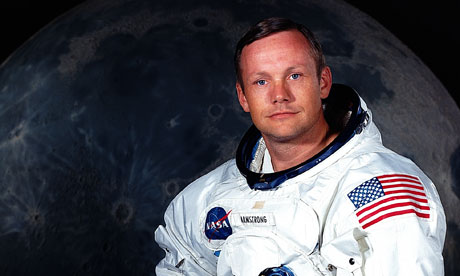
After reading the Armstrong family's statement last night, that's the photo which expresses the legacy he wished.
He looks ready to wink back.
Also, the picture of Armstrong climbing back in the Lunar Module is fine.
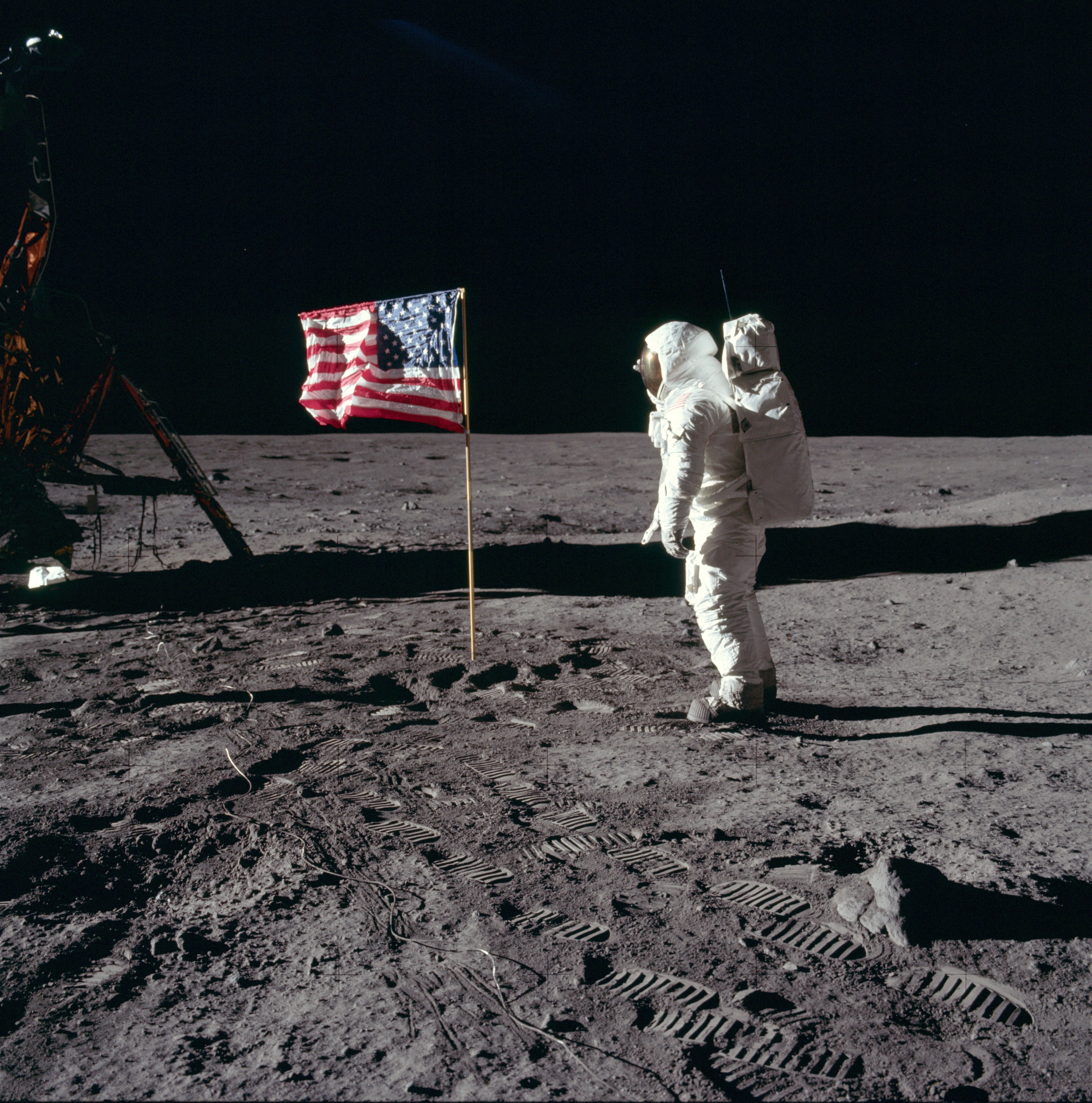
Conversely, to those arguing the use of a reflective shot of Aldrin's visor? I think that's worth including if I'd also included that shot inside the LM. An close up of this picture, showing Alrin's helmet, backpack, and shoulders, reading "Neil Armstrong took most of the photographs on the moon that had an astronaut in them. However he can be seen clearly in the reflection of Buzz Aldrin's visor here." Just pair it with a matching (size-wise) photograph, unzoomed.
He and Aldrin still have to get their spacecraft off the Lunar surface, rendezvous with the command module, fly back to Earth, and land the damn thing.
It captures a timelessness moment in between.
Uh, Neil Armstrong had a Hasselblad camera strapped to his chest. I'd say excuse the lack of sky composition. Besides, the original picture also captures the lander in the composition. Wouldn't you want more photographic detail in a moon landing operation photo instead of one which is more harmoniously composed but contains useless black sky? But like I said, he's taking pictures with a camera strapped to his chest.
.. And who cares if it isn't a picture of Neil? It is the best representation of the feat and overall project. Besides, he took the picture.
No, that's not what he's talking about at all. He's talking to photo journalists and he's saying if you have the doctored photo (the one with the skyline) delete it from your archives. Because you can't use it for many publications.
>And who cares if it isn't a picture of Neil? It is the best representation of the feat and overall project. Besides, he took the picture.
So every other paper can't print an article about how stupid you are that you put a picture of some other guy to represent Neil Armstrong?
Editors searching for pictures of Neil? Because he was the one that died recently and they have to write stories about him?
- People who know it isn't a picture of Neil Armstrong and feel like they need to point that out.
- People who are bothered by the slight inaccuracy that it isn't a picture taken of him.
Either way, he took the picture. He took one of the most famous pictures.
If the caption to the picture reads "Buzz Aldrin as captured by Neil Armstrong", who cares? Have you ever seen a caption which says that it is Neil Armstrong? I haven't. People just assume it is because he is the best known since he was the first man on the moon.
BTW in AS11-40-5903 they took it too far and cut Buzz Aldrin's antenna.
It wasn't pixels -- it was emulsion film.
Nor was it that precious. What would they do with a photo of more rock/equipment and less space?
I guess the photos was more for a documentation/publicity use than of actual scientific interest.
I fiddled the curves a bit on the inset photo, but still need to do something with that blue/violet cast on the bottom right.
http://dl.dropbox.com/u/8403291/armstrongs-picture-of-aldrin...
I wouldn't rely on that for any real information.
EDIT: Not to mention the fact that the suit says "E Aldrin" on it. I have a hard time believing they swapped suits, too.
http://www.youtube.com/watch?v=FwZPLfFcYoA&feature
Due to a glitch in the video it's not clear which astronaut is which leading up to the photograph, but if you watch them afterward when they talk through what they're doing, it's clear that Aldrin was the one posing next to the flag.
As for the doctoring, I don't find it unethical. I don't have a problem straitening a crooked photo, adjusting the contrast, etc to make the photo visually appealing. That's not the same as adding a person. I understand journalists want "the truth" but with film there are so many artistic decisions made when processing a photo anyway. Maybe the truth is that is was very dark or bright. Should darkroom manipulation be skipped and the photo be blown out or solid black because that's the real truth? If there was a scratch on the negative I don't mind if it's repaired as long as it isn't maliciously trying to trick us.
Lack of political will to fund it. Funding wars was more important than funding science.
> There are many unanswered questions here.
Sadly, no. We know precisely what happened, and that's the depressing part.
http://www.lrb.co.uk/v27/n17/steven-shapin/what-did-you-expe...
How come the flag is waving in a environment with no atmosphere ?
tl;dr the flag had embedded wires to keep it unfurled, also the pole was flexible and springy, it kept wobbling after it was planted in the ground
Darn the fluff, get the truth. Upvoted.
See here a British youth journalist challenge Buzz Aldrin about it: http://www.youtube.com/watch?v=2kKFYTBo6kA
Second, any reporter must verify his, or her sources, otherwise they are subject to manipulation and if a source is falsifying information, for whatever reason, that information must not be used as the reported cannot know to which degree was the information tampered with. It might have been just a minor cosmetic touch-up, or it might have been a complete fabrication. So while the demand to remove from the archive a famous 43-year old image sounds odd, it's very much on par with a practise that any decent publication must follow or risk the integrity of their whole publication.
If crops, borders, rotations, etc. constitute "doctoring" then virtually every publicity photo NASA releases has been doctored. And if those minor transformations aren't allowed then surely none of the composite photos from the Mars probes are acceptable either, right? Compositing is way more invasive than cropping and rotating.
At any rate, NASA has published the raw version of all their photos and therefore, everything is verifiable.
that information must not be used as the reported cannot know to which degree was the information tampered with
Yet, in this case the reporter knows to which degree the information was tampered with - and the reporter has no problem verifying it either.
One reason I don’t want to see it: That’s not Neil. That’s Buzz Aldrin.
The main objection is that's not a photo of Neil.
Newspapers are based around a mission of delivering facts (or at least the facts they want to share), and when that core rule is violated the inherent trust is broken. So when someone is misquoted, a story manufactured and so on then the journalists have failed, are fired and cast out of the community (mostly). Photography was one of the biggest changes to news reporting as it allowed facts to be visually disseminated as well, but because they're essentially a snapshot of the moment as it had happened modification of almost any kind was immediately held up as a no-no.
Some newspapers are getting a bit more progressive, but every 3-6 months in the photography community there's a discussion regarding whether the tools photographers use should be allowed in photojournalism, or whether in the central mission of delivering the truth photo modification, even in a trivially form, is counter as how can you say the changes haven't gone further.
For the more curious: http://www.petapixel.com/2012/06/15/time-travel-and-ethical-...
http://www.petapixel.com/2012/03/08/should-photo-contests-re...
http://www.nppa.org/news_and_events/news/2006/08/ethics.html
http://edition.cnn.com/2012/02/22/opinion/phones-instagram-a...
It depends on how precise you want to be I suppose.
Even a cursory look reveals the astronaut has a name tag with "E ALDRIN" on it. Neil's always in the reflection of Aldrins visor.
Citation needed. It looks to me like only a small gang of wingnuts are part of the "moon landing conspiration believers" (I never met one). Like s slight portion of those believing that 9/11 was a CIA/Israeli job, or that there isn't any biological evolution.
> A 2000 poll held by the Russian Public Opinion Fund found that 28% of those surveyed did not believe that American astronauts landed on the Moon, and this percentage is roughly equal in all social-demographic groups.[19] In 2009, a poll held by the United Kingdom's Engineering & Technology magazine found that 25% of those surveyed did not believe that men landed on the Moon.[20] Another poll gives that 25% of 18–25-year-olds surveyed were unsure that the landings happened.[21]
Note that a belief that "man never landed on moon" could be just out of ignorance, not necessarily a belief in a conspiracy. And considering that both the UK and Russia have relatively very high educational standards, it's not hard to believe the percentage is much higher elsewhere.
> Like s slight portion of those believing that 9/11 was a CIA/Israeli job,
"Slight portion"? Citation needed. :-)
In Latin America, East Europe, Arabic countries, Russia and Japan ~90% of the people I talked to believe 9/11 was an inside job.
As for the moon landings - I'm one of those conspiracy believers. I've looked at what NASA&Co has to say and it's far from convincing. Here's a good site IMHO proving Armstrong and the other 20 astronauts never left Earth orbit: http://www.davesweb.cnchost.com/Apollo4.html .
It's still hard for me to believe they were passing the camera back and forth. That, with all the other inaccuracies, lead me to believe it's fake. Why someone would purposefully fake that I don't know...
Yes, I know, it is really, but you don't know that from the photo, and that's an important distinction when you don't know the full context your reporting of the photo will be presented in at a future date. I think the argument is that crops and rotations are generally ok (although the argument about the upside-down footprint is interesting), but a transformation which claims to add information not originally in the photo cannot be ok.
They sent pilots, to the moon. They had a couple of hours. That's all. Film allowed them to collect a large amount of data which hundreds or thousands of scientists could later analyze.
Some rocks are more interesting than others. But it's better to have the scientists decide which to take a closer look at on the next landing.
Today, some of the flags planted on the moon still stand upright. However, 40 years of intense UV radiation have bleached them all white. The plaque remains.
This bespeaks a gross lack of knowledge about how a modern economy works.
I'm also alright with it, they had to do what they had to do to make it work and make it clear.
If you use a simple-to-follow rule like "no editing except to crop and correct color balance" that's easy to understand and follow.
When you allow some manipulation as long as it's noted, editors will composite a celebrity's face onto a model's body for the front page and note it's as a fake in tiny text in a contents list three pages away. Far-fetched? Newsweek have already done it [1].
[0] http://en.wikipedia.org/wiki/Bright_line_rule [1] http://www.nytimes.com/2005/03/03/business/media/03mag.html
Yes, but that's still no reason to release a known "fake" image. Also, you can tag it with captions and disclosures, and someone might still link to the image as "look, there's no antenna on his head unlike other photos, proving the landing is a fake".
"Yet, in this case the reporter knows to which degree the information was tampered with - and the reporter has no problem verifying it either."
Publications have a no-doctored-images policy, it doesn't allow for exceptions, even if the length of the manipulation is known, especially when the original is available.
And people brainwashed by mainstream propaganda don't need reasons to repeat what they've heard on TV ;-)
You're right that some of the photos were doctored -- good work! The primary purpose of all of the Photoshop work was to remove the red hues from the ground. Some of the backgrounds were reused, of course. That wasn't uncommon back then. And of course the constellations that are thousands of light years away would have looked distorted, so they had to be removed.
But you're wrong about the framing and focus problem. While it turns out to be impossible for a geometrically-inclined engineer to aim a camera without a viewfinder, NASA was able to work with Polaroid to invent a fixed focus lens, which they later commercialized as the Brownie.
Great research! That davesweb guy does good work. It's too bad that the govt can't acknowledge the hard work folks like him have put in. It's just still too sensitive. My Dad never should have told me, but you know how people get when they're old.
Oh, this goes with saying I guess, but they never did find the monolith. So when Bush gets his colony on Mars obviously that will be priority number one.
Obviously your an idiot and get your information from conspiracy wackos and the x-files.
I'm mainly commenting to apologize that some of your comments are now dead- while I could understand if this one were, your grandchild comments expressing interest in other peoples' (non-conspiracy) arguments are dead which I think goes against the whole point of commenting here, especially when child comments saying "your an idiot" get upvoted.
Indeed. The USPS did it with explosive furniture. If you disagree with me, you're NWO COINTELPRO M-O-U-S-E.
http://screwloosechange.blogspot.com/2008/07/craziest-theory...
Slight?
Jyap, I think you're wrong on this one and digging yourself a bigger whole. In journalism, it's certainly an obvious problem. But even amongst amateurs who prefer accuracy, it's clearly a problem. A picture of a different person is hardly a "slight inaccuracy". It is a complete and major innacuracy.
Umm the fact that its a picture of some one else is way more than a "slight" inaccuracy.
you could probably replace photos of Stalin and Churchill and no one would care about that "slight inaccuracy" :)
Surely, that would only be a slight detail.
I _effin_ care. E.g. I want a picture of Neil Armstrong for my article. Not a picture that _he_ took of somebody else. Not a quick sketch he did of his cat. I want a picture of HIM, preferably on the moon.
That he "took the picture" is meaningless for the purposes of _showing_ the man in action. If I was writing about Knuth I wouldn't post a picture of McCarthy he took and caption it "John McCarthy as captured by D. Knuth".
As someone who used to do photo editing for a newspaper, I assure you that this is Photo Editing 101. Your arguments are loco.
Neil is visible in the photo, in the reflection on Aldrin's visor. In this photo which he took while walking ON THE MOON. Which, if you take a step back and lose the journalistic tendentiousness, you will realize makes this about as cool as any picture ever taken.
If I want to depict Neil Amstrong, the "coolness" of a picture showing some other guy does not come into play at all.
Isn't it obvious?
I mean, seriously, "as cool as any picture ever taken"? "visible on the reflection on the visor"?
A) Use the mentioned picture as the centerpiece to their article.
B) State incorrectly that it is a picture of Neil Armstrong.
Neither is likely to happen. It is just a common misconception that it is a picture of Neil Armstrong since it is the most famous picture of the mission and because people know Neil Armstrong. People see the picture and assume it is Neil Armstrong. Credible publications won't use the picture.
The parent article makes out that there aren't many pictures of Neil Armstrong. They will most likely use the one mentioned taken by Buzz Aldrin or this one:
http://static.guim.co.uk/sys-images/Guardian/Pix/pictures/20...
You'd be surprised. With the cost cutting of proof checking and editorial departments, and the rush to catch internet time news, I've seen much much worse misattributions and even hoaxes running around in respectable publications (far from only online ones).
Also, every single image you see of Saturn from Cassini has been manipulated. Almost every photo of Mars from Curiosity is manipulated. So what then?
Sure, but not much sillier that saying that putting up a picture of a different person is a "slight inaccuracy".
>Also, every single image you see of Saturn from Cassini has been manipulated. Almost every photo of Mars from Curiosity is manipulated. So what then?
Notice how I, unlike TFA, never said anything about manipulation? I only raised the issue that we DO care a lot, as photo editors (1), if it's a picture of Neil in the article or if it's a picture he took of Buzz.
But, since you ask, you show those images with an explicit notice that they are manipulated. If they were images of events with political aspects, war images, images or persons etc they would not be published manipulated, but in this case we are talking about essential manipulation (stitching, colour correction, move to the visible spectrum, etc), and not creative image doctoring like pasting some space or removing a person USSR style.
(1) And presumably as readers. You don't just put out some different image that one assumes from the article content and then except readers to check the caption (which they seldom do). All sorts of perception manipulation can be carried out that way.
If there are any worries about misunderstanding, make sure the photo's caption is clear. To someone who isn't part of the Church of Photojournalism, it honestly seems very simple.
If you are concerned with "depicting Neil Armstrong" above all else you're not going to want a photo with his visor down in any case. But that makes excluding this photo seem every bit as stubborn as excluding a photo of a Saturn V rocket or something.
"Church of Photojournalism", "journalistic rule lawyering"?
Has it ever occurred to you that the journalistic standards surrounding photo manipulation may have actually been arrived at after a century of experience, rather than a bunch of tightasses obsessing over haughty principles, as you've so conveniently insinuated?
This is something that bothers me about HN regularly - we have such a strong tendency here to trivialize other people's jobs, to the point where anything that isn't immediate obvious to the layman must be idiocy of some sort.
> "To someone who isn't part of the Church of Photojournalism, it honestly seems very simple."
So the fact that tens of thousands of photojournalists over the course of an entire century have arrived at, and agreed upon, this set of rules for reportage means nothing. Clearly you, a lay person who has never been deeply exposed to photojournalism, you know better. It seems simple.
I think the standard rules of photojournalism are ordinarily probably very useful. If the comments of the guy I initially replied to are truly representative of the field (you haven't given any opinion here), it's IMO clearly not perfect.
> So the fact that tens of thousands of photojournalists over the course of an entire century have arrived at, and agreed upon, this set of rules for reportage means nothing.
Is there truly a consensus position on something this specific? Such that it would categorically be a mistake under the rules to use a (very good) photograph of Buzz Aldrin walking on the moon when the subject of the article is Neil Armstrong? In spite of the fact that walking on the moon is what Neil Armstrong is known for, and there are no proper pictures of him doing it, and a pic of Aldrin taken by Armstrong is the closest we're going to get?
I'm skeptical that the field's century of experience leads to such a clear and unambiguous conclusion.
I can't possibly be the only person confused by the author's visceral reaction to pasting in a block of black above a photo, or slightly offended by your comparing it to USSR-esque person removal.
There's distortion of the truth, and then there's removing redeye from a picture. Which of these would you say this falls under?
Second, noticed how I haven't mentioned NASA in my reply about doctored images? I gave some examples of the kind of things photo editors avoid. Nowhere I said, explicitly or implicitly, that NASA adding black was like a "USSR-esque person removal".
Also notice how I gave TWO examples? "like pasting some space or removing a person USSR style"? NASA did the first, USSR did the second. Where's the confusion?
I called both "creative image doctoring", but NOWHERE did I implied that what NASA did is equally morally outrageous as the second.
No, but you compared something completely innocuous with something completely evil. I sincerely don't believe even did it on purpose, but it reads like a cheap appeal to emotion.. probably an implication you weren't trying to give off.
Fixing red-eye is borderline and needs to be done carefully. Someone fixing red-eye and obscuring a coloboma has distorted the image, and distorted truth.
Can you really see no difference in fixing a photographic defect and adding in stuff that was not there?
Obviously it depends a bit on where the image is used, but I'd hope that any publication would list the changes made to a photograph.
The truth that if you make it "a little of this is OK", "a little of that is OK" people will abuse it. No manipulation is clear cut and KISS.
And making an image "aesthetically appealing" can have consequences of viewer manipulation. E.g making pictures of war prettier, or removing some things that don't make the frame pleasing but reveal stuff about the actual situation, etc etc.
Even this manipulation hides facts. E.g the fact that Neil couldn't operate the camera with precision -- so it can be used to show that the walk on the moon was easier or more "piece of cake" than it really was. (Remember that one major use of the moon mission was cold-war era PR for the US).
>here's distortion of the truth, and then there's removing redeye from a picture. Which of these would you say this falls under?
Even removing redeye from a picture would be frowned upon in newsrooms.
E.g What if the picture is of a drug abusing athlete, and the process shows his eyes more normal than they were?
Then be outraged at the abuse. Just about any tool can be misused, but that doesn't make using that tool wrong.
>so it can be used to show that the walk on the moon was easier or more "piece of cake" than it really was.
I see what you're getting at, but even that seems like a stretch, even in the light of the cold war. "Dumb Americans can't even operate a camera right!"
I see the principle here, I really do, but a principle is not applicable in all cases. Leaving no room for nuance is not an ideal to strive for!
I'll add a bit more nuance to that - people don't always read every word of a newspaper article. That's fine, it's why the inverted pyramid [0] model is used. If there's a big headline (Neil Armstrong Dies) and a single photo (the one of Buzz Aldrin) and the fact it's not a photo of Armstrong is in a little caption, it's going to contribute to the misconception that the photo of Aldrin is actually a photo of Armstrong.
Contributing to misconceptions is bad and should be avoided. Luckily this is easy - just use the photo of Armstrong in the lunar lander.
On the other hand, it's unlikely anyone would mistake Leonardo and the woman in the Mona Lisa so it wouldn't seem so bad to me!
I might have some bias here as someone who reads primarily online media, but I haven't observed most venues limiting themselves to a single photo.
[0] http://science.time.com/2012/08/25/remembering-neil-armstron... [1] http://www.standard.co.uk/news/world/neil-armstrong-modest-h... [2] http://www.telegraph.co.uk/science/space/9501410/Neil-Armstr... [3] http://www.guardian.co.uk/science/2012/aug/26/neil-armstrong... [4] http://articles.timesofindia.indiatimes.com/2012-08-26/us/33... [5] http://www.thestar.com/news/world/article/1247118--neil-arms... [6] http://www.washingtonpost.com/national/health-science/neil-a... [7] http://www.bbc.co.uk/news/world-us-canada-11162858 [8] http://www.bangkokpost.com/learning/learning-from-news/30958...