Why is the sky blue?(explainers.blog) |
Why is the sky blue?(explainers.blog) |
So was blue intrinsically pretty and thus made into the sky, or considered pretty and thus imprinted in the minds of humans that way?
Can you be more specific?
Rayleigh scattering is elastic (only the direction changes), whereas Raman scattering is inelastic (energy, that is color changes in addition to direction) scattering.
This is just silly. Some birds have blue feathers. There are various ways to be blue. Similarly, air is blue.
But the winking and "cool guy" emojis are so grating. In general, technical explanations that apologize for themselves with constant reassurances like "don't worry" and "it's actually simple" undermine their own aim.
Your job -- if you're making content for people with double digit ages -- is to make the explanation as clear as you can, not to patronize and emotionally hand-hold the reader.
Not all readers are the same, so you will fail at your job for some readers.
But few readers are emotionless automatons that need nothing but dry technical content, unless it’s a topic they are very motivated to understand.
I would agree with that. And I think emojis and unnecessary reassurances subvert that goal. It's fluff, it's more to read, and if the writing isn't already clear, they don't fix the problem.
> But few readers are emotionless automatons that need nothing but dry technical content
Nothing in my post argues for dry technical content.
Bartosz Ciechanowski's superb work, which may have inspired the author, gets the balance just right without any hand-holding asides:
Sky is grey
Nope! Purple is not violet! It a color that the eye perceives when stimulated by both blue and red wavelengths at the same time; there is no wavelength that produces purple by itself.
Why should only visible EM radiation have colors, but not radio, X-rays, etc?
Obligatory xkcd[2]: "Rayleigh Scattering" https://m.xkcd.com/1818/
Others?
The liquid air article on wikipedia doesn't have any photos.
Air is blue. The reason air is blue is blah blah blah physics, see the article we're all commenting on, but at the end of the day air is blue. We don't demand the same elaborate physics questions for why a ripe banana peel is yellow.
The sky is not blue for the same reasons that a banana is yellow.
But the reasons behind color in both cases is interesting regardless.
There.
https://sunwindsolar.com/blog/solar-radiation-spectrum/?v=0b...
Both the "because that's what the sun emits" and "because we are mostly water" explanations are incomplete. There are plenty of other animals [1] that can "see" infrared.
The real reason is simply because that's how we evolved. That's how the "because those are the frequencies that pass through water" explanation comes into play: vision first evolved in aquatic animals, so frequencies that don't penetrate water wouldn't have been all that helpful to their survival and reproductive success, and so wouldn't be selected for. But that's incomplete too: salmon are one of the top IR-sensing animals and they live in water, so when there's an evolutionary need to select for IR vision, it happens. The reason we "see" in the visible light range is simply that that's how we've defined "visible".
There are some physics reasons as well, notably that most mammalian body structures emit heat, which would blind an animal that relies on infrared to see (notice how most of the animals that can see infrared are cold-blooded reptiles, fish, and insects), and that most of the high-resolution biochemical mechanisms that can convert electromagnetic waves to electrochemical nerve impulses operate in the visible light range. Structures that convert infrared radiation to nerve impulses are more complex and more costly to support, so unless there's a clear survival benefit for the species, they tend to get selected away.
[1] https://a-z-animals.com/animals/lists/animals-that-can-see-i...
Looking at a periodic table makes this pattern kinda clear.
The reason a banana peel is yellow is that in a lit environment, it makes yellow light hit your eye.
The reason air is blue, is that in a lit environment, it makes blue light hit your eye.
Obviously one can go further to deeper reasons. Go deep enough and no different colors have the same reason. But you not understanding the level of abstraction in use doesn't make me wrong.
Prior to the great oxygenation event, Earth's sky was not blue; it was likely red-orange, carbon dioxide and methane being primary components.
How does scattering work? Why does light scatter? _What does scattering even mean in the context of light?_
Any other questions give you the same disappointment?
The big bang ... expansion ... something something ... dark energy....
Thank you for making it. :)
(The blog post, that is, not the sky. If you made the sky - please let me know!)
Kind of reminds me of worrydream (Brett Victor), better explained and neil.fun vibes (and many others I can’t recall right now)
https://www.youtube.com/watch?v=PbKsC4GCT5k
*Since blue is the shortest wave length...*
- at night (of course)
- there are ~1 septillion stars that are all shiny
Like, dude, as if anyone would care about such a highly technical point, like eg some React framework quirk or race condition mitigation for specific generation of Intel procesdor or a semi-well known edge cases with btrfs inode behavior, even if I had been on that exact camp.
rayleigh scattering.
what's that?
light from sun bouncing around.
why?
because it does.
why is it blue though?
green was taken.
why?
do you want chocolate or raspberry icecream?
chocolate!
yay!
(No, this isn't the best way. But it was A way and that was enough. The kid became a physics lecturer.)
The light "beam" we perceive is the result of infinite circular waves. The points were the light is not are points where they cancel each other out. We had that as part of the school curriculum, do you not have that, or did you forget?
(Is there something in particular you're referring to? I feel like sticky nav and sidenotes aren't particularly unusual?)
Not unusual, but you used them with taste and restraint, like the rest of your layout and animations. That's something that HN comments like, I think. Notice the distinct lack of "OMG some fancy presentation trick ! Litteraly unviewable!" comments that often happens when an unusual layout is presented (and often with reason; but sometime to a fault).
I guess the main praise your page UI is that it looks, well, like a page. But augmented I guess ?
Personnally I really like the way you used a grid to separate the content from the nav. I like that you used both the left sidebar for nav and for the header number (re-using the same space for multiple purpose feels elegant, because those purpose are secondary to the content, if that makes sense). And I like that the grid anchors your eyes by fencing the different chapters along with the nav. (and now that I mention it, it feels weird that the headings are outside their chapters, but it didn't felt like that upon first reading).
""" “I’ve got just one question, Cliff,” he says, carving his way through the Eberhard-Faber. “Why is the sky blue?”
My mind is absolutely, profoundly blank. I have no idea. I look out the window at the sky with the primitive, uncomprehending wonder of a Neanderthal contemplating fire. I force myself to say something—anything. “Scattered light,” I reply. “Uh, yeah, scattered sunlight.”
“Could you be more specific?”
Well, words came from somewhere, out of some deep instinct of self-preservation. I babbled about the spectrum of sunlight, the upper atmosphere, and how light interacts with molecules of air.
“Could you be more specific?”
I’m describing how air molecules have dipole moments, the wave-particle duality of light, scribbling equations on the blackboard, and . . .
“Could you be more specific?”
An hour later, I’m sweating hard. His simple question—a five-year-old’s question—has drawn together oscillator theory, electricity and magnetism, thermodynamics, even quantum mechanics. Even in my miserable writhing, I admired the guy… """
Its like asking how does Java work or something like that? You can go from "The JVM interprets java byte code" to quite a lot of depth on how various parts work if you have enough knowledge.
"you type a phrase into google search, you press enter, get some results. tell me, in technical detail, what happened in that chain of actions"
the diversity of replies is fascinating, you learn a lot about a "full stack" candidate this way.
Feynman's classic "Why?" chain: https://www.youtube.com/watch?v=36GT2zI8lVA
[edit] Also, in my family, you'd ask Dad these questions. And if he didn't know the answer, he'd pull out the Britannica, and have you look it up, then go over it with you until he understood it well enough to explain it. "No short answers" was his motto. (He was also a trial lawyer). Most people are just not equipped to handle cross-examination, and it's scary for them... but the primary reason is that they never learned to admit when they don't know the answer.to a question, and that admitting you don't know is not a failing, but actually a strength, especially if it impels your curiosity to go find the answer.
   While computers and robots are doing the scut-work of society so that the world, in 2019, will seem more and more to be “running itself,” more and more human beings will find themselves living a life rich in leisure.

  This does not mean leisure to do nothing, but leisure to do something one wants to do; to be free to engage in scientific research, in literature and the arts, to pursue out-of-the-way interests and fascinating hobbies of all kinds.
Unfortunately the link seems to contain some advertisements so perhaps google yourself to find a better source. I looked for a filetype:pdf but that didn't help me (although Gemini AI did helpfully summarise the same article).
We are definitely fortunate to live in a world with free access to information.
Unfortunately my skills at search are getting rusty.
Highly unlikely as the feedback cycle used to train LLMs will choke off all future learning.
In other words if AI bots consume and regurgitate everything you publish on the internet what is the incentive to publish anything? No one will read it except the bots. The training datasets will either become stale (no longer learning anything new because nothing new and useful is published) or actively poisoned (because only bad actors will bother to publish).
And the generation constantly fed mostly correct information by AI will implicitly trust it further making poisoning of the models a high-value target.
Very few people will be left who understand how to think and have the motivation to do so. Even fewer will have the motivation and the means to publish to others.
Startup wise, there's old work on conversational agents for toddlers, language acquisition, etc. But pre‑literate developmental pedagogy, patient, adaptive, endlessly repetitive, responsive, fun... seems a potential fit for LLMs, and not much explored? Explain It Like I'm 2-4. Hmm, there's a 3-12 "Curio" Grok plushie.
We value what we achieve with effort, I would say proportionally to energy put in (certainly true for me, thus I like harder efforts in activities and ie sport climbing).
Progression and regression are always going to be at war with each other. There will always be humans that want to hurt instead of help, there will always be humans who TRY to help but ultimately hurt. There will always be misinformation, there will always be lies, and there will always be liars.
The good news is there will also always be people trying to pull humanity forwards, to help other people, to save lives, to eradicate disease, educate, and expose the truth.
I don't think society will ever be solved in the way you're saying because there will always be hurtful people, but there will also always be good people to keep up the fight.
> “Scattering” is the scientific term of art for molecules deflecting photons. Linguistically, it’s used somewhat inconsistently. You’ll hear both “blue light scatters more” (the subject is the light) and “atmospheric molecules scatter blue light more” (the subject is the molecule). In any case, they means the same thing
There's nothing ambiguous or inconsistent about this. In English a verb is transitive if it takes one or more objects in addition to the subject. In "Anna carries a book", "carries" is transitive. A verb is intransivite if it takes no object as with "jumps" in "The frog jumps.".
Many verbs in English are "ambitransitive" where they can either take an object or not, and the meaning often shifts depending on how it's used. There is a whole category of verbs called "labile verbs" where the subject of the intransitive form becomes the object of the transitive form:
* Intransitive: The bell rang.
* Transitive: John rang the bell.
"Scatter" is simply a labile verb:
* Intransitive: Blue light scatters.
* Transitive: Atmospheric molecules scatter blue light more.
It’s basically the same reason the sky looks blue, just built into a wing. If you were to look at the wings from a different angle or get them wet, the blue often disappears because you're messing with that physical structure
Also, as many might know, blue eyes are the result of a lack of pigment (eumelanin). The iris is translucent, but Rayleigh scattering preferentially backscatters blue photons. Green eyes have some pigment, making them a mix of brown and blue.
https://en.wikipedia.org/wiki/Interferometric_modulator_disp...
I'm not aware of any record of us having done so, but it's absolutely the kind of thing we would do, and there's much more pre-history than history when it might've happened.
If they say, the air appears to be clear when I stare at something other than sky, the answer is you need more of air to be able to see its blue-ness, in much the same way that a small amount of murky water in your palm appears clear, but a lot of it does not.
If they ask, why don't I see that blue-ness at dawn or dusk, the answer is that the light source is at a different angle. The color of most objects changes when the light source is at a flat angle. And sun lights hits at a flat angle at dawn and dusk.
If they ask, what exactly is the inside phenomenon to see the sky color to be blue, then explanations like this blog are relevant.
If they ask, what exactly is a color, the answer is that it is a fiction made up by our brain.
So perhaps "clear with a blue tint"?
https://www.youtube.com/watch?v=4a0FbQdH3dY
https://en.wikipedia.org/wiki/Rayleigh_scattering
I do have a question though.
The article says:
> blue and violet have the closest frequencies to a “resonant frequency” of nitrogen and oxygen molecules’s electron clouds
I thought it was more to do with the photon frequency matching the physical size of the air molecules? Or is that the same as its resonant frequency?
So it’s a combination of the composition of the thing and the environmental coupling with other vibrating things
Size and material composition are the primary factors
So for this case, the photon spectrum interact with nitrogen-oxygen mixture most efficiently at the frequency that reflects blue
I mostly studied sound frequency mixing with static objects (matching or cancelling the fs of room/space with the fs of a driver) but the principles of resonance hold across media
Direct link to timestamp 33:56
> Well, those are the only photons with enough energy to bump the dust molecules’s electrons up to a new energy state.
This is also why posters in a window turn blue. The warm-colored organic pigments that produce the yellows and reds do that because they absorb blue light and UV. And that light has the energy to knock apart their bonds and break them down. The dyes that absorb the lower energy waves, passing through blue, last longer resulting in bluing.
It just says that clouds act like a collection of randomly-oriented prisms, such that whenever light of any wavelength comes into the cloud, it is dispersed from the cloud evenly in all directions.
This would explain why a cloud was white if even white light was coming into the cloud. But the rest of the article establishes that the light coming into the cloud is predominantly blue and purple. Why isn't that also true of the light leaving the cloud?
Clouds illuminated by the setting sun aren't white.
Basically, the scattering process that "remove" blue from the spectrum also removes green, albeit to a lesser extent. There are some greenish and yellowish wavelengths in the sunset sky, but they're dominated by red, so the overall color appears red or orange.
In order for the sky to look noticeably green, there would have to be something that scattered reds and blues, without significantly absorbing green.
If you try to interpolate between sky-blue and orange using graphics software, the result depends on what "color space" you're using. If your software interpolates based on hue, you might see green (or purple) in the middle. But that's not physically realistic.
A realistic model is to interpolate each wavelength of the continuous spectrum separately. Interpolating in RGB color space is a crude approximation to this. And if you try the experiment, you'll see that the midpoint between sky-blue and orange is a kind of muddy brown, not green.
I was confused about how a monotonic function (f^4) could possibly describe a resonance phenomenon (which ought to have a strong local extremum), and this is the answer.
So, "Rayleigh scattering" is the common term still used today, but there is a deeper reason for the formula being correct — it remains correct even when molecules are relatively close together, such as in the lower layers of our atmosphere.
I found this nice paper[1] giving an overview of the timeline, various discoveries, etc: http://users.df.uba.ar/bragas/Web%20roberto/Papers/sobelman%...
Sunlight in space is considered white. When it reaches earth surface, it's considered a warmer color. Why human eyes that never (during evolution) saw sunlight without the atmosphere, consider it true white, and not colder color?
Implementation can be wonderfully useful as both a test of, and a forcing function for, really understanding something. At least when ground-truth (ie tests) is available.
One day, long time ago, a now forgotten Polish physicist Marian Smoluchowski [1], was on the walk in the Alps Mountains (except being physicist he was a professional mountain climber/hiker), he looked at the sky and said - no freaking way, there is no dust over there.
So he started thinking and thinking (and Albert Einstein said, after premature death of Smoluchowski, that he was the best thinker he knew) and this moved him into consideration of fairly fresh and new branch of physics at that time - quantum mechanics.
As it turned out, that was it. He figured out that light is scattered on quantum fluctuation of the air density, what explained fully blue color of the sky as well as gave a birth to critical opalescence theory.
[1] https://en.wikipedia.org/wiki/Marian_Smoluchowski - if Smoluchowski hadn't died early, in 1917 from dysentery, he would have been better known, as he would have been awarded three Nobel Prizes (in physics and chemistry), as researches he did were awarded (other guys get the prize).
"There's air in my room, it appears transparent. The sky is made of air, it appears blue. Why the difference"
That's because dogs only have two types of cones (color receptors) in their eyes, blue and yellow, not three as we do, so they see violet as blue.
Therefore, the sky is blue to us and to dogs, but for different reasons!
The reason, I believe, is that cold air tends to be drier, and drier air scatters less, leading to more of the overall flux you receive coming straight from the sun rather than from the diffuse source of the sky around you. But I'm not certain of this.
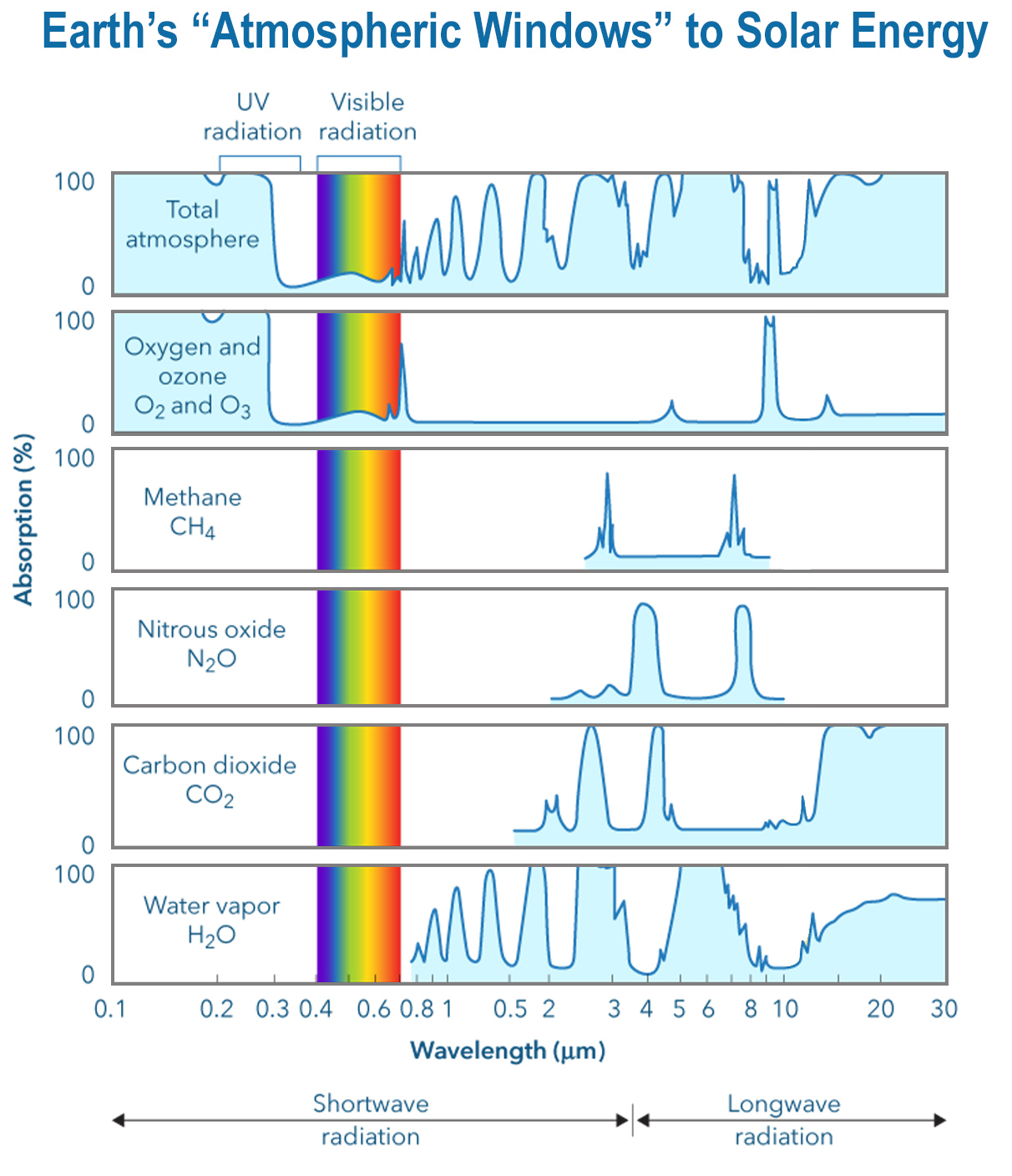
Visible light passes through the atmosphere, gets absorbed by the ground, and then re-radiated at infrared (IR) wavelengths. Atmospheric gases like water vapor, methane, and CO2 cause a certain amount of that IR light to shoot in every direction. So a portion of inbound solar energy gets trapped bouncing around inside the atmosphere for a while before it finally makes it out.
Basically the greenhouse effect is the sky glowing in infrared in addition to blue. We can’t see infrared, but we can feel it with our skin. It feels like warmth.
Actually, I liked it so much that I went to the homepage of the blog, only to find out that this is the only article. Oh well... I hope there will be more to come!
(I will almost certainly do one on quantum mechanics, but that's such a big explanation that I want to do some simpler ones first)
Also, if you took a sufficiently large quantity of air and put it into empty space and shined very bright white through it, it would experience rayleigh scattering—-meaning that air, when you have enough of it and shine a bright enough light through it, is blue.
Color is a property something has under certain conditions, it is not a property of what that something is under all conditions.
Because it's the color of the atmosphere, specifically nitrogen and oxygen! It's technically correct to state this.
Gasp! But aren't nitrogen and oxygen usually described as "colorless"? Well, yes but... If they were perfectly colorless, the sky would be black. It's technically more correct to describe them as nearly colorless and very slightly blue. Very slightly because you need to see through kilometers of atmosphere to perceive the blue. It doesn't matter if the color is caused by absorption, or reflection, or (Rayleigh) scattering of certain wavelengths. The "color" of an object is simply the color you perceive with your eyes. If you perceive blue, it's technically correct to say its color is blue.
It's like saying plants are green because green is the color of chlorophyll. And in the case of chlorophyll, the color is caused by absorption not by scattering. But the physics is irrelevant. Green is its color.
Q: But sunsets/sunrises are red & orange not blue! A: the simplest answer is: color of an object can change under different light conditions. Specifically in this example, when seeing the sun through not kilometers but hundred of kilometers of atmosphere, all the blue-ish wavelengths have been scattered in random directions so only the red-ish wavelengths remain, thus the atmosphere is illuminated by progressively redder and redder light as the photons travel longer and longer distances through the atmosphere.
You can conceptualize Rayleigh scattering exactly like you did so it doesn't conflict with my explanation: as light hits the "surface" of nitrogen and oxygen molecules, it "reflects" (scatters) blue wavelengths.
Did English speakers say "this novel reads well" two, three hundred years ago?
Debates whether to update the sidenote with an explainer on ambitransitive and labile verbs
For the first person there is 'listen' (or 'hear'). Does English not have a corresponding word for the third person ?
What about Germanaic or Nordic languages ? Do they have a third person analogue of 'listen' ?
> Listen the watchman’s cry upon the wall.
Edit: formatting
"Show" work for any sort of visual thing you might want to present to someone. It's a bitransitive verb: it takes both a direct and indirect object in addition to the subject:
    "Bill showed Marsha her new car."
     ^^^^        ^^^^^^ ^^^^^^^^^^^
     Subject     D.Obj  Indirect Obj.
    "Amy told Fred a story."
    "Bill played Fred a song."
There is also "audition" which can be used transitively, but I don't think it works bitransitively. You can say "I auditioned a bunch of saxophone recordings.", but you can't audition something to someone.
If something "carries" or is "a carry", it means it is so strong it metaphorically carries the rest of the setup with it. For example:
> This card carries.
> These two are the carries of the team.
The bell rang should become The bell was rung, either way it means The bell rang another bell.
"the bell rang" illustrates an effect (the vibration and sound of the bell as it rings).
i think this is more an illustration of the ambiguity of the root word "ring", which can be an action by a subject upon an object, or to describe the behavior of the object itself.
In "shrimp fried rice", "shrimp" is a noun adjunct [1], which is when you use a noun as an adjective.
The charming ambiguity comes from it being unclear whether "shrimp" is an adjunct noun modifying "fried rice" ("shrimp fried-rice") or modifying the past participle verb "fried" ("shrimp-fried rice").
If you took a large column of air into space and shined white light through it, it would be blue.
Green + Red = Yellow
Red = Red
That is the natural transition from overhead sun to sunset as each higher energy wavelength gets cut off more and more. When blue is mostly gone and green starts to fade we call it the Golden Hour.
Mid-day sun in a clear sky is very white, in the 5k-6k color temperature range. It's hard to get a sense of how white it is because of how bright it is. In fact, the color temperature on the surface can be even higher than in outer-space!
Compare this to a "warm" light bulb, which is around 2.5K. Sunrise/sunset is also around that range.
Perhaps the "warm color" sun mindset comes from the only times that people can look directly at it. That is to say, around sunrise or sunset.
(I'm going to skip over some basic stuff, and use some generalities)
Each Cone in the eye responds to a range of frequencies. This means that things that unless it's on the extreme low, or high, end of the frequencies that the human eye can discern you are going to have two, or all three, Cone types responding. The strength of those responses is what your brain uses to interpret the color that you see.
The real problem is that out in space there is no attenuation of sunlight, it's bright. Super crazy bright. It basically overloads all of your Cones, and Rods, all at once, there is no way for your brain to find a signal of "oh there's more higher wavelengths here so interpret bluer than normal" because all of the signals got maxed out. If you max out all of the signals, you get white. It doesn't matter that in absolute terms there's more blue, the lower and mid frequencies are also maxed out.
On Earth, the sun's disc at noon appears yellow-ish due to being white minus some blue light scattered away by the atmosphere. But there is also the rest of the sky illuminating the ground, as you can still easily see in shadowed areas. That is blue light from the sky hemisphere.
It very approximately adds back up to white overall for something exposed to direct sun and the whole sky, depending on the sun's position in the sky.
That would be understandable but it’s not what’s going on: http://hyperphysics.phy-astr.gsu.edu/hbase/Chemical/watabs.h...
No, not really- the limitation is chemical, not evolutionarily-driven. Earth is very well lit in infrared, but it's very difficult to make a chemical that is biologically useful for seeing infrared because the wavelengths are just too long. Its very challenging to do more than the most primitive kinds of sensing in infrared. If our sun was much dimmer, we would probably be blind, but if not our eyes would still not see in far infrared. Same goes for ultraviolet- the energy is too high and molecular bonds are too weak. Seeing in visible light is a reversible reaction, but ultraviolet wouldn't be.
What you're saying is true of ocean animals, especially in the deep sea. They don't see red very well or at all, but the evolutionary pressure against seeing red is not terribly high except very deep where food is very limited.
There also is evolutionary pressure on our vision, but it has nothing to do with the sun. We're twice as sensitive to green since it is so common and important, but green comes from photosynthesis and not from the color of the sun. In a way, we are most sensitive to the least important color of light- the color that is not absorbed by plants. The wasted, useless byproduct of sunlight is what lets us identify food.
Plus, we actually basically only see in blue and green. The overlap between rods and red/green cones is huge. "red" and "green" as we perceive them are mostly fabrications of our neural circuits- if we were seeing them how our photoreceptors actually receive light, all shades of green/red would be very strongly mixed together. All shades of red would look significantly green except for the very farthest reds, which would look very dark because of low sensitivity.
Same outcome, but for a different reason!
I have clarified what I am looking for in a cousin comment.
(I agree that just going on about Rayleigh scattering is probably overly obtuse: at least not without explaining that scattering is part of how color is formed in the first place. But it's also not just a case of 'well air is blue like apple juice is orange')
30 years ago, just finding those articles would require spending many hours in the library (and that's if I'm lucky and the library has them).
It's definitely not just cat videos.
Isn't that a better world than one where the ringtones were free?
> Well, the thing is that the educational materials are largely free.
A triumph and fruition of these last decades of massive effort. Now we just need to deal with their quality (with commercial as bad as free). AI may help, by reducing barriers to content creation - you might for example, now more easily author an intro astronomy textbook, one that doesn't reinforce top-30 common misconceptions, something the most used (US; commercial) texts still don't manage.
Gen Z grew up with Mr Beast
We are proper doomed mate.
(but sort of like chromophores in an octopus or cuttlefish, perhaps).
I can 'show' (or point someone to a) a sight that I am not myself creating in anyway. The word I am looking for would mean to 'make you hear' in the same may to show is to make you see.
I showed him the distant tower.
I ??? him the faint sound.
The model the article describes is:
1. The sun puts out a bunch of light.
2. Light that is lower-energy than blue light fails to be effectively scattered by the atmosphere, and follows a path from the sun to you.
3. Light at the levels of blue and up is effectively scattered by the atmosphere, and comes to you from a random direction.
So if you look toward the sun, you receive light that has been depressed of its blue-and-up wavelengths, and the sun appears to be yellow. If you look away from the sun, you receive light that has been enriched in blue-and-up wavelengths, and the sky appears to be blue. Crucially, the sky looks blue because it is sending you more blue light than the background level.
A cloud that isn't between you and the sun is getting its light from the sky background, which is blue. Why is the cloud not blue? It can disperse all the light it receives evenly, but that light is enriched for blue-and-up wavelengths.
The background level is black! No air, no scattering. d > A cloud that isn't between you and the sun is getting its light from the sky background, which is blue. Why is the cloud not blue?
The cloud is bathed in intense, direct sunlight which is slightly yellow, and it is exposed to a small amount of scattered blue light. It could be that this mixture whitens the color, essentially reconstituting the light.
Why does white paint look pure white? Or snow on the ground? Same reason. It's reflecting the sky blue in a small amount, plus the yellowish sunlight.
If you are in a dark enclosure like a cave or barn, and sunlight is streaming in through a small aperture, if you hold some white object up to that light, it doesn't look the same as if you do that outside because it's not illuminated by the blue sky, only by direct sunlight.
Moreover, the shadowed parts white object sitting outdors, exposed to sunlight. tend to be tinged with blue.
By "the background level", what I mean is the emission spectrum of the sun.
(And by "more blue", I mean in a relative sense, not an absolute sense.)
1. Imagine a conceptual sunbeam originating from the sun and passing through the sky high over your head.
2. This sunbeams low-frequency components ("reds") continue on in their straight path, making them invisible to you.
3. The high-frequency components ("blues") are scattered by the atmosphere, going in random directions. When you look at the sunbeam, you can see these scattered blues, making the sky blue.
4. A cloud floating up in the atmosphere is illuminated by some direct sunbeams, which are "red".
5. It's also illuminated by the scatter from the atmosphere, which is "blue".
6. Do those two sources balance out exactly such that the light exiting the cloud has the same profile as light exiting the sun?
We don't have this because common ancestor for all mammals lost all cones but one, perhaps due to being nocturnal, and a second was re-evolved as mammals became more dominant (after dinosaur extension). A third cone was evolved in primates due to a gene duplication that gave us our green cone
https://www.sciencedirect.com/science/article/pii/S004269890...
Only a few on record but they tend to have absolutely insane color matching and color perception. One of note worked in the fashion industry and could match fabrics perfectly even in varying lighting (e.g. working under fluorescent but able to match colors that would stay matched in halogen/stage lighting)
There’s a Greg Egan short story (I think it’s ‘Seventh Sight’) where a bunch of formerly blind kids with cybernetic eyes hack the receptors to respond to wavelengths other than the traditional RGB. So perhaps it wont take millions of years.
The one bit I explored was 'what color is the Sun (the ball)'. Asking first-tier astronomy graduate students became a hobby, as most get it wrong (except... for those who had taken a graduate seminar covering common misconceptions in astronomy education). So I libgen'ed the 10-ish most used intro astronomy textbooks in US according to some list. IIRC, it broke down roughly into thirds of: correct (white); didn't explicitly say but given surrounding photos, or "yellow" (as classification without clarification), there's no way students won't be misled; and explicitly incorrect (yellow). Hmm, bulk evaluation of textbooks against some criteria is another thing multi-modal models could help with.
(A musing aside re AI for systemic reviews. Creating one is a structured process. They have been very manpower intensive, so they aren't refreshed as often as is desired, nor consistently available. And at least in medicine ("X should be done in condition Y"), there's a potential for impact. I imagine close reads of papers isn't quite there yet. But maybe a human-AI hybrid process?)
[1] https://www.per-central.org/items/detail.cfm?ID=14009 [2] https://web.archive.org/web/20070209033543/http://www.physic... [3] appendix A of https://digitalcommons.library.umaine.edu/etd/2200/ [4] https://www.oranim.ac.il/sites/heb/SiteCollectionImages/pers...
> Systematic reviews are rigorous, transparent, and reproducible research studies that synthesize all existing evidence on a specific topic to answer a focused question and minimize bias. Unlike narrative reviews, they use predefined eligibility criteria, comprehensive searching, and critical appraisal to evaluate primary literature, often employing meta-analysis for quantitative results. [goog ai overview, edited]
Not answering this question but I found an interesting short paper about how at sunset and sunrise the color gamut of shadows doesn't fully overlap with the direct illumination color gamut due to the differences in the paths the light takes:
Hubel. 2000. The Perception of Color at Dawn and Dusk.
https://library.imaging.org/admin/apis/public/api/ist/websit...
Some reds look like brown. I hate reds. I’m not sure about the Pantone-like color matching but I definitely see different colors than most people. To the point where my flight license is restricted.
Dichromatic but not trichromatic.
I have no idea how to test it. But in my heart I know that screens with RG, GB or RB color models would suck enough that any screen addiction would be cured instantly.
1 axle.
1 wheel.
1 bundle.
100 boxes of ammo.
10,000lbs of bear meat.
2lbs of squirrel meat.
We sank like a rock.