Europe's $24T Breakup with Visa and Mastercard Has Begun(europeanbusinessmagazine.com) |
Europe's $24T Breakup with Visa and Mastercard Has Begun(europeanbusinessmagazine.com) |
23% of people in Poland, assembled luggage in case of war. Yet EU is still buying russian gas and oil.
and they don't have permissions to military to pass through in case of help from country to country
I hate having to use visa or mastercard when better options exist but the solution is to allow competitive solutions and make surcharge mandatory so customers bear the cost of their payment choices.
In the begining of this year, they basicly banned EU merchants from using confirmo (crypto payment gateway), when it was finally getting traction.
Will it be accepted in hotels abroad? Can i withdraw cash at ATM abroad? Can i add it as a card to my Google wallet?
Usually banks app are nightmare. Pins everywhere, extra passwords. MFA not with my dongle....
Sigh.
Seriously, I have had no issues with visa or mastercard. This euro-nationalism is odd to me.
Oh! That's exactly what we all needed - 16 banks suggest their own "system", even more crude and clumsy imitation of the surveillance standards of payment systems and marketplaces, which shielded banks from snitching clients' consumption patterns.
They don't need anything advanced like Apple Pay layered tokenizations that at least respects a little of privacy. Everything is linked to a single phone (the article states that the focus is on Bizum and those pathetic peer-to-peer payment systems). The banks are in good shape to capture data, the tax authorities have a clear picture of how to squeeze the plebs even more - nice.
How about stablecoins with native yield from ECB treasuries? It solves everything and costs nothing. But we see what happens in US - "treasuries spread is not for plebs", - banks say.
I am also about to score life time golf status at one of the airlines. Yes thank you
Now, what will happen in the UK.
I have a recent background as a member of the Senior Management of one of the largest banks in Europe (8 years stint).
I worked in IT - and build the only successful platform for financial services done in-house and to ever make it as a standard not because management tried to force people, no because it solved customer's problem (external and internal customers aka employees).
I don't buy any of these EU is going fully independently. EU's IT isn't capable of doing this. No way ever ever.
I will 100% of the time bet against it. I saw so many things, experienced so many things - and no way is there anyone out there in Europe who to this day simply can acknowledge and appreciate the marvelous work and evolution that for example Google took or any other startup to leading global business like Apple, Facebook, Microsoft, Amazon and so on.
Even IBM's mainframe: if you do not understand the very problem they solve - don't talk about "independence from X".
There is no successful startup from Europe, that has any results like the mentioned. All have to do with IT, all went from idea to what they are now.
And Europe now wants to do what?
All my fellow European's here boasting around: I feel sorry for you. All the "Let's build our own Google" (Google search) folks that predated the other independence stories like this here simply disqualify themselves the moment the say out loud such sentences.
Read 5 books about Engineering at Google, read the HTML5 spec by searching for Ian Hickson, go to the Computer History Museum in Mountain View, CA - and tell me that EU is going well in IT independence in taking a totally different approach, ignoring every and any circumstance and context the mentioned companies had, using design by committee, state dictated orders, establishing standards by enforcing them by law instead of evolution and being the best there is.
Good luck, we will see how it went.
And no, building something that looks somewhat okish from the outside, but is utterly crap inside - we talk about, excuse me my corporate language I was penetrated with, "best in class world leading number one" apps that leave any comparable solutions in the dust - just as Google, Apple, Microsoft etc. did.
If you cannot win in free markets - you declare victory by misusing regulation. That's cheap and well, socialism.
All of you will beg that all the systems and providers will still do business with you after years of trashing them.
Are Mastercard etc. awesome? Are they objectionable? Of course - but trashing them, boasting you will easily beat them while having the double standard on relying on them freely is disgusting.
All EU patriots: Throw away your iPhones, deinstall all the US apps - use at least existing Open Source alternatives. Cancel your Netflix, Microsoft Office subscription - do it.
Good luck anyway. After all, you are doing a live experiment on the head of the people forced to live with a minorities decision.
/s
Visa/Mastercard are the biggest evil. Why do you think Trump got pissed at Brazil having its own payment system without Visa/Mastercard network deleting billions in revenue from Visa/Mastercard
The problem major problem is already mentioned: Each EU country wanna have their own independent system. Nothing prevent the countries from doing that but it must talk within the same payment network so people in the Netherlands can buy from Italy using their own payment system.
Own payment system is different than payment network :)
Of course, what could go wrong!!
Unbelievable, a chance to make a whole new standard, new system, new everything, but yet we still have the need to tie it to ancient protocols, only to find later it’s broken by design and we start adding all sort of duct tape solutions to make it “secure”..
This is either a completely and entirely stupid move by some boomers living in the 80s, or maybe, it’s intentional to enforce something insecure like a phone number/GSM as a “national ID” to easily track citizens and force them to have a phone number linked to their real life, and I think it’s the second one, the same reason why many “secure” chatting apps still require a phone number.
It's also more convenient than giving out an opaque UUID to your friend to transfer you money or something similar.
The bigger problem I see with this is it being one more service locked exclusively to Android and iOS devices, but it's the same with most currently used banking apps anyways.
After you provide your gov ID
https://www.comparitech.com/blog/vpn-privacy/sim-card-regist...
So now this phone number is tied to your gov ID and bank account, amazing design of a single point of failure based on a broken protocol (GSM).
Not to mention that some of the alternatives are owned by a consortium of... European banks.
And the SIM registration requirement in nearly every EU country exists for 10 years now - in my case it was as simple as replying with code to operator's message because they had my personal information already for over a decade. There was a grace period after which unregistered SIM cards become dead - the requirement was dubious but you had to comply in order to call, text. There were "solutions" I've bumped on in depths of the Internet but neither felt serious nor safe.
I could get it without an ID and my (EU member) country is painted green/blue on those maps in your source. I always love it when people from abroad try to tell me how things work in my country, when they clearly have no idea.
Amex acceptance is lousy for a reason
Card and cash users alike.
> Well, either the US or China.”
> The host’s response — “I didn’t realise this” — captured the broader European blind spot.
People have been firing warning shorts for years. It is not a blind spot. It is just being ignored.
Not part of US not part of EU either.
what a losing proposition.
if it can be a card network with fraud protections that visa offer -- this will easily overtake Visa, Mastercard
Brazil with Pix have already proved this.
Not necessarily
If we can have visa and MasterCard while not being part of the US, we can potentially take part in whatever the EU creates
Terrible store of value(worse than bitcoin) Horrible International transaction fees(swift much worse than bitcoin) Most money laundering and criminal activities happen in the current banking system.
We rode on USA infra for too long. Europe is full of "managers".
When China and Russia have their own pay systems, why not EU?
As long as all the other cards still get acceptance, this seems like a great system.
> The Wero app can be installed on any mobile device or tablet running iOS 16 or later, or Android version 9 or later. We recommend updating your device to the latest version of its operating system for maximum performance, convenience and security.
> It is not possible to use Wero via a web browser or on a computer.
Your comment is of course downvoted
1. You first need to install an app (because you want to use tap to pay)
2. Then you need to download another app to authenticate the first app
3. But to set up the 2nd app you need to wait for an actual physical mail which contains a code.
4. Then you set up the 2nd app, but then again it asks for you to do a KYC using your Id Card.
5. Now you need to download another app to do the KYC using your Id, but it asks for another code which you receive by physical mail when you got your Id years ago, but you have no idea where that mail or code is, now you have to request for another code and wait like 2 weeks till you get a physical mail with that code....
.... and the story goes on.
I guess France and Germany are siblings in kafkaesque administrative shenanigans.
Why a subset of the EU and of Europe?
The fact that EU sees dependence on American tech in the same way as Russian oil now is saddening and telling.
Americans and American companies had it really good - our tech extracted money from the world, and they were mostly willing to pay for it. And it was an incredible advantage to the US.
But now, it seems that we are happily throwing all that away, for what benefit I do not yet see. Regardless of whether this effort succeeds, why stoke this fire at all?
I would say I hope Americans realize what they’ve done by making their own companies enemies of the world at large, but I’m not holding my breath for any sort of self reflection.
Though at least in Germany we have "girocards/EC-cards" that are not owned by Visa/Mastercard. Some banks are phasing them out in favor of a Visa/Mastercard debit card.
So maybe this is just an attempt to make Wero a bit stronger in comparison to PayPal. AFAIK Wero does not replace a credit card.
all of this infrastructure Europe claims to want to build will take many many years to realize, particularly at the relaxed European pace. trump will be out of office by the time the EU has held it's fifteenth planning meeting to issue it's first strongly worded letter of intent.
America was called an "enemy of Europe" (before the Greenland stuff) even though it was more generous towards Ukraine than a bunch of European countries, and essentially every country outside of Europe. Polls showed that China has higher approval than the US in Europe, despite the fact that China actively supplies war material to Russia. Again, this was before the Greenland stuff (I'm against that obviously).
There's no point in trying to please these people. They regard us as a vassal state. They're not joking when they say they think of Americans as idiots. We should've withdrawn from NATO a long time ago. Hopefully Europe's corporate boycotts will help to pass Massie's withdrawal bill.
It will also be interesting to see drug prices in Europe rise after the Europeans spent years making fun of the US for high drug prices. https://marginalrevolution.com/marginalrevolution/2026/02/tr...
The Europeans tend to reap what they sow in the US/Europe relationship.
https://en.wikipedia.org/wiki/NATO_bombing_of_Yugoslavia -- another offensive "humanitarian" action
By withdrawing from NATO and pulling our military bases out of Europe, it becomes more difficult for the US to "intervene" in the Middle East at the pleasure of Middle Eastern interests.
Furthermore, if Russia invades more countries in Europe, I don't want the US to "intervene" with yet another "humanitarian" operation.
We can slash the size of our military and spend that money at home on healthcare, debt reduction, etc.
and you said China actively supplies war material to Russia. but in early 2025, China’s top UAV export destinations were Hong Kong, the Netherlands, and the United States, https://www.airmobi.com/from-billion-dollar-orders-to-global... why Netherlands need so many UAV? That's why polls showed that China has higher approval than the US in Europe.
Furthermore, Europe has very little soft power in the US at this point. There's no region of the world I am less interested in helping. With every post I read from you guys, I understand more and more why my ancestors left that place. Think of it this way: We need to reallocate money away from our military, and towards our healthcare system which you guys are always making fun of. Does that help make my point clear?
As a user named raven12345 stated:
>Is there any doubt that a country that hasn't fought a war in decades is more popular than countries like the US and Russia, which are constantly at war?
We in the United States need to stop involving ourselves in so many wars. Plain and simple. You said it yourself.
>So why should they care about competition between China and the US elsewhere?
Where did I say that? I don't want the US to be competing with China. I'm an isolationist. I prefer a Swiss approach to foreign policy for the United States.
>That's why polls showed that China has higher approval than the US in Europe.
So we need to drop sanctions on Russia, like China has done, so that the Europeans will like us more?
"...companies — possibly with the tacit approval of customs authorities — have also engaged in classification fraud, concealing sensitive goods under misleading labels. In addition, some shipments are routed through third countries to disguise their final destination in Russia. By continuing to publish detailed customs data, Beijing openly signals its disregard for Western trade sanctions against Russia. But the data reveals only what China chooses to make visible — and it remains unclear what volume or categories of trade may lie beyond the published figures."
https://kinacentrum.se/en/publications/china-russia-trade-in...
"To help prevent a further deterioration of Russia’s economy and defense industrial base, Russia has leaned heavily on China. China-Russia trade reached nearly $250 billion in 2024, up from $190 billion in 2022.46 China has been Russia’s top trading partner since 2014, with its share of Russia’s foreign trade increasing from 11.3 percent in 2014 to 33.8 percent in 2024.47 In addition, Russia relies on oil exports to China, which now make up about 75 percent of China’s imports, compared to a pre-2022 average of between 60 and 65 percent.48
In the defense sector, China has significantly increased exports to Russia of “high-priority items,” a set of 50 dual-use goods that include computer chips, machine tools, radars, and sensors that Russia needs to sustain its war efforts.49 While Russia lacks the capacity to produce many of these goods in sufficient quantities, China’s massive manufacturing sector can produce a number of them at scale.50 Chinese exports helped Russia triple its production of Iskander-M ballistic missiles from 2023 to 2024, which Russia has used to pound Ukrainian cities.51 In addition, China accounted for 70 percent of Russia’s imports of ammonium perchlorate in 2024, an essential ingredient in ballistic missile fuel.52 China has also provided Russia with drone bodies, lithium batteries, and fiber-optic cables—the critical components for fiber-optic drones used in Ukraine, which can bypass electronic jamming.53"
https://www.csis.org/analysis/russias-grinding-war-ukraine
Contrast the $250 billion Russia/China bilateral trade figure, with the $146 million worth of drones which the Netherlands imported from China. Like comparing an apple to a grizzly bear.
$146 million is also fairly tiny compared with the $60 billion worth of weapons that Europe bought from the US over 2022-2024: https://www.iiss.org/online-analysis/military-balance/2024/1...
When you buy weapons from the US, it's a worrisome dependence on an evil warmonger. When you buy weapons from China, it's "yay we are buddies with China now". See why I've had enough of your "friendship"?
For years, Europeans have sharply criticizing the United States for sometimes partnering with authoritarian countries. It's fascinating to see the rapidity of your reversal: how eager you now are to partner with China, an authoritarian country which happily trades with Russia. It goes to show that this "don't partner with authoritarian countries" stuff is just disingenuous virtue signalling.
Unless you have already prescribed to the acceptance of big countries swallow the small ones at whim, it is not only our problem. Also Russia gaining control means often the USA loosing.
> Why don't you ask your new friend China for help?
Who said China is the friend of Europe? The USA has become a new unpredictable adversary, while China is an old enemy. Human nature is just to choose certainty over uncertainty even if that is actually worse.
> We need to reallocate money away from our military, and towards our healthcare system
I don't think EU countries have a problem with that. They rather complain, that you are currently allocating money to a military, that wants to attack EU states and to a para-military that attacks USA citizens.
> So we need to drop sanctions on Russia, like China has done, so that the Europeans will like us more?
It is that China is seen as evil anyway, so nobody expects them to sanction Russia for real, while we didn't saw the USA that way.
> For years, Europeans have sharply criticizing the United States for sometimes partnering with authoritarian countries.
You don't criticize enemies, you criticize friends. I think the criticism also was more that you create authoritarian countries, partnering was also done by European nations, that's called realpolitik.
The US is a big country. Why would it be affected by a problem of big countries swallowing smaller ones?
The Europeans always argue that the US only acts in its self-interest. But then when they explain why helping Europe is in the self-interest of the US, they always have the most nonsensical arguments.
>Also Russia gaining control means often the USA loosing.
I favor a policy of neutrality and world peace, not rivalry between major powers like the US and Russia.
>It is that China is seen as evil anyway, so nobody expects them to sanction Russia for real, while we didn't saw the USA that way.
Why is China more popular than the US in European opinion polls?
>You don't criticize enemies, you criticize friends.
That doesn't make any sense, you criticized Russia plenty. Furthermore, European "criticism" of the US is far too mean-spirited for it to be plausible that you are our friend. (That's been true for decades.)
>I think the criticism also was more that you create authoritarian countries, partnering was also done by European nations, that's called realpolitik.
Interesting how "realpolitik" can be used to explain European behavior but not American behavior.
It's always the same double bind. If we are involved, we're called imperialist. If not, we're called complicit. There's no way to win.
Because of less trading partners? Because supply chains exist? Because big evil empire is still better than bigger evil empire that is also a neighbor? Because treating problems when they are "small" is less resource-intensive then when they have grown? Because you have military-bases in these regions that you use to project power across the world? Sorry, but don't say you don't find them useful. If you wouldn't have a use for them, you wouldn't use your software power and money to maintain and them. Europe has long appeased the national interests of the USA as inheritance of the world war two, which like you say has also raised reluctant opinions.
> they always have the most nonsensical arguments.
Do you seriously think, that globalization can let you reap the world as a cash cow, but aggression, war and destruction in a not so far part of the world, even if it is no longer your ally, won't affect you?
> Why is China more popular than the US in European opinion polls?
I already addressed exactly that:
>> The USA has become a new unpredictable adversary, while China is an old enemy. Human nature is just to choose certainty over uncertainty even if that is actually worse.
It is just not known what the USA are going to do in the next 10 years. From slippery-slope to an open alliance with Russia to do a Polish-style division of Europe and America, over war with China to actually having midterms and a 180° turn in policy, all seems possible.
> That doesn't make any sense, you criticized Russia plenty.
While believing to have some power via financial ties. Now it's back to formal complaints and deadlines.
> European "criticism" of the US is far too mean-spirited for it to be plausible that you are our friend.
From the European viewpoint the criticism on the US administration is what would be also in the interest of the US populace. The US electorate of course begs to disagree, they elected Trump after all. Sorry, that protesting against expansion of corporate and state surveillance, influence of the military industry conglomerate and erosion of worker and environment regulation offends you personally. I fail to see how that is mean-spirited.
> That's been true for decades
The same criticism has existed for decades, but the official policy has stayed the same for a long time, namely that supporting "our" camp in world politics is worth compromising on international law, human rights and national security interest.
> Interesting how "realpolitik" can be used to explain European behavior but not American behavior.
It literally just used the word to explain American behaviour.
None of these arguments make much sense.
>Because treating problems when they are "small" is less resource-intensive then when they have grown?
I don't think it is a problem for us either way. No one is going to attack the US.
>Because you have military-bases in these regions that you use to project power across the world? Sorry, but don't say you don't find them useful. If you wouldn't have a use for them, you wouldn't use your software power and money to maintain and them.
The US has made many mistakes in its foreign policy. I've made my opinion clear on that. Just because we did something in the past does not make it a good idea.
>Europe has long appeased the national interests of the USA as inheritance of the world war two, which like you say has also raised reluctant opinions.
Well you'll be glad to stop then.
>Do you seriously think, that globalization can let you reap the world as a cash cow, but aggression, war and destruction in a not so far part of the world, even if it is no longer your ally, won't affect you?
Tell that to the Swiss.
American soldiers should not die due to European ineptitude. There were only 2.5 years between Pearl Harbor and D-Day. Russia invaded Ukraine almost 4 years ago. If you truly believed this was an existential threat, then you've had plenty of time to prepare.
>It is just not known what the USA are going to do in the next 10 years. From slippery-slope to an open alliance with Russia to do a Polish-style division of Europe and America, over war with China to actually having midterms and a 180° turn in policy, all seems possible.
How about you respect our ability to determine our own foreign policy, and take responsibility for your own issues? As I said, stop treating us like a vassal state and telling us you know what is best for us (as you do in your comments). I'm not the only one who notices you doing this: https://substack.com/home/post/p-158145261
Look at this argument I had the other day... a European spent a bunch of time condescending to me, and wasn't able to muster a single factual argument in favor of their position. This sort of thing is very typical in my discussions with Europeans: https://news.ycombinator.com/item?id=46742363
When Elon Musk endorses parties in Europe, Europeans complain he is interfering in their politics. The trouble is that Europeans have been doing the same in US politics for a heck of a lot longer. It's always the same patronizing and ignorant interference, based on a caricatured view of the US: https://www.noahpinion.blog/p/eurocope "Haha, Americans are dumb. Haha, Americans die in school shootings. Haha, the American healthcare system sucks." All along, we've been deterring Russia for Europeans, and now as a result, Russia is working to destabilize the US (according to another commenter in this thread). I'm sick of it.
Think of it this way. I want out of NATO, so as to reduce the influence of the evil "military industry conglomerate". Just like you yourself said, we need to reduce its influence -- which means reducing our military size and commitments. Get it? I'm just taking your arguments to their logical conclusion.
> US foreign policy analysts think that every issue is the next WW2
If "US foreign policy analysts" would actually think that these situations might lead to the next WW2, then you wouldn't counter them with destabilizing countries, that leads to the rise of extreme parties and then treating them with ignorance. Because THAT is exactly how WW2 happened.
> If we are involved, we're called imperialist
Deploying the military is not the only way to get involved.
> It's always the same double bind. If we are involved, we're called imperialist. If not, we're called complicit. There's no way to win.
If other countries say that has bad consequences, you deploy the military, if they say we need your help here, you turn the blind eye. I mean you are a sovereign country and can do what you like, but you do it, because your administration thinks that is a good idea, not because all the other countries would tell you to. You frame it like other countries called for action and you did them and now they complain. No, they told you they won't like that, and you did it either way.
Nope. Just the opposite. The reason the US did regime changes during the Cold War was because we were paranoid that communism would affect us. We need to be less paranoid.
>Deploying the military is not the only way to get involved.
Doesn't matter, we're called imperialist however we choose to get involved. Ever heard the term "neocolonialism"?
>If other countries say that has bad consequences, you deploy the military, if they say we need your help here, you turn the blind eye.
Even when US military action is requested or approved of by people in the country, we're still called imperialists. Consider the war in Vietnam. The South Vietnamese were attacked. We came to their aid for some time. They kept fighting after we left. Yet this was still described as "neocolonialist" activity on our part. That's how our actions are always described.
I was more thinking of "post" Cold War interventions.
> Doesn't matter, we're called imperialist however we choose to get involved. Ever heard the term "neocolonialism"?
Yes. The US isn't alone in that situation. The EU is described as neocolonialist in the same way. Personally I think that is stupid and we shouldn't have let us be influenced by that. Now Europe stopped being "neocolonialist" and the Chinese has taken over that role in Africa. Now it's much worse both for us (EU) and for Africa. Great.
> Consider the war in Vietnam.
Honestly I wasn't alive and don't know the public opinion of that time. I basically only know it from history class. The rough sentiment is that the French messed up and the US has payed for it. It's true, that some actions in the war are portrayed as bad, most famously Agent Orange, but I think the war in total isn't blamed on the US.
> That's how our actions are always described.
Reading the other thread you linked, I think you have a worse view of the public opinion of the US then it actually is.
> I favor a policy of neutrality and world peace, not rivalry between major powers like the US and Russia.
> Russia should use its special services within the borders of the United States and Canada to fuel instability and separatism against neoliberal globalist Western hegemony, such as, for instance, provoke "Afro-American racists" to create severe backlash against the rotten political state of affairs in the current present-day system of the United States and Canada. Russia should "introduce geopolitical disorder into internal American activity, encouraging all kinds of separatism and ethnic, social, and racial conflicts, actively supporting all dissident movements – extremist, racist, and sectarian groups, thus destabilizing internal political processes in the U.S. It would also make sense simultaneously to support isolationist tendencies in American politics".
In other words, they want an endless line of Donald Trumps to ruin your country and turn it into a banana republic so that you wouldn't have the energy to pay attention to Russia stomping over the rest of the world.
Why would any American voluntarily choose this fate?
None of this would've happened if we had avoided imperialism post-WW2.
"mopsi" stated how you going isolationist and stuck in domestic struggles, is following Russias plan. So no, the current state of the US results in you stopping to
> "contain" Russia and protect Europe through NATO.
So this is what the EU complains about and tries to tell you: you follow Russians plan and that can't be in your best interest. (Not that the EU would be free from such interests either.) Do you think Russia would leave you alone when there plan succeeded? That would be the biggest success of Russian policy since 1945. When they can get you from the major world power to being a isolationist country with domestic struggles, why would they stop?
> None of this would've happened if we had avoided imperialism post-WW2.
I think you need to define terms here. What exactly counts as "imperialism post-WW2" and what not? I mean the arms race let to the collapse of the soviet union, so I guess until to the 90s it went pretty good for the countries part of the "First World".
If you wouldn't have stayed in Europe after WW2, the USSR would have reached to the Atlantic. And no not just in 1945, they also tried that in the 50s and continued to want that. Not sure, if you already know, but Putin was in prison in Germany in the 90s for trying to topple the German government and his goal was to expand the "Soviet/Russian" empire to the Atlantic. He was already ~40 and has served in the KGB before, so I guess he hasn't changed his opinion since.
The current deteriorating state of the US is the result of departure from the previously held values and forms of cooperation. Nothing illustrates this better than the US president openly threatening the sovereignty of Canada and Denmark while accepting massive bribes from Arab sheikhs and calling genocidal dictators like Putin his "friends". This is the wet dream of people who want to see the US fail.
Why would any American want to hit the gas pedal and accelerate even further down this road?
Last August US threatened tariffs on Brazil over their Pix system. One of the reasons given was that people using Pix instead of credit cards deprived Visa and Mastercard of fees.
Just a correction: the US imposed those tariffs. Threatened too, I guess, but the Orange Man did more than that.
It's not as much about replacing Visa/Mastercard, as it is about plastic card technology becoming obsolete, and the duopoly failing to react to the market because of corporate inertia. Had they created a modern online payment system, Wero would never take off.
As an european, I'm for all the european tech stack funding projects going on, but I'm also glad we move on these other issues without waiting forever.
One not-so-fun fact is that when the US sanctions anyone, their ability to transfer and use money via Visa etc. is taken away. In the modern world, being cut away from even using your debit card is a huge, massive hassle.
It is one of the many different ways being sanctioned makes life more difficult. I can't imagine the US being too keen on giving up those powers.
You'd add a lot of technical complexity, especially if you need this to be instant. You'd loose the ability to effectively fight fraud, and because of this get a huge target on your back attracting all sorts of unwanted behavior.
On the other hand, you'd gain... nothing? Especially since consumers cannot be expected to run their own blockchain stack, they'd need to fully trust their banks and intermediaries anyhow.
Money would go directly bank-to-bank, nothing in the middle.
If the government is going to act irrationally and (through visa/mc) prevent legitimate transactions then people will just deal with fraud.
Even if Europeans agree with the DLsite ban they see the writing on the wall for European eCommerce sites.
The article briefly touches this point but dismisses it saying wero and the digital euro complement each other, but doesn't go into detail on how. I see no point in a privately run digital currency when we can have a public one. I guess whichever has good privacy, reliability, ease of use and speed will win.
(but it probably won't ever happen, because banks are lobbying against it with FUD campaigns, they feel like it threatens their existence)
Wero is something completely different. It allows consumers to easily pay merchants, mostly online. The digital euro is not a payment network in the same sense as Visa, Mastercard, iDEAL and others.
https://www.ecb.europa.eu/euro/digital_euro/faqs/html/ecb.fa...
It says they'll have offline transactions, if they have that, then you can probably make those "offline" transactions from Kms away from the receiver. We'll see how things evolve, I'm still not convinced that wero will have any use once the digital euro arrives.
Or, an easy way for vendors or car rental agencies to block a set amount when you rent a car.
However, all of these things can be built and I hope Wero gets the time to grow into a full alternative to US-based payment systems.
Not because I want them to fail, but because this market can use a bit of competition and new ideas.
Probably merchants like Netflix would also love recurring payment functionality. Let's just hope they'll make them cancelable this yime.
Earnest question: is the EU really Visa and Mastercard's most profitable market? I would have expected it to be the US, both by customer volume numbers and in terms of regulatory environment (i.e. the US allowing payment processors to take a larger cut).
Smartcards with PINs were ubiquitous much much sooner (it being a French idea did not help for US market penetration), which means today the magnetic stripe on our cards is little more than decoration. Seriously, I'm 29 and I've yet to see a single magstripe payment here (while it was daily when I went to the US).
Also, we pretty much only have debit cards (don't know why, but don't know why I would want a credit card). This is even less risk for both the network and the merchant and the bank, reducing issues for all links in the chain.
Or the fact that Europe has 100M extra people in it, and a lot of countries seldom use cash nowadays.
I disagree. In Portugal, MB Way arrived, allowing people to use their phone to send money to each other, or pay in terminals, and it was widely adopted. People want ease of use and low fees, not to keep their credit cards.
With this being said, the Digital Euro has more potential.
Living in the Netherlands iDeal is perfect for online shopping, but once the money is gone there is no way to get it back.
With Visa/Mastercard there is a level of protection available which leaves the door open to get your money back if you are being scammed.
I believe Wero is going to implement this as well, so time will tell but I think any move to break the duopoly of Visa/Mastercard is good for consumers.
In Asia you can pay with Alipay in most countries. In South America you can pay QR codes via Mercado Pago (for example).
Or at least make this new system interoperable with the more established players worldwide without the need for a Visa/Mastercard.
That's exactly the problem. Several actors have won the market of their country, but only of their country.
Will Trump be enough to make the europeans realize that they need to work together, and that an italian win is just as good as a german win?
For someone from france, sure.
For both italians and germans, it matters who wins (and i'm not making a pun here).
I agree with you
However that specific example somehow feels off and déjà vu
wow, so not even all of the European Union, not even all Eurozone countries, hmm
I get their SEPA system but do they really not have a functioning credit network between consumers and merchants?
The digital euro could be a good candidate here and it also aspires to have cash-like privacy features. It's also mentioned in the article as separate and hopefully non overlapping product.
I think it's absolutely amazing that "crypto" (from bitcoins to shitcoins) have turned out to be no more useful as a currency than chips from the local casino. This has damaged their ability to function as a simple currency that can be used to pay for goods and services. And they have damaged the reputation of the whole distributed ledger technology to the point where, in 2026, banks aren't even considering implementing a closed circuit inter-bank distributed ledger as a way to send euro from one bank account to another. If the digital currency in this closed system was actual euro, there would be no reason to speculate on its value and turn the whole thing into a circus.
I'm sure I'm missing something (a lot actually)
NASDAQ (NYC) currently runs on software/systems built and maintained by Stockholm-based developers. NASDAQ merged with Swedish OMX in 2008, founded as Optionsmäklarna OM AB in the 80s.
Developing countries have mostly leapfrogged to total contactless payments.
In South Aast Asia, you typically scan a QR code and approve a payment from your own phone. Far less fraud as a result. Nobody is able to touch your card, you don't have one.
Europe likely identified they better make the jump.
There are benefits to non-QR based payment systems, such as not wanting to pull out your phone, open an app, scan a QR and approve to make a payment that takes me 2 seconds with regular contactless payments.
Physical cards are also a nice fallback to have in cases of running out of battery, theft, etc.
We have progressively absorbed single function items into a mobile computer.
Watch, notepad, calendar, phone, flashlight, camera, dictionary, encyclopedia, etc.
The issue with declaring single function items as obsolete is that it removes redundancy and really sets us all up for an increasingly more critical single point of failure in our pocket.
Who returns your money to you if you purchased something on mail order with this, and it turned out to be fraud?
Debit or ATM cards are different. They pull money directly from your account and can exist independently of Visa and Mastercard. For example, some credit unions still issue ATM only debit cards that are not part of the Visa or Mastercard networks.
I've paid numerous time using the swiss counterpart, Twint, in small shops. For some like the farm I used to buy vegetables to it was their only supported payment besides cash because they deemed the card systems too expensive.
The same way chinese tourists can already pay with alipay in many retatail outlets in europe, you can already pay with such european systems on Aliexpress. More are probably comming.
Wero are not in the business of issuing cards, though obviously they could get into that business - just like UnionPay did in China. I suspect there would be a lot of inertia there, as card payment fees are capped in Europe anyway.
Granted, the FAQ entry is rather light in details:
https://support.wero-wallet.eu/hc/en-us/articles/39413057671...
Neither are visa/MC for the most part. Mostly debit. ;) this isn’t really about the card anyway but the network behind it.
This is likely to be similar to the existing European payment systems just wider in scope. There are a bunch already it’s just fragmented and country specific. Sepa wero ideal girocard crates bancaires
When did banks actually make that switch?
It must be relatively recent, because I remember not that long ago my credit union ATM card was not part of Mastercard. Now I have a new one and it suddenly has a Mastercard logo.
even better, its not public.
This depends highly on what countries and banks are involved.
If I (as a Swede) want to send money to my german friend, I have to use Revolut or Wise since going through my bank is an enormous hassle and involves higher fees.
And it's not secure or anonymous at all. At some point you need to buy crypto or sell crypto, or buy some goods with crypto, and at that point you can be easily identified. Happened so many times.
Even here in Russia, under all US sanctions, only a few use crypto. It's so inconvenient that even under pressure of US sanctions it hadn't become more popular.
Regarding anonimity when exchanging, yes. But you can make the same point about cash. You are identified when withdrawing, and identified when depositing. You cannot be identified when cash changes owners, and the same holds true for lightning payments. So if anonimity is the same, lightning is still to be considered superior as it works also for online payments while cash is bound to physical means of payments.
and you think the EU would want that?
It's free, their tech is great and their fx rates are more than fair.
Short-term negative-sum transactionalists are governing the US. Even if November stabilises things somewhat, the cat is probably out of the bag.
Trust comes on foot, but leaves on horseback. _That_ is why a well-integrated EU-based payment system is needed.
There are examples of other co-branded national payment systems out there (troy + Discover comes to mind).
If a European payment system (with cards, at a store) is to exist, then visa/mc will still want a piece of the pie by at least playing along to remain as a co-brand and taking their cuts from international payments.
So sorry, we do definitely get what this entails :)
Why would they continue?
>If you wouldn't have stayed in Europe after WW2, the USSR would have reached to the Atlantic. And no not just in 1945, they also tried that in the 50s and continued to want that. Not sure, if you already know, but Putin was in prison in Germany in the 90s for trying to topple the German government and his goal was to expand the "Soviet/Russian" empire to the Atlantic. He was already ~40 and has served in the KGB before, so I guess he hasn't changed his opinion since.
Interesting. So the US saved Europe, you say. Yet we get nothing but complaints, mockery, and condescension from Europeans. You mock us for the same military-industrial complex which saved your butts. Wonder why we aren't interested in saving Europe again?
Because they like to increase their influence and territorial control and already did the hard part? Granted the USA becoming like Iran or Venezuela today seems a bit of a stretch. I honestly lack the imagination how a USA in ten years, that hasn't had elections that actually affect things, serves the best leader of all time and is a major ally of Russia looks like. There will also be so much other territorial changes in that scenario.
> Interesting. So the US saved Europe, you say. Yet we get nothing but complaints, mockery, and condescension from Europeans.
I don't think you get much mockery about the US cold war policy *in Europe*. Granted these people exist, but they also often do sit in the same party that merged with the ruling party of the GDR.
> You mock us for the same military-industrial complex which saved your butts.
I think a military industry propped up in war times by the government, and the resulting military complex having subverted civil rights and politicians are different situations. A military that is conjured by the people makes a country stronger, large "dead capital" in weapons and industry starting to control the government becomes dangerous.
> Wonder why we aren't interested in saving Europe again?
To some point yeah. I'm not going to say the EU hasn't made bad decisions in the last 30 years. I don't see it that black an white, so e.g. "So the US saved Europe, you say." I would say the US in alliance with West-European nations did save Europe, the Morgenthau plan wouldn't have helped against the USSR either. But my main argument for this discussion is, when the USA go isolationist now, it first messes up a lot of other things in the process and second the same will repeat that happened in the 1940s, there will be the need for the USA to intervene, because it affects their bottom line, and the situation will be much worse, and it causes much more loss (of human life).
This is essentially the same that process the EU just went through. It did "nothing" in 2014, because that is not NATO and we don't want to get involved in a war, and now it became worse. (I think our "we did get involved too much" is Yugoslavia, to some point participation in wars with the US and of course WW2.) Now we did get involved, because the next border will be a NATO and EU border. Sure, we can say it won't happen, Russia is not THAT strong, but the next decision would be to either get the EU in a complete war against Russia, or to give up on the territorial integrity of EU states. And we don't want to face that.
If we continue the discussion, I think it stops to make sense to treat both the US and the EU as single entities, because in both there are parties that have been arguing for one policy and for others.
They didn't just switch. They purchased Discover.
edit: added the "just"
Also to say, cash remains. That's more radical and effective as a fall back than a card which one can lose. When abroad I remember the anxiety of losing my wallet when abroad. With a phone, it's actually less problematic to walk into a shop, get the cheapest android in there and set up all my banking on it. Half a day of a holiday wasted, that's an acceptable inconvenience given the risk. Losing a card, not really.
> Also to say, cash remains. That's more radical
?!
> and effective as a fall back than a card which one can lose.
Cash loss is a thing, actually. Plus cash is more attractive for theft.
These are not open or interchangeable standard, they aren't interested in that. They want our valuable transactional data, and location when those are made.
QR codes are a standard. It allows any bank to issue funds. It's a wire transfer. Transfer are a standard. Any bank can adopt it. Typically a bank adopts it..it doesn't require a specific device or partnership for merchant, nor the payer.
It also offers the ability to transfer funds remotely. In that sense it is more so contact "less" than the proximity handshake that contactless payments do, which is somewhat proprietary.
You can save a QR code, make a payment later. QR codes also are more intuitive because they represent an identity. An electronic device that can be swapped, tempered with, is unhelpful to help figure out a fraud or who we are actually paying until the handshake happens.
More importantly they don't incur a hidden fee for either the payer or merchant. Because it's a transfer. Not a transfer disguised as card payment.
A QR code scan keep the payer in control. Merchant presents an amount to pay, payer initiates the transactions, approves, and gets a confirmation. Can use bank A, or Y, or even a bank in another country, so long as it supports QR scan and a fast wire so that the merchant can be assured the transfer is well received.
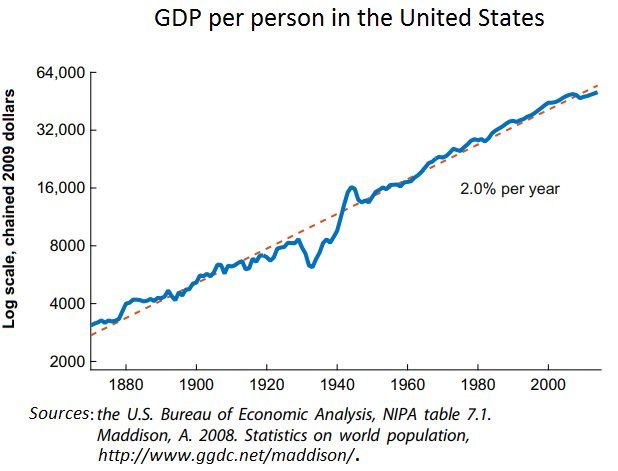
https://upload.wikimedia.org/wikipedia/commons/0/01/GDP_per_...
You yourself just explained how Russia saw us as a threat and destabilized our politics, which lead to the current situation. We would have been better off if NATO was never formed.
If you believe I'm a Trump supporter then you're misunderstanding my position.
> The US prosperity trend has been the same before and after WW2:
> You yourself just explained how Russia saw us as a threat and destabilized our politics, which lead to the current situation. We would have been better off if NATO was never formed.
Other sources disagree: https://ourworldindata.org/grapher/daily-median-income?tab=l...
But it doesn't matter--you're arguing that prosperity for the average US worker began stagnating about 20 years after the formation of NATO. That's basically an anti-NATO argument, from the US perspective.
>Russia fundamentally wants to see you fail and take your place in the world.
My goal is to abandon our place in the world and be like the Swiss. I don't want to destabilize yet another country (Russia in this case). We're gonna have to live with Russia whether we like it or not.
Russia has made major leaps in destabilizing your politics since we (the EU too) believed we won the cold war and stopped treating the Russian empire and allies (which China definitely was, now it's more equal or the opposite) as a threat. The USA also has a superiority complex, like most European nations also had, which certainly isn't helping now.
> If you believe I'm a Trump supporter then you're misunderstanding my position.
You said the USA going isolationist is going to solve problems, which granted isn't as extreme as the Trump foreign policy, i.e. it won't fuel the worsening of the current situation, but it isn't going the improve it either.
… banks saw big, no, BIG $$$ and lost their minds. The transition was rather swift: between the very late 2000's and approximately 2015 (give or take a few years), the transition had been complete. Credit cards became a massively profitable and booming business for the banks, with all sorts of loyalty programmes and bonuses (at consumers’ expense, of course, as the banks also jacked up interest rates on revolving credits). Note that all of this took place before national governments stepped in to regulate the transaction fees.
This coincided with the growing allergy of Western governments to owning any critical infrastructure (including payment networks) and the rising trend of outsourcing as much as possible to the private sector. As it is easy to imagine, it did not take long for the national banks already being in bed with Visa/MC to convince their respective national governments to stop investments in maintenance and enhancement of domestic payment networks and delegate the payment processing to the cartel: «they can do it better than you do».
… all of which has led us to where we are right now. Technically, national payments are still alive, but they are more in the contained mode of operation and not in active use or development.
Europeans use these dispute protections much less, so Visa/Mastercard are mostly seen as expensive pass-throughs.
And in Europe, when people hear Mastercard or Visa, they just associate the name with refused payments at points of sale depending on the luck they had with the merchant, or the foreign country, etc.
I do agree that in this case, picking MC/VISA is not really important. When I changed banks a few years ago, it so happened that I switched from a Visa to a Mastercard. Nothing changed save for the logo on the card.
But that might be one reason why business ideas from the US do not always translate well to Europe, and vice versa.
As to how, in the financial term: we europeans don't really have the credit culture the US has. Having a credit is something very last resort, especially for "trivial" stuff (e.g. christmas shopping, to keep your example). Most europeans will have one or two credits tops: real estate loan, and sometimes car loan. Companies (mostly US) start offering payments spread over multiple months, but it does not really have a high penetration (at least in France), being in small useless debts is something we avoid like the plague.
And how do we have enough money in the bank? We just shop after payday, not after. Or, for most people, we keep a somewhat constant amount in the daily account. It's just another way of managing your own money.
Also, such terminals often use multi-carrier data plans that can use the best carrier available, while your own phone is stuck with one of the options (of course, you always have the worst one).
When you go to your local restaurant, do groceries you are paying a few percentage in tax for using you card.
Platforms online already act as escrow anyway. PayPal, Stripe, act as escrow..yes they take a percentage, but that's more granted for these cases.
PayPal and Stripe are the payment processors who are taxing the card usage and acting as escrow. The technology part of transactions is with Visa and MasterCard. Who will do that part for free if they are not to be involved? What would be the benefit of separating escrow and processing, and how would it realistically be done?
Irregardless of what the economic data actually says, why is this to be blamed on the NATO? I don't see the causal relation. If there was indeed something in the 1970s then I would default to blame the oil crisis.
> My goal is to abandon our place in the world and be like the Swiss.
They were directly in between the other nations in WW2 and capturing them made no sense for the others. They are also pretty small and lie in naturally protected mountains. I doubt the USA can become that, they are just too large.
Also the Swiss just gave that up partially. How much is currently under dispute. https://en.wikipedia.org/wiki/Swiss_neutrality#Russian_invas...
> We're gonna have to live with Russia whether we like it or not.
Yeah, I guess the US is in the privileged position that they can make that decision baring cyber attacks and domestic destabilizing.
> Other sources disagree
> But it doesn't matter--you're arguing that prosperity for the average US worker began stagnating about 20 years after the formation of NATO. That's basically an anti-NATO argument, from the US perspective.
> My goal is to abandon our place in the world and be like the Swiss. I don't want to destabilize yet another country (Russia in this case). We're gonna have to live with Russia whether we like it or not.
As for Russia, you have the luxury of shaping the kind of Russia you live with. Is it the Russia that enslaved half of Europe and is using their brains to build a massive stockpile of nuclear missiles to blackmail you while you dig shelters in your backyard out of fear for your life, or is it a different, more peaceful Russia that has abandoned imperialism like Germany was forced to? Isolationism is a fool's errand. You can very well pretend that the war in Ukraine doesn't affect you, but consider that the nuclear missiles Russians tried to set up on Cuba were built in Ukraine. Would you rather have Ukrainians living under Russian boot and building nuclear missiles to burn down American cities, or have them building rocket engines in support of NASA space explorations programs like they did in the same Soviet-era nuclear missile factories in the early 2000s? It's not a difficult choice.
Most countries in the world don't have a choice and have to deal with whatever the life throws at them. You do have choice. Use it wisely.
I don't see why they would be, generally speaking.
"it’s very difficult to look at a country where the typical person lives in a larger house, is more likely to own a car, eats more meat, and uses more electricity than people in other rich countries, and to conclude that this is “a poor society”." https://www.noahpinion.blog/p/no-the-us-is-not-a-poor-societ...
>In monetary terms, Americans consume more health services than anyone else, yet have fallen behind in life expectancy
US life expectancy has little to do with our healthcare system. See https://xcancel.com/jburnmurdoch/status/1641799742228144130#...
>The prosperity of the average worker did not begin to stagnate when NATO was formed, but indeed decades later
My claim is simply that NATO is not key to our prosperity. Post-NATO stagnation, insofar as it exists, is quite compatible with that claim.
>Switzerland is entirely surrounded by the EU, and its economic prosperity depends on access to the European Common Market.
None of the objections in this paragraph would apply to a more geopolitically neutral US. The US economy is large and relatively self-sufficient. Imports and exports are a relatively small fraction of our GDP.
>nuclear missiles Russians tried to set up on Cuba
...after we set up missiles in Turkey...
The Cuban missile crisis demonstrates the danger of American belligerence, and the importance of us being more peaceful, less paranoid, and more neutral.
Can't we have cards for this? In Spain, for example, to use Bizum, you need either an Android/iOS smartphone (and for the Android case, as you use it from your bank's app, it would typically require some Google security assurances - so no Huawei phones allowed, for example) or logging into your bank's website and use Bizum from there, only if your bank allows you to use Bizum via web. And it's not very practical or convenient to do that when you're in a store and want to pay, in contrast to swiping your credit card.
So while I see very convenient gaining some sovereignty from American companies for these payments, I think we're losing it when we will need devices controlled by other American companies in order to use the new system.
What about being required to carry a your-own-government-controlled tracking device?
Because the US or Chine government can't harm me in Europe via the data they collect from me, But the EU authorities can if they want to, so naturally I fear them more if they were the ones hoovering my data.
What are the odds they're using this on-shore tech grab to implement their own domestic version of China's social credit score system, to easily get data on their own citizens who commit "wrong-think", without having to through the effort to twist the arm of US entities every time they want to do that?
Food for thought, but I do think we're living the last years of online anonymity, it's inevitable.
One only needs a few looks at what the EU Commission has been doing lately to see that if left unchecked their plan is a UK-like total surveillance state.
The usual first victims are sex workers, not political minorities.
Attestation in on itself isn't unwarranted which (to me) is an important security measure. Attestation as commonly implemented on Android via Play Integrity (the way banking apps are known to do) is restrictive, sure: https://grapheneos.org/articles/attestation-compatibility-gu... / https://archive.is/snGEu
The article starts with Wero right off the bat, which a pan-European rebrand and continuation of the Dutch Ideal. The Dutch have been using Ideal everywhere, and you usually use that to pay online. It redirects you to your bank to acknowledge the transaction, and most bank have auth methods where a smartphone is optional. Most often used for sure, but optional, and you can complete the transaction with a hardware reader and your debit card as well.
The only exception are the neobanks like Bunq, which actually are smartphone-only. That one in particular is great if you appreciate the CEO and staff keeping a personal eye on your transactions (no kidding).
They sold their transaction platform as a service to Apple Pay. And funneled all your transaction data to palantir.
Financial networks are side channels for intelligence gathering. And that makes the folks doing them outside of your nation an adversary.
With the US choosing to become an enemy of western democracy in Europe, the need for more investment in building trusted core infrastructure is inevitable.
Certainly none of this is ever simple. But this is just a microcosm of a much larger shift across many industries in Europe and we as tech nerds should be mindful of the tectonic shifts that are happening currently. The capital investments occurring have serious long term implications for us all.
My point being, if these payment systems start becoming more interconnected and join within a standard, I wouldn't be surprised if we eventually saw Bizum cards around here, Wero cards in other places, and many more.
At least that's my take on it. Of course there's still a long way to go, such as developing the system, banks adopting it, businesses adopting it, then customers (which would probably take years, many people wouldn't bother switching at least until their current card expires)
[1] https://www.bbva.com/es/es/empresas/bbva-primer-banco-en-esp...
I don't know about Huawei, but actually most (all?) of the banking apps in Spain should work on a non-Google-certified Android builds. There's an community list tracking GrapheneOS compatibility at https://privsec.dev/posts/android/banking-applications-compa... and all of them currently appear supported just fine.
https://www.androidauthority.com/why-i-use-grapheneos-on-pix...
> Police in Spain have reportedly started profiling people based on their phones; specifically, and surprisingly, those carrying Google Pixel devices. Law enforcement officials in Catalonia say they associate Pixels with crime because drug traffickers are increasingly turning to these phones. But it’s not Google’s secure Titan M2 chip that has criminals favoring the Pixel — instead, it’s GrapheneOS, a privacy-focused alternative to the default Pixel OS.
EDIT: Previously on HN: https://news.ycombinator.com/item?id=44473694
But isn't the promise of Apple Pay that you never expose your real credit card # to the merchant? So they can't track you? I know Walmart in Canada really resisted Apple Pay for a few years because it would mean no more ability to track people by their payment methods.
What's an extra layer of surveillance? Why accept the "credit and debit" surveillance middlemen but not the google/apple middlenmen?
What the world needs are "cash cards". Something equivalent to cash not tied to your identity that you can use in the real and virtual world.
I simply do not understand why governments or the private sector do not provide such options.
How exactly are you doing that? with 3D Secure online credit card transactions now require confirmation in the mobile app (or via OTP sent by SMS, but this is being phased out, as it is insecure)
Likewise, in Germany we can have SEPA for most stuff.
And in Greece there is Viva.
Problem is getting something that actually works across all European countries.
While we may make most of our payments within EU, basically everyone still occasionally pays for something outside of EU, either online or when they travel. This means if the new thing only works in EU, every European will still need and have a MasterCard/Visa even if they use it less often than before.
This is still a massive amount of leverage - MC/Visa still have the ability to block payments made from EU citizens/companies to outside.
https://en.wikipedia.org/wiki/Unified_Payments_Interface
It sounds a lot like what they're discussing.
I would also hope so, that is the entire point. The reason they are scrambling right now is because Starlink just shut off all of Russia. Because Starlink was so cheap and easy (and stable for the last 4 years of the war), a lot of people in Russia stopped using any other form of internet access. And while all of Europe is happy to see Russia go away, they are concerned that the same can be done to them at a whim by any number of American companies. So they are trying to quickly create alternatives to anything American including software providers like Microsoft 360.
As for credit cards, it is not as if there is something intrinsically American in credit card processing. They can just as easily create a new system that uses the same protocols as Visa and Mastercard.
Having your entire economy dependent on a company you don't control in a country you don't control was considered acceptable for as long as a concept of "allies" existed. That is not the world we are living in right now.
What you're saying is just plain false. No one has ever used Starlink in Russia. It doesn't even work here. It never did. Russian troops were using Starlink on Ukrainian territory, that's what was shut off.
They're the same bright minds that ensured no alternatives could naturally come out of the European market trough relentless bureaucratic central planning. I have zero hopes of a good outcome
What are you smoking ..err.. any source to your claim ? (Which is between bizarre and just plain wrong).
What are you talking about? Starlink never worked in russia. It worked in Ukraine, and it was shutdown in Ukraine by using a white list for which any Ukrainian can easily apply.
The goal was to shutdown Starlink usage by russian drones in Ukraine and by anyone on the occupied Ukrainian territories.
Pasting this ddg-ai thing but I think its called UPI 123PAY
UPI 123PAY allows users to make digital payments using feature phones without needing a smartphone or internet connection. Users can set up a UPI ID by dialing *99# and can make payments through methods like IVR calls, missed calls, or sound-based technology.
By the way, since you wondered, it seems to be
> built around the digital wallet Wero
and wikipedia says its a mobile payments method. I hope not. I hope it's rather an interface/spec.
(On a side note, I also hope individual countries of EU ensure that those spec leaves an ability for them to continue internally or even externally if rest of the EU decide to cut someone off or so.)
Wero is the implementation. I think it makes sense to provide a turnkey solution to all participating banks, so that we don't have 100+ versions of the same app.
Countries that don't want to trust EPI (or simply outside the Eurozone) are able to take the same path as Bizum in Spain, and make their domestic solution interoperate with EPI instead of replacing it.
Are you aware of any banks that don’t require you to use their Android/iOS app to use PIX? I’ve had accesss to maybe a dozen banks and none had that ability. Sometimes you get via web, but needs their app’s 2FA to log in.
I completely agree. Sadly UPI is now almost completely dependant on platform integrity ( google and apple).
Even if it does, Google won't be taking a cut from it.
Also, it's then much easier to provide a mobile web version, or something else.
My country's internal system also sells a bracelet for contactless payments, and there are obviously payment cards.
Once there's a mandatory standard, it's much more likely competition will show up. EU wide SWIFT, direct debits, instant transfers, all show this.
Cards will have a slow demise over the next 10 years but it's coming whether we like it or not.
Like to log into e-banking services over here we either have phone apps, or a code calculator device that can be used instead of those: https://www.seb.lv/en/private/daily-banking/tools-and-online...
Seems like common sense to me, the same how I have a wallet on my phone but still carry cards for payments just in case.
No, these companies keep themselves in power not because they've solved such a difficult problem that nobody else can, but because they have a moat which they protect.
Time to do away with these foreign entities.
We've already got a strong payment processing brand with Interac, it's used daily for millions of debit transactions, and supports all the features you'd expect (in Canada) from a payment card (tap, chip&pin). There's also the MasterCard Debit and Visa Debit branding which seem to bridge debit transactions to the MasterCard and Visa networks. And there's already Interac-capable terminals basically everywhere that Visa and MC are accepted.
My thought is that Interac should launch a credit card brand called "Interac Credit". The actual credit would be via the banks, just like it is with Visa and MC. Interac already has the relationships with merchants and banks to make this happen, and it has the mindshare with consumers to make it successful.
Wero is like a monolith, while EMPSA is more like mobile phone roaming. If I would bet, I would bet on EMPSA.
https://en.wikipedia.org/wiki/European_Mobile_Payment_System...
Point being that with a cheap alternative, it's actually much more convenient now to use a Visa or Mastercard especially with tap to pay because with competition being so high, the diversity means people allow all payments.
https://x.com/moo9000/status/2006304163404128289
The difference this time is that Digital Euro is forced by ECB and control (and deposits) are taken away from banks.
> The core problem has always been fragmentation. Each EU country developed its own domestic payment solution — Bizum in Spain, iDEAL in the Netherlands, Payconiq in Belgium, Girocard in Germany — but none could work across borders. A Belgian consumer buying from a Dutch retailer still needed Visa or Mastercard. National pride and competing banking interests repeatedly sabotaged attempts at unification.
> The network effect compounds the challenge. Merchants accept Visa and Mastercard because consumers carry them. Consumers carry them because merchants accept them. Breaking that loop requires either regulatory force or a critical mass of users large enough to make merchants care — which is precisely what the EuroPA deal attempts to deliver by connecting existing national user bases rather than building from scratch.
It's now been about a month since a White House deputy chief of staff for policy and homeland security advisor openly talked about/advocated for taking Greenland by force. POTUS was vague for a while.
Northern European nations sent like a hundred military officers to Greenland. POTUS then threatened those nations with, wait for it, tariffs.
Then the markets crashed and Rutte/Nato provided a face-saving de-escalation path.
Their site claims that it can only be used on iOS or Android: https://support.wero-wallet.eu/hc/en-us/articles/25599074240...
Also:
> It is not possible to use Wero via a web browser or on a computer.
This seems an even worse situation than carrying around a Maestro (mastercard) with me.
In what way specifically? Android and iOS are just the OS the banking apps that implement Wero happen to run on. There is nothing stopping them from releasing a Linux app. Or a web app.
“Breakup” seems a bit exaggerated considering the % of payment volume which might switch to the new system.
Is it really just PayPal left offering a sane online payment service?
---
From https://support.wero-wallet.eu/hc/en-us/articles/25599074240...:
> It is not possible to use Wero via a web browser or on a computer.
But now i think of it… how does Visa and MC do it? Cuz i dont have a username or phone nber with them (i know they have my number). But i havent switched my number, so maybe if i did, i would have an issue?
I can send money ONLY to my contacts. It doesn’t allow to type in phone number, one needs to create a contact.
I feel like Europe is just doomed. The stupidity is endless here.
It didn’t work for the amount we needed (over 15k).
Biggest banks here refused to support Apple Pay and worked hard on legislations to open NFC access. Now we can pay with no fees to Visa/Mastercard or Apple even from our phones.
Instead, we are getting a digital euro, a fully dystopian abomination.
But I'm sure there are plenty of villains and idiots that will try (and succeed) in diluting those principles and will get some dystopian (trace everything) version of that.
Even Polish banks discourage using debit cards directly and just switch to Blik.
Lost card? There's no card, so doesn't apply. ATM skimmers? Nope, I think all ATM support Blik, so can't sniff anything. Want to send money to a friend? Instant mobile-friendly transfer. It's even possible that the family can pull the cash out from the ATM from your account when you're in a different city if you'll give out the code.
Just the transaction processing fees going to VISA and Mastercard now would probably pay that back within a few years. Also, we're talking about all or almost-all European countries. So it doesn't sound like that much.
> Low interchange fees under EU regulation make profitability difficult.
Mandating that businesses which accept US credit cards must accept the European payment card would take care of that. Actually, maybe that's not necessary, it's probably enough to mandate that companies making card processing tech which supports US credit cards must also include support for this card; and businesses would just get it with their next system upgrade / terminal replacement or something.
> Consumer habits are deeply entrenched
I 'like' how people are described as "consumers", as though every payment is for consumption.
Anyway, habits are not that deeply entrenched. Didn't people adopt those country-level payment cards? Don't people occasionally change credit cards? It's not even a change of tech, it's just yet another card.
> and neither Visa nor Mastercard will sit idle while Europe tries to dismantle their most profitable market.
Now this may be a significant factor... they could influence politicians, tech solutions makers (with sweetheart deals if they don't support the new payment tech, or whatever), they can get the US government to make some kind of threat (we've already seen the threat to invade Greenland). So, yeah, there's that.
Item two is convenience. All these systems are "faster wire transfers". I don't really see the point of them when you can already do instant IBAN or even phone number based transfers.
What they do not have is a line of credit backing them. Got to make sure you have money in "the particular system your merchant accepts". Also at least in eastern europe credit cards come with the possibility to pay in a few installments with zero interest (paid for by the merchant of course, so not everyone does that). This is gone in the new system.
What they also do not have is the fraud protection of a credit card. You may be able to revert a transaction but the money is gone from your account and it will take a long time to see it back.
On the other hand it's harder to spend money you do not have so perhaps the EU is trying to make its citizens more financially responsible? :)
* Cards are convenient. No need to go get cash, no change at each transaction to manage carrying around. * Cards give a discount in the form of "cash back". (As mentioned elsewhere, this really just inflates the cost of everything for everyone, but I might as well claw it back.) * I don't actually go "into debt". I pay off my card (automatically!) every month, and incur no interest charges. I use it like a slightly deferred debit card with benefits.
The last bullet being significant to your point: I don't "spend money on [a] loan".
Of course it only works to your advantage if you pay your credit cards in full every month.
Card terminals here in Poland usually accept BLIK payments
It is also very popular payment method in e-commerce
In Czech Republic we have QR payments. They're ok, but could be more streamlined...
Let them focus on offering a payment system, and let others focus on their thing.
In particular, I heard this through Mallen Baker at https://www.youtube.com/watch?v=7ACzkuSFzT4
It's an app that uses NFC or, if needed, reads a QR code and does a web request (i.e. needs internet).
Neither Google nor Apple will block that, or take a cut; and it's already available in multiple markets.
This is about taking stuff that already works in one or two countries, design a similar system that works across countries, and mandate that all banks under ECB supervision implement it.
Google keeps self-sabotaging Android Pay. They lacked market power so cellular carriers blocked it hoping to advance their own payment ecosystem (ISIS). Google changes the payment brand every few years, and fragments it into two separate apps or combines them. It's rather like their messaging strategy.
So I don't think distribution is a problem. Of course companies would prefer to save the cost, and they also prefer that you use their applications, but I just don't think it's more convenient for the end user. Taking a card with you is not a big deal while having to use a mobile application or approved device limits your freedom to choose which smartphone you want to use or how to use it.
It makes sense to build upon modern SEPA payment rails and focus on mobile wallets. Europe has always been on the forefront (Swish, Vipps, ...) and we have entire generations of consumers who barely if ever use plastic cards.
Might as well make it to the brain while we are at it. Safe when one is brain dead or unconscious. What say?
But 99.99% of the time won't be the implementation of such interfaces, but monitoring and security.
Sorry: This is Spain (to clarify).
Physical cards ftw!
Btw i love simply using cash in South America when getting a taxi, no stupid "apps", no tech nonsense. Just wait at a proper spot and hail.
I suspect simply stating that it must be a supported standard will do most of the work, much like standardising phone chargers.
- For many consumers there isn't sufficient money in the account to settle all the one-time and ongoing transactions they are liable for -- credit cards are giving you a revolving loan, there's risk it will not be repaid, and that risk ends up reflected in processing fees
- For many _businesses_ managing cash flow is existential -- as merchants they want to be paid as quickly as possible, but as B2B customers they want to have 30-60 days to sell the input goods they've purchased so they can pay for them upstream. There is a premium for that flexibility that gets reflected in processing fees.
- For both consumers and merchants, fraud risk is real and while it's the most solvable part of all this it's a real (and costly!) factor today. That risk for fraud gets moved upstream to the networks/acquirers/processors/issuers and that premium shows up in (you guessed it) processing fees.
If you want to switch the world to a debit-based system where economic transactions are limited by cash on hand, I'd argue that's a poorer and less dynamic world than the one we're operating in today.
Payment networks don’t provide credit or any kind of liquidity whatsoever, that entirely provided by the various financial entities that communicate via the payment network. The reason Visa and Mastercard haven’t been easily replaced is simple network effects, nobody wants to integrate with a payment network where there’s nobody to transact with.
This is a uniquely American viewpoint. In most of Europe you don't buy anything on credit ever.
I'm confused - is it not the issuing bank that gives you the loan, and the credit card company just provides the infrastructure?
Btw. having an overdraft limit of a few hundred Euros is quite typical for those liquidity issues. You don't need a credit card for that.
Neither Visa nor MasterCard are loaning customers their money. It's the European banks that hold the bulk of the risk for European credit card transactions.
This is really much less of a thing in Europe, or at the very least in Germany and Spain. Mostly it's the overdraft from banks that you can use as what you call a revolving loan. Most of the visa and mastercards I've had in my life simply debit from my main account.
Disagree. Credit has its uses, but debit is superior for the vast majority consumer transactions: lower fees, lower risk, instant settlement, easy P2P transfers, and broader accessibility. That we've become used to credit card payment system in the West is largely a historical aberration that needs correcting.
Also, I'm a bit biased since I live in China, but WeChat Pay and Alipay are so far superior to the credit card system that I can hardly find a single redeeming quality in the latter. China was lucky in that it leapfrogged the traditional credit card system since it didn't have that historical baggage.
Some of the services include: - Consumer Credit - Fraud protection - Payment network - Discount service (rewards, etc) - Concierge services - Rental/Ticketing services - etc
No one is denying the utility of what they have created. The problem is they’ve built monopolistic walled gardens where these are all bundled together which raises overall costs while also prevents competition.
These services can easily be unbundled (for example in India the payment network is open and cost free, so anyone can provide those other services on top of the payment network).
What has made this far more urgent, however, is that these companies are located in the U.S. which has recently leveraged the power these networks have to attack EU citizens for frivolous reasons.
So even if the MC/Visa business model was perfect, it would be foolish for even American allies to rely on them given the actions of the current administration.
This is not meant as a personal attack, or meant to be defamatory. I am detecting a familiar pattern, that is entrenched culturally.
Further, I identify this cultural trait as one of the obstacles or reason for many European problems.
It’s an opinion I have.
I lost 3 credit cards INSIDE an airplane (hello AirAsia!). I only realized it when I turned on my phone while queuing at immigration and was bombarded with dozens of "Successful transaction" messages. That's ~30min from stepping off the airplane. When I checked my statements, I saw dozens of physical transactions (swipes/taps) with different merchants in different cities from the airport.
All 3 cards have different PINs. All require a PIN for transactions above ~USD200. Yet the banks rejected my disputes because "it's a physical transaction, so you must be the one doing it." Apparently, they all think I could fly to different cities, buy different items, and fly back to wait in immigration, all in 30 minutes.
Err, no - for _all_ businesses managing cash flow is the _only_ NR 1 crucial thing, because if they dont, they will disappear by tomorrow :)
Their risk is covered multiple ways (as reflected in their profits). You pay an annual fee to have a card. You pay per transaction, you pay for paywave, you pay 21% in interest.
They cover their risk by hitting every possible angle.
I think there's plenty of money to back all the activity.
Especially if there are central banks willing to back them
In the EU, debit cards are pretty common, and largely its a network effect. You need to get terminals that are supported by your payment provider.
A lot of merchant terminals are provided by banks, and frankly they are itching to get a sweet sweet cut of each transaction. Not only the information, but the cut of each transaction. Something like 0.2-1.5% of each transaction. (I'm sure mastercard and visa give them a cut)
For Credit cards, the banks/operator already handle most of the risk, and then pay visa a percentage for the privilege of charging usury like rates
Also bank transfers are easy, instant and free.
> For many _businesses_ managing cash flow is existential -- as merchants they want to be paid as quickly as possible, but as B2B customers they want to have 30-60 days to sell the input goods they've purchased so they can pay for them upstream. There is a premium for that flexibility that gets reflected in processing fees.
Yes those businesses use a bank loan for this, no need for a credit card again.
> If you want to switch the world to a debit-based system where economic transactions are limited by cash on hand, I'd argue that's a poorer and less dynamic world than the one we're operating in today.
Thinking that the world doesn't have credit just because they use debit cards is one of the most idiotic things I've read today
And who wrote those? Aren't they just another part of the moat?
> It's actually quite fascinating how it was started.
Visa was founded in 1958 by Bank of America (BofA) as the BankAmericard credit card program.[1] In response to competitor Master Charge (now Mastercard), BofA began to license the BankAmericard program to other financial institutions in 1966.[8] By 1970, BofA gave up direct control of the BankAmericard program, forming a cooperative with the other various BankAmericard issuer banks to take over its management. It was then renamed Visa in 1976.
The answer is: "Banks."
It’s a captive market, which means Visa & MC really don’t have a ton of incentive to compete. How do you get new payment networks to integrate? Banks typically only offer a single network on their cards, and businesses use whatever their PoS systems accept. For a new network to compete, it’d need to be available everywhere.
It’s the textbook definition of core infrastructure for society and frankly should be operated like a utility. It’s not like Visa & MC are innovating - just look at the lethargic rollout of contactless in the US until COVID forced everyone’s hands.
The sole purpose of visa & MC is to grow profit each year. That’s it. I’m not a fan of that being in the middle of practically all consumer spending
I don't know that the problem is sophisticated, but it's certainly complex [1]. It's a bit of both in terms of complexity and defending a moat, which all businesses do, including, and especially European ones.
And companies like Visa, Mastercard, American Express, &c. arose initially from solving a real need. Before these companies came into existence when you traveled you'd have to take cash, or traveler's checks or some other nonsense. Today you can, at least as an American, just walk in to the subway in just about any country and tap to pay. Need a coffee at Mt. Fuji? Easy. Buying a bottle of Calvados in some remote area? Yea just tap to pay with your Mastercard.
> Time to do away with these foreign entities.
You'll never do that. Why? Because at a minimum you want American tourist dollars and Europe isn't going to start issuing European credit cards to Americans or other citizens around the world.
[1] Why is it complex? Well you have to deal with American and European financial regulations, KYC, &c. - you have to vet merchants, you have to run the infrastructure to process transactions, refunds, direct payments from bank accounts to pay for cards, and all of those things. Those are real, genuine business activities that are non-negotiable and while they may seem simple, in practice they are not at all simple.
It could be handled similarly to how tourists in Brazil can now use Brazil's Pix payment system.
One way Brazil handles it is with 3rd party digital wallets that tourists can install on their phones such as Wallbit [1]. Another way is with 3rd party services that let you pay from your own digital wallet or bank app and the service makes the Pix payment [2].
[1] https://www.wallbit.io/en/blog/brazilian-pix-and-a-payment-a...
[2] https://www.pagbrasil.com/lp/pix-for-international-travelers...
Hard disagree. Until Covid, many small shops didn't take cards in Europe. Taxis, restaurants, market stalls, even trains were often cash only not that long ago. I in the UK ran accounts in companies that had people travel extensively in Europe. We used to issue travellers with EUR200 for the things that cards couldn't buy. Most shops didn't take Amex due to fees. Americans will either have to bring a compliant card or change some cash at the airport.
I also think you have misjudged the mood. I guarantee there are a large number of people in rural Europe that would be very happy never to meet another American tourist, even if it costs them. Americans can look forward to worse service everywhere. I wouldn't be suprised if some people in rural France refused to let you have the Calvados at all.
Those are partially or completely taken over not by the card network but by the bank that is issuing you the card, so a change in the underlying technology will be transparent.
The reality is more complicated.
I have had Visa or Mastercard being refused in other countries by some retail outlets / institutions.
In fact I never travel with only one card from a single bank because I always want to have a backup. And it is not really Visa vs Mastercard because I have had occurences of having 2 Visas, one of which would work and another would not on a specific shop for no obvious nor documented reason.
Is that really true? I remember wanting to buy a train ticket at Charles De Gaulle airport, and the machine only took French credit cards. That was around 2010, so I don't know if something changed.
Had to use debit.
And people do underestimate the complexity of it
It wouldn't be hacker news without a comment like this. I haven't personally worked in finance, but I've had a lot of friends do it.
It _absolutely_ is complicated. It's not too complicated for a nation or the EU to do it in house, but no, there's a bit more there than "Claude make me a ledger"
Now most merchants have to work with two companies, visa and mastercard. Want to accept russian MIR cards? Well, in some countries you're not allowed to, and in some, you must, since visa and mastercard don't work there. Now if you add a european company to the mix... whill their cards get accepted in south africa? What about in eg turkey? China? Will whatever indian alternative is get accepted in france?
Currently, with a visa and mastercard, except for maybe russia and iran, you're pretty sure it'll get accepted at least somewhere in any urban area you visit, so you won't be hungry and have somewhere to sleep. If my bank replaces my mastercard with the EU alternative, I won't be that confident about that for quite a few years.
On the other hand, cash is still the king of everything everywhere... somehow some politicians are trying to get rid of that for some reason.
Thankfully, this use case has been solved by Russians themselves.
Regulation changes "why bother" to "oh crap".
This is the central power lever of the EU and one that is frequently underestimated.
European power projection doesn't work through tanks and aircraft carriers. It works with regulations, trade deals and economic incentives. Remember how a few years ago everyone was scrambling to get GDPR-compliant? That wasn't some random event. That was the EU projecting power.
Why do iPhones have USB-C now? European soft power.
Why are things like Champagne and Prosciutto di Parma protected brands that can only be sold if they're from the actual region? And I mean not just in Europe itself, but everywhere it has deals? Canada, Japan, India, China, Mercosur, etc etc? European soft power.
The EU is playing a different game from the other major players. Not one of brute force, but one of shifting the foundational rules of commerce in their favor. And they're very good at it.
1. Debit Mastercard/VISA. These are Debit Cards that use the Mastercard/VISA communication system to process transactions. While they are not "Credit" cards because you are using cash in an account that is your money, they rely upon the VISA/Mastercard system and merchants will be charged the Mastercard/VISA fee like a Credit Card.
2. Interac Debit Card. Interac was the first company to offer a debit card type system in Canada, and they are the traditional bank card. These cards use the Interac system (so does eTransfer) and Merchants are charged by Interac for using the system. Its typically less than Mastercard/VISA, which is why you see these "Debit Card only" signs.
3. Mastercard/VISA and Interac hybrid cards. These are newer and combine both Mastercard/VISA and Interac cards in one. The merchant can choose how they want to proceed.
Most of these "Debit" only signs are really saying "Interac only", but because for 30 years Interac was the only provider of Debit cards in Canada, it became the common vernacular to say "Debit" when you mean "Interac".
Visa and Mastercard exists because of US hegemony. The Europeans just put their heads in the sand for a long time and accepted the "superiority" of American payment solutions because it benefited their geopolitical play at the time.
Some sources (Old and New):
- https://www.reuters.com/business/finance/exclusive-visa-comp...
- https://jakartaglobe.id/business/indonesia-expands-qris-reac...
- https://www.china-briefing.com/news/wto-china-unionpay-rulin...
- https://valorinternational.globo.com/foreign-affairs/news/20...
I suspect there's quite a few other things you have to consider when you're managing trillions of dollars of transactions a year. Fraud, settlement times, up times, security, customer service, debt collection, interest rate calculation, reach, KYC, record keeping, legal inquiries.
But I'm sure we're just a couple grok comments away from a competitor
Hence why crypto hasn't taken off with merchants. Because who's going to pay for merchants to change their point-of-sale systems to accept a new payment method.
Just dealing with fraud is a major problem in itself.
Roughly nobody argues that part is difficult.
> It's not complicated.
It's very complicated, for the reasons that all complex real world systems are. It's an absolute mess.
> Time to do away with these foreign entities.
I don't really mind the "foreign" part, but it's fairly wild that essential financial infrastructure is privatized, so let's!
Any cross border payment solution, even within Europe, that lacks strong fraud protection is dead on arrival.
But I suspect the fraud problem will be ignored until it cannot be ignored anymore. And then we will go back to square one and try everything again.
Convincing your neighbors to build a refugee shelter in your neighborhood is difficult, and it's not like we have a shortage of house-building knowledge.
It’s about the cost of another employee in salary per year for restaurants.
While many other countries employ pay by QR code which is free.
In which countries is this service free? Alipay and Wechat are probably the biggest actors in this space both take a cut.
Knowing the card will always work 24/7/365 with such a high degree of assurance is a non-zero factor in how well a consumer economy performs.
Honestly its a few things.
No, the technical and financial implementation is quite complicated. Its not just a balance in a database.
Yes, they do maintain control through a vertically integrated business structure. But its very easy to justify due to risk management.
>No, these companies keep themselves in power not because they've solved such a difficult problem that nobody else can, but because they have a moat which they protect.
The moat is the difficulty. And they do protect it.
Theres a common type of customer in IT who thinks they can do everything themselves and the "finding out" phase of their shenanigans is often extremely costly, not just for themselves but for their customers.
The chief product of a good supplier is not just software or technical services, its the regimented and disciplined implementation of those services.
Some people will pay more for an IT provider who permits less because they lack the internal organizational discipline to do these things correctly for themselves.
As far as various governments are concerned, the payment card industry is largely self regulating. And that's because the apex card providers provide the balance of enforcement downstream to all the nitwits who would otherwise have to be stung by hundreds of security lapses before they would otherwise respond. The PCI SSC has created an environment where data security is more restrictive than most polity's would require, and its standards are applied worldwide. Often people get liability exemptions for meeting this standard, rather than the standard itself being enforced by legislation or regulation.
Governments honestly love this shit. Its like catnip.
And if you had 1 tiny look behind the curtains of a merchant credit card processor, you would see that they would abandon this level of compliance at the drop of a hat were they permitted. The glue that holds the whole thing together is the restricted access to global Visa and Mastercard payment processing.
If you think all this is trivial, demonstrate how trivial it is, and spin up your own cards, card payment platform, various interconnects and clearing houses. I think you would much more quickly assemble a working computer out of a kids sandpit. Shit I remember a bunch of crypto projects sought to replace Visa and Mastercard, the best we got was Crypto branded Visas and Mastercards.
The banks have consistently refused to do anything, because they don't want any change that threatens their oligopoly. Canadian bank services are more or less the same as they were a decade ago.
The current government will have to show that it can resist rich people lobbying in this regard, before any real change can happen.
There are some new banking startups popping up in Canada like Neo Financial (from the guys who made SkipTheDishes) but they are online-only and have limited integration with stuff like Plaid.
Sometimes I feel like they don't actually refuse to do things, maybe they are not capable to improve. Something in their chain of command is broken and doesn't let them change.
Canada could get the best of all worlds. Let Visa and Mastercard compete with Alipay and whatever the EU comes up with in the 2030s.
Also Interac does not do online transactions outside of some very specific merchants that take Apple/Google Pay transactions. This is how Interac reduces fraud risk, which is why interchange rates for Interac are so low.
A world with a patchwork of payments processing options will look different for travel and business, in some ways worse, but such is life in a "multipolar world" which the Americans elected their leadership to conjure up.
False? Co-badged cards are used in Germany, were used in NL, are used in NZ/AUS, many more examples than just "Asia".
We can and should make this practice illegal, along with several other anticompetitive policies in this space. Oh no they might hit us with tariffs in response?
<< Interac e-Transfer is a fast, secure and convenient way to send money to anyone in Canada using online banking. The participating bank or credit union transfers the funds using established and secure banking procedures. Transfers are almost instant, but can take up to 30 minutes depending on your bank or credit union. >>
Visa: 1.3% to 2.3% Mastercard: 1.5% to 2.6% Mastercard: 2.3% to 3.5%
Nothing precise as it depends on whether that's debit vs credit cards, and the type of card. Also volume related and what the bank may subsidize, or take on top.
A % of that also goes to the issuing bank*, not to MC/Visa, so I suspect the mentioned 0.2% is talking about what MC/Visa has as their cut.
*: That's also how banks can profitably offer things like cashback.
Visa's processes ~$14T in transactions. At 0.2% thats roughly ~$28B in revenue (VISA posted ~$40B in revenue in 2025) versus 2% is $280B in revenue.
EDIT: The 2~3% you're talking is the payment processor fees which get divvy'd out to acquiring processors, acquiring banks, gateways, merchant processing, etc. etc.
https://eur-lex.europa.eu/EN/legal-content/summary/fees-for-...
> Specifically, the regulation:
> caps interchange fees at 0.2% of the transaction value for consumer debit cards and at 0.3% for consumer credit cards;
There was a recent case of one Serbian company being sanctioned by the USA, and Visa and Master refused to process payments. No big deal, since even a small country like Serbia has its payment system called Dina that kept the company afloat.
There's not a single technical reason for bigger and richer countries to develop their own card payment system. It's not rocket science. The only reason they didn't is their regulators wanted a dependency on the USA payment processors.
I only took a credit card for a bit when I went traveling, then canceled it.
Polish BLIK, which is not even mentioned in the article and which has joined the EuroPA Alliance, processed €83 billion in 2024, with a 30% y/y increase in H1 2025. I understand that BLIK is much older, but it invested significant effort and money in marketing and promotions while delivering a good user experience. BLIK is now trying to expand to Romania and Slovakia, yet Wero is getting all the hype on Hacker News. Maybe this is a case of East, South, and West Europe being treated differently. Is the only “European” solution one that comes from Western Europe?
That have at least been my experience, trying to integrate Vipps in Scandinavia.
The real deal is the card payment networks that your plastic thing can use at a merchant's point of sale. All the rest is moot as we already have SEPA for e.g. online payments (it does have its issue for sure, but it's something).
Never heard about this before, and I'm a German.
But maybe I misunderstood and other places are actually replacing tech.
My experience is opposite, Now with UPI which 99% of people have access to there is no incentive for people to accept Credit Cards.
If in EU a local payment system captures the cash market, then the habit of using digital payments will actually also help Visa and Mastercard make more sale.
I currently don't have a credit card, but when I do, I find paying by a Visa/MasterCard much more preferable than UPI, simply because it's easier by tapping.
(And then as pointed out, anyone smaller straight up doesn’t support anything outside of UPI.)
Brazil introduced Pix in 2019, it's now the most used payment method for all transactions nationwide, ahead of both cards & cash.
India introduced UPI in 2016, it now handles >80% of digital payments there, and handles more transactions a day than Visa does worldwide.
It's totally plausible to me that a similar replacement could overtake cards completely within a decade. The lack of cross-border support means "Pay with Bizum" is a niche feature that's only useful in Spain, but if "Pay with Wero" becomes an instant & ~free payment method that works for hundreds of millions of users then it's a very different ballgame.
Is that by volume of transactions or total amount, or both?
Cash transactions can of course only be estimated for this statement.
On the other hand, if you step back a little bit, Russia is currently stuck in a Sovjet civil war, so I don’t think the Kremlin way is that great.
But yeah, it is amazing that in 2022 nobody here even noticed that MC/Visa left. Even MC/Visa cards haven't stopped working and are working to this day (banks made a rule that cards that expire after 2022 continue to work for several more years so that everybody has time to switch to MIR).
It's not seamless if it includes a war, global isolation, exodus of all business and disconnection of the banks. This means they were left with no alternative, in which case, sure, it's 'seamless' to use the only alternative method.
Europe will have a lot of friction with consumer habits and Visa will always be relevant for buying things from outside EU. These are all competing entities which hate anything that makes them seamlessly lose their business.
It's about card payment and even if things ending up in your network they first going through visa.
And it's about online payment (PayPal).
no it isn't
for bank to bank payment your statement might be true
but this isn't true for EC card payment and most online payment
_all_ EC cards either use the Visa Payment network and secure modules or the Mastercard one (but by now it's mostly Visa in most places). Sure they have your banks local branding but it's Visa anyway.
This also applies to payment terminal, most (not all) go through the Visa payment network to process payments.
And even in the same country a lot of online payment either goes through credit cards (again mostly Visa in EU) or PayPal. This isn't technically needed at all but due to fragmentation whatever alternative you want to use is just sometimes available.
Which is where Wero comes in:
- try to reduce fragmentation by making it a cooperation across many banks (of which most had their own failed PayPal alternative)
- onboard people on (local) online banking and private Phone2Phone payment (e.g. bill sharing)
- then (now) expand to pushing some payment terminal providers to support it with Phone based payment. There are multiple initiatives for it.
The later part is possible due to 3 reasons:
- payment apps on phone bypassing secure module monopoly nonsense related to EC/Credit cards and visa
- a lot of the in-person checkout systems of small businesses are now a tablet + separate cash register + EC terminal. This means that even if the EC terminal doesn't support Wero the payment system can still do so through their tablet.
- Also I think some of the wider used payment terminal in large EU specific chains can get Wero support with a software update.
Still it's by far not a perfect situation:
- still too much fragmentation/to little adoption by banks
- "old" payment terminals and (physical) checkout systems which are bound to Visa and can't easily be updated
So there most likely won't be a hard break anytime soon, and your EC card will likely continue using Visa secure module and network for a very very long time.
But having a technical working alternative which can slowly start eating market share is already a huge step forward.
With credit cards, they actually claw that money back from the merchant, and then if the merchant can't pay they just eat it themselves.
So the merchant has to work in fraud rates into their pricing, and the credit card company has to work in fraud rates that the merchant can't cover into their rates.
It always seemed toxic it to me that the merchants are the one's responsible, despite the fact that they easily have the least power to do anything about it. But the ease of payment processing, and the number of people who just won't buy it if they can't use a card, outweighs dealing with fraud I guess.
It would be an economic boon to the bloc if they assumed more of the risk.
I'm curious how India's UPI handles fraud/refunds, as the system seems to have garnered near-universal praise.
Like, if someone stole a credit card and use it to buy stuff ?
Non-Euro countries won't be guaranteed to have it until July 2027.
SEPA instant transfers aren't guaranteed instant as they might still be withheld for fraud checks.
That is why national payment systems tend to work relatively well. Cross border systems are a completely different challenge.
I would agree that BTC and many assets are a terrible payment method due to poor UX (block time, clunky wallets), speculation, and wild price swings. But crypto in general works well for payments I would say.
Transaction fees have improved significantly where it can be on the order of a few cents per transaction. So yes this is a little high for a $1 candy bar but this is fantastic for a $1,000 watch.
The number of chains and interoperability is a bit of a pain at the moment, but this problem can be resolved by delegating to a payment processor, or simply targetting ETH, the top stablecoins, and BTC which account for the vast majority of the market.
> Expensive and difficult to run
Again I am biased because of my experience, but I could set up a payment gateway for ETH in a few hours using free public nodes at virtually no cost. No business overhead. No agreements with payment processors or card companies. The biggest cost and overhead ends up being accounting, because crypto still has ill defined laws and regulation.
Now, of course our corner shop appliance store still only accepts cash. It was fun to pick up cash from multiple ATMs and pay 1500€ with a pile of 20€ bills a few months ago.
It works for the purpose to pay something online.
If you want an example, Eurowings.
I thought Carte Bleue no longer existed?
However a recent development was Russian use of terminals on attack drones. Out of that Starlink was able to block terminals with certain velocity (and possibly bearing) in the region. In addition Ukraine got around to making internal registry of all frontline terminal allowing Starlink to white-list. So no it was a bit more than a tweet involved.
https://x.com/FedorovMykhailo/status/2017932529882296706
SpaceX worked with Ukraine together to register authorized Starlinks.
You obviously can’t simply geo-fence because the usage is not in Russia, but Russian troops using it in Ukraine.
And you can’t simply blacklist Russian use, because lots of devices with legitimate Ukrainian use cases were imported in privatly or by third party.
That is why legitimate Ukrainian devices must now be cumbersomely whitelisted.
UPI will work even without a smartphone, it will work on even with a basic feature phone, using USSD codes! That's called UPI 123PAY.
https://www.msn.com/en-in/money/news/upi-without-smartphone-...
This feature allows rural populations, poor people, small merchants, etc., to send and receive UPI payments, even without a smartphone.
So UPI has no dependency on Google or Apple, it can work on any basic phone that supports USSD codes feature!
I forget what the company was called, m-pay or something like that.
I agree the reality is a bit more complicated and even wrote about it in France when dealing with gas stations but what I wrote is broadly true. You can just take a credit card to Europe and the vast majority of the time you just won't need cash. I also agree it's a good idea to have a couple of cards though and maybe your debit card too. Frankly I do this in the US as well, and not just when traveling abroad.
However, i heard from my Indian friends is that UPI fraud is on the raise and becoming a big challenge.
Edit: UPI fraud rate is similar to CC fraud rate but only about ~6 % of the money lost to UPI fraud has been recovered. If this trend continues (fraud pct continues to grow and recovery rate does not improve) UPI system might get into trouble.
Btw, the stats say that the UPI fraud rate is doubling every year for past few years.
I imagine bank transfers are still the largest payment method by value. Pix is taking over bank transfers, but companies have very few reasons to migrate.
Whatever LLM duckduckgo is using says 10k and ability increase as more transactions are made (to increase trust) - but it's probably using outdated data.
When did you try this? I'm guessing more than a year ago.
The wonderful French train company wouldn't refund the ticket either and instead insisted that we might use it one day on another trip to France. Thankfully by the time I got to the front of the line to chat in broken French to the ticket administrator, I had already accepted my fate after hearing a number of tourists (not Americans mind you) yell and stomp their feet uselessly in hopes of obtaining a refund.
[1] That was a fun adventure too. At CDG, well I found out later that taxis are "allowed" and are the same price as the Uber ride and so we could have avoided this by just taking a taxi through Uber, but a group of folks from Great Britain were ahead of me in line and I came across them later when looking for where to get a taxi/Uber. There were rideshare signs or something but they didn't lead anywhere that made sense. They seemed rather aspirational. Well, one of the members of the British group spoke good French (or good enough) and found out the secret spot to go after chatting with an airport employee I think it's at Terminal E (someone else may know for sure) or something and so my wife and I befriended the same British group and went along with them for the long walk over.
We were able to get a ride, though not cheap. Of course the bus was an option and we're no stranger, but we were on vacation and the $50 ride was just chalked up to the cost of doing business. We were already 2 hours behind schedule because of the train fiasco.
All that to say, I think using an American credit card these days is the least of your concerns. I was surprised to see American Express taken rather much more widely than anticipated. Be careful getting gas though as they place holds on your card for $250 or something like that, and once you get enough holds you can't get any more until the prior ones "roll off".
I have credit cards for decades with various institutions, but NEVER EVER went to minus, see no reason to change it. Just a bit of discipline. We don't have public credit score or similar dictatorial stuff here. The only loan I will ever have on my name is called mortgage on real estate, and beyond that is a line I'll never cross. Same goes for everybody I know - family, friends, coworkers.
This comes from somebody working for a bank so not some clueless fool.
Diners club? Well.. "it depends". Many don't work with it.
Indian, russian, chinese, cards? Maybe in india, russia and china, but you shouldn't expect it to work "everywhere" like visa and mastercard. Same will be true for EU cards for quite a few years, especially if the system gets fragmented into many different companies using many different systems, and you'll always wonder if your german card will get accepted in Algeria like your friends' french card is.
Vienna/Austria is such a strange place wrt payment right now. Some places are cashless, many are cash only, many are card only above a certain amount. I had one lady running a ramen restaurant accept instant SEPA.
And it's going to be interesting tax wise when they remove the requirement for receipts on transactions under 35 EUR.
I was just commenting on how good, widespread it is and no it is not the doing of the current Govt. It just gained traction during a massive f up of the current Govt.
You can buy vegetables at a farmer's market, and just scan a QR code.
Chip and pin and NFC transitions took off much quicker outside the US because merchants generally owned more of the chargeback risk than in the US, and therefore were willing to update their POS equipment accordingly.
Risk (like debt) is another place where a US-centric view will likely lead you to misunderstand the purpose of Visa/MC.
Not really. The risk of all fraud is initial borne by banks issuing the cards, after all they’re only parties that have an actual financial relationship with the person providing the cash/debt. If something which results in that person cash/debt being stolen, it’s between that person and their bank to figure out who’s liable for the lost money. Chargebacks are just a mechanism for banks to recover some of that lost money, once the liability between the card holder and the bank has been settled.
One of the big reasons why Chip and PIN etc took off outside of the US, is that the US is very accepting of fraud, and charging crazy high interchange rates (up to 10x what they are in Europe) so the cost of fraud is spread over many individuals. Other parts of the world have regulations capping interchange rates, and providing better consumer protection, demanding that banks and payment networks tackle fraud, rather than increase the cost of everything by 1-2% to cover fraud losses.
I have no idea what policy made the US hold into signatures for that long. But the seller and the buyer are the least powerful people on that entire chain, so I don't think it reasonable to look at them.
And the bulk of the fees from credit card transactions goes to the bank(s) since they hold the risk: https://en.wikipedia.org/wiki/Interchange_fee#:~:text=The%20...
https://www.kaspersky.com/blog/nfc-gate-relay-attacks-2026/5...
If I take a random loan with the bank and use those funds to do the same purchases using debit, then I'm the one taking the loss.
I'd argue this was the trolling
At any rate, making someone who haughtily trivializes a problem solve that same problem is a useful exercise both in the complexity of the subject matter, and—perhaps more importantly—in humility.
Most Dutch people were unaware of the issue (because Dutch cards worked abroad), and those who were, were fully convinced that it's because Dutch system is objectively better (it wasn't, it was just a separate network). Then in like 2024/2025 Visa and Mastercard finally retired their special V-Pay and Maestro brands, and now most terminals in the Netherlands accept most normal cards.
There's nothing wrong with having national cards, since >90% of transactions are national anyway. That's how German Girocard worked for decades until the coordinated push to switch to Visa Debit happened.
And the government did nothing to protect domestic payment systems. As if they value foreign dependency more than the independence.
Even before UPI credit cards were common accepted online. So I am not sure about that as well.
Yes, this is exactly what Walmart does in the US since they still don't accept Apple Pay/Google Pay. When I go in and make a purchase using my credit or debit card, they'll associate it with my Walmart account and it'll show up as a "recent order" in the Walmart app because I have the same card saved there for ordering groceries online. They use those in-store purchases to recommend things to add to my grocery orders all the time.
Why wouldn't they be able to do that with at least Google Pay?
I pay with my phone using Google Pay at a Swedish grocery store chain and it's connected to my loyalty account there.
(Since I don't use Apple Pay I don't know if the same works there.)
Example, in France most debit and credit cards are called "carte bleue" (literally blue card) but all of them either have a visa/mastercard logo. However when you pay with them you can decide with the merchant to use the CB system or the visa/mastercard. Sadly very few people know that and do the selection.
The Dutch iDEAL, on which Wero is based, already works for a lot of global payments. E.g. Stripe and Shopify support iDEAL:
https://stripe.com/en-nl/payment-method/ideal?__=
https://help.shopify.com/en/manual/payments/shopify-payments...
I regularly get offered iDEAL as a payment option when ordering outside of Europe.
I suppose the most problematic would be traveling. I recently when outside the EU and was surprise how smooth the process was using my Visa card, to the point I didn't use any local currency.
On the other hand, I recently buy books from the UK and it get stuck for two weeks in customs, and it had nothing to do with the payment platform. I had not realized how difficult is to import something from outside the EU, even for personal use.
The big benefit is that all internal EU card transactions are no longer routed via US companies which is quite ridiculous.
its not exclusive, but there is a problem with network effects. From the point of view of a business why should they add support for a new payment system no one users, from the point of view of consumers why should they sign up to a new system that no one accepts?
As I said in another comment the most likely alternative is a more decentralised system that all countries/currency blocks that want sovereign payments can get behind.
If you build it on IBAN it already works everywhere.
It is majorly used for debit cards, and similar in use to the famous Minitel in France.
You can use it to load pre-pay phones, or other kinds of rechargeable services, buy tickets for public transport and various kinds of shows, pay water, electricity, taxes, among other services.
There is now an app used to pay on shops via QR codes.
You can also pay online with one time cards, that are generated for a single transaction.
Outside Portugal it is a regular debit card.
When you access Multibanco with foreign cards, you can only withdraw money usually.
That said, I love MB and MB Way. What an upgrade it's been over paying for stuff in the US (where I lived before moving to Portugal).
I was buying tickets on MB, before it became common place in the Internet.
B2B the integration has even bigger impact.
I don't think eletric plugs are even regulated. British plugs never changed and they were not an argument in Brexit.
The places where a "cash card" have gained popularity have all been using the "backdoor" of public transit payments that are so ubiquitous they also get accepted by retail (e.g. Suica in Japan, Octopus in HK, EasyCard in Taiwan, etc)
[0] https://sv.wikipedia.org/wiki/Cash_(betalsystem) based on the Belgian Proton https://en.wikipedia.org/wiki/Proton_(debit_card)
Banks generally don't like disposable digital purse cards. They make money off fees and interest. If a product doesn't rope you into a customer "relationship" where you link your pay deposits or later might get a mortgage or car loan they can only make money off fees. Enjoy paying $5 to activate a $100 prepaid debit card!
Using Google or Apple Pay so I can tap my phone instead of my card gives me no extra benefit that I care about and complicates my ecosystem with another party.
1. Merchant (bears little fraud risk but a lot of chargeback risk)
2. Payment Gateway (little direct risk but some liability risk)
3. Merchant Acquirer (more direct risk but mostly if merchants become insolvent)
4. Card Network (Visa/MC/AmEx - less risk but significant underlying costs managing a global technology that spans the financial system and needs to be distributed to almost every merchant of any scale in America)
5. Issuers (Banks + AmEx - most risk but get a big share of interchange fees)
I've surely missed something here that the very smart (and increasingly grumpy these days!) HN community will doubtlessly pile-on to correct, so I apologize in advance for errors or omissions... and I bow down if @patio11 swoops in to tell me about the complexity I've missed in either payments or Japanese economic/cultural conventions
Will also add that the benefit of credit is not overdraft but smoothing cash flow... if I'm living paycheck to paycheck and get paid every two weeks, I will incur essential expenses at the beginning of the fortnight that I can afford but lack cash in my account to pay now. I can't overdraft because I won't have the funds to deposit into that account for another two weeks. I'm getting a service that smooths my cashflow and there's a small premium added to reflect that. (Could you save up enough to avoid needing this? Is that a uniquely American way of living? I don't know! I'm making a descriptive claim not a normative one!)
This is so true, the EU countries are super diverse, and yet EU citizens tend to believe that whatever happens in their country is common across the Union.
I don't want some asshole to be able to instantly drain my bank account. If I did, I'd be carrying a suitcase of cash around with me.
Visa/MC make about 0.1-0.13% of each transaction, not a 1-2%. The rest of the interchange (the vast majority) goes to the issuing bank.
Patio11 doesn't name names or give precise figures, but: https://www.bitsaboutmoney.com/archive/how-credit-cards-make...
Only in the U.S. In many other countries the processing fees are regulated by the government so the banks can't afford to give you your "cash back".
The low fees are for debt and high for credit cards and VISA/MC won't allow you to accebt only the debt cards
You suspect average percentage is low but try to get a payment processor agreement and see within two years what you actually pay overall. It may get even above the rates I mentioned with fix costs the jeopardy to your business when a fraud does occur and the issuer blocks you from accepting any payment, or worse, accuses you of being the fraudster.
We are well educated by the financial system and VISA/Mastercard to believe this technology is for our own good. Many in the financial industry denounces their predatory practice, that of a cartel of 2 or 3 that imposed a dictate for decades. Things are finally changing, resistance will continue but you will see QR or some alternative will settle in.
The problem is, since the DAN is a stable number that never changes per card, they can save it and use it to recognize you across visits. That's how stores can tie Apple Pay/Google Pay transactions to loyalty programs without scanning a separate card. The DAN doesn't differentiate between online/in-app purchases and physical purchases either, though the number is different between devices (i.e. use phone to pay in-store, use computer or tablet to shop for groceries). But realistically, Apple Pay/Google Pay would only marginally improve the privacy in the Walmart scenario, which is a bummer.
But most people have a bank account for a fixed price and some even for free. So individual transfers are considered free, even if the correct term would be "already paid".
Thankfully Americans at least have enough purchasing power that the demand for convenience - just take my money with this card will keep us away from bad solutions in Europe.
Only sucks for the Americans though, I think most people non American countries will be fine with that
Why can't I just use my one debit card anywhere, why do I need to setup a separate card with a random app in another country, then another in another country etc.
My visa debit card allows me to travel virtually anywhere and use my own money without issue.
Anything else is just extremely inconvenient and technologically not really necessary
My visa debit card allows me to travel virtually anywhere and use my own money without issue.
Anything else is just extremely inconvenient and technologically not really necessary
All the stuff I'm familiar with is only payments (with entity and reference).
Now that I think about it, you could search for things on Minitel but I don't remember if payments were made as phone charges or if they could also be done with transfers.
Minitel was so prohibitively expensive to use (just about every service cost multiple francs per minute), I didn't do much with it.
https://immolusitania.ch/the-real-deal-with-atm-machines-in-...
That doordash makes local eateries more prosperous.
It would elevate the debate if we acknowledge the dark patterns these business came up with to extract rents from the economy. That a category actor greatly benefits that's the outcome of any disrupting tech.
i was under the impression UPI is just the underlying protocol, but an interface can be built on top be it tapping/QR/others? is that not the case?
You need to look at both sides of the transaction to figure out the total.
There are exceptions for business cards, as said in the document:
> provides for a limited number of exemptions, such as business cards used only for business expenses being charged directly to the account of the company;
If there were an EU card system id certainly sign up for it and demand from vendors that they support it. I don't want my data ending up in America especially these days.
The network effect will work out fine because we have reasons to want it.
Network effects are very powerful.
You might care enough about privacy but most people have given up.
But I honestly don't know many people with a CC here, and those who do (myself included), we don't have the same advantages/disadvantages of a CC: no points, no "free" miles, no interest and no possibility to rack up debt like in the US since Visa automatically deducts the full amount from my bank account at the end of the monthly billing period.
In New Zealand, most low margin business (like cafes) ask you to accept an ~2.5% transaction fee (if you use a credit card or paywave). You can avoid the fee by using a debit card with a chip.
I'm unsure what choice the poorer make. If you're actually low income, maybe you don't go to cafes.
I did notice that a thrift store didn't charge the extra 2.5%: so perhaps poorer people have more pressure to use cards with fees?
Amex is noted for its high fees - so perhaps it is a bathtub where only the middleclass care.
Of course, right now nothing can dethrone Visa/MC for international payments, besides perhaps crypto in very limited and often shady scenarios. And Europe can't really do anything about that. But that's a different problem altogether (one that annoys me to no end as a frequent purchaser of digital products from Japan).
Just like I access hacker news by the Internet, not by IP address.
UnionPay can. They are accepted in many parts of the world, and they are free from US restrictions.
It's a security measure against the owner of the device, in other words, an attack. Would you be okay with me using a remote control to forcibly slow down your car so I can merge? Using attestation this way is fundamentally incompatible with ownership. If the bank wants some assurance about a device, they need to sell or issue one to me, like credit cards or point of sale machines, which are explicitly not your property.
The fact that the assurance is provided by a third party you have little recourse against just adds insult to injury.
Would you consider MFA to be a measure against you, the owner of the device, because it makes it harder for you to login?
>If the bank wants some assurance about a device, they need to sell or issue one to me
They are offering you free software and are operating under a security model tied to these specific devices. You're still free to walk into their branches, or use their physical cards, if you prefer not use their limited selection of devices.
>Would you be okay with me using a remote control to forcibly slow down your car
Car manufacturers do this as well though. Some of this is for the benefit of their customers (preventing theft from easily cloned keys). Some of this is not for customer benefit, like locking down infotainment systems.
Banks however are only interested in preventing fraud.
In theory - of course, it shouldn't make it any harder for _me_ to login, it's just that in practice the friction is inevitable since it can't distinguish between me and someone else without it.
> You're still free to walk into their branches, or use their physical cards, if you prefer not use their limited selection of devices.
The point is that this freedom is going away. I'd absolutely want to use their physical cards (there are smartcards with e-ink displays which would be a great thing for confirming payments), but no, they're slowly taking this away, starting by limiting transfers done without their mobile app.
And _their_ mobile app needs to invade __my__ property by locking down the system. I understand this might be neccessary to ensure the UI can be trusted, but this shouldn't happen on my device as it restricts my ability to do completely unrelated things.
Not really, unless the MFA involves the same type of attestation involved in the process. TOTP is fine, and you can put it in your password manager to avoid phones, and can be done without consenting to any spying. And I don't really own the account anyway.
> use their physical cards
The premise of this discussion is these will get replaced by the hostile phone app, since the Europeans are too lazy to make a proper replacement.
> locking down infotainment systems
I don't agree with that either, but you can presumably buy a car without one, and you'd still be allowed to drive. What if the government says, you can't drive anymore UNLESS you use the locked down infotainment system and consent to all the ads/spying that comes with it?
In this example, a banking app is not making the entire Android device non functional when it refuses to work when remote attestation like Play Integrity fails.
Like I said, I'd be fine if they offer a viable alternative, like a card or a physical authentication dongle (which doesn't require spyware to use).
If it's an important safety measure _for me_, shouldn't I get to decide whether I need it based on context?
I think it's fair for banks to apply different risk scores based on the signals they have available (including attestation state), but I also don't want the financial system, government & big tech platforms to have a hard veto on what devices I compute with.
Sure, banks could probably build a mechanism that lets some users opt out of this, just as they could add a Klingon localization to their apps. There just isn't enough demand.
I don't think a good security engineer would rely on atty as "front line" anti brute force control since bypasses are not that rare. But yeah you might incorporate it into the flow. Just like captchas, rate limiting, fingerprints etc and all the other controls you need for web, anyway.
I know I'm quibbling. My concern is that future where banks can "trust the client" is a future of total big tech capture of computing platforms, and I know banks and government don't really care, but I do.
I think even AH accepts credit cards these days, though I haven't tried it myself.
In South Africa where I live, anywhere that accepts cards accepts Visa and Mastercard. Outside of the "informal business" sector (e.g. tiny "businesses" like a roadside stall), card acceptance is so ubiquitous I don't carry cash anymore and it's very rarely an issue.
Because this is a thing in most of Europe. Most people don't own a creditcard, and those that do use it mostly for online purchases outside of the EU. I don't travel to another continent without looking up how to pay for things when I get there.
It’s generally a good idea to learn something about your travel destination and not to assume everything there is the same as where you live. The world is big and diverse.
Even more surprisingly to me - a pretty decent chunk of businesses even would accept AmEx. By no means all, but I recall it being basically nonexistent not that long ago.
And to be clear - much of my time was not in areas that get a ton of foreign tourist visitors.
Not saying your experience didn't happen, but given our very different experiences it might be something with your particular bank/issuer/card?
I suspect you're right: it depends on the specific card/bank, not whether it's credit or debit.
I was slow to try it and it’s great.
There's still an ongoing trick that some European businesses do where they'll try and get you to pay in dollars because they can arbitrarily set the exchange rate. It's obviously within "reason" but on the higher end for no purpose other than to make extra money. I find such behavior to be dishonest and deplorable.
They fought tooth and nail against cash discounts OR credit surcharges and they finally lost. In some areas it's rampant that you get a pretty substantial discount - often 4 or 5%, better than cash-back - and many places post "cash prices".
You can get even more if you're willing to ride the hassle of the gift card train.
The credit card companies know people spend more if they use credit cards, and they turn around and sell that to the merchants.
Credit card companies are allowed to run cashback for using them.
All in the name of "consumer rights": https://www.gov.uk/government/publications/payment-surcharge...
Colorado law recently changed permitting merchants to pass on the actual cost of processing, except for cash, check and debit payments.
https://colorado.public.law/statutes/crs_5-2-212
This law overrides any prior contractual agreements with banks/processing companies that prohibit surcharges. This is previously how MasterCard and VISA coerced merchants into absorbing the processing fee, by contractually requiring credit same as cash pricing.
There's a reason every European PSP charges 2-4x higher fees with Amex cards.
My bank requires me to fill in a paper form, scan it, send it by mail, wait a week, then get an answer (often, "no, give us more details") if I want to send money in another country. Neobanks tried to solve this for lower amounts, but will freeze easily your account for "AML" if you send low six figures.
> Full coverage for deposits for payment and settlement purposes, bearing no interest, being redeemable on demand, and providing normally required payment and settlement services
Not saying that's the case, just given circumstances not sure if risk is needed to explain the result in this case.
There’s nothing special about Mastercard and Visa rails that prevents you recreating all the functionality that the broader ecosystem provides, without Visa and Mastercard. Hell all of that functionality could be provided by exactly the same companies and banks that provide it for Visa and Mastercard networks.
Wero is basically a rename (and territorial expansion) of the Dutch iDeal system, which processed €141 billion Euros in 2024.
Wero acquired iDeal and integrated it (as well as Payconiq)
Just my pet peeve, but say Central Europe here, not East. Unless of course you mean Ukraine or Kazachstan.
Referring to old Iron Curtain is refueling the animosity of the ancient past.
Just looking at the banks that make up each - 16 for Wero and spread over Germany, Belgium, France and the Netherlands versus 6 Polish banks - it feels like the systemic risk is higher with the latter. But time will tell.
Last year BLIK also signed a letter of intent to join the EuroPA which has Italian, Spanish and Portuguese banks involved.
Isn't that like the entire purpose of government and law - to help citizens come to a consensus?
What is needed is a card for online shopping that is valid in all Europe.
depending on what you buy "a lot" can be close to non or close to all
In the end it has major issues:
on the consumer side
- majorly reduced consumer protection compared to e.g. pay pal. If you wire transfer by yourself doing charge backs ~two weeks later after not getting the goods is hard, potentially non-viable (dep. on country etc.).
- you can typo address or reference number, leading to a lot of headaches (also recently they changed it so that the recipient "name" has to be correct, but many companies send you only IBAN,BIC,ref number and not the exact by letter company name under which the bank account operates...)
on the seller side (sometimes also affecting consumer)
- the order is in a "in-between" state until they receive the money, which can be days. During that time they can't rely on actually receiving the money but they also have to keep the good ready to sell. Especially in situations where you e.g. sell limited time/amount goods (e.g. resellers, collector goods etc.) this can be a pain. If you then add any form of expiration data (e.g. concert ticket) this can make the payment method a absolute no-go.
- your selling/order processing system needs access to your companies incoming transaction history, which preferably should be a separate account. This mean additional administrative overhead and failure conditions. Also many such systems are kinda build crappy in my experience.
while I have been using that in some situations it really isn't competitive as a modern online banking solutions
but what it also shows is that you can get really far with comparably "dump/naive" methods.
----
Also for completion there is one additional SEPA method: That is you give the company the right to just take money from you bank account. You can split that into 2 versions: 1) permission for fixed amount reoccurring payments (e.g. donations,subscriptions) 2) arbitrary amounts at arbitrary times. The later requires a relatively high burden/overhead on the sellers side so you only see it with Amazone or Paypal
If you do not accept Visa and Mastercard you are not going to accept payments from all sorts of travellers (tourists, business people, people from your own country living abroad) either.
> I guarantee there are a large number of people in rural Europe that would be very happy never to meet another American tourist, even if it costs them.
Xenophobic or anti-tourism?
Who all stop in chain hotels, who will accept whatever you bring.
> Xenophobic or anti-tourism?
Anti-American tourism. I would say it is a mainstream opinion in Europe that American tourists are very annoying. Each country has its stereotypes about each other, usually stemming from WW2, but the feelings against American tourists have the wonderful effect of uniting Europe. Then America elected a president that threatened us first with economic sanctions, then war. Perhaps it is a fault in our characters, but we tend to take against people that threaten us with military action.
No, that's pretty much all European hotels actually. Hotels require credit cards for three reasons:
1. Security - if you leave the room a mess or destroyed there's an avenue for recourse.
2. To make more money - having a card on file for "incidentals" increases purchases from hotel guests.
3. Obtain payment - most people don't have the cash laying around to pony up to pay full nightly rates, nor do they have any desire carry thousands of Euros around on their person just to go pay in a large purchase at this conjured up local cash-only inn. It also makes your hotel property an easy target for robbery.
It's strange to me that you're taking such a hard stance over something that is obviously incorrect in order to... make fun of people from around the world who can only afford to stay in chain hotels on vacation?
I usually stay boutique properties which are sometimes, but not always managed by boutique property groups. They take credit cards. Every. Single. Time.
Can you provide the name of a single hotel in Europe that doesn't take credit cards?
but also this means that major security features don't work anymore creating a higher risk for the bank
and Russia prepared for this for years after the sanctions related to the annexation of Crimea
and Russia kinda,nearly cut fully ties for the US
and it still hurt them quite a bit anyway
so such thing would be more like a last resort emergency solution then the "getting less dependent on while not cutting all ties" situations we currently have
It works at the moment, here in France, with Swile (for instance)
Opposed to what America has become.
If I went to another country and broke the law, got arrested - should I call that country xenophobic/anti-tourism/racist?
As for your second paragraph, you seem to be dreaming. Americans are some of the best tourists to deal with, and anybody who works in the tourism sector is happy to receive them.
A few years ago I shut down a website in Poland for someone because people didn't want to pay with cards, they wanted COD. My colleague took a train regularly in the Netherlands a few years back that was cash only. Dutch websites also have to offer whatever the Dutch payment provider is (I forget). Another colleague in rural Spain found that the price they were charged was lower if they paid cash by the exact amount of VAT. In Germany I ran a website that had to allow bank transfer as a payment method because 'companies generally don't have credit cards' according to the locals. Up until Covid travellers from our office to France and Germany always needed to use a few Euros. Up until Covid it was an absolute taboo to buy drinks with a card in the UK and Ireland, unless it was with a meal. My local chip shop is cash only today, but none of them had a machine before Covid. My local Chinese restaurant tells everyone the card machine is dodgy to see if they will pay cash. They only installed it during Covid.
I think we will manage without Visa just fine.
> and anybody who works in the tourism sector is happy to receive them.
Of course they are! That is literally their job. It is everyone else that has a problem with them.
I don't know what a few years back was, but I can't believe there was a train in NL that was cash at all for quite some time. In the past over 10 years it's always been an OV-chipkaart, and you can get an anonymous one that you pre-load with money. I'm not even sure if you can pay with cash, short of buying a ticket/loading the card from a person at a desk.
> Dutch websites also have to offer whatever the Dutch payment provider is (I forget).
iDeal, which Wero is based on.
About the only thing I use cash for in NL is paying for my barber as he doesn't take any card, and I'm pretty sure that's black money.
Germany has always had a bit of a relationship with cash, I'd always keep €1-200 in my pocket when I went there, though this is changing now.
> I think we will manage without Visa just fine.
There is also Cirrus and Maestro which are run by Visa and Mastercard, which appears on a lot of debit cards around the world, though I don't know exactly how it works (i.e. do the cards tend to use the local network within the country and only go to the cirrus etc. networks when international, or do they do it always?)
As for your run-ins with card hostile businesses and people, you have the option to make your purchases with businesses who accept cards. Most customers choose that options, because cards offer the best protection and convenience for the customer. To the tune of the endless teeth grinding of some small business owners who think that their low profits are to blame on a tiny merchant fee.
National banking players did not want to give up their turf. The European Union had to twist their arms to get them to agree to SEPA transfers, instant transfers, etc.
If banking players cannot agree, then regulation (or the threat of regulation) must be used.
Without laws there would be no bank in the first place, neither at national or paneuropean level.
I once worked at a company doing payment card personalization (its the company who turn blank smart cards into finalized cards on behalf of banks. They print the customers names, emboss the account number, and program the chip and the magstrip)
Every year they had comprehensive security audits from Visa, Mastercard and Groupe Carte Bleue.
One guy there told me that they did the Groupe Carte Bleue audit first, because its the toughest. If they passed it they were sure to pass the others.
VISA and Mastercard never resolved major technical problems. It's nothing a bank wouldn't already be able to achieve internally from a technological complexity point of view. They didn't invent any of the technologies, they just navigated the political and regulatory hurdles, then leveraged their position for more.
Your comment makes it look like the problems are "just" political or regulatory. These are more often then not the bigger ones.
Trump sure has moved the needle on that! We used to pay protection money to the US via this. Now we don't get the protection, so we don't need to pay.
Technology and some systems could be shared.
(Although you CAN pay with pix at many supermarkets, I'd rate it as rare. Also useable for online payments, but you take the risk in case of fraud, unlike with creditcards)
If you don't have the ability to accept a card at all, that's a different use case.
Business owners are forced to accept this situation because customers have your expectation. But it’s really not a good situation we’ve ended up in, letting for-profit, uncompetitive companies skim off the top of consumer spending. It’s frankly a rip-off.
Tap to pay could literally just come from your bank’s app.
I think your everyday credit/debit card is still objectively better overall, even moreso for tourists which was the main topic.
Not if you are paid in cash by your employer
That’s not how chargebacks and refunds work. Mastercard and Visa are not involved in the vast majority of disputes at all, it’s entirely handled by the card issuer and card acquirer. Mastercard/Visa only get involved in cases where network party has broken one of the technical rules of the network. For cases of missing or faulty goods etc, Mastercard/Visa do nothing except transport the messages used by bank/merchant to litigate the dispute.
When Mastercard/Visa are forced to step in and make an arbitration decision, they charge a hefty fee (hundreds of dollars) to the losing side to do so. So they have no issue with people raising disputes, it makes them a lot of money.
> Amex can see what I purchase but knows very little about me otherwise. I like this separation, and I like that it's hard for the government to get a complete picture of my financial affairs.
This is naive, all banks and credit card issuers are required by law to perform KYC (Know Your Customer) to ensure they know exactly who they’re transacting with. It’s trivial for the state to buildup a complete image of your financial situation by sending a small number of court orders to banks and financial entities to turn over all their records on you. That’s ignoring the automated tax reporting that banks also have to do.
Its an American company.
Thankfully though a lot of times these ATMs and such are avoided by American tourists because....we just use a credit card.
By the way, those fees are split with other folks. For example you might find that American Euronext ATM in a shopping plaza or outside of a storefront. Those European businesses are getting a cut of that exchange rate.
Doesn't really help if they only take cash, which is still common in Germany for example, but gotten a lot better in the last decade.
Ok so the scam is shared, great.
I’d be interested to compare their rates to Wise. The credit cards here in New Zealand don’t come close. However we regularly get screwed down here, and sadly it’s not just foreign companies that do it.
Well for US-based "no foreign transaction fees" credit cards the rate is 0. There's no additional fee. For cards with foreign transaction fees you'll see something like 1% that goes to Visa/Mastercard/whoever and then the bank will charge a fee too, typically a percent or two.
But that's one thing, and then you have the actual currency conversion rates. I found an excerpt from an article that I think explains it well enough [1].
  "Typically, a purchase at a foreign merchant is made entirely in the local currency. The cardholder authorizes the purchase amount in the local currency, and the purchase price is not converted until the payment is processed.

  When you make a purchase at an international store, you may be asked if you want to convert your purchase to your home currency. This service is provided at the point of sale as a value added service and allows you to know the converted price at that moment—but don’t be fooled; it comes at a cost.

  While this may initially sound like a wise way to avoid fees, these charges are in addition to any foreign transaction fees your card may apply. These fees assessed by the merchant at the point of sale are called dynamic currency conversion or DCC. You can think of DCC as an added service and just like most services that make life easier, there’s a convenience charge. Plus, even when using DCC, you’ll usually be charged a foreign transaction fee by your card issuing bank unless your card has no foreign transaction fees."
[1] https://www.forbes.com/advisor/credit-cards/foreign-transact...
I think you wastly exegarate your observations.
> Why would you expect to be able to use a creditcard in a physical shop in the Netherlands?
And then
> Because this is a thing in most of Europe.
Netherlands' anti-credit card stance is quite unique, perhaps only matched by Germany and their obsession with cash.
In Brazil you can easily be paying 5-6% when accepting card payments, if not more. You'll generally get a 10% discount when opting to pay with cash in clothing/electronics/etc stores.
Selling something expensive? Well if a customer doesn't have the cash, by the time they go find an ATM (and pay a fee yay!) they probably changed their mind on the purchase.
There's a myriad of reasons to use cards (credit or debit). There's merits to using cash.
But, back to the actual discussion thread, there's no good reason to try and get tourists to use some convoluted app instead of just paying with a credit card.
There are also business and regulatory problems with regard to international transactions.
>Can you provide the name of a single hotel in Europe that doesn't take credit cards?
Holy goalpost.
Show me a hotel in Europe that doesn't. Stop trying to associate credit card usage with foreign tourism in a negative light.
>take
What are the odds that once shut down "chat control" will come up under a new name?
Right now, it's more like US corpos are try to twist the arm of EU governments [1][2], pushing heavy propaganda to manipulate our elections [3], allying with the US government to do so. And the US government has been threatening EU govts with invasion [4], leveraging US corpos to harm lawful individuals doing their jobs in the EU [5], and sanctioning elected officials for performing their duties [6], or threatened to [7].
Sure, there's an hypothetical risk of the EU turning sour. On the other hand, when it comes to US corpos, the risk has materialized.
[1]: https://www.bbc.com/news/articles/cly930y90lro [2]: https://www.bbc.com/news/articles/c0589g0dqq7o [3]: https://www.politico.eu/article/twitter-faces-renewed-scruti... [4]: https://en.wikipedia.org/wiki/Greenland_crisis [5]: https://www.lemonde.fr/en/international/article/2025/11/19/n... [6]: https://www.brusselstimes.com/1931733/eu-parliament-blasts-u... [7]: https://www.politico.eu/article/us-accused-threats-eu-diplom...
What part of the cellphone manufacturer being based overseas makes you think the government can't track you via it?
Even leaving asides 5-eyes style data-sharing agreements, your US/Chinese smartphone still connects through a domestic cellphone carrier, using a domestic number. That's enough to have at a minimum fine-grained location tracking, call logs, and data usage.
That's an amusingly naïve perspective. The US government absolutely can harm you, via a multitude of ways.
China's government has strategic goals to destabilise and weaken the EU, and data-farming will be part of their strategy.
It always boggles my mind that most Europeans are absolutely convinced that nothing like that could ever happen again. Meanwhile, many people in the US are convinced that the government will be coming for them any minute now.
It’s not that it cannot happen again. It’s that the EU is explicitly built against that and if it happens it will come from the national governments (see Hungary), not the EU.
There's a divide between generations and geographies to start with. Younger vs. older generations see things differently. Westerners vs. Easterners (especially those who remember the communist times) see things differently.
It's very hard to say what many and most people are doing on either side of the Atlantic. Until a few short years ago you wouldn't have imagined enough Americans would vote for the leader they did, knowing exactly what they're getting, and yet they did. So people aren't always forthcoming about their views and beliefs.
In Europe for anyone who can't remember the "hard times" it's easy to fall into the trap of believing things will stay good forever. The US hasn't had equivalent "hard times" relative to the rest of the world for as long as any person in the US has been alive and a few generations more. So they too can easily believe things can't turn sour, which is why this recent and swift downturn caused so much shock and consternation. But the US also always had a lot of preppers and people "ready to fight the Government" (that's why so many have guns, they say). It's a big place so you expect to have "many" people like this.
It's a bit ironic that most of those people voted for Trump, who is now doing exactly that. But I guess they think it's ok as long as the government is coming for others, not for them (at least not yet)...
The EU commission just passed chat control to have government mandated software in every phone
The most recent related information I could find was some movement to extend the temporary derogation of the ePrivacy Directive, which expires on 2026/04/03, to 2028/04/03 but even that did not seem to have passed yet. [2]
The very fact they're trying to extend the temporary derogation hints to me that they think it'll take some time yet to pass Chat Control (if at all).
[1] https://oeil.europarl.europa.eu/oeil/en/procedure-file?refer...
[2] https://oeil.europarl.europa.eu/oeil/en/procedure-file?refer...
https://www.eff.org/deeplinks/2025/12/after-years-controvers...
Their reaction and opposition to ChatControl (or near complete lack of both) would indicate otherwise? They could hardly care less about privacy.
National governments which have openly declared that believe they have the right to unlimited access to any private communication hardly lost any popularity or faced real consequences.
In some areas, sure - like GDPR.
In other areas, absolutely not - like chat control.
As another commenter pointed out, it seems as if government mandated privacy intrusion is OK, while violations by corporations are quickly shutdown. It’s like the opposite of how it works here in the US.
That has never been passed in any form.
> the opposite of how it works here in the US.
It appears that you have conveniently forgotten about FISA, EARN IT, CLOUD act, PATRIOT act, LAED, etc, etc.
The Danish proposal for indiscriminate chat control did not receive enough support and was retracted last autumn. Similar proposals have been put forward regularly over the past 30 years and have so far come to nothing just as regularly.
For the conservative (and sometimes not so conservative) non-experts things like this sound like an easy win. So every new generation of politicians has to be educated about it again.
The Danish proposal for indiscriminate chat control did not receive enough support and was retracted last autumn. Similar proposals have been put forward regularly over the past 30 years and have so far come to nothing just as regularly.
Once you give people an outside boogieman(Putin, Trump, Covids, etc) or a self inflicted false flag crisis(surge in violent crime rates for example) to shake them up to their core and put the fear in them, you can then easily sell your intrusion of privacy in their lives and extension of the police state, as the necessary solution that protects them.
When you start lose control of your people because their standard of living has been going downhill for 2 decades and they realize the future prospects aren't any better so they hate you even more, you can regain control of them by rallying them up on your side in a us-versus-them type of game against external or internal aggressors that you paint as "the enemy". The media is your friend here. /s
This isn't an EU or US exclusive issue, it's everywhere with a government issue. The difference as to why the EU people seem to be more OK with government intrusion compared to the US, is that EU always has external aggressors the government can point to as justification for invasiveness and control, while the US has been and still is the unchallenged global superpower so it has no real external threats ATM, meaning division must be manufactured internally (left vs right, red vs blue, woke vs maga, skin color vs skin color, gender vs gender, etc) so that the ruling class can assert control in peace.
Either way, we all seem to be heading towards the same destination.
Now imagine being debanked by your own government because they don't like what you're saying and becoming unemployed, homeless and dead. I don't think they're remotely comparable.
For example, a few years ago, a power tripping gov bureaucrat turned off my unemployment payments over a technicality. Luckily, I had enough money to pay a lawyer to sue them and won, but it was tight. What if I hadn't had the money to hire a lawyer? Since I was in a foreign country, with no family or close friends to fall back on. I was exclusively relying on the welfare state I paid into for years, that then turn its back on me for shits and giggles.
So I don't think you understand just how bad it can be for you if your government decides to turn on you and fuck with you, if you're comparing this to losing access to your work email account.
See the famous case of UK postal workers that got fucked by their government trying to hide their mistakes.
Of course in this judge's case there might still be some banks who are willing to work with him even at the risk of getting sanctioned as there weren't language in the news that he was completely debanked which I assume they would highlight if it was the case.
You don't have to imagine it.
Alina Lipp, Thomas Röper, Xavier Moreau, Col Jacques Baud, Nathalie Yamb. The last two are Swiss nationals. The Baud case is interesting because he's a Belgian resident who now can not even buy food or pay his bills while living in his own home.
They lost access to everything american, including Visa and Mastercard. It's in french and maybe not the best source but it's not paywalled :
https://www.tf1info.fr/international/nous-sommes-attaques-le...
> "Payments are mostly cancelled," he continued, "as almost all cards issued by banking institutions in Europe are either Visa or Mastercard, which are American companies."
They are not completely debanked since they can go to the bank and withdraw cash, but it's a crippling situation to be in.
Hm, Play Integrity isn't that slow on Android, from my experience.
> don't think a good security engineer would rely on atty as "front line" anti brute force control since bypasses are not that rare
I'm not privy to device-wide bypasses of Play Integrity that ship with Trusted Execution Environment (which is pretty much all ARM based Androids), Secure Element, and/or Hardware Root of Trust, but I'd appreciate if you have some significant exploit writeups (on Pixels, preferably) for me to look at?
> My concern is that future where banks can "trust the client" is a future of total big tech capture of computing platforms
A valid concern. In the case of smart & personal devices like Androids though, the security is warranted due to the nature of the workloads it tends to support (think Pacemaker / Insulin monitoring apps; government-issued IDs; financial instruments like credit cards; etc) and the ubiquity & proliferation of the OS (more than half of all humanity) itself.
A monitoring app doesn't even interact with systems you don't own. Just put a liability disclaimer for running modified versions.
> warranted
Decided by whom? And why is Google trusted, not me? At minimum, I shouldn't face undue hardship with the government due to refusing to deal with a third party, unless we first remove most of Google's rights to set the terms.
This is unserious when Insulin overdose can be fatal.
> And why is Google trusted, not me?
(Hardware-assisted) Attestation on Android doesn't require apps to "trust Google".
Hi, you don't have the break the control on the strongest device. You only have to break it on the weakest device that's not blacklisted.
The situation is getting better as you note, but in the past the problem was that a lot of customers have potatos and you get a lot of support calls when you lock them out.
> think Pacemaker / Insulin monitoring apps; government-issued IDs; financial instruments like credit cards; etc
I agree with you on the need for trustworthy computing. I mainly disagree on who should ultimately control the trust roots.
Funny that you say that, but the so far best artificial pancreas that is completely free and open source will soon be much harder to install to any Android phone without every user getting a valid key from Google.
In Germany, doctors even recommend these tools if they work. Because they make patients who know what they are doing healthier and more safe.
Naturally me and hundreds of other diabetics have already contacted our EU representative due to the changes Google is planning to make in their platform.
https://androidaps.readthedocs.io/en/latest/
This tool has literally saved my life.
Correct. And the end of ownership, privacy, and truth too. If something can betray you on someone else's orders, it's not yours in the first place. You'll own nothing and if you aren't happy, good luck living in the woods.
Airbnb reservations I also tend to do on credit.
Anything related to company expenses I also do on credit and receive reimbursement prior to having to pay it myself.
The only time I even considered it was to build a credit score in the UK to eventually apply for a mortgage, but even then it's not really necessary.
There are also official debt registries, where you (and prospective lenders) can look up how much debt you have.
A bit different than the credit score concept.
Besides, if you want insurance just get a 30€ per year rolling package.
My credit card has a yearly fee of €36 (and it’s not like having a debit card instead would have been free). The total annual insurance premiums of all insurances that it includes (travel, third party liability, purchase) would exceed €200 from the same provider.
By December 2025, consumer credit in the Euro area alone stood at an estimated €812 billion.
Sure, in Europe people will subscribe to a credit to buy a car or materials to improve their home.
But buying your groceries or lunch with a credit card is quite a rare exception.
It also varies greatly by country, but all major European countries still have significant credit card (not consumer, so excluding e.g. car loans) debt, with the most "credit willing" countries like the UK reaching around 1/3 the US average credit card balance (but you'd also want to adjust for average salaries before comparing these). There is no single attitude to this across Europe.
You could draw all of it and put in a a 2x leveraged SP500 ETF :-D for 3 month and then return the money :-D
1) physical card, which works like a credit card. 2) You can flex payments you made on your regular card.
The rules are the same. If it was a card purchase it will more than likely flex (it will if you used the Flex card, account it will depend on the type of transaction.) But it needs to be used for purchases. I guess you could set up a CC processing unit and pay yourself, but it somehow doesn't seem worth it. You can't flex a bank transfer for example.
When you Flex, it gives you the option to "pay on next payment cycle", "pay in 3 installments with 0 interest", "pay in 6/12 installments with the usual big interest". But you can at any point pay it off and so you could do it over 4 months and only pay minimal interest and you could pay over the amount due and make it pay off quicker.
Imagine if all the shares in Bank X were paid for by loans issued by Bank X.
The widespread use with "buy now pay later" also counters your wildly baseless claim. Klarna, PayPal 30 days etc.
It's totally not the "ministry of truth".
I didn't suggest otherwise?
> Ok so the scam is shared, great.
Yea, just making sure we're all aware that Europeans are positively complicit in this scam.
Implying we could or would not.
I wasn't implying that Europeans can't use credit cards. We were talking about tourists using credit cards versus cash.
So to be more clear: find me a hotel in Europe that doesn't require a credit card to book or have on file related to the reasons I stated above.
And separately, does that hotel accept credit cards?
By the way, American debit cards also run on Visa and Mastercard. So going back to the OP this idea of Europe "breaking up" with Visa and Mastercard is just not going to happen even if somehow whatever number of European businesses just stopped accepting credit cards.
In Moldova where I'm from, only 8% of adults have one.
Also, your police aren’t afraid to go the extra mile to quash dissent. Look at what’s happening in the UK for example with Palestine Action. The only difference is that they are less armed and better trained.
Not having a credit score isn't necessarily a big problem, as banks use it for context rather than making decisions purely based on it, but I did see some advice online about getting a "credit builder card" [1] (essentially a high interest and low credit limit card) as a way to build up credit history.
I decided that getting in debt just so I can prove I can get out of it is a stupid system, and didn't do it. Last time I checked (with Experian), I had a perfect credit score, so I don't know what happened in the meantime.
1: https://www.experian.co.uk/consumer/credit-cards/types/credi...
From your nickname it sounds like you are from Romania so if that's so there might be a dose of xenofobia included there as well. That is kinda big in the UK right now, the whole Brexit was fuelled by it, sadly, especially concerning eastern Europe. I was on the receiving end of some of it myself too, being called 'a non-national' and eyed with distrust. I'm sorry.
It is not unreasonable for governments to pursue avenues for laundering money. I recognize that you likely don't believe governments should prosecute money laundering, but that view is not aligned with the majority of citizens in your country.
The government can prosecute money laundering and all the other crimes, but it's not an excuse to impose extrajudicial punishment. Until they stop, having some cash and crypto is your only means of defense.
I'm unsure about your reference to extrajudicial punishment, is it referring to de-banking associated with AML and KYC regimes in the US? If so, I agree that unjust things are unjust. I believe we should seek to fix those injustices directly through lobbying lawmakers, rather than rejecting an entire system that has significant security benefits.
I am sympathetic to people who have a fatalistic attitude when it comes to political reforms. Having other financial instruments as a backup is a good practice.
In 2025, North Korea managed to steal from the world over 10% of its GDP worth in cryptocurrency.
Since when is google a bank?
>The only solution is untraceable, permissionless money, like Monero. Why do you think governments try so hard to ban it?
Because untraceable currency is mostly used by criminals for crime.
How is this comparable to your government debanking you meaning that no bank, landlord, layer or job will touch you?
It is not risk taking, it is a system that not just normalized the debt, but punishes people for not taking it. When you are recommended to use credit card, so you can function on debt, so that you can get better mortgage later on, then the thing in play is not just "risk aversion".
My European business banks have never offered any kind of line of credit. Of course they probably would if I needed, and went there to grovel and prostrate myself. In contrast, my American business bank just sends unprompted e-mails sometimes asking if I would like to borrow a bunch of money.
American trust is based on rationality and intuition, while European trust is based on rules and authority. That's why business can flourish much more in the USA.
And look where that's gotten you.
> American trust is based on rationality and intuition
Just remind us where the 2008 subprime crisis started again?
American Express is big in this market - what looks like a normal Amex Business Platinum card can very well be a charge card that needs to be paid in full at the due date every month.
There are minor differences but the big one is no carried balance between months is allowed. Payment in full due each month.
Things have been changing a bit in recent years. Since the "debit" and "credit" nature of the card is now written on them, French folks have started to request "credit" ones for travelling (to rent a car for instance).
My understanding is that for car rental purposes, anything using Visa/MC (and not a national debit network like Visa Debit in the US) will work, it doesn't actually need to be backed by a revolving credit. At a US gas pump, a Frenchie needs to select "credit" even though the card has "debit" written on it. Still, should the clerk refuse the card because it reads "debit" without running it... better have this "credit"-labeled one.
And if you are a $MegaBigCorp customer of them, you can customize even more.
It makes much more sense too.
The financial system is built to stimulate that. For example if you'd buy a house you need to pay about 30% in cash and you can't loan that money somewhere else. This way you get people that know how to deal with money. And also the bank doesn't run a big risk if there's a market slump.
The minimum 10% deposit is mainly there to cover taxes, which cannot really be recovered by the bank in the event of default.
And the fixed-rate mortgages are a good thing (though only when the rate is low hehe)
If your CC is stolen, you are not out all the cash in your account until the dispute is resolved.
If your debit card is stolen, you lose that cash, making it more difficult to pay whatever other obligations you have that period.
But the more concerning fraud is when you purchase something and don't receive what you should have received from the merchant. Whether it is due to outright fraud or not. In these cases you will also have your money reimbursed by your credit or debit card.
Also how would someone misuse it? You need a PIN Code for every transaction anyway, and the EMV Chip can't be cloned like Magstripes.
Online Payments need a mandatory 2 Factor Authentication
https://svenskforfattningssamling.se/sites/default/files/sfs...
Edit: Page 28 to be precise.
The law explicitly states that funds have to be reimbursed to the victim immediately or at latest on the same bank day.
It’s sort of true in a legal sense, but not a practical one. If you find yourself in a dispute (even outright fraud sometimes) you might end up stuck for weeks or months with your disputed funds frozen.
If you are a highly paid software engineer with considerable assets and transaction volume at your bank it’s likely you will never experience hardship with disputing a transaction. If you are someone scraping by and that $200 depends on you paying rent on time that month you will find your experience to perhaps be different.
I’ve helped friends and family with such disputes in the past. Credit cards even when it “goes wrong” are much better to deal with. Your credit limit being reduced a bit is immaterial to your life most of the time. Having your own money tied up during an investigation that demands more and more paperwork like police reports etc. can be incredibly damaging and if nothing else quite stressful. The experience some of my friends had in these matters is nothing like I had when I had my wallet stolen and I no longer recommend anyone use debit if they can avoid it.
Heck, I had a friend who doesn’t even have a passport dispute an ATM transaction in a country he never visited. The bank initially denied it and it took weeks to eventually get it resolved in his favor.
In the end having the banks money tied up vs your own money at risk is always better if you can handle the responsibility of a credit card.
Was that an introduction to the rest of your comment?
Explain to me please how a dispute with a vendor on a purchase makes a difference for your ability to pay rent? If the purchase was not fraud, then you have used that money anyway with your purchase. Unless you're planning to pay rent by bartering your Amazon order.
If you're instead talking about a stolen or cloned debit card, then that money is refunded usually as soon as you've made a police report and sent it to the bank, which is a matter of two days at most. The paperwork is not difficult, because cards get stolen and cloned all the time.
But the fraud protection is the same, even if procedures and timelines might differ.
It's not entirely hopeless I guess. For what it's worth, the US government recently issued an EO that purportedly stops banks from debanking you for political reasons. Hopefully a future administration would take care of the other part.
So to prevent individual EU nations ever becoming authoritarian, like Hungary, we have to cede sovereignty and authority to the EU & EC unelected bureaucrats like Ursula VDL who take over as the main executive leaders, ensuring we'll no longer have the danger of national-level authoritarianism.
Hell of a solution.
Surely the better solution to issues like Hungary is ensuring we get more democracy to Hungarian people, not giving authority over Hungary to someone else the Hungarian people can't elect.
Not really, and the example of Hungary shows that it would not be that effective for that purpose.
The EU is a union of nations, not really of people. It was built so that nations play nice with each other. Each member state still does more or less what it wants within its borders, as long as it does not jeopardise the union.
In that way it’s not perfectly democratic, because there are layers of indirection between the citizens and the institutions.
Commissioners are nominated by member states and approved by parliament. So they are generally aligned with the politics dominant at the national level and palatable to MEPs. Von der Leyen is there because she had support from the German government and was from the dominant block in parliament. It’s not direct democracy, but it is not a faceless blob either.
what's the difference? The EU relies on national gov't to enforce rules. Until the EU becomes a sovereign entity with standalone enforcement mechanisms, it's no more able to ensure things can't happen than the UN.
It's not the same. EU will cut your funding if you don't follow their rules. UN is not finding any EU countries, but the opposite, we all pay to fund the UN.
Since you’re a pedant, look at what Germany is doing in this same area.
I said the following in context of using credit cards:
> Buying a bottle of Calvados in some remote area? Yea just tap to pay with your Mastercard.
> Hard disagree.
graemep then wrote:
> It's not just American tourists. It's everyone from everywhere. If you do not accept Visa and Mastercard you are not going to accept payments from all sorts of travellers (tourists, business people, people from your own country living abroad) either.
Let's continue...
jimnotgym says:
> Who all stop in chain hotels, who will accept whatever you bring.
Here is where I highlighted why credit cards are used (and sure, debit cards too) and then claiming that every hotel in Europe takes credit cards.
And then afterward you've said a few things which, of course one of them I acknowledged using the wrong words for. Since then you've just been arguing points that aren't relevant to the conversation at hand. You at one point claimed you used a debit card at a hotel.
Great.
Find me a single hotel in Europe that doesn't take credit cards Why? Because jimnotgym is asserting credit cards "are a tourist thing" and are used only at chain hotels or hotels for tourist. I'm giving him a softball question and setting an extreme anchor point here. The vast majority of hotels in Europe take credit cards regardless of whether they are catering to "tourists" or not. That's a demonstrable fact. But do all hotels? I bet they do. Which goes to prove that credit card usage at hotels isn't limited to "tourists".
If you have any specific questions you'd like to ask, I'd be happy to answer them. I don't know what point you're trying to make here and it really seems like you've lost track of what the initial conversation was and now you're just arguing things that aren't being argued.
Many companies will refuse all debit cards, or all cards with "electronic use only" restriction, at least for the deposit, irrespective of the payment network involved.
It's as close as you get to a complete shunning from modern society. You're reset to the cash you hold on you and keep custody of. And yes. In the U.S., the list that manages who can and cannot transact is centralized under OFAC. So it is at the whims of Executive whether or not any financial activity can be done with you.
Luckily in most European countries renters are protected and they cannot just kick you out of your home for missing one rent payment (IANAL, but in NL it requires 3 months of no pay and a judge has to approve). Most likely they wouldn't approve if you missed a payment because you were locked out of your banking account.
https://www.riksdagen.se/sv/dokument-och-lagar/dokument/sven...
The law 2018:175, which I previously linked to, is crystal clear and protects consumers against unauthorized use of their digital payment means, including but not limited to all types of card transactions. Otherwise, please let me know which chapter excludes debit cards.
Even bank transactions are protected by this law. And it has been all the way to the supreme court, which ruled in favour of the fraud victim against the bank. The victim had voluntarily handed over their digital banking credentials to scammers, and the bank refused to reimburse the stolen money. However, the supreme court ruled that the bank was indeed bound by law to reimburse the money:
https://www.domstol.se/hogsta-domstolen/avgoranden2/2022/115...
But even so, if the law is not enough and if the supreme court ruling is not enough for you, then at least empirical evidence should be enough? Just ask around with family and friends and you'll find at least a few people who have been the victims of having their debit card stolen or cloned. They will let you know that the bank returned their money swiftly.
I wrote about outright fraud taking weeks (in one case, months) to resolve. From my own personal direct experience.
> I had a friend who doesn’t even have a passport dispute an ATM transaction in a country he never visited.
Does this sound like a dispute with a vendor or outright fraud?
A dispute with a vendor can also mean an overcharge or something like a renewal fee for a yearly membership that is under dispute. It's not just marginal items you bought and the vendor refuses a return or it never shows up or whatever.
Like I said - if you are a highly paid professional you likely will never have a problem with this. It's an invisible part of the economy to you. If you are working class you are much more likely to have a wildly different experience. Banks have what is effectively an internal credit score system for each customer. For those with serious assets with the bank you get a lot more leeway and benefit of the doubt until you start abusing it.
I've had my own bank account emptied by card cloners. And the bank reimbursed the money swiftly after having made a police report. The same for everybody else I know who have fallen victim to the same. None of us with any kind of impressive assets when it happened.
As for disputes with vendors, sure, I give you that there is a difference in time frame when paying by credit instead of debit.
A cloned or stolen card should never take weeks or months to resolve. In that case, you've been the victim of a criminal bank. It's not the experience for most victims, whether rich or poor.
these debit like credit cards put a different light on the statistics. as some people here have said, europeans don't use creditcards, and then someone contradicted that with a statistic of how much is paid with credit cards. how much of those credit card payments are made with debit like cards like mine?
europe doesn't want their people to get into credit debt. possibly protection for people is stronger and makes it harder for banks to recover if people fail to pay? but most likely countries just want people to be able to protect themselves from overspending.
like i can get an overdraw limit on my bank account. it is set to a default value based on my income. but i deliberately reset that to zero. i don't want an overdraw limit. if i really need to overdraw i'll change the limit at that time and i think i can even set that it is valid only for a short time and then it resets automatically.
IIRC, bunq in the Netherlands issues Mastercard "credit cards" (with no "debit" annotation as on true Mastercard debit cards). They're treated as credit cards for Mastercard purposes but are backed by deposits.
as i said, it is possible that i can actually get a real credit limit on the card, or possibly the bank has other credit card products.
users can even avoid interest if they pay that card off every month
I pay everything with my credit card (bills, stores, online, etc) and pay it off at the end of the month. Even my tap-to-pay is tied to the credit card. I never use my debit card anywhere but an ATM. I have never had my bank account violated but I have had the credit card stolen from a store I visited (card company caught it as there was a bunch of fraud from the same store, they let me know and they proactively replaced my credit card)
I have never had my ATM card compromised as it is for one purpose, the ATM
best part of all is my credit score loves the large payments I always make on my credit card
Yes that's what I'm talking about too, and it's called misuse. Liability is capped at 50€ as I said. We also don't have any fixed overdraft fees, only a compared to credit cards low interest rate, but this would also be the banks problem in this case. Also you still need a pin to pay or 2FA when paying online for European Cards. So that scenario seems very unlikely anyway.
> I have never had my ATM card compromised as it is for one purpose, the ATM but I have had the credit card stolen from a store I visited (card company caught it as there was a bunch of fraud from the same store, they let me know and they proactively replaced my credit card.
I have never had my card compromised, as it only uses the EMV Chip for payments in the civilized world, which you can't clone, and even then you would still need the PIN to pay, or the second Factor. I also never had my Debit card (what you mean with ATM card) compromised, because it's the same thing.
In fact just today I read this article in my EU country that sounds almost identical to what this comment describes:
“ If, for example, the payment was made by credit card and the product has not been delivered, the consumer can contact their credit card company directly and request a refund.
Credit card firms can usually refund the money quickly, Beurling-Pomoell noted, whereas consumers who paid by debit card must try to claim their money back from the bankruptcy estate.
"Unfortunately, [reclaiming money from a bankruptcy estate] is usually a very long and difficult process. Consumers are generally in a relatively weak position when a company goes bankrupt," he said.
Beurling-Pomoell added that consumers should always consider using a credit card when purchasing a product that they do not immediately receive.”
Their self-harming has been impressive.
https://www.ft.com/content/837a7b40-f534-11e3-91a8-00144feab...
This may be what the letter of the law says but this isn't reality. Using debit puts you at greater financial risk.
What how? Surely the US populations credit card debt dorf even the global populations debit card fraud numbers. So while my whole family in a combined 200 years of adulthood have indeed lost some 1000 euro total in fraud, it's not thing compared to the average Americans credit card bills.
I'd rather risk the street criminals with my debit than the suit wearing ones with their credit.
With a credit card, if the card is compromised, its not my money being stolen - its the card issuer's money from my line of credit, and they were planning on settling up with me when my monthly statement closes. I still have to launch a fraud case with the issuer, but critically, _all of my money is still in my bank account_ and I can continue to pay my other bills and obligations as normal.
I think its reasonable to consider giving up that buffer to be additional risk for the debit card approach, setting aside any other advantages or disadvantages between the two.
Just a quick Google... Wells Fargo's policy is 10 days to either case resolution OR provisional credit. I assume that's typical for American banks. For somebody living paycheck to paycheck, 10 days is a long time to go without access to what little cash they might have.
But even if it were - most people operate one checking account, and most folks don't keep an especially large balance. If your debit card gets compromised or there is an erroneous charge, it will process up to your balance. It is incumbent on you to notice the fraud and take action. If the bad dip is today, and tomorrow morning my mortgage and other payments bounce or hit overdraft, I have a mess to clean up.
With a credit card, you're typically hitting a larger credit line that isn't fully utilize -- you may not notice the bad charge for a month, but there's no impact to you... the thief stole the bank's money.
Not to mention the per-purchase (online/in-person) limits, mandatory PIN entry, and daily maximums...
I've never had a web shop use an API to deduct from my bank account - the closest thing is PayPal, which as far as I can tell is basically ACH under the covers, just though an intermediary. Pretty sure more Americans use their CC or debit card for online shopping.
Your bank lacks proper security protections then. Here most banks have limits on debit card transactions. If you want to do a very large transaction, you have to increase the limit for a short time period in your banking app, and there is a delay of a few hours (they'll warn you when the spending limit is increased).
IANAL, but also consumer protection is much stronger in Europe. E.g. in NL if you stick to 5 basic rules, which are sensible things like not intentionally giving away your banking card or PIN code, the bank has to refund stolen money:
https://www.consumentenbond.nl/betaalrekening/bankvoorwaarde...
The text on that link of yours is sneaky though:
"...you MAY be asked to..." (Emphasis mine)
When a card is stolen or cloned, it is usually discovered really fast. Either by the victim or by the bank. It's probably in most cases a matter of hours or even minutes.