While I definitely approve this and consider the limit to be one too many, I wish ecigarettes would be rather the target as soon as possible. Those are dangerous, and lately the most potential culprit for lithium related problems aboard.
The high end vapes use huge amounts of current to the point that vape users will specifically seek unprotected cells because the protection circuitry adds a slight bit of internal resistance.
So then the unprotected cells can then short out in their bags or otherwise be damaged and fail when the vape electronics fail...
Making fire is literally their function unlike a laptop.
Combine that with basically unregulated and semi illegal supply chain and it becomes a recipe for disaster
On the 737s there were only two plugs per 3 seats so not everyone could be plugged in.
I’m an average person and my shoulders and knees are all pushing against everything.
It's not charging a device during flight that's the issue.
They have a "fire containment bag" they can chuck it in should you notice it getting hot or smoking.
https://www.virginatlantic.com/en-US/help/articles/powerbank...
In a similar vein, China banned non-CCC certified (the equivalent to UL or CE) power banks on flights from 2025, which seems to be targeting the quality control side of the problem. Not just on paper - the security officers inspected every lithium battery I was carrying, even the one in my flashlight.
I do tend to mostly read on planes, but e-readers are nice because you can pack fifteen books into something the size of a couple of phones, and they can be backlit so you don't have to annoy your neighbor when they're trying to sleep. Back in the day I always had the problem of putting like three library books into my backpack and more into my checked bag, but I'd still finish them all before the return trip was over and be left without anything to read. With e-readers, I can check out new books mid trip, or even at the airport.
Easier if you have a vast domestic flight market (US, China, etc), but not really practical if you're flying across borders, which is the base case in Europe, much of Asia, etc.
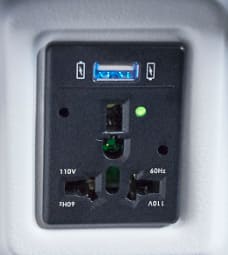
With traditional outlets you also inherit the whole legacy mess of competing standards for power mains. You don't want to feed 240V to a NEMA 1-15 outlet and melt someone's device mid-flight.
I do wonder if in some far future we'll just replace wall outlets with USBs for ordinary appliances, reserving traditional outlets for major power draws like stovetops, HVAC, industrial equipment etc. Maybe planes are the vanguard of this future?
The only question is if the rules will mind the difference in battery composition and chemistry.
Every one I have owned has been recalled for being a fire hazard. EVERY SINGLE ONE. I stopped buying them as a result. We're talking name brand devices, not junk off AliExpress.
ICAO Technical Instructions (Part 8, Table 8-1 amendment):
“Spare batteries, including power banks: must not be recharged on board the aircraft; should not be used to charge portable electronic devices on board the aircraft; the number carried is limited to a maximum of two per person.”
In China (Mainland of course), they will toss your powerbank at security if it isn't approved, and the approval they are using is rather recent and Chinese specific, thankfully most recent powerbanks made in China have the approval. They are very efficient in snuffing out powerbanks also, their thoroughness would definitely make our TSA blush.
> But the onboard outlets were good enough for anything I needed to do during the 15+ hour flight.
Only if those plugs are actually working....sigh.
Hence why many places bring a container filled with water to extinguish an EV fire, and then probably send it to a wet shredder to make sure it doesn't re-ignite.
We cut the rate of fire (already low) in half by containing compromised batteries. It’s something like 0.02%-0.03% which is significant given the massive scope. Something like 200k devices and about 3% with battery issues of all types.
When you think about the number of flights, passengers with lithium batters and challenges of the airplane environment, it’s a hard problem. We’re lucky the engineering around these devices are as good as it is.
Paragraph 4.3.3:
> While data indicated that portable electronic devices were more often the cause of fire in aircraft cabins than power banks were, the latter were a significant concern due to their increased use and a prevalence of lower-quality products with defects or vulnerabilities that were more likely to lead to thermal events. Power banks were also not offered the same level of protection that batteries installed in portable electronic devices were provided. The amendments therefore focused on power banks.
Another reason is that phones get replaced more frequently, whereas a power bank will be continually used essentially until failure. I only stopped using my last power bank because it puffed up like a balloon.
But yes, probably where this is all headed is that some day in-seat power will be banned so that you can only discharge and not charge your devices.
I recently took a flight where I had a laptop, my phone, a power brick, a new power brick for my wife, a second phone (for reasons) and a battery for a piece of ham radio equipment in my backpack. As I got on the plane, I was thinking I was probably one of the risker passengers on board :) Anyway, when I use the brick, I keep it zipped in a jacket pocket with just the charing cable coming out in an effort to keep it from finding its way to a place that it shouldn't.
Yeah, and it's the other one that is the main problem. It is simply impossible to know the quality of a power bank by looking at it.
> China banned non-CCC certified (the equivalent to UL or CE)
And it costs nothing to stamp the logo as if you're certified without actually going through any certification. Powerbanks are almost expendable, and can be acquried from supermarkets, corner shops, airports, even night clubs. There are even disposable ones (horrible idea). The more complex and expensive the device (like a laptop), the more certain can you be that there will be at least some quality control. In a $5/5eur powerbank, which any one could potentially be, it's almost guaranteeed there would be none.
that’s not fully true though, ROMOSS is the brand that sold power banks caught fire, however all of those were CCC certified.
Samsung says they will ship some solid state batteries in watches and earbuds this year, where the batteries are so tiny they're affordable. Even solid state batteries for phones are still too costly. Everybody in the industry is trying to solve the production price problem. Consensus is that the price starts to come down around 2028 or so.
Lithium iron phosphate batteries don't have a thermal runaway problem, either, but they have about half the Wh/Kg of lithium-ion, so they're not popular for portable devices.
Ten years out, lithium-ion batteries will probably be obsolete technology and totally prohibited on aircraft.
They sent in multiple cells for lab testing, but more importantly the second Donut demo was a motorcycle charging.
Fun fact though:
> Between 1831 and 1834, Michael Faraday discovered the solid electrolytes silver sulfide and lead(II) fluoride, which laid the foundation for solid-state ionics. Through his research, Michael Faraday took note of these solid compounds transitioning from insulators to conductors after being heated. While this would take almost another century to be acknowledged by Michael O'Keeffe in 1976, this mixed ionic/electronic conductions became the first record of a solid-state battery
(emphasis mine)
The real production solid states are made with inorganic materials, many not in pouches nor cylinders, and has wild environmental resistance like supporting charges in -55 to +125C(-70 to +260F) which won't be possible with most water inside.
That's not actually how it works though, it's all a risk and percentages. Nobody says "driving is either safe or it's not" or "delivering a baby is either safe or it's not"
To make it clearer, imagine another context: "It's dangerous for a passenger to have a gun on board. Therefore, we're strictly limiting passengers to only two guns."
Like, no. The relevant sad case is present with one gun just as with two.
Of course, what complicates it is that these power banks present a small but relevant risk of burning and killing everyone on board. So yeah, you might be below the risk threshold if everyone brought two, but not three. So it's not inherently a stupid idea, but requires a really precise risk calculation to justify that figure.
Someone bringing 150 "lipstick" single-cell promotional chargers -> bad
Someone bringing one phone and one laptop battery pack -> OK
If you are limited to two, you are probably not bringing anything that is near e-waste quality.
Two powerbanks contain the same amount of energy as a hand grenade.
Maybe there is enough plane onboard capacity to deal with just 50 batteries, let's say; multiply the failure rate expected and the pax capacity of the plane and you get how many batteries you can afford to have onboard and still be able to deal with worst case scenario.
What you're saying is equivalent to claiming that this quantity is somehow independent of n.
If LiPo was the issue, using LiFePo4 or LTO cells for planes would be a totally reasonable alternative too. LTO cells are so safe the manufacturer of them has videos on youtube of them hammering nails into the cells, cutting them with a saw, and crushing them with a press and they don't really care.
I've seen many spicy pillows and even a thermal runaway or two on the flatpack batteries.
Although honestly how bad is it, powerbanks are very popular, I can imagine in some regions there'd be hundreds of flights taking off daily with 150+ power banks on board (the majority of passengers on a 737), and they've all landed safely.
In my city, I could scan a QR code and pay the parking meter that way. Now they've decomissioned this and you have to go to the app and select the section of the road you're parked at. Why, because scammers made scammy QR codes. Great tech, can't have them because humanity's inherent scumbaggery.
Naturally you will ask, what about tablets and laptops? They are prohibited from checked luggage for this reason. Power banks however are smaller and easier to conceal.
The risk is really in a fire developing in your bag down below in cargo, where no one can see it. By the time the fire alarms go off, it's too late and good luck if you are over water or the Arctic. If it happens upstairs they can at least tend to it with a fire extinguisher or bag/blanket.
See ValuJet Flight 592, fire in an airplane's cargo hold is probably one of the scariest ways to slowly die.
It's all about corralling risk. You can't tell people they can't bring their laptops. But power banks are unnecessary nice-to-haves.
Agree that China TSA equivalent > US TSA.
A mitigation is anything that reduces the probability or the severity of a risk. There are different categories of mitigation, some of which are more robust than others. Once the risk score moves below the acceptable threshold, the risk is satisfactorily mitigated.
Example: Rapid depressurization. Without mitigation, the risk of rapid depressurization is unacceptably high. So we mitigate the probability by requiring sensitive inspections for metal fatigue, and we mitigate the severity by providing oxygen masks, a standard flight crew procedure for making an emergency descent, and regular training on that procedure. (Plus a bunch of other things I'm not thinking of off the top of my head.)
Assuming ICAO did their due diligence - and I don't have any reason to think they didn't - they would've assessed the probability and severity of all of the ways a consumer power bank might fail. That analysis is the rationale for both the number of power banks allowed on a flight and what you're allowed to do with them. And yes, they will have considered the probability of people not following the rules (which is the reason, btw, that airplane lavatories have enormous "no smoking" signs right above an ash tray).
They have until Tuesday.
I’m not sure what you mean; when I Ctrl+F “shampoo”, this is the only hit I see.
I'm generally not a proponent of draconian regulation but I firmly believe that any electronics handling substantial voltage not approved by UL or similar should be rejected at the border. It's all dangerous and incentive to manufacture it needs to be curbed.
With that said, it can be even worse when it isn't listed.
It's made in Cyprus (EU) and has apparently received some EU funding. Using Google Search AI mode and asking what is CEO Sergey Shek connection with Moscow Radiological institute gave me following reply.
"The connection between Sergey Shek, the founder of Radiacode (formerly Radiascan), and Moscow's radiological research centers is primarily rooted in his and his team's professional and academic history. The key points of connection are:
    Academic and Professional Origins: Radiacode’s founding team consists of Russian physicists and engineers who were educated and began their careers at prestigious scientific institutions in Moscow. These include researchers formerly associated with the N.N. Semenov Federal Research Center for Chemical Physics and other centers specializing in nuclear physics and spectroscopy.
    Early Product Development: The company's initial products, such as the Radiascan-701, were developed in Russia using the technical expertise gained at these Moscow-based institutes. The technology behind their current high-precision scintillation detectors stems from this scientific background.
    Relocation and Independence: Following the start of the conflict in Ukraine, the company officially rebranded as Radiacode and shifted its headquarters and operations to Cyprus and the United Kingdom. Sergey Shek and the company have sought to distance themselves from Russian state institutions to operate as a global, independent entity.
Russian background didn't sound good to me for obvious reasons. Thus I did not install app to my daily driver phone and use a separate Android device for this app. But the device is nice and app quite good for what I've used it.
Adding: You can find videos about the device from Youtube.com
At least in that case, no corporate executives were executed (I was living in China at the time so followed the case closely):
Those Executed:
Zhang Yujun: A farmer convicted of producing and selling over 770 tons of melamine-laced "protein powder" to dairy wholesalers.
Geng Jinping: A milk collection center manager who added the toxic powder to fresh milk before selling it to major dairies like the Sanlu Group.
Corporate Executives: The highest-ranking executive involved, Tian Wenhua (former chairwoman of Sanlu Group), was sentenced to life imprisonment rather than death. Other executives received prison terms ranging from 5 to 15 years.
Other Penalties: A third man, Gao Junjie, received a suspended death sentence (which typically commutes to life in prison), and several others received life sentences or long-term imprisonment.
What about the rest of us?
That kind of fraud is oftentimes only a fine in many other nations.
What about power banks from India? Vietnam? Malaysia? Korea?
That's what I'm saying. If there are nations where you can get away with it, then those power banks can end up in Western, African or South American markets.
(I'm counting getting a fine, or paying a bribe, as getting away with it. I don't really consider those punishments that will provide sufficient deterrent.)
Maritime patrol aircraft like the P-8 already have such a system, for releasing sonobuoys and float-flares while at altitude.
So it's not a technical issue, more one of regulation and maintenance.
Meh, it's a risk reduction thing. Aircraft sometimes dump fuel too in emergencies: https://en.wikipedia.org/wiki/Fuel_dumping
Earth is covered with a lot of water too, if you could eject it... risk is approaching zero on dumping a flaming battery over ocean.
There are plenty of good cell manufacturers that won't have problems in this current dumping situation (and will have certain passive protections like a CID to cut the current if it gets too hot). Problem is people like cheap and there are sketchy knockoff cells without those protections and shoddy manufacturing quality.
If there was anything recently that forced the change it was probably the CT scans of the Haribo battery packs showing the cathode/anode overlap. This sort of thing should spook airlines.
Do we still have UL? Do they test battery packs? Why not make it a requirement to only fly with ones that pass lab testing like UL?
> If there was anything recently that forced the change it was probably the CT scans of the Haribo battery packs showing the cathode/anode overlap.
It seems to be this, and yeah, it seems actually bad:
https://www.theverge.com/news/818906/haribo-gummy-bear-power...
https://practical.engineering/blog/2025/4/15/when-kitty-litt...
Sounds like the cleanup costs were largely related to the fact that the reaction caused an airtight drum to explode and spew radioactive waste throughout the facility, though, which presumably wouldn't apply to the "metal fire on an aircraft" scenario.
I'm curious what would actually happen, worst case.
Assuming the metal fire couldn't be extinguished, could it at least be contained to melt a small enough hole in the aircraft to safely land?
My guess on the plane scenario, there are enough secondary effects (smoke, insulation/trim/carpet/seats catching on fire) that would bring down the plane. but I don't think a personal battery has enough fuel to burn thru. I think the isolation bags are probably just aluminum(perhaps steel) foil. enough layers to let the infernal thing burn out without catching anything else on fire. You probably still get a lot of nasty smoke.
I try not to keep any in drawers but possibly in one open place and having fire blanket close to that stand.
Fire blanket would not help much for thermal runaway but I guess it would be better than nothing for containment or at least getting that one away from all the other batteries so they don’t chain react.
We had an incident where a laptop with a swollen battery fell and lit up in a public way. It attracted attention and some research was done - they realized it happened a dozen times a year. Hazardous disposal options vary by location. So the question became… what should be done with these compromised batteries before they get disposed of?
It’s a simple thing that costs nothing. It’s like a fire extinguisher to me - I’ve never experienced a fire at work, yet we have extinguishers and exit signage everywhere.
That said, the rate of burning batteries is very low. (Like 0.001%) Unless you have a ton of people and different use profiles, you’ll never see this happen.
Clearly, battery packs have more legit utility for more people at much lower risk than a bomb.
It's not fallacious, it focuses the issue, and in this particular case shows that it's not about "binary thinking" it's about risk.
And my original puzzlement continues. At what level of risk, does limiting the number of devices on board to 500 or even more, actually accomplish anything?
If they're not all that dangerous, then why limit them at all? And if they're dangerous enough to limit at all, why in God's blue sky, would you allow that many of them on a plane?
We don't limit people to 1 knife per person, even though knives have utility to a lot of people who carry one with them every day.
Because it's a numbers game... the original order itself even acknowledges that the problem is not unique to power banks, but that what makes power banks unique is the amount of increased risk they pose compared to other devices, due to a higher ubiquity of them in general, and of low-quality unsafe ones.
If laptops were catching fire with the same frequency, they'd ban those too, but they're not. They technically can be made just as unsafe as power banks, but they usually aren't, and this directive is based on the frequency of occurrence of a particular type of device, not a general "what if" strategy.
Banning all electronic devices would be extremely unpopular and possibly tank their sales. They're trying to balance safety with convenience at a level that is acceptable to most people.
* Less likely to be of the same low quality
* Less likely to all go off
* Less likely that someone is doing something malicious/suspicious with it
vs. someone who has 20 power banks themselves in a bag, in which case if one of them catches fire unexpectedly, they will probably all go up at once and create a cumulative effect much more dangerous than 20 individuals.
90% of powerbanks made are from mainland china. Worrying about powerbanks made outside of China is like worrying about guns made outside of the USA, theoretically possible, but those countries are so dominant and efficient in those fields that it is more of a "what if" rather than a real concern.
[1] https://www.tsa.gov/travel/security-screening/whatcanibring/...
It's a bit of a grey area on jurisdiction because FAA cares about flight safety (fires) whilst TSA is primarily looking for terrorists.
United Airlines, however, prohibits laptops and tablets:
* Remove any lithium batteries from electronic devices stored in checked bags.
* If batteries cannot be removed, these devices must be stowed in cabin bags only.
* Store any spare batteries in cabin bags.
[1] https://web.archive.org/web/20260129152627/https://www.unite...
I'd rather not test this theory because of your cavalier attitude while I'm in a chair 40,000 ft over the ocean.
E.g ANA: https://www.ana.co.jp/en/jp/guide/inflight/service/seat_plug...
Related Wikipedia page: https://en.wikipedia.org/wiki/EmPower_(aircraft_power_adapte...
It's already difficult enough to prevent people from making contact with the live parts when you're dealing with a plug and socket actually designed for each other. There's no hope in hell when you have ten extra holes.
So how do most European airlines have just that on their intercontinental flights?
I don't think I've flown intercontinental without universal power sockets (accepts EU & US plugs, sometimes others, voltage info hard to find) in the past 10 years.
In some cases it's sadly still a premium cabin thing. I refuse to fly economy at this point, premium eco tends to be good enough to get power sockets.
Almost all the international flights I've flown have had power outlets, always between 220V and 110V countries (heck, only Japan is 110V besides the US as far as I know).
I it works for China because they use (as an option at least) similar outlets to the USA (just ungrounded, pop).
Japan is an oddball by being 100V.
US is 120 and that extends pretty far south (and north).
https://en.wikipedia.org/wiki/Mains_electricity_by_country
I’m semi amazed motor vehicles are as standard as they are with 12V and the same socket worldwide. I guess the tobacco industry is a great unifier.
I find the standard voltages pretty interesting. The 230 V standard, for example, is mostly a lie. In reality, Britain and former British colonies tend to run on 240 V, and continental Europe/Asia/Africa tends to run on 220 V. The 230 V standard includes wide enough tolerances so that no one needed to actually change anything. I've never actually seen 230 V, the supposed standard, in real life.
NATO compliant vehicles are 24 volt as far as I know
How, exactly? The airlines have absolutely no way to know what shoddy electrical device you bought god-knows-where you're plugging into mains power in their airtight travel-coffin, packed with hundreds of people, hurtling across some ocean.
> Almost all the international flights I've flown have had power outlets
Seems deeply unusual to me, but I won't dispute your experiences. I've flown internationally fairly often, and in my experience power outlets are rather uncommon (at least in the eastern hemisphere, flights to/from the Americas may differ, I haven't flown around there for many years).
I'm kind of surprised by this. I have no idea how you would do this safely at scale.
You can't just slap some ungrounded 240V Frankenstein multi-socket on the back of a plane seat and call it a day. Hell, you can't even do that in your own house in most developed countries.
That's before you even get to passengers plugging in their own $2 socket converters off eBay, half-inserted and loosely hanging off your already-lethal socket. And then these passengers wrap themselves in a synthetic blanket and go to sleep. What could go wrong.
We're not talking about some CRUD web app here, where being held together by sticky tape and prayer is fine and expected. This would actually kill people. Not exactly easy to deal with a smouldering corpse in the middle seat at 30,000 feet.
Edit: oh man I needed to scroll down, about a million people told you that hah.
I've just measured the voltage in a socket my home (Germany) and the multimeter says 231 V. (And it's nighttime, so no solar generation from houses in the neighbourhood potentially distorting the local grid.)
Without being able to grip any individual plug's prongs, any actual plug plugged into the socket will always hang from it. This exposes the top of the live contacts, now flowing with mains (!!) power.
> https://www.ana.co.jp/cont-image/common/etc/0059-lang-multi....
Look at the image above. Note the sheer size of those bottom holes, and remember that the socket can't firmly grip anything (compare the narrow US/Japanese holes, the diagonal Australian/Chinese holes, the circular European holes, the outer British holes - all overlapping but in different places). You are basically guaranteed to get exposed contacts.
This is just bizarrely dangerous on a transcontinental flight where you might be asleep, covered in blankets, etc. Given that this kind of socket would be illegal to install in your own home under most electrical codes, I have no idea why it's fine on a plane.
(And that's without getting into how this provides a completely incorrect voltage to most of the plugs, or how it encourages folks to try to shove non-compliant plugs into all that spare room, or the existence of plugs like Argentina's, that will fit but will be electrified on the wrong prong, etc etc)
You're argument about "exposed contacts" is absurd. The entire design of the US plug is exposed contacts. Anyone can and will find a way to use them in an unsafe manner. We allow people to eat with steak knives, despite them being able to cut their own jugular vein with them.
This socket does not provide "half" the power. It provides around 110 VAC to most outlets. Almost all devices you are going to be using are rated for 90 VAC-240 VAC. The frequency range is wide too, 47-63 Hz. Some of them work all the way up to 277 VAC as a rated voltage. The actual socket is incredibly complex and monitors for the presence of a load & the total current. Have you ever noticed the flight attendants know exactly who is using the plugs at what time? If you actually plugged a 240 VAC angle grinder into this plug, it would just turn off immediately.
This socket would be explicitly legal to install in almost any jurisdiction in the US so long as it has the right engineering documents. Equipping your home with these outlets would be so many orders of magnitude safer than normal wiring, although you could not run devices like a vacuum cleaner or a large appliance.
> You're argument about "exposed contacts" is absurd. The entire design of the US plug is exposed contacts. Anyone can and will find a way to use them in an unsafe manner. We allow people to eat with steak knives, despite them being able to cut their own jugular vein with them.
This is an absurd argument re electrical safety. We spend enormous time and effort idiot-proofing consumer-facing electrics, and for good reason, consumers are idiots, but even then they don't deserve to be electrocuted by mains power. "You eat with stake knives so you may just as well run barefoot through razor blades" is not a good faith argument.
> Almost all devices you are going to be using are rated for 90 VAC-240 VAC.
For a narrow range of modern tech devices with adapters, sure. For the average electrical appliance that people grey import from Alibaba or buy roadside in Kuala Lumpur?
"Almost all" - how many percent, exactly? Are you just thinking of your iPhone charger? Or are you thinking about some cheap night light that some mum is going to plug in because her kid is scared to fall asleep without it, or some Soviet-grade portable hand heater that some elderly babushka carries around with her?
This is typical engineer blindness. "Well the elderly semi-literate Russian babushka should obviously have known that her GOST 7396 space heater from some souk in Dushanbe was not one of the devices I was imagining when I put together my utterly-non-compliant Frankenstein socket..." Really? Why? Is that going to be persuasive to anyone?
> Some of them work all the way up to 277 VAC as a rated voltage.
What's even your point here? That high voltage devices... exist? What does that have to do with anything?
> This socket would be explicitly legal to install in almost any jurisdiction in the US so long as it has the right engineering documents.
And murder is explicitly legal to commit! (Terms and conditions apply, must be wearing camo and be pointed vaguely in the direction of the Strait of Hormuz.)
Your argument is almost entirely just trivia, and not even categorical trivia at that. 'Well, almost all devices do this...', 'some even work all the way up to... ', 'so long as the right documents are provided...'. These are not acceptable standards when dealing with the public. Consider that 'almost all' people do not steal, and yet we fill public spaces with security cameras.
When dealing with risk, you don't just consider likelihood and call it a day, you consider severity too. An event with potentially catastrophic consequences is something one takes seriously, even if deeply unlikely. There are probably tens of thousands of unsophisticated people in the air every second of every day, wanting to plug in their vape chargers and portable hand fans and god-knows-what-else.
When your Frankenstein socket - which quite explicitly adheres to no safety standard whatsoever - inevitably fails and causes property or health damage, and you're trying to explain why you ever thought it was a good idea to some safety auditor or, God forbid, a judge, how far do you think your steak knife analogy is going to take you? Or the curio that 277 V devices exist? Or the fact that this is illegal to install in a home, but you think you could get a special permit to do so - well, y'know, not after this incident, your Honour, but sort of abstractly speaking...