Artemis II is not safe to fly(idlewords.com) |
Artemis II is not safe to fly(idlewords.com) |
Columbia and Challenger crew totaled 14, who else are you referring to?
The key is that there's no honeycomb providing key structural support to the "honey."
Orian is everything erong with US technology development and procurment.
if author is reading this, you should fix this maybe.
/s
Humans in space are currently still a waste of time/money, largely just a big surrender to PR, space-selfies, the attention economy, and the general emphasis on "seem not be" you see elsewhere. Please just send robots, build a base, and let us know when we can put more than ~10 freaking people up there at one time. If that fails, then at least we'll have results in robotics research that can be applicable elsewhere on Earth right now as well as help us achieve the more grand ambitions later.
House is on fire, has been for a while, fuck business as usual. I honestly think all those smart people ought to be charged with things like using their operations research to improve government generally, or with larger-scale high tech job programs. If you don't want to let NASA big-brains try to fix healthcare, we could at least let them fix the DMV. Hell, let them keep their spin-offs too, so they actually want success, and have some part of their budget that won't disappear. Basic research and fundamental science is (still) something we need, but we need to be far more strategic about it.
Food for thought: The way things are going, we can definitely look forward to a NASA that's completely transformed into an informal, but publicly funded, research/telemetry arm for billionaire asteroid-mining operations, and thus more of the "public risk, private-profits" thing while we pad margins for people who are doing fine without the help. OTOH, if NASA is running asteroid mining businesses at huge profits, then they can do whatever they want with squishy volunteers as a sideshow, and maybe we'll have enough cash left over to fund basic income.
I'm tired of nickle and diming science funding. You had scientists like Sabine Hossenfelder cheerleading NSF cuts cause of "waste" on string theory and particle accelerators. NSF is 0.1% of the federal budget, and it has funded a remarkable number of world changing inventions over the last 40 years.
We don't spent JACK on space. Look at the huge returns from the Hubble and James Webb. Why aren't we building HUGE HUGE space telescopes as immediate followups? We should have 50 James Webb equivalents. NASA once had plans for a "Terrestial Planet Mapper", a bunch of giant space telescopes flying in formation that combine their signals for truly incredible resolution, good enough to image planets around distant solar systems to a few pixels.
We've now seen plenty of planets in the habitable zone with nearby signatures of biological precursor molecules. We've found asteroids with sugars and amino acids in them. Give NASA 10x the budget and end these damn wars. The Pentagon failed 7 audits and can't account for $2 TRILLION and we're talking about humans in space a waste? It's a drop in the bucket, and it provides a beacon for humanity to dream.
The Apollo projects created a whole generation of people who wanted to go into STEM, that's the biggest ROI.
NASA, the NSF, the NIH, et al, are not the problem. Their spending is insignificant, NASA+NSF is < 1% of the budget.
As for defense spending, to be clear I'm all for swapping the pentagon/nasa budgets, but afterwards I'd still call bullshit if I think there's gross mismanagement at NASA. Pandering to the public with space-selfies is mismanagement, even if it's brought on by desperation and shrinking budgets. I think there's a strong argument Webb was also is bad strategy / mismanagement, but it's too long to get into here.
Unfortunately, like everyone else, NASA, NSF et al do need to worry about public trust, ROI, and the dreaded question: What have you done for me lately? There's this idea that basic research must be incompatible with that sort of thing, but I disagree.
Not only that, for truly long term perspective its about mankind survival. Even that POS musk realizes that (at least he did, not sure where his psychosis got him now and don't care much TBH).
If we stay around just Earth, we will be eventually wiped out. Maybe not in next million years (or maybe yes), but but given enough time one of many ways that would happen will happen, from the sky or from processes happening purely down here, manmade or not.
Its not rocket science, its not some magical theoretical what-if, just hard facts when digging around a bit and looking at history. Anybody who has power to change things and decides not to should be treated accordingly.
[0]: https://en.wikipedia.org/wiki/Timeline_of_the_far_future
Of course, six decades later, we should be able to do a lot better.
I didnt know, cus I just dont give a shit about this stupid project.
You think that was her wish? Typical situation is "We only get X, too much of it goes to Y, which is bad for Z". Of course X is not negotiable in an upwards direction, Y is some entrenched status-quo that's difficult to change, and Z is lots and lots of stuff. Everyone who cares about Z attacks Y because they can't increase X and don't expect they can decrease it (although sometimes just calling attention to the zone does that anyway).
DOGE is/was stupid and awful, not for their mission, but because of their methods, missing skill sets, sheer repugnant criminality, etc. As a general rule in any push for efficiency you'll be way better off exercising a little creative intelligence rather than doing straight austerity anyway. And while I don't think the entire government should be run like a business, why isn't more of it self-funding? So maybe let serious people with good intentions at NASA or NSF do DOGE-style work, creating tech or process that cuts costs for other less intellectually-gifted sections of the government, and then let them keep half of what they save the tax payers. Half of what they save could triple their budget! It's not ideal to use our best and brightest this way honestly, but house on fire, you work with what you have at hand.
There are rumors (that I've never been able to run down) that the astronaut corps insisted on this so the Shuttle could not be flown unmanned.
The outcome doesn’t determine the risk. I agree that this kind of office politics / face savings definitely is the cause of these two things.
Bureaucratic requirements and institutional jockeying largely ballooned the Shuttle into something it was never supposed to be.
They don't? They sure seemed to back when they ignored the engineers and launched Challenger, and again with Columbia. And those were times when the country had competent political leadership instead of a complete clown-show.
I have very, very little faith in NASA at this point after seeing how much the administration has wrecked other federal agencies like the CDC and NHS. There's no way I'd fly on that thing.
So, rushing, to fulfill an arbitrary PR schedule dictated by further chasing of the yesteryears of America instead of calmly evaluating "what did we screw up, what needs to be fixed, and what can we do about it in order to bring this into reality, safely?"
"Things of quality have no fear of time" should be carved into the walls at NASA.
Orbital mechanics are not something you can just intuit, but are pretty simple.
Learn about Delta V. Play some Kerbal space program. View this diagram:
https://upload.wikimedia.org/wikipedia/commons/9/93/Solar_sy...
The ISS isn't listed but the math doesn't change much for it VS the listed 250km earth orbit.
TL;DR
In space you can think of yourself as captured in an orbit. It takes a lot of energy (fuel) to boost yourself out of that orbit and flying towards some other body. But after that, you have to also expend more fuel to actually be captured by that orbit. The returning craft would have to expend energy to be captured by the earth's orbit to rendezvous with the ISS, rather than just hit earth and land.
Surely there is a difference between "our engineers did the best they could and the mission has a X% chance of failure" and "management overrode the engineers so they can get a launch in before the program is shuttered."
THEY REUSE THESE CAPSULES?!
This whole project seems pretty lame.
This seems like the only one, and according TFA, it sucks.
"do not let safety be the enemy of progress"
aka some of you may die but I'm okay with that and will sleep fine
https://www.nbcnews.com/news/us-news/interim-nasa-head-tells...
Not that I expect that to happen, but worth keeping in mind in case something horrible happens. NASA wouldn't be the only one responsible for lost lives.
Starliner was not safe to fly either, thrusters couldn't be trusted, but Boeing and NASA managed pushed on and decided to fly anyway. The flight demonstrated that the problems were bad indeed. NASA communications pretended things were not good but not disastrous.
Turns out things were much worse than NASA and Boeing wanted to admit: https://arstechnica.com/space/2026/02/nasa-chief-classifies-...
“Starliner has design and engineering deficiencies that must be corrected, but the most troubling failure revealed by this investigation is not hardware,” Isaacman wrote in his letter to the NASA workforce. “It is decision-making and leadership that, if left unchecked, could create a culture incompatible with human spaceflight.”
Still, after astronauts Butch Wilmore and Suni Williams eventually docked at the station, Boeing officials declared it a success. “We accomplished a lot, and really more than expected,” said Mark Nappi, vice president and manager of Boeing’s Commercial Crew Program, during a post-docking news conference. “We just had an outstanding day.”
The true danger the astronauts faced on board Starliner was not publicly revealed until after they landed and flew back to Houston. In an interview with Ars, Wilmore described the tense minutes when he had to take control of Starliner as its thrusters began to fail, one after the other.
One thing that has surprised outside observers since publication of Wilmore’s harrowing experience is how NASA, knowing all of this, could have seriously entertained bringing the crew home on Starliner.
Isaacman clearly had questions as well. He began reviewing the internal report on Starliner, published last November, almost immediately after becoming the space agency administrator in December. He wanted to understand why NASA insisted publicly for so long that it would bring astronauts back on Starliner, even though there was a safe backup option with Crew Dragon.
“Pretending that that did not exist, and focusing exclusively on a single pathway, created a cultural issue that leadership should have been able to step in and course correct,” Isaacman said during the teleconference. “What levels of the organization inside of NASA did that exist at? Multiple levels, including, I would say, right up to the administrator of NASA.”
Some of NASA’s biggest lapses in judgment occurred before the crew flight test, the report found. In particular, these revolved around the second orbital flight test of Starliner, which took place two years earlier, in May 2022.
During this flight, which was declared to be successful, three of the thrusters on the Starliner Service Module failed. In hindsight, this should have raised huge red flags for what was to come during the mission of Wilmore and Williams two years later.
However, in his letter to NASA employees, Isaacman said the NASA and Boeing investigations into these failures did not push hard enough to find the root cause of the thruster failures.
And so on. Lots of parallels with the Artemis program, though in Artemis Isaacman doesn't seem to be following his own conclusions from the Starliner failure.
There are a lot of funerals in chapter 1 of Tom Wolfe's book, "The Right Stuff".
I suggest that some choice of profession come with a higher life-risk tolerance than others. "Accountants willing to risk their lives for the job" would be news. Firefighters, less so. Test pilots or astronauts, not much at all.
Neither of these are major risks compared to never being what you want to be.
I want you to repeat those words as you melt away re-entering the atmosphere.
Humans don't seem to learn in the way we think or what them to
For me, so long as the information is transparently discussed with the astronauts they can agree or disagree. But the task is intrinsically extremely risky.
It makes it very challenging for anyone to really know how to balance those risks.
The peak outcome (modal, mean at least) is a good outcome. But the tail is very very long with all the little ways a catastrophe can occur. I think the median outcome is also deeply in the "good" category.
And we sample this curve a few times a decade!
It doesn’t make any sense to spend that much money on something that’s still Russian roulette for the astronauts.
If the purpose of the human risk is to let the agency accomplish more, then it needs to be reflected in the cost as a drastic reduction (so you can actually spend the money on doing more). Now Artemis is the worst of both worlds.
Sure it does.
We've got billions of humans to spend on getting humanity out of its gravity well. We can and will spare a few more.
Getting humanity out of our gravity well is the most important task this species faces, along with stabilizing our use of the resources in this one. https://nickbostrom.com/papers/astronomical-waste/
If you're not willing to spend a few lives on this problem you're not serious about the problem.
Let the astronauts give informed consent. If they mission is to dangerous for NASA then we can only hope, ISRO, CNSA or ROSCOSMOS will go.
This is the most frustrating part. The Pentagon can fail the same audit multiple times and be missing trillions of taxpayer dollars but NASA has to move heaven and earth to show their relatively paltry $100B budget isn't going to waste. I'm tired of the double standards.
Are you sure about that?
https://spaceflightnow.com/2022/05/24/spacex-swapping-heat-s...
Then again I'm not one of those people who roots for NASA to fail for some reason.
And this is definitely concerning stuff
In fact it's worse for the astronauts, because in this hypothetical only the heat shield failing will condemn the POs to death, whereas any critical part failing kills the astronauts
Yes, it's a much sexier job than project manager, but clearly there are some people, in some circumstances, that would accept it.
If they had set out to replicate the Moon landing at much lower cost and a controlled risk, that could have been different. Now they ended up with a very expensive, unsafe, and uninteresting mission - the worst possible combination.
Or Extend the mission to something novel? Some how without ballooning the project?
Neither is possible in the slightest.
For what it's worth the Apollo program adjusted for inflation is pushing 200bn USD compared to Artemis 100bn.
The Artemis programme is far safer than the Apollo program in terms of risk, Apollo sampled a much flatter high risk curve just 7 times.
Bottom line let the Astronauts decide what they consider safe enough they're very smart people and deserve to be allowed to give informed consent.
The Shuttle deaths no problem.
They had a heat shield on the capsule that failed testing, so they swapped out the interchangeable heat shield for one that passed testing.
There was no entirely new design, there was no new material science, it was the same heat shield that the previous crewed capsules have used without the manufacturing defect.
I don't know what "new" or "different" or "updated" or "structure" mean then anymore.
obviously that isn't true -- it aims to be relatively safe
...but in any case - it aims to bring humanity to the moon. That's the aim. Keep your eye on the prize.
"It is very risky, and we are intimately [aware] of that risk"
ie It's not perfectly safe, and the astronauts are well aware of this fact.
"do what scares you...that's why I'm [on artemis]"
clearly very risk-aware.
This broken safety culture has been around since the beginning of the Shuttle program.
In 1980, Gregg Easterbrook published "Goodbye, Columbia" in The Washington Monthly [1], warning that NASA's "success-oriented planning" and political pressure were creating the conditions for catastrophe. He essentially predicted Columbia's heat shield failures in the article 1 year before the first flight.
Challenger in 1986, and the Rogers Commission identified hierarchy, communication failures, and management overriding engineering judgment.
Then Columbia happened in 2003. The CAIB found NASA had not implemented the 1986 recommendations [2].
Now Charles Camarda (who flew the first shuttle mission after Columbia and is literally a heat shield expert!) is saying it's happening again.
[1] https://www.iasa-intl.com/folders/shuttle/GoodbyeColumbia.ht...
[2] Columbia Accident Investigation Board Report, Chapter 8: https://www.nasa.gov/columbia/caib/html/start.html
It's broken everywhere. I have worked in some dysfunctional shops and the problem I see time and time again is the people who make it into management are often egoists who don't care about anything other than the financial compensation and clout the job titles bestows upon them. That or they think management is the same as being a shotgun toting sheriff overseeing a chain gang working in the summer heat in the deep south.
I've worked with managers who would argue with you even if they knew they were wrong because they were incapable of accepting humiliation. I worked with managers who were wall flowers so afraid of confrontation or negative emotions that they covered up every issue they could in order to avoid any potential negative interaction with their superiors. That manager was also bullied by other managers and even some employees.
A lot of it is ego along with a heavy dose of machismo depending. I've seen managers let safety go right down the tubes because "don't be a such a pussy." It's a bad culture that has to go away.
Even if it can't ever be truly fixed, at least recognizing the issues and shining daylight on decisions for some form of accountability should be a base-level approach.
> they were incapable of accepting humiliation
I agree mostly but here is a different take on it: I think these are normal human feelings and behaviors - not the best of us, but not unusual either. If we want to get good things done, we need to work with and through human nature. Power corrupts everyone and shame is generally the most painful thing for humans.
Putting people in a position where they need to treat their power with absolute humility or accept humiliation (and a major blow to their careers) in order to do the right thing is going to fail 99% of the time. (I'm not saying people can't do those things and that we shouldn't work hard and aspire to them, but it's not going to happen reliably with any but a few people.) That expectation itself is a culture, organizational and managerial failure. If you see a system in which so many fail, then the problem is the system.
And when I say 'managerial' failure, I include leadership by everyone and also 'managing up'. We're all responsible for and agents of the team's results, and whatever our role we need to prevent those situations. One important tactic is to anticipate that problem and get ahead of it, putting the team in a position where the risk is proactively addressed and/or they have the flexibility to change course without 'humiliation'. We're all responsible for the team's culture.
I think many blaming others underestimate their own human nature, the effect of power on them and their willingness to endure things like humiliation. Rather than criticising others, I keep my attention on the one in the mirror and on strategies to avoid situations equally dangerous to my own character; otherwise I'll end up doing the same very human things.
EDIT: While I still agree with everything I wrote above, there is an exceptional cultural problem here, one which you'll recognize and which is common to many SV leaders, the Trump administration, and others you're familiar with (and which needs a name ...). From the document referenced in the OP by "heat shield expert and Shuttle astronaut Charles Camarda, the former Director of Engineering at Johnson Space Center."
"Instead, the meeting started with his [Jared Isaacman, the new NASA Administrator's] declaration that the decision was final. We would launch Artemis II with a crew, even though the uncrewed Artemis I mission around the Moon returned with a seriously damaged heat shield, a failure in my opinion. I was not going to be allowed to present my position on why the decision was flawed. Instead, the public would hear, through the two reporters allowed to attend, the Artemis Program narrative, only one side of the story. They would be bombarded with technical information which they would have very little time to understand ...
Jared could claim transparency because the only thermal protection expert and public dissenter, me, was present. ...
I was allowed only one-day to review some of the technical documents which were not open to the public and which were classified Controlled Unclassified Information/International Traffic and Arms Regulations (CUI/ITAR) prior to the Jan.8th meeting. ..."
https://docs.google.com/document/d/1ddi792xdfNXcBwF8qpDUxmZz...
https://docs.google.com/document/u/1/d/1ddi792xdfNXcBwF8qpDU...
It’s pretty clear at this point that the shuttle was already broken at design. But seeing the same powder keg of safety/budget/immovable time constraints applied to a totally different platform decades in the future feels like sitting through a bad movie for the third time.
Reports are heavily redacted. They aren't shared. Failures aren't acknowledged. Engineering models aren't released. That secrecy eventually causes what we see today.
The more populated and complex an organization gets it becomes impossible to maintain a singular value vector (get these people around the moon safely)
Everyone finds meta vectors (keep my job, reduce my own accountability) that maintain their own individual stability, such that if the whole thing fails they won’t feel liable
We've spent the last several decades making sure that every single person trained to participate in commercial aviation (maintenance, pilots, attendants, ATC, ground crew) knows their role in the safety culture, and that each of them not only has the power but the _responsibility_ to act to prevent possible accidents.
The Swiss Cheese Model [1] does a great job of illustrating this principle and imparting the importance of each person's role in safety culture.
A big missing piece with manned space flight IMO is the lack of decision-making authority granted to lower staff. A junior pilot acting as first officer on their very first commercial flight with real passengers has the authority to call a go-around even if a seasoned Captain is flying the plane. AFAIK no such 'anyone can call a no-go' exists within NASA.
When you’re a rocket scientist at NASA, you also have relatively few alternatives other than SpaceX or Boeing.
The problem is that it is treated as if people's jobs are to do X. What happens when someone says given the problem constraints it's impossible to safely do X? The naysayers get replaced, X gets done anyway.
Actual safety only comes when there is an external agency who monitors safety and accomplishing X is not part of their objective.
Considering how much humanity has allegedly advanced since then, I don't understand what are we gaining thats caused us to have to abandon safety.
Narrators voice: there was, in fact, issues with safety culture at nasa between Kennedy's speech and the moon landing
https://ehss.energy.gov/deprep/archive/documents/0308_caib_r...
Why Buildings Fall Down: How Structures Fail by Matthys Levy and Mario Salvadori, a wide ranging history of structural failures of various kinds, and their causes.
Ignition!: An Informal History of Liquid Rocket Propellants by John Drury Clark, which is a personal memoir from a senior researcher with many decades experience developing rocket fuels - he is the proverbial Rocket Scientist. Most interesting, and amusing (in a morbid way), is the quite different culture of safety “back in the day” of this somewhat esoteric engineering/chemistry field.
(okay, I'll stop now!)
I'm wondering if every generation has to relearn the basics for themselves through experience.
Each generation has to make the same mistakes. Because book learning doesn't seem to do it for some things.
Inviting Disaster: Lessons From the Edge of Technology was one of the texts for an aerospace class I didn't take but friends did, but honestly you can just read the book.
There are lots of frameworks for teaching safety and programs for compliance and such but they are far too easy to cargo cult if you don't appreciate safety and the need for safety culture and UNDERSTAND what failures look like.
And when you really understand the need and how significant failures happened... "state of the art" tools and practices take a back seat, they can be useful but they're just tools. What you need is people developing the appropriate vision, and with that the right things tend to follow.
It seems that in modern times, humans focus on safety almost to the exclusion of everything else. As much as the more traditional salutations "godspeed" or "have a nice day", we're even more likely to hear "drive safe" or "have a safe trip" or "be safe".
We're very nearly paralyzed by insisting that everything must be maximally safe. Surely you've heard the mantra "...if it saves just one life...".
The optimal amount of tragedy is not zero. It's correct that we should accept some risk. We just need to be up-front and recognize what the safety margins really are.
If you’re interested in a heck of a good read, the Columbia Accident Investigation Report is a good place to start:
https://ehss.energy.gov/deprep/archive/documents/0308_caib_r...
It looks at the safety culture in NASA and at how that safety culture ran into budget issues, time pressure and a culture that ‘it’s always been okay’. But people were aware of the problems.
There’s a really frustrating example from Columbia where engineers on the ground badly wanted to inspect the shuttle’s left wing from the ground using ground based telescopes or even observations from telescopes or any other assets. There’s footage available was an email circulated where an engineer all but begged anyone to take a look with anything. That request was not approved - they never looked.
Realistically there’s a point to be made that NASA wasn’t capable of saving those astronauts at that point. But they had a shuttle almost ready to to, they could have jettisoned its science load and possibly had a rescue of some sort available. They never looked though but alarm bells were ringing.
It’s more accurate to say people are highly aware of safety but when you get a bunch of us together, add in cognitive biases and promotion bands we can get stuck in unsafe ruts.
> Moon-to-Mars Deputy Administrator Amit Kshatriya said: “it was very small localized areas. Interestingly, it would be much easier for us to analyze if we had larger chunks and it was more defined”. A Lockheed Martin representative on the same call added that "there was a healthy margin remaining of that virgin Avcoat. So it wasn’t like there were large, large chunks.”
Followed by:
> The Avcoat material is not designed to come out in chunks. It is supposed to char and flake off smoothly, maintaining the overall contours of the heat shield.
This is echoes both Shuttle incidents. Challenger: no gasses were supposed to make it past the o-rings no matter what, but when it became clear that gasses were escaping and the o-rings were being damaged, there was a push to suggest that it's an acceptable level.
There was a similar situation with heat shield damage and Columbia.
In both cases some models were used to justify the decision, with wild extrapolations and fundamentally, a design that wasn't expected to fail in that mode /at all/.
I know the points that astronauts make about the importance of manned space exploration, but I agree with this author that it seems to make sense to run this as an unmanned mission, and probably test the new heat shield which will replace the Artemis II design in an unmanned re-entry as well.
https://arstechnica.com/space/2026/01/nasa-chief-reviews-ori...
Camarda is an outlier. The engineers at NASA believe it is safe. The astronauts believe it is safe. Former astronaut Danny Olivas was initially skeptical of the heat shield but came around.
And note that the OP believes it is likely (maybe very likely) that the heat shield will work fine. It's hard for me to reconcile "It is likely that Artemis II will land safely" with "Artemis II is Not Safe to Fly", unless maybe getting clicks is involved.
Regardless, this is not a Challenger or Columbia situation. In both Challenger and Columbia, nobody bothered to analyze the problem because they didn't think there was a problem. That's the difference, in my opinion. NASA is taking this seriously and has analyzed the problem deeply.
They are not YOLO'ing this mission, and it's somewhat insulting that people think they are.
> That context is a moon program that has spent close to $100 billion and 25 years with nothing to show for itself, at an agency that has just experienced mass firings and been through a near-death experience with its science budget
And there are options now.
This is a strange claim, considering NASA used to have 2 facilities that were capable of this - one at Johnson and one at Ames. They were consolidated (https://ntrs.nasa.gov/api/citations/20160001258/downloads/20...) but it seems like the Arc Jet Complex at Ames is still operational https://www.nasa.gov/ames/arcjet-complex/
I changed projects bc it was obvious to that the risk was substantial, long befor Artemis was called Artemis, people said this.
> [...] previously known as Orion Flight Test 1 [...] Without a crew, it was launched on December 5, 2014 [...]
Ergo the mission design is wrong, not the heat shield design.
02/1967 - Apollo 1 fire
01/1986 - Challenger disaster (19 yrs later)
02/2003 - Columbia disaster (17 yrs later)
It's been 23 years since Columbia, and there seems to be a 20-ish year rhythm to NASA disasters where the organization learns lessons, becomes more careful... and then standards potentially slip.
I didn’t even have a strong interest in space before the dude started writing about it. Maciej could write about literal rocks and make it worthwhile to read.
Fun wording. This isn't news, concerns have been raised about Artemis II saftey in the past 3+ years since Artemis I and before then as well.
The flight risk is surely acceptable if this is not the first flight of many but the last.
Anyone know if there's a detailed response from NASA to the article?
The only thing the author of this blog piece has to offer that’s new is his very strong personal intuition that the new design hasn’t been properly validated, without any engineering explanation about why the testing the performed won’t adequately simulate real world performance.
"countdown clock started ticking down" "to a targeted launch time of 6:24 p.m. on Wednesday, April 1."
> NASA’s initial instinct was to cover up the problem.
to at least warrant a link.
reminds me of automotive safety recalls that trace back to "simplified" component designs. sometimes the old complex way was complex for a reason.
I’m not a rocket scientist, but then neither is the author.
https://docs.google.com/document/d/1ddi792xdfNXcBwF8qpDUxmZz...
Examples could be the Challenger disaster where managers overruled the engineers (who said in a meeting a launch was too dangerous) or the Boing 737max. Also a lot of companies in germany that I experienced (as employee and as consultant) seem similiar.
One reason could be (and I saw that myself) is that there can be a situation where the best employees start leaving. It's likely natural since they can find something else easier than the others.
Most people want nothing more than to complete a job to the satisfaction of their supervisor and go home for the day. When you get large groups of people together, this will always be the majority. Mission driven folks will always be crowded out of a large organization, replaced by careerists who play the meta game.
So would you say that every large organization is doomed?
I've snorted my coffee. I happens to any organization that's run by people who are only in it for power, not outcomes.
Is Orion’s heat shield really safe? New NASA chief conducts final review on eve of flight. https://arstechnica.com/space/2026/01/nasa-chief-reviews-ori...
  The Avcoat blocks, which are about 1.5 inches thick, are laminated onto a thick composite base of the Orion spacecraft. Inside this is a titanium framework that carries the load of the vehicle. The NASA engineers wanted to understand what would happen if large chunks of the heat shield were stripped away entirely from the composite base of Orion. So they subjected this base material to high energies for periods of 10 seconds up to 10 minutes, which is longer than the period of heating Artemis II will experience during reentry.


What they found is that, in the event of such a failure, the structure of Orion would remain solid, the crew would be safe within, and the vehicle could still land in a water-tight manner in the Pacific Ocean.Spaceflight is complicated. We don't know everything. There is a lot of unknowns that happen everytime you light off a rocket.
It is a lot easier for Elon, as the loss is only a pile of money.
Without ever working at NASA, I expect there is a week long "risk management prior to launch" meeting where many, many issues are brought up, discussed, and decided.
It reminds me of both the movies Capricorn 1 and Iron Sky ... and not in any good way.
When I was small, I used to have bad feelings about my parents getting in a car accident every time they went out. It never happened, and they lived into their 90s.
I had forgotten that O.J Simpson had been in the movie, to be honest.
Is there truly no engineering or science merit to flying astronauts by the Moon?
I think SpaceX used a piece of cheese in one of their test fliying arround Earth, just to show that the temperature was never outside a confortable range. They could have user the sensor they already had, but using the cheese too is good for PR.
Starship has only ever lifted 44k pounds, and most of it's more successful tests operate only with 35k pounds.
Does anyone know any more about this?
> but when it became clear that gasses were escaping and the o-rings were being
> damaged, there was a push to suggest that it's an acceptable level.
Interestingly, the article<https://docs.google.com/document/d/1ddi792xdfNXcBwF8qpDUxmZz...> by heat shield expert and Shuttle astronaut Charles Camarda, the former Director of Engineering at Johnson Space Center, asserts that it was *not* the O-rings:
"The Challenger accident was not caused by O-rings or temperature on the day of launch; it was caused by a deviant joint design which opened instead of closed when loaded. It was caused by mistaking analytical adequacy of a simplified test for physical understanding of the system. The solution, post Challenger, was the structural redesign of the SRB field joint and the use of the exact same O-rings."
I find that highly surprising, because "it was the O-rings" explanation seems universally believed and sanctified by no lesser authority than the Nobel prize laureate Richard Feynman.
Essentially you are mischaracterizing what Feynman did or say, although this is also Feynman fault :-), by doing the famous public demonstration, with the ice water in a glass [2], although even there he only said it has "significance to the problem...". In other words, we should not simplify, even for the general public, what are complex subtle engineering issues. This is also the reason why current AI, will fail spectacularly, but I digress...
Feynman documented the joint rotation problem in his written Appendix F, but his televised demonstration became the explanation...[3]
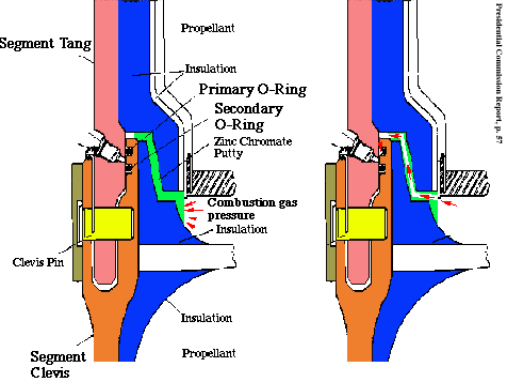
Camarda is correct here. There was a fundamentally flawed field joint design, meaning the tang-and-clevis joint opened under combustion pressure instead of closing. This meant the O-rings were being asked to chase a widening gap something the O-ring manufacturer explicitly told Thiokol O-rings were never designed to do. Joint rotation was known as early as 1977, a full nine years before the disaster.
The cold temperature made things worse by stiffening the rubber so it could not chase the gap as quickly, but O-ring erosion and blow-by were occurring on flights in warm weather too and nearly every flight in 1985 showed damage.
The proof is how they fixed. NASA redesigned the joint metal structure with a capture feature to prevent rotation, added a third O-ring for redundancy, and installed heaters but kept the exact same Viton rubber. If the O-rings were the real problem, you would change the O-rings. They did not need to.
The report [1] is public for everybody to read...but not from the NASA page... who funnily enough has a block on the link from their own page, so I had to find an alternative link...
[1] - https://www.govinfo.gov/content/pkg/GPO-CRPT-99hrpt1016/pdf/...
[2] - https://youtu.be/6TInWPDJhjU
[3] - https://calteches.library.caltech.edu/3570/1/Feynman.pdf
The o-ring failure was a measurable consequence of the joint design failure. The data behind the model didn't go down to temperatures as low as that at Challenger's launch date.
For more inappropriate extrapolation to justify a decision: the data for the heat shield tile loss model was based on much less damage than sustained by Columbia (3 orders of magnitude IIRC).
Now they are looking at the same style of fallacy and don't even have a model based on damage sustained in flights.
Another parallel I haven't seen discussed here yet, though I haven't read all comments: I recall Feynman feeling like he was on the investigation panel as a prop, that the intention of the investigation was to clear NASA of any wrongdoing. They used a model, considered risks, etc. Feynman recognized the need for a clear and powerful visual to cut through an information dump and pull it to front page news. The invitation of Camarda to a presentation with a pre-determined conclusion has the same feeling. I don't know what Camarda can do to put it on a (non-HN) front page today.
If you read Feynman's account in the book What Do You Care What Other People Think?, you'll see that he realized afterwards that he was prompted to make the demonstration he made at a NASA press conference--putting a piece of O-ring material in a glass of ice water, clamped with a C-clamp, and then taking it out and releasing the clamp to show that the material did not spring back--to get public attention focused on problems with the joint in a way that could not be ignored. But, as has been pointed out downthread, when the joint was redesigned, the new design did not change the O-rings at all. So the specific issue that was shown in Feynman's demonstration was not the issue that actually needed to be fixed. It was just a convenient way to show the public that there were problems with the joint, with a simple demonstration that everyone could understand. Trying to show the actual problem--that the entire joint design was fundamentally flawed and needed to be changed--would not have worked in a context like that.
Also I'm not sure the assertion is correct. If the sealant and O-Rings were adequate, the joint would not have failed. It was suboptimal, and increased risk, sure, but it in itself wasn't the reason for the accident. It was the joint and the o-rings in combination. The holes in the swiss cheese model lined up that day, and a lot of small problems combined into one big problem
I don't know how a big organisation can think like that. But I guess these calculations were ones out of millions of ones made for the project.
At this point in time, manned space exploration should come out of our entertainment budget. The same budget we use for football or olympic games.
I also looked up the NSF's 2024 budget, which, at $9B, was much lower than I expected.
NASA desperately needs more options. They shouldn't need to expend an SLS to launch an uncrewed Orion with a test heatshield on a trajectory equivalent to a moon return. They should be able to launch that on top of a Falcon Heavy. A Falcon Heavy can launch 63 tons to LEO and a fueled Orion plus service module weights slightly north of 20 tons. An Orion mass simulator with enough attitude control mated with a FH second stage would leave a lot of delta-v to accelerate the capsule back into the atmosphere.
Their inability at social cues will cut right through.
Works every time.
Happens often. Just look at the climate change discussion.
Because, and it speaks volumes that nobody ever circles back around to this, that is absolutely f-ing normal. If everyone ran around like the sky was falling every time some widget made it into service and some unexpected thing was noticed nothing would get done.
"hey we disassembled this gearbox and there's a little rust from condensation + chemistry = cyclic usage, we better take a look at it"
"we've taken a look at it and the corrosion is forming because X, this is fine because the surfaces that can't rust see lubricant flow and the per our calculations the maximum amount of rust into the lube is Y and since the service interval is Z this is fine, tests confirm this."
^ the above happened for a multimillion dollar per hour of downtime gearbox. That was 40yr ago. It was in fact fine. I know it was fine because they added venting suggestions to the docs and the client balked because they bought another one in the 2010s and a bunch of "we went over this when it was installed and it was fine then and the building is even more tightly humidity controlled than it was in the 1980s" back and fourth whining ensued.
You don't know how many other things they noticed when they put the shuttles into service that did in fact turn out to be perfectly fine. It's real easy to be smug in hindsight but good luck trying to pick the needle out of the haystack in advance.
Now obviously the shuttle people flubbed it and much has been writtenn about it, but the point still sands.
That there was blowby where there should be none was known, but nobody dug into why. There was no determination that it wasn't enough to be a problem, just an observation that it hadn't blown the booster up yet. For something with a wide spread in the data points, no way to model the maximum expected values.
Once they got serious about looking it didn't take much to reproduce the problem. They built a single joint, mostly filler inside, fuel to model the real thing during ignition. Maybe worked, maybe spot-welded, maybe complete failure. The colder the more likely to fail.
Landing on the moon in 1969 was an extraordinary achievement, perhaps the most beautiful thing ever done by mankind. But now? What's the point exactly?
We know we can't go much further than the moon anyway (as this very same blog has demonstrated many times); what do we expect to achieve with astronauts that robots can't do?
The foam shedding/impact problem was heavily analyzed throughout the Shuttle program, and recognized as a significant risk. Read the CAIB report for a good history.
That report also describes the groupthink dynamic at NASA that made skeptical engineers "come around" for the good of the program in the past. Calling Camarda an outlier is just a different way of stating this problem.
The NASA engineers wanted to understand what would happen if large chunks of the heat shield were stripped away entirely from the composite base of Orion. So they subjected this base material to high energies for periods of 10 seconds up to 10 minutes, which is longer than the period of heating Artemis II will experience during reentry.
What they found is that, in the event of such a failure, the structure of Orion would remain solid, the crew would be safe within, and the vehicle could still land in a water-tight manner in the Pacific Ocean.
Fundamentally space travel is not save, it cannot be (atleast at our Technological level) Space is unimaginably hostile to life. We cannot reduce this danger to zero.
You're getting clicks, they're going to the moon and there's a lot of people on Earth who would happily take any tradeoff for that.
From Camarda’s own account after the meeting:
> Hold a “transparent” meeting with invited press to “vet” the Artemis II decision with one of the most public technical dissenters, me, in attendance (Jan 8th, 2026).
> Control the one-sided narrative and bombard the attendees with the Artemis Program view
> Do not allow dissenting voices to present at the meeting
> Do not even allow the IRT or the NESC to present their findings
> Rely on the attending journalists to regurgitate the party line and witness the overwhelming consensus of knowledgeable people
The whole thing is a good read https://docs.google.com/document/d/1ddi792xdfNXcBwF8qpDUxmZz...
Characterizing someone being (slightly?) more diplomatic as “maybe convinced” is shameful.
Being pedantic, NASA management "ignored" engineers - because money.
That said, I 100% agree with you assuming:
> “We have full confidence in the Orion spacecraft and its heat shield, grounded in rigorous analysis and the work of exceptional engineers who followed the data throughout the process,” Isaacman said Thursday.
I only say assuming not that I don't believe Isaacman, but historically NASA managers have said publicly everything's fine when it wasn't and tried to throw the blame onto engineers.
With Challenger, engineers said no-go.
With Columbia, engineers had to explicitly state/sign "this is unsafe", which pushes the incentivisation the wrong direction.
So, I want to believe him, but historically it hasn't been so great to do so.
I think the problem with both Challenger and Columbia was that there were so many possible problems (turbine blade cracks, tiles falling off, etc.) that managers and even engineers got used to off-nominal conditions. This is the "normalization of deviance" that Diane Vaughan talked about.
Is that what's going on with the Orion heat shield? I don't think so. I think NASA engineers are well aware of the risks and have done the math to convince themselves that this is safe.
The design change by LM, not commentedkn by Textron is like. a beehive with no honeycomb-a crystallized block of honey.
i'll take the structural support of honeycomb any day.
It's a normalization of deviance. That is what Charlie is bringing voice to. Many of us fear reprisals and even when talking to heads of, like with Columbia, we are ignored.
So, Charlie is a voice of many people, not an outlier.
And the idea that 'if we throw this much money at it, it really must be fine' I don't buy either. Look at how that worked out for Boeing.
For all my feelings about Musk I would much rather step into a rocket that has exploded in all kinds of imaginable situations before so they know how the materials and design actually behave in real world scenarios. I do really think that is the way to go.
Definitely, but we still have to figure out if Musk is such a genious or NASA is full of retards.
And if it doesn't blow up due to heat shield failure, TFA (and its references) will be forgotten.
And if it does blow up due to heat shield failure, TFA (and its references) can suddenly claim prescience, all the while this is one of thousands of factors that went into the risk assessment. If one really wanted to claim prescience, it'd need to be a ranking of a sufficient number of failure modes.
To illustrate the problem: I hereby claim they will have a "toilet failure". Now if they actually have one, I'll claim `m4d ch0pz` in rocket engineering.
(P.S.: it's a joke but toilet failures on spacecraft are actually a serious problem, if it really happens… shit needs to go somewhere…)
https://news.ycombinator.com/item?id=47603657#47610348
In that case, go on claiming rocket engineering m4d ch0pz.
The HN hivemind will remember, he's a well known user with a well known site.
Let's hope there is no accident, but after the landing there will be reports anyway. We will take a look at the report of the shield and see if it shows a problem in spite it didn't explode, and compare with the prediction in the article. He may even write another article after the fly.
For comparison, I remember the Feynman appendix. One important detail was that Nasa said the the probability of accidents was 1/100000, but he concluded that it was closer to 1/100. Nobody expect to fly a hundred Artemis missions to get a good statistic. Even if the current version explosion rate is super high like 1/10, then you can probably fry a few missions without problems if you cross your fingers hard enough.
This take completely ignores Camarda's observations that there is a culture of fear spreading at NASA which punishes whistleblowers. I'm not saying he's 100% correct, but how can you claim such a take is truly balanced if there's a possibility one of the parties is engaging in a cover-up?
The engineers at NASA & astronauts aboard Columbia & Challenger also believed the programs were safe.
> What they found is that, in the event of such a failure, the structure of Orion would remain solid, the crew would be safe within, and the vehicle could still land in a water-tight manner in the Pacific Ocean.
Indeed, this is a much more balanced take. And it turns out that the OP armchair expert is assuming NASA doesn't know what they are doing or is negligent.
https://docs.google.com/document/d/1ddi792xdfNXcBwF8qpDUxmZz...
NASA is an institution and the incentives align with launching despite risk in cases where the risk was completely unanticipated. The project has its own momentum that it has gathered over time as it rolls down collecting opportunity costs and people tie themselves to it. If you think an astronaut would pull out of a launch because of a 5% risk of catastrophe... well you are talking about a group of people which originated from test pilot programs post-WWII where chances of blowing up with the gear was much much higher, so even though modern astronauts don't have the same direct experience, it isn't beyond reason to assume they inherent at least a bit of that bravado.
it doesn't matter.
https://en.wikipedia.org/wiki/Artemis_II
"It will be the second flight of the Space Launch System (SLS), the first crewed mission of the Orion spacecraft, and the first crewed mission beyond low Earth orbit since Apollo 17 in 1972."
such "second/first" were ok 60 years ago. Today the only reason for that is that the SLS isn't reusable while the cost is hyper-astronomical.
Today's tech complexity, engineering culture and overall managerial processes don't allow the first/second to succeed as a rule. Even the best - Space X - has got several failed launches back then for Falcon and now for Starship.
Of course we wish success, and it will probably succeed - just like the Russian roulette so aptly mentioned in the sibling comment.
I don't think you can compare the two. Starship's risks are so high failure is almost the expected outcome, it's a trial and error based process. Starship and Artemis is an apples/oranges comparison with respect to how the programs approach risk tolerance.
Look up the term "expected value". If pressing a button has a 10% chance of destroying Earth, it is both 1) likely that pressing it will do nothing AND 2) the case that pressing it is extremely unsafe.
The first Shuttle launch probably had a 1 in 4 chance of killing its crew. It was the first launch of an extremely complicated system and they sent it with a crew of two. Can you imagine NASA doing that today?
In a news conference last week, a NASA program manager estimated the Loss of Mission chance for Artemis II at between 1 in 2 and 1 in 50. They said, historically, a new rocket has a 1 in 2 chance of failure, but they learned much from Artemis I, so it's probably better than that. [Of course, that's Loss of Mission instead of Loss of Crew.]
My guess is NASA and the astronauts are comfortable with a 1 in 100 chance of Loss of Crew.
[edit]
For comparison, commercial aviation has something like 1 in 5.8m or 6x 9's of reliability.
The "likely" in "likely ...to land safely" and "likely to work fine" is not nearly good enough.
False on both counts. Both the SRB joint design issue and the foam shedding were known, researched and dismissed very early in the shuttle program. They suspected it after STS-1 and confirmed it within a few flights.
As he shows that Olivas changed his mind:
“ Olivas told me he had changed his mind, expressing appreciation and admiration for the in-depth engineering work done by the NASA team. He would now fly on Orion”
Anyway we live in an age of armchair experts in youtube (who are often very smart but quick to rush to judgment without enough context)
The article explains the situation in a more balanced and fair light
Would Columbus' ship ever have been allowed to sail in the modern day? Proximity wingsuit flying and free-climbing is legal and people choose to do it even though the probability of death is extremely high. Spaceflight is significantly safer and far more beneficial to humanity, yet we block it. No one counts the lives lost due to slowing scientific progress but we should. How much further behind would we be scientifically if Darwin hadn't ventured out on the Beagle due to endless safety reviews. Would the US be what it is today if Lewis and Clark had to prove to congress that the trip was safe?
Given the opportunity, many of us would choose to die as part of a grand adventure in service to humanity vs. wither away of old age.
Or to put it another way, if you were the manager on the day of the Challenger launch issuing the "go" command over the objections of the Thiokol engineers saying it was unsafe to launch in below-freezing temperatures, would you have done so with paeans to Christopher Columbus? That's the sense I get from your post.
Problems with the O-Rings had been known and on the morning before the challenger launched the engineers begged management to delay the launch.
They are YOLOing it. It is insulting that clowns like yourself continue to cover for them.
NASA lowers its standards every time an accident happens. When they designed Shuttle, they intended for a failure rate of 1 in 10,000 or thereabouts.
Remember, it was meant to fly dozens of times per year. At the real failure rate, we would have lost dozens of Shuttles by now. The public would have shut NASA down in protest for massacring astronauts.
Good job moving the goalposts.
> They just slink away, and then when the next event happens, they cry wolf again. When they happen to be right 2 of ~130 times, they get to say "see I told you so!" and go on speaking tours about how they figured it out but NASA wouldn't listen, say they should be considered for a leadership position in NASA etc.
NASA does not have a single model that accurately predicts the heatshield damage. They are lying about this fact and crossing their fingers that all is okay. That might work in SWE's little AWS and GCP world, it doesn't work during hypersonic reentry. IOW they are gambling.
If you have a college degree, especially one that taught statistics, put it in a shredder and remove it from your CV. This is embarrassing.
1. The application method is different. Apollo applied it to a metal honeycomb structure with very small cells, while Orion uses blocks of the material. (NASA tried the honeycomb approach for Orion, but it was too labor-intensive).
2. Orion is much bigger and heavier than the Apollo command module. The informal consensus is that Apollo may have been at the upper size limit for using Avcoat.
So cost cutting, as always.
Just out of curiosity, do we know if the honeycomb method worked before it was deemed too labor intensive? Because I'm told that using this block method results in chunks blowing out.
I'm also having a problem with this set-up: Apollo is at the upper size limit for avcoat; Orion is way bigger; use avcoat.
Reading a real front-fell-off aura from this project. It makes me wonder if spending 6% of GDP to develop and run a crewed lunar program 60 years ago and then immediately destroying the evidence, r&d artifacts, and materials fab capabilities was a good idea.
The original design used a honeycomb structure, because problems with cracking and gas permeability had been known (in the 1960s).
On the other hand it would be more labor intensive to build it in that way.
https://docs.google.com/document/d/1ddi792xdfNXcBwF8qpDUxmZz...
It's impossible to say a space flight mission has 0% chance of casualty. It might be impossible to say that for virtually any activity involving humans.
> All this would be inexplicable enough if, indeed, AVCOAT was the only known material from which heat shields could be built. But while Lockheed continues to soak the US taxpayer and play chicken with the lives of NASA’s astronauts with this “flight proven” (but completely different) design, Lockheed happily built a PICA heat shield for JPL’s large Mars rovers Curiosity and Perseverance, and SpaceX’s Dragon capsule also uses PICA-3.
Artemis, launching on April Fools Day, seems like a joke waiting to happen.
>> Artemis II could fly just as easily without astronauts on board
I don't disagree but I also don't really get it. The US performed the feat almost 60 years ago when the technology to do it didn't exist at the beginning of the program, and people didn't even know if it would be possible.
Today it's pretty well understood as a funding challenge more than anything. And sending people with the level of automation we have available today is essentially just a political move.
Maybe I’m naive, but what is the threat here?
> If it was canceled outright it would be much harder to react to any Chinese success
I feel like the appropriate reaction would be to congratulate China.
At least this one had real missions fly if it suffers the same fate. The crew of Artemis is among the ones most aware that most space missions never happen. The anxiety of being in these astronaut classes must be unbearable, especially as the ISS ages. I don't know if this mission can maintain public confidence in the program as the world grows more chaotic and people's attentions are not focused on the sky but the ground.
What I'm seeing from Artemis recently is "good signs of life" rather than the opposite.
They acknowledged that Artemis III is "system tests" rather than "a full landing", which gives it far better chances of happening before 2030. They're trimming the fat deposits from the program by removing things like Gateway or NRHO. They're pushing for a more aggressive launch cadence. They're actually seriously bringing up "a persistent Moon base" and "manned flights every 6 months" as Artemis program goals.
This is more focus and ambition than what NASA had in actual literal decades.
No doubt, and most of that is due to Isaacman. But when the government party changes, they will replace him. Possibly again with a politician/bureaucrat like Bill Nelson, who is unlikely to similarly shake things up when necessary.
Read a sample here: https://www.amazon.com/Normal-Accidents-Living-High-Risk-Tec...
So you have a group of really talented people using their talents to do awesome things, and then you have some useless idiots who are good at kissing the right asses, running the show and taking most of the credit. And that's how you end up killing astronauts, because the useless assholes in charge aren't even competent enough to recognize when they should listen to the brains of their operation. All they care about is looking good to their superiors and hitting some arbitrary deadline they've decided to set for no damn reason etc.
That being said, I'm a big proponent of "you can't make ICBM's carrying humans 100% safe", but you sure can try your best.
It's pithy, but correct.
Source: I'm "on the spectrum." This often resulted in me being the skunk at the rationalization picnic, because I didn't realize the boss wanted me to rubberstamp a bad design.
There's no good reason not to do this, except as a lazy cost-cutting measure (and, presumably, under time pressure to perform the eventual moon landing mission within the timeframe of Trump's presidency).
Sure, they made tests. But it's not the same as trying in real conditions. The argument is that if they were able to predict everything with tests before the real flight, then Artemis I wouldn't have had those issues. But we know what happened.
Now which program seems the more risk tolerant?
A large commercial airport handles many times that number of flights every single day. Worldwide there are a hundred times more flights per day than the number of manned space flights in history.
I suspect every model of commercial plane has flown far more flights than all the human rated rockets put together.
>Temperatures on re-entry “were lower than we expected” on EFT-1, Hawes told reporters here during Lockheed Martin’s annual media day.
>That data supports a Lockheed Martin proposal to scrap the current heat-shield design, which features a 5-meter-diameter honeycombed frame, in favor of an alternative composed of rectangular heat-resistant tiles glued together with a silicone-based adhesive, Hawes said.
https://spacenews.com/lockheed-martin-pressing-to-simplify-o...
But the more impactful point is that the Chinese don't want to stop at what the Apollo program accomplished. They want to build a moon base, turn it into a lunar research station and invite other countries to cooperate. If the Chinese are wildly successful on that front, cooperating with them to get access to their moon base might be very enticing. Both for research about the moon and about low gravity. If the US doesn't answer with their own moon base that might end up in a reversal of the ISS situation (where everyone except China was invited to cooperate on the ISS).
Of course we don't know whether the Chinese will be successful in those points. But so far their space program has a great track record. They did manage to build their own space stations and lunar rovers, everything after that is, as you say, mostly a funding challenge
I'm not sure this is true. We had very good scientists and engineers at that time.
And sometimes, the extant magical belief that "government" is different & immune lets those same human factors be ignored until they feed bigger, slower disasters that everyone is afraid to admit, because (ostensibly) "we all did this together".
A government employee or a private corporation doesn't matter. To the actual humans, they are the same, in that each provides a particular compensation, tied to their decisions.
Why you would pay something like that with tax money is beyond my understanding.
It just gives you the option of not paying them if they don't do their job correctly.
It is astounding to me how such a successful, rich group of companies manage to get subsidies in quantities that groups you'd think deserve or need it more, from valuable science endeavours to orphans dying of cancer, can only dream of.
Do Fijian rugby games see a 0.5% increase in longest drop goal distance?
On a slightly related note, I always found the games played in Pretoria in South Africa fascinating. It's 1350 m above sea level, so kicks all go 10% to 15% further (my estimate) which makes quite a difference when there are players kicking penalties from over halfway even at sea level.
Though the US could just do it. Who's to stop them from selling these pieces of paper?
This is not the Shuttle that couldn't be flown without a crew.
https://www.rockislandauction.com/detail/62/1323/rare-and-un...
Obviously concerns should be vetted by the engineering teams involved but it appears they have been addressed to meet the needs of the mission
Big space never did this because the current megaproject cost plus is just what they want, a blank check.
Witn SpaceX Musk was mainly wasting his own money especially in the beginning. So it made sense. It just makes sense, it's not even a 'shortcut'.
Ps yes he did get some grants but not beefy unlimited ones.
There was very little laughing at the starship RUDs. I think it's pretty clear that this development model is far superior now.
Don't forget that big space had a big incentive to paint it as useless, to protect their pork barrel.
It's related to funding. I mean it's always money, right?
But in Challenger's case, there was very heavy pressure to launch because of delays and the rising costs. I remember in a documentary they explicitly mentioned there was a backlog of missions and STS-51 had been delayed multiple times. To rollout/fuel, costs a LOT and challenger had been out on the pad for a while. Rollback was a material risk+cost.
For columbia, yea less about money. They ignored the requests to repoint spy sats and normalized foam strikes.
> I think NASA engineers are well aware of the risks and have done the math to convince themselves that this is safe.
And that's the way it should be. Everything has a risk value regardless if we calculate it or not. It's never 0... (maybe accidentally going faster than light is though?) We just need to agree what it is and is acceptable.
Story time - I was a young engineer at National Instruments and I remember sitting in on a meeting where they were discussing sig figs for their new high precision DMMs. Can we guarantee 6... 7 digits? 7? and they argued that back and forth. No decisions but it really stuck with me. When you're doing bleeding edge work the lines tend to get blurry.
This sounds more like there is money in the room than it’s about the money. None of the decision makers personally profited from saying go. It was much more of a prestige thing.
Columbia: It had previously barely survived foam damage. They figured out where the offending foam had come from and fixed that part--but only that part.
And in this concrete example — the heat shield isn't boolean either. I don't know how steep the gradient between pass and fail is, but it certainly exists, and it's possible they come back successfully but with it singed significantly outside expected parameters. (Even "less than expected" would indicate a problem here IMHO.) That does mean it's not necessarily a question of having enough boolean datapoints.
You can pick a more strict safety criteria, but the result would be (something)/135 >= 2/135 > 1/100 >> 1/1000000
(Also, technically [you may begin your eyeroll] even death isn't a simple boolean condition. I guess brain death should do it.)
Anyway all I'm saying is that all of these considerations need more qualifiers to be really useful.
I think the high loss rate for Starship can largely be traced back to the choice of using steel for the vehicle, which drastically reduces margins across the system. You could certainly say that they had a higher expectation of failure because they made that choice. In that sense, I understand your point. But to the best of their ability, they try to fly every vehicle successfully.
The only Starship loss that bothers me is the first one. I have no problem with "let's see if this works", I have a problem with dismissing the opinions of all the experts and launching without a flame trench. You don't need to be a rocket engineer to see that when you give all that energy no place to go a lot of it is going to get reflected back at the rocket.
What should be counted against them are the two operational Falcon 9s that were lost. The second one especially bothers me: we didn't really need that part anyway is not an answer to why the part failed!
Yes, that's my point. SpaceX understands they need to do many unmanned flights before trusting a launch system with a crew. NASA is trusting Artemis with only a single unmanned flight. That is very high risk tolerance, to the point of recklessness in my opinion, compared to SpaceX.
> although they were moving they were getting shoved deeper into the joint,
Why would they be "shoved deeper," when the problem is that the joint opens wider under load?
What would happen "normally" (i.e. the normalization of deviance) was that the rotation (from the SRB joints bowing--essentially "ballooning") would create a gap, and the O-rings would get blown into that gap and ultimately seal in there
With Challenger, it was too cold, so the O-ring rubber was not malleable enough to seal into that space (like the O-ring towards the right of the diagram), so the hot gases were allowed to blow by and erode the O-ring. If they had sealed in (like the one on the left) it would have just taken the pressure but not worn away
But data from previous Shuttle flights showed that even that wasn't happening, at temperatures up to 75 F. And the Thiokol engineers had test stand data showing that it wasn't happening even at temperatures up to 100 F. In short, that joint design was unacceptably risky at any temperature.
It is probably true that the design was somewhat more unacceptably risky at 29 F. But that was a relatively minor point. The reason the cold temperature was focused on by the Thiokol engineers (who were overruled by their own managers in the end, as well as NASA managers) in the call the night before the launch was not that they had a good case for increased risk at cold temperature; it was that the cold temperature argument was the only thing they had to fight with--because NASA had already refused to listen to their much better arguments the previous summer for stopping all Shuttle flights until the joint design could be fixed.
Let's examine a slice of the booster. Going vertically you have one segment, then the joint, then the next segment. The O-rings were in that joint and had some ability to move horizontally.
As designed the joint would always be in compression, the O-rings sandwiched between two big pieces of metal. If they moved horizontally in the space they had it made no difference, their job was simply to keep the 1000psi inside the booster inside it. Going inward there was a layer of putty that could stand up to the heat but was useless for sealing.
Unfortunately, when the engines lit the whole booster stack twanged a few inches. A joint meant to always be in compression was suddenly for a moment in tension--the two pieces of metal moved slightly apart--gas could now go above/below the ring. If the rings were pliable enough they got slammed against the outside of their groove where the pressure against the joint stopped the escape of gas--examination of the boosters showed blow-by but it cut off soon enough that the mass of metal was enough to absorb enough heat to avoid catastrophe.
But that night was very cold. And it was very calm--the boil-off from the LOX tank was simply dumped overboard and the booster that failed was downwind. The point of maximum chilling was between the booster and the tank, the lowest segment joint got the worst of it. And that's where it failed.
When the stack twanged the ring didn't slam against the outside quite fast enough--some exhaust leaked past and tore up the ring. But the gas still had to go out the joint--and the shuttle fuel used aluminum. The ring wasn't sealing the joint but enough aluminum solidified out against the still-cold metal of the joint that it sealed the gap and Challenger roared into the sky. But as it went faster and faster the vibrations grew stronger--and eventually the really sloppy weld let go. Even that didn't doom the mission, there was enough fuel to tolerate the pressure loss. But the leak was pointing at a strut and the tank with a whole bunch of LH2 in it. Neither was designed to stand up to that.
There was also a second failure that got little attention: the putty. As intended, it should have covered the entire gap, the force would have been evenly applied and it probably would have made it. But the putty was spread and the segments placed together--in atmosphere. Air was trapped and compressed--and the putty gave way letting it out. What had been an even layer now had holes in wherever the weakest spots were--and that concentrated the escaping gas from the booster. And why wasn't that caught? Because in the static testing someone had gone inside and made sure the putty job was good. Easy enough in a booster laying on it's side, but the Shuttle was stacked vertically.
But probably the policy is in place because it used to happen before the policy was in place. It's just not obvious to people who have never seen the consequences before.
I'm also reminded of the Yale machine shop safety supervisor who died by getting herself wound around a lathe spindle. Working alone, late at night on powerful rotating machinery wearing loose clothing.
Just that it happens.
How do you explain so many people believing it is safe?
The problem is risks are far too easy to brainstorm, anyone can come up with endless risks that it takes endless time to mitigate.
If I were the manager for challenger, I would have run the o-ring experiment as soon as it was brought up as a concern. Put the fuel pumps in a freezer, test if they leak. Feynman famously demonstrated it with a glass of icewater. Experiment is what separates made up risks from real risks, I would have definitely told the engineers to take a hike and would have hit launch if they couldn't provide experimental evidence of o-ring failure in cold temps. (Spoiler alert: in that case they easily could have)
The real test was creating a full-scale test of ignition, an engine containing mostly inert filler (to occupy the fuel volume) and just enough fuel to reach stable burning.
The article itself answers this question: institutional incentives leading to heavy social pressure to agree with the groupthink and declare something is safe when it is not. And we know that the scenario it lays out is highly possible, because it has already destroyed two Space Shuttles. Now that this has happened twice, the burden of proof is on the people saying it's not happening again, especially when the OIG's report directly contradicted what NASA had been saying about the heat shield up to that point (indicating they were lying and had to hastily retcon their story).
This specifically I take issue with. You had a bug in your software before so now the burden is on you to formally prove your software is bug-free.
The burden of proof should remain on the naysayers. Take a plasma torch to the heatshield pock marks and see how long it takes to burn through. Do experiments just as Feynman did with the o-rings. Let the outcome of the experiment, not office politics decide.
Useful to be sure, but it's easier to game something like LOC than it is to game "product made money" and "nobody died."
I emphatically believe that understanding the incentives of all the players is paramount because that is what will ultimately determine their behavior.
It would be cool if there were ways to have a "Game Theory Toolkit" that could be plugged into an organizations communications that could automate the defining and detecting of those unwanted behaviors.
NASA's missions are way too big, because the science payloads are unique, so they "can't do" launch early, launch often. And then things sit in storage for years, waiting for budget. (And manned flights are in an even worse situation of course, because they are two-way.)
And there's too much sequential dependency in the marquee projects (without enough slack to be able to absorb problems if some earlier dependent outcome is unfavorable), or in other words because of time and cost constraints the projects did not include enough proper development, testing, verification.
NASA is doing too many things, and too much of it is politics. It should be more like a grant organization, rewarding cost-efficient scientific (and engineering) progress, in a specific broad area ("spaaace!"), like the NIH (but hopefully not like the NIH).
The main reason NASA can't do that with Artemis is that every SLS launch costs at least $2 billion.
It's strange because unmanned mission are heavy in the "under promise and over deliver" territory. They may say something like "we are sending a car to Mars for a month", but everything is over engineered to last for a year. Then it miraculously work for eleven month and it's a huge success.
For example when they had to go up to refill the wiper fluid on the Hubble in '93 it was no biggie, because as shitty as the shuttle was, it was at least reuse-minded, and there were regular missions (and budget for that). The ISS assembly coasted on the Clinton era budget surplus, but then it was evident that prancing in LEO is great for hijacking Soviet satellites, but not much else.
And compared to the Hubble the JWST was a classic Eminem mission (one shot, one opportunity ... no, wait! that's on Mars!), even if it took 5-10 more years than planned, it seems it was completely worth it.
I could go off for literally hours on this topic but suffice to say I’ve done an unbelievable amount of CRM as an officer in the United States Air Force who flew on and executed 100s of combat missions in Iraq
My friends from Shell 77 are all dead because of CRM failures
Sounds like you need to watch the Rehearsal
Reagan speaks with grandfatherly warmth about the importance of finding a middle ground between reasonable safety regulations and progress. In the same clip, he mentioned not knowing of any group with as little influence on politics as business.
Dog convinces owner to let it off leash. The rhetoric that charmed Americans into letting down their guard, in miniature.
Layering additional safety layers on top of a fundamentally misaligned organization process also generally balloons costs and delivery timelines (see: NASA).
The smarter play is to better align all stakeholders' incentives, from the top (including the president and Congress) to the bottom, to the desired outcome.
Right now most parties are working towards very different goals.
The contractor has no trouble inflating the first one whenever they can, but they want to strip the second one to the bone to maximize profits.
NASA is an organization that is dysfunctional and way too expensive for what it does. It then decided to use agressive cost cutting to cover up these problems.
> The paste-like material was gunned into each of the 330,000 cells of the fiberglass honeycomb individually, a process taking about six months. [1]
[1] https://en.wikipedia.org/wiki/AVCOAT#Apollo_Command_Module
Amortized over the whole program, each launch cost the same as building 2 Gerald Ford class nuclear carriers, or $26 billion USD.
SLS already costs about as much as a nuclear submarine. Per launch.
In the 50s, there was something like a handful of test pilots dying every single month. A subset of the ones who survived became the first astronauts. My understanding is that there are still a significant number of astronauts who were test pilots first.
If you don't have massive risk tolerance, you don't sign up for a moon mission.
Maybe this is a perspective or semantics thing, but I think it’s distinct and important. They’re not Mavericks they’re Icemans.
If you would give your live for a single awsome trip (and you would still have multiple years to live), then you are likely suicidal.
Even if it is rational because your live sucks so hard, I would still have to classify you as suicidal.
That's not how risk analysis works.
Let's say every Apollo mission had gone flawlessly, and no one even came close to dying. Would you then say that the risk of death for future missions would be zero? No, of course not.
This phrase is misleading, as Laplace's Rule of Succession is equivalent to assuming a uniform Bayesian prior over all values of p. That is, before any experiments, a 50% chance of success. Depending on the situation, this may be roughly accurate or wildly wrong. You cannot appeal to this rule to resolve the situation.
Of course one should also analyze the technical sytems involved and then it is clear that 0% failure is not reasonable.
NASA computed the chance of “landing a man on the Moon and returning him safely to Earth” as less than 1 in 20. I would think a lot more than 1 in 20 of those failures would result in killing crew members.
https://ntrs.nasa.gov/api/citations/20190002249/downloads/20...:
“Appreciating and deemphasizing risk in Apollo
Joseph Shea, the Apollo program manager, chaired the initial Apollo systems architecting team. The “calculation was made by its architecting team, assuming all elements from propulsion to rendezvous and life support were done as well or better than ever before, that 30 astronauts would be lost before 3 were returned safely to the Earth. Even to do that well, launch vehicle failure rates would have to be half those ever achieved and with untried propulsion systems.”
The high risk of the moon landing was understood by the astronauts. Apollo 11's Command Module pilot Mike Collins described it as a “fragile daisy chain of events.” Collins and Neil Armstrong, the first man to step on the moon, rated their chances of survival at 50-50.
The awareness of risk let to intense focus on reducing risk. “The only possible explanation for the astonishing success – no losses in space and on time – was that every participant at every level in every area far exceeded the norm of human capabilities.”
However, this appreciation of the risk was not considered appropriate for the public. During Apollo, NASA conducted a full Probabilistic Risk Assessment (PRA) to assess the likelihood of success in “landing a man on the Moon and returning him safely to Earth.” The PRA indicated the chance of success was “less than 5 percent.” The NASA Administrator felt that if the results were made public, “the numbers could do irreparable harm.” The PRA effort was cancelled and NASA stayed away from numerical risk assessment as a result.
1) you have an established pattern of behavior of ignoring safety concerns (Challenger, Columbia), and
2) people are alleging that you are doing the same thing now, with independent auditing from the OIG backing them up,
that's sufficient to shift the burden of proof back onto you.
Your attempt at a gotcha with the heatshield is just ridiculous: everyone already agrees the heatshield works in small-scale testing. That's the entire problem! It failed on the actual mission and NASA couldn't explain why, so instead they pivoted to trying to explain why the failures don't matter.
(EDIT: As an addendum, I'll also add that you don't even need to go back to Columbia to find an example of NASA lying about safety to protect reputations. Remember when they insisted for months that the Starliner mission was going just fine, and then eventually they said the astronauts weren't coming back on it, and then it landed and the final report was that there multiple failures leaving it on the knife edge of total catastrophe? And remember how that was less than two years ago? You're a maniac if you take the safety claims of this organization at face value)
This was a critical part of the danger:
> Temperature Effects
> The record of the ... meetings ... on January 27th, the night before the launch of flight 51-L, shows ... limited consideration was given to the past history of O-ring damage in terms of temperature. The managers compared as a function of temperature the flights for which thermal distress of O-rings had been observed--not the frequency of occurrence based on all flights (Figure 6).
> In such a comparison, there is nothing irregular in the distribution of O-ring "distress" ... between 53 degrees Fahrenheit and 75 degrees Fahrenheit. When the entire history of flight experience is considered, including "normal" flights with no erosion or blow-by, the comparison is substantially different (Figure 7).
> This comparison of flight history indicates that only three incidents of O-ring thermal distress occurred out of twenty flights with O-ring temperatures at 66 degrees Fahrenheit or above, whereas, all four flights with O-ring temperatures at 63 degrees Fahrenheit or below experienced O-ring thermal distress.
> Consideration of the entire launch temperature history indicates that the probability of O-ring distress is increased to almost a certainty if the temperature of the joint is less than 65.
https://www.nasa.gov/history/rogersrep/v1ch6.htm#:~:text=Thi...
---
In fact it is also a case study in data visualization: https://williamwolff.org/wp-content/uploads/2013/01/tufte-ch... (more briefly: https://www.residentmar.io/2016/02/07/space-shuttle-challeng...)
For completeness: the engineers' rebuttal: https://people.rit.edu/wlrgsh/FINRobison.pdf but I don't think the back-and-forth takes away from the larger point that there are more- and less-effective ways to visually convey data
Are we? People saying "have a safe trip" is pretty weak evidence.
The counter evidence is just about everything else going on, at least in the US. Relaxed worker safety standards, weakened environmental protections, and generally moving as fast as possible.
> humans are so oblivious to safety
But sure everything would be better if any moron was allowed to decide how to keep their own kids safe.
These sorts of collective values (or lack thereof) make it more important that individuals focus on their own safety in day-to-day life, no?
And workers should refuse to do unsafe work, and simply take one of the many safe jobs instead.
We don't need a childhood vaccine schedule. We just need parents to keep their kids from getting sick.
Kind of silly that we as a society even bothered with all of the dangerous safety standards to start with.
Rather strangely when choosing transportation options, people generally don't say "I'll take the subway it's safer", when it very much is.
On the other hand people accept things like "I have a fear of flying" much more easily than "I have a fear of cars".
As I was reading the post I was wondering along the same lines, if this is different from before. Going to space is an inherently risky activity. It's always going to be easy to write the "this is not safe" think piece, where you can either say "I told you so" or "Whew, thankfully we made it this time!" afterwards. Things like this only happen when you accept some risk and people say "yes" press forward.
All that said, not all risk is equal, and I'm trying to understand if NASA is uniquely dysfunctional now and taking needless, incidental risks.
But taking a risk regarding an unknown or to expand knowledge or actually accomplish something is one thing. Ignoring known and mitigable risks just to save money, save face, meet a deadline or please a bureaucrat is another.
Anyway these clowns even fail your criterion, because by covering up the results of the first launch/experiment, they are not being up front about a risk.
In my opinion this is a top-down, human hierarchy thing. CEOs and agency administrators create and set an organization's culture and expectations.
The irony is that a faulty heat shield is an engineering challenge that real engineers would love to tackle; all you have to do is turn them loose on the problem, let them fix it. They live for that. I find it actually aesthetically offensive that the organization and its culture has instead taught them venal, circumspect careerism, which is cowardice of a different kind.
Not surprising if you understand what the real cause was: https://news.ycombinator.com/item?id=47585889
The engineering was clear: don't fly. But given political realities had they said that they probably would have lost the contract to build the rockets--and that was a big part of their business.
They made the human choice: chose the option with a chance of success vs the option that was a certain failure.
That assertion requires some reasoning and evidence to back it.
No. The whole assembly --joint, sealant and O-rings, -- failed.
"They were not adequate" - yet, after the redesign, they kept those same O-rings and declared that boosters are safe to fly, in manifest contradiction to your assertion. So your reasoning is clearly flawed.
Still a very high number, but nowhere near the military-budget-levels you're talking about.
Hopefully they're well-understood and meticulously mitigated risks. Because if they're not... well there's always modern day Boeing.
[0] Hint: As our sibling conversation shows, that's a non-trivial question.
I don't know... we select those people. Usually not for their ability to treat their power with humility, though.
That's my argument in favour of quotas (e.g. for women): the way we select people in power now, we tend to have white old males who have the kind of relationship we know with power.
By deciding to select someone different (e.g. a woman), we may realise that not all humans are... well white old males. Not that we should select someone incompetent! But when we put someone in a position of power, I am convinced that many competitors are competent. We just tend to chose "the most competent" (with some definition of "the most"), which may not mean anything. For those positions, maybe it's more that either you are competent, or you are not.
Say from all the "competent" candidates, we systematically selected women for a while. We would end up with profiles that are not "white old males", and we may realise that it works just as well. Or even better. And that maybe some humans can treat power with humility.
And if that got us to accept that those are desirable traits for people in power, it may serve men as well: plenty of men are generally not selected for positions of power. Forcing us to realise this by having quotas of minorities (say women) may actually help "white old males who can treat their power with humility" get recognised eventually.
I think also that gender or skin color doesn't make anyone more or less susceptible to these problems. We will find much better leaders by broadening our search beyond ~25-30% of the population, and we may find them better able to handle the challenges of power, but it won't be because of their gender or skin color.
My point was that there are probably a lot of "white old males" that just do not apply for positions of power, because they have learned all their life that they don't have the profile we usually select. And those may actually have qualities (like humility) that would make them better in those positions.
Now, it's difficult to say "this time, we will try to select a white old male who has humility, but first we have to convince him to apply even though he has learned his all career that it's not worth applying". But saying "let's try to hire a woman instead" may be a proxy to that. Sure, some women can be exactly like those people we already select (maybe Margaret Thatcher had a profile of the typical "old white male" that usually got into a position of power).
But I do believe that most women or people from minorities have a profile different from the typical "old white males" who are selected. So it may be a good proxy for "trying a different profile". The idea being that by trying a different profile, we may realise that it actually makes better leaders, and eventually the white old males who do have humility may get selected as well.
Not sure if I'm being clear? :-)
Just saying - my observation: statistically the most competent will be white old males. Same goes for humility.
Sounds weird to me. Is it a "just saying - my observation" kind of take, or is it statistics? It cannot be both, can it?
Obviously we don't have any statistics about that, first because we don't have any measure that can say who the "most competent" is when it comes to "being in a position of power". The only measure we have is that the person in power was competent enough to get in power, which doesn't mean they are not toxic (very often, they are).
Nope, it's start off with individuals, often way up above. Calling a system problematic is, essentially saying no one is responsible.
That's a great and essential point.
I think if we deal with reality, the correlation between system and human behavior is inescapable. And of course leaders and managers have a strong influence on the people they lead/manage (and vice versa to a lesser degree), and peers have a strong influence on each other. Otherwise, leaders might as well not exist. We are social creatures.
At the same time, each of us is fully responsible for what we individually do.
It can be a hard circle to square, and there it becomes a vivd issue at times: If the general orders something immoral or illegal, the colonel passes the order to the captain, and the seargent takes a squad to do it and the private carries it out, who is responsible and how much?
All of them are responsible, of course. But how much? Do we hold the 18 year old private as responsible as their officer, the captain? Do we hold the young officer as responsible as an senior one?
My point is, that for the private, we do offload some responsibility to the system. For the general, much less so. (Or we should; often the general and others use their influence to get out of it and the captain or private is blamed.)
Fair enough.
It just depends on whether you think that the fact that they accept the risks is reason enough to let them fly a potentially-dangerous spacecraft.
Artemis II doesn't need astronauts to do its flights. Astronauts are trained to survive in a spaceship that does not need them to do anything at all. That it is their dream to survive in such a spaceship does not say at all that they have any valid idea of how much risk they are taking.
We can say "maybe the astronauts would accept to fly knowing that they have a probability of 1/30 of dying" all we want, but that doesn't answer the question here, which is: what is the probability that they die?
The article says "we don't really know: the first test flight was very concerning, and we used the exact same methods to prepare the second flight, so we won't really know how unsafe it is until we try it".
Sure, they have made tests on the ground. But the first flight proves that those tests are not enough, otherwise Artemis I wouldn't have had those issues in the first place.
Artemis II is not safe, at least by the standards we apply to things. It's the third flight of a capsule, on the second flight of the rocket, and the first flight of things like the life support system.
At the end of the day, one of the reasons astronauts are respected is they understand those risks, and go into space anyway. That doesn't mean we shouldn't try to minimize risks - but at some point the risk becomes acceptable, and the cost of reducing it too great.
To paraphrase a quote from Star Trek - risk is their business.
That's not reassuring, though. And it isn't just about them.
No offense to the astronauts of course, but asking people that have dreamed of this opportunity their whole life doesn't actually tell you all that much about the actual safety of the mission as a whole.
Also, they don't have anything human rated going beyond LEO. Coming back from the moon means you're going significantly faster and thus need a better heat shield
(By slow down I mean to change to an orbit that has more drag and wouldn't take forever to return to Earth.)
But maybe that changes as NASA will demonstrate with artemis 2 and 3 (which will then use another newly desiged heat shield).
Starship's heatshield has already been tested full-up half a dozen times. Many changes have been made as a result.
cut your nose off to spite your face if you want but the rest of us will recognize the importance of space-x and be grateful it is here.
Now imagine the public good will if the US could have built a network of LEO satellites providing communications to everyone on Earth regardless of nationality, with equal access and funded by governments so that all their residents could have access to it for free (once they buy an antenna made in the US).
Some will say it'd be communism. I would say it could be part of a Pax Americana that doesn't involve coups, but is based on willing cooperation.
https://yalealumnimagazine.org/articles/3288-after-a-fatal-a...
In any case, a tragic situation.
Look at this joke of a list https://www.nasa.gov/missions/station/20-breakthroughs-from-... for an illustration. And those were the 20 best things they could come up with.
Apart from the research into the effects of microgravity on humans, pretty much everything else could have been done cheaper and better without humans.
Or take this example:
> Deployment of CubeSats from station: CubeSats are one of the smallest types of satellites and provide a cheaper way to perform science and technology demonstrations in space. More than 250 CubeSats have now been deployed from the space station, jumpstarting research and satellite companies.
Cubesats are great! But you don't exactly need a manned space station to deploy them. Similar with many other 'achievements' like the 'Alpha Magnetic Spectrometer'.
See also how they don't mention any actual impact. Only stuff like "This achievement may provide insight into fundamental laws of quantum mechanics."
And this is supposed to be the list of highlights. The best they have to offer.
If a company could spend 24B in research they would probably produce a lot more things than NASA
Trained astronauts are also really 'expensive'. In addition to the innate worth of a human (which you might chalk up to culture), there's also lots of opportunity costs of what the astronaut could otherwise do, and replacement cost of their training etc are pretty high, too.
> But maybe that changes as NASA will demonstrate with artemis 2 and 3 (which will then use another newly desiged heat shield).
It would arguably be better (or less worse) if they did this deliberately and designed the mission from the ground up to be pushed to failure and to learn as much as possible from that failure. Instead of just accidentally sacrificing people.
I can't agree more.
Another thing I believe needs to be watched periodically is Pale Blue Dot [2].
[0]: https://www.youtube.com/watch?v=w-COlil4tos
Look at what happened with William Shatner and Jeff Bezos when they came back from space. Shatner started to say something about what an impactful experience it was, but Bezos cut him off and was like “Woo! Partay!” and switched his attention to a magnum of champagne.
Astronauts are regular smart people capable of making good and bad life decisions too.
I don't know if it's a thing that wears off, if Bezos was just in business-mode the entire time, or just didn't want someone monologuing right after getting back.
You could have the same effect with LSD/Psilocybin for quite a bit less $$$$.
Perhaps, but they should also get a few free orbits of the Earth *after* their term ends, on a launch system built by whichever contractor has given the most "campaign donations" to politicians. Surely they'll trust it to be safe, right?
Give them the rest and recreation they need in these wonderful places.
Yeah, you may be right.
Trying and seeing what happens is also science, after all.
"I've seen things up there that are huge, absolutely huge. And let me tell you, astronauts, they came up to me, they were crying, big men crying. Earth, it's a good name, but it's not big enough, not grand enough. So, I'm thinking we rename it. How about 'The Trump Sphere'? It's got a nice ring to it, doesn't it? And let me tell you, nobody would argue with that name!"
I literally can’t even continue this thread.
Not that I don't think it's cool to have a web of spacecraft enveloping the planet and bringing high-speed communications to everyone everywhere - it's pretty impressive to point up and show a train of satellites to a kid - but astronomers have been complaining about them and they are right.
This was a cost plus contract, if NASA didn't want to dig into the blowby issue they weren't really in a position to do so.
About war: in our universe we got the first digital computers because of military efforts during the second world war. However, without a war IBM and Konrad Zuse and others would have gotten there, too. With much less human suffering.
Most US investment in associated tech - including the Internet - came through DARPA.
Not pointing this out because I support war, but to underline that the US doesn't have a culture of aggressive government investment in non-military R&D.
NASA and the NSF both get pocket money in budget terms. And at its height Apollo was a Cold War PR battle with the USSR that happened to funnel a lot of of money to defence contractors.
The original moon landings were not primarily motivated by science.
Just don't spend tax payer money.
(And, if you don't like the monetary framing: just look at the real resources spend instead.)
However I'm not nearly as harsh on unmanned space exploration.
1) It's better aligned with mission profile (inspirational, emotional, but not strictly necessary;
2) There's much more of it to go than NASA gets;
3) It would be a better use of that money than what it's currently used for.
We'd get more and better science by spending it on unmanned space stuff. Or you could even just leave the money with the taxpayer.
Very down-to-earth guy who knew what he wanted and made his choices. Didn't at all seem like the sort to find edge-of-the-atmosphere flying a mystical experience.
presumably "redesign" means some stuff changed. why is it not possible that the O-rings were inadequate for the old design, but adequate for the new design?
Speaking of which, has anyone ever adequately explained why Challenger's Right SRB joint temperature was measured as -13 deg C using infrared pyrometers, when the lowest ambient temperature that night was -5.5C, and the Left SRB was measured -4 C? What subcooled the right SRB?
Allan McDonald's "Truth, Lies, and O-Rings" is mandatory reading for anyone who wants to discuss the details of this particular bit of corporate and government malfeasance. It's 600 pages of technical detail and political intrigue. He suggests that a plume from a cryo vent could have impinged on the field joint and cooled the o-ring to lower than ambient temperatures. No proof though.
Boneheads getting lucky, happens to the worst of them more often than lots of people want to admit :\
I came from Florida and am not a fan of cold weather.
That morning of course nobody knew about defective engineering at NASA contractors when it comes to o-rings. I got in to work, and the office people had turned on the seldom-used little black & white TV in the office manager's room so they could watch the Challenger launch. That was about the only time anybody watched TV at work, except for baseball playoffs when they occasionally occur in the afternoon.
It was 19 Fahrenheit at the launch site so I never thought for a minute that they would go through with it. It was simple common sense. You don't even try anything "normal" during the one day per decade when it gets that cold, and that would be in north Florida. You wait years for it to get below freezing at 32 F, especially on the central Florida Atlantic coast. And no matter what, you never have to wait long for it to get above freezing. I just naturally couldn't imagine anyone not fully on board with living to wear shorts another day. I was thinking about the rubber seals that must be there to keep the crew hatches airtight, for one thing, but aware there were countless other variables which I didn't have a clue about that could also be cold sensitive, like electronics.
I went into the back where my lab office was, thinking they were surely going to delay the launch, at least to later in the day. I didn't get back to the front office until a little after liftoff time, where I expected to find out how much of a delay or reschedule there was. It was very quiet. I asked what happened and they said "it blew up!" I actually thought they were kidding me because I missed the liftoff. Then I saw the tragic replay that was enough to make anybody sick.
Eventually, the o-rings were pointed to, and publicly disclosed and it was stupidly worse than I imagined.
A few years earlier I had experienced a dramatic o-ring blowout on some high-pressure apparatus that one of our engineers had designed at a previous employer. That was an engineering lab, and I'm no engineer but it turned out they needed more help than just chemistry lessons for experiment design. Since I was the one who had taken a reading within the blast zone minutes before I went back to my desk, I took over the redesign of the heavy-walled high-pressure custom cylinders, going over every little thing from alloy properties, dimensional characteristics, reinforced thread strength, etc. It was helpful that I had worked in a machine shop before, but I was the only one there who had any full time experience at metal fabrication. Well constant overtime really. When I got to the critical o-ring design parameters, that alone required more engineering effort than the rest of the project. Each standard o-ring has its own precision design parameters, highly dependent on the durometer hardness of the rubber among many other things.
Without considering durometer, here's a very simplified chart of some key parameters (primarily US inch units):
https://d2t1xqejof9utc.cloudfront.net/pictures/files/186532/...
There's way more data than this and most of it was gathered over decades of serious destructive testing & analysis.
And here's a pretty good article about the Challenger fiasco:
https://clearthinking.co/the-teleconference-before-the-chall...
Plus a color diagram that may be a little clearer:
https://onlineethics.org/sites/onlineethics/files/Challenger...
Never did look into the Challenger o-rings this much until now, all I knew was that defective o-ring design is more likely than not, and you would be a fool to use any o-ring that was not standard size without the equivalent of decades of destructive testing yourself.
All I needed to know was these o-rings circled the entire booster, so that alone was a no-no since it was nowhere near standard. Now in the clearthinking article I see the nominal measurements, 38 feet in circumference but only 1/4 inch thick. Yikes, what were they thinking? No wonder they used two o-rings, it was plain to see that one would never be enough :\
Look back at the d2t1xqejof9utc.cloudfront chart. Notice that a 1/4 inch thick o-ring is not expected to have nominal reliability outside the tolerances listed.
Notice the Groove depth and the gland depth are two different things but actually need to be as close as you can get in practice, within 3 thousandths of an inch altogether across the entire (38 foot!) diameter, or half of that when measured at any one point on the arc. This requires some precision machining and quite rigid metal substrates or it will never come true. This is precise enough that large temperature swings would always be a factor, but more so the greater the diameter of the substrate. And the maximum eccentricity of the groove relative to its substrate must be within 0.005 inch. The widest tolerance on this little chart is the "squeeze" of the rubber to be between 0.040 and 0.055 which is not for the machine shop but depends on the o-ring thickness being within its own design specifications. Not surprised to find out they were Viton rubber which is widely known to be some of the most chemically resistant for a non-teflon compound. Probably would have been better if Thiokol also was aware how "good" Viton is for its intended purpose, strong resilience at temperatures 200 F and above, below which it doesn't seal as well as ordinary rubber. Viton is just too hard and non-tacky at room temperature by comparison.
After all these decades, now I'm even more convinced it was always an accident waiting to happen :(
No, this is not any official statistics. It's personal observation. Just like I can conclude that statistically most men are taller than women based on personal observation. ( you can remove the word statistic if I sound confusing)
( At this point I generally like to ask the person who I am conversing with - what is your real world experience with complex technical projects? Or alternatively do you exchange notes with people who manage complex technical projects.)
And you seem to genuinely believe it. Well I don't, at all.
> what is your real world experience with complex technical projects?
My real world experience with complex technical projects shows completely different "gut feeling statistics". My real world experience with complex technical projects is that those white males who are particularly good at getting in positions of power are generally incompetent at doing anything other than getting in positions of power. More: they are often counter-productive, at least regularly toxic, sometimes downright dangerous. And they systematically believe that they are good people and that everybody loves them, even though my experience being part of "the people" is that it's usually very, very wrong.
So that makes at least one point where they are statistically (from what I see, no actual statistics) incompetent: they don't realise that what they see reflects their position of power (people act as if they respected them) and not reality (people act completely differently when they are safe to do so, e.g. when drinking beers in a safe environment).
Furthermore, the evidence that car seats actually benefit safety is significantly less robust than you might think. The "mountains of evidence" that do exist for things like 70% reductions in fatalities, bizarrely enough, generally compare the rate of fatalities for car seats vs completely unrestrained kids. When you compare the rate of fatalities in car seats to kids wearing adult seat belts, the bulk of the evidence suggests essentially no difference. Fatalities happen when the forces involved are catastrophic and sadly a car seat doesn't help much for kids over 2.
Even a back of the envelope comparison makes this extremely plausible: car crash fatalities for kids 9-12 have declined by 72% from 1978-2017. If car seats and car seat laws save significant numbers of lives, you'd expect that the fatality rate for kids 0-8, who are generally in car seats, to have decreased much more. But it hasn't, it declined by 73% over the same period.
Now, car seats and boosters do seem to moderately reduce non-fatal injuries - huge spread of estimates here, most clustering around 10-25%. It's reasonable for most people to use car seats or boosters most of the time based on this alone, IMO, especially for young kids. But do they justify a mandate? IMO: no. Absolutely not.
Worth mentioning that mandates probably do succeed in one thing: they reduce the number of children born at all by at least 57x more than they prevent child fatalities. Roughly 8,000 kids per year, 145,000 kids since 1980. That's with the (unlikely, as discussed above) assumption that car seats do in fact save significant numbers of lives. But it's also entirely possible that they've prevented hundreds of thousands of kids from being born, somewhat reduced the nonfatal injury rate, and saved essentially no lives.
Citations below:
Fatality reduction with car seats or boosters:
- https://pricetheory.uchicago.edu/levitt/Papers/seatbelts.pdf (found that seat belts as effective as car seats for children 2-6)
- https://onlinelibrary.wiley.com/doi/10.1002/jae.2449 (independent replication of above with different data set)
- https://pubmed.ncbi.nlm.nih.gov/19959729/ (no statistically significant difference between booster seats and seat belt alone for fatalities)
- https://pubmed.ncbi.nlm.nih.gov/16754824/ (the main counter-estimate to the above, with the 28% fatality reduction)
Non-fatal injury reductions:
- https://ideas.repec.org/a/bla/ecinqu/v48y2010i3p521-536.html (no difference in serious injuries, ~25% reduction in least serious injury category)
- https://crashstats.nhtsa.dot.gov/Api/Public/ViewPublication/... (14% reduction in likelihood of injury for boosters)
- https://pubmed.ncbi.nlm.nih.gov/19841126/ (45% estimate)
- https://pubmed.ncbi.nlm.nih.gov/12783914/ (59% estimate)
Reduction in birth rate from car seat mandates:
- https://papers.ssrn.com/sol3/papers.cfm?abstract_id=3665046 (car seat mandates "led to a permanent reduction of approximately 8,000 births in the same year, and 145,000 fewer births since 1980, with 90% of this decline being since 2000")
Note that both the 45% and 59% estimate for injury reduction and the 28% estimate for fatality reduction all come from one research group using a proprietary data set. Everything that's independently reproducible points towards small or zero effect on fatalities and modest effects on injuries.
Look at what lengths you went to in order to justify and defend what is, by your own arguments, the demonstrably less safe option.
- a small reduction in minor injuries,
- worse childhoods and parenting experiences (difficult to quantify, but real),
- and a few hundred thousand fewer children being born in the first place,
- very few, if any, lives saved?
If yes, then cool - but I strongly disagree.
If no - then I think the evidence and details very much matter, and that's why I was happy to invest my time in them.
Welcome to the macroeconomics practical, where we'll dig a ditch, refill it, and count it as a productive addition to the economy both times!
A rocket scientist/engineer/technician/etc at NASA is not going to work on the thing we "should" spend money on instead if tomorrow you shut down NASA's manned spaceflight programs. They'll probably go work on ads at Meta instead.
> They'll probably go work on ads at Meta instead.
And provide value there, yes! That's how the economy works.
> That's not how resources work. Resources that are used for space exploration aren't magically available for anything else when you don't do space exploration. The economy is not a zero sum game and human capital is not fungible.
Your 'Meta' example was about fungible human capital, wasn't it? In any case, human capital is fairly fungible in the long run: people won't train on the skills necessary to hurl primates into space, if they know that there's no manned space programme in the first place.
And to make my position sharper:
NASA and the world would be better off shutting down their manned space programme tomorrow. A lot of the skills and human capital (but not all!) involved there can be funged into unmanned space exploration.
Private sector doesn't do much without obvious short-term gain, and it especially doesn't do basic research. It may be good at fitting more pixels in ever thinner phones, but it wouldn't get to that point if not the government that needed number-crunching machines for better modelling of nuclear fission some 80 years earlier.
First, things weren't like this even 10 years ago. Humility in power had long been a fundamental American moral before that: All are created equal, the rejection of aristocracy, and the foundation of freedom and self-determination; freedom of religion and speech - nobody else should tell someone what to say or their religion; George Washington refusing to accept more power or a third term; the humility of leaders like Lincoln and Eisenhower and King; the supremacy of civilians over the military; the early New England culture and Henry David Thoreau; the required public humility of almost every president before Trump - nobody talked or behaved like him. I read a ~10 year old New Yorker article recently about the public humility of many Wall Street leaders in the 1980s, at least, who wore more modest clothes, built their houses with low fences, etc. The pioneers of the Internet who believed in openness and end-user control. I read something old about SV - from the early 2000s I think - a conference of CEOs, etc, and someone asked who flew in their own jet; the speaker remarked how embarassed many were to raise their hands.
The good news is, that moral existed for centuries and is part of the American fabric. We just need to be reminded of who we are and of what really made America great. (Yes, there were endless exceptions to it - in every person is good and bad, pride and humility - but today narcissism is embraced.)
> I didn't mean that it was because of gender or skin colour.
> I do believe that most women or people from minorities have a profile different from the typical "old white males" who are selected.
I don't see how those things reconcile. I think people in each group are, on average, just as likely to be corrupted by power, etc.
It's the power that does it; it's the most powerful drug, the Ring - until they have power, you don't know reliably how they will respond. Fewer non-hetero-males and minorities have power, so it may seem like they aren't corrupted by it.
'If you want to see someone's character, don't give them hardship, give them power.' The American elite are failing the country and the world.
For one, and once again: those people spend most of their life knowing they won't access a position of power. White males who don't have the profile of the "dominant white males" are in a different position: they don't grow up knowing it, they have to realise eventually that they are just the kind of white males who gets power. And if they do, the risk is that they fall back to a whole life in a society that did not actively tell them that it wasn't their place, so that's still different from women or minorities.
> Humility in power had long been a fundamental American moral before that
It's not only humility, I thought we were using it as a way to say "the qualities that would make a great leader for the people".
And #metoo showed us pretty clearly that the white males in power decades ago were so often abusive that the only thing we can say is "well but it was a different time".
Today, if I look around me, those who get in positions of power are more often than not toxic. What they are good at is winning against their competitors, not building much. Once they have the power, they can attribute to themselves whatever was built by the people "below" them.
So I think the opposite: we are way past the point of space exploration being directly useful for weapons.
The race is now to bootstrap your nation’s permanent presence in space, because at the moment there is a first mover opportunity for what is slowly but surely becoming just another frontier for economics, geopolitics, etc. to play out over (granted this is already happening, I suppose I’m talking about a step change in scale).
But I've already noticed that some people think sportsball and adtech salaries are enough to build society's mythos around, so whatever.
There is a difference between cherry picking studies that back up your view point and how medical experts set policy though.
Experts review all of the data, and ignore outliers like a paper published in a law journal that suggests car seats are the primary reason families have shrunk from having three to two kids since the 80’s
There is a non-zero amount of deaths the car seat law would prevent. The burden will discourage larger families and will contribute to population decline far larger than the lives saved.
You’re not only arguing for it, you’re doing it in a way as if preventing death is such an obvious single dimension to optimize that you’re calling people irrational because they are against something that reduces fatalities.
Your same argument is what leads to prohibition and a long list of other things that suck the color out of life in the interest of “safety”.
- the experts have told people to use car seats
- experts wisely base policy on "all of the data"
- therefore, "all of the data" must support the claim that car seats save lives
If we're going to discuss the question of whether experts have set policy well or poorly in a particular case, then such a strong prior on "experts always set policy well and based on the best available evidence" kind of assumes the conclusion, doesn't it?
Experts almost always set policy better than non-experts doing their own research. Especially on complex topics.
There is no point in two amateurs arguing over a topic they don't understand.
All I can do is refer to the publicly available reasoning and studies of experts, which have evidence and conclusions opposite of the amateur conclusion above.
- travel with many kids (nope, physically can't carry 4 car seats plus luggage)
- using a taxi, e.g. to go see a movie (nope, can't carry a car seat into the theater)
- carpooling with other families (I'll drive them, you pick up? Nope, we'd have to shuffle car seats around.)
- rides with grandparents or other family members (sorry, we'd have to deliver the car seat to them first)
- splitting kids between two vehicles for errands (let's spend 10m wrestling car seats from one car to the other first)
The whole texture of independent childhood is altered by car seat mandates! Everything gets filtered through "is there a car seat available?". If you haven't experienced this, it's hard to describe - and I think it's absolutely a case where tradeoffs like "how will this affect quality of life?" are completely overridden because "well, if it just saves one life..."
> Car seats and booster seats significantly reduce the risk of fatal injury in crashes by 71% for infants and 54% for toddlers (1-4 years old), saving over 11,000 lives in the US since 1975
> Booster seats reduce the risk of serious injury for children aged 4-8 by 45% compared to seatbelts alone.
It's from the AI summary because it was the most quotable but the articles I found say pretty much the same thing. Seems pretty solid to me.
> If you haven't experienced this, it's hard to describe - and I think it's absolutely a case where tradeoffs like "how will this affect quality of life?" are completely overridden because "well, if it just saves one life..."
If you haven't experienced your children dying unnecessarily because it was inconvenient to make them safe it's hard to describe..
What articles did you find, exactly? What primary evidence are they basing their claims on? Many of the numbers you'll find with a google search are unclear about what they're comparing to - I believe both of the fatality numbers above (71% and 54%) are relative to completely unrestrained kids, which is not the relevant comparison.
The 45% number I specifically discuss in the other comment, but every independently reproducible study using publicly available data has found much smaller effects, around 10-25% for minor injuries and no statistically significant difference in severe injuries.
To be clear, I'm not saying "don't use car seats," I'm saying that the evidence doesn't support mandating them through age 8 (or 12!).
Our kids would be much safer if we drove everywhere at 15mph - less convenient, but it would prevent many unnecessary deaths. Unfortunately, it is impossible to do anything in the world without risk. So we're forced to balance convenience against safety every day, whether we want to admit it to ourselves or not.
Yes, I think that we'd all be better off if every person was allowed to have their own personal values, deciding what's more important to themSELVES, rather than piling on and trying to force every one into a one-size-fits-all solution.
For my part, I'd much rather have people wishing me "have a rich and fulfilling life" rather than "be timid and careful to maximize your time even if it's boring and unrewarding".
Sure, you can disagree with my priorities, but that's the whole point. We should each be able to have our own priorities.
You can endanger yourself all you like, I couldn't care less but you don't get to endanger others even if you made them.
Far more harm comes from that than tail risk elimination mandating car seats between 8 and 12 years.
Would you be willing to make all new parents submit to frequent breathalyzers during pregnancy and after birth? Drinking is a massive factor in infant mortality at birth and SIDS.
Isn't this true for every safety measure?
I don't need a guard on my table saw if I don't stick my thumb in it. Don't need a helmet if I don't fall off of my bike.
Every safety measure faces a question of whether the resources allocated to it are an efficient means of achieving that reduction in risk.
To GP's point, we probably can't prevent people from crashing altogether, but we currently have a road system designed to sacrifice safety on the altar of throughput [0]. How many more or fewer kids (or just people) would die if governments allocated the resources to making roads safer that they currently mandate their citizens use on car seats?
> I don't need a guard on my table saw if I don't stick my thumb in it. Don't need a helmet if I don't fall off of my bike.
Do you think the guard on your table saw makes you safer than training and experience using the saw safely? There are always limited resources and multiple routes to safety, so we shouldn't assume any given safety measure is the best use of those resources (especially in consideration of second-order effects).
[0] https://www.strongtowns.org/journal/2018-3-1-whats-a-stroad-...
This was not the major factor, but when things were still like that, it was not only NASA that made more forward progress than later times.
It notes this, which might be pertinent to your comment regarding how the overall statistics don't show the trends you expect:
> A NHTSA study found that while most parents and caregivers believe they know how to correctly install their car seats, about half (46%) have installed their child’s car seat incorrectly.
Here's a more quotable one that directly addresses your claim that it's compared with unrestrained: https://www.cdc.gov/child-passenger-safety/prevention/index....
> Car seat use reduces the risk for injury in a crash by 71–82% for children, when *compared with seat belt use alone*.
Here's another one specifically concerning booster seats: https://www.childrenshospitals.org/news/childrens-hospitals-...
> Children in booster seats in the back seat are 45% less likely to be injured in a crash than children *using a seat belt alone*.
That's about as much effort as I'm willing to put into this conversation. I'll finish off by saying I'm not American and these rules exist outside the US as well - I have a hard time believing so many countries would separately implement this (or similar) mandate if it was as unfounded as you claim.
Should all parents submit to frequent breathalyzers? Tell me, how many parents, as a fraction of all parents, drink irresponsibly to the point where it significantly endangers their children?
Now compare that number to the fraction of parents who drive their kids around in cars. You're grasping at straws comparing apples and oranges.
More than the ones that get harmed between 8 and 12 in cars.
Your whole argument seems to be “it would be okay to take kids from their parents if the enforcement was easy”. It’s clear that you’re in the camp of sacrificing pretty much any liberty in the name of safety.
Holy crap man how braindead are you? I'm out of this conversation there's clearly no point talking to you. Wow.
I'm not arguing all laws are good or make sense. In this specific case, the law lines of up with the recommendation of experts studying the topic.
Competent experts could tell you how much safer you would be if you wore a helmet to drive your car. They can't tell you how much you should value that extra bit of safety.
Can you point to a single competent expert who recommends the average driver should wear a helmet while driving? Again, there is a difference between one study showing helmets reduce injury in crashes, and an expert reviewing the problem as a whole and making a recommendation.