My energy provider uses a tracker tariff which can change every half hour (it does have a maximum cap to prevent the issues seen in Texas). Prices are currently negative, so every kWh I use right now means the electricity company pays me.
Nuclear promised energy which was "too cheap to meter". But solar actually delivered.
It seems silly, but actually... it's driving useful behavior I suppose. Then again, maybe a good government would notice this and just fast track grid storage rather than distribute that work to all the citizens.
It discharges when prices are high. So it'll mostly go into my oven tonight. If export prices are high, it can also sell back.
Very roughly, we sell about 16% of our stored electricity - the rest is used by our home.
See https://shkspr.mobi/blog/2026/02/30-months-to-3mwh-some-more...
Yes, some people do this. There's even a startup built around the idea: https://www.axle.energy/
Do you think the Saudi's price their $10 per barrel oil at $10? The average price? Median? Or marginal?
They price at at the marginal price.
In the UK what this means is that cheap production like renewables and storage are incentivized to get built while the most expensive fossil production is shutting down.
Then at some point renewables start to become to marginal producer and prices crater. Which is already happening.
If you switched to 'people get paid what they bid' it's almost certain the market would just converge back to this anyway - but with a lot more gaming and guesswork (wind guessing the gas marginal price to try and get the highest price).
It says something that the people running the monopoly cash machine are asking questions about bankrupting their customers/ability to pay but politicians are shutting their eyes and pounding onto the accelerator. What a world.
Are you referring to the war Trump started, or are you all climate denying loons who love Trump and think net-zero is a Chinese hoax?
Or just nihilists that just think the world is going to shit in multiple ways and refuse to even contemplate small silver linings on dark clouds?
It's impossible to tell from these quips.
My guess is that £20bn/year is a fair cost overall in subsidy payments. This is clearly not offset by natural gas fuel savings even with elevated prices.
The UK IMO made a couple of critical mistakes. Firstly, far too much offshore wind is in Scotland when it should have been closer to population centres in England. A few factors for this but the issue is planning is devolved to Scotland (so they have every incentive to approve as many) but energy subsidies are set by Westminster. By the time UK central government realised this it was too late (or they didn't want to rock the cart for political reasons post/during Scottish independence referendum).
We're now having to pay £20-30bn+ to get Scottish wind generation down to England where it is needed (primarily through new 5 (!) 2GW HVDCs from Scotland to England). It would have been far far better just to... build those wind farms closer to England. This would have still required grid upgrades but far cheaper ones (bringing it 100-200km to population centres instead of all the way from Scotland, plus you still need to do the ones in England on top of that for the most part to get it from the HVDC landing sites to the population centres).
The second major issue is there is definitely massive diminishing returns from adding more renewables at this point. There's too many renewables on the grid a lot of the time, even if transmission was perfect - supply is outstripping demand. Instead of building more and more generation the subsidies should be redirected towards storage projects.
But overall, for the same £20bn a year you could have probably built 5 Hinckley Point C sized 3.2GW nuclear plants concurrently (assuming £4bn a year capex for 10 years). In 20 years you'd have probably 30GW of nuclear built, which should cover nearly all electricity demand in the UK in that time, with very limited transmission costs (existing nuclear plants have good grid connections and you build them close to them). And importantly, you would basically eliminate _any_ dependence on gas from the UK grid. Clearly nuclear has risks in project delivery, but at least it's reliable once built.
Electricity prices are high in the UK but there is a net benefit to it at least some ways, as always the devil is in the details, all the details.
Current price −£24.86/MWh (yes you get paid to use it)
Yeah citation definitely needed. UK electricity prices are high because we are highly dependent on imported gas.
Yes, building infrastructure costs money. Where's the problem?
I support the roll out of renewables. I worked for a renewable energy company in the UK.
I just think a lot of consumers (industry and residential) have had to pay a very high price to get to the current situation. And lots of foreign private and other institutional (the Crown) organisations have benefitted most from this fast but expensive transition.
Imagine where Europe might be if half a trillion euros was spent on renewables.
The core problem as he describes it is that European governments don't own these providers so it's a wealth transfer from taxpayers to the ultra-wealthy.
Back in the pandemic, Spain was one of the few countries that tackled the inflation shock in a better way with a windfall profits tax. Interestingly, Europe is talking about doing that now [2]. That would be smarter.
Energy prices disproportionately hurt the poor [3]. If the government owned or part-owned the energy (like Norway does) then you could offset that without burning cash to stick your head in the sand for a little bit longer.
[1]: https://www.youtube.com/watch?v=Oi265I48MdI
[2]: https://www.cnbc.com/2026/04/04/europe-energy-windfall-profi...
[3]: https://www.minneapolisfed.org/article/2023/rising-household...
https://www.gov.uk/government/publications/electricity-gener... https://www.gov.uk/government/publications/energy-profits-le...
And the reason Spain is so well insulated is because they have limited gas interconnection so they have a 'captive supplier' in Algerian gas. Algerian gas can basically only go to Spain, Morocco or the domestic Algerian market. They have some limited LNG export capacity (which is growing and will significantly change the price Spain pays longer term).
https://www.ft.com/content/7e8b47b3-7931-4354-9e8a-47d75d057...
The next milestones to hit are:
* A 10x increase in generation capacity
* A 100x increase in storage capacity
* A 1000x increase in seasonal storage capacity
* Electrification of heating
* Electrification of synfuels and synthetic chemical feedstocks
Full energy sovereignty is achievable within 10 years at wartime-spending levels. Probably 30 years otherwise.
Rehabilitation of nuclear is almost certainly required for the transition and a very good hedge / backstop regardless.
Using nuclear means electricity prices will be set by the price of nuclear - which is even higher than the price of gas.
Besides, it is economically impossible to operate it as backstop as almost all of its costs are in paying back the construction loan: run it 10% of the time and its cost-per-kWh is increased by 10x, run it 1% of the time and its cost-per-kWh is increased by 100x. With that kind of budget there are suddenly a lot of alternatives to nuclear as generation-of-last-resort.
It's painful indeed. Today, I watched the price go negative as wind and solar reduced the gas contribution to about 3% of the mix. As that gas mix rose to 5%, the price turned around and became painfully expensive again.
There's also subsidies for fossil fuels to consider [0]. I don't hold these figures as gospel, but there's inarguably a massive amount of money going to propping up the (wildly profitable and hugely destructive) industry that's causing most of your raised issues in the first place - either through reduced maintenance and infrastructure investment (gotta get those shareholder returns) or lobbying/public influence campaigns.
To be clear - I absolutely agree with most of your complaints. I just see them as issues caused/exacerbated by entrenched political players, and I think the benefits to our society of getting off our fossil fuel addiction are worth the costs of modernizing our infrastructure for the long haul.
[0] - https://www.theguardian.com/environment/2023/mar/09/fossil-f...
I don't really agree with this 'declining grid' narrative the renewable lobby has pushed. Yes there is upgrades to be done, etc etc. But peak UK electricity demand is down from ~65GW to ~45GW (which may change, but doesn't look to be).
Nearly all of the cost on the grid is to do with renewables, not 'general upgrades'. We would not be building 10GW of HVDC from scotland to england. We wouldn't be doing a drastic 275kV -> 400kV rerating and duplication in the middle of nowhere scotland otherwise.
Planning began for Hinkley Point C in 20113. It was approved in 2016. Construction commenced in 2017-2018. It's hit major delays and is currently projected to come online in 2030. It could be delayed furhter. Unit 2 is expected about a year later [1]. Cost have ballooned to almost £50 billion [2] and may balloon further.
So you're looking at almost 20 years to build, £50 billion in costs and electricity production of ~3.2GW.
AFAICT that 3.2GW is ~7% of the UK's current electricity requirements so I'm not sure where you're getting "nearly all electricity demand". Also, 5 Hinkley Point Cs would be 16GW of electricity not 30GW.
Hinkley Point C has a contracted price of £133/MWh. I imagine there's some risk-sharing and inflation in the contract so this will probably go up. Compare this to £65/MWh for new solar and £72/MWh for new onshore wind [3]. Plus of course that wind and solar projects don't take 20 years to come online.
Lastly, the only way the per MWh costs can even get that low is by giving Hinkley Point C a 60 year lifespan to amortize the cost over a sufficiently large timespan. It's likely that as the plant ages, operational costs will significantly increase beyond what's projected.
[1]: https://eandt.theiet.org/2026/02/23/hinkley-point-c-faces-fu...
[2]: https://www.telegraph.co.uk/business/2026/02/20/hinkley-poin...
[3]: https://www.carbonbrief.org/qa-new-uk-onshore-wind-and-solar...
And there's no reason we couldn't have used other reactor designs, apart from lack of financing so only EDF gambled everything on the EPR for HPC (again) and failed to deliver on time/on budget (again).
>Hinkley Point C has a contracted price of £133/MWh. I imagine there's some risk-sharing and inflation in the contract so this will probably go up. Compare this to £65/MWh for new solar and £72/MWh for new onshore wind [3]. Plus of course that wind and solar projects don't take 20 years to come online.
In 2012 prices HPC was £89/MWh. AR7 is delivering (in 2012 prices) offshore wind for ~£65/MWh.
But regardless these aren't comparable at all, for the reasons I set out above. That £65/MWh often doesn't include grid upgrades (which aren't required to nearly the same scale for nuclear, as they tend to be nearish existing population/demand centres and have existing grid infra). AND you still need (expensive) backup for that wind. We are building (right now!) new gas peaking plants that are allowed by law to only operate 10 days per year. The cost per MWh if you include that capex is horrendous.
>Lastly, the only way the per MWh costs can even get that low is by giving Hinkley Point C a 60 year lifespan to amortize the cost over a sufficiently large timespan. It's likely that as the plant ages, operational costs will significantly increase beyond what's projected.
Not true, HPCs 'agreement' is for 35 years. After that they just get the market price, so it is not based on the 60 year lifespan per se.
The planing issues were mostly due to the conservative party having a complete hate for onshore wind.
All of that fully decentralized, within the next years instead of decades, with distributed (not megacorp) ownership AND not having every other of these megaprojects cancelled due to protests.
And that figure doesn't even include externalized cost like national/environmental security or decommissioning costs.
Nuclear is riding a dead horse in 2026.
[0] (PDF) https://iaee2021online.org/download/contribution/fullpaper/1...
The UK needs to subsidize nuclear, as well as wind, solar, and everything in between.
There's a reason countries like the US, China, Japan, India, South Korea, and others are investing in this kind of domestic capacity and spending tens to hundreds of billions to do so.
And it's a relatively small amount of mass to ship - perhaps 500 tonnes of yellowcake for a reactors' yearly requirement.
How? The issue is local NIMBYs [0], anti-industry environmentalists [1], far left leaning groups [2], and even the fishing lobby [3] all attempt to obstruct wind farm expansion and make it difficult for moderates in Labour to actually execute on building energy independence for the UK.
Of course, this is also being amplified by information warfare by opponents to the UK [4][5], as can be seen by the social media campaign against offshore wind farms in the Isle of Man [6].
Frankly, the UK needs to internalize Fiona Hill's [7] position and start cracking down on fifth columnists like Farage, Corbyn, and their acolytes.
[0] - https://www.bbc.com/news/articles/c3r39el1ne0o
[1] - https://www.heraldscotland.com/news/26000069.rejection-200m-...
[2] - https://www.thetimes.com/uk/environment/article/labour-versu...
[3] - https://fishingnews.co.uk/news/developer-pulls-out-of-east-o...
[4] - https://www.theguardian.com/politics/2026/jan/18/uk-politics...
[5] - https://www.thetimes.com/uk/social-media/article/iran-war-fa...
[6] - https://www.facebook.com/61588338835208/
[7] - https://xcancel.com/FrankRGardner/status/2027098560647348410
But it was incredibly dumb to build many GW of offshore wind in Scotland when the grid was already over capacity.
But timeshift seems to be increasingly important.
You can see the transition happening. Right now.
Unless the UK is planning on increasing it's number of nukes why would it need more cores?
> We anticipate low solar capture prices of close to €25/MWh in 2027 and €20/MWh in 2028
> And the reason Spain is so well insulated is because they have limited gas interconnection so they have a 'captive supplier' in Algerian gas
Interestingly, this is also a factor in US pricing of natural gas and oil. The hotly contested (and ultimately cancelled) Keystone SL pipeline was designing to bring energy products to a wider market and ultimately to raise prices. Don't believe anyone who tells you oil companies build pipelines to lower prices. As an aside, different pipelines were built instead without the same controversy.
[1]: https://www.spglobal.com/ratings/en/regulatory/article/spain...
Also, in my experience the green initiatives generally have terrible publicity and these kind of articles are just pointing out some positives in a sea of negatives. What we endlessly miss is that the British public generally wants Co2 reduced and have got that.
If you like the idea of renewables take some time to understand the economics instead of spouting the same tired lies.
They don't "hamstring the economy". Nor will adopting them cause you to "fall behind". The "rest of the world" is rapidly adopting renewables.
But what is this "renewable lobby", and how are they doing funding-wise against the various extremely well funded and deeply entrenched fossil fuel industry lobbying groups (and companies!) that have been pouring money into UK politics ever since they stopped setting UK foreign policy directly and overtly?
All I ask is that people take a step back and look at the whole picture, and then question whether their arguments benefit an industry that is responsible for so much damage and destruction (environmental, economic, human health, societal, political, etc.) or if their arguments benefit individuals and society as a whole.
Nuclear power built out in such a way as to achieve the original "too cheap to meter" goal would be a dream. But don't let perfect be the enemy of good and all that.
The UK relies heavily on tourism. Tourism is disrupted by global instability. Climate change and fossil-fuel-catalyzed wars cultivate global instability. And the UK doesn't have the land or people to compete on the global stage in manufacturing exports (not that they do bad work, just that the scale doesn't exactly pan out. Not unless people are really keen on telling the tale of two cities again).
Best policy is likely to focus on domestic affairs (how to keep the country stable and solvent as the population shifts towards more and more retirees) and maybe look into rejoining that massive free-trade sector right down the block that the country so short-sightedly left a short time ago, since it'd really open up the tourism and trade markets.
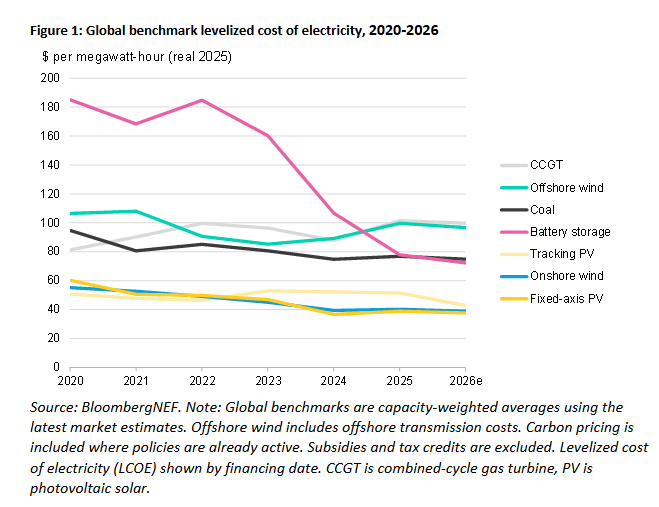
Also, it's based on 2021 (or before) storage cost figures, which have halved in the meantime. https://assets.bbhub.io/professional/sites/44/LCOE-11.png
I call BS.
Still, it would feel nice - after the initial cost- to have very cheap power (only charge when cheap).
There's a plethora of producers with varying equipment, startup times, ramp times, costs and so on.
As renewable penetration expands the most expensive, or least flexible ones are called in fewer and fewer hours until they shut down. If one oil and gas producer tries to raise prices a competitor steps in and fills the demand.
Did you think there was this one monopoly oil and gas power producing able to dictate prices at will?
I don't know enough about oil & gas to tell you what is happening there, but not every market truly operates as a free market.
For example, nuclear power plants almost always have a contract with the government for a specific electricity price: if the market pays more the profits will go to the government, if the market pays less the government subsidizes production. Something similar happened with early wind power.
In a world where renewables are cheaper the transparency speeds the transition
The idea behind the regulation is that it's providing the maximum incentive to bring cheaper electricity to market.
If you try to mandate that high cost producers charge less, they will do what makes sense to control costs and then quit altogether once they are losing money.
Like you are not going to agree a eg 3 year supply deal with $SUPPLYCO at a significantly lower price than what you could get on the spot market for it (or what you could hedge out on futures).
https://octopus.energy/power-pack/
See also https://www.ofgem.gov.uk/publications/case-study-uk-electric...
And is that actually worth it to anyone who does the math? An optimistic 161 pound saving compares to how many of my battery cycles for example? My car costs 50-60k so battery degradation is not nothing.
I did a quick fag packet calculation and even today 10% of everyones EV battery would be enough to cover the grid for an hour. That's enough of a buffer to spin up gas turbines for example, so you can actually shut them completely off.
My Hyundai Ionic 6 rolling battery costs 50-60k. Spending a cycle of it's battery is not a discardable cost.
Some will still take it but this seems just like a more deceptive version of those uber driver that get a pricey car and then find out that combined with maintenance, degradation/devaluation and other hidden costs they don't actually make that much driving around.
>I did a quick fag packet calculation and even today 10% of everyones EV battery would be enough to cover the grid for an hour.
I presume you deduct more than half of the rolling battery capacity out there. You can't discharge those to 0% shouldn't charge them to 100%, many won't be charged fully (or connected) + If I need to leave in the morning like most I don't want to necessarily be dropping charge into the grid.
Oil and gas plants in Europe are very much not on CFDs. They can bid out their power using futures. But that is like any other market.
Frankly, opposition to either onshore or offshore wind farms is dumb and is clearly being weaponized by opponents of the UK.
> But it was incredibly dumb to build many GW of offshore wind in Scotland when the grid was already over capacity
Overcapacity is a good problem to have from a NatSec perspective (as is seen with Chinese and Indian solar).
Also, it's the Scottish Government that has been backing offshore wind farm development for almost a decade [1].
Similar initiatives could have been done in England, but face persistent issues at the local level due to weaponized opposition.
[0] - https://www.bbc.com/news/articles/c74vj881090o
[1] - https://www.gov.scot/policies/marine-renewable-energy/offsho...
The issue is the next generation of offshore wind projects in England is up in the air. This was why Hornsea 4 [0] was cancelled by Ørsted, how the Isle of Man has mobilized against the Mooir Vannin project [1] despite it having the potential to help Liverpool and Manchester, and the Shetland's project being cancelled due to the fishing lobby [2].
What is under construction today doesn't matter because those projects started a decade ago. What matters is whether new projects are being allowed or blocked.
[0] - https://www.reuters.com/sustainability/climate-energy/offsho...
[1] - https://www.bbc.com/news/articles/c74vj881090o
[2] - https://fishingnews.co.uk/news/developer-pulls-out-of-east-o...
Isn't it equally dumb to continue to bet the entire country's economy on a tiny little bit of England (and then shame the other regions as unproductive layabouts when they don't produce as much tax revenue)? Energy production is not the only, nor even the biggest imbalance in UK resources. Maybe people and businesses should go where the energy is instead of waiting for it to come to them.
I hope not. We're currently getting shafted by National Grid pricing, and this is only going to mean we get to pay even more for electricity where it's generated while the south coast of the UK gets it cheap.
If you fixed at 33p, sucks to be you, my electricity has been free to negative all day.
Like a gambler who only talks about their wins, people on these smart energy plans on the few days it goes very cheap only seem to pipe up with the current low unit price, and never mention their longer-term moving-average unit price...
17.1p (last 6 months) no battery, no timeshifting
> Not true, HPCs 'agreement' is for 35 years. After that they just get the market price, so it is not based on the 60 year lifespan per se.
Isn't this conceding the point that costs are going to go way up as HPC ages? Why else would you have a 60 year lifespan on a plan but 35 years of agreed pricing?
Obviously there is some investment needed but if you take a look at the capex cost of the north Scottish grid upgrades PLUS the HVDCs it's pretty terrifying.
The idea is that the financing will be "paid off" after 35 years so it doesn't require a "guaranteed" price after that (it reduces finance costs significantly when HMG is underwriting the main payback period. I expect the remaining 25 years will be extraordinarily profitable for EDF. Even if there is more maintenance costs they will have no finance costs. And finance is the main cost of HPC (60-70% goes to interest payments on the debt).
Problem is we don't have good data on actual costs. So we don't know if we're talking about something substantial or something hypothetical. Absent that data I think my comment is fair.
>I presume you deduct more than half of the rolling battery capacity out there
No. We are talking about 10% of battery capacity so your battery at 80% would only need to go down to 70%.
A problem we have in the UK at the moment is that we have gas turbines running even if not needed just incase the wind suddenly drops. It takes (or can take) about an hour to spin up a turbine from cold. So a battery supply that could cover that hour would mean we could use a lot less gas. Most of the time it isn't even used, and if it is, most probably won't use that full 10% and once the gas turbines have spun up it could recharge the batteries.
To link it back to the earlier comment, even if the maths is bad for EV as battery storage, you can still use it as battery of last resort. It would be expensive, so ev owners would still be up on the deal, but there would be a system on place to actually use them when actually needed.
The arbitrage difference between filling your battery cheaply and discharging when prices are high is greater than any theoretical wear on your battery.
Even better if you are being paid to charge your battery.
It was annexed in the mid-19th century, they abused the Yorkshire Gold way before that.
If 2 European powers had a war over a territory that is now part of a third country we would still describe the war as being between the 2 original countries. Even if other territories that weren't part of those nations at the time now are.
But yes, on the other hand we are talking specifically about Texas so maybe you're right.
On the 3rd hand the chance to get superior with the colonies should never be passed up.
I'm open to the idea that oil and gas are protected and subsidized in many different ways.
Accurate information on how much more they costs than renewables I don't see the link.
Accurate prices are good. Actions that stop the market acting on the accurate prices are bad.