It was cheaper to simply let things fall into disrepair, and build shiny new buildings and developments further away from the city center. Rinse and repeat. This is why a lot of inner ring suburbs are filled with strip malls that can't maintain their parking lots, don't have the residential density to support nearby businesses, etc.
It's kind of an interesting development pattern that's been pervasive since the 1950s, and some towns and cities are trying to reverse it with infill.
We've intentionally made it unconscionably expensive to bring anything not built to current standard back into service even in a limited capacity (e.g. sublet a factory into smaller space) because we have because this stuff is mostly the purview of local governments who seem to optimize for some middle-ish ground path of "what makes Karen screech least" and "what makes the professional developers who know everyone in government happiest". There's various exemptions for small residential stuff, but at scale it's all just crap that tends toward "don't allow anything that isn't a new build or a high dollar revitalization project"
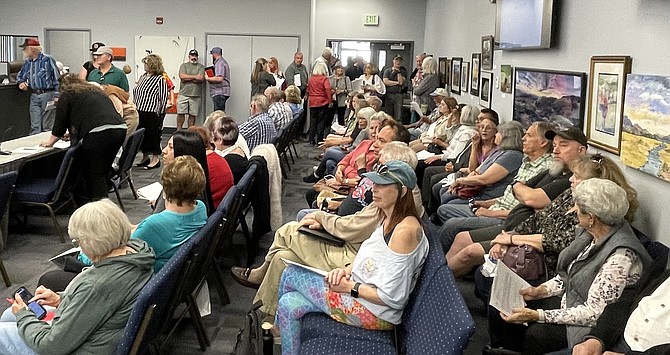
Seriously, go to your local zoning board, planning board, etc public facing meetings sometime. The shit they put people who just want to spend huge sums of money to develop stuff, run businesses etc, in your city/town through is beyond the pale. And then some "professional" shows up with a BigCo packet about "here's why our toxic waste dump on the ground floor with a strip club on the top floor can go beside the school" and they can't approve it fast enough. You'll be looking for bulldozers on facebook marketplace before the meeting is half over.
Recommend a source?
I do the bulk of my shopping IRL.
And the usual demographics where support for such boondoggles throughout history is found will cheer for it because they'll dress it up in environmentalism and 15-min cities and whatever the other issues of the day are.
There's almost no overlap between people on and with the means and time to go to planning and zoning meanings and the people who have the greatest marginal utility lowering the bar to owning a business or a home.
[] https://nevadanewsgroup.media.clients.ellingtoncms.com/img/p...
I watched two brothers in their 30s who'd bought a 12-unit (they lived in it) go rounds with the city over all manner of petty bullshit that can be construed as a legitimate concern on paper but really isn't if you look at the totality of the situation. Ultimately they hired the law firm which was owned by a lifelong developer who was the head of the equivalent board in the next town over (i.e. someone who knew people) and suddenly none of those things were problems anymore.
I'm sure white flight was a component, as well as subsidizing the auto manufacturing industry and a car centric planning model with federally funded highways.
https://en.wikipedia.org/wiki/White_flight
https://nlihc.org/resource/myth-white-suburb-and-suburban-in...
https://www.governance.fyi/i/191825260/the-money-problem-is-...
https://www.brookings.edu/articles/the-end-of-suburban-white...
Road funding is a big reason. Federal, state, and local taxes are used for roads, and more driving. Parking minimums required land to be dedicated to parking, further encouraging car usage for transportation and spreading out development with parking lots in between developments.
> Why didn't anyone choose to develop density on existing sites?
Existing sites would have had to not be developed enough to trigger a rezoning. If a different use was being proposed for land, then a zoning hearing would be needed, and parking minimums would have to be enforced. Thus requiring adjacent lots to be bought and redeveloped into parking unless exceptions were made. You can see remnants of this in some cities where amongst historic buildings and skyscrapers there are large surface parking lots.
> We built that stuff just fine from 1870 through the 1940s. What changed?
Quite a few things. Parking minimums as mentioned, euclidian/single use zoning, etc. I think one of the core things that changed is something that Strong Towns mentioned. Up until the early 1900s, municipal planners would try to project how much tax revenue per acre of land was being generated and how much tax expenditures were made for those areas. Over time, tax per acre or per parcel was deprioritized, and level of service for roads was used as an economic metric. More vehicles in an area means more economic activity (in theory), so municipalities started optimizing for more vehicular movement.
In the end, it was a lot of government regulation that resulted in this. From the federal level, to states, counties, and municipalities. It worked for a large portion of the voting populace, so it was generally favored.
you're basically rebuilding from scratch at that point.
Meanwhile all the shithole land with no "dwelling" on it was never eligible for mortgages so people weren't able to bid it up to oblivion on debt that they locked in with 30 year mortgages so you get weird results like the cost of vacant land is way cheaper than the same piece of land with a house that can really only be bulldozed (latter would be cheaper in most times in history). End result is I built an entire house on property cheaper than a burned out uninhabitable trailer. Building on unmortgagable land is a way to bypass the fact houses are all locked up in 30 year loans at negative real interest rates.
End result is it's far cheaper to build a house than buy even a shitty burned out one because to do the latter you have to buy someone out of their money printing machine of a negative real rate loan, which obviously they are only willing to do for a king's ransom.
------ re: location ---------
I won't share my address but if you are looking to do this yourself: look up fishing canneries in Alaska, most of them are close enough to cheap plots you could do this on, often even without permits or property tax. These canneries are also usually desperate for workers and pay a livable wage to those with refrigeration technology certifications.
The only people that have been over that have been unimpressed are people already living in an actual house, but that's not really the target audience for this kind of thing.
---- re: below [my account is throttled] ------
I speculated on an old well share that turned out to be good, so got a well for basically nothing. If you don't have such luck you can haul water.
I use septic, which in some counties (mine) no requirement you be licensed to build. It can be built with only a shovel and some pipes and concrete if you are on an extreme budget, although helps a lot more if you can get ahold of an excavator.
I have developed land in my county so I'm familiar with the costs to develop, buy land, place utilities etc. (I did not become a land developer on purpose, only because I realized this absolutely crazy arbitrage)
It would cost you about $200-$250k to buy a rural small acreage land with a manufactured home on it. If you pay cash for the land and drop the exact same manufactured home on it, it would only cost you about $150k, and you would get a brand new house instead of a "used" one.
There is huge pent up demand for someone to just buy a huge swath of small acreage properties and just drop the cheapest manufactured home you could on it as the non-luxury starter home market is currently not being met. You could pretty much double your money. I'm not sure why this isn't being done en masse although a few private actors seem to be doing it and making a killing.
and then show me where the jobs are.
Build a new luxury apartment, and someone moves from a mid tier apartment into it, and someone moves from an affordable apartment into that, and so on.
Price is a function of constrained supply. The type of supply is not important to increase the numbers.
https://hn.algolia.com/?dateRange=all&page=0&prefix=false&qu...
The neighbourhood. When I moved to New York in my twenties, I had roommates. Everyone had roommates. That meant sharing a bathroom and kitchen. Not only did this breed camaraderie and teach me to not be a dick, it also freed up cash so I could enjoy the city and save.
It just so happens that America is luckily predisposed to this kind of living, with an abundance of space to accommodate lots of people in their own non-shared living spaces. The problem with that though is that you limit the opportunities for business, because space is cheap, so you have to implement regulations and zoning to create opportunities for moneymaking and before you know it you can't actually build housing anymore, despite the abundance of space sitting right there.
American cities were replete with dorm room style housing. These were especially popular with new migrants to the city.
An incredibly large percentage of apartments in cities like NYC are used as multi family housing with several housemates sharing them to save on rent.
The reality is that the reason such housing doesn’t exist/isn’t more widespread is because cities have passed laws eliminating them. Before the white flight to the suburbs, the attempt was to keep the poor out of cities where the rich lived by eliminating housing of this sort since the poor couldn’t afford single family housing.
This led to a proliferation of laws that required bathrooms and kitchens in every unit, etc.
The arguments against conversion assume you care about the current owner's financial situation.
You'd also have to install a bunch of showers, which could be a significant problem on its own.
And then there's the increased amount of sewage, which the building might not be able to handle - even the local sewers might not be equipped to handle the uh... Load a large commercial building would generate with 24/7 occupancy vs 8/5 occupancy.
The reason you don't see folks converting commercial spaces into residential isn't because it's not wildly profitable, but because building new purpose-built residential buildings would be cheaper than a conversion for anything other than one or two floors.
Compared to installing a new domestic water pipe riser and drains in an office tower (plus pumps, pressure tanks, etc), installing a shower in each unit is essentially free.
Connect the in-unit supply lines to the tap, core drill a hole in the floor to get to the floor below and connect to the drain piping, done.
They have been going wild in the UK converting office space to residential.
How is there more than an office full of people?
I do see this. That's my point. Your plumbing problem has been solved by not jamming a ton of people into the building.
So they can support high density human habitation according to the Feds, but not normal housing according to who?
I still haven't seen numbers that show this is a physics problem versus zoning problem. Worst case, make some things (e.g. washers and dryers, maybe even showers) communal.
Obviously since it's illegal these aren't advertised but they're quite prevalent, and issues are rare enough that now decade past muh Ghost Ship Warehouse is the constant drum being beat by the brain dead building code worshippers who actually bought the line of bullshit that having people homeless and freezing and shitting in the streets was actually a 'written in blood' advantage.
Edit cause I had more thoughts: Honestly, probably one of the biggest mistakes we've made as a country have been not putting up enough resistance to RTO. The single family home is, I believe, probably one of the nicest standards of living in the world. Plenty of space for hobbies and activities, privacy, usually some community among neighbors. The only problem is that it's hard to square the circle when it comes to single family living and living close to an economic hub. To afford this standard you have to live close enough to a hub that you can afford one of the well-paying jobs that exist there, but not so far that your commute significantly eats into your life. With RTO, I think we lost a pretty good opportunity to weaken our dependency on the geographic economic hub. We could have had a diaspora of knowledge workers which gave people the opportunity to pursue a better life at a lower cost, and we sorta just threw all of that away.
Note that this is a very modern familiarity. One that basically goes lockstep with our housing crisis.
The pent up demand for this is obvious to anyone who's tried to secure a room only to have a gazillion people competing with them to pay $1000+ to rent an oversized closet to sleep in.