If you can, you’re rotating beans and corn every year. (“Roundup ready” of course)
Wheat is on the marginal drier land. Not that they couldn’t plant wheat there but beans are way more profitable and so they don’t.
The plains is by definition more arid, marginal land a step up from pasture/grazing.
A lot of traditional wheat/sunflower/barley/oats has gone over to beans and corn bc roundup and GMO.
On my family’s farm I don’t remember the last time we had wheat crop but that was our staple for like 50 years.
It depends on what you mean by "beans". The Palouse agricultural region is famously one of the highest yielding wheat and legume producing regions in North America.
Nah. Wheat isn't profitable if you look at it in isolation, but it is still net advantageous to have in the rotation.
> (“Roundup ready” of course)
Nah. IP soys aren't as attractive as they once were, granted, but the premium is still compelling enough to grow some.
...
> A lot of traditional wheat/sunflower/barley/oats has gone over to beans and corn bc roundup and GMO.
So wheat absolutely can be grown on the same places that beans grow, despite your leading claim. And I grew up in the Midwest plains; wheat IS a crop that can be grown there. Marginal? The breadbasket of the US? Huh. News to those who live there.
US farmers are planting less wheat, which made the crop harvest marginal, and along came a drought.
"a severe drought in the U.S. Plains has curbed production of hard red winter wheat, the largest variety grown in the U.S... The USDA projected U.S. wheat production in the 2026/27 season at 1.561 billion bushels, down from 1.985 billion in 2025/26, as a severe drought in the U.S. Plains was likely to slash the hard red winter wheat crop by 25% from a year earlier."
"The USDA rated just 28% of the U.S. winter wheat crop in good-to-excellent condition in a weekly crop conditions report on Monday, the lowest rating for this point in the growing season in four years."
This was mentioned in the very first sentence, it's the very first attribution of falling wheat harvest.
Yes Hormuz and rising oil costs are also a factor, a secondary one since they are impacting spring wheat planting decisions as you mention.
Both drought and the fertilizer shortage (which, as the article notes, was too late to effect planting decisions but DID impact the costs, and thereby decisions on the applied quantities, of nutrients for the winter wheat crop this year) are impacting winter wheat yields.
Relevant example from today:
"The commodities guru who warned about silver falling now, is saying the hantavirus could do the same to oil"
Click later:
Guy is just hedging against losses.
I am genuinely starting to wonder how much of the trade swings are from algo trades reacting to headlines ( and subsequent ones reacting to content;p ).
Though potash is one part of three (Nitrogen < Hormuz / Phosphorus < Florida / Potassium < Saskatchewan) used in commerical fertilizer I believe.
(One person's perspective living in Southern Alberta)
which itself is a major factor - the US imports tons of potash from canada, only to re-export it elsewhere. a clampdown from canada would be more likely to hit a south korea or china more than the midwest
If the closure persists then no doubt other sources can ramp up to fill the void, but it's going to be too late for this season. Some Asian farmers have already chosen not to bother planting rice crops since the increase in fertilizer (urea) cost has meant they'd be losing money.
Fuel prices are also impacting imported produce prices.
But there's a very weird underlying sentiment on HN where many people seem to directly or indirectly jump whenever they can to downplay the existence of climate change. Sometimes, they are emboldened by articles like this which intentionally use misleading headlines.
You're completely right, though, that in this instance, soy beans were mostly focused on because of consumer trends and less fertilizer need. Wheat is just an expensive crop right now. Also, soybeans would actually be less resilient to drought which furthers your point re: the article headline.
Conveniently for them, it's very difficult to attribute any specific weather event to climate change in isolation.
So lower fertilizer demand, and healthier produce, could be a net positive.
Kind of like an oil shortage is driving an increase in EVs and renewable energy.
Finally waking up the US that oil dependence is a National Security issue that renewables are possible solution for. That renewables aren't the 'woke' enemy, but a valid technical option.
So, maybe a net positive.
Amazingly invisible fact to the US political right. Glaringly obvious, yet they can't see it. It's almost like they don't even have their country's best interests at heart...
Even worse, oil dependence is a competitive liability --- not an advantage.
AI is energy intensive. And more expensive, carbon based based energy is a competitive disadvantage.
A competitive disadvantage in AI is an economic issue --- which ultimately translates into a National Security issue.
China leadership understands this. USA leadership is clueless.
It's not the drought per se, it's input costs. Farmers are favouring crops that need less nitrogen and potassium.
Commodities have responded accordingly.
A year ago China stopped buying soybeans from the US is seems ("China Bought $12.6 Billion in U.S. Soybeans Last Year. Now, It’s $0." - https://www.nytimes.com/2025/09/25/business/china-soybean-sa...), was that resumed, or who are all these new soybeans going to? Is it all for national use instead of export?
The US also uses a lot of soy beans internally. Prices are down, but farmers are still selling soybeans and with careful management are making money.
But make no mistake, it has caused problems for farmers.
The report from my small hometown farmers is that everything, except for beef, is down right now while the prices of inputs like fertilizer are high. Some of the farmers in my hometown have already sold their land to megacorp farmers in response because they simply can't survive.
The website's domain was created 3 months ago (site doesn't even have any entries in the wayback machine) and supposedly pulls from USDA AMS data but when I looked at reports[1][2] I didn't see double prices compared to last year.
Some prices even looked lower? But it was hard to make comparisons because of report structure and data disparity.
[1] CA Hay: https://mymarketnews.ams.usda.gov/viewReport/2904
[2] CO Hay: https://mymarketnews.ams.usda.gov/viewReport/2905
> Last week I posted about how hay buyers and sellers were frozen, waiting for each other to move first. Here's an update....
looks generally correct. On the 2025 CO hay report you can see that last year in this period, there were 22k tons sold. This year, there were 9750 tons sold. Last year[1], the week before (4/28/2025) there were only 400 tons reported sold.
Seems like there is an annual inflection point that causes prices to settle, and it wouldn't be in the report linked just yet. Meanwhile, if you do a news search for hay prices, you can see plenty of articles from different sources discussing how the drought is driving prices higher, so it appears to be at least a common discussion point.
[1] CO Hay 2025: https://esmis.nal.usda.gov/sites/default/release-files/r207t...
Thanks for sharing!
Are there different grades of soybean?
I guess you meant something more like "shows a causal relationship"?
Because they're already correlated, which I thought was the point..
20% of the remaining global supply comes from Iran, which has its own issues of drought and war.
I hope the “riots” are in the form of voting.
"The Dictator's Handbook: Why Bad Behavior is Almost Always Good Politics" (Bruce Bueno de Mesquita, Alastair Smith)
https://www.amazon.com/Dictators-Handbook-Behavior-Almost-Po...
The CGP Grey youtube short is an entertaining summary of the books subjects:
https://www.youtube.com/watch?v=rStL7niR7gs
>in the form of voting.
The current US representatives were voted into, out-of, and back into power.
It is interesting, but will likely remain stable. =3
Doesn't escape despotism cycles, and just makes a country a worse place to live.
Historically, without respect for people you disagree with, it only gets worse for everyone. This lesson was simply forgotten by many. =3
The closure of the Strait of Hormuz is another big factor here as fertilizer prices have massively gone up. Diesel is more expensive too. Many crops this planting season (in the northern hemisphere) haven't been fertilized like they would normally and it's too late now so that will absolutely impact food prices later this year. The Global South will be disproportionately affected.
Lastly, the continued Russia-Ukraine war continues to impact Ukraine's wheat crops. Ukraine is (or was?) often called the "bread basket of Europe" because it was such a significant wheat grower and exporter.
We (the world) are genuinely going to have much more expensive food prices later this year and, in some places, there will be genuine famine.
The data comes from USDA's WASDE report which is released every month, between the 8th and 12th. There is no "timing," and people were talking about the expect wheat harvest this season for weeks ahead of Tue's report anyway
The "when" of media coverage is just as important as the "what" and the "when" here is while the president is currently in China. If you want to think that's irrelevant, that's a choice I guess.
From what your saying it sounds more about Tariffs
the prior high purchases were to refill their reserve after covid lockdowns broke supply changes. now its about full again, so they only need the steady state supply
Edit: I'm being downvoted because someone found a source that says 3% of winter wheat in Montana is irrigated.
My point still stands, while yes some percentage of wheat is irrigated it is extremely uncommon.
> Leonard’s operation near Goodland is a diversified operation with a mix of dryland and irrigated acres in addition to a small cow-calf operation. Encouraged by his PlainsGold seed rep, he entered the yield contest for the first time in 2022. His entry came from a field planted to certified seed wheat that followed pinto beans, which provided some moisture profile.
> “Our soil will hold about 1.8 inches of moisture per foot,” Leonard said. “So, if we have six feet of subsoil, we have some gas in the tank. We had some of that last year, but we don’t have that this year.”
> From planting until harvest, the field only received 6.2 inches of moisture, so Leonard pumped another 10 inches of water to help the wheat crop along. He also furtigated nitrogen through the pivot to further boost yields. The widespread drought conditions last growing season meant it was too dry for even the weeds to grow, so he did not apply any fungicide.
---
https://api.mountainscholar.org/server/api/core/bitstreams/9...
Page 6:
> The four major grain crops grown in Kansas (corn, soybean, grain sorghum and wheat) have experienced upward trends in yield (Figures 7 – 10). Corn yield has had the most dramatic increase for both irrigated and dryland production with irrigated corn yield improvements of approximately 2.5 bushels/acre for the each year of record, This result is more than twice the dryland rate of 1.1 bushels/acre. The average irrigated yield increase is 0.59 bu/ac, 0.60 bu/ac and 0.31 bu/ac for soybean, grain sorghum and wheat respectfully. Irrigated yield increase trends have been larger than for dryland.
Page 8 figure 10 shows the yield trends for wheat - both irrigated and dryland since 1974.
E.g.
https://www.canr.msu.edu/news/considerations_for_raising_irr...
https://extensionpubs.unl.edu/publication/ec731/2009/pdf/vie...
https://ucanr.edu/blog/uc-small-grains-blog/article/irrigati...
https://www.canr.msu.edu/news/considerations_for_raising_irr...
https://waterquality.colostate.edu/documents/factsheets/0055...
edit: cloud seeding too.
Let's take Kansas... the largest producer of wheat in the US. https://www.statista.com/statistics/190376/top-us-states-in-...
Kansas wheat crop down 38% from last year https://youtu.be/QjrhAXzEGDc
Kansas cannot run on desalination plants ... there's no salt water. The gulf coast of Texas is 1000 miles away.
While aquifers do regenerate (Groundwater levels in the Kansas High Plains aquifer see first overall increase since 2019 https://kgs.ku.edu/news/article/groundwater-levels-in-the-ka... ) I'm going to point out that news article has seven years of declines previously.
The aquifer that Kansas draws upon is the Ogallala Aquifer ( https://en.wikipedia.org/wiki/Ogallala_Aquifer ) and you can see the rate of depletion at https://www.climate.gov/news-features/featured-images/nation... - there are spots in Kansas where the groundwater dropped by 150 feet from before it was tapped with deep wells to 2015.
Yes, most of the earth is covered by water. Getting that water to Kansas and Nebraska and North Dakota, however, is a problem.
There are only 3 countries that do: Bahamas, Maldives, and Malta.
Other countries that depend heavily, but not completely: Qatar, Kuwait, UAE.
There are countries in middle east like UAE, Saudi arabia etc. which rely on desalination but they are relying it for the clean drinking water, not for the food generation. They import almost 90% of their food iirc.
The amount of energy required to desalinate all water and the environmental impacts to get that energy would literally be quite catastrophic and I am not even sure if it would be even feasible and food prices would literally skyrocket or food would simply be produced even more less by magnitudes of order.
Desalination uses far more power than AI ever would.
we live in an open system at any scale except the whole universe and even that is gaining energy
the earth is slowly losing both hydrogen and oxygen, and has tons of energy coming in from the sun
into the scale of a field, or a state or a country or a continent, theres very obvious flows of the water cycle introducing water via rain/snow, and removing it via evaporation, seepage, and rivers.
the only closed system is if you make one of those wine fermenter biospheres, and even there its open to energy coming in via light
the second law will keep applying
its not particularly available to the rest of the globe because you need different refining.
i find it to be kinda funny that albertan oil prices jump with global markets when albertas major complaint is about a lack of access to global markets.
Canada also doesnt have the export capacity for selling potash directly. if its being redirected away from the US, its US importers deciding they can get a better price by re-exporting it
like a "in theory in ten years from now, these other customers could swap what oil theyre using, so were gonna charge you more now just in case"
This is where capitalism drives humanity off a cliff.
Desal isn't useful for anything but a stop gap
https://www.fas.usda.gov/data/commodities/forage-and-hay
https://wits.worldbank.org/trade/comtrade/en/country/QAT/yea...
In fact, this is the only remaining way I know of to more or less 'homestead' federal land in a way that results in a permanent deed. The rest of the homesteading type stuff was revoked back in like the 70s or 80s.
https://www.blm.gov/sites/default/files/Desert%20Land%20Entr...
The Colorado River compact came into effect in 1922 and I'm almost surprised literal fist fights haven't erupted over it during the modern negotiations.
For supplemental fertilizer you buy though you are correct.
Many of these causes imply spending copious money that they are less well disposed to stuff in their pockets or give as tax breaks to their benefactors.
Others make good political ammunition for their uneducated base.
These are the people who roll coal
"Fungible describes goods, assets, or commodities that are mutually interchangeable, meaning one unit is equivalent to another of the same type and value.
they are two parts of a three part whole.
they arent perfectly fungible either - the core nitrogen, potassium, and phosphorus can come in many forms, and need some chemical processing to get into the right shape for use
If this was meant to manipulate Trump into specific behavior, it is a masterful long play seeing as how this report is published in roughly the same way for over 50 years.
I'm honestly scratching my head over here because this is bordering on being deliberately obtuse. Chinese purchases of US agricultural products is a high-level plank of any US-China trade deal and a very likely agenda item on any trade summit.
This also isn't new. What do you think trade agreements are, exactly? My favorite example is a US trade dispute with Australian wheat producers in the 2000s. US wheat is subsidized. Australian wheat basically isn't but is still cheaper. So, to avoid WTO repercussions, the US said Australian wheat was a biohazard risk and that's why it couldn't be imported.
This dispute was ultimately resolved as part of a wider agreement that created a new visa (E3) specifically for Australians wanting to work in the US.
Tariffs too are a tool of and a bargaining chip in trade agreements.
It is, but is generally post facto instead of pre facto, which may be why you don't recognize it as such? In the US, subsidies are given by covering a portion of crop insurance premiums. When crops fail, the insurance covers the losses. Whereas Australia waits until crop failure occurs and then provides assistance to affected farmers "bailout"-style.
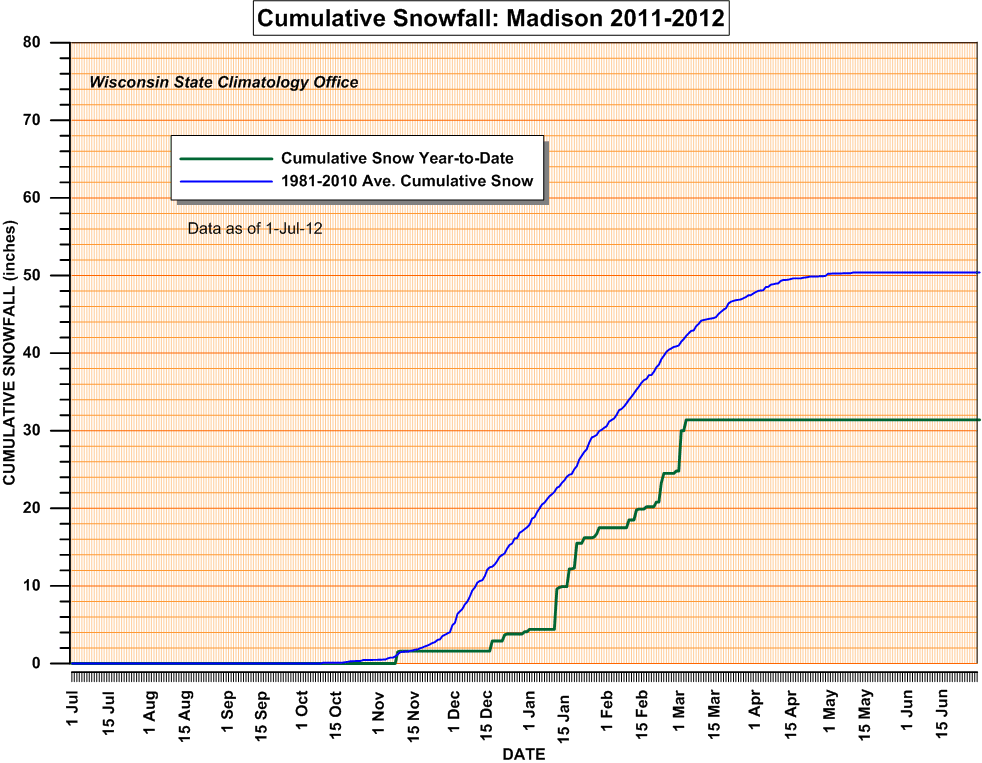
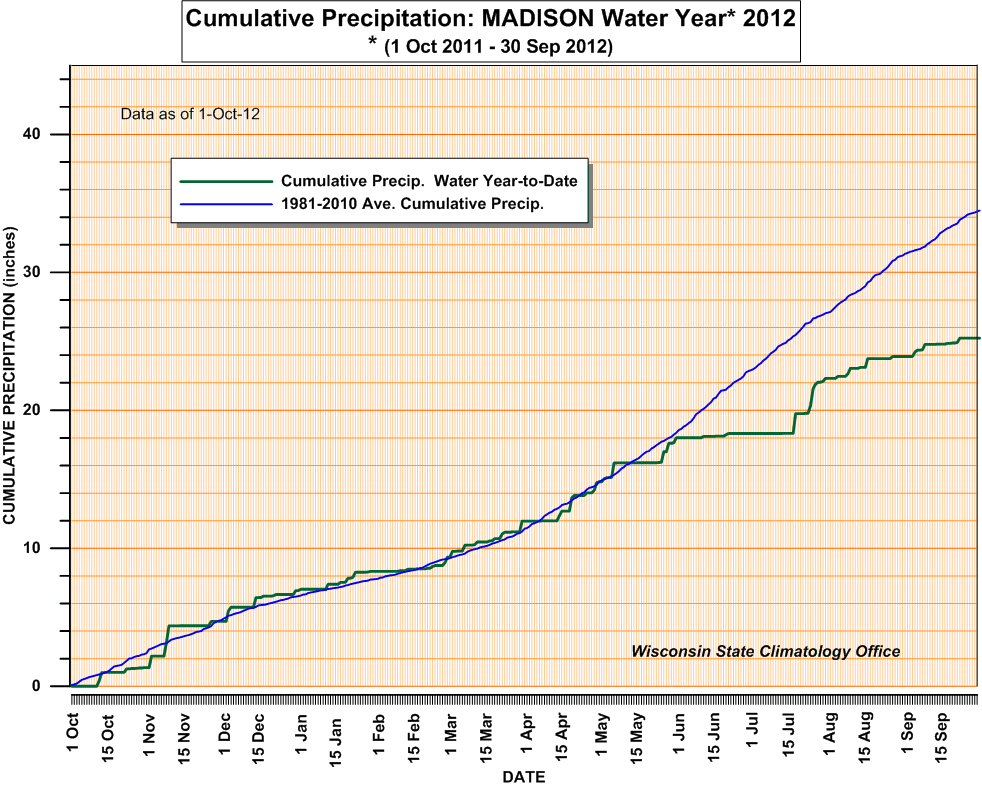
PBS program on the 2012 drought - https://www.pbs.org/video/wpt-presents-wisconsin-drought-201...
And what the fields looked like ... http://www.wcwcw.com/feature96.html (also has a national map, and all of Nebraska, Kansas, Iowa, Missouri, and Illinois were in bad shape - Wisconsin looked pretty good by comparison in that map).
If you've got similar data for ND... (digging) https://www.ndsu.edu/agriculture/sites/default/files/2026-05... page 2 has the precipitation chart. North west ND looks bad.
Citation needed.
I'm sure you can find a few outlier cases, but in general speaking terms datacenters - AI or not - are not even a rounding error on any local water source so far.
It's just not a thing. It's made up for social media rage bait.
> I think data centers look bad because of the human impacts that I've seen
What human impact is this, precisely speaking? Outside of the (again) few outlier cases, datacenters are basically warehouses you didn't even know existed until you were told to be mad about them. Plenty of friends who know I'm in the space have recently asked me about this, not having a clue they've been living within a mile of a facility for the past decade.
Facilities with co-located power plants are not datacenters. Those are power plants with a datacenter attached to the side of it. The power plant would be the concern. Even then, these are exceedingly rare and a symptom of a generation or two of American's deciding not to invest in energy infrastructure.
Power usage is a concern due to the lack of investment in generation or transmission infrastructure in this country the entire time all HN members have been alive - along with the outsourcing of effectively all US industrial capacity to third world nations. Anything else is effectively amped up rage bait without a grounding in reality.
I'm not sure if the BLM has relaxed their discretion under Trump.
If you can sell to 3 markets, you can negotiate. If one stops buying from you, now you only have 2 markets. And they each know that you can't sell to the other, regardless of demand.
The less favourable your selling position, typically the less you get...
And to stop misinformation in its tracks:
> A March 2021 meta-analysis published in Reproductive Toxicology concluded that neither soy protein nor isoflavone intake significantly affects reproductive hormone levels in men. Analyzing data from 41 studies and 1,753 participants, the researchers found no statistically significant effects on testosterone or estrogen regardless of intake dose or duration.
so Gemini says, link - https://pubmed.ncbi.nlm.nih.gov/33383165/
- tap into a reserve, like buying from china itself - buy from somebody else who grows their industry - consume less and produce less of the downstream item - swap to an alternative input, eg. canola
its a national security issue to take dependencies on imports to or exports from america now. if a nation does, it will be part of trade negotiation, where the benefit from the US outweighs the liability.
If you havent watched the Carney Davos speech, its worth a watch or a rewatch - this is how the world is thinking about US trade. Significantly risky. I think the US soy price still has room to go down, as other countries take over the production, and have favoured nation agreements with each other
idk if its really a bif deal though, farmers grow soy because its good for their fields, and getting to sell it is an extra bonus. if a farmer is dependent on selling the soy, they probably arent doing so well overall
But who? Compared to 2024, 2025 had almost half soybean exports it seems (https://www.fas.usda.gov/data/commodities/soybeans), I'm guessing most of the difference was China basically stopped buying soybeans.
But it's a huge difference, yet production seems to be ramping up? I don't understand why they'd do that when the exports are going down?
And the chart you linked appears that exports for non-china countries is basically static.
Were I to guess what's going on, but we'll see when the 2026 data comes in, is that soy farmers are likely storing a good portion of their bean harvest. Some will still have contracts that keep them farming. I suspect that many have switched over to other crops.
On the margins. However most farmers consider their soil health and long term plans. All good farmers (especially the mega corps) will intentionally plant most crops not based on what they expect out of the market next year, but what their soil needs. Most fields will not produce well if you don't consider what was grown on it last year and in turn what you want to produce next year. A few fields (millions of acres worth, but still only a few) there are options and those will adjust, but for the vast majority you have to follow a long term plan or your soil will fail and bankrupt you long term. Even the fields that do have options, it is just this year, and next they will have to return to a long term plan with no option. That where I live you have go [corn, corn, soybeans] or [corn, soybeans, corn], but [corn, corn, corn] is not an option. (I'm not aware of anyone doing two years of soybeans but maybe it happens)
On reddit, some farmers have cited 1 to 1 and 1/2 years of storage. [1]
I suspect that a large portion of these soybeans will be stored with the hope that the market gets better in the future (I've never farmed soybeans. We did wheat and hay). Potatoes and apples are the same way.
For Potatoes, they'll measure for hotspots throughout the year to make sure there's not rotting going on in the core, but assuming that doesn't happen, they can be stored for a very long time in giant potato piles. Hay is weird. Fermentation is actually a desirable thing because it releases nutrients (and the cows LOVE it). It makes storage super easy. I've had multi-year old hay bales that we've fed to cows.
[1] https://www.reddit.com/r/farming/comments/113t3nx/how_long_c...
the methane isnt the issue, building and operating the processing plants is
https://en.wikipedia.org/wiki/The_Trenton_Pickle_Ordinance_a...
The age of a law or regulation is likely a strong indicator for its relevance in modern times, especially if it’s regarding something quite niche.
So is the age of the law, for that matter; courts don't waste one second on the topic. Settled law is settled.
The age of a law does not matter with regards to its validity, you are pedantically correct. But it very much matters to its relevancy, which was my argument. Laws regarding horse traffic in Manhattan may still be valid, but a lot less relevant than they were hundreds of years ago - assuming they haven’t been repealed.
Regarding the “Colorado River compact”, I would say my qualifier of “quite niche” is important. Ownership and water rights over the second largest watershed in the US by affected population is far from “niche”.
On the other hand, how settlers can claim public land in the desert (which happens incredibly rarely now, by design) is quite niche.
I've never worked at a megacorp farm, but my observation is that the majority of farmers aren't thinking like this. Granted it might be different because the crops around me which are most commonly grown are wheat, barley, and hay. IDK the effects of soybeans/corn on soil and it's possible they have a much more pronounced effect. For wheat, barley, hay, most the farmers I know will plant it YoY and use fertilizer to counteract soil deficiencies.
Crop rotation, AFAIK, is mostly employed to reduce the need for fertilizer.
It definitely is a problem because farmers tend to over-fertilize which can cause nasty problems the runoff water.
I also expect this will likely become something a lot more farmers start to practice as fertilizer prices spike.
I read your original comment too literally with regards to this law still being a problem, rather than the historical second order effects of the law.
Not just technically. It is a relatively common food. A fair bit of it is crushed (i.e. turned into cooking oil). But it is also a product used in a number of processed foods, tofu, etc. Granted, it does seem to be eaten less commonly in the USA, but is more often used in Asian cuisines.
> Are there different grades of soybean?
All crops have different grades. Poor weather conditions is the most likely reason for a downgrade.
The most common use is crush the beans, and collect the oil feeding the rest to pigs. If you read the ingredients at the grocery store, soy bean oil comes up a lot. Soy bean oil is also often used in diesel engines after processing.
They're mild, a little nutty, but also a little waxier in texture than most beans (similar to edamame in that way, but closer to other beans than edamame when they're cooked from dried).
I still haven't found a great use for them other than as a slightly weird substitute for other beans, because there's not a lot of recipes around for them (because they historically took like 3 hours to cook), but I personally enjoy them just fine.
or tofu, soy sauce, miso, natto, tianmianjiang, a thousand other things made from soybeans
Edamame is limited to special varieties that are harvested before ripening, which isn't the soybeans those supplanting wheat will be growing. You're probably thinking of tofu, natto, or something in that vein.
As much as it bothers me, I do feel like I've had a healthier diet since cutting out soy. It's not the soy itself which makes these things unhealthy but rather that it's used as a filler in processed foods.
I'll be honest, though, I do miss Nutella.