An AI Hate Wave Is Here(axios.com) |
An AI Hate Wave Is Here(axios.com) |
Or are you saying that learning is a violation of copyright?
Alex Karp, in particular, has some of the most absolutely horrifying clips of his TV appearances circulating all over video social media. But Musk has broader reach, and is even more oblivious and has tied himself to someone who he himself accused of pedophilia.
Andreesen, Thiel, Sam Altman, and the above are great at raising valuations for investors but they are doing it incredibly stupidly in a way that leads to massive backlash. California is voting for a billionaire tax this year, and I think that these tech CEOs only have themselves to blame for the backlash they are causing.
The problem isn't that these people are simply inarticulate and incapable of expressing their views in ways that appeal to people. It's that their views are unappealing (if not downright objectionable) to most people.
You feed pigeons randomly, and if they happened to be standing on one foot when they got fed, they will associate that behavior with what happened. So they will stand on one foot while feeding.
In the same way, they economy goes bad, they might blame what they read about the government, or AI, or standing on one foot.
So yeah, money becoming less of a proxy of "how much someone contributed to society" and more "how much someone contributed to the oligarchs' goals", while those goals are for AI and for peoples' detriment, makes the situation actually about AI.
The technology that helps extract wealth improves, while most of the purely consumer-oriented products are becoming a con and a scam, especially if US companies are involved. The Mirabell's "original" recipe turned the best treat in the world into a generic candy, all are just palm oil + sugar + shrinkflation. There is also non-repairable tech with non-standard components, non-removable batteries, meat gets filled with water, washing machines die right after warranty ends, every digital service is trying to steal data instead of taking only the necessary or at least being transparent about what's taken and why, entertainment like Reddit and streaming services also get worse... AI slop is just another example, but a bit more visible and with a bit more side-effects.
This seems like the polar opposite of what the "AI safety" people are worried about and it seems unlikely that they could both be true at once.
> As I understand it, the last sentence stems from the fact that too large of a share of the total wealth is in the hands of those that don't benefit from more homes. AI is what's prioritised by them and what will lead to even smaller flow from the efficient wealth aggregators to those needing homes
These are both two independent things and two independent sets of people.
The main group of people opposing housing construction is landlords and existing homeowners. The ones doing AI have almost no overlap with that. Moreover, "you get paid less" and "housing costs more due to artificial scarcity" are only tied together in the sense that money going to landlords and banks isn't going to workers, which again isn't the AI thing.
Or to put it a different way, you could mitigate a lot of the "AI problems" by building more housing and the AI people would be pretty fine with that.
But the real villains here are the same as ever, the most dangerous non-human persons: corporate persons.
The economy, real wages, etc are basically higher than ever (despite idiot Trump's best efforts).
People are mad because being mad is fun and we're all on being mad machines 24/7.
Hopefully non-logged in users can at lease see the income-by-age graph: https://www.economist.com/cdn-cgi/image/width=480,quality=10...
https://prospect.org/2024/05/14/2024-05-14-trendy-nonsense-g...
Nothing a couple years of brain washing bots and algorithmic feeds cant fix.
1. The public response resembles the stages of grief, and people are fluctuating between denial (AI isn't really that smart) and anger (AI is horrible).
2. Your perception of something tend to be shaped by the sum of your experiences with it, and a lot of the exposure to AI is via fake, scams, bots, and low efforts content (AI slop).
3. I think that the fear of losing your job and your life's stability is there, but it's not yet as common as it should be in the general public. I expect that to be the main driver of AI hate, and that will be a lot fiercer than the current hate, and could lead to a civil war or worse. Depending on AI progression.
4. There is also a lot of tribalism involved. We live in a polarized society, and many people adapt their opinions to the opinion of the group they identify with. That itself drives anger towards AI, as it is part of the greater cause.
Speaker: AI is awesome, it's the future. Graduates: booo booo booo booo
https://www.nbcnews.com/video/multiple-commencement-speakers...
It’s lead to plenty of good as well, a luddite I am not. I love my tech. I love conversing with people online, I became a happy mIRC user well over 20 years ago, I use telegram & discord daily. I just really, really despise tech’s current trajectory. I grew up wanting this stuff to supplement my life, not control & rule over it. The days where I want to toss it all in the trash and run off to the woods are increasing all the time. I didn’t want an internet where i’m constantly having to ask myself every image… is this real? I certainly don’t want one that’s constantly surveilling me and I definitely don’t want one that’s about to threaten to lock me out, or up(!), the moment I commit wrongspeak.
The analogy would be a 17 year old kid passing his driving test and getting straight in a 500bhp rear wheel drive sports car. We as a society have just collectively done that over the last two decades. And it feels like we’re just about to take it nuclear with AI.
So we can dwell on all of that past or set ourselves some basic goals and ambitions to aim for. Refocus. Change the conversation.
Somebody responded to me earlier that “at least we have reusable rockets”. Do you know what I really want? It’s really quite basic - clean air, clean water and clean energy. Let’s collectively work to tick those three off the list, for every.single.soul here on this planet first, then after that, we can focus on making them free for everybody. Then we can set our sights on the stars.
https://web.archive.org/web/20260517221805if_/https://www.ax...
> Axios AI+: Catch up on what's new and why it matters in just 5 minutes.
> Sign up for Axios AI+ to continue reading for free.
Madison Mills = reporter (no control over Axios)
AI wave timeline:
Investors throw money at AI and companies using AI
Company X sees investors throwing $$$ and starts dancing too
Axios (monkey see monkey do)
Future:
Investors stop throwing money then dancing stop.
It's about the greed, lies, fascism, and basically that AI is making almost everything it touches worse.
Most people I know will claim to not like AI, but they happily continue to scroll their Facebook, Instagram, or TikTok feed that's full of it. Until they delete the app in protest and go read a book, little will change.
CEOs love to get up and say "Hey, we are firing 1000 people because of this awesome AI" [1]
For people that like computers, AI is jacking up the price of electronics with CEOs saying things like "We don't even have a place to plug these cards in, we are just buying up whatever we can get" [2]. They are further causing memory manufacturers to simply discontinue consumer products [3]
Then there are the AI CEOs that love advertising the fact that their companies will eliminate huge swaths of the job market and make good paying jobs obsolete. [4]
Of course when the general public even starts to ask "ok, what is this and why should I care" a lot of the answers are "You just should, you'll be left behind" without actual explanations for why or how. [5]
And of course lets not forget that practically cartoonish villiny of the data centers being ramrodded through by bribing local politicians with false claims of tax benefits. All while being powered by massive amounts of fossil fuel burners. [6]
Yeah, people hate AI, because it seems be a bunch of out of touch CEOs that only talk to each other in glee about how awesome it will be to have no workers and how great it is that they have enough money and political influence to do anything they like regardless public sentiment.
It's a product that wasn't sold to the average joe, it was sold to the uber wealthy. It very clearly shows.
[1] https://blog.cloudflare.com/building-for-the-future/
[2] https://www.tomshardware.com/tech-industry/artificial-intell...
[3] https://investors.micron.com/news-releases/news-release-deta...
[4] https://fortune.com/article/why-microsoft-ai-chief-mustafa-s...
[5] https://www.youtube.com/watch?v=_hTJUl4--8c
[6] https://www.sltrib.com/news/2026/05/04/utah-data-center-fina...
Shoving shitty products down customers throat was a bad idea from the start. And now there are even more reasons to hate it
I think there is some mass confusion happening right now (psychosis even) and things are getting scary.
> "use AI make stuff and go forward for the win".
If anyone with AI access can do this, then what real value can one produce? For example, if one makes a nice little FizzBuzz widget, then why pay for their widget when I can just make my own? Sure, there is a cost to buy/time to recreate analysis to be had, but it's easier to recreate software now more than ever.
Why would AI providers benefit from anti-AI propaganda?
1. AI owned by everyone
2. No AI
3. AI owned by billionaires
If you can make the poors fight for 2 instead of 1, then you guarantee that you don't get 1. If instead, the poors fight for 1, they've got a chance of getting it. You present AI as a false dichotomy: no AI or AI for billionaires.
Any of us arguing for (1) get shouted down by the very people who would benefit most from it. The poors do the job of the billionaires.
Are you seriously mulling that as a question?
We see these subhuman billionaire ghouls invited on TV daily to fearmonger about AI finally replacing all labourers and freeing the Epstein class from relying on these pesky workers. We see them making millions in fake money with each announcements, while the rest of us have nothing to show for it. We see slop everywhere, permeating every facets of our lives, in the name of never-ending cost reductions.
It really doesn't matter what AI can or cannot do, what it even is. It is capital incarnate. The promise that labor was finally vanquished and the bourgeoisie is free from its shackles, at last. It is certainly sold as such, and people notice, even if unconsciously.
I've had some interesting conversations about the pre-AI slop and how the distinction is often not too meaningful. I mean, on some level /knowing/ that the corporate slop was written by a person kind of loses its meaning when one considers the amount of filtering, rules, rewriting, and so on is involved by a string of people who either don't care about what they write or actively dislike it.
A lot of this stuff often had at least flickers of a human soul behind it. I imagine for a lot of the soaps, hallmark movies, and romance novels this might've made some difference, even if just subconsciously recognizing the author(s) and building up some kind of image around the other by yourself or with others.
I'm reminded of some of the truly awful 'worship' songs I grew up with, and how some of the authors (often of course sticking close to the source material) even had a kind of following. some of these songs were just a little 'too' predictable, but others felt pretty much like they were written by AI, except back then none of us imagined that AI could really do this back then.
Or the pastor I spoke to who was convinced that chatgpt had access to his more personal notes, because as an experiment he made it write a sermon, and it (probably? obviously?) extrapolated from the prompt the more specific theology he followed/ascribed to.
I'm not knocking the value of a sermon or song, even if boring and predictable, or perhaps even when AI-written. they often explicitly /don't/ serve the purpose of being novel or new, but I find it super interesting how these aspects of real life are, to a degree, not too hard to replace with AI.
Thankfully for this pastor, most of his value involved human connection, knowing whoever just married, died, got sick, and having his full humanity on display from the pulpit!
But down the road the AI bros promise us that this will reduce inequality and make human society better, somehow.
I really need to understand this shit and if anyone can weigh in on it I'd be most grateful. We will all eventually get replaced by AI and yet we need to pay Big AI to stay in the game. Even when nobody has any income.
I'm sure that there is someone here who can smack down this comment and put me in my place and give me a good and proper lesson in economics.
Perhaps you software engineers are in a bubble - people I know from accountants, portfolio managers to mechanical engineers are barely using AI - they use it more to tell jokes.
It is going to make human society better. And it already is doing it.
The problem is neither you nor me are a part of the society. The AI bros are.
Don't fall for the divide and conquer. You have agency, you can do your part to steer the ship if you can resist the learned helplessness of hatred.
AI is a tool. I enjoy using it as a search engine. But just like I don't trust everything on the internet, I don't blindly trust AI. AI's index the same information as search engines with additional retrieval error factored in.
There are deeply unprofitable modes of AI. The chat interfaces are, as I understand it, deeply unprofitable loss leaders whereas the enterprise API's and agentic stuff is profitable.
Maybe try to intensify your use of the unprofitable offerings if you you dislike what the AI companies stand for before the economics come back to earth for them?
Hate it or love it, something's inevitably coming. Literally no way to stop it when it's ultimately China vs US, which wasn't even a concern during previous technological revolutions.
Right now, seems like we are heading directly towards "hoover towns" [1]. The US government has abandoned any notion of protecting or providing for the citizenry.
We got out of hooverville last time through massive government investment into the general public. A "new deal" where the government provided good paying jobs to the unemployed for the public good. Yet, slowly ever since the enactment of those protections, we've been seeing a slow whittling away of the notion of the government protecting the people. Instead, we've become a government that only protects profits.
The dot-com era treatened and killed many jobs in banking (bank tellers and such). AI is now doing the same, but now it is threatening the jobs of consultants.
Not only did she gain $50k more in tenant improvement/free rent/et and other freebies that the brokers/lawers she did not get, but easily saved $10k to paying these "professionals".
I'm not saying lawyers and accountants are going to all be out of a job (at the end of the day, they do more than just comb over documents to find the needle in the haystack), but a lot of the manual grunt work can be automated there too.
One can argue that hard labour is the one which isn't impacted but even those dont pay enough to break your body completely over unless you own your business, and even then, to say that AI/Robotics companies are definitely going to or are already trying to position themselves here too.
My point is that a lot of industries feel unsafe right now because of AI, but its just that tech has the most direct impact.
I have to bring this up every time someone brings up luddites. I'm a Luddite.
The Luddite movement was not "people scared of new technology". That's propaganda that's stuck around for far too long. Luddites were skilled craftspeople that saw businesses gleefully eliminating their jobs without any sort of plan or thought for what it'd do to their lives. They were weavers seeing industrial looms doing the job of 1000 weavers being managed by one child with 2 fewer fingers.
It's pretty directly analogous to AI. We see all the major property owners licking their lips at the notion that they can simply fire a huge portion of the workforce with no thought of "what will these people do now"? Most of them are happy for us to just go away and work for uber/doordash.
If AI reaches it's promises, we do not have the infrastructure to handle an economy where only a few wealthy owners rake in everything and the rest fight for pennies (which are sapped away from the current rent seeking economy).
I totally agree with all your remarks btw. I think society having lots of skilled tradespeople is a major win for everyone. Yet we as a society seem to be doing everything we can to stifle and destroy a lot of skilled tradework. Much has already died over the last few decades and either will never return, or will take herculean levels of effort to get restarted.
There's a lot of rage against the web too. Not quite as strong, but the image of what the higher concentrated capital does with it, how it uses this platform that's available everywhere, that's super powerful... I hope people can somehow see past their rages and frustrations and think and ask after themselves and their friends, their communities.
Aside from them though, the stories of webshacks of the past, individual practitioners out there, pre the Pax Reactus, figuring stuff out: that tale of a smaller scale industry was beautiful. And I don't know what a new claim to power, what staking in today looks like. How to we see ourselves as deciders, project ourselves as making meaningful decisions & steering? How do we show that, and what can make it looks like a success?
I think developers have these amazing connections with the work and hope for what connecting can be, what the internet means, and are so inspired by having help with the labor of building. But these stories these feelings: they are gonna be crushed. It's not a tale that's easy to tell. Those "Close to the Machine" (Ullman) live a weird life if having these deep connections & intimacy with systems, that are so sweepingly powerful, but man, it is such an alien world to most, and trying to tell these stories, trying to share this wonder: it's hard.
I worry so much that the beauty & wonder here won't figure out how it can stand. I think of the Rose in Dark Tower, showing up across time & form, in ways, signalling so strongly to some few in the world who recognize it, but the world mostly moving around it, unheeding.
Yes, this is it, you understand! The little spark of creation that we all can wield is so clear in software development.
> But these stories these feelings: they are gonna be crushed. It's not a tale that's easy to tell.
Noooo! This is the narrative. The matrix has you. Don't believe the hype. The problem of existence is choice, and it's a continuous problem.
The top down narrative control is so so powerful now. Your mention of anger at the web is all one and the same. I am seriously yearning for the Lightphone[1] just to disconnect from the web and messaging apps when I'm away from my desk.
> The Economist piece and kindred articles are good examples of how to lie with statistics. You can show that the typical 25-year-old’s income outpaces boomers’ income when they were 25 only by failing to adjust for inflation and the rising costs of life’s necessities, or using averages rather than medians.
But the Economist did use inflation-adjusted median earnings in its analysis of incomes by age among different generations. The Economist cited the median after-tax income, adjusted for inflation. (https://www.economist.com/cdn-cgi/image/width=600,quality=10...) I'm not sure why this author seems to think that the Economist is failing to adjust for inflation or not using medians, when it says so quite clearly in their graphs.
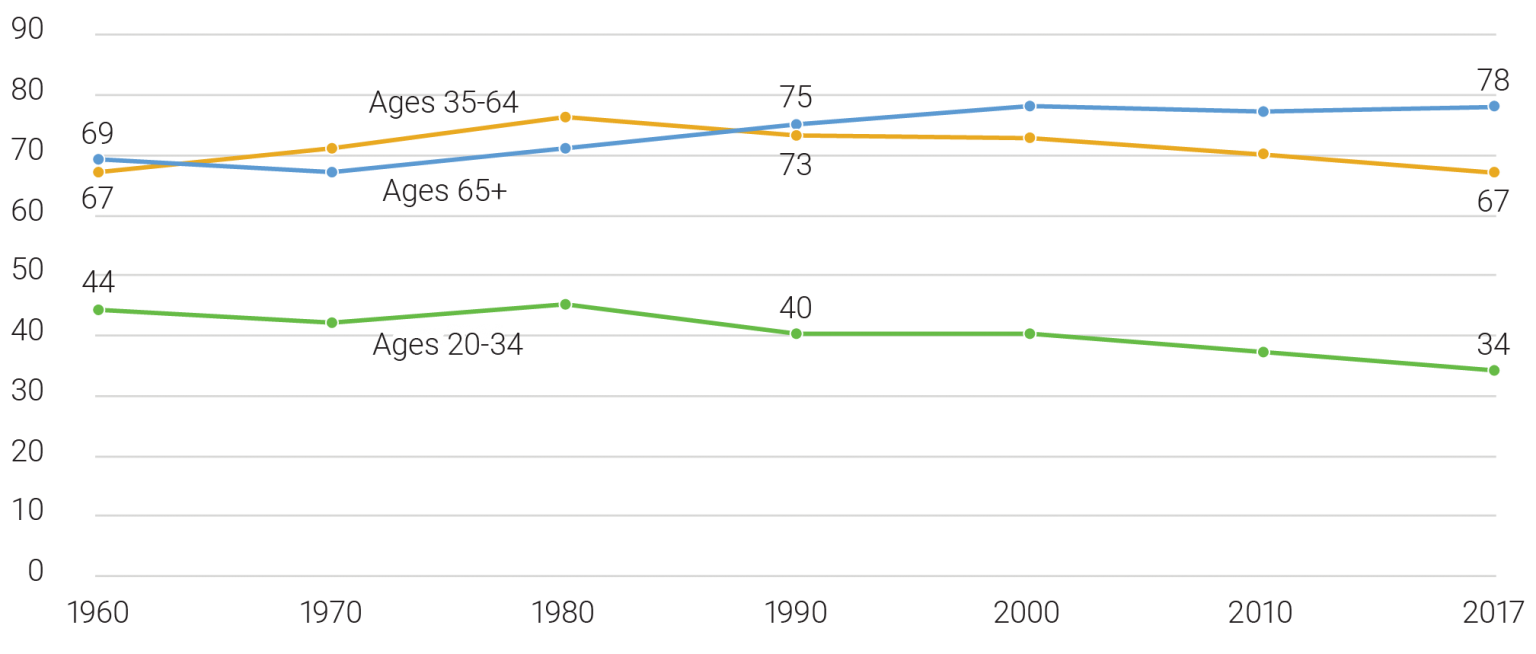
The Prospect article also says that home ownership among under-35s has gone down, and links to data on the home ownership rates grouped by age (https://www.prb.org/wp-content/uploads/2020/02/a-02132020-ar...) but the data ends in 2017. The oldest of Gen-Z would only be 20 years old at the time this data ends. When we look at the Economist's wrote:
> Bolstered by high incomes, American Zoomers’ home-ownership rates are higher than millennials’ at the same age (even if they are lower than previous generations’).
A chart of home ownership rates that end in 2017 could not possibly refute this claim given that Gen-Z would be too young to buy homes around the time that the data's source ends. The home ownership rate among under-35s increased from 34% in 2017 to 39% in 2023 (https://www.census.gov/library/stories/2023/07/younger-house...), so when Gen-Z started to enter their earliest feasible home-buying years the ownership rate was in a period of recovery. The Economist's claims seem to bear out.
The rest of the piece goes off on tangents largely unrelated to the financial outcomes related to Gen-Z relative to previous generations. For instance, it cites a pew survey on the percentage of young adults that support their parents. But it does not compare that against earlier decades, so there's no evidence in any change in rate over time. In fact the bulk of the piece shares data that aren't relevant. E.g. how does the racial breakdown of the subprime mortgages relate to incomes by age and birth year?
It's a sign of how disempowered the populace is that these selfish ghouls don't even feel the need to pretend to be decent functioning adults anymore. Because, why bother? What is anyone gonna do about it?
I bet you there are people equally repulsive and influential but face little public backlash because they never show up in front of a camera.
It's a big club and you ain't in it. (C)
So far the responses are more about anecdotes than general trends.
Capital will still flow, it will just be between the people that already own things who are willing to trade. If the government doesn't take a more active role in the economy, then we are looking at one where every bit of capital is extracted from those that have little and where the majority of the flow of capital happens in between those that have it.
IE, those that can afford a yacht will be able to buy one from the yacht company whose owners can then turn around and buy private jets.
The average joe who wasn't in "yacht" society will be left to fend for themselves, ideally for the yacht owners, they'll just die because they are a "waste" on society.
Before that happens, I expect some of the average joes will be able to find work propping up the lavish lifestyle of the yacht owner. Polishing their yacht, making their food, etc.
Even then there still won't be capital per se, as that system is rooted in humans' economically valuable labour. There can always be bartering of course, but it'd be pretty meaningless as all the "owners" will be able to create their own X, where X is a jet, yacht, or anything else that one with the access to the means of production (AI+robots) desires.
As to those without access, they'll just die out; there will be no fending at all unless one is given or takes access.
The only way they can make it illegal to take the human out of the loop is if they ban self representation. Otherwise people will do research with AI and just present their findings in court. But the free/cheap lawyers are actually so much worse.If laws prevent self representation we would increase the inequality even more.
Notice that all these countries are English speaking countries? Aside from speaking English they also have lots in common when it comes to the way the economy and society is run. I can only speak for the United States, but I’ve noticed unfordable not luxury apartments going up everywhere and starter homes are not.
It looks more like you only read English-language news which is concerned about the happenings in English-speaking countries.
https://www.numbeo.com/property-investment/rankings_by_count...
These are current average houseprice-to-income ratios per country. The first English-speaking country on that list is in 87th rank.
The issue is, why does it cost several times as much to add a housing unit in the US as it does in Mexico? That can't be explained by the cost of lumber or copper since they're tradable commodities and if it was labor then prefabricated components should be driving down the price unless it's some kind of a racket. Which implies that it's mainly rackets and zoning restrictions.
I suppose the message is that although housing (and health care and higher education) costs in the US (and elsewhere) have outpaced wage growth for the last half century or so, it could still be worse living in a country with much lower wages to begin with.
I'd say the most important metrics are those that matter to people, not those that other people say should matter to them. Births are going down, suicide is going up, but they're just drama queens, we ran the numbers... that is what turns mere criticism into hatred.
Less and less people own a bigger and bigger share of wealth, and they're too often not decent people who respect democracy and the fact that they're still just one person, not a particularly special one, and still only have one vote. No, many of them are not content with that, and have assaulted the people ever since they successfully fought for the few worker's rights they have now. That is bad enough, and not even close to the full picture. That "it used to be worse" in some metrics isn't relevant, what matters is now, how it is because of robber barons, and how it would be without them.
If someone steals most of your shit but leave you with more than "people used to have, on average, in historic times", you wouldn't be placated by that. Because, weirdly enough, you don't view yourself as a mere abstraction to be talked about that way, and billions of other people don't view themselves that way either.
https://fred.stlouisfed.org/series/RHORUSQ156N
Yes, "sex in exchange for money or drugs" - improving.
Give a shit.
And are you saying you would not in fact not mind being treated worse than other people today, as long as you're getting treated better than someone in the stone age? You completely sidestepped that part of my comment, only to frame me as somehow upset and irrational, such as
> "Pretending information is imaginary or offensively abstract because you’re upset about income inequality (which is even more of an abstraction)"
Fairness and justice matter. Sure they're abstract, so is happiness, so is hate. Come to think of it, none of the important stuff, none of the in-between stuff that makes any of the measurable stuff real and meaningful, can be easily measured. And how people feel about their lives and where society is going matters because they feel it, not because it filters down to some numbers you happen to accept.
And even IF everything was getting better all the time, it would still matter that people don't feel it. They're not "tempted" by being unhappy, nobody wants to be. Pretending that's the case for the majority of people, just because you're upset human reality is messy and wet is not good or helpful.