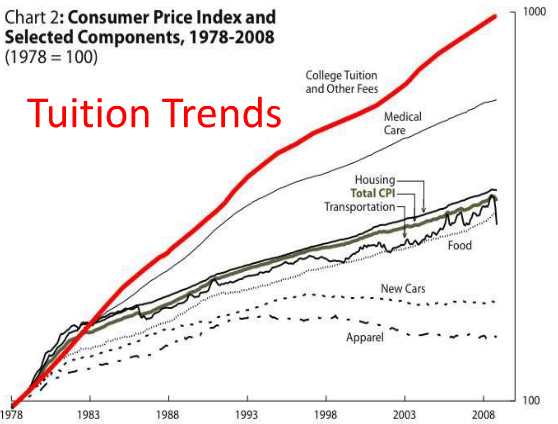
So peanuts.
The public universities budget in California is something like 60 billion.
This isn't even a rounding error.
It's been literally the biggest grift of the past 50 years[1]. Education should be free.
[1] https://eliterate.us/wp-content/uploads/2011/03/Tuition.png
Sooooo... A few days of claude code "thinking", for a few hundred people?
The CSU system is going to have to to make tough consolidation decisions soon because you can't have declining urban and suburban campuses at the same time.
Is this a political coalition thing or is there a real teacher-related reason they don't like it?
As others note, there are a lot of reasons for teachers to refuse or hate AI, though in my experience most don't know shit about it and just want students to stop using it as an expedient. I, for instance, take a look at the tiny Dell cubes that have barely powered our Windows workstations and hilariously bedraggled Prometheus units and anticipate "well, we can't even afford to update these pieces of shit, so I suppose as a 'Microsoft shop' we'll be on a upgrade path to CoPilot-enabled cloud computing or some bullshit like that, then it'll really be all over" so my primary concerns are infrastructural. But god yeah the AI writing I get, jesus. These kids think they're driving around in the AI equivalent of Lambos, but free tier CoPilot is a used 2017 Chevy Cruze.
Well, of course. Horse buggy manufacturers and drivers were dead set against automobiles.
As a hiring manager, I will immediately prioritize hiring graduates of that school. I can teach someone who knows how to code how to use Claude Code. I find the other way around quite difficult.
(not suggesting this is an effective or smart move).
The NYT often has a bias against AI, but the article's contents are actually a pretty reasonable summary of the different attitudes towards AI in academia. Then they went and slapped a terribly sensationalist headline on it, which doesn't seem well supported by the actual article.
I don't understand why these are seen as mutually exclusive choices. I think I would be in both of these camps if I were a student.
So yes, both attitudes are simultaneously possible.
But since that’s not going to happen it’s in everyone’s self interest to use AI as effectively as possible.
It’s the world’s biggest Prisoner’s Dilemma.
it's okay to be in multiple camps when things change fast. its a survival instinct.
Isn't this one of the better uses of AI? Any librarian would have knowledge gaps and bias. Librarian-provided info is best-effort and not considered perfect. They're librarians, not subject matter experts. An AI could give (and cache, since books don't change) summaries of any book, and compare them, far better than a librarian except for niche areas a particular librarian might have read themselves.
But now ...? For STEM, at least, everything is digital. You don't need to go to the stacks to get an old journal article.
And yes, it's sad, and it feels like an era is ending. But that's because it is.
Why is it always the same kind of intellectually challenged people who need custom avatars?
https://www.youtube.com/watch?v=9YOEEpWAXgU
“Our professors were pretty anti-A.I., and then C.S.U. signed the contract with OpenAI and things changed,”
Ok, another corrupt university run by bribes.
This reminded me of back when it was popular on websites to use transparent video to have owners of companies virtually "walk" onto the webpage and talk directly to the user. Stuff like https://newimagemedia.com/videopackages/walk-on-spokesperson... There's a similar awkward period right now as people try to figure out AI.
What are we even doing here?
This has been the case for essentially all newspapers since time immemorial. Reporters write the articles, editors write the headlines.
(* in keeping with this site guideline: "Please use the original title, unless it is misleading or linkbait" - https://news.ycombinator.com/newsguidelines.html)
The author does seem interested in supporting the headline, but I think they're too good of a journalist to pull off the outrage. It mainly comes through in passages like this:
After I pointed out to Janos that Marx himself would have had a field day with MarxGPT, he laughed… by interacting with ChatGPT, he and his students solidified its role in the public education ecosystem; and their ability to do so was the result of the transfer of almost $17 million of worker-generated public funds to a private, for-profit company.
They do get to AI critics eventually, though obviously ‘activists dislike X’ isn’t really proof for ‘X is tearing us apart[, Lisa!]’. Namely,
“We feel like a guinea pig for what A.I. is going to do to higher education,” Kenney said. The embrace of generative A.I., she went on, is “a step down the path of creating a really different kind of future citizen and worker.” This kind of student would be intellectually passive, less likely to see themselves as agents of their own lives.
This winter, the [critics at SFSU] circulated a petition asking the chancellor’s office to invest in protecting faculty jobs and academic programs rather than renew the OpenAI contract.
Vanderbilt University opened a franchise somewhere in California recently. The politics aren't that different though so won't be too much of a shock
No, but that would make it a "political coalition thing", which is why I asked
I travel to many universities for conferences and see firsthand that talking is now allowed in some institutions' libraries, with only a small room made available for readers who need quiet.
There are similar arguments about building housing in a flood zone.
Instead, we should be building more housing in safer places.
In that specific area of Santa Rosa, now that it’s burned it won’t burn like that again for a few decades — it’s not like SoCal LA where it goes up every ten years like clockwork due to chaparral — and it turned out that no one had been enforcing “safe distance around home clear of brush and trees” and so it’s probably now the lowest wildfire risk city in the entire state to build homes in as a result: proper code enforcement, safety protocols, and a case study of how fire spreads through blown embers, dry roofs, wall-adjacent bushes, and open vents.
The fires reached all the way to the highway and very nearly jumped it to burn towards the ocean and they were prepared to sacrifice the entire eastern half of the city to prevent that, because Marin and Sevastopol refuse to thin their trees and it would have spread in a single day to all of North Bay if they let it cross. (And, yes, even Marin deserves not to be razed by fire, however much ire they’ve earned!) So it turns out that building homes near any forest is a bad idea if you’re not also thinning out the forest with selective logging, and as a result the entirety of Northern California and Western Oregon are more or less ‘places with high wildfire risk’. It doesn’t have to be that way, but certainly it will be until leaders grow a spine and stop capitulating to the existing homeowners.
I wrote a rather detailed paper about this with a dozen references spanning the past century for school last year; no AI required, just a handful of luxurious 2500-word days and then an couple more for editing. Best week of the year. Each wildfire costs $100-150M of California GDP in direct and indirect impacts; at $15k/yr fulltime minimum wage, hiring a thousand laborers to carry hand axes into the forest and thin them for a full year — machines can’t traverse and even if they could, machine logging and controlled burns can only happen during 4 months out of 12 — would prevent at least one wildfire (breakeven point) and every one prevented after that would be pure profit for the state economy. You’d think greed would drive them to do it, but apparently it’s anathema to suggest manual labor can solve problems anymore. Maybe someday Santa Rosa or Sonoma County will work up the courage to do it :)
"In A History of News, Mitchell Stephens notes sensationalism can be found in the Ancient Roman gazette Acta Diurna, where official notices and announcements were presented daily on public message boards, the perceived content of which spread with enthusiasm in illiterate societies."
Edit: here's an example. Headline on the front page is "A Chaotic, Confusing Campaign: Here’s Who Should Be the Next Governor of California". Makes it sound like you're clicking through to an endorsement, right? Nope, the article is actually a voter guide. It's a completely misleading headline.
[^1]: You can often inspect the URL to see the original descriptive headline before the clickbaiters got to it which makes it even more annoying.
[1] https://myelearningworld.com/cost-of-college-vs-inflation/
Declining enrollment affects universities very unevenly. University of California is still under pressure to increase enrollment, which is mostly constrained by physical capacity. The housing situation is particularly bad on some campuses.
You pay for the rubber stamp.
There exist parts or even degree courses in university education that cannot really be learned this way. Think of laboratory courses or courses where you need access to expensive equipment.
Also, there exist topics and degree courses that are much harder to learn by yourself than others.
Finally, keep in mind that computer science is "special" in the sense that:
- What the university teaches you or should teach you (a degree course at a university rather prepares you for an academic career in the field) makes you quite overqualified (in the academic sense) for many programming jobs. Such topics are possible, but in my opinion far from easy to learn by yourself.
- Many employers want very different skills from applicants, which often involve "fashionable" skills with a very short half-life. A university system is likely not the best kind of education system to teach this kind of skills: it rather (ideally) excels at teaching topics that are complicated, but have a much longer "half-life" before becoming outdated.
Why do you need equipment to learn something? You can learn the information outside of a lab.
>Also, there exist topics and degree courses that are much harder to learn by yourself than others.
Free AI like ChatGPT can assist with offering many different explanations personalized for someone to make it easier to learn.
There is a single person responsible for this.
His name is Reagan.
What I can tell you is the following: a lot of academic topics are quite subtle - to get to more than a basic level, you have to learn things that are very subtle, and where you only can judge the correctness of the information years later (basically when you have finished your degree or even PhD).
Because of this, I would rather read the most renowned (and ideally hardest) textbooks in the respective area (if you really need to cheap out, download them at some shadow library) instead of trusting some AI.
I can tell you that for quite a lot of questions in my area of expertise, the answers that AIs gave were far from being sufficiently reliable for learners who want to get a deep knowledge about the topic, and the errors were often quite subtle.
In mathematics, for example, it is not uncommon to hang for hours over a page or even a paragraph, trying to understand why the statement holds - and this in a situation where the proof is for sure correct. Now imagine the situation of hanging over a page of text that you will need hours for understanding when you cannot even rely on the prior that the information in the text is correct ...
Now imagine if AI can explain that page better so someone can understand it in a minute. This is why it is revolutionizing education.
The problem is the "understanding" part: from my experience oneself is the huge bottleneck here: one realizes very fast that the lacking component is one's own brain capacity.
This is also why many mathematicians and physicists are so obsessed about IQ: mathematics and physics are disciplines where IQ points really can give you quite an advantage.
So, the really helpful thing to ask to the AI for is not better explanations, but methods for getting a huge increase in brain capacity.
Because of all this, your point is rather a mixture between a nice science-fiction story and a marketing pitch for an AI company.