Why Can't Walnut Creek Build 3 Bedroom Apartments with a Playground?(kevin.burke.dev) |
Why Can't Walnut Creek Build 3 Bedroom Apartments with a Playground?(kevin.burke.dev) |
Also, all of this is about NIMBYism, which is about house prices being inflated to make up most of households’ wealth, which is not fixable without triggering a massive wealth redistribution. Most western societies are stuck in a very non-ideal Nash equilibrium and it is not going to be solved any time soon.
Even if only some of the cars had the ability to park themselves - onsite or offsite - you could drastically reduce the floor space required for parking. Reducing the floor space reduces the building height, the construction cost, and the required rent.
We are going to be stuck with the choices we make now about how much space to allocate for parking for the next ~75 years or however long this building is there for. I don't think humans are going to be driving for a lot of that time.
Where did you see that sentiment expressed? I couldn't find anything along those lines in the article. The closes was about parking, which I think is very different.
> Maybe this building in 2026 can't assume robots are parking the cars. But we could change the city's rules now and maybe a building a year from now will be able to dedicate less space to parking.
Humanity has manage to make it this far, almost entirely without three+ bedroom units.
It does not make sense to mandate parking standards in new buildings that assume 100% of cars will be driven by humans who park and then need to open the door to exit the car.
It's a juxtaposition of optimistic futurism (in 5-10 years, most people will just rely on robocars and robotaxis) and anti-regulatory sentiment (critical of the requirement that elevators accommodate stretchers).
Some of the more difficult problems are hand-waved away as, "We could solve this if we just put our engineering hats on."
That said, I don't want to throw the baby out with the bathwater. It's true that other countries and cultures have very different approaches to residential development. But a big part of that is cultural differences in how people live and what they want. Cultures that are more family-oriented are naturally going to have housing that is more family-oriented.
People have been saying that robotaxis and self driving cars will take over in a couple years for at least a decade.
It hasn't happened, and not only that, but if the companies making them want to be profitable, they will price out a huge percent of consumers.
My guess is that humans will remain the majority operators of vehicles for at least 20 more years, maybe more.
That isn't to say we need parking requirements though. We should still get rid of them and let the market determine how much parking we need.
I just spent a week in Austin and took a half dozen Waymo rides. Robotaxies are definitely here and they are awesome. There's no reason why they won't be coming for Walnut Creek.
This exists in America. It's not foreign culture. We just pretend it is to avoid change.
Is there a paid lobby behind this?
As soon as you look at comparisons like this that are also in the US but somehow managed to be much cheaper, you realize the problem isn't whatever this analysis is about. It's got to be something else.
"Most of the apartments have a window on just one side. The interior facing rooms on the lower floors are going to have a lot of trouble getting light in. With a window on only one side, you can't ventilate your apartment by opening windows on multiple sides. This increases the demand for HVAC, which increases the cost of living."
I doubt A/C costs are anything but negligible compared to the other design decisions.
This is someone who is just looking for an excuse to not like the apartment.
And the difference is A/C is paid by the renter not the building owner. If you want to address cost of living one thing we could do is make it easier to have the wind cool down apartment buildings.
I agree with pretty much everything in your article, Kevin. But I wonder whether Waymo actually has a holistic vision for how families would use their service? Do they expect people with small children to haul around a carseat or booster seat (possibly multiple) for these trips until all their kids are old enough? And spend the extra couple of minutes double parked while they install/remove it?
The schools or daycares or camps could help figure out unloading on the other end.
They already don't have those parking requirements in Copenhagen, and it sure as heck ain't because they've got cars parking themselves with one inch of clearance.
I had no idea it was a town also.
Less bedrooms generally means more units and rent. Kids in units means much higher wear and tear. Design is highly dependent on the goals of the building developer.
It takes the explicit will of the government (dare i equal it to the will of the people?) to force developers to build at least half decent stuff i a half decent way. Note that the market - "people would vote with their dollar" - doesn't work here due to highly constrained, in many ways by the government, supply.
* 2-exit-stairwell requirement
* elevator laws
* parking laws
Article contrasts with an apartment building in Denmark to show what could be possible.
Elevator laws make sense so long as they apply to general areas and not every single building. It would really suck for the majority of builders to decide to cost-skimp and skip elevators, effectively locking disabled people out of dense living.
Parking laws need to be removed and replaced with minimum transit requirements. Provided transit options are accommodating for disabled people (which is totally possible, all the buses around me do it) then the only thing hurt (read: no longer subsidized) by making parking optional are car manufacturers, dealers, and gas companies.
It's not the elevator requirement that is the problem, it's that they have to be very big. Can't use the small elevators that fit inside a stairwell for example.
And you do not need to have an entire building of self driving cars to make a large dent in the building footprint that is currently dedicated to parking.
* My salary:housing ratio is better in California than in Nebraska. I have to work fewer hours each month to pay for my home here than I use to, for roughly similar niceness.
* What is spendy is services, like paying someone to do work on the house. Those workers make more here, too.
* On a side note, anything you buy from a national retailer costs the same in both places. An iPhone or a minivan both cost $X whether you live in CA or IA, so I only have to work about 1/4th the amount of time to buy a new phone here as I use to.
Yes, the cost of living is a lot higher here. Especially for those in tech, in my experience the pay difference far outweighs the cost difference, even including housing.
I disagree on HVAC: i have proper ventilation on both ends of my apartment, if it's under 75 my apartment never gets uncomfortable with windows open on both ends, and i grew up with 69F Des Moines houses.
And in Des Moines, you HAVE to drive, you HAVE to have parking at home, everyone owns a car, there is no alternative way of living.
Where i live now, i have a car, i still live in an apartment, i can walk to the train or the bus or the grocery store or the bar, and i still use my car sometimes, but if i couldn't, i wouldn't really be missing out.
That to me is the problem: places where kids have no room to explore or play, where people's livelihoods are attached to their ability to maintain a car, where people on foot are treated as second class. That's definitely most of my experience in Iowa suburbs
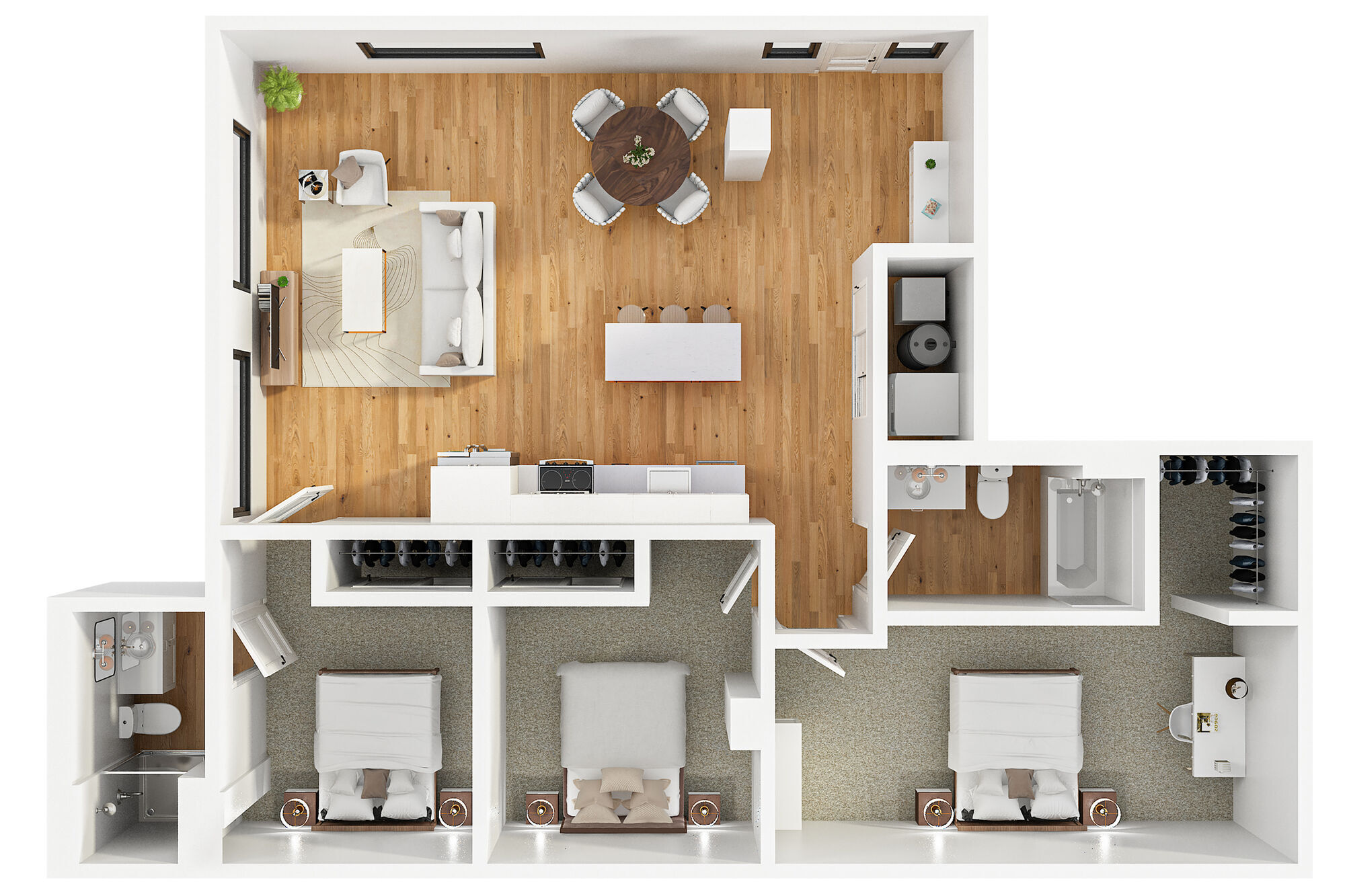
Finally found one on my fifth try. Here is one of the three bedroom floor plans that they offer. None of the bedrooms have a window https://capi.myleasestar.com/v2/dimg/178334024/2000x1333/178...
The real problem is families in the US don't desire apartments and so no one builds apartments that families would desire to live in, thus perpetuating the problem.
Also, in California, "apartment" means short-term leasing and is usually full of young singles, couples, divorcees, and retirees. It is often a big building with many studio, 1, and 2 bedroom units. A similar multi-dwelling structure with individual unit ownership is referred to here as a condominium (condo). These often have slightly larger units since they are targeting the home-buying family rather than the itinerant renter.
In SF Bay Area suburbs like Walnut Creek, there are also neighborhoods with town-homes. These are like condos in ownership structure, but often only have 2-3 units per building, wrapped with a small private yard maintained by the owners. And these lots are in turn surrounded by larger common grounds, which are maintained jointly by the HOA for the whole neighborhood.
In Asia I would guess families make room for their older relatives which would mean an extra bedroom is needed. Immigrants to the US typically do that but I think it's uncommon among the rank and file Americans.
In fact 4-5 bedroom single family houses in the US are extremely common. What I don't understand is why apartments always seem to stop at 2b or 3b.
Here's a recent story of what happens when Asian family sensibilities move into a typical American neighborhood
https://www.nytimes.com/2026/03/12/realestate/massive-home-a...
neighbors were upset about this addition, built to house aging parents
https://wjla.com/resources/media2/16x9/1280/986/center/90/fd...
There’s also a pretty strong effect in the US that selects towards raising 4+ person families in a house (whether rented or owner-occupied) if at all possible, so a 4 BR apartment is likely to be occupied by the (relatively) rare tenant who prefers to live in an apartment, but more likely one who is forced to by lack of option. I suspect this effect is much smaller in Asia.
Oh, in the current market, you can raise obscene amounts of money on pure hype. Look at how much money SpaceX raised on an S-1 prospectus that everyone looked at and went "this is pure fantasy."
The point is that if you are builder who wants to build a 7 foot wide parking stall (or avoid parking stalls altogether and just have the cars park themselves as efficiently as possible) you are not legally allowed to do this.
And a self driving car is capable of locking all the doors, identifying threats, calling 911 etc.
Since then, Waymo has actually regressed and stopped driving on freeways, which is a big problem for suburbs. Distances are farther and parking is more available, which suggests people would be taking Waymo less than in more dense areas.
Smaller, more affordable elevators mean that they're less of a luxury item. You could put an elevator in your house, or retrofit an older apartment with an elevator, much more easily. This is incredibly common in other countries
In a podium building you only have so many corner units, everything else is 1 or 2 bedroom units. In this particular building that means only 12 units out of 66 https://www.costar.com/article/939748887/lloyd-companies-bra...
"there is a reduction of 90% of hours of a possible use of mechanical ventilation, showing the feasibility to achieve thermal comfort within the house by using passive ventilation"
https://www.sciencedirect.com/science/article/abs/pii/S03062...
" Indoor thermal conditions were found to be within the comfort zone for more than 70% of the time under cross ventilation operation while single-sided ventilation provided adequate thermal conditions for only 1% of the time. Results from this study highlight a significantly better performance of cross ventilation over single-sided ventilation." https://www.sciencedirect.com/science/article/abs/pii/S03787...
Des Moines and Omaha are pretty good, though. I'm especially partial to Omaha. However I personally still wouldn't live there by choice, either one. But i know people that are happy in both all the same.
Houses, on the other hand, have 4 external walls at the very least. Not to mention most 4+ bedroom houses are 2+ stories as well.
[+] It might be also required to have staircases at decent distance, as a second staircase going through the same stack of apartments is not of much use as it's likely to be blocked by fire at the same time as the other one.
Apartments are for dense housing, big apartments aren't dense, therefore look elsewhere for your large apartment, I guess. You could have 4 tiny bedrooms, I guess, but that's weird too.
It's nice to have an office/guest room, but if you're raising a family that needs three bedrooms in apartments, you're compromising.
The reasons vary, but I have lived in Boston/Cambridge area for 40 years and can’t think of literally any of my friends who raised a kid past the age of 3 in an apartment, despite many of them (including me) enjoying the apartment life while young and single. But, literally as soon as we could [barely] afford to, we bought a house and only then added to the family.
It also affects what the ground floor of buildings looks like - you can't have ten ground floor pedestrian exits or bike parking in the courtyard if the courtyard is on the third floor.
25+ years from now, if it’s more economical to use for housing, knock it down and build high-density housing.