Where to Find the Colors Your Screen Can't Show You(moultano.wordpress.com) |
Where to Find the Colors Your Screen Can't Show You(moultano.wordpress.com) |
[1] (18 minutes) https://youtu.be/-DyrBDsKA5s
For printing there was PANTONE's Hexachrome which used 6 ink colours to greatly extend the possible colour range --- but the only printer I know of who made great use of, and profited by doing so, used it only for its increased range's covering of additional spot colours --- so they basically persuaded every printer w/in driving distance to sub-contract spot colour work to them (for those colours which fit in the Hexachrome gamut), then used fancy software to gang up jobs onto a plate, run as many copies as were necessary, cut and stack, and then send out the jobs and run the next plate, no need to wash down the press and change inks.
I tried to sell the idea of implementing it for high-end photo pieces at a printer I worked at, but no real interest because it was difficult for sales to communicate, and no one wanted to spend money printing a sample/researching images which benefited from it.
Thanks for such a beautiful article about not looking at a screen: I'm off outside... :)
Hint: If you listen to a live orchestra without amplification, and the sound "sparkles", it's because of the frequencies slightly above 20khz that are normally filtered out of audio CDs and streaming music.
Anybody know any links to webshops for such items?
https://www.youtube.com/watch?v=_NzVmtbPOrM
There's also Vantablack and similar ultra-black dyes which are a somewhat adjacent phenomena but in the same category of "colors your screen can't display". The most black a pixel can be is "off" (and that's only achievable if the display is on if your screen is an OLED), and the back coating of your screen is probably not as black as those dyes.
- use raw format on the camera
- edit raw eg pro photo rgb
- send this to a wide gamut printer with a large set of inks to view the image
the printer would replicate the color outside the srgb space
there are such inks as cyan, light cyan, orange
Seeking out obscure colors or unique ones is a fools errand.
In reality, the greatest defect of the sRGB color space, which is still too frequently the default color space, is that it is not able to reproduce many saturated orange/red/purple colors, which are very frequently encountered around us, e.g. in flowers, fruits and clothes.
The missing orange-red-purple corner appears small in the diagram in comparison with the missing blue-green corner, but in reality humans perceive much more different colors in the orange/red/purple corner, so the relation between those areas would be opposite in a uniform color space.
The Display P3 color space is much better than sRGB for reproducing orange/red/purple colors and now it is available even in many cheap monitors. However many monitors that can reproduce Display P3 come configured by default to use just sRGB. Such monitors should always be reconfigured to use Display P3.
Monitors that can reproduce an even greater part of the Rec. 2020 color space are obviously better than those that can do only Display P3, but such monitors with a higher color gamut are usually more expensive. The full Rec. 2020 color space can be reproduced only with laser projectors, because it uses monochromatic primary colors.
All of the non-commercial triple laser projectors I'm aware of are single-chip DLP, so they suffer rainbow artifacts and have poor black levels. They're also liable to laser speckle[^1] if you're not careful on your screen selection.
The JVC (LCoS), Sony (LcoS) and Epson (LCD) laser projectors all use a single blue LED laser and phosphor wheel to make white light, then use prisms and filters to split it to RGB and can only get 87-98% of DCI P3. They have better blacks and no rainbow artifacts, but the color reproduction is not as complete.
Which is to say, it's still a compromise in projector land, unless you've got $400K for a https://www.christiedigital.com/products/projectors/all-proj...
If I understand correctly fig. 3 in [1] should be perceptually uniform. The bluegreens missing from sRGB, but present in BT.2020 comprise a sizeable chunk comparable to redyellows.
[1] https://www.researchgate.net/publication/345252499_Evaluatin...
It is true that both the red and green primary colors of sRGB are bad (because they correspond with obsolete CRT phosphors that have not been used for decades), but in practice the defects of the green primary color are much less important, because the objects with saturated green colors are more rarely encountered.
Like I have said, objects with saturated orange/red/purple colors are very frequently encountered, even in most homes, e.g. flowers, fruits, clothes, blood.
Photographs or movies showing such objects that have been recorded using a wider color gamut look extremely differently on an sRGB monitor vs. a monitor supporting Display P3 or an even wider color gamut.
Only very rarely I have seen examples with obvious differences between monitors when showing green objects, e.g. some documentaries with certain vividly colored animals, like some insects, birds, frogs or lizards.
Do you know if this is why looking through a true green-blocking (pure magenta or purple) filter (e.g. Wratten 32, 33, or 34A) is such a different experience than a digital photo taken using the same filter?
Looking through those filters is extremely surreal for me, but I've not been able to capture anything like it with any camera.
Software that does color processing should convert all input pixel formats into BT.2020 linear FP16 color components, do whatever processing is desired and convert from linear FP16 to whatever pixel format is sent directly to the monitor through DisplayPort/HDMI, as the last step.
I have not looked on the market to see how widespread are different kinds of monitor specifications nowadays.
I am using relatively cheap monitors, but not the cheapest, e.g. some common types of Dell monitors. There are more than ten years since my minimal requirements for a monitor have been 4k resolution, 10-bit color components and Display P3 color gamut and 60 Hz at 4k and 10-bit.
So I believe that, especially after a decade, it is easy to satisfy these minimal requirements or better, except that not everybody checks the monitor specifications when they buy one.
10 bits per channel is the common target for higher color depth. The formats with 16 bits per channel are generally for image storage and allowing more bits for downstream transforms to avoid quantization. I don’t even know if there are video cards that would output 16 bits per channel, let alone panels for it.
As a cinema enthusiast, I say 24 fps ought to be enough for anyone.
Separately, sorry to nitpick, but while wide gamut colors with only eight bits of data have lower resolution than sRGB, that doesn’t make them an inferior option. You might not be able to specify the exact shade but a) your effective accuracy is still greater and b) you trade that for greater range.
Just as an example, assume you have buckets of granularity 1 (sRGB) and 0.5 granularity (wide gamut). With only eight bits you can precisely select any individual bucket of granularity 1, whereas with only eight bits you sometimes miss the intended wide gamut 0.5 precision bucket and hit its neighbor instead (as if you had a granularity of 1 in this specific worst case). That doesn’t make it worse; you just aren’t taking full advantage. On top of that, your range with granularity one is, say, 200 to 800 while your “range” with the wide bucket is 0 to 1000 (just as an example).
There’s a reason photos or graphics saved as eight-bit png or jpeg still manage to look ten times better in a wide gamut profile than in sRGB (on a better-than-sRGB display).
JPEG is a different thing, first it does RGB -> YCbCr conversion, then it splits the image into blocks. Wikipedia article shows a good diagram of the 64 possible DCT blocks. Each image block becomes a linear combination of the DCT blocks. You did that for the Luma channel, then you do the same thing for the Chroma channels. It's even common to reduce the resolution of the chroma channels (chroma subsampling).
Then JPEG means that you are deleting information that is less popular after you've made your blocks. Often throwing out more information in the chroma channels than the luma channel. You're left with ringing (high frequency noise to fill the block), and blocking (differences between edges of adjacent blocks). Better compression codecs have ways of mitigating blocking and ringing.
SCNR
This post is making me feel a bit inspired to go outside and immerse myself in the forest to take in the greens. Thanks for sharing.
Does anyone have any comments on the future of printed media?
In the back of my mind, I find it oddly surprising that we have 3D printers but I haven't seen a printer where you can mix your own pigments and print with them.
Many years ago I knew someone in Seattle who made microprints with burnished copper plates, some of them with a dozen different colors. He designed a couple of commemorative postage stamp-like objects, and that somehow got him hired by an eastern european country as an anti-counterfeiting advisor and then he disappeared.
<https://en.wikipedia.org/wiki/Impossible_color#Chimerical_co...>
Triangles between screens may differ with tuning, but I suppose they all are limited in range. I’ve yet to experiment if this experience was a “brand experience” because I liked the TV or that the colors are indeed more intense than even some HDR/DV flat screen from the past few years.
This article was so well written that it gives a lot of energy to make this comparison for real. Absolutely masterful writing and all of the plenty examples make me want to look for colors I’ve missed out on while watching so many screens.
What the article does very well is vibrantly describe what you are missing and then post an image of it, such as a beach. Looking at that image, it falls absolutely flat compared to memories and the imagination of those places. This makes it tangible how limited screens really are.
Edit: added last paragraph
The most striking experience I had was working with a blue laser (430nm). The best way I found to describe its color is that it was screaming "blue" at me. Since then, I'm always disappointed when looking at a screen displaying #0000FF.
To be fair to Jurassic Park, though, at least in the book the quirks of T-Rex's vision were explained by the details of genetic engineering (the base DNA used was some kind of amphibian, that allegedly had this problem — still not very scientifically plausible, but not quite as silly as in the movie). It goes a long way to emphasize that in the end these are not real dinosaurs, these are human-made abominations.
Thanks to the author
I do have a question that the article doesn't seem to attempt to answer, though. The article says (paraphrased in my new understanding) that any spectra which makes the cones in your eyes react the same way will result in seeing the same colour. Do we know of any examples of this?
(Colour-blindness seems like an obvious example; I'm curious though if there are any examples of two common scenarios where it can be demonstrated that there are different spectra in each, and yet most people will see them as the same colour.)
Independently from this, the names for colors are culturally determined.
The Japanese call green traffic lights as 青 "ao", blue.
Russians have different terms for different shades of blue.
https://en.wikipedia.org/wiki/Blue%E2%80%93green_distinction...
https://en.wikipedia.org/wiki/Stabilized_images , https://en.wikipedia.org/wiki/Fixation_(visual) , https://en.wikipedia.org/wiki/Microsaccade
We fake the movement of anything we're staring at, by means of tiny automatic eye movements, in order to remain able to see the thing at all.
I've noticed when I'm spacing out and staring at a single point for a while that there's some kind of "tunnel vision" that develops, where everything besides the small point I'm looking at starts to darken and if I shift my body suddenly everything that was fading will "refresh." I always thought it felt similar to when a particularly bright light "burns in" your vision for a moment. Sounds a lot like the phenomenon described in the Stabilized Image article. Neat stuff!
> Nearly every species of scorpion intensely fluoresces under UV light. […] Scorpions have photoreceptors in their tails, separate from their eyes. […] It is hypothesized that a scorpion uses this fluorescence to tell whether any bit of its body is left exposed from its hiding place. Its tail “looks” down at its body, and if it sees its own fluorescence, it knows it is exposed to light, and in danger.
And a special call-out to the “Andean Cock-on-a-Rock” :), see a photo in the article.
That's screen reality. 1% evocative symbols and 99% in your head.
It's odd he noted Apple monitiers were "better". Maybe but marginally. Many options for other platforms, like Asus Pro Arte, beat it handily. And profressional color graders use Sony BVM series (Trimaster HX / OLED) for HDR or Flanders Scientific (FSI) DM/XM series or Eizo ColorEdge CG series. You won't see a single Mac at a movie studio for movie editing or color grading.
Dandelions in sunlight are an easy option, at least in my part of the world. If your replacement lens is UV-transparent, dandelions should have a very distinct colour difference between the center and outer parts of the petals, instead of a mostly-uniform yellow.
I wonder if the inaccurate representation of colors by screens, etc, in any way underlies the distinctive color palette of many AI image generators?
Open Utilities->Screenshot.app Options->Capture/Capture Format->HEIC. Note, it changes the system screenshot default away from PNG too.
So there's 3 options you have for rendering the colours outside the sRGB space in this kind of image.
1. Don't. This is usually the most honest, and what all but the first diagram in this article opts for.
2. Clamping. You just set the green component to 255 for every colour beyond green=255, which effectively looks like you extend the edges of the triangle to the edge of the visual range. This is the most common, and the approach used in the article's first image, but it's basically a lie. Some articles will dumb the out of range colors to make it clear they're not the real colour, but this article's first image doesn't.
3. HDR: If the author uses an image format capable of decoding HDR data, and your browser, OS and monitor, and the author's authoring pipeline are all correctly configured to pass through that HDR data, you can get a bit more colour, depending on your monitor. Not the full visible gamut, but up to whatever colorspace your monitor is using.
Anyone who has mixed paint at hardware store or paint store with a modern paint machine will eventually notice this. A of lot them have a spectrometer to match color from a sample. The software often has a preview that appears on a screen of the sample color. That preview color is often not quite the same and it's often either the limit of the sRGB color space or the monitor.
The data from the spectrometers is eventually converted to CIELAB color points with a D65 white point. Then that little preview needs to be converted to sRGB to display it or some colorspace the system supports.
There also some problems with the LAB colorspace, but they are minuet compared tot the limits of sRGB and display hardware.
1) trying to convince content makers to use new custom high-gamut hardware to capture the new spot colors
2) you'd need a full video content production pipeline that can render to that color space
3) finding enough people to care enough to pay the (substantial) premium for niche production numbers.
4) Most content just doesn't warrant high gamut unless it's narrated by David Attenborough.
So, you have both a chicken and egg problem, and not that big of a TAM to warrant the struggle.
You can publish a photo with default automatic JPEG processing, say by a phone, and it will certainly look flat. You could also present a masterful interpretation of raw sensor data that uses the most out of the available display space, and the impression might be different.
There is no objectively correct way to represent reality in a photo; even the concept of neutral grey is not a real thing as soon as perception is concerned. A default camera interpretation of light is baseline and safe to maximally avoid awkward edge cases. We all know that time we photograph a bright pink sunset but our phone renders it as pale yellow or orange. However, give the same shot human attention, and even though it may never be as pink as what you have perceived in reality it will pop enough that the viewer will have a similar response.
It is photographer’s job to work raw data in specific ways and make what impressed you stand out to your audience, arranging colours both relative to each other and in absolute display space, however limited it is. Human eyes are incredibly adaptive: we lower our relevant thresholds, adjust our idea of neutral grey—in short, we adapt to given display medium, to given photographic style, etc., and in the end perceive a true lush lagoon in a photo even if our eyes only receive a truly minuscule amount of colour range present in the scene.
Original NTSC cyans are more saturated than even DCI-P3 cyans.
Typical CRTs use the cheaper, brighter phosphors specified by SMPTE C (the basis for the sRGB gamut) and a circuit that pumps the saturation to compensate.
It's likely your screen uses the better phosphors instead of a colour correction circuit.
See the first minutes of this video, where he has a spectrum analyser: https://youtu.be/-DyrBDsKA5s?si=mRJPT2ecy6NqpB4N
On one side you have an apple, illuminated by natural sunlight. it fills your eye with a rich texture of subtly mixed frequency's covering the whole gamut of visible and invisible light. On the other a picture of an apple composed of brutal pure frequencies only emitting at 430, 540, 570 Nm. Can you tell the difference?
Modern color modeling is much richer then 3 parameters, because human vision is much more complex than simply color frequencies. CIE 1931 was low brightness, 2 degree field of vision, center of vision derived. As brightness increases, color perception shifts. Colors are NOT linear; sRGB and CIE 1931 chose such a small section of human vision that they approximate that section with a linear assumption. Modern CIECAM models are not linear, are not 3 parameter, because color is not linear (CIECAM02 is 6 parameter [2], there are several after that one). A century of experiments, wide color gamuts, HDR, have thrown out CIE 1931 as a good model. It’s only momentum now, and slowly higher end things are replacing it.
A good introduction is Color Appearance Models, by Mark Fairchild, also any of his technical papers give a starting point into the science.
[1] https://community.acescentral.com/t/cie-2015-cmfs-what-would...
Does that look like 3d?
Either way, you can project a volume onto a plane, which is great for communicating visual data on paper or screen.
The interesting question is "why that arc in particular"; my ignorance will shine through if I speculate.
I assume that the projection encodes something about our relative perception of each cone's band, hence the big green corner.
This will actually differ from person to person. If you look at a pure yellow wavelength light next to a red/green light mixed such that they create the exact same perceived yellow to you, it will look different to another person.
Aside from that, not really sure what a 3d view with the dimensions being r,g,b would actually offer
Problem is offset printing presses are HUGE and expensive and require making plates first. There are digital offset presses, but they generally can't have an other stage added like traditional offset printing, it's capped at however many colors that machine has built in. They also are huge compared to other printers people will have at home or the office.
-EDIT- It is probably possible to scale down the hardware and do something like digital offset presses. I think it would cool if there was a *small* printer people could connect multiple color stages like a legos and mix up a colors for those stages.
Oh man the stories write themselves
The problem is that you almost never are showing a single solid color and in the real world it matters much more how wrong your colors are compared to the ones displayed next to than it does how wrong they are compared to some far away reference. Banding is VERY noticeable and would be even more so if camera sensors didn't have noise.
According to the article you get purified greens from transmittance through foliage, ie backlight in eg a maple forest. This makes me suspect that it may be more important than just exotic animals, and maybe we are more sensitive to ”greens” than we think? For instance, a lot of my photography of trees/forests tend to feel much more ”green brown mess” and loses structure when going from reality to screen. (Another explanation is that my photos are bad, but I like that one less)
This sounds plausible. I think that in general for content that you record yourself, where you would record whatever is interesting, e.g. the more unusual things, especially outdoors, it is more likely for all the parts of the color space to be important.
My point was that for the content most frequently watched on a monitor, like commercial movies, it is much more likely that the main effect of using the obsolete sRGB color space is to see a lot of objects whose color is in the orange/red/purple area and which appear to have washed-out colors.
In almost any commercial movie, if I switch at almost any point between a Rec. 709 copy on an sRGB monitor and a Rec. 2020 copy on a Display P3 monitor I immediately notice some reddish objects that have become more vivid, looking like in real life, while on sRGB they look abnormally dull.
Until a dozen of years ago, I had used for many years sRGB monitors and I was content with them, but immediately after I used for the first time a Display P3 monitor I could no longer enjoy sRGB photographs or movies, because now their limitations had become obvious.
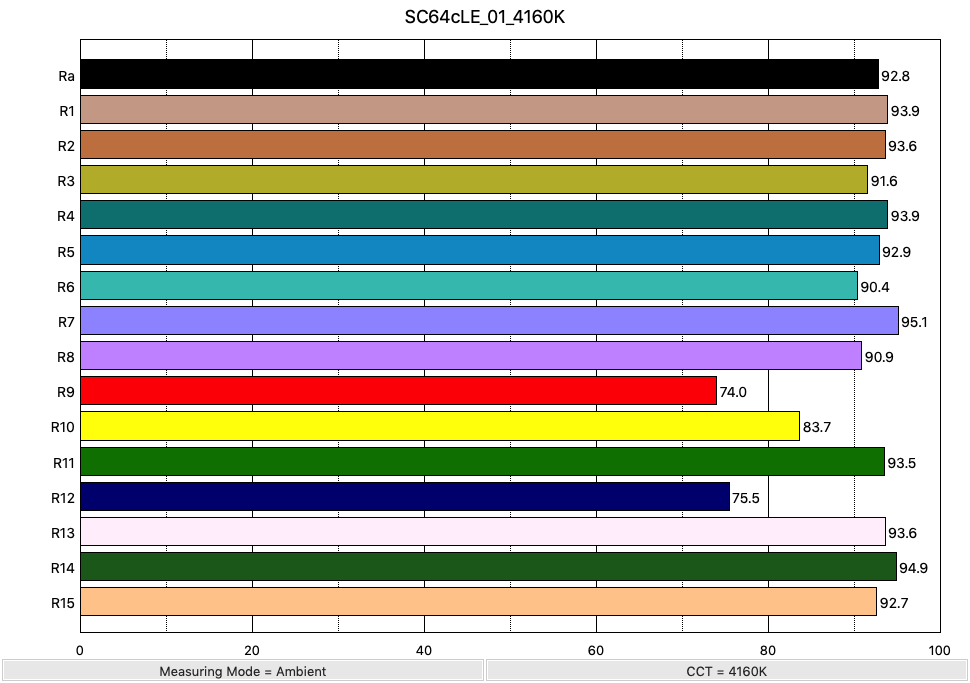
Unfortunately, there isn't really a way for a consumer to know short of buying a spectrometer like my Sekonic C-800 Spectromaster.
For illustration, I have uploaded a few readings here, mostly flashlights, not LED bulbs: https://majid.info/images/reddit/spectro/
If you look at the Zebralight SC64c LE, for instance, it has an excellent Ra of 92, but only 75 for R9:
https://majid.info/images/reddit/spectro/ZL_SC64cLE/SC64cLE_...