I imagine the buildings there just aren't built to support that heat plus the body height of hundreds or thousands of attendees?
The human body has a natural resting temperature of about 37°C, and metabolism of course generates more heat constantly, so we constantly have to shed that heat. When the temperature is low, we can rely purely on conducting the heat into the atmosphere to shed the heat (which is probably why internal body temperature is higher than the atmosphere!). At higher temperatures, conduction is less efficient, or sometimes even adds heat load into the system (at above 37°C, obviously), so we start relying on evaporative cooling (i.e., sweat) to cool us down.
The wet-bulb temperature is the minimum temperature that can be reached by evaporative cooling. So when the wet-bulb temperature is in the mid-30s °C… people start to become literally unable to regulate their core body temperature, and the heat is lethal. Wet-bulb is largely a combination of the temperature and humidity, but unfortunately, it's not typically reported in most weather reports, so people go off of the air temperature (and the humidity) that is reported.
Which is a long-winded way of saying "the humidity matters a lot for how much a given temperature is bearable." I don't know what environment you come from purely by rural New South Wales, but my first guess is the semi-arid and thus low-humidity bush regions of the state, which means the apparent wet-bulb temperature of 37-40°C would be a lot lower than the equivalent 37-40°C for most of the humid continental climates of Europe.
> The total heat transfer of a human is the same as the metabolic heat production, and is approximately 100 watts, or 400 kJ/hr, or 60-70 kcal/hr at rest. It occurs by:
  >  Radiation (50%)
  >  Convection (30%)
  >  Evaporation (20%)
  >  Conduction (usually 0%)
If you live in a town in New South Wales where the average humidity is less than 50% in the wettest (or, should I say, least dry) season, you might not understand what it feels like in London where the average doesn’t dip below 65% any time of year.
Today London will feel at least 4 degrees Celsius hotter than Hong Kong. The latter is already an extremely unpleasant place to be in these conditions (and had in fact its own very hot weather warning issued), and unlike London it has a very strong culture of air conditioning.
4 degrees might seem like not a lot, but heat extremes are a tricky beast. Once your body cannot evaporate heat fast enough, you’re literally toast.
I grew up in a humid city and summers were unbearable. Now I live in a dry climate and 30°C is pretty comfortable.
When the heat wave struck, initially that thermal inertia works in your favour as the cool building keeps the interior cool. But after a day or two it heats up. Once that happens, the temperature at night doesn't drop. As you say, ventilation is not good, so the humidity rises too. The thing becomes an overnight sauna.
After one night of this, I went looking for a fan. In my Australian home, every room has a ceiling fan. In this German dwelling (rented by my daughter, an Aussie, for the past few years) there wasn't a single fan in the house, and worse none of the nearby shops sold fans. It looked to me like there was no "social knowledge" of fans or how to handle heat in general. I eventually got a fan off Amazon, who thankfully delivered the next day.
We were also there in another year in winter. These same buildings were amazing the cold. They could maintain a cosy inside temperature with very little extra energy. But geeze, you don't want to be in one in a heatwave that goes on for days.
The humidity here it's hell. You feel 35C like ~42C in dry climates.
https://www.cell.com/trends/genetics/fulltext/S0168-9525(20)...
Last summer my house got to 39, and I didn't have AC (it was broken). I think I'm still recovering.
There’s something about 85F/30C and 80%+ humidity that prevents the temp from going much higher for a longer period of time.
EDIT: actually yesterday was the hottest single day ever in recorded french history, and it happened in the merry month of June, not August. Truly your typical heat wave.
EDIT2: I was wrong, the record is not actually 23 years old, but… 1 year old, as the record had already been broken in 2025. Can’t wait to get my next dose of very typical 44C temps in may next year.
Their climate resilience seems low.
> The event will finish with a fire side chat
Is this a prank?
It's corpo speak for "a more casual discussion"
While well managed traditional cooling management can keep them pleasant enough, this would require light programme adaptations, basically shifting to starting early morning - noon, covering the glass dome, and night ventilation, but that seems to be more insurmountable than cancelling.
Apparently the LSE does have airco spaces, but these aren't as inspirationally nice it seems.
By comparison, the worst US state for heat related deaths, Nevada - a literal desert - has >10x fewer deaths per capita than Greece.
You'd think a bit of heat would be a bonus given the topic.
34C is hot and it's legitimately difficult to work indoors without AC, but there are probably people in London working outdoors in the sun.
Air conditioners can be had for as little as $150CAD.
Now, despite that, for some reason the Weather Network forecasts do tend to reflect reality than the Govt. ones. Maybe their hype is working on me.
It's a mix of cheapness, climate change as things got hotter, and the unfortunate influence of Green types who believe in suffering.
Glauber's salt is a PCM phase-change material that melts at 90F / 32.4C and starts absorbing thermal energy.
Well ... it speaks for their competence. It's like creating a Teams meeting about classified security issues on Windows 95 systems...
Is there a known week during which nobody should plan any events at all now?
Canadian here. Window air conditioning units work in any fully-openable window. They are $150CAD. Portable air conditioners work in almost every configuration of openable window. They are $250-500CAD.
It takes time to build AC units and ship them to Europe. However, if you delivered a shipment of small units to local retailers normal lower-and-middle-class people could buy one for the price of a month's worth of beer. Canada's economy is much smaller than the EU, yet somehow you can walk into a Walmart, Home Depot or Canadian Tire and buy a $150 air conditioner to install in your own home with 15-20 minutes of effort.
Canadian houses and older buildings are built to withstand winter and somehow we manage. We have a lot of 100 year old buildings (my house for example). Office buildings and hospitals are slightly more complicated, but I think Europe invented windows a long time ago.
The climate is warming; but also, the alarmist types who feint in "extreme heat" of 33-36C are kind of silly.
>Venue: LSE Shaw Library, Houghton St, Old Building, London
https://halls.lse.ac.uk/story/25006031/deal-with-the-uk-weat...
> LSE halls (like most houses in the country) don't have air conditioning, it can be quite suffocating.
I blame LSE. Uni should provide safe and comfortable environment for students.
Maybe examine the reflex to dismiss out of hand without evidence?
It may be that you sweat the same at 30C (i.e., water coming out of your pores), it's just that with higher humidity the sweat cannot evaporate and collects on your skin in beads, which you notice.
Heat waves only became a serious problem in Europe in the last decade. The vast majority of buildings predate the need for air conditioning by several decades - and in plenty of cases by several centuries. The buildings are designed around being livable in a pre-climate-catastrophe climate without needing air conditioning - which is perfectly achievable if you aren't stupid enough to build a city in the middle of a desert.
Adapting all those buildings and streets will take time. Blindly putting AC everywhere and forcing everyone to drive from building to building in an ACed car isn't going to work, that kind of wasteful behavior is how we got into this situation in the first place. You need to redesign the heat management, and you need to start with things like mandating shades to prevent heat from entering buildings in the first place, and planting trees to avoid the heat island effect.
AC will indeed be needed to deal with the final heat peak when outside night temperature is in excess of 30C, but it isn't the one-size-fits-all solution for every heat-related problem it might seem at first glance. If your AC needs to run for more than a few days per year, you've seriously screwed up.
Another thing that would help is if Europe stopped being so averse to new construction so that people could build new buildings with central AC that matches the current reality of its climate and demographics, rather than the climate and demographics of last millennium.
It does take time, but it MOSTLY takes a shipment of small units to local retailers for normal lower-and-middle-class people to buy for the price of a month's worth of beer. Canada's economy is much smaller than the EU, yet somehow you can walk into a Walmart, Home Depot or Canadian Tire and buy a $150 air conditioner to install in your own home with 15-20 minutes of effort.
Canadian houses and older buildings are built to withstand winter and somehow we manage. We have a lot of 100 year old buildings (my house for example). Office buildings and hospitals are slightly more complicated, but I think Europe invented windows a long time ago
... actually works just fine. How do you think mass AC adoption in the US happened? Window units work just fine. Fancy splits and central ducting can come later.
Don't let perfect be the enemy of the good.
This somehow seems to be beyond today's population and society. How dare this weather impact my schedule!
- "We don't need AC, It's only hot a few times during the year." - "Oh what a terrible heat, global warming is getting worse every year."
Pair to that the fact that in many places windows don't open all the way due to bureocratic regulations and many interior designs are very questionable in terms of air flow and you get some unpleasant scenarios.
But it's always funny how many people don't really realize how soon the AMOC will likely collapse (probably within the next 30 years - definitely within the next 70 years) and just unlivable most houses will consequently become, as what we currently consider an extreme winter would consequently become a mild one... The infrastructure just hasn't been built for -20°C
I have one of those portable evaporative coolers and they don't need much power (50-100W). I have one and measured ~110F input and 78F on the output side using nothing more than water and a fan, pretty remarkable. The trick is staying out of direct sunlight, and the body can cool itself well with the same mechanism. Sweating is extremely effective due to the low humidity.
And then the same people who moralise air conditioning will burn tons of gas all winter for heat.
Oh, and sensible design choices like eaves that block light from windows in summer are blocked by planners in many cases, bizarrely. The houses are brick ovens.
Anyway I got AC installed here in Utrecht last week, really enjoying it
https://vividmaps.com/comparing-latitude-of-europe-and-ameri...
US states like Texas and Florida have no latitude equivalent in Europe. Los Angeles is farther south than all of Spain.
At the same time, the UK, much of Germany, and Poland are farther north than any state in the US lower 48.
And it raises the heat outside of buildings. Not so good for people who have to be outside, think first responders etc.
"just turn on the AC and keep burning the world down" isn't really the answer.
No it doesn't. Seriously, where does this meme even come from? It should be pretty obvious just from a solar insolation map that AC is just noise vs the sun. The energy usage is tiny vs vehicles or non-heat pump heating and only electric. What changes temperature overall is the balance of thermal retention by the atmosphere vs radiation into space, hence why net increases in GHG are so dangerous. And at the ground level similarly how heat is dumped to atmosphere. Greenery, whites, shade etc is good, asphalt, mass standard glass is bad (hence many cities being heat islands). Old, leaky units sure, we absolutely should work to reduce that. But it's astonishing how people claim AC makes the outdoors hotter so consistently.
This is an outdated attitude. PV solar panel output correlates really well with air conditioning demand, no need for storage. Overcool your thick-walled masonry buildings during the day as a form of energy storage.
They don't create heat. It was there in the first place, just a different location.
It is, because we're not going to be here forever, so might as well make the best of it. Trying to stop entropy by making everyone's lives worse is ultimately futile, but a certain group of activists have certainly been trying...
Has been on my "to research" list for a while. I agree with you that Europeans should stop being so stingy with AC (speaking as an European who still hasn't an AC, but not much longer), but I do wonder how much they actually do to prevent heat deaths.
Because, how many heat deaths happen at home where people would potentially have AC? As far as I can tell (pre researching it) most, if not all, heat deaths I am aware of, happen outside. So the question would be: What is the effect of having a cool 22C home in regards to suffering heat deaths outside. Does it make it better, because your body can cool down? Does it maybe make it worse, because you step into a harsh difference when leaving it? (The last one is probably an easy no, since plenty of countries with high AC rate don't seem to have that issue).
(Or just general damages from heat, not just heat deaths)
You will not die from sleeping in 30c. What europe will have to get used to is slow down over the mid day when the heat is worst.
https://www.euronews.com/my-europe/2025/07/15/these-eu-count...
Heat death affects disproportionately those of old age. Everyone dying at 76 for other reasons is not going to die at 83 due to heat.
While it is true that Europeans don't have air conditioning at home for the most part, it's also true that those old Europeans that die during heatwaves would already have been dead in the USA. I am 99% confident that 98% of the difference in heat deaths can be explained in this way at the 95% CL (!)
Gun related deaths are simply a way for Americans to cope, I suppose! A bit of ragebait. I honestly hope you fix your health system.
Especially as air conditioning are heat pumps.
Would have helped solve the large dependency on natural gas heating for free as a byproduct!
NB: a friend in construction explained this to me so I could be wrong but it would explain why even pretty fancy new apartments with heat pumps have no cooling.
AC would not be so much needed if we started reducing pollution and greenhouse gases.
You'd think the government could subsidize aircon like they did solar for years, and both of those things combined would translate to very pleasant summers spent in energy neutral air conditioned homes.
Do also note that AIUI in the US only deaths that were officially ruled from heat are counted as such by the CDC (source: https://www.nytimes.com/2024/08/23/us/extreme-heat-deaths.ht...), whereas the EU usually performs estimates based on overall deaths in excess of the expected baseline. So it's not apples to apples.
I do agree that avoidable deaths should be avoided, though, so I'm with you on that.
What are the reasons "most of us simply cannot have AC"? Either laws/regulations banning it or making it prohibitive, or living in rentals without proper protection.
There is no reason why heat protection couldn't be mandated for rental units just like heating is required in winter. Or why tenants couldn't have a right to install AC at their own expense.
Meanwhile, because permanent AC units are de facto impossible, the portable Mideas sell out as soon as the heat wave hits, and we're forced to run air conditioners with literally open windows just so we can run the hose through.
(You should get one for next year, by the way. You probably missed the opportunity for this year unless you want to pay a scalper 2-3x the normal price, but they can be installed in essentially any window or balcony, are reasonably quiet, much better than the 'air hose out the window' monoblock units, and they fucking work)
The AC debate is not an honest one (or just an ignorant take). I really hope Americans can.fix their healthcare system.
Im really curious how this works. Do standalone units not exist?
A lot of Americans would be indifferent if it wasn't for Europeans (mostly Germans ime - Southern, Central, and Eastern Europeans are indifferent to supportive) who often try to act all superior about not using ACs or heat pumps because they supposedly "cause colds" or are somehow "unnatural" or try to make it a moral action despite a large portion of Americans using GreenTech to subsidize AC spend.
TBH, a lot of distaste Americans have for "Europeans" is basically a distaste for DACH residents weird sense of superiority (especially racial - you guys don't realize it but you tend to treat Black, Asian, and Hispanic Americans negatively until we wave our passport and Amex Gold/Plat). Most other Europeans are much more pleasant to be around with.
Heat as the primary factor, vs heat related deaths is significant.
Heat is a system stressor. There's plenty of people having heart attacks and dying from weight related issues that probably got pushed over the edge by a hot day in Nevada that are missed in official stats.
1. Energy is very expensive relative to the U.S. 2. Houses are old old and retrofitting air conditioning is very difficult 3. Houses are more than 1 story with many small rooms making portable and window mounted units unsuitable for a whole house
All modern apartment buildings in London are built with air conditioning because a central air system and district power make it cost efficient.
If you visit a hot place like Dubai or Bangkok, there are endless indoor malls with air conditioning that serve as a place to shop and a third space. Much of Europe doesn’t have that.
The U.S. specifically is also very car-centric. You walk out of your air conditioned house into your air conditioned car and drive to your air conditioned mall. Much of Europe… isn’t. People walk, you can’t avoid the heat.
Yes, certainly, there is a cultural resistance to air conditioning but adding air conditioning to homes isn’t going to stop people dying, homes are the least consequential part of heat in day to day life. Health advice in a heatwave is pretty much: don't go outside.
Europe has roughly 750 mn people. When you’re in the southern parts many homes actually do have AC.
We’re not stupid. Many new buildings have ACs. The northern parts just haven’t adapted to the increased temperatures at scale yet.
Where is this meme coming from? I'm in Poland atm. Half of my neighbours have aircon. I dont just because I'm on the ground floor and the max temp is 25.5C Every new apartament building is build with holes ready for AC.
There are people who think it's a good idea to aircondition service station forecourts. I find the irony of the situation tragically absurd. There's a little of that in the comment you are responding to.
It's not just the resistance but the price. There is tremendous price gouging in the AC industry. The real cost of a mini split system is the low hundreds of dollars but good luck finding one for that price in Europe. If it were regulated as a life critical technology and not as a luxury then it could be substantially cheaper.
That’s unlikely to be sustainable for an out of pocket of a low hundreds figure.
Dont take pieter levels so seriously
Its going to be a huge challenge because the buildings are not designed with that in mind, many buildings are hundreds of years old making these sorts of renovations notoriously difficult and expensive, but it has to start because climate change is only going to get worse and worse.
Some of that has to do with engineering and age / history. Many older building in the southern part of Europe are built to cope with heat, at least "normal heat", and have done so very well for centuries. In places like Spain and Italy, society has adapted around the worst heat by means of Siestas.
In Northern Europe, there are maybe (during "normal summers) 7-14 days in a year with heat waves, and long dark winters with freezing temperatures so large windows are not uncommon. Houses there are built to trap heat (and cold) with insulation, with current building codes mandating around 350mm (~13.5") of insulation.
I have and old (1970s) house with 100mm insulation in the walls and 200mm insulation in the roof, and that house heats up in the sun. I also have a 2014 "modern" house built to regulations at the time, so around 300mm insulation, and despite a full day of sun, 30C, that house doesn't heat up nearly as much. Insulation by itself obviously doesn't protect you from prolonged high ambient temperatures, and I do have a portable AC for those situations. I think I've used it for 10 days in total over 2 years. Most days, simply opening windows and doors are enough to cool down the house. Having roof windows creates a "chimney effect" letting the hot air out on top, drawing relatively cooler air from closer to the ground.
I also have an older summerhouse (1984), constructed with wood inside and outside, 75mm insulation in walls, 100mm in the roof, and that has a proper mini split aircon unit, Panasonic NZ25VKE, and in the 5 years I've had it installed, it has used 4.75 kWh on cooling. For comparison it uses around 1400 kWh yearly on heating. The wooden construction doesn't trap heat like bricks/concrete does, so even on very hot days simply opening a couple of windows/doors is generally enough to get the heat out, as well as putting the heat pump on "only fans" mode.
And finally, a lot of newer buildings (2010 and onwards) does have climate control, both heating and cooling, but Europe is an old continent, and the buildings are old as well. It's not uncommon to see 200 year old buildings still in use today. 100 year old buildings are quite common. The church in the town I live in was built between 1250 and 1595. It has of course been updated with electricity and other modern commodities, but no air conditioning. The meter thick granite walls keeps it nice and cool.
Ironically, the US' insistence on running on electricity powered by coal, oil and gas is contributing to global warming making the problem worse, emitting about 2-3x as much CO2 as Europe on electricity (https://app.electricitymaps.com/map/live/fifteen_minutes), making the need for AC greater. If anything, the Americans don't get scolded enough for their resistance to renewable energy sources.
What a pathetic
Oh but what's the problem, just add more air conditioning! :facepalm:
Sure we would, since AC has nothing to do with it.
That said F-gases would have been an issue, EU only recently banned them.
Also most of Europe truly didn't need AC for a long time, growing up temperature above 30C was exceptional and I didn't even know the term tropical night (nighttime temperature above 20C).
(Now that places are getting 10+ consecutive days above 30 with peaks close or above 40)
Our continent has more extreme weather than Europe... we've adapted accordingly because we value human lives. Have you?
If we want to reach the climate targets, we need to reduce our yearly CO2 "budget" per capita significantly. It was at about 800kg per person & year for 1.5 degrees a few years ago. As we have resigned that target already, we're at about 1500kg per year & person for the 2 degree target. (estimations of total CO2 budget until 2050, divided by #people on earth).
After 2050, that number per person should go to net zero.
So the way Air Conditioning is used is a significant problem. If the entire world would use it like it is used in the United States, we would get into a runaway situation. And we kind of are heading towards it.
We do a lot of things wrong but AC isn’t one of them.
(Unless you’re in the PNW where they never needed it before recently, and somehow continue to build units without it)
But getting a portable AC unit is relatively simple, they definitely don't need "re-engineering the environment". Sadly most portable AC's here are single-hose units which are not great. They are cheap though with prices similar to yours, cheapest at around €200. Mini-split systems are very common though as a retrofit: On apartments you can almost always put the outside unit on the balcony.
The cynical side of me almost wonders if the current approach is designed to reduce health care and pension costs by disincentivizing installation of a technology that saves elderly people.
Of course air conditioning is reasonably well suited to be a solar load during peak hours, but in most parts of the world if everyone just installed AC units like are common in many parts of the US it would mean a huge amount of extra fossil fuels burnt.
For exactly the same reason an evaporative cooler isn't going to work: there's no "space" in the air for the water to evaporate into.
Existing properties are eligible for the Boiler Upgrade Scheme which also now covers air to air (ie. reversible) systems.
There's still a bit of "what? no radiators?!" cultural resistance to overcome, but I'd expect this to fall away quickly as the climate continues to warm.
Well, not really ignoring it, more like making it worse while setting giant piles of bills on fire.
By creating and artificial climate in all or our homes we are so disconnected from the world that we think technology will fix it.
Just wait fro the wildfires to blow up this week in the western US. AC will not help.
But climate change is bullshit, right?
Obviously the installation will be more expensive in Europe due to higher wages, but the units themselves should be dirt cheap.
When you start handling that range you've to take into account that these people are going to die because of something, save a guy from heat here and that's an extra death because of cancer 4 years later.
Now I'm not saying it's a thing to be ignored, but be wary of playing quick and dirty with statistics.
I still like to draw a parallel, because they’re both deaths that we have the means to prevent, but the culture perpetuates the problem. That culture needs to change (doable in Europe with regard to AC because heatwaves will snap people out of denial, much harder or impossible to solve the gun culture problem in the US).
Maybe Europe should sell guns to the states - ideally sold in €
Same difference.
E.g. 2 degrees temperature raise did not sound bad to me, untill someone explained to me this is from ground to space, and the actual raise is double or triple that. Then we looked on a map and found current day Morocco seems close to what my Belgium is expected to become in that scenario. I still am not capable of deciding how realistic this is.
So you made me surf to amocscenarios.org, and even if this thing is reliable, it still is hard to interprete. My winter goes from -5 every decade to -18. I've never had either in my life. What does this even mean? Can my ww2 rebuilt house deal with -5, as it supposedly already did? What to do forcdealing with -18?
And that's the opinion of someone knowing a little bit. Now go to someone who has to managed 10 of life's disasters over his lifetime and explain how bad this really is.
It's only slightly related insofar an amoc collapse would make winters in Europe more severe (not in USA) - but it's only "inspired by" such a scenario and should not be seen as a plausible future prediction
this is also my experience as a north American, sweating is a no-go and they clutch AC at 18C.
Greetings from the Shoelace neighborhood, Montevideo
what are you implying here
For steam based heat systems there is also cooling options, so that is a fix for those cities with central heat service.
Bonus - you can throw your bulky, ugly radiators out too!
You can no longer shift your activities when the weather reaches 35C (95f) every day for weeks without noticeably cooling down in the night.
And even if activity shifting was possible, which again, it is not anymore, the authoritative, fatalistic poverty mindset required to demand that one does not actively cool during hot hours is a European mentality not many other cultures, if any, understand.
I do not 'demand' you do the same. I just point out that there were options besides cancelling the meeting, some involved airco, LSE has airconditioned meeting rooms, admittedly without the gorgeous historic atmosphere, some didn't.
I'd grant you that you didn't explicitly advocated for restrictive AC regulation, but I claim your dismissive attitude is implicitly part of the reason AC regulation remains restrictive.
It doesn't affect life expectancy much, because most deaths are among the elderly (70% over 80 IIRC).
In France, the same exact situation would be reported as a heat casualty leading to heart attack.
IMO even that's not a proper comparison though because you cannot compare Alaska to Texas, or Rome to Helsinki and thus throwing all of these in together for discussing heat deaths us just pure nonsense and rage bait.
The entire United States had 2,325 heat-related deaths in 2023, which is the all-time high.
Do the math (US pop 340M vs Spain 49M) and it gets really ugly.
[1] https://www.reuters.com/business/environment/spain-records-h...
And yes, it's true they're kinda ugly, but it's better than baking in the heat.
Air2air have a cop of 2.5 - 3.2 while air2water it’s 3.0 to 3.5
Window units don't work in most of Europe because our windows aren't compatible with them. If they were, I would have one.
And again, it doesn't solve the core cause. If you want to cool down your home, your first step should be to stop heat from entering. If you can get the same result from €900 of shades and €100 of AC as from €1000 of AC, you'd have to be stupid to go for an energy-guzzling AC-only approach.
tl;dr If you are considering a portable AC unit, try to get a dual hose one, or save for a mini/multi split.
They'd be more compatible with AC if not required by law to be incompatible. Places like NYC and Boston weren't built with AC either and adopted the technology just fine.
This isn’t true. I’ve lived in 3 places in London with single glazing. They’re surprisingly common. All new properties come with it but the majority of our housing stock is old.
There’s also little comparison between air con and double glazing. One will be helpful for 4-6 months of the year and reduce my energy bills. The other will be necessary at most 1-2 weeks a year and will cost me thousands of pounds up front. Most people simply can’t afford that.
If most people can’t afford a heat pump, why do we entertain the idea of making them pay an order of magnitude more to better insulate their home, which doesn’t even work in the end?
You’ve been misinformed by European media. Please do your research, it’s all online.
The talk of double glazing is funny to me, this was becoming a standard like 20 years ago where I live. Nowadays new construction does triple, with some special insulating gas between the panes. Single pane windows do not exist anymore.
No wonder you feel you need AC if you build single pane window, carboard wall homes.
On top of that, until a few months ago, government subsidies for heat pumps didn't apply to the versions that include air con so anyone who did get a heat pump didn't get that version.
>> why do we entertain the idea of making them pay an order of magnitude more to better insulate their home
We don't. There have been various schemes over the last couple of decades where people could have this done for free or at very low cost.
>> You’ve been misinformed by European media. Please do your research, it’s all online.
I suggest you do the same.
Of course thinking a cold is caused by being cold doesn't help either...
Global warming intensifies differences in weather patterns. Hotter hots, colder colds, more intense storms, etc.
Most people have an intuitive understanding of what an average is, but "distance from the average" is mystifying to them.
Living in Germany, rental apartments simply don't have AC. Even luxury apartments that are 4k+ per month typically dont. Thats changing very slowly but still a long way to go.
A lot of landlords simply don't give a shit as they're not required to install one and since there is a housing shortage, good luck convincing them of anything.
Even if you own your apartment, installing a split AC requires unanimous approval from the other apartment owners before you can install one because making any permanent modifications to the outside of the building (like drilling a hole) needs their permission.
The older generation (generalising here) often has the opinion that the cold air from ACs is unhealthy and causes cold.
Once you get past all of that, is when price can become the issue. The AC units, even top-of-the-line, cost around 1k-1.8k. Good luck finding someone to install it for you. You need an electrician and a licenced installer.
I own my house so I dont need anyone's permission. The cheapest total cost (including the 1.2k for the unit I want) is 6k. Because apparently drilling 2 holes and, running the wire and coolant pipes is 4.8k.
Midea has released the Porta split a few hears ago which was a game changer for many people. I currently have one cooling the bedroom.
Unfortunately I personally live in a highrise, and in a rental unit, so that "small hole and a bracket" definitely isn't an option for everyone.
Found the bureaucrat!
Yes, exactly: install AC where it truly helps and where it is truly needed. That's the point I was trying to make. Most of the rest is solved far more efficient by things like installing shades. In other words: don't go all-out on giant whole-home AC without first stopping the huge inflow of new heat.
> if Europe stopped being so averse to new construction
We're not, there's plenty of new construction over in Europe.
The difference is that European buildings are built to last, so structurally there's no need to tear them down after a couple of decades. They are perfectly usable for another half-century after a minor renovation (including retrofitting AC!), so why destroy a charming historic district for absolutely no reason?
That doesn't mean buildings are never torn down, of course. Right now a lot of post-WWII rental units are being replaced by new construction, as they are architecturally nothing special and renovating them to modern standards is simply way more expensive than replacing them entirely.
I speculate the restriction on AC in that conference room is because it is a unique historic location they want to preserve, not some ideological anti-AC dogma.
"This number is small but it means BAD THINGS" isn't a very good message
If you factor in the need to replace radiators etc, then the ability to act as an air con probably makes air to air the better choice. Now that the Boiler Upgrade Scheme grants cover air to air as well as air to water, I'd expect them to become much more common in the UK than they have been until now.
Most UK houses have radiators and not underfloor heating and so cannot operate in that way without a hugely expensive retrofit of underfloor heating. It's typical to heat the water to over 50C if you want to reuse installed radiators. In this configuration the A2W pump is less efficient than A2A.
Worth noting these numbers are low. Latest A2A pumps can have COP of up to 4, but an A2W can achieve 4.5 if you keep water temps very low.
On the other hand, there are plenty of noise-related laws preventing you from installing an AC loud enough to be a nuisance for your neighbors. But that's solved by getting one with proper sound isolation, or placing it in such a way that the noise doesn't travel to the neighboring properties.
Similarly, you aren't allowed to install an AC on the facade of a protected historical building. But that can be solved by installing it on the rear of the building (where it is invisible), or by placing the unit itself indoors and using hidden air vents.
There's also the issue of landlords and HoAs banning you from making modifications, but that's not really a matter of legality.
Our machine in "silent" mode is around 42dB ~60cm from the unit, and we can get it to 40dB with a little distnace from property line and a sound barrier between it and the neighbour. It really is _shockingly_ quiet compared to the dull roar of AC that was ubiquitous to me growing up in central California. (40 dB is "faint" or "computer/babbling brook according to https://soundproofingguide.com/decibels-level-comparison-cha... ) Neighbours still whine about it though. I think they dislike A/C on principle, though.
Trust me, the rest of the world has figured this problem out a long time ago. The hottest countries in the global south tend to also be the countries with low electrical capacities.
If you live in a country where 3kW is the electrical capacity of your entire house, you just buy an AC that draws around 1kW.
You size the AC units to your circuit you don't size your circuit to the AC.
Many buildings already have shades, but please tell me more how those shades and "properly ventilating during the night" (aka not getting sleep half the night due to outside noise) will keep my apartment at a livable temperature when the air temperature outside never drops below 23 degrees for more than an hour.
You can't effectively remove the heat that has pooled in the apartment with a 2-3 degree temperature difference, let alone in the few hours where you actually have that difference.
So because of thinking like the one in your post, we can't have real AC's (because to "protect the environment" we'd first need to install every other system that doesn't help then prove that with a mountain of paperwork), so my only option is to open the well-insulated window so I can stick the coolant hose of a portable unit through it.
I think the "properly installed AC bad" mentality will only change once the entire population of renters has those inefficient portable units (that are de facto impossible to regulate) and even the anti-AC group realizes that encouraging "real" ACs is much better than the workarounds that the status quo forces.
Where are people constructing buildings that need to be torn down after a couple decades? This is a refrain I've heard about construction (in the US?) several times in discussions like these, and I find it very puzzling.
I know of entire subdivisions where the new homes are being actively consumed by black mold due to insufficient HVAC capacity for latent heat removal. Every single central dehumidifier installed in those builds has lost its refrigerant charge due to some common manufacturer (Honeywell) defect. So, in some cases we didn't HVAC hard enough despite being America.
I don't understand how you can maintain a civilization in a place like Miami or Galveston without modern hvac.
https://en.wikipedia.org/wiki/Housing_in_Japan
"An unusual feature of Japanese housing is that houses are presumed to have a limited lifespan, and are often torn down and rebuilt after a few decades,..."
Europe is a continent with a lot of different countries, all with different laws and regulations. Even the ones who are in the European Union have different rules and regulations.
So please realize that any blanket statements about Europe work as well as making one about the Americas (ie North/South).
Agreed. I live in an apartment complex finished in 2020 and they have no provisions for AC, really not optimal. At least add provisions for holes so renters can easily install a mini split.
Freezing to death in winter should be a harder problem at this point right?
Now that I had to explain my personal living arrangement, am I please excused from the constant nagging about europoors and their stupid hangups about AC?
Funny enough Germans appreciate good ventilation, but here we have following: wind outside - ok, same wind inside (draft) - you killing me. Always wear slippers inside, protect your feet and neck from coldness. Avoid AC at all costs, especially bad if it blows right into your face. Also no fans right into your face or body. Wet hair - do not under any circumstances go outside. Even the most respected people I know fall into this trap.
Possibly some confusion comes from rhinorrhea - people mix up these symptoms with actual disease. And most ironically lack of appropriate ventilation increases spread of respiratory infections.
Last decade+ we had a bit of a HRV fad, wonder if that is reflected in some stats. Anecdotally I heard people shut these off to save power and open window instead...
Extrapolate salaries, cost of living and that's more like 3k in your money.
That said magic happens when government subsidizes things. Friend spent 8k euro for 10kW solar + 15kWH battery system, of which government reimbursed 7.8k. 1.35k USD for entire system, when you'd pay this much for someone to plug some cables for half a day.
Edit: Turns out, sash windows are more commonly found in the UK (compared to other European countries), but still not as common as in the US. So, UK = not as hot (so far), thus still probably not worth it (yet) as a market.
But you should still be able to get two tubes fitted into any kind of window with the right seals. If you were really up for renovations you could get closeable exhaust holes punched through your brick or something maybe.
The reason would most likely be low demand.
Best of the best is about 15-16 SEER
That's entry level central HVAC efficiency
Minisplits are far higher, 20+
That's completely false. They work just fine despite not being terribly efficient at least provided you install them correctly (but that caveat naturally applies to any window unit).
In fact despite the low efficiency using only one in a single room is likely far cheaper than cooling the entire house. It's the same principle as an electric space heater versus a whole home heat pump.
Of course running a minisplit only in the one room would be substantially better but for a 1 kW unit the difference is less than $1 per day (unless you're subject to the California electric grid I guess).
Obviously you need a model they is made for which winters but people use them all over Finland including Lapland without any issues. If you want to save some money on the coldest days you burn some wood in the oven/fireplace if you have one.
edit: heat pumps (both air and ground) have been very popular in the nordics for quite some time now. One big reason is that we have cheap electricity and very expensive oil/gas. Lately also municipal level central heating networks have been slowly moving to heat pumps as their source of heat.
What's wrong with heating air? It was the norm in every house I grew up in...
My nose simply doesn't work with it, I get an allergy-like reaction that never stops (non-allergic rhinitis), and my wife has the same issue, and many people I know too.
Ironically when I had a 200 year old thatched cottage it had 'eaves' by virtue of the thatch extending almost a meter from the wall. It had built up slowly over centuries of rethatching.
My experience is mostly with Californian houses that definitely had eaves.
I found this example. https://images.pixels.com/images/artworkimages/mediumlarge/3...
Looks like the bottom row of masonry is actually failing here due to the rain damage and lack of upkeep on limestone paint. It will have to be repointed eventually.
Another thing with the califnornian spanish style home is the foundation is usually post and pier vs actual masonry exposed to a potential drip line. The one traditional californian design that tends to have eaves is the craftsman. I think it is a bit of an imported design from out east though, wasn't present in the mexican era. Some of these craftsman are on post and pier and don't really need them per say. But others actually have masonry foundations sometimes river rock foundations. I think there is also an aspect of venting the roof space through exposed rafter vents and you probably don't want water getting into unfinished wood.
When you look at even hotter climates, e.g. traditional adobe, no eaves there at all. Rafter beams just hanging out freely.
Midea put quite a bit of money into ads, sponsorships, etc but they also simply make a really good product.
I've had a monoblock AC before. Same BTU as the Midea one I have now. It was significantly louder, took way longer to cool the same room, and used more energy.
Romania and France are different in a way that Oregon and Florida aren't. They have the same federal government, the same official language and relatively similar culture. Yeah, there are differences, and they can feel huge if you're in the western bubble, but differences like those are also found in other countries.
I will concede that the US is more ethnically or racially diverse than most parts of Europe, but that's about it. Saying that Oregon and Florida are as different to each other as France and Romania is, in my book, incredibly incorrect and it feels a bit insulting, though I can't out my finger on why exactly.
Is that increase small compared to other things, like surfaces that absorb more solar radiation? Maybe. It depends on a lot of factors, but the amount it increases the heat of the outside is certainly non-zero.
The exhaust of a single car/plane/ship are also immeasurable, yet here we are...
And if you stand near an AC unit, you can definitely feel heat coming from it.
> A significant degradation of external thermal comfort can also be seen in the simulations, as heat released by AC systems warms the outside air (see figure 3). The temperature increases due to AC depend on the time of day and on the characteristics of the heat wave, mainly its intensity. On average, the duration spent under high heat stress conditions in the streets is increased by about 20 min per day because of AC.
https://iopscience.iop.org/article/10.1088/1748-9326/ab6a24#...
Yes, it does. It may be small temperature increase but AC use increases outside temperatures. It is just physics.
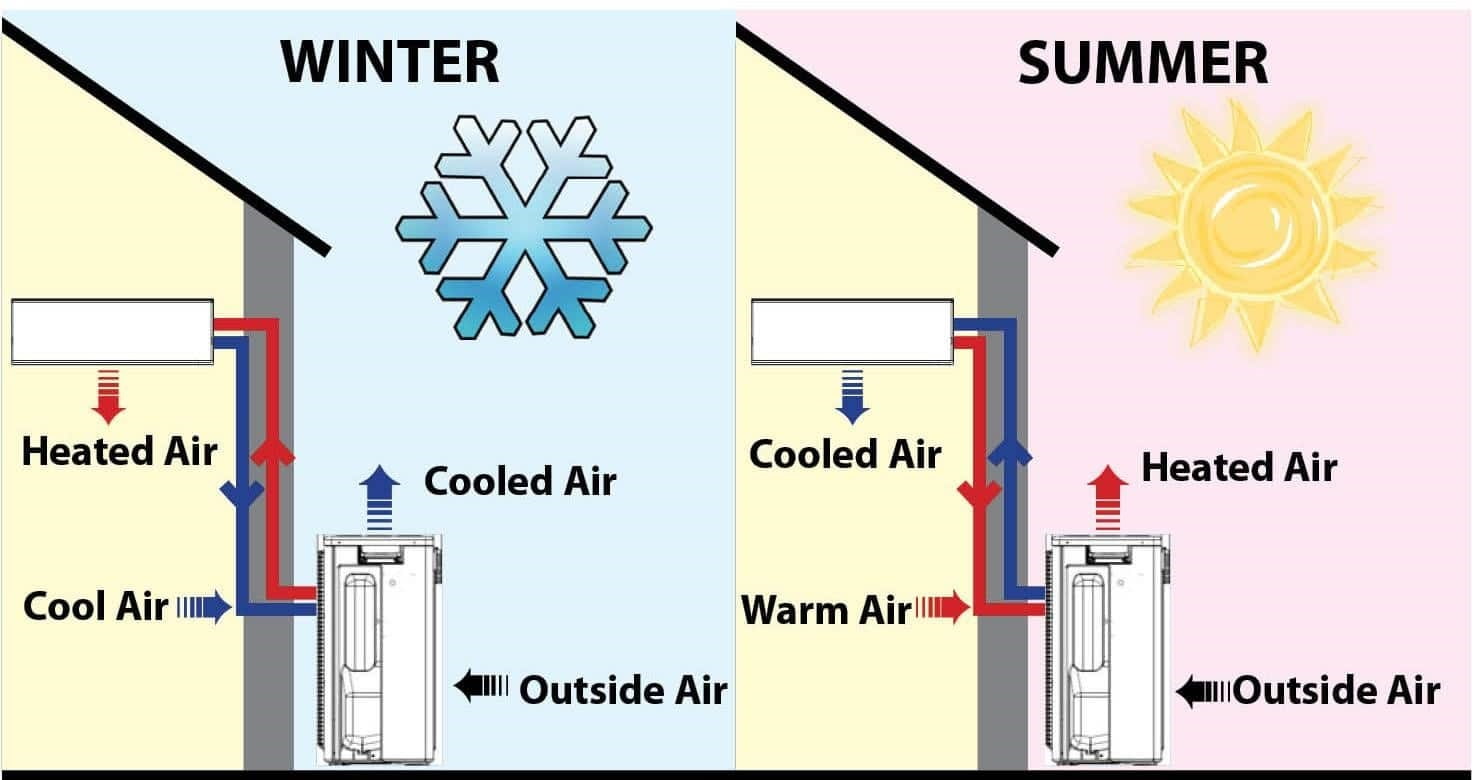
Here is a simple diagram: https://www.lozierheatingcooling.com/filesimages/heatPump.jp...
In reality equilibrium is restored quickly (and the thermal mass we're cooling/heating here is insignificant anyhow).
> provides diagram with zero evidence that AC meaningfully influences temperature
Clap, clap.
Humans have a really hard time understanding compounding risk. But there are billions of us. How many billions of drops can you handwave away?
But making a hole in the wall to the outside is. That would generally be considered a permanent change and requires approval from landlord and in case the apartment building has multiple owners, approval from those as well
That’s way high: You can buy 2 for that much if you want a big name brand that provides support for self-installs. 3-4 of them for $5k if you don’t care about that…
Source: I’ve done it
The AC unit is a little different than "traditional" window units. There is no slot or anything really to grab on to the window or the sill. It is mainly secured by a brace that is also not screwed into anything really, just directing the weight of the external portion of the unit into the side of the exterior wall.
Besides that, just know you’re participating in a system of belief that needlessly kills thousands each year (and many more to come, if you believe as I hope that climate change is real). Just dwell on it a little. Thousands dead because of ideological comfort and resistance to change, which in and of itself is a weird form of climate skepticism.
If you answer this, please address each of my points from both comments. You have adressed none so far.
Since both of the cases happen mostly indoors we can assume it's both thanks to state of the buildings.
Not everyone can afford AC or insulation and cold used to be and still a bigger problem. Heating is absurdly expensive with leaky building so people prioritize insulating.
“Ideological comfort” lol stop it what the hell. Do you think people in europe wouldn't like to have AC if they could reasonably have it?
Nope, heat pumps are cheaper and more efficient. Insulating did not even make a dent in reducing emissions in Germany after years of trying.
Whataboutism about cold related deaths doesn’t change anything about the heat related deaths. Did you know the Philippines lose fewer people to heat than Europe, per capita? They have AC.
Again, you’ve been misinformed. Please research the subject, use an LLM, whatever you need. The information is right there.
An ordinary heatpump for an ordinary house should cost something like 3000 NZD including labor for installation. What are we doing differently?
Hell, people are dying now in Europe in part because US AC abuse burned so much energy it contributed in a large part to global warming.
Opening sideways also shouldn't matter for a casement AC unit.
[0] obligatory TC rant: https://youtu.be/_-mBeYC2KGc
Most of Europe has a "registered building" system, where buildings above a certain age are considered historic. Renovating those buildings is an extremely difficult, expensive, and bureaucratic process. You generally need to preserve the period-appropriate look and materials. An AC unit sticking out of a wall won't pass muster.
Even newer buildings are problematic. an acquaintance of mine lives in an upper-middle-class apartment complex that was finished two or three years ago, and their architect has some claim in the contract that prevents residents from installing AC units to "preserve the building's unique look."
The US is build around privately-owned housing (and hence creature comforts) a lot more than we are, so AC is a lot easier to implement there.
It feels weird to have to mention this, but although there are a lot of historical buildings in Europe, it's not the norm.
Population grows. There was a noteworthy war not that long ago. The vast majority of buildings are not that old.
And just to be clear, there is a huge difference between a person who has a keen interest in history (nothing wrong with that), and one that wants to leave every single old building untouched, and if there's a danger to residents, move the residents.
If you have a balcony, you can mount the external unit there, but then you need to route the piping to the room(s) that need AC. Then you need to cover the pipes somehow, which is still perfectly doable, but goes way way beyond "drilling a hole".
You can have a portable unit, but it's loud, takes up space indoors and needs to be stored somewhere most of the year when it's actually cold rather than super hot.
Since these one tube systems just push hot air out, you are creating low pressure in your room and you will suck the air in from somewhere. Often times simply from outside from the leaky windows.
I don't understand why it's hard to buy systems with two hoses that would keep the pressure in the room.
As to the negative pressure, personally I just leave the door to the room cracked open very slightly. But if you have central heat ducts air will get sucked in through that no problem.
In system where the pressure would be equalized the leaks would be much smaller. For some reason it's impossible to buy these type units in EU.
The sun = 175 quadrillion watts of heat.
So I would say, the heat from running ACs is not significant. It's also additive with all the other existing forms of energy use we have. Unlike greenhouse gases, which are multiplicative.
The increase in the heat outside the houses, caused by the air conditioners running MOSTLY ON RENEWABLES[1] is a drop in the ocean. Especially if we speed up installing heat pumps powered by renewables and acting as AC in the summer.
There's plenty of good arguments and then there was yours. No, ACs running worldwide are not a net contributor to the climate emergency.
If you at least said that solar reflective paints and foils should be much more popular, along with reforestation of cities, which would then bring the cooling needs down but no, you had to do the strawman.
[1] https://ember-energy.org/latest-updates/for-the-first-time-w...
Air Conditioners do not produce a net heating effect unless you power them by burning fossil fuels.
Our current cities and infrastructure are designed to be black heat sinks to soak up heat and hold onto it and ground level. But there is research into what would happen if we flipped that design around.
"If we all do this little thing" thinking is utter nonsense. If all of human consumption or contribution to warming or what-have-you is 1000, applying a change that lowers that to 999 is not doing anything more than that.
This here is not even a 0.1% thing. You could probably get a better result by telling people to read ebooks rather than hardback. It's just absurd.
And yes, there are options for tubes/ducts for the more common window types. Like tilt-and-turn windows, horizontally sliding or all the other kinds of inward or outward opening windows - but most of them are the ducted portable units the original comment was speaking of, which aren't great. There are also some better portable split units, but those are pricier and the install is not as easy. (They're great though.)
I also sometimes miss being able to stick my head out the window but that's a tradeoff about screens and in the end of the day I prefer not to have to worry about bugs.
This doesn't mean that there's zero heat added locally (as many seem fond of suggesting): The compressors and circulation blowers and fans don't run for free, and every Joule of electricity they consume is ultimately converted to a Joule of heat in a process that wouldn't occur in the absence of aircon. That's not zero.
But in very broad strokes, it's not very significant. It's somewhat akin to running a refrigerator inside of a kitchen.
With aircon, the refrigerator is the size a whole house. That certainly sounds huge, and it is huge. But that refrigerated building is inside of a room that is the size of the Earth's atmosphere, which is very obviously vast in ways that kitchens simply are not.
It doesn't really matter. Millions of homes with aircon don't mean much when the atmosphere is millions of times bigger than they are.
Would love to see you convince the landlords to refurbish the building to use expensive heatpumps when gas is already in place. Also heatpumps just like any other heating solution sucks without insulation.
It would be better to look at new buildings and you will find out that yes even europeans when building new get AC/heatpumps and solar and all the good stuff.
The thing is - I as european don't know a single person who has or is building a new house. I know few that live in a house but most prefer appartments.
They've been redoing the insulation since new regulation was enforced in France and Germany, it's been years now. So, that kind of thing is doable, except billions have been spent for a dubious result (look it up, Germans heat just as much as before). I am appalled at the complete lack of information on these subjects. For shame.
EDIT: Fact checking myself, the Germans have been reducing their heating, but significantly lower than expected because of a rebound effect (part of the efficiency gain is converted into comfort).
Or you could just respect that people tend to know much more about their medical conditions than you will ever know.
It's not my house, it's many different places and many different irritating causes. It's not an issue with dust or high CO2 in my case.
You’d probably want to look at greater picture - I’d much rather have runny nose than suffocate in co2, catch infections or die from heat.
Billions of people live in air conditioned environments. They don’t seem to complain.
Sadly can't edit the original comment anymore.
Heat pump uses electricity. It does, however, transfer more energy than it's using.
Magic of science! That page should be simple enough for the start: https://qualityhomeaircare.com/heat-pump-efficiency/
> Heat pumps convert energy to heat more efficiently than combustion-based systems, potentially delivering 300-400% efficiency compared to the 80-98% efficiency of the best furnaces and boilers.
> This fundamental advantage stems from the fact that heat pumps move heat rather than generate it through combustion or resistance.
No heat is created either, that would explicitly violate the first law of thermodynamics. An air conditioner powered by solar energy (or anything solar powered) ends up releasing the exact same amount of "excess" heat as the sunlight would have if it hadn't been absorbed by the panels.
As an example of thermal lag: My present home doesn't have aircon upstairs. I've got a room with a west-facing window up there, and I just happen to chart temperatures in that room.
The daily temperature peaks in that room during the warmer months tend to happen at night -- sometimes, as late as midnight. The daily temperature minimums tend to happen around noon.
This suggests that solar power is least-useful for that particular room when solar availability is greatest. It doesn't overlap very well at all.
(I'm still looking into installing fairly modest solar rig, though, just to help offset my own baseload when I can and maybe make extended power outages more survivable.)
Sure. But solar panels are intentionally designed to absorb a lot of energy. So if you are putting the panels over a dark surface, like asphalt, you'll probably have a net zero effect on heat. If you put them over something light colored, you are now converting more visible light that would have been reflected into space into heat. To be clear, that is still a lot better than burning fossil fuels, but it isn't completely free either.
But they do. And do we build the AC with solar power as well? Ship the parts around the world on sail boats?
It would actually be a much better global warming mitigation strategy to install bidirectional heat pumps (A/C in the summer, heat in the winter) that runs on electricity (which is increasingly produced using renewables) and then get rid of fossil-fuel burning furnaces.
It’s ~25kg for a 2.5kw/9000 btu condenser I just looked at, but yeah, if there’s no balcony/fire escape, and you’re well off the ground, you might need some rappelling gear, and you might want a pro. No idea about whatever heavy bureaucracy you live under, that’s a human imposed rather than fundamental challenge. Pipe routing isn’t a big deal, the copper lines are very flexible, just need to be careful not to kink them - give the bends a good radius. And to answer your unstated objections, you will need some tools you almost certainly don’t have lying around. Mostly, though, you need an attitude of being able to do stuff, and getting it done.
Or you can get a portable or window unit. Midea makes some really nice window units now. Might need hung windows, though, not sure whether it’s possible to make them work with casement windows. It takes a little space, but that doesn’t seem like a huge deal?
Or do nothing and just deal with it.
But if you actually did read what I wrote, there was no complaint from me about the cooling part of the AC.
Let's burn more dinosaur juice instead of using passive, clean device.