Deciphering basmala(blog.plover.com) |
Deciphering basmala(blog.plover.com) |
It's pretty great fun pasting it into various text entry fields to see how they behave.
In standard-ish single-line-ish Apple text fields on my Mac (iMessage text entry field, Chrome Omnibox), it renders like this, which... I'm not sure is correct? https://cleanshot.com/share/0GkNJGQ7
On the other hand it renders akin to Chrome in TextEdit.
What's curious to me is that Apple only uses Noto Nastaliq Urdu if Urdu is enabled in preferred languages and is higher than any other Arabic-script language. [2] Is that so on your machine?
[1] https://fonts.google.com/noto/specimen/Noto+Nastaliq+Urdu?pr... (There's a slight difference in the placement of diacritics here because of a newer font version.)
[2] https://support.apple.com/guide/mac-help/latin-fonts-correct...
0: https://lobste.rs/s/7s4sjp/u_fdfd_arabic_ligature_bismillah_...
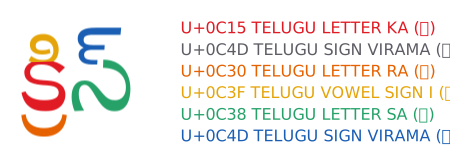
(If people aren’t convinced by that, my next area is complex text layout, starting with my name in the Telugu script, <https://temp.chrismorgan.info/క్రిస్.svg>, also augmenting that with how the r can be drawn to the left or underneath or even a little to the right of the k, which I really should add to that SVG file.)
So using the Abjad system to give number values to the Arab letters there are many counts that add up to a multiple of 19. A critic (and I try to be one) so note that every 19 tries ("would this add up to a multiple of 19?") you are expected to find one that does add up to a multiple of 19!
In order to show how many cases add up, I created a unit test suite to demonstrate the claims.
See the code here:
https://github.com/cies/quran-analysis/blob/master/replicate...
Many of the claims involve the Bismallah (search for "bismallah" in that code).
Seeing Arabic calligraphy has made me add Arabic to the list of languages I am very slowly teaching myself.
Islam prohibits representational art and so, except for a few pockets, all the skills of Muslim artists went into two things - Calligraphy and geometric tessellations (what's called "arabesque" and which you see on mosques, rugs etc.). The calligraphy itself has several hands (which is what we call "fonts"). The most popular one is called https://en.wikipedia.org/wiki/Naskh_(script) which is the one used for the copies of the Koran from Saudi Arabia. It's very legible and doesn't lend itself to too much flourishing. The Basmala glyph mentioned in the article looks like Naskh with the S of Basmala (س) elongated. There are others too. Thuluth (which is used in the copies of the Koran for ornamental work like the titles of the chapters), Nastaliq (which people often call Urdu or Persian because of how those languages are usually written in this hand), Kufic (which is an angular hand that overlaps with tessellations in ornamental work), Mughlai (which is a denser hand that's common in the Indian Subcontinent) and several others. There are even local variants with which you can identify geography. This style is specific to the Malabar coast in Kerala and, as far as I know, it's seen only there. https://en.wikipedia.org/wiki/Arabi_Malayalam_script#/media/...
You’re supposed to place your hand under the line you’re writing. Not to the right of it.
At the time of Prophet Muhammad, Arabic was broken into various dialects, with a notable split between Western (Hijazi) and Eastern (Najdi) Arabic. Muhammad belonged to the Quraysh tribe in Mecca, whose dialect was Western.
The Islamic empire rapidly grew to include different Arabic dialects and non-Arabs after Muhammad's death. A linguistic unification of the Quran's text and pronunciation was needed. The third "Caliph" (religious leader), Uthman ibn Affan, developed a single definitive version based on the Quraysh dialect and rigorously destroyed all variants.
Subsequently, non-Arab scholars - who had less native intuition of the Quraysh dialect - codified Arabic grammar based on the Quran and pre-Quranic poetry. This included the system of lines and dots above and below letters to indicate the shape of short vowels.
Other kinds of pronunciation include the way the Alif Maqsoorah is uttered. For example the name Moses is pronounced Moosa or Moosé (or varying degrees in between) depending on the recitation. These kinds of recitations trace their ways back to how different tribes spoke.
You can hear an example of such recitations for the first Surah of the Quran here[1]
I thought it was "tatwil". I could be wrong, though. An interesting article on Arabic typography, whose correctness I can't judge:
https://commons.wikimedia.org/wiki/File:-516170388361w7xlt8c...
Next I'm going to learn the rest of the letters and try to start reading menus.
but I also wonder if younger generations still learn cursive, I can imagine it's impossible to read if you've never seen it before)
Which makes me think: come on, in the age of Claude, the gap between "we know what to do" and "here is the working code" is narrower than ever.
Who will be the one to pick up the job? Has to be an Arabic speaker I guess!
Or, it could be that out of all system fonts on MacOS, only Noto Nastaliq Urdu has a glyph for the bismillah, and thus the system uses it as a fallback...
Nevertheless, at least from a secular standpoint it feels more like Arabic was standardised using the Qur'an as a primary anchor, rather than the Qur'an stepping in to "perfect" Arabic and give it rules.
The Qira'at include both: different pronunciations of the same word or letter, as well as a curated set of recitations for the same word. This is very well established and evident, so I'm not quite sure where you read there is a debate.
In fact, the same recording I linked to in my previous post has both kinds - Ayah #4 is recited as "Maalik youm id-Din" and "Malik youm id-Din" (long vs short vowel). Maalik means "owner/master of" and Malik means "King". Both were pronounced by Prophet Muhammad ﷺ and recorded and transmitted. The rest of the pronunciations in the recording were dialects (e.g. ص is pronounced 3 different ways: pharyngealized voiceless sibilant, pharyngealized voiced sibilant, and a voiceless sibilant like /s/ in English).
Much of these pronunciations exist to this day too.
Not all dialects were permitted to be recited. For example, the letter ق is never pronounced as /g/ when reciting the Quran, even though that pronunciation existed, and exists today in spoken Arabic.
Regarding Arabic and the Quran, you can read about how the most eloquent Arabs at the time submitted to the language of the Quran - even those who rejected Islam out of pride and arrogance. When it was evident to everyone that the language of the Quran dominated all, it was only natural that it became the standard for the language. Simultaneously, the Quran itself is understood and comprehended through the language spoken at the time, which is why pre-Islamic poetry and prose - among others - are used for things like linguistic exegesis.
I think the debate is less about how the Qira'aat vary, more about how genuinely/accurately they reflect pre-Islamic dialects. For example, Marijn van Putten has a book "Quranic Arabic" where he apparently advances the argument that the Quran was originally composed in Hijazi Arabic, and subsequently evolved into the reading traditions we have today.
> For example, the letter ق is never pronounced as /g/ when reciting the Quran, even though that pronunciation existed, and exists today in spoken Arabic.
Indeed; one side of my family is Iraqi :)
> Indeed; one side of my family is Iraqi :)
Yep, I was thinking about it and it very well seems that /g/ is the most widespread pronunciation in the Arab word: Iraq, many parts of West Asia (parts of Syria, parts of Jordan, and parts of Palestine), the Gulf states, Yemen, and many parts of North Africa, even parts of Egypt.
Those who wrote about Tajweed (Quranic Recitation) early on mentioned a lot of those other dialects (including examples of tribes that utter them) which would not be valid to recite the Quran. ك to /sh/ or /ch/ is another one, those also exist today and existed pre-Islam.
Not sure what you mean here. I asked ansari.chat [EDIT turns out I used the new version ansari.ai] for an overall assessment of the book as well as a critical analysis of the synopsis. It praised the book but highlighted some tensions between its findings and Islamic theological assumptions: https://askansari.ai/share/de25f788-60fd-4bdd-9383-ac6752f06...
The summary assessment of the synopsis is:
> The synopsis accurately represents a work of brilliant linguistic reconstruction that is highly supportive of the Quran’s historical authenticity, yet challenging to certain traditional theological assumptions about the transmission of the Qira’at.
If anything, it vindicates my statement that there is "ongoing debate" over the historical nature of Qira'at.
--------------------------
EDIT
I realised that I was using the "new" version ansari.ai. Perhaps you went with the "old" version? I asked the old version as well, although it did not know about the book so I could only ask about the synopsis: https://ansari.chat/share/6a4780a6623c605140a58f76
The conclusion:
> From a Sunni Islamic perspective, this synopsis appears to approach the Quran through a secular academic lens that is incompatible with Islamic beliefs ...
> While academic study of Quranic Arabic linguistics can be beneficial, it must be grounded in the Islamic understanding that the Quran is the preserved Word of Allah, not a text that evolved through human linguistic processes.
I don't find this compelling. We must be able to challenge theological assumptions and "because I say so" type arguments.
_advertisement_-_catalogue_of_books_and_textiles_-_Ponnani_(1908).jpg)
