Slate EV truck starts at $24,950(slate.auto) |
Slate EV truck starts at $24,950(slate.auto) |
Working from home, I don’t drive much. If I could not have a car at all, I would. Having a no frills truck, that’s isn’t an old beater in constant need of repair and maintenance, sounds really nice.
Hope they can enter India in the next 5-10 years.
Edit: damn, bed length: 5 feet. Wonder if they could get an extra foot in the other direction as well, although I'm guessing all that would eat into range.
https://insideevs.com/news/799667/slate-truck-lfp-battery-ra...
(Anyone seen detailed dimensions specs?)
The width is 50 some inches but the wheel wells are there so you may need some 2x4 or something to keep plywood from flexing over them. And the length of the bed isn’t near 8 feet so you’d need the bed open and the boards strapped in.
This jalopnik article had some helpful measurements: https://www.jalopnik.com/1845231/slate-pickup-bed-fit-every-...
https://www.slateforums.com/forum/threads/slate-truck-dimens...
Of course I'm waiting for real world reports, but I'm not going to rule it out yet.
"Just fine" lol. Alright let's go straight back to being 16 years old and doing ghetto shit for the sake of it.
AWD is ubiquitous nowadays. Can get it on entry level vehicles as an option. Electric vehicles are way simpler, as in they could simply strap a motor to the front wheels without much complication.
I already have a 4WD SUV. 4WD is simply superior in the snow, even if I could suffer and survive with RWD.
A $20k American-made electric pickup with no paint, no stereo, no screen
The Slate is like the original Nintendo Wii - swapping sophistication for fun.
I wouldn’t be surprised if it gets delayed and inflation pushes that MSRP up.
That said, lack of 4WD is really a bummer.
[1] https://en.wikipedia.org/wiki/Ford_Transit_Courier#Tourneo_C... [2] https://en.wikipedia.org/wiki/Citro%C3%ABn_e-Berlingo
The other common EV batteries suffer increased degradation at the high and low ends and it is generally recommended to stay in the 20-80% range except on road trips. Then charging to 100% just before you start and driving down to 10% if you are going to recharge soon after back to above 20% is OK.
Let's first consider non-road trips. With level 2 home charging and a 200 mile range LFP EV like the Slate, I could actually get 200 miles between charges. I'd be cautious though and try not to let it go below 10%.
That's 180 miles of usable range.
On a non-LFP where I only get to use 60% between charges (80-20%) I'd need a 300 mile range EV. That's more than the 262 mile range of the 2027 Chevy Bolt which is doing fine and costs more than Slate. That's also better than or close to the most popular non-Tesla EVs in recent sales, namely the Chevy Equinox, Ford Mustang Mach-E, and Hyundai Ioniq 5.
For road trips it is a little different because even though LFP won't be harmed going to 100% it, like non-LFP, slows down when you are trying to charge with high power DC chargers, so it is almost always faster to just charge to 80 and get back on the road than charge to 100 to get maximum distance before the next stop. The LFP still punches above its weight on road trips, but not by as large an amount as it does for around town use.
On a road trip, past the initial segment when running on home charge, if we assume the Slate will be going from 80 to 5% and the non-LFP is doing 80-10%, the Slate would be equivalent to a non-LFP with around 215 miles of range.
For people who won't want to use it for long road trips (road trips long enough that you would have to charge before reaching your destination) it should be fine.
BTW, for long road trips charging speed is generally quite a bit more important than range as long as you have enough range to cross the gaps between charging stations. The Ioniq 5 is widely considered to be one of the best long road trip EVs because of its fast charging even though its range is smaller than many competitors. It is 800 V so can accept very high power without excessive heating, and its charging curve stays high for longer than most others. (But you need a trip that has high power chargers, which most Tesla Supercharger stations lack).
Correction: 2027 Bolt is also LFP.
Compared to Ford or GM's EV trucks? It's almost 1/3 the price...
The closest comparison is like the Ford Maverick, and that starts at 29.
And looking at their website now, I see the same thing unfortunately. Why would someone "preorder" a car that only exists as a prototype and digital art? What proven track record do they have of actually being able to manufacture these, and what independent outlets reviewed it?
I'm sorry, but a lot of red flags immediately pop up for me, I'm confident this is 99% a scam.
High end luxury vehicles are coach built. The Ferrari Luce is a mid end luxury vehicle. Rivian is more like a low end luxury vehicle.
A new 4wd kei style truck is ~10k, with a bigger bed. I know its apples to oranges, but damn do I hate the ridiculous regulatory capture around small vehicles and trucks we have in the US.
I mean, that's fine, but... I am on your "About" page, that's because I actually want to know about you. How can I trust you with $25k if all I know is "We’re designed in California and Michigan, engineered in Michigan, and assembled in the Midwest. And our team is spread across the entire country, from Washington state to Florida" ?
What's your funding? Who owns you? Who's the CEO? What are the credentials of your engineers? Basically, why should I believe that you can pull this off?
Normal people make product-buying decisions based on the product.
None of those things are true for a brand new company. Tesla was infamous for having random things wrong with their cars in the early days which the established car companies had figured out a long time ago. And there's a non-negligible chance the company will end up folding before it can give you your product, or before they can fix the product you got.
The amount of money they have, the character of their backers and their CEO, and the quality of their engineers matters significantly.
oh, wait, that is what Americans do.
And the Slate should have better utility, for anybody who needs a truck/SUV vs coupe. And also comes without the Musk stigma.
Of course most people only need a coupe to begin with. Too bad you can't buy any that are cheap. (that and you mostly only need a coupe, but at least once a week need something more)
Your other question is about.. bed vibes? That's not a real spec (for any truck builder). You can put a 100x4 sheet rock in any 4'+ wide bed.. best of luck to the person behind you. Don't forget the red flag (day) or light (at night).. in north america.
"always" is just not true. "most of the time" is true, and it will get less and less as time goes by.
Generators are also much more efficient at converting fuel to electricity. They don't have to provide pretty good power output at all RPM's, they are much more fine tuned. There are also emission reduction options that are economical at the scale of a power plant, but not when attaching to millions of cars.
> no oil and fluids, no oil or engine filters, water pumps, spark plugs, valves, seals, etc etc
Those are cheap though.
You still have tires, shocks, and the general body wearing out from use.
It really is under appreciated how much less stressful EVs are to own on a day-to-day basis until you have one. Never worried about gas prices, it's always "full", don't have to deal with crazy people bumming money at the gas station, &c.
So when they think about owning an EV, they focus really hard on "gas station mentality" things like "how long does it take to fill" and "how far can you go between fill-ups?".
Once you own an EV (and have a home charger) you pretty quickly forget about those things shy of the occasional 300+ mi road trip.
For an around-town daily, the only real reason you wouldn't want to take an EV is because literally all of your options are rolling privacy violations. At least with an ICE you can buy a 2011 panther platform and rest easy.
Thankfully, Slate solved this problem. I don't care that it's a cheapy, uncomfortable shitbox with no range. Please yes, more modern cars that aren't literally made out of spyware at an atomic level.
I’m pretty sure that’s the whole g-damned point of an EV. Who are you thinking needs to be told this?
EVs are a massive serfdom wealth and freedom transfer masquerading as a decade of not having to visit a gas station while hiding the country sized hole that will be needed for all the battery trash.
They are a blight on humanity. China survives them at scale because they are communist and have policies to mitigate economic fallout in one sector by having people supported in others. The USA just makes more homeless people and tells the next generation of high schoolers to enroll in a special work ready jobs pipeline program for whatever the local school board thinks will be left. And their non-employment rate skyrockets.
I understand you're probably frustrated because you have been sold a manufactured idea that as an American, luxury is supposed to be attainable to you. That you were promised a high end lifestyle. That the American dream guarantees to lift you out of the filthy squalor of the ancestors. Finally, the common man is to be given nice things! He will live as a king! Or maybe you're just a westerner in general, and you really bought the lie that you are actively wealthy compared to the rest of the world.
That was all a lie.
And your assumption is absolutely faulty, by the way. I just actually know a nice thing when I see it. It's defined by it being a nice thing. An ugly, mass manufactured truck filled with materials that feel bad in the hand is really not that nice in the grand scheme of things. Sorry. You should absolutely be filled with outrage that even something as mundane as this is unattainable though. Projecting that frustration on to me for not letting shitty marketing jargon slide is ridiculous. This doesn't just affect us, either. You should remind the wealthy at all points that their standards are sliding backwards, and their hollow sense of luxury has become a category of complete crap driven by lowered standards and artificial scarcity.
The problem is we can only guess because we are talking about going to trash in 8-10 years, and most EVs are not near that old. Still signs are good.
Fortunately it appears that only the leaf is destroying batteries that fast. Everything else we don't know how long a battery will last, but likely long enough that only collectors (who pour more money than the car is worth into it anyway) will care.
In Seattle, we also went from flat 13.4c/kWh to a new variable rate with 8c/kWh available from 12-6am. My electric bill just dropped by about 30%.
https://www.tesla.com/charging-calculator
"Seattle" may be a critical bit here. The Fed thinks the "U.S. City Average" cost of electricity is far higher than yours:
https://fred.stlouisfed.org/series/APU000072610
Based on how many of my friends followed their first EV purchase with an electrical outlet upgrade - even those with very short commutes - I suspect your "120/15 is only fine for normal commuters" is still a tad optimistic.
EDIT: Re-reading comments here - I'd bet a leading reason to upgrade from 120/15 to 240/50 charging is to get much more of your charging done within the 12am - 6am "lowest rate" time window. Or whatever that window is, locally.
At local rates that $16.47 in electricity (235.3 x $0.07). On average my electric bill went up 15-25 dollars a month.
I spent the first two years of ownership charging mostly from the 110v socket outside the house because over night its enough to cover my commute of around 27 miles at the time.
Now that I have a 60A 240v circuit setup outside and a 40A EVSE I never even worry about what state of charge I get home with.
Our car (2025 Ioniq 5) gets about 3-4 miles of range per hour on a 120V outlet. If you're home for 10 hours overnight, that's at least 30 miles of range each day. Some random article I found[1] suggests the average commute is about 42 miles. So if you include some extra time on weekends, a 120V outlet easily matches the average commute distance. If you drive less than that, or are home more often due to WFH or whatever, then a 120V outlet is definitely enough.
In reality, probably people drive significantly more than that, eg for shopping and seeing friends and shuttling kids around and whatever. So in the end I do agree with you, lots of people will want to get a 240 line to their garage. But an existing 120V line is probably genuinely enough for a whole lot of people, too. It is for my wife & me.
[1] https://www.axios.com/2024/03/24/average-commute-distance-us...
I've seen places offering to do it to a leaf. However the cost is more than the leaf is worth by the time it needs it. I know a few people with a leaf that has half the factory range left and they just deal with it because the cost isn't worth it.
Pretty interesting as far as cars go. I think all of the customization options are really smart, but we will see if that is enough for the average consumer. The number of relatively inexpensive options and ability to customize various details rivals some high end car configuration systems, Porsche is famous for letting you customize every detail.
The way Slate has designed their vehicles, they are making it very easy to change just about anything with the vehicle. I can see this being very popular with young people who cannot afford a lot of car, but still want a highly customized and personalized vehicle that they identify with. We will see if all of the other factors work out in Slate's favor.
Mind you, when ordering a lease car for the first time recently, I did notice that I was paying a premium for non-bland colours. I suspect the weird financial structure of new cars has - they're often not bought to hold, but leased - has a lot to do with the blandness.
Any mass-market car has practically the same color options. Wraps have existed for a looong time.
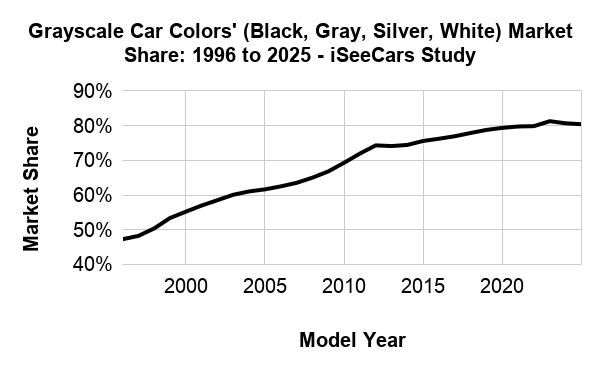
People have other colour choices, but they're constantly choosing the most spectacularly boring, neutral colours possible.
The colour thing is neat, but I'm not sure it's going to be a big deal. It might actually lead to the paradox of choice where people basically feel even worse about their options.
https://magazine.northeast.aaa.com/daily/life/cars-trucks/au...
https://www.ppg.com/en-US/autocoatings/color/history-of-colo...
Wraps are typically pretty easy to remove. Far easier than removing a paint job.
Very good point, that will be interesting to see
I just wish they had also released a smaller body, so you could build something close to a regular hatchback (like a Golf or Mazda 3)
Gen Z & A value uniqueness and authenticity. I think the customization options will resonate a lot with them.
If car colors were not mired in paperwork, I imagine dealers would respray them some shade of Millennial-gray, similar to realtors' M.O. when prepping homes for sale.
it’s actually incredibly disappointing, because 99% of people are just gonna get the gray, and will be unhappy because it’s super boring.
real manufactures like porsche or bmw offer a ton of shades too, it just costs a lot, but they are very popular.
The real downside to wraps from my perspective is that they don't last as long as a regular paint job. After 4 or 5 years you'll see damage and need to get it re-done if you care about the look. And if the underlying plastic is scuffed up, the plastic panel will need to be repaired before the new wrap will go on smoothly.
It's hard to estimate how important that might be now that all other cars force them on everyone.
Or is this another iPhone Mini / Framework / sports wagon where a small, passionate minority ends up disappointed and angry that their priorities are not shared by the mainstream?
I sincerely hope for the former. We need lower-cost vehicles, I like diverse product offerings, and this is a purist’s take on a small truck. But then I like small phones, (the idea of) repairable laptops, and sports wagons.
Do we know that? The website seems silent on the topic, unless I've missed something.
In this case, not even paint, but you can buy decals and wraps.
Edit: it only needs an app for updates, which isn't notably different than taking you older pre-modem cars into the dealer for updates. Also I can't find any evidence that the base model even has a GPS built in.
Everything about modularity seems awesome, but you can see panel misalignment in several shots. Are the component tolerances really going to be that low?
That said, given the price point and the new-ness of the manufacturer, there's all but certainly going to be fit & finish issues.
I know why, the market is nostalgia and it wouldn't sell well if it looked more like a mini kenworth which has a hood that slopes down and in and less like a pickup truck.
That low range is going to turn off a bunch of buyers. I doubt another 10-20 miles of range would capture more buyers than a non-traditional shape would turn off. But I wish the market was that rational.
If the company is still around 5 years from now, I could see myself getting one of these to replace our current "compact" (but still enormous) SUV.
The only reason it takes an EV to get this is CAFE.
I love the Tacoma for a lot of reasons, but that Ranger really had a lot going for it in the summer.
This feels much more like a spiritual successor to that truck than the actual new Ranger or Maverick. I’m really hoping this succeeds so that they’ll be around to replace our Dakota when it dies!
The modular design is cool though.
Well you quoted a hybrid, which needs fuel. At current local electric rates ($0.07/kw) I can fully charge my E-Transit (~68kwh usable in the battery) for $4.76. Then I can go around 130 miles before coming back home to charge.
Vastly cheaper than a gas van, but lets look at the Maverick which gets even better economy.
Most gas stations I drove by today were $3.15 to $3.39 for 87oct gas. Self reported fuel economy for the Hybrid Ford Maverick on a few sites maxes out around 37mpg combined.
That means for a Slate truck with the larger 84kwh battery you'll be spending $5.90 for a full at home charge in my area which will get you ~240 miles. While if you bought a Maverick you'll be getting around 70 miles for the same cost.
This is all before we even factor in maintenance differences.
EDIT// They dropped the 84kwh battery, but my point still stands.
I love that it is a bare-bones basic vehicle that can made to be whatever you need it to be and that it does not have all the factory owner tracking bullshit in new cars today.
I can see this being useful to my wife and I both as a small truck and as an SUV. For the things that we do every week this vehicle would work fine and would replace our Ford Ranger. It might be able to replace our 90's F150 too.
I do most of my own maintenance so a vehicle that comes with factory manuals at no cost is far superior to any other that I have owned. I have bought factory manuals for all of our vehicles so that I can minimize downtime when doing maintenance. I would also take advantage of a service network in the event that I had more projects than time, which is increasingly the normal case at my house. With that network I could spend my time on things that have the highest impact.
The vehicle's range works fine for my wife and I. As a vehicle for our kids off at college it is not as attractive. The distance from our house to campus is just under the stated range of the Slate so anything that prevented the vehicle from hitting maximum target mileage would cause it to fall short and I would need to tow or trailer it the rest of the way home. That would be a drag (haha, I made a pun). Adding the ability to run from an external battery would be a huge plus since that would eliminate range issues.
I wonder how difficult it would be to add connections and charge circuitry for an EcoFlow or Jackery battery bank so that it could be carried in the cargo compartment and serve as a backup.
I would also probably use solar panels to keep it topped off while in my driveway. I think the existing EV chargers manage that well today.
China will sell you fully kitted hilux equivalents with japanese engines for 10k. Even toyota is making 10k trucks in thailand.
US manufacturers are just not ready to face free market competition these days. They're entirely reliant on tariffs protecting them.
I’m not really sure what the solution is at this point. We can’t just drop the tariffs, as that will decidedly end almost all manufacturing that has been propped up by them. On the flip side, the current administration’s recent erratic application and resulting litigation in this area have created an environment where no one in their right mind would invest in building out new capacity. The winds have demonstrated that they are too likely to shift again.
I hope someone can swoop in on this thread and explain how it’s all going to work out. Because I just don’t see it anymore….
And that makes me sad, because I want to love the Slate. Seems great. But I can’t see past how the pricing is tantamount to systemic theft, knowing that it has been artificially inflated by such protectionism.
That’s not a full answer but party of the story.
As a nation we want a local manufacturing base. But as consumers we just want the thing, and it doesn’t matter where it’s made.
https://www.kens5.com/article/news/local/public-safety/1-yea...
[PAGE] https://www.slate.auto/en/specs
[IMAGE] https://images.ctfassets.net/20dhmw20vttc/2wmiW5shOfgAKsd1nF...
Also, like many contemporary vehicles it still has that snubbed nose design that limits vision of low profile objects in front of the vehicle. It's a design choice, not a necessity. Wonder why given it was a blank slate design,
So $0.12 per mile saved in fuel costs implies about 80k miles for break-even.
This excludes costs of servicing, which should be higher on the gas car.
[edit typo'd an extra 0 it's 80k miles for break-even]
[edit2]
After looking up my energy bill I pay $0.27 so it's between 10 and 11 cents per mile saved. Break-even is still under 100k miles.
$35k - $26k = $9k
$9k / $0.12/mile savings ~= 75,000 miles breakeven
Factors like the (perceived) environment friendliness, comfort and (in)convenience are likely to be much more important.
Can we stop being so out of touch and/or deluding ourselves to believe $35k is “pretty inexpensive” for people not living in a bubble; whether that is the Americas bubble or the tech bubble within the bubble or the urban bubble within that; let alone for a tiny two seater electric truck that has a 200 mile range.
The 45th percentile, i.e., the bottom 90% have a median income of roughly $40,000. $35,000 for a enclosed covered or even hatchback type mini SUV is not reasonable and you know very well when they come out with that, it’s going to be at least $40,000. None of that is inexpensive or even pretty inexpensive. That’s just rationalization and coping, trying to convince ourselves and others of things that are incongruent.
“Pretty inexpensive” would be an enclosed bed version that cost $22,000 maybe.
For additional context; the industry standard measure of income to cost ratio has risen from 9.3 weeks of household income gross pay for a baseline vehicle, i.e., civic, in 1973 to, 16.5 weeks of gross pay in 2024; and that’s based on the fraudulent official inflation numbers.
Yet more context, a civic can seat 5 people and still has a range of 450 miles on a tank of gasoline that you can find all over the place, even in far off rural places OSD puppy can carry gasoline with you if need be.
There is no sense in rationalizing and deluding ourselves about the real limitations that still exists that are real and are why adoption is not matching imaginations.
$35k is not outrageous for a new car, but the Slate is supposed to be affordable basic transportation. Slate is selling barebones, stripped down basic transportation for the price of a middle class family car.
I can find electricity in far more places than I can gasoline. It even comes out of my walls. Do you have gasoline piping throughout your home?
A $35K vehicle will reach $22K on the used market a lot faster than a $60K vehicle will.
$25k is about right for a cheap new car today (you can get a few base models for less than that, but good luck finding one). Median household income is around $83k. So a cheap new car cost went up by 10x but income only went up by less than 5x. Inflation implies it should cost 8x as much, but it costs 10x as much.
Of course the Chevy Nova didn't have ABS, airbags, a touch screen, an automatic transmission, power steering, or retractable seat belts. Car companies could make models without some of these (though most are required by law; can't even have a car without a screen since RVC is mandated). But now they would be competing with used cars that have most, if not all, of these things and cost less.
It suppose is "pretty inexpensive" compared to other new trucks you can buy right now. However, my much more equipped, full size truck cost less, inflation adjusted even, than this thing when it was new. Today's truck market baffles me.
At the same size (17"), going from steel to alloy improves performance but reduces durability. Larger wheels (20") are generally a downgrade for performance and ride quality.
Engineering Explained has a video on this topic: NYvKxsYFqO8
- wider wheels are marginally less efficient but almost negligible
- rims with larger diameter have larger air resistance. Probably because the rim patterns intersects the air in weird ways but it's not explained. Tire walls are relatively smooth, so tires with higher aspect are way more aero-efficient despite having more marginally lower rolling resistance.
Same conclusion: interesting, but not necessarily interested. Hope they go places though.
But, is that likely? Most people buy cars on credit and won't have $10k cash to spend on those bits later. I guess they could put it on Visa, but that's a terrible financial choice.
But (at least in my experience), that made for a worse product than having factory installation and QA. I bought a brand-new car from a Scion dealer in 2005 and indicated I wanted to add keyless entry. I paid the dealer, they did the install, and I left ... with a car that would intermittently fail to lock some doors with the key fob. I realized shortly thereafter that the dealer had installed an aftermarket system to save money rather than the offical Scion keyless entry system. I complained and eventually got them to install the right system, but jeez, that did not enhance my experience compared to just finding a car that was built in a factory with the options I wanted.
I'm not saying the modular Slate pickup isn't cool. I'm kind of tempted by it. But I wouldn't be surprised if people find themselves with leaky roofs, electrical gremlins and random squeaks and rattles compared to if they just bought some other truck/SUV and left it alone.
Most people who buy a car would never be bothered to "tweak" it later, upgrade, add stuff. Modularity also constrains the design and could add some reliability issues.
The biggest benefit would be home repairability so I think that's a big driver for why other manufacturers don't do it. EVs already require less maintenance so that's lost revenue.
P.S. Looking at the options on the site, other than the body style everything else is just as easy to have on any other car. Most of the customization is purely esthetic (wraps, decals, rim options, light plates) and even the practical options like light bars or roof racks are common in the OEM world for any classic brand.
If the customization can be done after the fact it lowers the risk of buying.
Makes sense to me.
Want an open air 5 seater in the summer and an enclosed pickup the rest of the year, except for November when you really want an SUV? Sure, no problem.
But car batteries, brake pads, tire pressure sensors are all becoming increasingly software-locked in. We're lacking open standards for this stuff.
300-350 miles would be a lot better. That would cover most of my trips (and allow for some payload) with a little bit to spare before I needed to stop to charge.
I guess the price isn't too bad. I still remember something like a Toyota or a Ford Ranger or Chevy S10 selling for under 10K new, but inflation and all... probably not terrible for a compact truck in 2026.
Real world, 99.9% of driving I do is well under 100 miles per day, and my charging between 6pm and 8am on a 120V outlet adds 50-60 miles. You could plug in every night, but in practice I wait until the battery is below 40%, and tend to plug in every 1-2 weeks depending on how much I use it.
It's been driven over 200 miles in a single day twice, and each time the car was charged for 15-20 minutes at a fast charger to top up. shrug
For many people, in real world usage, 205 mile range is great for how you'll actually use the truck.
200 miles more than covers all of the driving I do on any normal day. Today is an exceptional day, and I'll be driving a total of 120 miles for work. The Slate would cover that just fine with a ton of breathing room.
I do take far longer trips than that for pleasure, but they're rare.
I think if I only had an EV to drive, and that EV could only do 200 miles on a charge, then I'd be able to figure out how to make these <5% events work for me.
(I can use a break after a couple/few hours on the road, anyway.)
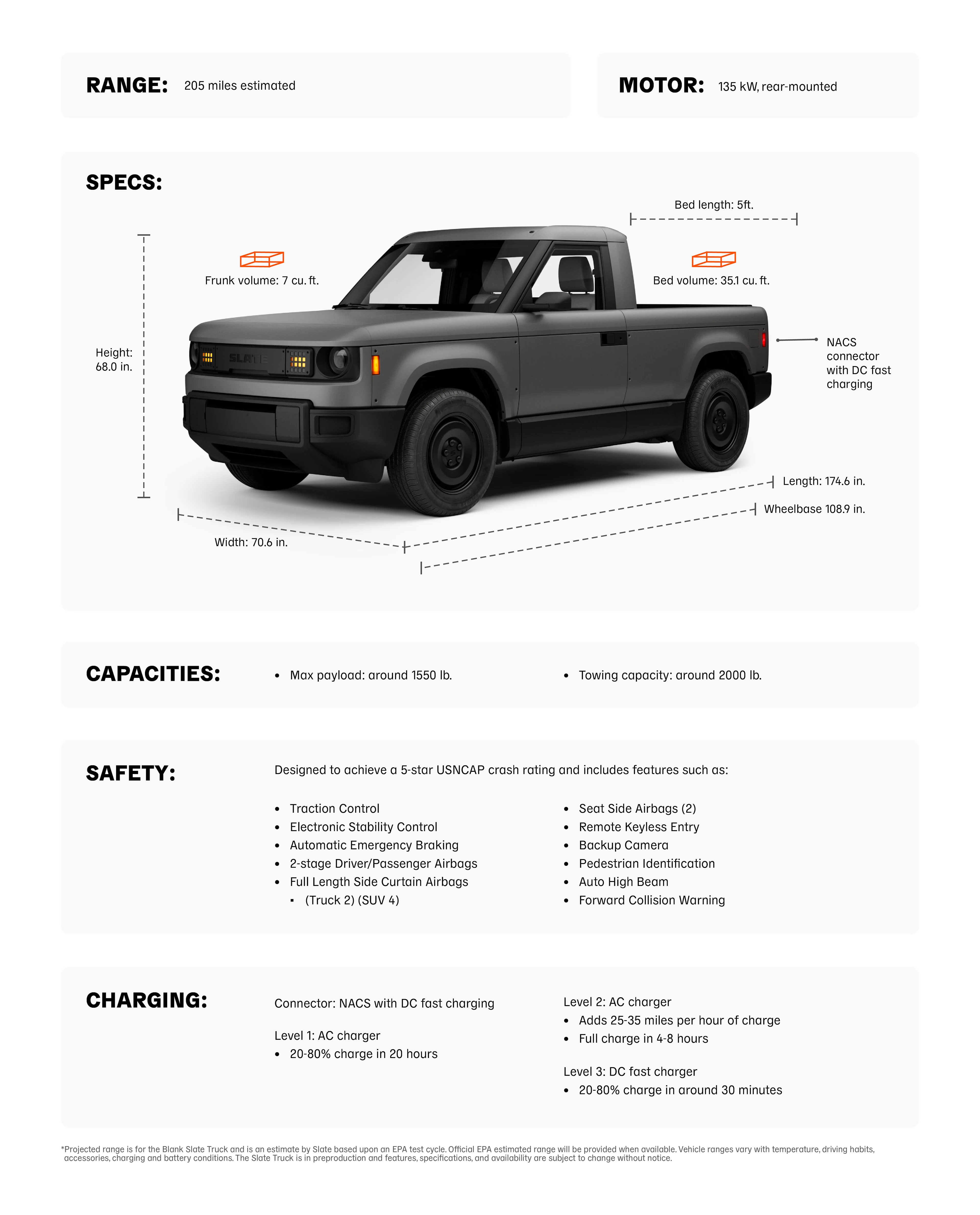
They list some details on the Specs page[1]. They quote 200 miles of range, which is not great especially for a small car. They list a 20-80 charge time of 30 minutes so it's probably a 400V architecture, which is becoming outdated as 800V architectures and chargers exist now.
Seems like a fine about-town car, but probably not a great one for road trips. I think that probably aligns with the NVH[2] expectations you should have for a car of this price.
[1] https://www.slate.auto/en/specs
[2] https://en.wikipedia.org/wiki/Noise,_vibration,_and_harshnes...
The flip side of that is over the holiday weekend I drove more than 250 miles to go visit my folks for Father's Day, which is just a couple of hours driving each direction. That's not even a long drive, that's a fairly normal weekend mini-roadtrip. It's not unusual for me to sometimes drive to the office in the next city over for meetings, and that's 116 miles from my house, where I work from home hence having significantly shorter typical driving experiences than most Americans. That next city over is a place where quite a lot of folks work and commute daily. 200 miles is definitely on the short side of acceptable range in the US.
Maybe it's just a Texas thing, but driving a hundred miles or more in a single direction is a typical behavior for many people under a variety of circumstances when you expect to return on the same day. This state also has the largest market for truck sales in the US.
A 200mi range means you can comfortably commute an hour to work each day, and then get back and "drive around town" in the evening without any worry.
Good luck getting 800V mode to kick on half of the time if you ask most US drivers of 800V architecture EV's. Most of the networks I see with 800V capabilities are also the most expensive per KW of electricity by 10-20 cents a KW.
I'd much rather stick to 400V platforms for the next decade before we get serious expansion of modern charging networks in the US.
Very surprising it doesn't say the battery capacity anywhere and has no option for a bigger battery
I mean I see the inverse as true, and entry level vehicles seem to have the most colour diversity in their sales. It is cars like the Nissan Versa where you see real colour variations.
It's actually a little depressing if you're sitting in traffic, just watch the cars go by and see how few of them actually have a unique color. And most of the exceptions are something like an almost gray blue.
For my part I've found new car styling hideous with little difference between brands my entire adult life. Probably for nostalgic reasons I like the sharp geometric shapes of cars from the 1980s which largely disappeared with a focus aerodynamics for gas mileage. So I'm usually satisfied with whatever color is on the lot since I hate the look by default anyway.
Order from the manufacturer, they will deliver it to the in-network dealer of your choice.
It is far more difficult to properly paint a vehicle than it is to paint a house.
Weapons systems do sound pretty sick though
Framework is making a go of being a niche provider, which is great. But they are currently estimated to have less than 0.1% of the laptop market.
[1] https://www.hagerty.co.uk/articles/maintenance-and-gear/it-l...
I can charge it at home. The tire discounters by me charges $15 for a rotation if they didn't sell you the tires, and they do the inspection to see if there's anything they can sell you.
It's less that the oil change costs that much and more that they don't want you to show up with a car they've never seen for an oil change when they can make more doing other work in that bay. So it's priced to keep people out rather than to draw people in.
Seriously tempted with the Slate though. I have the $50 pre-registration down from a few years ago, so I could have it in July-August of next year.
The problem with the Slate isn't that cheaper vehicles exist. The problem with the Slate is that you can buy nicer, better equipped vehicles for the same price.
That means, for a given spindle height, the car ride height is the same regardless of wheel diameter.
I'm curious, is that your personal average or is that what the company claims?
I've not taken the plunge on an EV yet, but realistically I'm interested in the actual range driving 70-75mph on the highway, with the AC running, as compared to the manufacturer's claims.
Of course, you probably want to arrive at your next charge stop with 5-10%, and the top 10% of the battery charges very slowly in all EVs, so you normally multiply by another 0.80 factor to take that into account.
I can live within those limitations.
Not so fine if you go by Silverado EV experiences where they fail to ever go into 800V mode reliably and cause months of dealership woes with zero fixes. [1]
In my opinion its just another failure point that makes me prefer 400V EV's.
Slate can wrap before delivery.
> It will operate as the central shop where the modular two-door, two-passenger pickups will be wrapped in custom colors and finishes chosen by customers, with more than 100 color options available.
https://news.dealershipguy.com/p/slate-auto-bets-on-customiz...
https://www.courier-journal.com/story/money/companies/2026/0...
I'm also not entirely sure about this facility. Some places are saying this is a facility to produce wraps, as in they manufacture the wraps for others to install. Others suggest this will be a place to get the car wrapped. Is it both? Who knows. I haven't seen any official correspondence from the company directly clearing up what all this facility will actually do.
According to the filing they did with The Kentucky Economic Development Finance Authority (KEDFA), the facility is to be a "vinyl wrap kit manufacturing and fulfillment facility." Usually a "fulfillment facility" is a logistics hub. It sounds more like a place where they'll manufacture the wraps and ship them out than a place where it'll be installed, but it isn't completely clear either way. See page 94-95 of the first PDF and page 14 of the second:
https://cedky.com/cdn/140_KEDFA_Board_Book-_Mar_26_26.pdf?4-...
https://cedky.com/cdn/140__Mar_26_2026_KEDFA_Min.pdf
Maybe there was more said in the meeting, I don't know. But if they said it was for installation as well, it wasn't reflected in the meeting minutes. It would probably really change the scale of the operation though. About forty people for manufacturing, logistics, and installation of wraps for tons of cars? And you're going to need a facility to get a lot of cars through, quite a bit larger than some commercial printers and packaging machines. It would also seem strange to me to build the cars, ship them 200 miles, then wrap them, then ship them out to customers. Why not just wrap them in the Warsaw Indiana facility? Maybe they will eventually wrap them in the Indiana facility, who knows.
But as it stands right now, if you order one of these Slates with a wrap, you better be ready to install it yourself or hire someone to do it. That's Slate's official stance on it currently.
I was under the impression that you could order wrap from factory and it would come wrapped and not in a kit ready for you to apply.
It isn't an option here. When you go to pick a wrap it directly states:
> 2 people required. 12-16 hours. A big commitment for a DIYer. We'd recommend professional installation if you're not sure you can tackle it.
The only difference is you're shopping around at wraps at purchase time, you still need to either put it on yourself or find your own shop to install it post-delivery. No different than you driving any other car off the lot and going to the body shop down the street and having them wrap it for you.
I definitely wouldn't buy an EV based on lower service costs.
- check the brake fluid for water - change the cabin air filter - change the gearbox oil - check/change the battery coolant
If you're going in more frequent than that you're getting a very expensive windshield wiper replacement.
The real kicker is going to be repair costs. An EV has about 10% of the moving parts of an ICE car, so in theory repairs should be much less frequent. But if the ICE is a Toyota and the EV is a Tesla, YMMV.
You'll probably have to replace the battery at around 250,000 miles but at that point the car is worth pretty much scrap value anyways.
The trackers aren't in the infotainment. Removing the infotainment do not solve the tracker problem.
I've decided to just buy my own vehicle rather than deal with the hassle.
Southern California Edison on the time-of-use plan, charging during "Super off peak." Note that nowhere on the bill do they show one number for how much you pay per kWh. These numbers will change next month as we go from "Winter" to "Summer"
Delivery charges: $0.17664
CCA Cost responsibility surcharge: $0.02007
Nonbypassable charges: $0.00644 + $0.00591
Fixed recovery charge: $0.00619
Generation charge: $0.05958
Unless I typoed something again (oops 800k) that works out to $0.27 for the cheapest I can pay in winter. I compared last fall and this was by far the cheapest plan offered to me for overnight charging.
(My car averages 3.3 miles / kWh, so ~$0.055 / mile assuming 100% charge efficiency... I'm using a 120V outlet so it's probably 75-80% charge efficiency, pushing the cost to ~$0.068 / mile.)
Suggests up to 25% loss if your just plugging into an outlet, but a wallbox improves that considerably.
Oh man, that is ... a lot labor. I can't imagine many people are going to want to do it
I feel like this truck really appeals to the more moderate project car folks who want something both reliable and personal to them
It also appeals to anyone that wants a new vehicle but has been priced out their entire lives - especially for an EV.
I don't think I've ever gone shopping for a car and had the dealer present me with the exact same trim options but color selection was only going to change the MSRP by $800 at most...
Most people don’t have to pick an everything vehicle. We all benefit when we focus on maximizing our division of labor.
For example, my boss, who has a 1.5 hour driving commute, refuses to get an EV because he drives a 750mi road trip once a year. In order to avoid spending an extra 3 hours for this road trip, he shoulders all the additional gas costs (and many more than 3 hours spent driving to and sitting at gas stations annually) and then service costs of owning a gas car on top.
The guy is trading $2500+ a year and 20 hours a year fueling, to save 3 hrs on a single road trip. Totally illogical.
And with lots and lots of typical road trip hotels (your Hampton Inn and Holiday Inn Express) now with L2 chargers, there's even a good chance that my only charge for the day is the lunch charge, and overnight I fill up for free. A few years ago they'd sometimes be broken, or there'd only be two, or whatever, but it's just steadily getting better.
For practical EV purposes there is not electric everywhere. If there isn't enough at home chargers are hard to find. Sure they are all over - but they are not advertised and not at every exit: you need an app to find them. Using an app is not safe when you are driving so you better have someone else with you to figure out how to find them or plan ahead.
Using apps like ABRP you can easily schedule your drip to have the optimal stops for route planning based on your battery technology, if you are doing a drive long enough to have multiple stops that should be part of your travel planning even with a gas car alongside a pre-trip check.
You can easily circumnavigate the entire USA with an EV that supports NACS!
Agreed
> the question is just do they have a 240v outlet somewhere nearby to a garage or parking spot.
They almost never do. This is the key thing you are not understanding about my reply. We can get level 2 anywhere, but most of the time it means you have to have an electrician.
> Using apps like ABRP
That is my objection. When I drive a gas car don't need an app. I drive until my gauge gets "low" and then find the next gas station - I can be assured that almost anywhere I will make it to a gas station if I start looking when the gauge reaches 1/8 (though I refuse to let it go below 1/4 for safety reasons). No app needed for gas, there are big signs everywhere that alert me where I can fill up. Last road trip I looked for those signs wondering if I could have used the EV and there wasn't 1 in 300 miles: then I pulled up the app, and there were plenty - but none where in places you could see from the main road and none advertised (they were also a lot less common than gas stations)
Technically true, but if you've only got 60 amp service to your home because it was built in 1955 and the cost to run a new service line is greater than the cost of a new car, it's pretty difficult to get any useful amperage to your level 2 charger.
But otherwise... Yeah, That's absolutely amazing to wake up every morning to a full tank/charge
> If gas prices return to pre-Iran-war it will be cheaper than paying to use an L3 charger, and even if they don't it will be far more convenient.
Yeah, that's Toyota's main argument for not diving head-first into EVs. Yes, merging the two technologies means you have the complexity of both... but after a decade+ of experience, they've gotten it down to be pretty reliable.
For a lot of people, that's still the best choice assuming you don't mind the budget for wear-items / oil changes ... etc. When my current econobox is _done_, I will probably go straight to EV just so I don't have wear-items to deal with and because I either drive a few hundred miles per week or fly. I don't need to account for family road trips or anything else that make the ubiquitous fuel station network worth it.
Gas stations have this problem too but it's not as bad, because filling up a fuel tank takes maybe 5 minutes not 20-30.
My boss's have been asking me how life is with my Ford E-Transit, but it doesn't have enough range for most of our site technicians which end up driving 200-300 miles a day.
A reasonably priced cargo van with decent range was a large untapped market for far too long.
I bought an E-Transit anyway to setup as a Home/Office on wheels. Really hoping that in the future we see aftermarket long range batteries for these first two decades of mass market EV's being produced.
The Transit Connect is discontinued in North America and was only ever a plug in hybrid here (outside a 500 unit collaboration in the early 2010s) but maybe one of the newer electric variants of the Transit lines will make its way over some time (e.g. looks like the Ford E-Tourneo Courier is an all electric in Europe).
The ecosystem?
Its a phone, not a tank.
People not using cases on their phone are insane to me. I can't even sit these spaceships down on a non-flat surface without them sliding off. They're the thickness of playing cards.
Similar to: "I bought my phone for identity, for style, for a feeling if being on the technology edge."
Yeah, I bought a phone with a web browser in an ecosystem I like.
That 1985 Toyota had a radiator in the grill so had a reason for that shape. This truck doesn't.
Compared to a Toyota corolla, there's at least a 50% higher fatality risk in pedestrian accidents solely from the higher hood. That's for the general population. Given how these fatalities usually work, the risk to children is exponentially higher. There are dozens of studies on this.
No, this car isn't the worse offender, but lets not forget the important part here: This hood design is exclusively done for aesthetics.
So if the maverick is barely a truck, then the 1990's ford ranger is barely a truck too.
2025 Ford Maverick 121.1 inch wheel base, 199.7in long, 72.6in wide, 4.5ft bed.
1990 Ford F150 Regular Cab Short Bed 119.9 wheelbase, 202.2in long, 78.4in wide. 6.5ft bed.
Idk how you get "almost identical" out of those numbers, unless you are using the long bed ranger or an extended cab short bed ranger. Even the longest 1990 ranger was shorter than a Maverick by a few inches.
The Maverick is actually the size of an F150 from 1990. Similar to how the Colorado/Ranger today is the size of a full size truck in the 2000's
The Maverick is barely a truck because of the bed size. But a lot of modern trucks have comically small useless beds so it is hard to fault it for that.
[1]https://www.therangerstation.com/tech/ford-ranger-dimensions...
"Want the SUV kit, or a wrap? We’ll install them for you before we deliver your vehicle, for a little extra."
> Order pre-installed: Pick your wrap when you purchase your Slate and have it arrive, wrapped and ready.
Ok then! Strange they don't directly mention it on their build page.
Would have probably been a better source to start with instead of an article about an article about a meeting with the KEDF.
Or you could have Google searched the website like I did for the same info and saved us all a lot of time ;)
I (and many others) would actually argue many common hybrid drivetrains are actually simpler than many ICE-only drivetrains.
Things like transmissions and complicated AWD setups are incredibly complex. Planetary gear sets and using an electric motor for the rear axle to add AWD can make things vastly simpler mechanically than a regular pure-ICE. You need a computer to get it to all play nice, but in terms of moving parts and things rubbing it can be a lot simpler.
Kids, women, and the elderly do take a disproportionate share, but nobody measured anything "exponential". "Dozens of studies" is fair. "Exclusively for aesthetics" isn't, though: the front houses a 7 cu ft frunk, and more importantly the Slate's short hood and modest height give it a smaller forward blind zone and better sight-lines than a full-size truck, which is the axis that decides whether the driver sees the kid at all, and the one the 45% fatality stat doesn't even cover. The real villains here are taller, longer-nosed, and parked in way more driveways than this thing will ever be.
This vehicle is a step in the right direction, especially for the urban environment. If we really cared, everyone would drive a Honda Acty in urban zones.
200mi is definitely acceptable in the US, but it's on the low end of the acceptable spectrum.
People often really overestimate their driving habits.
Some Americans would absolutely be heavily impacted by a vehicle with a vehicle with 200mi range on a good day. A ton of Americans would never really be affected.
200 miles in perfect conditions is the minimum anyone should accept. Just like in winter I never let my gas tank go below 1/4 tank - in case I get stuck and need to run the engine for heat while waiting for help. You should plan to only run between 20% and 80% battery, which means your 200 mile range is already 120 miles of useful range in perfect conditions.
I have a pickup and a car, I'll be trading both of them in to help cut the cost of this down, and if I'm going on a road trip I'll just rent a car. It's no big deal.
I never claimed that.
> People often really overestimate their driving habits.
I agree, and like I said I think 200mi is acceptable. But people do like driving in the US. I used to go up to Brainerd from the Twin Cities regularly; that's 135 miles each way. This is not uncommon, lots of people here like to do short road trips up north on holiday weekends. Sometimes I even did both directions in a single day. My 300mi Ioniq 5 could probably do that whole trip on a single charge, maybe with a short stop to bump it up, which will be fast thanks to the 800V architecture. But the 200mi range would take at least one full charging stop, possibly two, which will also be slower thanks to the slower architecture.
Like I keep saying, I don't think 200mi is a deal killer, but it's also definitely a con for the US market. But it keeps the price low, which is definitely the focus here and means it slots nicely into the 2nd family car budget. Nothing's perfect; I still think it's a cool product and will be keeping my eye on it.
A 13th gen RCSB F-150 is only modestly larger than a 1990 RCSB by your definition here, but we know that's not practically true because you are only comparing very specific measurements. Anyone that's had an OBS and been around Mavericks would never say the Maverick is the actual size of an OBS F-150.
Trucks are bigger than ever, that's self evident, but saying an OBS and Maverick are the same size is a stretch.
Well it fits sheets of 4x8. I finished half my basement with supplies and tools trucked around in my Mav. Wouldn't have been any easier with an F-150. Would have been more difficult with my hatchback.
> In reality you can probably bring your EV to the dealer once every 4 years or so.
Not really, I need twice-yearly seasonal tire changes/rotations.
I could budget for yearly service (rather than the never-service-until-required plan I went with) that would presumably lengthen the lives of my brakes as far as corrosion is concerned, but at current shop rates that would cost more than what my brake replacements cost.
Are you somewhere where you actually need dedicated winter tires or have you just convinced yourself that rocking all weathers all year isn't feasible?
So, living in Alberta, and spending significant time in the AB/BC rockies in the winter, I still think all weathers would be feasible, but I'm more comfortable with dedicated winters. (For that matter, when I'm buying winters, I'm always borderline on whether I should get studded or not.) (And as a parallel effect, with dedicated winters I can also run higher performance all-season tires during the summer.)
And if I ran all-weathers with my driving patterns, I'd still want to be rotating them yearly, so that would cut my dealer visits by half, but definitely not to once every 4 years.
And tying back to my last ICE vehicle - for the first 4 years of its life it would have been okay without a dealer visit if you took tires/oil changes out of the equation, but not for any 4-year period after that. There are just too many random little things that break down in cars over time. (e.g. after 12 years or so the cruise control buttons were getting really mushy - I replaced them myself for the cost of the $65 part, but YMMV on whether you feel a service visit is warranted when removing your steering wheel air bag.)
Also rotating tires every 10-20k miles is good because most cars run higher camber in the rear (inner shoulder wear) than front and the fronts wear the outside shoulder more because of turning. Swapping them extends tire life by spreading the wear.
I replace mine annually, but it's easy enough to do myself (right behind the glovebox, needs zero tools)
Electric vans will remain ecpensive until the eSUV market has been saturated: the cost to make either is similar, and using the limited inputs and lines to make more of the lower-margin vehicle model makes no sense when the market can absorb more of the higher-margin ones.
Similarly the GM BrightSpot Vans (which are now dead as a platform).
Although if you get lucky you can find used GM Bright Spots for $40k, and used E-Transits for $20k. Haven't seen any used eSprinters yet on the market.
Rivian vans start at $80k, which is in the same ballpark as the R1S starting price of $83. Rivian axed the cheapest SUV trim in its line-up, so we're even less likely to see cheaper Rivian vans now.
I take my E-Transit down to single digits because I gotta make this 130 miles of range work for me. I max out around 80 miles between stops during winter road tripping.
The EV life is just getting used to planning ahead of time like the old days again. I always pull up the route on ABRP app, and check its suggestions on plugshare for recent issues if I'm driving somewhere I haven't before.
Not everyone lives in the rural parts of the North though. In fact, most of the country doesn't.
Pulling the service wire, upgrading the panel, etc. are all normally priced.
See https://www.titam.ca/2021/05/cost-to-upgrade-underground-ele...
The transformer for my house is two lots away and under a pathway.
Would be less expensive to install a natural gas generator and connect an EV directly to that whenever I need to charge it.
Also, your price is in CAD not USD
Also also, for the case that you already have power unless it was installed a long time ago its probably already in conduit and doesn't require any horizontal drilling
Am I misunderstanding here? I bought a new vehicle last year, and for a given trim there were a half-dozen colour options available at no extra cost, with the upscale options either a $600 or $800 upcharge.
I know more than a few people with very expensive phones covered in thin carbon fiber style cases which are there purely to protect the glass and metal from egregious scratches, though.
I would never sit hours somewhere waiting to get my phone fixed, I value my time.
Not about all seasons, which are not rated for winter use.
In my personal experience most, homes have a dryer outlet in the washroom connected to the garage at least in TX. It's no bother running a cable from the washroom to the garage.
> That is my objection. When I drive a gas car don't need an app
Any time I am making a long drive I always use a GPS app such as Waze or Apple Maps, I don't know what's on the road ahead traffic, accidents and closures the app will re-route me appropriately and optimally. If you made a drive so regularly you felt like you didn't need an app then you would already know on that route where charging stations are.
I do agree they are less common than gas stations because of a few reasons but that's set to change with time and market adoption.
For me, installing a 240V outlet for charging would entail...
Running a new circuit from the breaker box (back wall of basement) to the front facade (40' forward, 1 level up) with whatever drywall patching/paint comes with that.
That gets the outlet. But, I don't have a driveway, so I'd need to trench my front yard and the public sidewalk in front of my house, so I can pull the charge line through to the front edge of the curbing adjacent to my parking space.
I figure all-in, that's a $10k buy-in that only serves one of my two cars, so I'm stuck rotating cars every few days (not a big deal, just not ideal). Only one of my parking spaces is assigned - the other is "guest parking" open to anybody.
And I fully realize my situation might not be the norm, but it's not far off for many TH or condo residents.
I use a GPS when I don't know the route, but I've been to parents in a different state several times - I don't need a GPS interrupting my music to get there.
I agree EV chargers are being installed and will be installed more and more.
That's assuming you have a garage and the breaker box isn't already in it, which is also common.
Of course, I have neither, so installing a car charger would be expensive. Thus my continued use of ICE vehicles.
Also, who the hell still uses GPS instruction its annoying. I always have my gps muted
You may use your phones maps app while driving to show you the nearest gas station, or even the cheapest. You might also do the same with EV charging.
> any of various forms of vehicle for carrying goods and materials, usually consisting of a single self-propelled unit but also often composed of a trailer vehicle hauled by a tractor unit.
> any of various wheeled frames used for transporting heavy objects.
> Also called hand truck. a barrowlike frame with low wheels, a ledge at the bottom, and handles at the top, used to move heavy luggage, packages, cartons, etc.
> a low, rectangular frame on which heavy boxes, crates, trunks, etc., are moved; a dolly.
> a tiered framework on casters.
> a group of two or more pairs of wheels in one frame, for supporting one end of a railroad car, locomotive, etc.
> Movies. a dolly on which a camera is mounted.
> British. a freight car having no top.
> a small wooden wheel, cylinder, or roller, as on certain old-style gun carriages.
> Nautical. a circular or square piece of wood fixed on the head of a mast or the top of a flagstaff, usually containing small holes for signal halyards.
I see no mention of "body on frame" as part of what makes a truck a truck.
Maybe it's because I'm a dad but I can't imagine telling the family, "Roadtrip time! Let's all pack into the smaller car!". When we're taking the long family road trip to the beach or whatever, we always end up with the big car full of boogie boards and pool toys and cooler and beach umbrella, etc. Bigger cars with longer wheelbases tend to be more comfortable on the highway as well.
The folks I know who do the ICE/EV split household like you've mentioned tend to do the opposite. Dad has a small EV for a cheap and easy commute to work and Mom has an ICE (or hybrid) SUV or minivan that gets used for the long road trips as well as daily errands (but Mom doesn't rack up enough miles for the cost of gas to be much of a worry). There also seems to be less willingness from women (at least in the US) to make the switch to full EVs.
A practical plan is a diversion of labor that maximizes the best and most frequent use cases.
Once we're at the point where a single vehicle and, say, an ebike are acceptable transit options, then America will have already exceeded it's climate goals. To achieve that, we'd likely need density near that of San Francisco (about 1.10 vehicles per household) or Chicago (about 1.12). Even bike friendly cities that are fairly dense, like Portland, have about 1.5 cars per household.
Again, though, the savings from that would be exceedingly obvious for anyone who chooses this path.
Range doesn't matter for ICE vehicles because of the speed of refueling and ubiquity of gas stations. And you know this.
I've gone on several 1,200mi each way road trips in cars like a Honda Accord and a Ford Focus hatch. A couple of those in that Focus hatch even carried four adults in the car. I just put a little luggage rack on the back.
It's not like you need a giant SUV to drive a few hundred miles. I can assure you smaller cars can make that drive as well!
Range doesn't really matter past a certain point for a ton of people. Few vehicles even go on massive road trips these days. Traveling with my little kids these days, we end up stopping just about as much in our ICE as we do on in our EV on road trips.
As I've mentioned here many times, the amount of time I spend "charging" my ICE dwarfs the amount of time I spend charging my EV, and my EV gets significantly more miles. Even with road trips factored in.
More proof people massively overestimate their vehicle needs. Thinking you need an SUV to go on a road trip, that a Prius just can't possibly be enough.
Preferences are driven by culture in the short run and by practicality in the long run.
But you're going to stop somewhere along that path already, right? You're not driving straight there and immediately turning around and leaving right?
I've done several road trips between DFW, Houston, and Austin in an EV with ~200mi of range and a 400V pack. The DFW<->Houston trip is nearly 300mi. Compared to my average trip time in my gas cars, its about an extra 15-20 minutes on a four and a half hour drive. I was going to stop for lunch on that four and a half hour drive anyways.
Oh no such a massive impact on my life, spending an extra 20 minutes a few times a year.
Meanwhile I spend hours a year going to gas stations and pumping gas for my gas cars that get fewer miles.
Honestly, no, I didn't. It's only 2 hours. Having to stop for a 30+ minute charge in each direction would add a significant amount of time to the trip.
I don't really understand why you're being so aggressive about this. We are almost entirely agreeing. 300mi is a selling point for buyers because it means an easier time doing 100+ mile road trips, which are not uncommon in the US. More range is a tick in the "pro" column when comparison shopping, and it could convince someone to buy a car other than this one. That's all I'm saying.
Sure it would, but why would you? It would be more like one 20 minute charge in Brainerd. Maybe a half hour if you want some extra buffer. And that's assuming you're unable to charge wherever you're staying.
Overnight charging will give you approx. 30 miles of range (depending on the car and state of charge). It's really hard to know without having an electric car for some time if it's going to be annoying for you.