Now [1] redirects to [2], essentially an About page with links to the data.
[2]: https://www.nypl.org/research/support/whats-on-the-menu
[3]: https://web.archive.org/web/20241222134751/https://menus.nyp...
The soot site is a bit vague about their product: https://spiral.soot.com/
I've previously encountered a similar product with much clearer marketing and documentation pages called Zegami: https://zegami.com/
https://de.wikipedia.org/wiki/Bierdeckel#Urkundencharakter (in German, English wiki doesn't have this info)
https://uitspraken.rechtspraak.nl/resultaat?zoekterm=Flessen...
https://uitspraken.rechtspraak.nl/resultaat?zoekterm=Eetpira...
Interesting. I’ve always seen this as a signal that a person was stepping away, but coming back. The person would cover it while going to the bathroom, in part so it isn’t as trivial for someone to slip something in their drink. Implying that they intend to keep drinking it once they return.
I’d be interested to know where it means that the guest doesn’t want any more beer.
Works for preventing insects from flying in when sitting outside though.
They had to cement the dining area because people used to bury the plates in the beach sand.
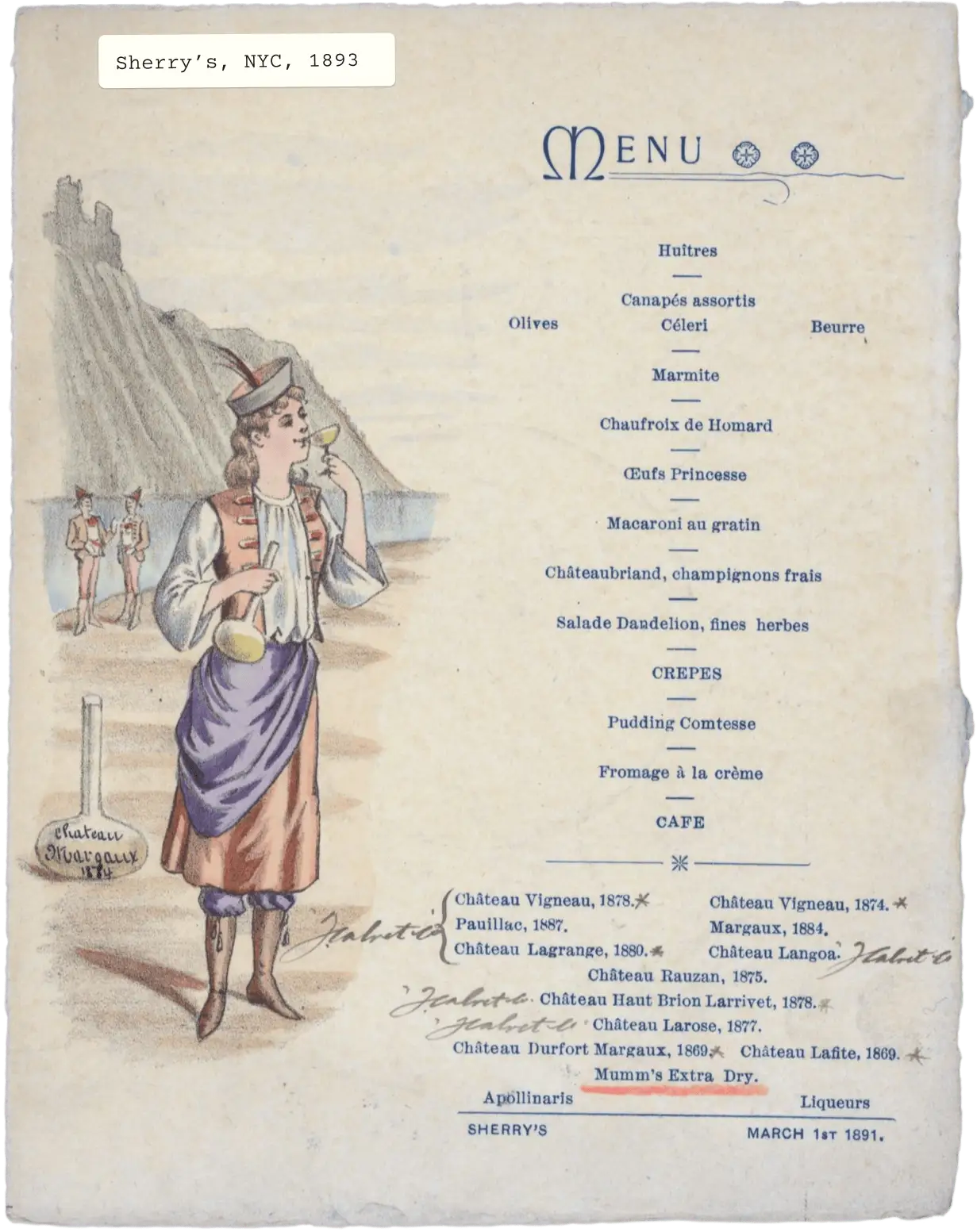
This also lead to the production of specific table items intended to display celery such as the vase shown in the menus above.
After looking at a dozen of the ones from the Boston area I have to say that my sampling disagrees with yours.
Turtle, Sweetbreads, Venison, Mutton are all things that would get a foodie OUT to eat today and seem to have been much more common then.
Also much of what I am seeing as "boiled" is going to range from "poached" (salmon) to "braised" (some of the tougher organ meats). Stumbling across a "boiled" chicken, served with rice and cucumbers in an 1800's menu made me jump to "Hainanese chicken rice". That preparation seems exotic to the modern American style but might not be as alien 100 years ago (Flavoring aside).
So it’s probably not exactly fair comparing with more casual modern restaurants.
Word art, clip art Lamborghinis next to the takeout number, all kinds of coloring. I love them.
Lots of classic restaurants. Many of which are no longer with us and, to be honest, many of which I wouldn't eat in today.
A modern open font that might match the style is Old Standard TT.
https://fonts.google.com/specimen/Old%2BStandard%2BTT
I was curious how these were made back then and what modern fonts might look best.
So looking back we see the similarities but are often blind to the differences.
So some things have definitely changed!
The prices, on the other hand, seem quite cheap--even after converting to 2026 dollars.
Coming home from the Appalachian Trail I stayed at the Inn at St. John's in Portland ME, waiting for my flight home. The Inn had an antique framed menu from Delmonico's Restaurant in New York, from 1834. The price inversion was occasionally quite shocking- on that menu I noted roast chicken was twice as much as roast mutton, for example.
Let's see if I can dig up my old trail journal . . .
    Delmonico's Restaurant
    494 Pearl St

    Cup of Tea or Coffee-.01
    Bowl of Same- .02
    Crullers-.11
    Soup- .02
    Fried or stewed Liver- .02
    Hash- .03
    Pies- .04
    Beef or Mutton Stew- .04
    Corned Beef & Cabbage- .04
    Pig's Head & Cabbage- .04
    Sausage & Cabbage -.04
    Knuckle & Cabbage- .04
    Fried Fish- .04
    Beef Steak- .04
    Pork Chops- .04
    Pork & Beans -.04 (What the hell? I mean, pork and beans?)
    Sausages- .04
    Puddings- .04 (The pudding of this time was probably more like a rindless sausage than anything we think of as pudding, and could be made from blood, innards, brains,     what-have-you)
    Liver & Bacon - .05
    Roast Beef or Veal- .05
    Roast Mutton- .05
    Veal Cutlet- .05
    Chicken Stew- .05
    Fried Eggs- .05 (I have no idea where this price comes from, although I think the lack of refrigeration in 1834 might have made eggs a bit more of a luxury then than now, and     it's also probable that a fried egg in 1834 was more something like a Scotch Egg than sunnyside up)
    Ham & Eggs- .10
    Hamburger Steak- .10 (Big spender! Again, a hamburger must have been something different in 1834)
Roast Chicken- .10cool collection, just harder to share some specific ones with friends.
There are so many on ebay and delcampe and I think people used to make these and save these special event menus much more than we do today.
I have been to a handful of tech dinners recently that have had them though so maybe it is coming back!
The tools we have shape our graphic design and sometimes a look back through history, when they had different tools, provides a rich seam of inspiration. Thanks for the post!
There are a variety of parallels in the history of overfishing where a given seafood that was once abundant was then seen as undesirable and served to servants or prisoners (lobster, salmon), but today is somewhat of an expensive delicacy.
If the primary purpose is a bar that also serves food, yes.
If it's proper dining. No
But QR codes are not awesome, I agree. They are more hygienic, less wasteful of paper, and easier to update. But I don’t want to use my phone when I am out with others.
And then they had a tongue sandwich!
Distinctly and many of the menu's I looked at were from private events.
But mutton was fairly common then and has fallen out of fashion in the US.
Venison went from "common" (1800) to rare (by 1900 we at all of them). Early restrictions on hunting were around deer.
The same with Turtle soup and mock turtle soup. Interestingly the mock version was made with calf's head. Apparently this was a texture thing (Im guessing high gelatin content in the head).
The interface into the data is, well, shameful. It would be nice if one could pull up hotel menus (rather than private events) by year. From browsing Boston menus it was interesting to see the early ones (for dining not event) be limited and the later ones (1907) look more like a cheese cake factory or diner (a bit of everything). Im guessing this has to do with the availability of industiral refrigeration (made not harvested ice) coming into use.
Hamburger steak was steak, chopped seasoned and reformed, which added a labor step though it allowed for the use of trimmings. 10¢ in 1837 would be roughly $4 today, so that doesn't seem too out of line.
The big difference is that fish and seafood is cheap.
But of course, saying "in Europe..." is always risky. Europe is very diverse.