The great observatories are marvels of engineering - a focused effort on technical mitigations to the satellite problem would likely push the problem out for decades into the future.
Two possible paths forward: 1. inserting a shutter into the beam path while a satellite is transiting the field of view of the telescope, or 2. (somewhat worse from an SNR perspective) terminating an exposure right before it's corrupted by a transiting satellite and starting a new exposure once the satellite has passed.
I for one would much rather see effort put into advancing telescope design than blocking advances of our use of space!
I agree with this and I'm not an astronomer btw.
What kind of astronomy knowledge is required to launch a satellite?
So we can’t see the stars from Munich anymore? Yes, that’s depressing, but we’re not trying to reduce light smog in Munich right now, are we? Because all the buildings that have been build, all the streets and trains, also make it hard to see the stars.
More light is one of the things progress has always brought, and eventually we will just have to accept that we started building in the sky, too.
We should introduce a global agreement that commercial satellites must fall out of the sky within a few years to reduce debris. It should be an agreeable term since the debris hinders everyone doing business up there. Every nation is going to partially ignore it anyway, for military purposes for example. But that’s a different demand than a cap on the total number of satellites.
we aren't?
Bavarian Regulation on Light Pollution, Federal Nature Conservation Act, etc
Municipal lighting is regulated with light pollution in mind and allegedly you get fined over bright commercial lights at night
99.9% of species that have existed on earth are already extinct. Climate change happens constantly over long periods. Our CO2 emissions will be background noise on a million year timescale.
Time to ignore the whingers and the NIMBYs and colonize the universe.
Satellite communication is an impressive technical feet. In some very niche cases it is the only viable way.
In the vast majority of cases though it is terrible compared to laying down cables.
What LEO does is addressing a minuscule market. Sure you know a guy, or you might even has a dish on your van, and honestly that's cool. But that is also NOT normal. The van life or having Internet connectivity while crossing the Atlantic on a boat is NOT daily life for the vast VAST majority of people. Most people do 9 to 5 from one suburb to another part of a city. Not a tiny remote town, a city. Those cities are where people actually live and work for decades now already have electricity and in most cases telephony. We can use those.
I think when we have to make decisions that affect us all we have to step back. It is not anymore about a couple of sexy examples, it is about actual impact and actual usage.
This is the opposite of appropriate technology while spoiling a common good.
I dunno how many times a day they snoop my phone position from space. Best case Mr Musk only know there is a phone here on the sun deck not which one. I don't know if the signal leaks PI.
But stuff like mitigating the constant threat of big enough objects showing up on a collision course with earth should not be paused until those eye-catchers fall out of the sky. If there is something coming at us that can wipe out more than the stock price of one particularly space-enthusiastic company, we should like to know within a time period appropriate for our current planetary defense capabilities. Which will surely improve, over time - so maybe we can pollute the sky, later.
I don't really think this is a serious risk. This is a once-in-a-million-years kind of event.
Also, asteroid detection is not seriously affected by satellites. We can easily tell the difference between a moving satellite and a moving asteroid because of their speed.
That "particularly space-enthusiastic company" is a big part of why we're in a decent place for orbital defense right now. SpaceX has a lot of launchers, and a steady enough launch cadence that they can put a payload up there really fast, if there is a reason to hurry. Before, there was a very real risk of having to wait months just to get a launcher lined up - now, that's not nearly as much of a problem.
https://conference.sdo.esoc.esa.int/proceedings/sdc9/paper/3...
This article mentions SpaceX 7 times and China once incidentally, they want to nag SpaceX into doing things that don't matter when China's launches do matter and nobody is going to nag them into decelerating.
Additionally, what we lose in visibility from earth we will more than gain in visibility from space telescopes, which will be funded by profits provided by LEO satellites.
Any way you slice it, it’s a massive net increase in scientific progress and quality of life for many millions of people.
This ain't progress it is an indictment of man's stupidity.
Not to mention that’s not how it works. We regret burning so much fossil fuel but those who make huge profits from it prevent as much change as they can.
You can bet Amazon and SpaceX will do the same no matter how the rest of us regrets it
Do we put up long-distance power lines and wind farms even though they ruin the views? Do you tear down a forest to put up farmlands and suburbs? Do you build a dam to provide water for irrigation, even though it kills the fish and floods a valley?
Satellites are actually easier than most of those tradeoffs, because nothing lives in space and there's no nature to destroy. It only affects us.
How about we set a limit on how many satellites? That’s exactly how to balance
Centralized control from a benevolent dictator sounds great as a first approximation but rarely survives diving into the details.
And how do you enforce it? It's not like you can just go up there an repo the satellites.
Answer was: automobile.
The purpose of most of these satellites is internet access where we already have less limited possibilities with less maintenance costs like constant replacement
And asteroids are an extremely rare threat in the first place. It's literally a once-in-a-million-years kind of event.
Source?
I bet it plays important role in all the anxiety and other popular health issues rising.
I've moved out of the city and can see most of the stars still, although my eyesight is now failing and I can't see stars I used to...
We are becoming inwardly and selfishly focused as a species and disconnected to the world the alone the rest of the solar system/universe.
More regulations would just have the result of cementing a monopoly for Spacex.
A lot of astronomers disagree.
How can this be resolved?
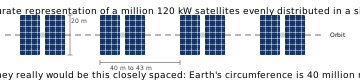
I'm still checking the maths on how bright a million satellites in a terminator-following SSO would be. I'm getting very big numbers. But then, the (vague and aspirational) suggestions I'm seeing right now for SpaceX are in the 120 kW range, which is huge, and lining up a million of those is enough for a contiguous ring just under 10 meters wide (how much under is "just under" depends both on how efficient the PV is and how high in LEO you go).
Regardless of if they're all in one orbit or spread over in multiple orbits at different shells that are all terminator-following SSO, from the ground you're getting a train of things with somewhat higher brightness than the ISS, with a fairly small apparent separation that (I tentatively think) becomes less than your eyes can resolve at at least one point in the sky (if there's say 50 shells, where those 50 get close to crossing).
I think we should wait to see how the first satellite data centre works out. It seems fairly unlikely that it could be practical. It seems kind of nuts...
>Reflect Orbital, a US start-up, aims to launch a constellation of very large mirror-like satellites to provide sunlight at night, with reflected beams that span at least five kilometres on Earth's surface.
Straight up nuts with no practical value, even if it did work out.
I wish I was joking.
I can understand European Southern Observatory (ESO) being concerned about becoming obsolete, but is the astronomy community as a whole concerned about the issue?
I understand there's currently around 722 observatories (some defunct, some are in orbit) based on this source: https://en.wikipedia.org/wiki/List_of_astronomical_observato...
But perhaps there are others I am unaware of.
Quoted: Hainaut explains that "satellites, illuminated by the Sun, are much brighter than distant galaxies. When a satellite crosses what we observe, it makes a bright streak on our image, zapping whatever is behind it."
It sounds like this only affects visible light telescopes.
Nope - it's also an issue with radio telescopes, and radio arrays such as SKA
The Starlink constellation is leaking radio interference in bands it pinky promised it wouldn't and the issue got worse with successive generations despite assurances it would be addressed.
Such leakage isn't, of course, limited to dawn / dusk - it's ever present and ongoing.
Space-based and ground-based telescopes are complementary to each other. You can't replace one out for the other.
But there is the rest of the world, and if I'm told that the Africans should not have access to high-speed satellite Internet[0] so that the Europeans can use one specific method of looking at the stars, I don't find that convincing. In time, as we expand, space-based observation will become fairly feasible for everyone. And the satellites we have will decay to the Earth should we fail to keep them up there.
We will build Earth orbital structures and swarms, and we will build Sun orbital structures and swarms, and we will go to the stars, and it will be better for humanity as a whole.
0: https://www.economist.com/middle-east-and-africa/2026/07/02/...
*The later you stay up the more disappear, until the middle of the night. But they're most obvious shortly after dark.
In my own childhood, seeing a satellite fly overhead used to be rare.
Now I see one every 2 minutes.
We talk about satellites as connectivity infrastructure, but I had not considered the impact to the night sky. I wonder if there are solutions like satellites posted further away around the moon with fewer relay satellites shared around the earth?
It seems preposterous that building a data center and
launching it into space would be more practical than building a data center terrestrially. Every problem gets 10 to 100 times harder (Cooling, energy, how are you going to do maintenance on the thing, it's in space?)
The only thing that's easier is you don't have to do any local community engagement.
If a grid connection is the constraint on your project, building an islanded data center with a buttload of solar and batteries seems a lot more feasible than launching it into space. Then you have the option to build a grid connection later and monitize those resourcess.
I recall around SpaceX 100th landing, that a day of just transatlantic flights was more than everything SpaceX had done to that point
And in all cases, if you produce the fuel using renewables then the CO2 output is trivially brought near zero.
I have a hard time fitting your response to the posted article.
Maybe you should have read the next sentence as well.
there are already several starlink competitors and even other countries planning to launch their own 1000-10,000 node networks
> For the SpaceX satellite mega-constellation, he found that dozens of trails would appear in each image taken two hours into the night with ESO’s Very Large Telescope (VLT) at Paranal Observatory in Chile
Not to mention the satellites of Reflect Orbital whose sole purpose is reflecting sun light into night areas
I strongly suspect that what'll happen is SpaceX does launch satellites with onboard GPUs, so the SpaceX hypemen can go "the skeptics said it couldn't be done!" and take off before the actual, more crucial question of "does it make _financial_ sense?" is answered in the extreme negative
I suspect Musk reaches pension age before that happens.
Are they worth the cost/tradeoffs? I don’t know. But there is practical value to lighting up the night.
Hell NO!!
Ubiquitous on-the-ground lighting is already disrupting plant, animal, and insect life cycles.
Adding a blanketing sun reflector illuminating five-plus square kilometers at a time will obliterate critical signals to everything living there, and won't do any good for the humans.
And nevrermind the astronomy.
It is an abomination and nothing but a scheme by amoral people to separate other fools from their money.
No. Lighting up the night is an abomination. Reflect Orbital can go fuck themselves.
The article makes mention of specific endeavours, like the night-time mirror satellites, which are particularly disruptive to astronomy, and the general risks of high numbers of satellites.
The ability to do Earth based astronomy is something that is of value to all the peoples of Earth, and is mainly funded by the western nations because of their current position as the people with more money.
(that we currently have no way to remove)
is actually 32,000 not just 14,000
what we need is the investment for "space roombas" that go around bumping things out of orbit that are dead or did not de-orbit properly
the problem is all that atmospheric burnup creates a lot of toxic pollution
* https://www.bloomberg.com/graphics/2025-space-orbit-satellit...
I don't think blocking the view of the night sky is necessary for "human flourishing", actually. Your attitude reminds me of the Victorians, who saw their coal-smoke filled skies as a sign of virtuous progress.
More reasonable minds prevailed, in the end, and now most people have a more balanced view - with the understanding that progress and industry must be balanced with the ecosystem we live in and depend upon for life.
“You guys know we could basically live in a Star Trek style utopia if we get this right, right?”
“The DATA cenTERS are STEALING the water and breaking Taleckshual ProPerty LERRS!”
Like, I thought we were for piracy, and against capital colonizing the space of creative ideas? But I guess what a lot of people were fond of was feeling important.
What is happening now is we have all our existing structure, and the existing requirement to earn money to live within this structure, and the human creative output we want in our eventual utopia is used to train automata with the express goal to replace humans in those creative endeavors, removing the ability for humans to earn money by being creative themselves.
It is not hard to see things from this perspective when a significant portion of writing is becoming obvious slop, and your liberal friends are having a hard time getting hired or landing writing deals or selling artwork. I would feel less important too; I'm already feeling this way when I review a PR with obvious LLM-generated descriptions and comments that reference the prompt.
Ideally, feeling important wouldn't be pejorative. Ideally, we'd have a way for artists to have food and shelter and continue to produce art. The hopes that AI will cause this to happen are equivalent to hoping WWIII will come along and wipe out 2/3 of humanity so we can start over with United Earth and warp drives and replicators.
I frequently hang out in my driveway in the early evenings shooting basketball and listening to podcasts. I'll see easily several dozen satellites over the course of the hour or two that I typically stay out there. and I don't even live out in the country or anything. I think mostly people are just not aware (yet?) of how rapidly the number of satellites have grown in the last couple years.
Also, what about planes? Those also cause similar light streaks. Another understanding I currently hold is that there is already a method for removing these artifacts
As though Africans aren't interested in the stars, or climate change, or that they can't figure out fibre optics is borderline racist.
Europe - and soon the rest of us - are facing massive heat waves that are likely driven by climate change, it's a real problem.
That's 'actual science'.
By all means, build what you like, but you don't get to dump your externalizations on everyone else. There is no 'We' in your projects, you don't speak for us.
This kind of attitude has for millenia been a dampener on human flourishing. My observation has been that those without empathy or foresight tend to attach themselves to these initiatives to obliterate our shared human heritage to satisfy their own ridiculous misconception of progress. Anti-intellectual, anti-curious, anti-social and so on because they've reached a local maxima in their ability to give a damn about what it means to live a good life and have chosen to spend their life in self-satisfied ignorance.
If I had to trace it to one source it would probably be the Club of Rome and Limits to Growth. Paul Erlich would be a close second with The Population Bomb.
Here’s a great podcast on the latter:
https://www.youtube.com/watch?v=Nn1gieFMuWI
This stuff sounds right because obviously you can’t have infinite growth in population or resource use on a finite planet. That means it won’t happen. The question is “how will it not happen?” The answer right now looks like “as people get wealthier they have fewer kids.” There are other possible answers like dematerialization of the economy which is also a thing.
Before the 70s this stuff would have been called far right and identified with ideologies like authoritarian eugenics and fascism. The 70s is when a lot of “volkisch” proto-fascist and crypto-fascist ideas got a lefty hippie makeover. The other big one is the idea that “natural” is inherently good.
I finally see this stuff getting some challenge from all across the political spectrum, even from the left. In previous decades you only ever saw it get challenged from the right or from what were once called libertarians.
A similar thread that links your examples together is how we all want to be the last person up the ladder. The last person to move into some neighborhood or into the last apartment complex. Or into a country. The last person to have internet access. Now we want to freeze how it is. Everyone after us threatens our experience.
An American with access to good internet for decades is annoyed that their stargazing session isn't what it used to be now that the city is growing and creating more light or that other people are getting to tech up.
Another episode of arrogant fantasy in the ponyworld.
Shut these ridiculous baboons out of society. Take their TESCREAL libertarian nonsense with them.
I am a human being. I flourish when I can see the planets and stars.
The utopia you describe sounds more like technological fetishism that benefits a select few, not the entirety of humanity.
Why don’t “we” just build more cell towers?
Why is littering our landscape with cell towers and power and fiber lines inherently better than putting this stuff in space?
Who is doing this allocation? Who is going to tell Pyongyang, Beijing or Moscow they can’t launch anymore?
When the average African live like the average American we'll be truly fucked, probably even before that. We should raise the bottom for sure but we definitely need to cure the degeneracy of the top too
Technosolutionism is a cult. We either put the caps on ourself or nature will hard cap us anyways, in a much harsher way.
And physics lets me get a lot further than "8 billion Americans."
A scientific justification is the balancing mechanism that produces the number which is then enforced.
Nature takes care of this for us in LEO. I’ve seen no serious plans to put millions of anything anywhere else.
The article
When is it enough?
The companies trying to make these plans are just looking for money. It's not for some noble goal for progress. If you fail to see that, I'm sorry for you.
Also, telescopes on the ground can be made much bigger and more powerful than in space, so even if some satellite profits were somehow (magically?) directed toward space telescopes, losing the night sky would be bad for science.
It’s not, we’ll be able to see the stars no matter what. There are many millions of people who are getting real broadband access to the internet for the first time right now because of these satellites. It really does enable an entirely new way of living for people in rural areas, I see this myself firsthand every day. Many areas are just economically not feasible to run fiber cables to.
Cheap access to space means you can put space telescopes into orbits that provide views entirely unobtainable from earth. And with cheap access to space we can eventually put space telescopes which exceed the size of the largest ground telescopes which won’t have to deal with atmospheric interference or light pollution at all.
Starship will lower the cost to orbit by 15x. Making entirely new types of scientific missions economically viable including extremely large space telescopes.
A decision of whether or not to destroy the dark night sky globally should be made at a societal level beforehand. Instead the path of maximum expected profit for a few people was taken instead of carefully considering the implications, alternatives, and mitigations.
IMHO even analog television and microwave oven look kinda out of place with the technology deployed at the same time.
30% sounds massive, but I wish they had given more detail to how much the images had been compromised.
I understand that can be tricky; cycling things on and off multiple times during orbital lifetime is more hardware stress inducing than leaving things static - but there isn't a lot of evidence of much effort being made on that problem aside from some insincere(?) lip service.
Maybe water rights really are the best model for this, but it’s a terrible model as demonstrated everywhere there are water rights. I’d like to think there’s a more sensible approach.
Yeah it turns out that "divvy up finite resource" is actually just an intrinsically nightmarish problem when it's something no one intrinsically owns, didn't create, but needs nonetheless, like water and land.
1. many astronomical observations are long integrations (many minutes of open shutter) and you often cannot read out the pixels during the exposure. So you can't selectively ignore pixels on a "by moment" basis. And with enough satellites, enough pixels could be affected to render an entire image effectively unusable
2. It seems you're thinking only about optical astronomy. There's also a ton of radio/millimeter wave astronomy that's done from the ground. Satellites have radio-wave downlinks that can be powerful enough to destroy the electronics used in radio astronomy receivers. The US's National Radio Astronomy Observatory has been working on data sharing with Starlink to mitigate this, but it's basically up to companies to agree to work together. Other satellites / companies don't engage in this coordination and so some radio telescopes need to go to a "safe"/stow position to protect the electronics. This costs valuable observing time.
I suppose the only downside is cost. So, the actual problem, is how to tax the shared resource that is our LEO. Aside from that, wed also want to incentivize not leaving space debris in orbit. Require insurance, and perhaps rent for orbital trajectories?
But, without working international order, theres no way thats gonna happen...
One would need to put the telescopes into fairly high orbits in order to avoid the interference. I think that even images made with the Hubble space telescope have sometimes seen the impact of satellite constellations.
But...they don't.
Or do you enjoy the suffering of billions of people working for less than 50 cents? Americans and Europeans only need to share with them what is let say above $5, and then we can get almost $2 for EVERY worker on Earth.
It is necessary to at least slightly limit one’s greed and show compassion to other people who are in an extremely vulnerable position.
Watch a time-lapse animation of aircraft movement. They follow fairly precise paths, and the number of them diminishes significantly at night.
In places like the ones listed above, they are uncommon at night. I've been to both. You might see one once an hour, if that.
I stand with my original comment.
If they say: "We shouldn't mess up the sky", it's the same as if CERN says: "We shouldn't eat anti matter."
It's foremost a warning.
AI adoption is a leadership failure more than a tech one right now. If you make people feel empowered with it, it can liberate work-free lives that humanity benefits from. If you use it to destroy people's livelihoods with no options it's not going to survive a revolution.
The world was already heading towards a dystopian landscape without AI. So many people on this planet live in a horrific dystopia right now, and here comes along something that might help them. Might give us what we need to stop global warming. I'd rather choose something with a 1% chance of working out than what we had before, 0%.
AI is a useful tool, but tools aren't always used to improve lives.
Perhaps we could try to destroy those power structures without having a giant war lol, just saying.
> What is happening now is we have all our existing structure, and the existing requirement to earn money to live within this structure, and the human creative output we want in our eventual utopia is used to train automata with the express goal to replace humans in those creative endeavors, removing the ability for humans to earn money by being creative themselves.
Right, I get the frustration, but how many "creators" were doing truly creative and expressive work writing ad copy or making up logos for shoe companies or whatever. The problem people have is capitalism, not the robots and it's short sighted of people to be angry at software tools rather than the system that has forced them to trade their time and skills for the right to exist.
I've literally lost my career before. The one thing that getting deathly ill has taught me is that "all things will come to an end." Someday, that will include me, but hopefully not today, and thanks to modern medicine, hopefully not any time soon. The idea that the only way an artist should be able to justify their right to survive is by shitting out jpgs on fiverr or whatever is as absurd as the idea that that was somehow meaningful work. If you're having a hard time getting hired, pivot. Adapt. Overcome. That's been my life for the last decade since I first got sick - and I'm not saying it's great, but you have to be able to adapt to new istuations. The world ain't going back. Do we become the Luddites and lose in the long run? Or do we "seize the means of computation and build something that strives for utopia?"
> Ideally, feeling important wouldn't be pejorative. Ideally, we'd have a way for artists to have food and shelter and continue to produce art.
I think food and shelter should be available for anyone on earth without any sort of need to justify it. But I do think that feeling really important should be a bit pejorative.
> The hopes that AI will cause this to happen are equivalent to hoping WWIII will come along and wipe out 2/3 of humanity so we can start over with United Earth and warp drives and replicators.
That's a false equivalency. Like, not even on the same planet.
The power structure is what is putting out the satellites and datacenters that you hope will bring the Star Trek utopia. Not sure you can both destroy it and reap its fruit, or that the fruit is not poisoned by the immorality and antisociality of the current power structure anyway.
Also, in Starlink's case, if utopic United Earth becomes real, it will probably be cheaper to lay fiber and cell towers, so it's maybe just a bootstrap and not a final end state.
Does not, will not and cannot happen. Power structures are made to keep themselves alive at any cost necessary. There will be a bloodbath one way or another, and these structures will either disappear, or march ever forward towards enslaving you.
Exactly. The "creative" wankery is just people who got college degrees but don't want to work in offices and/or do things with numbers.
Sorry, jobs that are fun and desireable aren't in big supply. Do something difficult, boring, disgusting, unsexy and perhaps dangerous and you are set.
I had a career in something I loved that was "fun" and even desirable. It was great. I got sick and couldn't do it anymore. I have (begrudgingly, and at times angrily) moved on. I pivoted. I adapted. I did what I had to do to survive and moved forward. I'm not saying I want other people to have to experience that, but I'd say it's given me a sense of clarity about the world that I otherwise wouldn't have.
If you cannot be flexible and adjust under pressure you're going to have a bad time. I think that a lot of people are unwilling to accept change and move forward.
Like, you can also choose to enjoy other things. You can choose to do things that are meaningful that other people don't want to do. Or just... you know, do your own thing. Figure it out. Adapt and do something different. Keep throwing shit against the wall until some of it sticks!
Small-n nature says (as best as I can tell) that I must obey conservation of mass and can't go faster than light -- and hence that I probably cannot, in fact, sustain a population of a 100 billion on Earth alone without significantly cutting down individual resource access.
Until very recently big-N Nature said we'd never have heavier-than-air-flight, an automatic translation program (see: plot point in A Fire upon the Deep), or, before the Green Revolution, a population above a few billion -- but just as there's no fundamental physical law forbidding these things (and hence they came to pass) so there really is no fundamental physical law stopping all of current humanity from living a decent life (happy to be proved otherwise).
It may be impossible with current technology, sure, but there's no new physics required to make it possible -- the physics we have now permit it, with sufficient technology.
In fact -- interestingly enough -- before nuclear energy you'd have a far stronger point (though solar energy now means even without nuclear we can probably scrape by enough energy -- but coal does in fact have a Malthusian problem)
Perhaps the last event was one million years ago and we are now (proverbially) 'due'.
> The gambler's fallacy, also known as the Monte Carlo fallacy or the fallacy of the maturity of chances, is the belief that an independent and equally probable outcome which happened less frequently than expected is more likely to happen in the future (or vice versa).
* https://en.wikipedia.org/wiki/Gambler%27s_fallacy
It's like people who say "it sure is strange that we had a 'once-in-a-century flood' two years in a row": that's not how odds/probabilities work.
* https://www.usgs.gov/faqs/we-had-a-100-year-flood-two-years-...
That usually refers to climate change and the fact that the odds have changed against our favor.
Ironically this is a great example of the gambler's fallacy.
I also suspect that to be the case but in order to be more objective I wonder. What's the theoretical maximum bandwidth per square meter (or other unit area) that it can deliver?
The rough hierarchy is: fixed fiber/cable > Wi-Fi > cellular > LEO satellite > traditional GEO satellite. Starlink is a huge improvement over old satellite internet, but it is still fundamentally a satellite system, not dense terrestrial infrastructure.
As a rough illustration, suppose one Starlink beam covers about 63 square miles and has 6 Gbps of usable downlink. At New York City density, that footprint contains about 1.85 million people. That works out to roughly 3 kbps per person. For comparison, network planners typically budget on the order of Mbps per person to comfortably support peak demand in dense urban environments.
You can improve that with more satellites, more beams, more spectrum, and better hardware. But even a 100x improvement only gets you to about 300 kbps/person. Additionally, this all adds cost... that isn't needed for the vast majority of time or space that the sattelites will be over. If the sattelites orbiting over New York also orbit over the Sahara Desert - every $ spent improving NY capacity is also improving the Sahara... but with no return.
The reason fiber, cable, Wi-Fi, and cellular work so well in cities is spatial reuse. Capacity can be reused block by block, building by building, apartment by apartment, tower by tower, and access point by access point. A beam from hundreds of kilometers overhead covers a much larger area.
So Starlink is excellent for rural areas, ships, aircraft, remote sites, disaster recovery, and backup connectivity. But it is not a replacement for terrestrial broadband in dense cities. It solves coverage much better than it solves urban capacity.
Is that the actual figure though?
> even a 100x improvement only gets you to about 300 kbps/person.
TBF even that would be quite useful for lots of things seeing as it's faster than the DSL service I once had. However agreed that it isn't going to replace fiber service and overbuilding to such an extent for outliers would be absurd.
Still, that's quite decent considering it's an estimate of a near worst case scenario.
If you really believe this (and I’m not saying I don’t, I just don’t have confidence in it), blocking domestic. datacenters doesn’t preserve that labour value. It just ensures whoever builds those datacenters controls production from afar.
Like, if AI really replaces human labour, does Africa and Europe having few AI datacenters protect it from America and China? Of course not. Not outside a symbolic level that even then would have to exist with the implied consent of the powers who produce.
xAI’s datacenters aren’t currently measurably replacing labour. So no, we’re not. If AI becomes economically competitive with broad sections of human labor, those who control it do have the power to replace humans.
But banning domestic datacenters doesn’t stop them from existing; it just stops them from existing here. If that precondition arises, that’s just a recipe for domestic deindustrialisation.
If you believe AI will replace human labor, blocking datacenters is silly. You want labor (or the public) to build and control them. I’m not convinced AI will replace labor, so I’m not yet at that step.
In the 80s, Rupert Murdoch built, in secret, a new fully computerised printing plant built in Wapping.
The workers went on strike, so he fired them. Didn't even lose a single day of output*:
https://en.wikipedia.org/wiki/Wapping_dispute
That is what you should fear from AI. Not the data centres themselves, that we could all be fired and the rich lose nothing as a result.
* [citation needed] :P
We may get that, but only if the ruling class want what the Victorians called a "folly": https://en.wikipedia.org/wiki/Folly
AI is wildly, wildly divergent in the possible futures it brings. It's really important to influence what happens, but don't limit the potential downside to only as bad as feudalism (neither neo-feudalist nor re-enacted): much worse monsters exist than the typical feudal lord.
(Was going to say "among those rulers who needed us alive to fight their wars and grow their food", but then I remembered Cambodia and Pol Pot).
No UN body can command a nuclear sovereign. They ultimately continually consent to oversight.
Why not, though? If any country violates their limit, just issue a concern. If they ignore it, upgrade it to a grave concern. Then they will surely have to obey, I mean, it's grave concern we're talking about, what else they could do?
Second, the situation is already so bad that current satellites in LEO already require active collision avoidance systems in order to avoid becoming sources of debris themselves. Starlink alone reports over 1,600 close encounters each week.
City killers? That size hits more often
> Asteroids with a diameter more than 30–50 metres (100–150ft) are large enough to make it through our atmosphere intact, however, and the chance of this happening is estimated to be around once in every 100 years.
> The damage from an impact of this size would be wide-ranging, and could wipe out an entire city if they were to impact a heavily populated area.
https://www.skyatnightmagazine.com/space-science/chances-ast...
Luckily, the majority of the earth's surface is unpopulated. Most of these rocks hit the ocean or Siberia and cause few or no casualties. The odds of it hitting a major city are quite low.
So the actual frequency of "city wiped" is more like once every 10000 years. Completely negligible compared to other city-wiping events (earthquakes or floods for example).
[1] https://en.wikipedia.org/wiki/File:Global_land_use_for_food_...
The more risks the more likely one of them will hit you.
Of course they are. Pre-Green revolution humanity probably couldn’t make a utopia. Currently, I’d argue we need way more energy to make utopia-like conditions available to all.
Technology isn’t sufficient. But I wouldn’t go so far as to say it’s unnecessary, unless one’s utopia permits dying horribly of infection due to minor cuts and abrasions.
I was there (cue Elrond meme), I remember.
And god forbid you were gay back then, or had an ailment that needed some high tech treatment, or needed to talk to someone on the other side of the planet for any reason, or wanted to have access to knoeledge.
We've come so far, and the people yapping about how "everything is the worst" are reactionary. Yes there are problems, I don't want to downplay them. But largely, until very recently, things were getting better en masse and zoomed out enough in time that trend will likely continue if we don't blow it all up or do something stupid like decide that science is too scary to do.
What I mostly see in these threads is "Capitalist Realism" - people can't even imagine things turning out some way other than "capital controls everything forever."
What I said applies to space, too, outside GEO, for the number of satellites anyone is currently talking about launching.
> the situation is already so bad that current satellites in LEO already require active collision avoidance systems in order to avoid becoming sources of debris themselves
They require collision avoidance to avoid being lost. There is no risk of a Kessler cascade in LEO right now and nobody who can do orbital mechanics is claiming as much.
We’d need millions more satellites than we have right now to start approaching the point where atmospheric clearance falls below the rate of new-debris production. And even then, you’re talking about a problem in specific orbits for months, maybe years. In the meantime, you get to allow nature to reclaim huge amounts of land from cell towers and conduit.
If you'd like to keep the US-led coalition of mostly free countries intact, then your concept of the US military needs must include a lot more activity that just "defending from a hypothetical invasion of North America by Old World powers". Defense of allies elsewhere, keeping trade routes on the ocean open and safe.
I think the fiascos around tariffs demonstrated quite nicely why glorious autarky is no longer an option. Too much stuff is produced elsewhere, from resources to highly specialized products like icebreakers.
Right now for the price of that one project one could have a humongous radio telescope in orbit without any interference. If only people could really look forward.
Radioastron required cross-correlating the signal with ground-based radio teleacopes in order to do science. The collecting area, dish distributons, etc. would need to be fully replicated in space if one wanted to avoid using ground-based facilities entirely.
Now we can launch two. Or two dozen. This completely obviates any need for ground listeners as for resulting angular resolution.
Since ground-based radioastronomy has other uses, will stay there anyway and since crosscheck is always better, future long-base radiointerferometry will use legacy ground-based observatories.
Sure. But what would have been better for the Fleet Street workers. The UK banning computerised printing? Or the union owning one?
If AI is going to be to jobs in general as computerised printing was to newspaper printing, just blocking it doesn't make sense. That's my argument.
> Sure. But what would have been better for the Fleet Street workers. The UK banning computerised printing? Or the union owning one?
Oh, definitely the latter.
The only way I see e.g. UBI working long-term is democratic* governments owning the means of production, and in the case of AI futures that means owning the compute, and the power supply for the compute.
Right now, the UK power supply is… privatised.
* small-d, not The Dems, I'm not an American
Like, worker ownership of the means of production and the assets in general is idea. But I'm speaking as an Alaskan who is quite fond of the PFD and think it doesn't go far enough.
Oh, absolutely agree. But the datacentre in Memphis is within its jurisdiction. If Nashville decides to stick it with a tax to fund a UBI, they can. Sacramento and Columbus don't have that option.
To be clear, I am not arguing for more datacenters being built the way they are being built. But if you believe AI will replace labour, you want to control those datacenters. Blocking them explicitly cedes that control.
The only modern contender, the Japanese Empire, arose partly by the encouragement of Teddy Roosevelt.
b) You are allowed to set ambitious goals
c) Your speech (e.g. “protect our families”) mirrors those of war mongers, what about the families who’s your bombs are pointing at?
Nobody gets to tell me to throw away my dream of a better and more humane world, and settle for one with horrors and war crimes. Us humans have multiple times in the past significantly reduced our weapons of war, we can, and should, do so again. Lets start with the missiles, and I‘m sure the interceptors will follow.
Commercial satellites are getting bigger and heavier. Launch that can put big and heavy in LEO can put big and slightly less heavy higher up. Add to that things like in-orbit propellant transfer and there is a good chance astronomy sees a golden age in the coming decades (in countries with space access).
I’m not dismissing the problem. Just this analysis as meriting any conclusions. It’s a start. But it’s only part of a full model of how these changes would affect astronomy.
Some sort of modular telescope array that could be launched in pieces and self-assemble in orbit. Something that improves in capacity as more pieces are added.
Everything seems to have stalled in this field, as if it's just waiting for a Starship which may never come.
I’d love to see an estimate of what a JWST-class telescope would cost to design, build and launch in a world maintaining a million-satellite fleet. My guess is less than $2bn.
Here's a visual to consider the implications of things you can do with actually one million satellites of the kind of size scale being discussed:
https://raw.githubusercontent.com/BenWheatley/blog/refs/head...
Satellites don’t orbit on the ground, which makes the 40m spacing nonsense. And nobody proposes putting a million 120 kW satellites in a single orbit.
They really would never be that closely spaced. To approach those densities in a single orbital shell you’d need hundreds of billions of birds in orbit. Spread across all of LEO (and only LEO) we’re talking orders of magnitudes more satellites (like, quadrillions).
Hence why the horizontal scale bar says "40 m to 43 m": Going to 500 km doesn't add much to the orbit's circumference.
> And nobody proposes putting a million 120 kW satellites in a single orbit.
One of my tentative conclusions is that it would be an improvement if they did. But also, there's better contiguous structures to build if you could put that much up.
It's in my blog post because I'm considering all possible arrangements of ways to do this. Current list:
  • Spread them out by altitude while still keeping them in sun-synchronous low earth orbit like SpaceX plan
  • Put them all of them in a single sun-synchronous low earth orbit so none of them can hit each other
  • Spread them out like Starlink currently is
  • Have swarms, where each group has many satellites significantly closer to each other than the usual safety separation, like Google's Project Suncatcher
  • Have fewer, bigger satellites, like Starcloud
Matters less than I expected when I started writing. How much so depends on what I end up adding by treating gaps in "full" (up to the safety margin) orbits as the thing of interest and seeing if someone's done a version of this on spherical geometry and also add a time component: https://math.stackexchange.com/questions/270937/how-can-you-...
(That I'm researching such questions should explain both why I'm at 7k words and why I've not published it yet).
(One big surprise to me while researching this: along-track, cross-track, and radial positional error per unit time are all much higher than I would have guessed: https://digitalcommons.usu.edu/smallsat/2015/all2015/58/).
https://www.healthsystemtracker.org/chart-collection/u-s-lif...
https://www.unc.edu/discover/u-s-life-expectancy-drop-caused...
https://www.ers.usda.gov/topics/food-nutrition-assistance/fo...
US got problems.
World's much bigger than the US, and is getting better:
https://ourworldindata.org/grapher/life-expectancy?time=1770...
https://ourworldindata.org/grapher/prevalence-of-undernouris...
https://ourworldindata.org/grapher/total-population-living-i...
Most of them launched on the Falcon 9. They just point down to the Earth by default. ;-)
And there are other cubesats testing stuff for x-ray astronomy or gamma ray burst detection, such as:
We’re only starting to truly mass manufacture satellites. A world with millions of satellites means one with lots of satellite production and design economies of scale. (Same for all manner of sensors and optics.)
> as if it's just waiting for a Starship which may never come
Or it may. We’ll know in a couple years. Building a scaling production system for Falcon right now would be silly.
And if Starship never works out, we probably don’t see millions of satellites. It’s a fundamentally tied problem, which is why I say the analysis is incomplete.
Post-Green revolution humanity hasn’t pulled it off either.
First world problems (many of which were previously uncommon) are quite different.
It is socialism that gets us to utopia not the technology.
Not just the complexity of design, but also cost and complexity of cryo-vacuum testing hundreds of deployment mechanisms any one of whose failure critcially endangers the project. The mirror could also be conventionally manufactured versus requiring gold-plated beryllium [1].
Designing it to not fail at the start & then work without any help for decades must have also made it much more expensive.
Correct. I wasn’t proposing a realistic configuration. Just showing why OP’s visual doesn’t work for the numbers it gives. (It 1D space fills. I expand that to 2 and 3D.)
Millions of satellites is currently accepted as the maximum carrying capacity of LEO before collisions becomes a PITA.
However, this was not the point of the illustration, which is more "if you can do this at all, you can do better".
How so?
How is a lot of things, including the rich paying for it to be eliminated even in the poor nations who had no strong government to do this themselves.
When is where: https://ourworldindata.org/data-insights/many-people-alive-t...