Europe's new climate in seven charts(bbc.com) |
Europe's new climate in seven charts(bbc.com) |
There will be winners and losers. As climate zones move toward the poles, weather patterns and agricultural viability will shift with them. This will eventually turn current breadbaskets into deserts while warming up northern/southern regions for longer growing seasons.
Various regions will cross ecological thresholds, causing sudden, dramatic shifts in local climates. For example, a warmer Earth could bring monsoon rains back to the Sahara and Arabian deserts, turning them green once again. In general, a warmer world is a wetter world due to increased oceanic evaporation.
Sea levels will gradually begin rising, but perhaps at a rate of 1-2" per year. It takes a lot of heat to melt glaciers.
Human existence is not in doubt on account of the climate alone -- our prehistoric forebears had a lot worse to deal with -- but there could be mass population movements and alterations in how agriculture is handled globally. Current political structures are not up to this challenge.
Give that state you described another 50 odd years again and things can get worse - the land based glaciers are already greatly reduced, almost gone. The bulky polar ice is retreating a little - but the warming sea surface is the thing, it'll carry warm water and melt more and more ice.
Now it's fun and games for predicting what comes next - the insulation in the atmosphere is still increasing and the same amount of trapped energy that now goes to turning a mass of ice to a mass of water (at much the same temperature) will now turn to raising that same mass of water from near 0 C to about 60 C (roughly IIRC) - speeding up ice melts.
There's also the increasing amounts of water and methane in the atmosphere that come along with rising temperatures, these are much much better insulators that measly old CO2 and will serve to trap ever more energy from the sun.
Geophysically that's how this all goes in the absence of any serious reduction of insulation in the atmosphere.
Do you mean in terms of climate change? I know some temperatures were different but this was much more gradual afaik, which is no problem for anyone with two feet and a sense of where to go, but they were much more dependent on the ecosystem which struggles to keep up with the speed of today's changes
From what I hear, what we're causing is unprecedented for humans. Not dinosaur meteorite level of course (it's not an overnight change) but an ecosystem extinction event is nevertheless going on (https://en.wikipedia.org/wiki/Holocene_extinction)
I agree with the broader point that we'll survive and the question is more about the amount of suffering we inflict on ourselves and other animals along the way. Just curious if any old human (or even any great ape from the 'homo' genus) did experience worse
Not to forget, we are dependent on the food web. These changes mean species will be wiped out, fishing stocks will crash, and invasive will spread.
Since you are likely in the developed world, tropical temps in Europe would mean refurbishment of houses.
People won’t remember things like the lakes freezing over or ice skating.
So extending the time before frost, won't help many plants reach maturity. The days will be shorter, and when the sun comes up there is barely any light anyhow. Raw "daylight hours" are meaningless here, when the sun only gets barely over the norizon.
One month of June light is like 6 months of December light in much of Canada.
Even if we stopped using fossil fuels tomorrow, it will take millennia for the climate to return to normal.
However while apocalypse scenarios (Nuclear war, asteroid impact, AI powered biological warfare) are low likelihood, extreme impact, climate change is extreme likelihood and high impact, not just the immediate effect on places like Europe, Canada etc, but also from the conflicts that climate change will drive, which in turn may escalate to those extreme impact nuclear wars.
On a 5x5 matrix, grand extinction events would be a 5 for effect but a 1 for likelihood, putting them in a "medium-high" category
Climate change is a 3-4 on effect but a 4-5 o likelihood, putting them in a "very-high" risk category
If it's anything like the recent energy spikes it means burdening future generations of wealthy countries with subsidised amenities while others go without.
It gets abstracted away for richer countries as they can outbid the poorer countries for food. In developed economies, most of a particular piece of food's price is not the costs that go to the farmer, but costs that come later in the process, so that cost increasing is also felt less.
Heatwaves on the other hand affect the western countries directly.
Because climate scientists agree that's what's coming (except for extreme, immediate reduction of fossil fuel burning).
Frequency? Do I look like a statistician to you?!
1980 to 1999 had 6 years
2000 to 2019 had 13 years
2020 to 2026 has had 6 years so far, and we're only 35% of the way through
The longest period of time from 1960 to 2000 where june temperatures went higher than 30 was two years, reaching 30 in 1975 and 36 in 1976.
2021 was the only June in the last 10 years where temperatures didn't reach that 1975 record.
People get use to it, it goes away, cycle repeats. Nobody remembers exactly unless they had a near death experience.
They remember a lot more snow and talk about how summers were not that hot. And like, they are otherwise into half of right wing conspiracy theories.
https://www.chmi.cz/namerena-data/historicka-data/historicke...
Hmmm...
In both cases, the pan evaporation rate went up; in the case of 9/11 it went up very noticeably in a short period of time.
Essentially: clean air == less "global dimming". Whether any really recent changes like the increasingly successful rollout of electric cars is yet having an effect, I don't know.
This reduced SO2 emissions by about 80%, which improved human health, but also caused an increase in short-term atmospheric warming.
> Europe's rapid warming is partly the result of the melting of bright snow and ice, and a drop in the number of tiny polluting particles in the air.
That first one is kind of important and it seems intentionally misleading to omit it
"But ..."
Revs the engine again. "ONCE AND FOR ALL!"
The Wire is one of my all-time favorite shows in part because it's a story of institutional failure at every level. The police, the ports, the media, the schools and the city government. That's really what's going on here. Utility companies (in the US at least) prefer fossil fuels because they're more profitable. The wealthy prefer fossil fuels because a mine or an oil well is and always has been a massive wealth concentrator. Build a solar farm and it... just produces electricity. There are far fewer profit opportunities so it doesn't happen. So fossil fuel companies have money to throw at politicians to enshrine their rent-seeking behavior. But most depressing is how many ordinary people buy into this system with some hand-waving about "jobs" even though renewables will be strictly better in basically every way at this point.
Spain could become the energy powerhouse of Europe here. It's one of the most southernmost European countries and has plentiful sunshine. Additionally it has a lot of otherwise degraded land. According to Google, 200,000+ square kilometers. You build endless solar farms and UHVDC transmission lines across the continent and you could massively diminish the dependence on natural gas. All the tech for all of this already exists. It can be added incrementally. There's no 20+ year construction cycle like there is for any nuclear project.
As an added benefit, this would likely help regenerate the soil as China has done.
It's worth adding that the privatization era of the 1980s and 1990s was a massive problem. Every utility in Europe should be nationalized. It's easier to subsidize energy shocks when you own the companies that are profiting from them.
https://www.ospo.noaa.gov/products/ocean/sst/contour/
https://nsidc.org/sea-ice-today
https://climatereanalyzer.org/clim/seaice_daily/
edit: The charts shown in the article, show the institutional insanity, by greying out Ireland, speaking of "europe", but showing only data for England.
Let's go back... ah, I see mile-high glaciers over London.
Global warming did occur in the past as well.
Excluding it subtly suggests that global warming is a short term phenomenon.
Secondly, much of Western Europe (except Norway) needs to figure out how to bring energy costs way down. It’s so expensive compared to the USA and Canada and people take home significantly less money.
Lived in Europe all my life, never seen this, in the past 40 years. I think it’s more an American fantasy than anything else. Historically, aircon in Northern Europe was pointless except for large office blocks, so was rarely installed. It’s been common in much of Southern Europe for a while.
I think it’s still a _fairly_ hard sell in much of Northern Europe; you might be talking about a few days a year when it’s actually required, which will discourage people from putting it in. Thought about it myself when I was WFH during covid, but in Ireland in particular it really is just a few days a year, at worst.
The first response to my post was one. Last post that touched on this a couple weeks ago had a number of them as well.
It might be my bubble, but I see a lot more people complaining about anti-AC warriors than actual anti-AC warriors. Do you have an example?
I mean it also doesn't make much sense anymore does it? You turn the AC on when the sun is out and theres an energy surplus.
We got AC last year, and solar panels at the same time, so the AC climate impact is zero. All reactions from neighbours etc were either neutral or positive. (This is in the Netherlands, which frowned upon aircos until very recently)
It is not as if there was a heat dome that is specifically sitting on the cities. It is more because the cities are so bad in heat control that they get tropical night via inertia.
“Republican Senate environment chief uses snowball as prop in climate rant”[0]
It’s an interesting plot twist in Termination Shock, where the popularist right shifts overnight from “it’s fake” to “real, but the liberals/globalists/experts betrayed us by doing nothing useful”. A reframe from environmentalism into grievance politics, which is already becoming real in France[1].
0: https://www.theguardian.com/us-news/2015/feb/26/senate-james...
Can't see how some random politician is "to blame", that's pretty absurd claim, and not supported by the claimed evidence.
The USA was far and away the very worst global source for a very long time, that only changed by offshoring the processing and manufacture that feeds US consumption.
(1) Based on the IPCC rule of thumb of 0.45 C increase per 1000 GtCO2 emissions, see e.g. https://www.cambridge.org/core/books/climate-change-2021-the...
I totally recommend airco but only the split units that actually provide relief. Still a lot of energy but I feel differently about that consumption when it's not mostly wasted
The mobile ones are nice to aim at you though, I'll give them that much. For the effect they give, you might nearly just as well run it outside (anywhere in the shade) and aim it at you. Then the noise also doesn't reflect off the walls so that's more bearable, too
Btw the split units, as a bonus, can usually also heat the room(s) they're in. The UK has quite a lot of (planned) wind power year round, so reducing gas consumption will also cut back on the fuels that are causing this
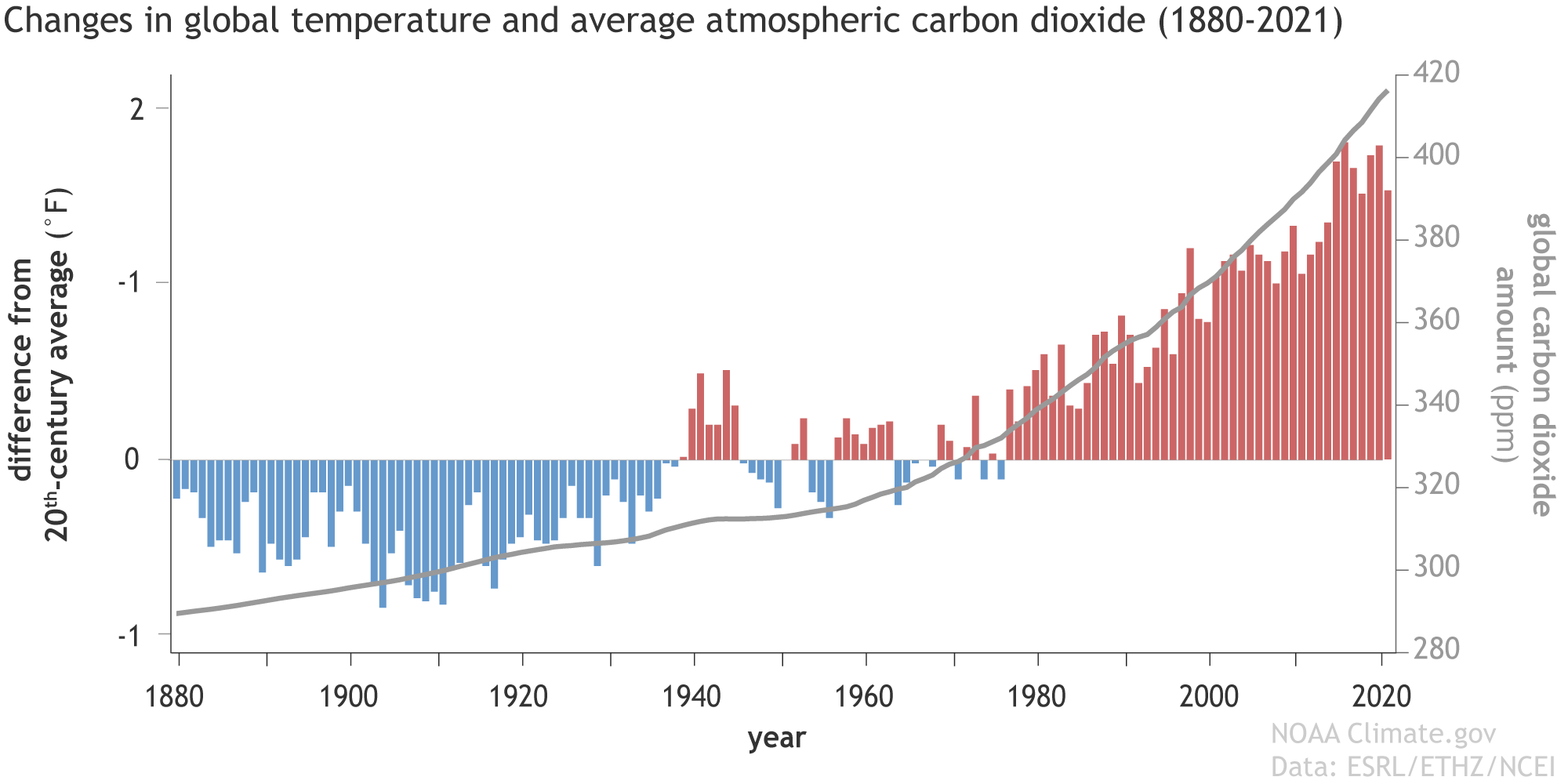
CO2 and temperature track quite well. However, climate sensitivity actually says the relationship is not linear but logarithmic. Doubling CO2 increases temperature by 2-3 degrees.
The thing is, in the last decade or two we have firmly moved into the regime where we are out of the natural variability. If you get a 30 degree summer every five years instead of every ten that might be a very clear signal for warming, but is not as notable. If every summer is 30 degree and sometimes you get 40 you really feel the new climate normal.
It has been rising exponentially.
> However real effects of global warming seems to be felt since, like 10 years old ?
Look up glacier timelapses. More vulnerable ecosystems have visibly reflected climate change for far longer than 10 years now.
Also the ocean and arctic were absorbing the majority of the heat. The arctics been going through these heat waves for 10 years, its white albedo decreasing and potentially permafrost melting making more effective emissions now.
We must act. Stop eating beef. Stop taking trips if possible. Vote for those who care about climate, not bugaboos like immigration. We have real problems like climate, and jump-scare tribal problems like immigrants and foreigners, which are actually good for a nation.
Saying this just having emerged from a heat dome, New England forest is not built for feels like 105F. Many living things in my own backyard are now heavily stressed by climate. We. Must. Act.
Nah we need to stop burning fossil fuels dude.
it rises faster now because we have more co2-emitters today than we did 20 years ago. source: economy has grown. idc if this sounds rude, but honestly you shoulve guessed this
lots of wealthy people are anti-fossil fuel.
> Build a solar farm and it... just produces electricity.
it needs land. It increases the value of land. Wealthy people own lots of land.
The main objections for switching to wind and solar are variability in output and the cost of building all the new stuff.
> Spain could become the energy powerhouse of Europe here. It's one of the most southernmost European countries and has plentiful sunshine.
Fine if you are Spanish. Not so good if you are from the north of Europe or somewhere with less spare land.
> It's worth adding that the privatization era of the 1980s and 1990s was a massive problem. Every utility in Europe should be nationalized. It's easier to subsidize energy shocks when you own the companies that are profiting from them.
I think it would have the opposite effect. Its tempting to sustain the profits when you get them.
I wonder whether the British government would be so keen on moving away from fossil fuels if it still owned BP?
They're really not. Or it's just perfrmative environmentalism. Because they continue to support to politicians and the system that maintains the status quo.
> Fine if you are Spanish.
Please read the whole paragraph. Transmitting power, which is what UHVDC lines are for and something China builds to transmit power thousands of kilometers from the Western half of the country to the Eastern half where everybody lives, exists [1]. Standard transmission lines lose 4-10%/1000km. UHVDC loses 1-3%/1000km.
Europe loves importing electricity. It's the key to greenwashing. Why not build solar where it's most efficient and import that instead?
> I wonder whether the British government would be so keen on moving away from fossil fuels if it still owned BP?
The UK has spent hudnreds of billions of pounds subsidizing electricity that goes straight into the pockets of the shareholders of natural gas companies and private utilities. Is that better?
From that day to today's heat dome, things have changed a lot
The 2050 temp they had predicted was less than the current heat wave
1. Stick to their plan to ban ICE car sales by 2030.
2. Unban on-shore wind power (Labour did this! Not that anyone noticed...)
3. Mandate solar panels and heat pumps for new houses.
4. Mandate bike lanes for new roads (blows my mind that this isn't a policy).
5. Take distribution into account when paying energy suppliers, so we aren't paying for a load of wind power in Scotland that we can't use (I believe this is being considered).
6. Upgrade the grid so we can get power from Scotland (I think this is in progress).
7. Make car charging infrastructure sane. No apps! Fines for broken chargers. More chargers along motorways. Street-side charging.
8. Stop freezing fuel duty.
9. Mandate OpenTherm (or similar) on boilers and thermostats.
10. Create an open, mandatory standard for remote adjustment of power consumption of things like air conditioners, freezers, car chargers and so on, that must be supported and can be used by power companies to optimise grid usage. Some large buildings do this but 99.99% of things that could do it don't.
11. Offer government backed loans for solar power. There are private companies that do it but they're seen as quite sketchy (e.g. if you sell your house...) so uptake is low.
12. Give office employees a right to work from home one day a week where it's possible (similar to how you have a right to change your hours).
13. Ban patio heaters.
14. Ban especially inefficient cars (e.g. less than 20 mpg).
15. Fix the railways... They are working on this tbf.
You might say that rich people and politicians have more responsibility because they have more power for making changes, but politicians are chosen by voters, and wealth doesn't make people more ethical
We can't even have global peace around the world, some people are still starving daily despite the fact that there is plenty of food to feed everybody on the planet, and slavery is still a thing, who's going to do what climate action exactly?
Ignoring heat wave deaths, Hormuz crisis has shown us that oil cam be blockaded but the panels and windmills installed on our rooftops can't be blockaded
Even Cuba is setting up solar plants with the help of China.
Philippines is the highest importer of solar panels since Hormuz was blocked. Rest of South Asia is quickly following
If the west de-industrializes then our enemies will destroy us... Russia's literally invading Europe right now (albeit poorly).
India is doing industrialisation via solar. Massive solar arrays on top of factories and warehouses.
How the heck is installing solar panels to generate green electricity de-industrilaize?!
Also India is building worlds largest solar park of 30GW
I have literally never met this straw man European (and I live here). Heat pumps are going in all over Europe at a rate of knots, and solar adoption rates in southern Europe mean that using those heat pumps to cool down in summer will be basically free
Again, there'll be winners and losers. Some in fortresses; others in famines and droughts. It is, of course, imperative that we do what we can do now to mitigate this. But the continuation of the human species is, I am sure, not in doubt. Our ancestors in prehistoric times have, assuredly, gone through FAR worse, including real population bottlenecks.
That's a myth, but let's assume it isn't. I'm thinking it sounds like a job for you.
Okay, here's what you've gotta do. Buy some titanium slabs. Etch onto them, in simple and decipherable language (there's a technical way to approach this, I can explain later,) the secrets of solar panels, how to refine scrap metal, the basics of modern materials science, and so forth. Include the secrets of nuclear power, germ theory, semiconductors, DNA, important mathematical and physical formulae, and whatever else you feel like they ought to know. Warn them against the once-low-hanging fruit of fossil fuel; tell them that hydrocarbons ought to be used as chemical building blocks, solely.
Bury the slabs in a seismically stable vault, and leave clues to its existence at various geographic landmarks.
That's it, you've saved technological civilization in 50,000AD.
Meanwhile paperstraws, and glued bottle caps, are supposed to save the planet.
20,000 years enough?
I love how the intelligentsia claim without evidence that that per-capita is the important and moral metric when you talk about total emissions, then all of a sudden absolute emissions are the important thing when you point out that western countries are not at the top of the per capita lists either!
There are others.
That's indeed a lot more extreme in a shorter amount of time, at least regionally. Feel like I should have known that! Thanks
The most dramatic story about that is what happened to the settling of Greenland (more than once). Basically during a cold spell the city was gradually abandoned, with sometimes the last few people literally freezing to death when their fuel ran out.
Even the people that have brains are ostensibly do care about climate change... when push comes to shove and you try to increase petrol prices to the level that represents their true cost, or try to erect a wind turbine near them... They'll say "erm actually never mind".
Actually it doesn't even need to be a wind turbine. There are many PV solar projects in the UK that get attacked by NIMBYs. Literally just solar panels in fields. The most low impact construction ever.
How could people possibly object to that, you ask? There are a variety of bullshit reasons they come up with e.g.
1. Extra lorry traffic during construction (a one-time minor inconvenience).
2. The applicants hadn't done a survey on how putting poles in the ground in the middle of a field might affect the habitats of newts, or some bollocks like that.
3. There's too much solar power already. I shit you not.
Probably quite a few thanks to globalist politicians among all major political parties to offshore production to countries with fewer regulations and much higher emissions intensity of production. But it would not be the highest emissions per capita.
Much the same as the EU.
The handwringing and self-flagellation still does not suffice for actual evidence for blaming one idiot politician in one country performing a political stunt. You clowns think this is a Captain Planet cartoon where there's a few evil moustache twirling dudes setting out to wreck the environment and you just need to defeat them and everyone around the world joins hands and its smooth sailing for the rest of eternity. You must be forever bewildered about the state of the world and shocked at the news of completely normal and foreseeable things happening, like energy being very valuable, and people wanting to buy things cheaply. I can assure you if Mr. Snowball here had never been born, there would be absolutely no difference to the current situation. If the North American landmass did not exist at all, fossil fuel use would still be causing the same kind of global carbon pollution.
> The USA was far and away the very worst global source for a very long time, that only changed by offshoring the processing and manufacture that feeds US consumption.
Petrostates have been much worse by emissions per capita.
So you're saying climate change is real, but the liberals/globalists/experts betrayed us by doing nothing useful?
Way more died during the heat wave in France in 2003. What did France do? Nothing substantial, because nobody is willing to bear the cost of substantial policies to fight climate change.
When China India and now Phillipines and rest of South Asia is installing record number of solar and wind
There are a lot of wealthy people spending serious money on lobbying against fossil fuels:
https://spectator.com/article/revealed-the-shady-funding-of-...
> Europe loves importing electricity. It's the key to greenwashing
Yes, its also a potential problem transmitting .
> The UK has spent hudnreds of billions of pounds subsidizing electricity that goes straight into the pockets of the shareholders of natural gas companies and private utilities.
It has spent a lot of money subsidising wind power. The UK has hugely cut its CO2 emissions. https://ourworldindata.org/profile/co2/united-kingdom
According to one study, the UK's investments in wind power have saved consumers 100 billion pounds since 2010 [1] all while spending 16-20 billion pounds a year on subsiizing natural gas [2] plus more on an emergency energy bill in 2020-2022.
[1]: https://www.ucl.ac.uk/news/2025/oct/analysis-wind-power-has-...
[2]: https://www.globaljustice.org.uk/news/uk-government-subsidis...
The other one is a campaign group who say there are subsidies but fail to name a single specific one.
Insulting people who come up with facts that do not suit your case does not prove anything, and there are guidelines on HN about personal attacks and assuming bad faith. Saying "Spectator bad" does not disprove anything it says either. Believing publications that take a line you agree with and disbelieving those that disagree with you is not a great way of learning facts.
Nobody is steering the ship. It's just drifting aimlessly in random self-perpetuating cycles. That's because financial markets are steering the ship but they don have any brains. If we put humans in charge of the ship again, we might be able to actually steer it and then we could steer it away from the iceberg that is climate change before we hit that iceberg.
Both are also increasing coal usage.
Total and cumulative numbers are all that matter for global warming.
https://ourworldindata.org/fossil-fuels
https://ourworldindata.org/grapher/coal-production-by-countr...
I am a bit lost though: the first global graphic shows a depressing increase of fossil fuel consumption, but the detailed graphics after either show a stagnation or a decrease (must be centered on electricity generation I guess).
The global picture seems very positive, reaching a plateau is a great achievement! Let's meet in 2026 to hopefully confirm this trend
You must choose if your hedonism outweighs the good of our biosphere now and in future. The billions of unborn humans. The trillions of innocent life forms that might go extinct. That blue bird or cardinal in the yard with no AC. The coral reefs decimated. The poor humans suffering tremendously. We have a choice to slightly reduce these things.
Most people choose hedonism.
The time to take that particular action was 20 or 30 years ago. We're not in a position to do a damn thing about next year's heat waves, or the year after that...
What we're talking about now is taking actions that may prevent much larger heat waves 20 years from now
I walk this walk, bud, but at the same time, whatever I do is completely irrelevant if we don't get off our collective asses and force the governments and corporations to do their part.
No. There is no such thing as "normal" climate. It's ever changing. We're just making the change a whole lot faster.
Imagine a line chart. It displays average global temperature over millions of years. It goes up a little, it goes down a little, it fluctuates over time. That's the natural change. It occurs over thousands and millions of years.
Looking at the last few decades on that chart, you'll see a wall. It's going almost straight up compared to the rest that just meanders lazily. You can see a few other similar peaks on the chart many millions of years in the past, they generally correspond with things like apocalyptic meteorite impacts etc. And even then the change occurs much more slowly than what we're seeing now.
It's honestly insane to me that we're watching the world end and half of people are like "but are we sure this isn't normal?"
Yes we're sure. We double checked. Just look at any "global average temperature" chart and try to predict where it's going. This isn't the stock market it won't just randomly start doing something else. The movement we're seeing is directly correlated to our ghg emissions, and there's a lag - the effects of current emissions won't be fully seen until up to two decades from now. So even if we stopped right now it would continue warming for decades.
Warming also releases more GHGs. As poles and permafrost thaws, enormous amounts of methane are released that was previously trapped, further accelerating warming and acting as a positive feedback loop on top of our steadily rising emissions.
In short were fucked, we know it, and anyone who doesn't know is not paying attention.
Obviously consuming even more should never be the solution to problems caused by overconsumption. We should be figuring out ways to keep electricity use in check rather than consuming more and more, but that's a fact that people would rather not accept.
Source? Where I live (NL) the electricity prices are very low on the days/times you’d need AC because of all the solar power generated then. I think you gotta back up your claim that 50% of electricity consumed by ACs comes from burning carbon. It strikes me as very counterintuitive (or dated)
What I find most amusing is people somehow think climate change will end humanity faster than what's _actually_ on track to do so, and quickly: people having children well below replacement levels.
You do realise that the global population is still increasing? While birthrates are falling, we aren't even predicted to hit the peak for another half-century. Even pessimistic estimates put it in the 2200s before we fall back to current population levels.
Which is ~100 years longer than current estimates give us before the effects of climate change starts taking a bite out of the world population
As I recall there was a UN survey that found financial security was the most common reason for adults across the globe to choose not having children.
Income levels are highly dependent on the degree of stability and monthly expenses that households can expect.
BTW both of these have been predicted since the 80s.
https://www.livescience.com/63334-coal-affecting-climate-cen...
Have you read this before? Great read.
I am not convinced nuclear war or biological warfare are as unlikely as you think. We have historically had narrow escapes from nuclear war.
It seems deliberately obtuse to try and deny there are significant energy (and thus natural gas) subsidies in the UK. Ok, try the Office of Budget Responsibility [1]:
> By the time of our November 2022 forecast, the Government announced a series of additional measures to support households and business, which increased our forecast of the total cost of energy support in 2022-23 to £67.1 billion (2.7 per cent of GDP).
> Insulting people who come up with facts
So you're not right wing? Cry-bullying about "personal attacks" for using an accurate political label correctly isn't helping your defense.
Pushing a conspiracy theory that a cabal of dark money is pushign renewable power and using The Spectator as a source is the UK equivalent of quoting Sean Hannity.
[1]: https://obr.uk/box/the-cost-of-the-governments-energy-suppor...
In any case, I don't share your low opinion of future humans. They'll be as capable as we are; maybe far more capable.
You also over-estimate and over-weight how destructive nuclear exchanges really are, the readiness state of the world's nuclear arsenals, and the willingness of their possessors to lash out at effectively unaligned countries like Argentina, Chile, Austria, Morocco, Fiji, and I could go on all day.
I don't think you understand the massive difference in scale between detonating a couple of atom bombs vs. thousands of thermonuclear devices, each with at least an order of magnitude (~16 kt vs hundreds) more destructive power. Nevermind the vast fallout dispersal that would blanket the northern hemisphere at least, as well as the ridiculous amounts of soot in the atmosphere from the resulting firestorms that would, to put it mildly, be a bit of a setback for agricultural yields for a damn long time. You might be okay in those unaligned places, sure, bit if you're in roughly half of the world you're pretty much effed.
We are individually responsible for our actions. Nothing more.
We are collectively responsible for the outcome.
In order to just offset our current emissions, we would need around a million carbon capture facilities equivalent to the largest one we currently have. For comparison, the number of power plants in the entire world is a few tens of thousands. So we'd need maybe like 50 times as many capture plants as we currently have power plants.
Like it's not even in the neighbourhood of realistic, it's just completely infeasible and I am sure engineers know that. You basically need to suck the whole atmosphere through facilities, and there's a lot of atmosphere.
I do agree that it's unlikely that we can ignore reduction and just depend on purely scaling capture, especially if we care about avoiding more negative climate effects as the scaling goes on. But to say it is "completely infeasible" is not accurate.
Maybe I'm wrong, I'm certainly not an expert. It just seems like a hopeless case to me. Even if they make one significantly more effective than this Stratos you mentioned, we're still talking about tens of thousands of them to have a real impact.
During the covid start lockdowns when everyone was forced to WFH and nobody was driving to work for a couple of weeks, we saw a massive decrease in CO2 and emissions. So it can be reversed, we just don't want to because we gotta keep the GDP hamster wheel moving
Outside of "great replacement" types who are worried about the continued supply of purebred aryans, I'm not really sure why anyone would be concerned by this
That is what stood out to me as well, but I could be doing them a disservice.
Society won't collapse. Humans will do amazingly evil things to survive. The British were happy to starved millions of Indians to death until the country gained independence. All to support the British empire. We live in an era of basically unprecedented niceness in the history of humanity. Even the great empires of the past oppressed and killed multitudes more through slavery or serfdom or constant expansionist wars or other such means.
> refurbishment of houses
Perfect work for refugees to do at gun point.
Billions may die but society will go on with a somewhat lower regard for life and a larger amount of nationalism. Arguably what we consider western society will collapse but that's only existed for under a century.
In some ways that is more depressing than society simply collapsing. We will leave behind a rotting zombified corpse of our society to future generations.
It is easy to write provocative things when we do not let ourselves bear the weight of their implication. This is horror being outlined.
In earnest conversation, these are sombre and sobering implications, not frivolous or minor things.
This is a sea of humans, extending from one end of the horizon to the other, hungry, lost, frightened, confused, sad and angry. It is the loss of culture, history and fascinating things that one cherishes.
> In some ways that is more depressing than society simply collapsing.
The inability to discuss a horror in realistic terms is how you get a horror. Not exaggerated "society will collapse" but actually tangible realistic and terrible outcomes. Society collapsing is an abstract and nebulous thing. The thing we will get is much worse and unless we look it in the face we will get it.
You already said these are massive geographic issues.
Yet these different, large, geographic problems are of a size that doesn’t end up having even a remote effect on human civilization?
How? Is there some geography which is not impacted at all? A geography where a massive portion of human civilization is situated?
This is what worries me.
At some point more northern facing countries will decide enough is enough and start mass genocide of any population attempting to flee.
Europe will be ok with just killing a few hundred million trying to flee in boats, and the eastern frontier is securable, especially with drones, but even with conscripts. Hell Ukraine has done a solid job on its own against an organised army on its doorstep.
America will act as a buffer for Canada and will have no problem with wiping out refugees. Argentina will be interesting but it's too small and isolated to matter globally.
The big global risk is that India and Pakistan have nukes and will be trying to flee into China and central Asia.
Setting aside refugees, far bigger risk for Europe isn't reurbishment of housing, it's tropical diseases in the south, it's the collapse of food security, and the general collapse of society as the economy falls over.
I find it very difficult to maintain an even tone and address statements that posit climate change positive effects on society.
There are so many incredibly bad things about climate change it boggles the mind.
I try and believe people are burying their heads in the sand to avoid the pain of reckoning with the end of everything they hold dear. This ends up with punches being pulled.
How's Valve Software doing?
I think that markets are not the problem, instead the problem is that pollution is free, companies and governments can pollute or Earth without paying externalities.
Blaming markets is completely missing the mark.
So: you have two nuclear powers who are both relying on the same diminishing resource to feed their people. Do you not see how that could cause....tension?
I am not just some random internet person making this up. A lot has been written about this subject by respected researchers:
- https://www2.acom.ucar.edu/news/waccm-model-simulates-global...
- https://news.climate.columbia.edu/2020/03/16/even-limited-in...
- https://www.newscientist.com/article/2529589-a-nuclear-war-b...
- https://nsarchive.gwu.edu/briefing-book/india-and-pakistan-i...
After that it's 'over' no? The world map is redrawn (many countries' shapes will look different), people that needed to move have moved or got killed (quite possibly by territorial humans refusing to let them onto livable land), but it'll settle into a new normal eventually
You wouldn't know it based on how everyone talks about Russia pulling the strings of just about every election (and being a moment away from conquering Europe while simultaneously being too incompetent to beat Ukraine).
TBF, I don't think anyone has seriously espoused this fear since the war in Ukraine bogged down. It's become very clear that NATO folks overestimated Russia's conventional military capability - and along with the Russians, underestimated how rapidly drone warfare was evolving.
The cold-war era risk still facing us is more that one of the unhinged megalomaniacs currently in power in Moscow/Washington decides to press the big red button and end it all
Messing with elections by fooling the most volatile and eager to be fooled is not a genius move.
Answering to nitpicking and word plays is just fun along the way.