Connections in Math: the two kinds of random(stillthinking.net) |
Connections in Math: the two kinds of random(stillthinking.net) |
Seriously. There isn't. You might say 'but measure the number of 1's vs 0's' and i'll just reply with '101010101010 repeated'. So you up it and start saying ok maybe measure frequencies of pairwise bits then and i just reply by cycling 00,01,10,11 endlessly etc. Frequency counts and any other measure you can think of doesn't actually work.
The root definition will state it's just based on the properties of the prediction but... what model do you use for the prediction? This gets to the heart of the matter;
The measure of information entropy itself is actually equivalent to creating on omniscient oracle. It requires being able to ask the question "Oh great oracle, what's the shortest program that can reproduce X"? or equivalently "What's the probability of this data assuming i always have the most perfect model to predict it?". You then calculate entropy based on that oracles answer.
Kolmorogorov, AI and information entropy are all pointing to the same thing. The reason people get confused by the fact that the frequencies of base 10 digits is the same for digits of pi and a truly random sequence is just because the counts of base 10 digits isn't a measure of entropy at all. Measuring entropy literally requires an omniscient oracle.
Both your comment and the OP seem to conflate a distribution with a sample from a distribution.
A distribution over strings has entropy. A single string can have a Kolmogorov complex but does not have entropy in the Shannon sense per se.
When you write a compression algorithm, you are often effectively building an algorithm to look at a single sample from an unknown distribution (the input data) and trying to invent a distribution that is both easy to describe and that produces the input data with respectably large probability. And then you output the description of the distribution and enough data to identify the sample in question, and the latter takes space that is roughly the entropy of the distribution you just made up.
> "What's the probability of this data assuming i always have the most perfect model to predict it?". You then calculate entropy based on that oracles answer.
Careful here. The most perfect model may be the one that outputs the data in question with probability one, and the entropy is exactly zero.
If you want information theory to give you meaningful answers, you need to ask it more carefully specified questions.
You have to limit yourself to each string being independent for that to be true which is a limitation that leads to the impossibility of calculating entropy generically.
The real blind spot is that entropy is meaningless for a specific sequence, you can't really ask about the entropy of pi if you don't have a theory for how the numbers are generated. Sure if it is pick a uniformly random real number between 0 and 10 then both files have equivalent entropy, but sending pi is also vanishingly unlikely.
There's actually a more subtle way in which this is a blind spot, which takes a bit more machinery. You can define entropy for an ergodic system, which could be considered a kind of mathematical RNG. Now as it turns out this provides a way to generate something almost equivalent to a particular distribution except that this argument only holds for most starting points not all. A direct example would be how pi generates a perfectly fine random distribution of digits (we think) but something like 1/3 does not.
You'll probably also want to look at uniquely ergodic systems. Those are interesting in the way that they behave 'random' for every input, one example is if you keep multiplying a number by anything other than a power of 10 and divide it by a power of 10 so it's between 0 and 1. Turns out you get the same distribution of results every time (eventually).
And while you can define an entropy rate without I think ergodic theory also helps inform why that is the correct generalisation. Your current article only considers the case where each digit is independently random (it's clear why, it's a lot simpler and all that information theory tends to talk about).
It's a bit like how benchmarks of compression utilities should always include the size of the utility itself. Otherwise someone can just submit a program with a dictionary of 256 common benchmark files for compression and claim "it compresses them to a single byte" :)
> So you can never close the case on even one candidate, let alone all of them at once, which means the lower bound stays sealed.
Which is simply not true. The specifics depends on what language you use, but let's take Turing machines as an example. Many candidates are easily disproven: ones that halt immediately, ones that have no rule for writing a "1", ones that have no rule for halting and so on. It's impossible to write a program that can handle every possible candidate though.
And if your string is short enough, let's say the string you are investigating is "0011" then you CAN sit down and check all Turing machines of size 4 and lower. This is essentially what the https://bbchallenge.org/ project did.
For Turing machines we have determined if they halt or not for all machines up to 5 states. It is very computationally hard to push this limit further, but we don't know where the theoretical limit is. We have some large upper bound where a Turing machine computes something that we know is independent of ZFC (see Scott Aaronson for more details), but many suspect that the limit is way lower.
I see that the irrational pi has a smooth distribution of digits and a file full of zeroes is compressible, but they are both sort of magically part of a world that does not run programs and thus not quite different in a practical sense.
Just my thoughts and sorry for the confusion.
Edit my presumption is an open question ;) I misremembered.
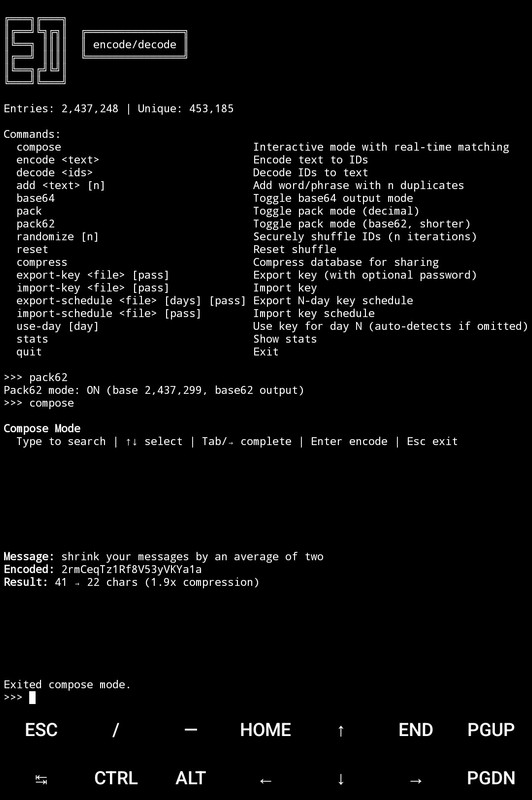
I tried to make a codebook of everything. You can get surprisingly good compression by assigning words and phrases to numbers.
My particular attempt had phrases up to 12 words.
No grammar or anything...to test the program, when I had a random thought, I tested to see if I could encode that thought. I could and on average the thought/message was compressed by 2. There was very few times where I wasent able to encode the idea into the available building blocks or language model of the database.
Apparently, the disclaimer was "put as a joke". Must be an eclectic sense of humor.
See https://forwardscattering.org/page/Kolmogorov%20complexity
And no, the invariance theorem doesn't save you.
A random variable is a random variable and is not the same thing as a stochastic process. You now seem to be talking about stochastic processes, which are a different thing.
A stochastic process can have an entropy rate:
https://en.wikipedia.org/wiki/Entropy_rate
If you want to calculate entropy "generically" without defining what kind of entropy you're talking about, I think you are not likely to succeed.
- Walters, P., An Introduction to Ergodic Theory, Graduate Texts in Mathematics, 79. Springer-Verlag, New York-Berlin, 1982
- Billingsley, P. – Ergodic Theory and Information, John Wiley and Sons, 1965.
You may need a refresher on measure theory, or just ignore that part I suppose