Chinese chipmaker shares surge 470%(bbc.com) |
Chinese chipmaker shares surge 470%(bbc.com) |
Of course CXMT, Micron, and family will still be profitable, but maybe not 'surge 470% from IPO' profitable.
If we are talking about all knowledge, then I agree that the compression ratio is very impressive already.
See Karpathy's "Cognitive Core" idea. (I don't have a good link)
There must be a limit, I agree, but there have been no signs of approaching it yet. The most recent cohort of small models have shown the biggest leap in capability so far.
Standard Def TV was plenty for 50 years. But when more was on offer, everyone went for it, and now you can't even buy a 480p TV.
LLMs haven’t been on the scene for very long. There’s still lots of room for efficiency discoveries. Plus, I keep hearing quantum is going to be a big deal in the next few years.
Some groups are baking models into silicone, Deepmind has an example, it gets 18,000 tokens/sec on Llama 3.1, not sure about parameter size
Sure, it might be very near using the current approach, but... it might also be might be very far off because we are using the wrong approach.
I mean, look at the max amount of intelligence you can get out of a human brain powered by two bananas...
Maybe? Human science history is absolutely littered with examples of things that were “constrained” by a fundamental law … until they weren’t, because we’d misunderstood or misapplied the law.
Dogs are very smart!
It's like people saying mobile chips are going to be better than PC chips... until they realize PC can be made of mobile chips too if that comes true.
This used to be true for the first several decades of microprocessors, and stopped being true in the early 2000s.
Their posterior. Or worse, their interest in going to the moon (HODL style, not Artemis style).
-HBM has a lot of room to grow(bandwidth/power/density). And an HBM memory takes 3x the amount of wafers of regular DRAM.
-HBM + better DRAM designs could increase random memory access speed by alot. I've seen research talking about 7x.
At what point it makes sense that half of consumer GPUs and most of the server GPU/CPUs start using HBM?
Also, you will be able to play with much more competent models locally. They will still feel like children compared to the adults living in the SoTA region.
Indeed it seems quite possible we are one architecture breakthrough away from existing chip stock driving us all the way to ASI.
Nobody has done AFAIK the information theory to prove it’s not possible.
Hyperscalers are screwed, data center mania couldn’t even be completed during this massive spending spree, all while the people seemingly sitting on the sidelines are working on getting these things baked into the OS and chipsets in a way consumers wouldn’t notice
i mean, it shouldn't be scary, because their failure is their own, and i doubt there would be collateral damage outside of those high risk investors.
It's scary for _them_, but it's an interesting case study for an outsider.
I lived through the crash of 1989, the Dot Com crash in 2000, the GFC of 2008, and whatever the crash and WSB speculation in 2020 were called. None of them had a tiny blast radius like you suggest.
To use an example, the Great Depression wasn't sunshine and roses even for the people who kept all their money under the mattress. Their job was just as likely to go out of business.
Right now, the US leads China in compute-heavy R&D because the US has access to more compute, and that compute has two components that China has limited ability to produce domestically: the GPUs themselves and the DRAM. A decent fraction of the balance of the plant is already produced in China.
If the US refuses to buy Chinese tech, then we may find ourselves paying more for compute than Chinese labs (DRAM first, but Huawei really really wants to catch up with the combined forces of TSMC, Nvidia and AMD) and falling behind on access to compute at acceptable prices.
If I were setting US policy, I would be trying to get the US-friendly companies to increase production and trying to encourage domestic production so that the US-friendly world can stay ahead. Getting held back by a DRAM cartel that wants to juice profits at the expense of output is not good for the US.
That's what the CHIPS Act was supposed to do, but it got neutered for partisan political reasons. The CHIP Act was already about a decade too late. US policy is inconsistent across administrations, and the beneficial moves usually made very late in the game, around the time second- and third-order effects of the bad decisions become unbearable.
No way he's letting Chinese chips in.
Is this accurate? It looks like they are no longer rising, at least for DDR5 memory:
https://de.pcpartpicker.com/trends/price/memory/
Most of the price increase did occur in Q4 2025 and most prices are fairly stable since then. Maybe this is different for LPDDR, GDDR, or HBM, but I would like to see evidence for that.
how much more do they need to ship to satisfy you?
On top of this, once European giants like NXP (formerly Philips semiconductors), Infineon (formerly Siemens semiconductors), and ST are actively reducing their footprint in Europe and moving to India or SE Asia.
In short: No, EU has no future in those markets as designer or producer of chips.
You can see it a lot in AI, right now. AI4industry is not where the gains are right now. We should be competing on training foundational models. Once the foundational models from US/China are strong enough, they will do AI4industry and we wouldn't have any edge on them anyway because their tech is more vertically integrated and they have better insight in how AI works under the hood.
Edit: changed China with Asia to distance the comment from Taiwan-China based politics.
And you know.. the actual design for plenty of these chips. By that definition Apple is also an Asian company..
> with EU tooling
That is only a (vital) part of the supply chain, there are plenty of other components.
Did you mean Taiwan? Because depending on who you ask that is, or is not china.
The Chinese have been cut off from EU tooling for a while now. And their attempts to build out their own lithography setups have been a failure. Their 7nm process is, by all measures, not delivering the yields that one would need to make it really successful.
Difference between Europe and the others is that it doesn't brag nearly as much.
I don’t think the goal there was to sit around praising past accomplishments. You always have to keep building.
In relative terms there is no innovation happening outside of that and some other smaller companies providing highly specialized components that are a part of the supply chain.
There isn’t just much if anything to brag about. ASML is great but it’s effectively a monopoly (for the time being) due to a large extent some correct historical choices.
Aren't they the only ones able to supply the chip-making machines?
It’s a bit like Novo Nordisk, they had a huge win and then just focused on making as much money while it lasted while more innovative companies ate up their market.
So others did spend energy on becoming better and now you see a different picture when you look at the world.
Chinese structural advantages: monetary policy, lower cost of living, better infrastructure (electrical and transportation are all new within the last 20 years), lower cost of {concrete, factory machinery, metals, electrical} due to economies of scale.
Chinese EV manufacturers advantages: they don't sell ICE cars, so they don't have any legacy customers, factories to retool, or brand migration issues. And they mostly stole their technology from hiring Tesla factory workers to moonlight for them and share the design, technology, tooling, and RE the Tesla finished product.
Major Western legacy car company disadvantages: Ford, Toyota, Volkswagen, etc... all have significant reasons why they can't or won't make the super risky attempt to go all-EV. They all have $10s of billions in debt they are still paying off for their current capital improvements. Those debts assume they contribute selling ICE because EVs last longer so they would sell fewer units per year. It's simply less risk to avoid making any EVs and pay politicians to protect their businesses than to try to compete with 10 year old Chinese phone-companies-turned-EV companies. On top of that, the worldwide demand for EVs is only about the volume of the single most popular model of Toyota. They would have to go into massive debt on a giant risk that consumers will want more EVs (and that the EVs they design/build will sell better than the current ICE cars they have meticulously crafted for 50-100 years).
Did they successfully steal Tesla's low-cost EV plans too? Using the traditional definition of "steal" (depriving the owner of their property.) The argument that all China is good for is stealing falls apart[1] the second Chinese products become superior (see battery chemistry).
Perhaps Tesla should pay Chinese EV designers and PMs to moonlight for them to shorten their model development cycles.
Domestic Chinese EV competition is fierce, if one can survive or thrive in that boiler, dealing with VW, Ford, or even Tesla is a cake-walk.
1. Nevermind the growing body of fundamental research papers published. An area the US is turning it's back on because some people are gassing themselves up on they idea they are intrinsically, and immutably great/superior, therefore there is no cost to wrecking stuff to "own the libs"
This is core reason why the German industry became so irrelevant in the last 2 decades: The rail infrastructure became pseudo privatized and now is in shambles (IIRC only about 60% of trains arrive on time). The PV industry was axed by the conservatives about 15 years ago and now is completely dominated by China. Even now, as the other EU countries demand strategic investments - and again the German conservatives say this ought to happen without any new debt. "We can only spend what we have", to quote Merz. Imagine China saying this about chip production, or even Sam Altman about compute hardware...
The problem is, shareholders have bled Western companies dry in the chase for returns on investments. There is no money left in the companies to retool them to be competitive with China.
Meanwhile, the CCP just pours dollars into their companies.
Unfortunately, there is no punishment in Western societies if you run a company into the ground as long as you pay your debts on the way out.
UK has been trying to get approvals for a new runway at Heathrow airport for over 20 years !!! now.
In China they already make integrated circuits with a finer pitch than at TSMC or Intel before the transition to EUV.
This is achieved by multiple exposures, which increase the fabrication cost, but with the current prices they still have very healthy profits.
The long-term idea that the we have to compete claim is based on is like AGI and it's gonna really care what Elon tells it to do. This is a dumb idea regardless of how it fails.
AI models are seeming the ultimate in fungible commodities at this point, why spend on R&D?
CXMT is making truly impressive inroads on what is currently a very Large addressable market using DUV.
While some other groups are baking silicone into models :)
but yes misplaced e
The question then is, how much memorization is really needed for intelligence if you can query structured information?
There were rumours about China grabbing hold of one of ASML's machines, but with no additional information on this it's safe to assume they're still hammering out 7nm chips using DUV at piss poor yields.
Hopefully, future models can be trained to be even more aware of external knowledge, accessible through web search / RAG / whatever it will be then, and might not need to internalize much knowledge at all.
Then you need longer contexts, which is proving to a much more stubborn problem than general knowledge compression.
But what about SpaceX, Blue Origin... there are also counter examples that show it is possible for investors to wait out the big profits.
What's the point of this? Honestly?
This memory stock popping on IPO has nothing to do with how well/bad capitalism provides in the USA. This is entirely about Chinese investors speculating on this company's ability to grow and undercut some Samsung, SK Hynix, Micron. Nobody knows on IPO day if a company will grow into the expectations of the investors.
And China's population mostly invested in Evergrande real estate, not stocks. Lots of workers in the US are at least invested in the stock market via their 401k/IRA, but the same isn't true of Chinese workers.
Also worth reiterating that most US stocks aren't doing great. The top 10 by market cap keep dragging the indexes into growth, but success is heavily biased towards the monster caps.
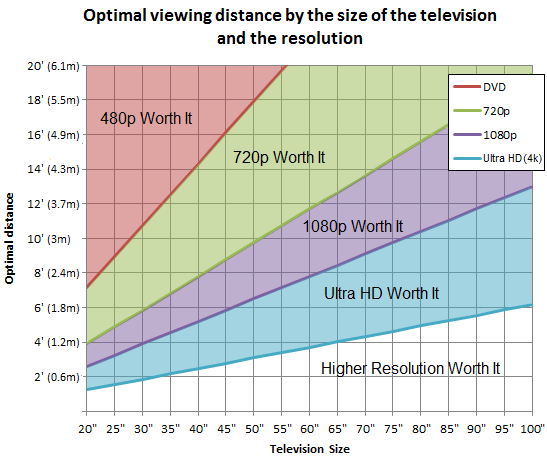
2K, 4K, and 8K+ TVs have been around forever, and although 4K has become the norm, it's widely accepted that there isn't much benefit for most people above 1080p
The 1080p thing is true in the age of 40” TVs but not so much now, think Costco has a 95” TV if not 100”.
Personally I think 4k (with HDR) is good enough for consumer use, so agree with the parent theoretically just not quantitatively.
It did take around 20 years from DVD to 4k Bluray though.
Is it? By whom? For larger TVs, closer distance, or a combination of the two, there absolutely is value from 4k. https://i.rtings.com/images/optimal-viewing-distance-televis...
Though I'm unlikely to ever upgrade from 1440p on my computer, personally.
And when (not if) we get to the 4k (or 8k) equivalent of LLMs, they'll just be baked into hardware and we'll have near instant responses while running locally.
There is no future where OpenAI, Anthropic, etc survive with their current business model; at some point we will hit a point where training a new model is done only every 5 years or so, and in that scenario we aren't going to be running models of pricey server GPUs with latencies measured in seconds and full responses measured in minutes.
We'll be running locally with sub-millisecond latencies and responses measured in milliseconds. There is no way for any big company to compete with the current business plan of selling inference or subscriptions.
In a way it is actually the same thing that makes us accept AI as working in the first place. It only needs to be good enough for human perception. The same is probably true for compute.
Plus there is a chance the actual scaling that matters is beyond our reach. Think instead of TB models, PB or ZB models. We don't even have that kind of information. Humanity in its entire history hasn't generated 1ZB of information.
On a task that corresponds to the benchmarks, yes absolutely.
And yet when we hit 4k, that's were people just stopped buying higher res. 8K is still useful, but only when the screen is so large that it doesn't fit in the room :-/
The very definition of diminishing returns.