Asus Bike Booster(asus.com) |
Asus Bike Booster(asus.com) |
[0]: https://www.digitaltrends.com/outdoors/asus-made-an-e-bike-c...
https://www.tcmit.org/english/research/car/car01
This is the last century version of the item that Asus is presenting here... but with a Gasoline engine.
The Engine is fixed on its own wheel and attached on the side of the bicycle.
This was apparently was a thing. It was used to motorize Japan at its industrialization debut.
On century later, electrification is now a thing and the same device is back with a battery. The loop is done.
PS: I do recommend the museum for anybody interested in industries and industrial processes.
*“VéloSoleX is a moped, or motorised bicycle, usually just referred to as 'Solex', […] originally created during World War II and mass-produced between 1946 and 1988, came in various iterations, while keeping the same concept of a motor with a roller resting on the front wheel of a bicycle”*
This powers the back wheel, though. I think that’s better for propulsion but it seems you’re giving up carrying stuff or a child on the back of the bicycle. Can’t even have a rack there with this contraption.
https://www.frandroid.com/marques/asus/3158393_meme-asus-se-...
* cadence sensor, looks like an optical sensor that has wireless connection to the main unit and/or app * app to adjust the mode * USB-C PD 100W - (improvement would be to allow for 2 inputs, charge at twice the speed, like new Anker Prime power bank) * removable/swappable batteries, love this * built in brake light, very nice
Does anyone know if that’s true and if that applies to conversions like this one?
Also that’s going to be more applicable with a mid drive or a hub motor than something like this.
3.7 kg (including battery)
This product takes advantage of advancements in lithium-ion battery technology driven by phones and cars, benefiting from improvements in both performance and cost at scale without requiring extensive additional research. Looking forward to trying it.
(I'm in the US and have been unimpressed with the kits available here. The Boost one looks compact and well designed).
https://wiki.lowtechlab.org/wiki/V%C3%A9lo_%C3%A0_assistance...
But less facetiously: there are large demographics that might ride bicycles more if it was slightly easier for them, including older people and people with mobility issues. I don’t have opinions particular to this product, but expanding the feasibility of cycling seems like a generally good thing to me.
there was another company named "bee" something that did these (gas as well 2 stroke)
and many early scooters, conversions, that all followed the friction style
I agree that rim brakes on an e-bike is extra bad.
About 5% more weight you need to slow down (80kg rider + 10kg bike + 4kg motor + battery)
- they have functional pedals (otherwise it's a motorcycle of some kind)
- they require pedal assist at all times and have some kind of power or speed limitation (anyone can use this, or at least it is least restricted)
- they have pedal assist available and have a different, higher power or speed limitation (usually reserved for 16+ or something similar)
- they have a power or speed limitation that makes them suitable for adults only but doesn't require a driver's license or inspection
There are efforts to regularize these, and also efforts to make things more chaotic. For example, New Jersey decided that all ebikes require a new ebike license and vehicle registration. Across the river in New York, no ebikes require a license or registration, and may be operated on any street which has a 30mph speed limit or less... but cities are allowed to make their own rules.
California's laws are mostly regarded by bicyclists as being sensible, at least in every discussion I've seen that didn't feature a twelve year old trying to convince his parents to buy him a 70mph electric motorcycle. See https://thecyclistchoice.com/resources/california-ebike-laws...
recent news: https://www.bbc.com/news/articles/c89nyk4pz74o
my costco has magnum melody
"Physical activity gains from active travel are similar in e-bikers and cyclists."
E-bikes make people who aren't fit enough to ride muscle powered bikes to start doing moderate exercise on local trips they would used cars for before.
Signed, former Cat 2 road racer
I suspect not. Even though ebikes are common now, I often hear this comment. Ebikes assist your pedaling; they don't pedal for you. (Well some can pedal for you but you learn quickly that if you let the motor do all the work you'll run the battery down and then you will have to do all the work pedaling a 65-lb bicycle home.)
Lots of people seem to think if a motor is present, then the motor is doing all the work. Ebikes are not motorcycles. What the motor actually does is make the hills less steep and less long. It's a lowpass filter for terrain.
Sure if you assume that someone switches from conventional bike to e-bikes and continues to only travel A to B like before, yes it's a net loss in exercise.
In the study however, they found lots of people substituted driving or public transport with e-bikes, which is a net gain from the reference point.
Even for people who had conventional bikes, getting a e-bikes meant travelling with e-bike more often and longer distances than with a conventional bike.
Which made it seem neat and clean, but meant it had serious reliability issues, couldn't handle wet conditions[], wasn't really repairable, and was expensive compared to more reliable alternatives with better battery life, etc.
[] The manufacturer apparently stated that "[...bad bearings] can occur when the Wheel is repeatedly exposed to wet conditions. Due to the nature of the problem, this cannot be repaired": https://forums.electricbikereview.com/threads/known-issues-p...
Hub gears work quite well though don't they? In particular respect of being sealed and protected from the weather. Unclear why there's an opposite effect for this wheel.
People who don’t bicycle in North America won’t quite get it. It’s not exactly Taiwan. Theft is rampant and it’s societally sanctioned in most major cities.
The cycling guys won't buy it, they want the watts from their legs.
The commuters will just get an ebike eventually.
The getting started crowd will eventually become one of these 2 or stop riding a bike altogether. Since I didn't see how much this cost, if it cost as much as a commuter bike, I really don't know who would buy something like this.
This sounds like LLM-generated to me, but I find it difficult to point out why.
Seems like normal text to me, I don't think we need to scrutinize every sentence, now. Who cares if they used AI?
just replace the front wheel
I did that 20 years ago with a brushed motor and wow that thing had torque, could go up the steepest hills at speed no matter what I was carrying
The problem here is this device can be easily removed even from a locked bike, and it itself cannot be easily locked to the bike.
Come on, ASUS. You're a real company, not some kickstarter scam.
Me: when's the bike booster available to purchase?
ASUS AI: For the most accurate and up-to-date product release information, we recommend following our Facebook and Instagram channels. We share all our launch announcements there first, along with exciting product previews.
Hilarious advice given both Meta products are notorious for not showing everything from the accounts you follow.
If you want something like this, there are very similar items on Amazon, Alibaba, etc.[1]
[1] https://www.alibaba.com/product-detail/Mountain-City-Road-Bi...
A 4090's TDP!
I realize that you really, really want to think that we are talking about electric motorcycles, but you obviously have no idea how e-bikes work, so I see little benefit in discussing it further. My HR monitor says I get plenty of exercise on an e-bike.
Did you mean hub gears or hub motors?
The Copenhagen had an ungeared hub motor. Comparing it to other hub motors, theirs was only IPX4-rated, which is basically splash-proof, not waterproof. Decent hub motors are IPX5 or 6.
On top of that, when your hub motor leaks and bearings seize up, fixing it is typically simple and cheap. Pop in a new bearing and new seals and you're done. Most bike shops can do it. With the Copenhagen Wheel, the manufacturer's advice was to throw it away.
The waterproofing rating seems to have been a design decision they made to simplify the design, keep costs down, etc. Since it all had to be custom, they couldn't benefit from the decades of experience, millions of units manufactured, and standardization that hub motor companies like Bafang or Bosch rely on.
See the page about it by the company that actually designed the wheel: https://www.mistywest.com/posts/project/copenhagen-wheel/ :
> "MistyWest had to work around the constraints posed by fitting a heat sensitive component next to a heat generation component in a closed system that allows for very little heat dissipation. The engineering team’s understanding of thermal physics enabled a stable battery system to be designed and adopted for the smart wheel. The inventors of the wheel were the first to ever fit a motor and a power source into a fitted bicycle wheel."
It was a challenging level of complexity. Even if they'd had more funding and stuck with the product, it's hard to see how they would have made it efficiently repairable.
It seems to me that the fundamental issue is that almost every other design is preferable from an engineering perspective. The only attraction of the Copenhagen Wheel was that it made for a quick and easy drop-in upgrade. But at the $1500 price it sold for, you can now buy a whole, much better ebike.
(As for hub gears, they're sealed and filled with oil, grease, or traction fluid, which helps keep water out.)
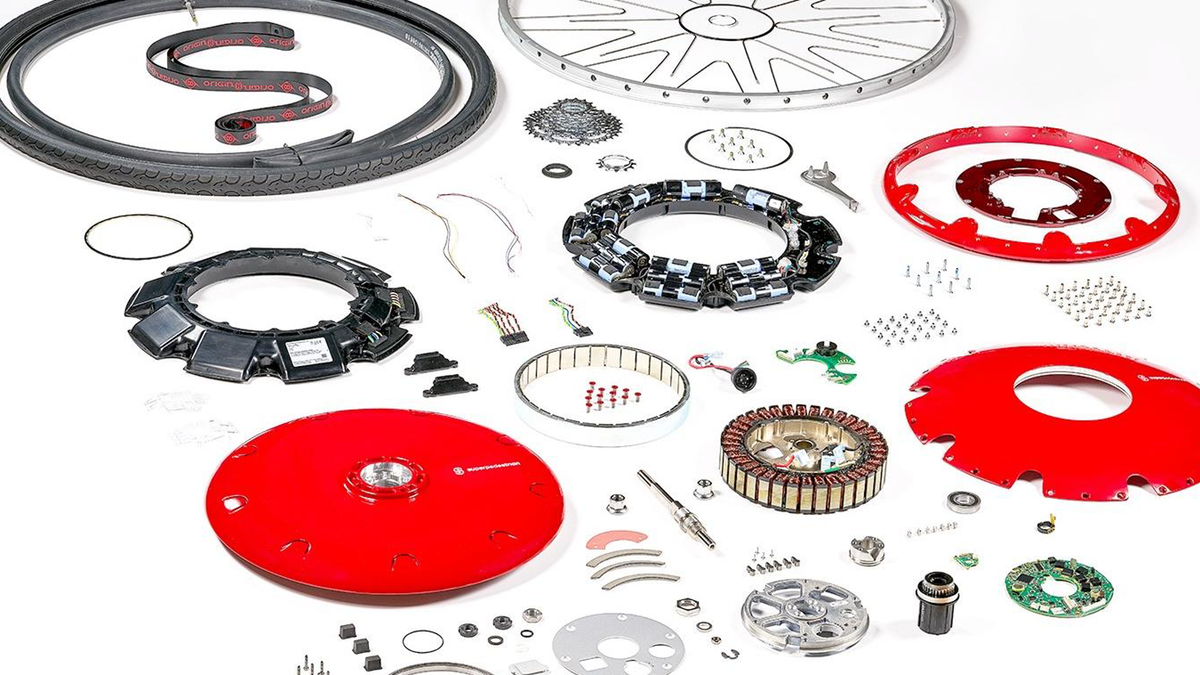
You can see it in this image: https://vcoregon.com/cdn/shop/products/e-bike_technology_db0...
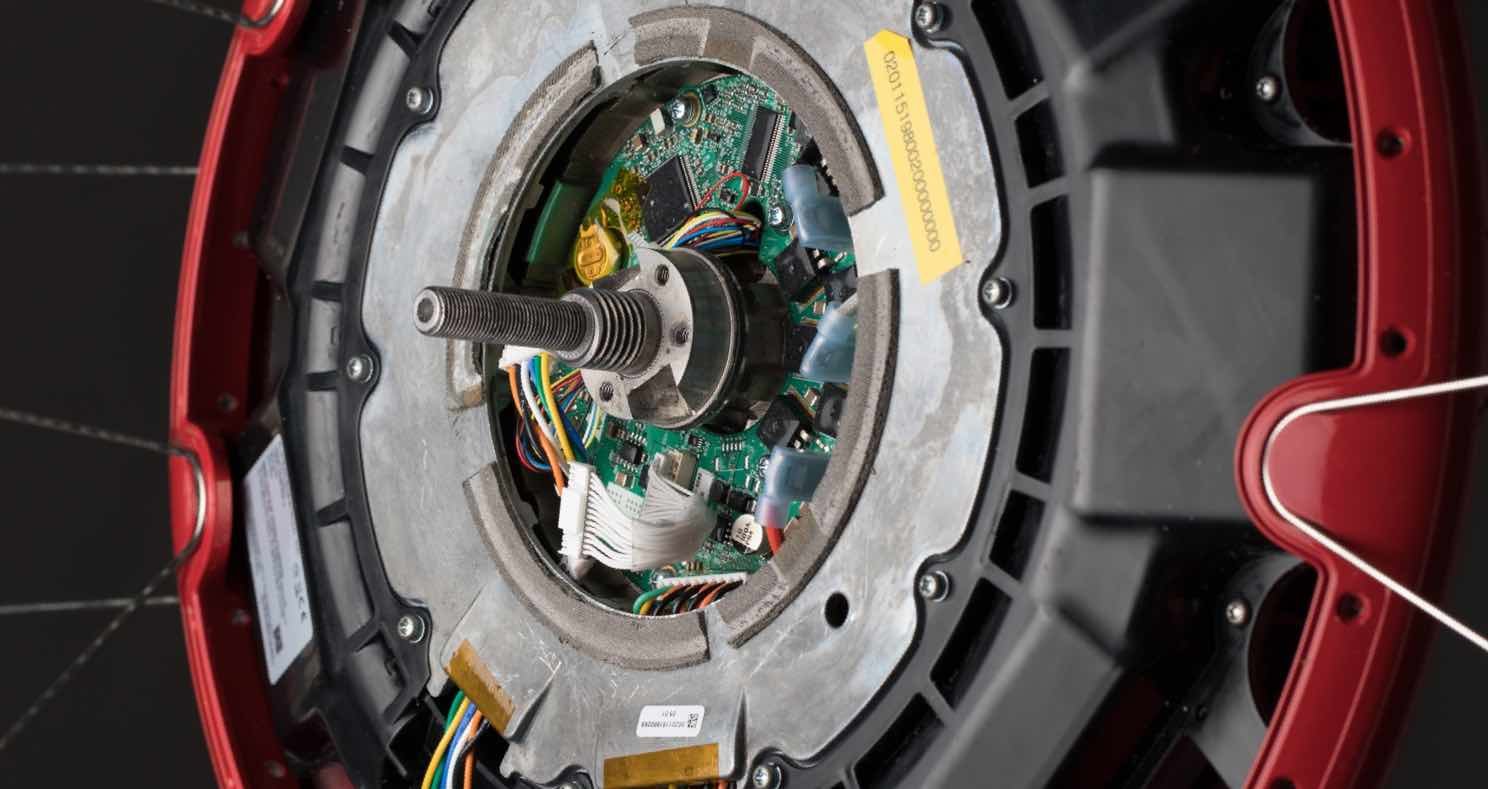
There's a picture of the assembled internals here: https://www.sefiles.net/merchant/130/images/zoom/tech-copenh...
Both images give some idea of the complexity. In bicycle engineering, there's a lot of value in simplicity. Fewer failure points, more easily detectable failure modes, and gradual failures are all features of classic bike design. Systems like this one throw that all out the window, and are much less likely to succeed as a result.
Re spokes as a heatsink, the problem is that the major source of heat is the hub motor, which is stationary, while the spokes rotate. Transferring heat between them would be difficult.
> it could have been a cheap conversion kit that doesn't break.
I seriously doubt that, especially the "cheap" part. There's one of those classic "pick two of three" triangles at work here: in this case complexity, reliability, and cost. To have that complexity be reliable is going to be expensive.
Btw, several other companies tried this. The FlyKly Smart Wheel (defunct), the Electron Wheel, the Evelo Omni Wheel, and the Zehus BIKE+ hub. None of them achieved "cheap conversion kit" status. Some of them, like the Zehus, were only available preinstalled by manufacturers, so their value proposition was making the manufacturer's life easier.
They generally:
* Wear tires surprisingly quickly
* Absolutely suck in any form of weather or terrain condition (dirt, rain, etc.)
* Have ~20% less efficiency than any other drive form.
But, they are easy, and they do work.
A proper e-bike needs to be designed as an e-bike from the beginning.
Expensive as f though. Also the gear-thingy looks proprietary (=expensive).
It was so bad that the rear wheel ended up getting bigger at the end of the race, as it picked up rubber deposited by the front wheel!
Keep it mind it was custom bikes though, the front tire just had to finish the race, they used a roller made of hard materials and knurled. I don't remember the reason, but it probably had to do with the fact their engines were quite a bit more powerful than traditional ones despite having the same displacement.
* you cannot install them on bikes with a rear rack. Here most city bikes have them.
Which makes me wonder about the cleaning after it rained..
A Skarper system [0] that drives through an adapted brake rotor sounds [1] like it is the way to go if really want [2] a well thought close to non-permanent conversion solution.
[1] https://road.cc/ebiketips/review_v2/skarper-ebike-drive-syst... .
[2] Compared to other conversion options they are currently expensive https://road.cc/ebiketips/content/advice/buyers-guide/best-e...
I recall a wheel-mounted rotor system from a few years back that did address theft, tire-wear, and weather, but it suffered from far too little torque and very limited battery life.
I'm not in the market for this, but I am in the market for making my cargo bike electric. Having to slow down at a traffic light and then start from zero absolutely sucks. It goes very slow, it is rough, and you won't have time. I'd use it just for that specific use-case.
It says on the website it will fit hardtails but not full sus, and that it isn't recommended on knobby tyres due to performance which isn't ideal either.
I could be wrong on all of this but those are just the concerns coming to mind as another mountain biker.
That plus “already has a bike” is a massive market.
It’s a relatively big city geographically, and it’s really nice to be able to do 5 - 10 miles in jeans and a long-sleeved shirt and not arrive at a social event in a sweat. The tube is really hot (high 30s!) in the summer and generally quite unpleasant (fleas in the upholstery!). So cruising around in the sun is a really big urban niche for rentals. Those that do lots of miles per day seem more likely to own e-bikes - delivery guys who probably average 50+ miles/day will absolutely feel the difference in their legs, and need to control their tiredness for their safety.
There’s also the fact that many people have bike racks that are fine for traditional bikes but not the additional requirements necessary for some (most?) e-bikes such as weight and strength.
—-
Just because it doesn’t work for you and your specific worldview doesn’t mean others wouldn’t see value in it.
I ride an all-original 1970s steel-frame road bike, which seems like a prime candidate for this sort of product. I'm certain no sprocket-based design would fit it. I'd buy one of these if there was any way to lock it up.
Bicycles without fenders are typically used for specific recreational activities and those sure as heck do not want this clumsy thing attached.. If they want any form of electrical assistance they would want it a lot more sleek and efficient.
Other than that, it reminds me of the Spartamet, a Dutch piece of tech from 1985 which added a small combustion engine to an otherwise regular city bike.
So they say there's a button on the thing itself which is not so much more practical. If they insist on wireless controls, the cost of a waterproof battery-powered button to stick on the handlebars sounds worth it.
Is this what investors sell to the board about how they are using AI for greater efficiency? Just to waste consumers time even more?
I gave the answer a thumbs up, of course.
“Easy installation” with two screws seems like a benefit to customers except when they come back to their parked bike only to find their expensive mod also had a hidden feature: “easy uninstallation”.
https://www.pitlock.de/en/set-sichert-2-innensechskantschrau...
> ...rated IPX4 for water resistance ...suitable for use in light rain, but it should not be exposed to heavy rain or submerged in water.
A bike part you can't use in more than light rain seems like a pretty big drawback to me.
From experience I can say that it seems like a lot more common sense to simply replace the front wheel of your bike with a wheel containing an electric motor, rather than attaching whatever Asus is selling to your bike.
Is it the very first? I have no idea. But it's the first that I've run across, and I'm ecstatic that it exists.
Proprietary power bricks for anything are stone-age and should be shunned by the market. Maybe the ebike market will start doing so.
Only the 2021 spec for usb pd supports 36v (common bike battery voltage) and more than 100W delivery. My bosch ebike charges at 36v 4A.
I also think that a small usb c connector could easily break when used in an ebike. But this should not prevent standardizing a “bigger usb c” to be used in ebikes.
I can't even look at this device without cheering myself on for buying the complete package, rather than messing around with gizmos.
To elaborate a bit, friends of mine have had bikes with both cadence and torque sensors. And I've tried their bikes out. Agreeing with one friend, the bike with the cadence sensor seems to decide how fast it wants to go.
The bike with the torque sensor behaves a lot more like what you're used to from riding a conventional bike. After all, the control input to a conventional bike is torque.
I agree, but would like to point out that sometimes this might not be what you want. I had a bike with a front motor and a cadence sensor that I used for my commute for a few years, and was very happy with the motor just pulling me along while I lazily pushed the pedals with ~zero torque, barely enough to let the bike know I'm there. Basically like pressing a throttle. If all you want is to get from A to B comfortably, I've found this to be superior to a torque sensor, and it was also dirt cheap.
Well yes, because there’s no other input. It’s an on/off switch, the bike just knows that you’re pedaling. Usually there are multiple power levels you can switch between with a button, and those decide roughly how much of a push you get from the motor, but the power curves are all “hardcoded”. It doesn’t feel great for active riding, but it’s adequate for commuter bikes. Torque sensors are actually kind of expensive on their own.
But in any case wet tyres would have a negative impact on the ability of this device to efficiently drive the tyre.
The worst part was filing down the metal brake assembly so it didn't rub the hub motor on the rear wheel. I assume that was a very unique compatibility issue. Besides that, it was no more difficult than assembling a computer, just a bit of screwing and wrenching which any bike owner would be able to do (add in some spitting and cursing if you've never worked on a bike before, as I hadn't). Done in a weekend.
The second hardest part was figuring out what to buy. The most straightforward option is a full hub motor conversion kit, which should work for any commuter application. Trying to individually buy parts (likely from aliexpress) is cheaper but a hassle to coordinate, since there's no standard for ebike part compatibility. Then there's also the choice between PAS and torque-sensing, throttle, etc.
I ended up buying the minimal throttle conversion kit from Grintech (~$1200 total) and installing it on a used hardtail mountain bike I got for $200. The bike goes ~26mph on a 48V battery, 30mi range, works like a charm.
ASUS employee: "maybe not, but I hear that electric bikes are hot"
Summers ending, watch your bike dealers for deep discounts!
RAM prices.
Unfortunately ASUS brand is not getting better with these actions.
https://onlinebicyclemuseum.co.uk/tour/cyclemotors-motorcycl...
What about wireless shifting systems like Di2?
Is it really wireless?
The SRAM one is.
Where is it ebikes don't have a good reputation?
Where I'm living, they have a very good reputation, and very many have them.
The motor shuts off at 26km/h.
"Bikes" with 20-30mph speed are awesome, much healthier than gas vespas, and much cheaper and more sustainable than cars.
Many commuters on e-bikes are people who otherwise would be driving a car, so e-bikes that help people commute to work in a timely manner are critical. At the end of the day people are going to do the thing that is competitive on time and if we want to reduce the crush of car traffic around the country then we need the people who can bike to go out and do it.
The design doesn't work if you have a mud guard or pannier rack. Also unclear how easily it is detached. Do I have to take it off everytime to prevent casual thievery? How do I take it off to charge inside? Does it have anti-theft bricking?
I'm struggling to understand who the target market is.
It has a removable battery so it seems the mechanism is designed to be left on the bike.
I'm guessing you are European? Bicycles in the US almost never have fenders except for old timey / retro style models. Fenders fell out of style in the 1980s and never really returned. People who do have them usually install them themselves as an upgrade.
Speaking as an American who owns a basic beach cruiser bicycle and
- puts less than 50 miles on it per year
- has zero desire nor space for a full electric bike
- would never use their bike in any kind of inclement weather
- would never use their bike for anything other than leisure
I think it might be aimed towards my demographic specifically?
Like this thing seems pretty neat, just strap it to my bike and go? Sign me up.
Counterpoint: Portland OR, where I live — enormous bike city (in some rankings, the highest in the country) — and most have fenders due to the rainy climate much of the year.
Find a bicycle without mudguards and ride very slowly, or just ride on clean roads on a sunny days.
Obviously I'm talking about good electric bikes, with mid-mounted engines that detect pedaling strength. These feel great, unlike electric motors strapped to bikes, which feel like, well, electric motors strapped to bikes.
The web page tells that the app can be used to switch between eco/normal mode but that seems to be the extent of it.
I was fine, but surprised he so carelessly and thoughtlessly sneaked up on me and tried to pass when I was already going fast downhill off of a bridge over a canal, on my legal eBike with 25 kph maximum assist.
Pedaling makes you pay attention and gives you direct control over the speed, and the assist drops out once you're going >25 kph. The asshole who hit me from behind probably didn't have time to find the throttle with his hand, and was never really in control of his bike or paying much attention up to when he freaked out and hit me.
What to do about fatbikes endangering our safety?
https://www.reddit.com/r/Netherlands/comments/1knza1c/what_t...
Fatbikes in the Netherlands 2026: What You Actually Need to Know
Feels like an overgeneralization. I have a perfectly slow Ride1Up Roadster V3. It's a PA bike with a throttle, but it's not a hot rod. Max speed with my weight is around 20MPH. I use the throttle to just get moving on inclines or at stops when I forgot to downshift.
That said, there are plenty of idiots around on bikes and cars.
Although in my experience when your bike/cargo is heavily loaded, a throttle is nice to get running, especially when stopped at a red light going uphill. Borrowed one like this and it was really useful. But i agree with your sentiment i see many people with throttled bikes going really fast and careless.
> That plus “already has a bike” is a massive market.
I imagine people who are elderly or differently abled would benefit more from an e-bike which is competitively priced to a bike + this device which will likely cost more than $1,000.
You won't be able to remove the cassette and crankset with a multitool but a full campagolo super record EPS groupset MSRP is above $4000.
I think the tyres would limit the power output most. Probably quite annoying to have no rear mudguard in anything but the driest conditions. You’d be spraying a lot of crap up at the motor (and probably your back).
Attaching and detaching it looks relatively simple, though - removing it for downhills doesn’t look arduous. You could probably 3d print a clip for the frame.
Given the likely reduced power, and that the spec seems to be saying ‘500w peak, but 250w is sensible’ - probably up to the user’s needs whether the hassle is worth the extra watts per kilo. For those without mobility issues or longterm injuries, it’s usually best to optimise the rider rather than the bike for that.
I feel like off-road climbing would necessitate really wide, sensitive speed variance that this motor is likely not great at supporting. It strikes me that you’d want more direct pedal feedback.
Really fun bike design problem.
The biggest issue to me is the inability to put the seat all the way down given that's quite important, and obviously this won't work at all with a dropper post (which are fairly common nowadays), honestly actual ebikes are quite popular in the mountain biking scene at the minute and they seem like a significantly better fit to me.
I wonder how much torque the motor could put out though without putting a lot of wear on your (probably fairly soft material on mtb) tyres or slipping on knobby, possibly dusty/muddy, tyres; that itself might kill it off for offroad climbing.
Sorry but what? The only alternative to a FS frame is a hardtail. Where “hard” means that the rear wheel doesn’t move relative to the saddle. Your road bike is a hardtail.
If the rear wheel moves relative to the saddle, it’s full suspension (full meaning front and back)
Either it’s unsprung mass or a liability, and, well, actual e-bikes have converged on BB motors for a number of reasons.
(Of course, "capacity" is misleading, as this will be less efficient than a real e-bike.)
Simply bolting things down harder is still defeated by a battery powered grinder.
https://www.techspot.com/news/113381-google-ai-told-people-f...
AngryData> No one goes around stealing bikes just because they want to do bad things.
But people go around stealing Flock cameras because they want to do good things.
The only reason most Americans outside NYC and Chicago ride a bike is leisure. Well, that or too many DUIs if we're being honest.
Ideally though if I had something like this it would encourage me to use my bicycle more.
Need != Target Market. Jet Skis target market isn't water patrol enforcers. It's people wanting to have fun.
They will even steal a helmet off a parked bike and that's way cheaper. Just look how many helmets are left on bikes in different parts of different towns (because there is literally no advantage to take your helmet anywhere other than for theft protection)
*At the very least, you have to worry about Jackie Chan "borrowing" your wheels for a wacky chase scene. Based on my knowledge of Hong Kong cinema, this must happen at least once per week. Dude is a menace and a fiend.
And if we want to limit cars - you know, the number one thing that actually kills a lot of people directly - then I don't think it helps artificially limiting alternatives like E-Bikes.
The only difference is with enforcing the rules, but there are solutions for that. Police on E-Bikes doing patrolling, mandatory number plates, E-Bike driving licence, .. not that I want all those things, but I much rather have that and not crippled bikes so cars stay the norm.
You can have an electric vehicle that runs at 100kph if you want, but that is not a bike, that is a motorcycle.
The problem here is people having vehicles assimilated as ebikes, but with radically different specs.
I have no problem with these guys driving their vehicles on the car lane, like motorbikes do, but that's not what we're talking about here.
These vehicles are running on the bike lane, drivers are without helmets, they cross pavements, and enjoy all the slow vehicles perks, while being far more dangerous for their surroundings.
I can only drive my E-Bike with my car to the forest (like to many people do), or drive slowly there myself.
When i was young all bicycles came with mud guard (then called "fenders") front and rear. Now they seem to be anathema.
Every bike I rode w/o fenders put a stripe of mud up my back!
Of course most bikes still come with fenders, but that's also a major limitation for this device: you've got to remove your rear fender. Maybe this device acts somewhat as a fender, but the site says you can't use it in heavy rain, exactly when you need that fender the most.
Here in Germany if you want to get a cheaper bicycle, other than flea markets, usually they make you mount the pedals yourself, doesn't have fenders, lights might also be missing, depending on the offer.
If, however, they are doing that for commuter bikes...
And not all hub motors are low-power. You can get Chinese ones with insane power output. (5000W! … just remember that Europe has strict power restrictions on e-bike motors.)
It has three wheels. Two smaller ones at front, one back. As such, I'd prefer to install the motor on the back. We do have that speed limit of 26 km/hour (my current e-bike has it as well), but since more force is required, the kit would need to know this as well.
I got it second hand, same as my e-bike. Otherwise, these aren't affordable for me. 6k EUR for a cargo e-bike is just insane IMO.
[1] https://www.babboe.nl/media/akeneo_connector/media_files/b/a...
But for people who'd reach the max 26 km/hour, if they'd need better brakes, then if they reach such speed manually (going downwards, for example) would suggest my current brakes aren't adequate either. But I'm not interested in going from to 20 km/hour ASAP. I am interested in getting a little of help at 0 km/hour going forward. After that, the electric part can go off for all I care.
I am not sure if this is enough argument for having this instead of having a decent electric bike plus a normal bike, but it is an argument I guess.
There are cases one may not want to use an electric bike, eg when going out for a coffee, a drink etc and you may not want to carry the battery or risk theft, in contrast eg to biking for 40 minutes every day for work each way.
Or put a different way: I use electric Lime rental bikes all the time, it’s super fast and convenient. But I’m keenly aware they don’t give me any exercise, so I do want to go back to unpowered bikes as much as possible.
Not sure how these two things got tied together in the common culture. Something I hear all the time is "but you have an electric bike, what's the point, it doesn't get you any exercise" and people saying that commute to work sitting in their cars.
Do you sweat a ton when you walk? Yet walking is exercise. The point being, of course, there’s a correlation between how hard the exercise is (plus other factors like clothing and weather) and the amount of sweating, but to claim that not sweating equals no exercise is incorrect.
Making the search process easier makes locating stolen stuff becomes more of an office job that’s cheaper to do so the math works out better.
While there are a lot of people riding more powerful bikes in Europe illegally, at least some countries are trying to crack down on them. In the US, it seems easier to buy class 2 and 3 e-bikes, and there seems to be a higher proportion of illegal bikes. It's an open secret which "class 1" bikes you can buy and then overclock easily.
So in Europe you mostly have class 1 e-bikes and obviously illegal (as in you can tell just by looking at them), but in the US you have these plus a lot of class 2 and 3 e-bikes, and overclocked class 1 e-bikes. The end result is most mountain bike trails in Europe allow class 1 e-bikes only, but in the US it's impossible to enforce class 1 only, so a lot of regions are trending towards banning all e-bikes from all trails. So be careful about wishing for a more powerful e-bike you can drive in traffic and mountain bike trails.
On the flats, I get no benefit since the motor cuts off at my normal cruising speed of some 20 mph. It just feels like a solid bike in that mode, a bit heavy, of course.
I have taken it on a few regular non-commute rides as a test and must say it did not make me lazy or weak, or suffer less. Easy of riding is not me. In the end, it is the rider that makes the ride.
I don't have a problem with them riding an eRoad bikes, I like that they can keep coming out with us, but like you say I wouldn't want to ride one myself.
I suspect this depends on the weather in your area - road cycling clubs near me often require mudguards for "winter club rides".
If you see someone with mudguards on a road bike it's a sign they're a proper cyclist.
I don't think you're allowed to entry audax events without guards and you definitely won't be allowed on a club run without them. Getting a face full of oily road water for the guy in front is not exactly fun. Even small clip on "racing blades" will get you a sniffy look.
If you google images of something like Redbull Hardline pretty much all the bikes you see will have at least one front guard.
That's because no one wants a face full of mud at the wrong moment.
Bikes are sold without mudguards, and the aftermarket ones are flimsy and don't fit very well. (The steel ones that came with my 1983 Schwinn frame being the exception).
"Who this is for" is the great un-answered question in American cycling. The reason is that our biggest untapped market is people who don't ride at all. The marketing looks like lifestyle marketing: Here's what's wrong with cycling and how we solve it. Here's what you will look like.
From a cyclist’s perspective, this is fundamentally a stopgap product for “curious” customers dipping their toes into e-bikes. I don’t say that necessarily to criticize it. There’s a place for a product that someone can put on any old bike and see if they want to buy a more expensive long-term solution. But that doesn’t make it a product I’d recommend.
The tire wear problem is significant enough that there are heat resistant tires specifically for this type of drum application (designed for old-style indoor trainers, not for use on the road), because use on a drum will cause premature wear for normal road tires.
Sure you can use all number of locks, security bolts, and stripping the bike down yourself every time you leave it, but it’s sucks. You’d rather public spaces just be safe.
If there's lot of theft and you can't store bike at a secure place - have a cheap bike.
not sure the game you want to go with examples
And yes, once your winter 'proper road bike' has mud guards, tyres with treads, and an all-weather-riding design people might start calling it an 'adventure bike' or 'gravel bike' instead.
1. someone has a cheap disc brake bike for pleasure rides (mostly in the sun)
2. they get something like this for commuting or whatever
3. now they're on their disc brake bike most days (including when it rains), going faster than they're used to
it's not the end of the world, but it also doesn't seem great
But the rule is good. Can't say I always adhere to it, but used to loose a lot of stuff , and thanks to the rule, many wasn't that expensive.
This is the approach if you go offers on regular supermarkets that also sell bicycles.
Personally I am never going to give more than 400 euros tops, for a new bicycle, it is either that or not much beyond 100 euros at a flea market.
Getting the bicycle stolen or worse, revenge damage when they fail to steal it, is not worth more than that.
You often don’t get pedals on new bikes because you have your favorite pedals that work for you and anything that’s included with the bike goes straight to the bin, because it’s useless trash. You don’t get fenders, because you don’t usually use those on any kind of sporty bike. They’re heavy, they don’t usually work that well, they are often hard to use in bikes with suspension with longer travel or and they can rattle or simply break and fall off if you ride hard. You don’t get lights and reflective elements, because they’re heavy plastic crap that breaks and falls off. If you often ride at night, you probably own some kind of night gear, high powered LEDs, reflective stickers or spokes…
And obviously once that is the norm for “bikes” in general, then why not save a few cents on supermarket bikes.
I don’t agree. After my last bike was stolen I decided to buy the cheapest Decathlon had to offer - 240 - for getting around town and there’s nothing unsafe about it. It’s heavy and has cheap components but everything works fine for light city cycling.
And from all places I lived in Europe, only around here this upselling seems to be a thing.
So once you take them off the streets for a couple of years, or decades for the more hardened ones, it's fine. It has an added benefit of breaking criminal networks so the future adepts have no place to fence the stolen goods.
I also think you have no idea how much it costs per prisoner per year.
I also think you have no idea how much harder it is for someone to get a job, housing, a partner, etc after they have a conviction. Or how much whatever life they had falls apart, which includes partners, friends, family. And guess what happens when you strip away all of someone's social connections? They lose that safety net, and are now dependent upon whatever society as whole provides. And in the US we have people saying "pull yourself up by your bootstraps" non-ironically, not realizing the whole fucking point of that phrase is that recovering from poverty in the US is extremely difficult.
That money is better spent on helping people who are not able to afford basic necessities, because that is why a lot of people commit property crime.
I suggest you actually open up some studies on this subject because you clearly have no idea what you're talking about. Or just open up a chart reflecting the economy over the decades and compare it with property crime rates.
The US has the highest incarceration rate in the world by both headcount and percentage of the population. How's that working for us? We have one of the higher property and violent crime rates among developed nations. Far higher than nations where criminals are imprisoned for rehabilitation, not to punish. Things like giving them a cell that looks like a bedroom, not pen in an animal shelter.
In the UK police will ask the value of the property stolen and use that to decide whether to do anything. Low-value is under a few £k.
No, it's actually solved by providing social safety net programs and managing the economy to have entry level accessible jobs that pay a living wage. People steal because they run out of other options. The cost of flock contracts would be far better spent on food pantries, job counseling, emergency housing...
There is nearly zero correlation between the number of police and the amount of crime.
Do you have anything to back this up? You think people are stealing because they lack basic necessities? How are you defining this?
That's into the absurdist territory, but it reflects the real pattern of behavior. People do go around committing petty crimes for various reasons.
I think it's ok to define "survive" as an addict who needs (<-also loosely defined) a fix.
You don't generally commit serious white collar crime, tax fraud or do crypto grifts to survive. For petty street crime, I don't really see any other motivation.
Phew, good to hear. Here I thought it would be a hard and complex problem, with lots of unknown unknowns, difficult political compromises, a generation-spanning efforts and many potential solutions with uncertain outcomes, partially contradicting each other.
Instead, we just have to make society better. So, what's step 1?
And if you are still worried about theft in the mean time, you could try looking at wage thefts which has a value greater than all other forms of theft combined.
That would make society better, I agree, but I don't see how that would lead to a reduction in theft, or crime in general.
> And if you are still worried about theft in the mean time, you could try looking at wage thefts […]
I'm not worried about wage theft, no. I am worried about theft of my personal property, though. And I notice that you haven't proposed any credible path to reducing it, beyond an incredibly generic "make society better", whatever that means and however you want to achieve that.
Do we have any sources that people are stealing to survive? What definition of surviving are we using here?
The recidivism rate for property crime is higher than violent crime, so it seems plausible that the same is true for theft: https://counciloncj.org/recidivism_report/
That being said, having driven electric bikes for a while, here in France they're ridiculously limited in speed and power. 25km/h limit on flat land usually makes sense (except on long straight lines), but when you get climbing even slightly you get down to ~10km/h and have to provide more effort. I guess that's where the 750/1250W 70Nm unrestrained motor comes in handy, and if you live in a place with lots of small hills the choice is either that kind of motor or a car, not the 1000€-total Decathlon/Carrefour electric bike.
To compare: a tour de france runner outputs 400-500W on mountain climbs while keeping up to 20-25km/h. So a 500W motor (plus 100W power output from yourself) should be enough for smaller climbs!
https://news.ycombinator.com/item?id=48761621
DonHopkins 44 days ago | root | parent | prev | next [–]
Enviolo stepless bicycle automatic transmission (never manually shift again, accelerate while continuously shifting under load), with a carbon fiber belt drive (maintainance free, silent, never get grease on your pants or hands again), and Bosch Performance Line mid-motor (strong zippy performance from the geniuses who paid a €90 million fine for Dieselgate), plus GPS tracker with "recovery service" (required for insurance).
https://www.youtube.com/watch?v=TQrgKBQrkag
https://www.youtube.com/watch?v=6xY2S-9gjHI
https://www.koga.com/en/enviolo-gear-hub
https://www.koga.com/en/bikes/e-bikes/evia-pro-automatic?fra...
It's a dream bike, optimized for comfort and city riding, but Koga is not available in the US, though.
Here's an American bike that has similar features (not as nice as the high-end Koga Evia Pro Automatic though), the Harley Davidson Rush/CTY (step through model is easiest to mount/unmount/ride):
https://www.youtube.com/watch?v=4SjN8RN9g7Y
https://www.youtube.com/watch?v=KoX9S5UhETE
The Enviolo Automatic also come in a heavy duty version paired with high performance motors for bakfiets (cargo bikes), for 3-4 children, big dogs, and groceries:
https://batavus.com/en-nl/products/fier-3-bbfn3
https://www.dw.com/en/bosch-pays-90-million-euro-fine-over-d...
https://en.wikipedia.org/wiki/Volkswagen_emissions_scandal
Edit:
Fair, they're ideal for city bikes, stop-and-go traffic, and the flat Dutch landscape where they're produced, where the biggest "mountains" you encounter are the bridges over canals. Their city model has 310%, trekking 380%, and the new utility hub has 400% gear range, which you can use on a normal bike, bakfiets, or speed pedelec.
In my experience with electric motors, yeah I can absolutely believe it. Electric motors aren't cheap!
I've ridden bikes with Bosch 65Nm motors and with a 80kg rider plus 20kg of cargo they're perfectly fine even up steep hills. As in 18kmph or more with only a moderate amount of effort from the rider. Your bike was really underpowered (50Nm?).
However bimotal is not that nice - adding a motor to rear triangle alters weight distribution and adds unsprung weight. Also unlike actual nice MTB e-bikes it cannot use chain/casssete for gearing, so gearing is fixed at the factory. If you’re used to nice bikes you will want your ebike to be dialed in just right.
One place where it makes sense is as an alternative to shuttling on forest roads / lifts for downhill-focused riding. F you’re going strictly downhill you can move the motor to the backpack after finishing the climb to reduce unsprung weight. This opens up a large number of trails where forest roads are blocked to car traffic. It also allows dh riding on trail where motor bikes are prohibited.
How nice should one's bike be that you'd rather turn it into a mediocre ebike for the price of buying a good ebike?
I have a ebike that cost ~1500 in 2018 and is probably comparable to what $2k would buy you these days. It's very heavy and while the drivetrain is repairable, there are important pieces of it that I would struggle to repair/replace if they died today.
I have a steel touring bike that's significantly lighter, has standard sized parts that can be repaired, replaced and upgraded (many of which I have already upgraded in the last 15 years) and fits me like a glove. If I didn't own an ebike and you asked me whether I'd rather spend $2k buying something like my ebike or adding a 750W motor to my Surly, I'd upgrade my touring bike.
I think there are many other and better things to try than the repeated failure of trying to catch and punish crimes even more harshly.
Not everyone needs Apple priced bicycles, that get as easily stolen as a 50 € from the flea market.
There is some sort of complacent attitude that results from, what is normally a road-only moped device, exploiting the privileges of the bike paths. I hope this law changes - I ride a 'normal' electric moped and motorbike also, so I guess I'm a bit biased, but I'd like to see those 45km/h limited e-mopeds classified for road only. It makes no sense to let them use the bicycle paths, in my opinion. They're road-ready, so let them stay on the roads.
The US tried "tough on crime" approaches, what has it resulted in? 25% of the entire world's prison population and it still has higher crime rates than its peer nations.
Ebikes are pedal assist, power limited, and limited to only assist up to a certain speed. You can go as fast as you're able, but if you're above (commonly) 25km/h the motor won't help you. They're allowed anywhere you're allowed a non-assisted bicycle.
Electric motorbikes may be limited by the manufacturer in order to achieve a certain license class, but once you get past the low power classes, they're only as limited as their petrol cousins. They're only allowed on roads.
Any middle ground, including things that look like bicycles but don't require the rider to peddle, fall either into the "electric motorbike" category or into the "not roadworthy" category. Riding them without a proper license, insurance, and equipment is illegal.
Somewhat unfortunately, much of the press seems to want to class the non-roadworthy motorised vehicles as a special case of "ebike" rather than the general case of "motorbike".
(And to your first point: yes there are speed limits but it's fairly common for cars and motorbikes to be able to go much faster than the limit. In first gear, even, for motorbikes.)
Just a few quick examples, you can find more with your favourite AI/search engine
16500 bikes confiscated - https://www.ilent.nl/actueel/nieuws/2024/09/12/ilt-legt-besl... https://nos.nl/artikel/2483770-inspectie-waarschuwt-voor-ill... https://www.reddit.com/r/germany/comments/1ndpf3z/i_just_pai... https://www.theguardian.com/lifeandstyle/2025/sep/04/britain...
If shifting gears takes to much of your attention, I'm concerned for all of us, and why do you need to pay more attention to riding "effortlessly"?
https://en.wikipedia.org/wiki/Cognitive_load
Have you ever ridden a bike with a geared derailleur, and forgotten to shift into low gear at an intersection, or had to suddenly stop before you had a chance to shift into low gear, so it's more difficult getting started again?
Did you notice how it's impossible to shift while you're stopped, and how tricky it is to get it from high back into low while you're starting, especially up hill, and how you can't shift while you're applying force, so you have to push yourself forward instead of pedaling to get it rolling enough to downshift while gently pedaling without accelerating?
A continuous hub fixes those problems, and an automatic transmission shifts you into low when you stop (even if you're not moving), and smoothly and continuously shifts back up while you're accelerating, and the continuous hub allows you to apply power while it's shifting (note I didn't say "changing gears" -- it's continuous, and doesn't have gears. It has planets and fluid instead. It can shift while it's stopped, and accelerate while it's shifting.
You have a lot more important things to worry about when you're accelerating from a stop at a busy intersection than pushing off and shifting without applying acceleration and only pedaling forcefully once you've finished shifting into low gear.
If you're riding a bakfiets (cargo bike) with your kids and a dog in the box, then you definitely have things you need to worry about more than shifting gears, and because of the mass and precious cargo, it's even more important to be able to accelerate from a stop without performing a derailleur dance in the middle of a busy intersection.
It's a trick you have to learn just like using the parking break when starting a manual transmission car facing up hill. Manual transmissions have a much higher cognitive load in both cars and bikes.
This kind of stuff should be intuitive if you've ever ridden a bike with more than one gear, or driven a stick shift car. Sure it gives you "more control", but more control = higher cognative load, and you're probably not a NASCAR race car driver who needs to optimize for control.
It's all explained here:
The Enviolo stepless CVP technology explained:
https://www.youtube.com/watch?v=6xY2S-9gjHI
Is enviolo the best internally geared hub for eBikes?
https://www.youtube.com/watch?v=Vob5Rb4IKsw
He talks about shifting when you're stopped at 2:32.
If I'm moving the bike by directly motivating the drivetrain with my foot, all this talk about "more control" feels very silly because I am already directly exposed to whatever is happening on the chain and at the wheels. I don't ride an ebike but because my tires are skinny I can definitely slip out if I start too fast in a low gear. The "fix" for that isn't to pick a different gear or rely on some fancy shifter to try and increase my mechanical advantage, it's to feel the tires slipping at my feet and just... pedal slower.
Ditto for going up hills. Is "the bike got hard to pedal" cognitive load or literal load?
I get the argument for riding a cargo bike but IME cargo bikes are almost always ebikes now because derailleur or not, not many people are going to accelerate quickly with kids and dog. Considering that fancy non-deraileur gearboxes cost nearly as much as cheap ebike conversion kits it seems like an uphill battle.
Yes, it's an annoyance, not an insurmountable obstacle. If one is bothered by it, there's the hub gear, invented more than 100 years ago.