Various other bio-fuel and synthesized replacements for petroleum-based jet fuel have been tried and are in development. The aviation industry is very slow to approve and adopt changes.
More egregiously FAME is a polar solvent that eats your elastomers, even some fluoroelastomers. It will also attack your polysulfide tank sealant. The remark that it's "technically feasible" to decrease oxygen through hydrogenation is not at all sufficient. Now you're into requiring catalyst beds and a hydrogen plant which makes this much less appealing. Plus ester instability when you sink heat into fuel. Plus freeze point. This is literally a tracked contaminant banned above mg/kg levels that doesn't even have very good properties otherwise they want to run as a major constituent of fuels.
edit: thanks for the downvote. I should've said "Maybe it's time to _invest into developing_ new sealing materials?" ;)
Remember when George W Bush signed into law the corn ethanol bill. Corn tripled in price within 8 years. Fuel didn't get cheaper. In fact it cost more to produce the ethanol.
There's simply no economic feasibility to replace every seal on every aircraft.
Edit: The US created biofuel subsidies a few years ago and it’s led to poor use of land with questionable climate impact. It’s effectively become a wealth transfer to support poor rural American communities, which isn’t necessarily a bad thing but there’re probably more effective ways to do that intentionally.
My immediate reaction to this is: it's probably a wewlth transfer to the few landlords owning the land and probably charging higher rent, not to the communities.
Of course I haven't analysed the data. If I am wrong, hopefully someone will feel compelled to correct me.
How common is farm landlords?
International markets and all that...
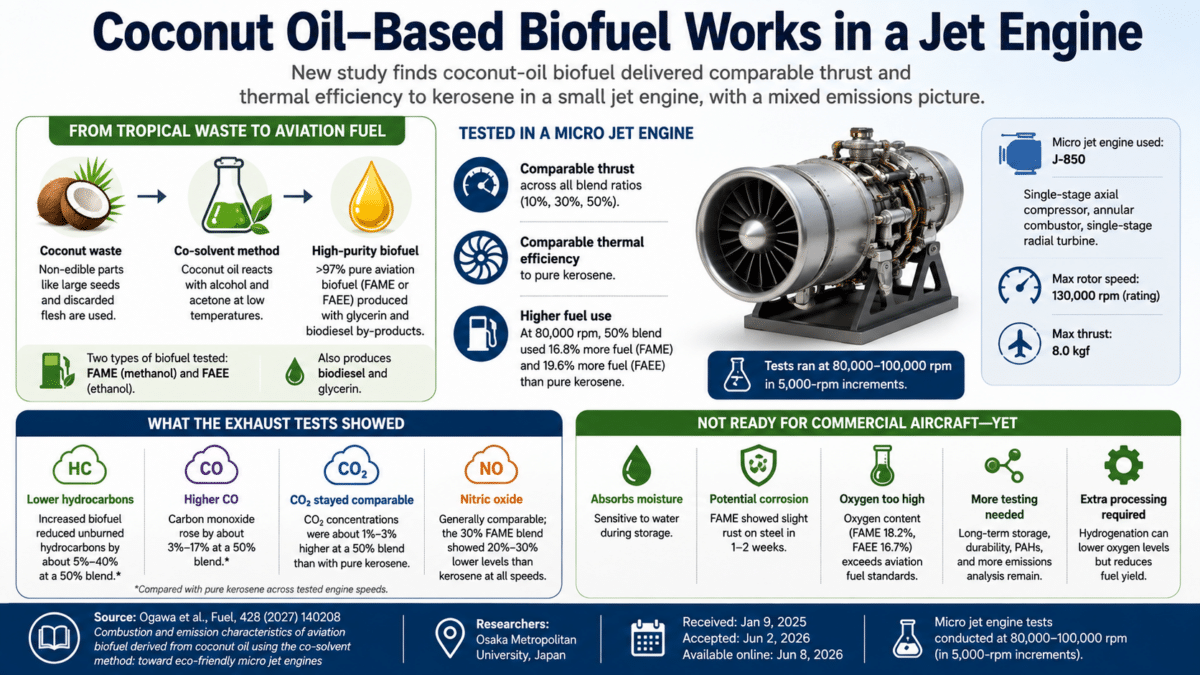
Edit: the article speaks about possibilities that open. It also clearly notices that the a number of problems are unsolved. The infographic is direct: https://studyfinds.com/wp-content/uploads/2026/08/Coconut-Bi...
Note that if some product available in limited amount, say "coconut oil", becomes an asset to improve any context, say "aviation", it does not follow that one should maximize that amount psychotically without a cost-risk-benefit. You can just exploit the available yield through planning.
Edit: you don’t have to plant all of Mexico, every percent of fuel you replace is the equivalent of a percentage of a country under a single crop, displacing what would have been there before (presumably some kind of food).
Turning it into fuel and burning it would compete with the other uses for those 30%.
In the short term, yes, because they were unnecessarily using carbon energy to grow the fuel.
But if we want to de-fossilise society in the long run, we need solutions for flying and long distance travel. Electric flying seems infeasible at the moment, and people are looking for suitable bio-fuels to make flying carbon neutral. Afaik the maximum planes were allowed to handle up to now, was a 50-50 mix kerosene-biofuel. [0]
Coconuts could be a breakthrough!
If you don't have anything to pyrolyse, use a sodium or potassium hydroxide wet scrubber to extract it from ambient air and recover it from the solution with burnt lime; it preferentially bonds to the carbonate, becomes nearly insoluble; you take the lime stone powder, heat it with a high temperature blow dryer until the carbon dioxide cooks out (you can use pure carbon dioxide atmosphere for that! Just let out excess buildup of CO2 pressure to your output cooler/storage.), have regenerated the burnt lime, take the resulting CO2 and hydrogen to perform water gas shift to turn the mix into CO and H2O, condense out the H2O, then use the CO + H2 mix for your Fischer-Tropsch synthesis.
You can use incineration facilities to tap off concentrated CO2 and mine landfills until they are empty to keep the incinerators fed to get the CO2 possibly-cheaper than from the direct air capture units.
Start by using more solar cell glass laminate for exterior surfaces of new construction and as roofs over whatever parking lots you do want to keep around longer-term.
Synthetic non-fossil fuel is going to need plenty of electricity and probably much of that "just" to electrolyze water into hydrogen which is reasonable for seasonal energy "storage" (run them during the high-solar 25~50% of the year, use underground caverns (former natural gas wells) or liquify it to store for the winter, run the synthesis plant that consumes it year-round. Don't just burn the hydrogen in power plants, though you can keep existing fossil fuel plants around for a while to run them during the worst week or two of an average winter. But expect the power to be as expensive as each kWh you get today from a small gasoline generator fueled with fully-taxed highway gasoline...
Should every Chinese and Indian visit Venice, even though it destroys the city little by little? Should we send things as futile as watermelons by plane?
Of course, the market wills it so some may think that it must happen, yet I feel that the globalisation and massification of everything made the world a less diverse and interesting place overall.
I am 100% for decarbonization as fast as possible.
BTW Law of Conservation of Energy will be applied to coconut-based energy as well.
Vaclav Smil mentions in his book that we should consume less.
I see so many cheap weekender air tickets… it’s almost impossible to resist the temptation.
Annually 5 billions people travel by plane…
I.e. measures like massive taxation (also for private jets of course).
> https://www.heartaerospace.com/newsroom/heart-aerospace-comp...
It's also very not true that farmers are poor in the US (median household income about 30% greater than general population). This mindset is like a century old.
Most farmers work a "real" job in addition to the farm work.
Then you also have farm workers, who do not own the farm, and they tend to be poor.
Like everything else. it’s been capitalized and farms have consolidated over time. There were lots and lots and lots of farm workers. who are pretty poor and now lack the assets that their grandparents had.
Right, we should tell the farmers to "learn to code"?
Too bad you can't ask Claude to grow potatoes. Though it probably uses the same amount of water and fuel to tell you it can't.
A few years ago? Corn ethanol subsidies have been a thing for my entire life.
It's a net-negative fuel. Costs more fuel to produce than it provides. It's literally just a way to waste water, farmland, huge quantities of diesel (burned by engines exempt from any sort of emissions), labor, etc.
What changed is that ethanol has been forced by regulations into more and more use over time. That has driven up demand for corn, and one of the worse side effects is that a major food staple for Mexico has gone up dramatically in price.
> effectively become a wealth transfer to support poor rural American communities,
If you think that's bad, stop and think for a moment about what purpose the US military serves for rural America, both directly through personnel but also indirectly through all the incredibly wasteful equipment, service, and supply contracts.
The US military's primary reason for existence is force projection, but its secondary is keeping rural American's uneployment from skyrocketing.
Biofuels are part of the all-in-one story of renewable energy, especially the transition phase of reducing carbon emissions before we can get to full electrification.
The question of whether or not they are effective in doing so- and whether or not the money for those subsidies would better benefit society elsewhere- is the very same one that skeptics of solar and wind hammer on.
I would much rather see those subsidies go to farmers growing human consumer food, and sending the excess to bioreactors to produce fertilizer and/or methane for power generation. Cheaper groceries make it easier for people to eat more whole foods, after all. Just last week, I found napa cabbage at $3/lb- meaning one head would have been $24. Fresh broccoli and other good veg are also expensive.
The reduction of harm from reduced CO2 by bio-jet-fuel would pale in significance compared to, say, subsidies in regenerative farming practices, or even simply healthy crops.
Looks to me like someone who is prospering based on coconut plantations would be the beneficiary from tapping a new market from a jet fuel process, and it probably could be made into a cleaner fuel than the waste-based bio-fuel.
I'm skeptical that rural community are the primary beneficiaries. Seems more likely that it's benefiting people who own the patents/companies.
You don't have pesticide or fertilizer runoff from solar farms. You don't plow the soil resulting in soil loss.
Biofuels, dumb.
A drop-in compatible jet fuel can be made by hydrodeoxygenation of biomass, using Virent's process. The waste cellulose in current US waste streams would be more than enough to displace all current US jet fuel consumption. An extra source of hydrogen would be needed to do this, but hydrogen can be made renewably (and, indeed, that's a good way to provide dispatchable demand to help deal with renewable intermittency, and will have to be done anyway to displace the use of natural gas to make hydrogen.)
As an example, a house in NH can generate a lot of excess solar power in the summer months when it uses hardly any electricity. If all that energy could be stored as hydrogen, in the winter (when solar power is less due to the far northern latitude and snow covering the panels) it could draw down on the hydrogen to generate electricity and also use it for a backup heat fuel.
Adding some numbers for a base line. (Note all of these numbers are almost the upper limit of a well managed farm with very good cultivars)
Best yielding palms yield ~300 nuts per pals at 70 palms/acre.
at 750g a dehusked nut with 20% oil yield
You get ~2.3 tonnes oil/acre.
For reference an a321neo burns around 2,300 kg of fuel per hour when cruising
I <3 you HN, never change.
Around 40 million flights per year.
40 trillion coconuts required for all flights, or 1000x current production.
To scale up coconut production we need 12 billion hectares, or 80% of the Earth's surface for coconut trees.
We need 100k cubic km of water per year, or twice the renewable fresh water on this planet.
Ok cool. We will need to terraform Mars before we can fly by coconut.
Finally I understand the mad billionaire's plan.
If you thought habitat destruction from palm oil was bad, that would be nothing compared to coconut oil making up any significant fraction of jet fuel.
I don't think the answer is obvious. And I think many of us are blind or numb to environmental harms of oil outside of carbon exhaust and the occasional spill, simply because we've accepted it as status quo.
The issue with oil is CO2 and other green house gases and then the occasional oil spill or leak. Land area wise they don’t take up much space
Guess what plants are made of.
> New research found that aviation biofuel made from coconut oil can power a small jet engine about as efficiently as traditional jet fuel, with lower unburned hydrocarbon emissions, though the blends burn more fuel and emit slightly more carbon monoxide.
This isn't the future I want.
In the post-apocalyptic future I will be the guy roaming the wastelands, armed to the teeth, seeking out rumoured stashes of Jamesons Raspberry Ruffles and those Roobar things.
we have a food shortage issue already globally..
waste products, yeah fine. but cutting down large area of forrest/food producing land for the growing of non food plants for fuel is just self destructive corp greed.
It will be similar (worse?) implementing a new type of fuel for commercial jets, especially when it comes to wide adoption across a majority of countries around the world. Basically you need something which is as least as reliable, clean (I.e., won’t clog/solidify), non corrosive, etc. and remain that way after being mixed with standard jet fuel.
I too want to see alternatives but expect to see more failures than success at this stage.
The solution: Ditch carbon based fuels as much as possible and replace it with electric transport.
I know that it's currently unviable to use electric aircraft in almost all use cases except short range drones. But then the solution to that problem is to rely less on air travel and transport and use land based alternatives.
This is about vectors and incentives. Investing in bio fuels to get a 100% replacement for fossil fuels is not going to work and it only stalls what actually needs to happen which is a radical transport system change.
biofuels won't work. they take too much land and are inefficient in terms of producing.
Around 3.5 million tonnes of coconut oil per year.
Around 4.5 billion tonnes of fossil fuel oil per year.
This statement seems disingenuous. Surely they did not invent a novel way to extract coconut oil as part of this study and not choose to publish it. Surely this is just existing byproduct that already has plenty of commercial use.
If you look at how many coconut plantations you would need to make even a measurable dent in jet fuel demand, this would be an unmitigated environmental disaster.
I want to solve climate change as much as the next guy, but chopping down all our tropical rainforests to make it happen sacrifices exactly what we're trying to save.
Not to mention another glaring omission here: "By adding acetone to a mixture of alcohol and coconut oil"
How much energy is needed to produce those two ingredients, and the things THEY are made from?
If I were a junior-high teacher, I'd probably give this paper a C.
The food that people buy at the grocery store in developed countries is primarily produced a relatively small number of industrialized farming operations which are high dollar businesses.
If we were to globally tax oil extraction proportional to the actual cost of equivalent carbon capture I imagine biofuels would begin to look quite reasonable.
That said it seems to me that tying the energy and food supply together economically in such a direct manner is likely to have some deleterious effects on poor countries.
There's one plantation of under 1000 hectares in Papua New Guinea that makes biodiesel from coconut oil to power their own operation and vehicles on the island.[1] But they don't export. On an island with few energy sources, the process makes sense.
This is more like an industrial process that self-powers from its own waste. Sewerage treatment plants do that - the process produces methane, often enough to power the plant. Not enough to put them into the gas business, though.
Amusingly, corn to ethanol plants in the US do not generally self-power. They consume natural gas to produce ethanol.[2] Net energy gain is maybe 1.3. Only subsidies keep this going. About 40% of US corn production goes into this boondoggle.
Sugar cane, though - that's a win for biomass.
[1] https://www.theguardian.com/world/article/2024/may/10/png-co...
[2] https://en.wikipedia.org/wiki/Ethanol_fuel_energy_balance
Currently, off the top of recent memory:
* Australia is exploring using canola to produce sustainable aviation and renewable diesel fuels, potentially creating 7,000+ jobs by 2030. - Landline (June 2025) https://www.youtube.com/watch?v=fIwsfxK6jw0
* North Queensland graziers are trialling a 10-hectare pongamia plantation to run alongside livestock. (July 2026) - https://www.abc.net.au/news/2026-07-19/pongamia-tree-aviatio...
* Agave is climate change resistant and has promise beyond just tequila - (May 2026) - https://www.abc.net.au/news/2026-05-23/australia-agave-farmi...
* Adelaide will turn 600,000 tons of forest waste into 140 megaliters of jet fuel per year, enough for 4.5M passenger seats. - (July 2026) - https://www.youtube.com/watch?v=z0u91oQ-hjY
The relative perspective on 4.5M passenger seats is that at one point in the recent past (possibly pre COVID) there were ~ 1M passengers in the air globally at any random time.
On the business investment and development side there are several operators, eg: JetZero Australia - https://jetzero.com.au/projects
I cringe thinking about more biofuel ideas getting forced through. Sure, let’s all spend a ton of petroleum energy on fertilizing, farm equipment, and processing, and raise food prices by using all the land for producing ethanol-corn, and jet fuel coconuts, just to get a slightly worse petroleum replacement fuel.
If you want to use biofuels, use a plant that grows in low-value areas like open fields. Something like corn or sugarcane.
I think this could be a solution if you wanted a fully off grid, solar powered house, or perhaps if we collectively decide to generate more electricity at home and not rely so much on the grid.
The question begs some other questions though.
One is more about what fraction of the economic production of the farm industry is owner operated; There is a long tail of now-tiny farms that are not economical to actually sow and harvest, which nobody could actually earn a living from. If it's 10 acres and somebody bales hay at almost breakeven, is it really a farm?
Conversely, there are a lot of very productive 5000+ acre farms comprised of many older properties combined together that are "owner operated" in one sense, but demand many farmhands and a lot of machinery to manage.
The vertically related industries have also seen a lot of consolidation. There are ~four seed companies, only a few pesticide companies, two main tractor companies, only a few slaughterhouse companies, etc. There are long-term contractual arrangements with some of these entities. Is an owner-operator farmer who controls so little of the business directly they may as well be a sharecropper really counted as a farm?
I can't speak to US farm practices but note that 5,000 acres is 2,023 hectares and a bit less than half the average size of farms in our local farming cooperative (CBH, Western Australia). today they are still mostly extended family farms formed from buying up and joining together many smaller post war farms.
> that are "owner operated" in one sense, but demand many farmhands and a lot of machinery to manage.
The "mean farm" of 4,500 Hectares (11,000 acres) here is typically managed by three full time workers and machinery, along with a network of mechanics, seed suppliers, pooled harvest hands etc.
> Is an owner-operator farmer who controls so little of the business directly
Again, I have no comment wrt US practices - here owner operators formed their own cooperatives to build out and co-own their rail, port, silo, seed storage, agronomy, facilities and via bulk production of > 20 million tonnes of grain per annum have leverage to make demands of equipment manufacturers.
> If it's 10 acres and somebody bales hay at almost breakeven, is it really a farm?
I know people that own 10 to 15 acres, live in very old farmhouses that have been fully overhauled to current standards and lease their cropable land out to form large thousand acre paddocks which receive back enough money to cover rates and improvements.
They own the land, they often tun AirBnB as a side earner, the land is farmed at a profit.
[1] - https://nypost.com/2023/11/25/business/how-bill-gates-quietl...
[2] - https://www.nass.usda.gov/Publications/AgCensus/2022/Full_Re...
Regarding corporate farms, they may actually be some of the most productive farms, and give people actual opportunities to find good jobs in farming (that donmt require that they inherit a farm from mum and dad).
If you manage to tolerate the interviewer, I think the person being interviewed here was very interesting, and made me think about corporate farming in a different way:
Why not both: https://en.wikipedia.org/wiki/Cargill
Since he made those predictions renewables grew many times faster, and with a much shorter doubling time, than he had predicted. But even before that renewables were on an experience curve that would have rendered his predictions implausible.
Even factoring in emissions?
Given oil from the ground is adding long buried CO2 to and steadily increasing atmospheric insulation whereas fuel-from-air is using what is already there.
Is this another example of discussions about oil not factoring in the negative externalities to make it look good?
https://statbase.org/data/mex-prevalence-of-obesity-among-ad...
Says that obesity was shooting up in Mexico before that. The obesity rate doubled in the 15 years before NAFTA. After NAFTA the rate doubled again in about 30 years. I can't really see any obvious change after 1994.
Are these numbers incorrect, or were you meaning some other metric of obesity or obesity epidemic?
It's sort of what they want for Canada. They keep trying to attack our protected agricultural sectors, and no sane country doesn't protect their food supply. Amusingly, they want 10% of our dairy market (as a start), and they already have a few percent.
Yet we're 1/10th the size of them. So they make a massive fuss, over 5 additional percent of our market or so, which for their market size is 0.5% of its overall size. The US economy won't even notice, but the Canadian market will 10x as much. It's just petty.
I'm not saying that there's not value of protecting our food supply. But, in an affordability crisis, kinda feels this should be on the table for discussion given our supply chain management costs the average consumer an extra $250 a year or so.
The best way to apologize for people who, is to say that they don't have enough time to cook between all the jobs they have.
Due to spoilage concerns grocery stores price food based on shelf stability not just production costs. Processed foods are generally shelf stable enough for this not to be a major concern.
Similarly economies of scale apply in many situations. Slow cooking beans takes more energy the smaller the batch size due to surface area to volume ratios etc.
Combined with the opportunity costs associated with cooking + cleanup means there’s very few healthy options that can compete with highly processed foods.
I have bad news for you about flour
By pointing out both the necessity of the transition and the historically slow pace of such transitions, Smil is raising the pressure on achieving such a transition rather than encouraging complaisance and/or excessive tolerance of the rate of change to date.
And despite the current pace of change, we're still far from goals with impacts of failure to move off fossil fuels ever more evident.
Me neither, but that doesn't stop me from celebrating possible breakthroughs in decarbonisation.
One of these days, electricity will be so cheap that we can carbon capture our way back to 0C net warming and fuel flights for every Indian and Chinese with fuel made from CO2. The developing world will accept nothing less than the abundance route to decarbonization.
The issue is not just the pollution from air travel, but also the types of consumption and ways of life that it enables. Besides ressources are not unlimited so even if you have fee energy, you still need to extract aluminium etc from the ground, and pour concrete on land to build airports and oversized infrastructure.
Ecology is not just a CO2 optimization game.
It's not just a question of CO2 pollution, but of human ecology as well: cities like Venice, Lisbon and Barcelona are being eaten out by tourism. What made them interesting is disappearing due to the local economy being highly disrupted by the massive inflows of tourists around the world.
Went to Venice by night train 15 years ago, would definitely recommend.
Conversely, however, perhaps we should question Europeans massively going to Phuket.
Who are you to dictate where Chinese and Indians can and cannot visit or enjoy delicious watermelons?
If someone wants to eat a watermelon like a dirty slave that is their business and you are not going to deny them that right. This is pure insanity.
China and India are the biggest domestic aircraft markets in the world. The manufacturers literally cannot keep up with the demand. If trains were more effective they would have built them already. If California has taught us anything it's that implementation of high speed rail is a joke.
I am appalled at the level of delusion and craziness in these responses, it would take a year to respond to them all.
Air travel is not going anywhere and we are not setting society back 100 years on account of dubious climate histrionics.
Want to save the environment?
Ditch smartphones (future e-waste) and all their useless apps (and resource-sucking infra) we could all live without tomorrow.
Turns out we were as effective in moving goods and services and leisure travel in 2008 as we are today.
We just couldn't post to social media about how uncomfortable the airplane seat was and how the onboard Wi-Fi sucked.
In the case of Venice, and other places in Europe, the influx of tourists is just too much and displaced local populations, and erodes the infrastructure. And for what? To rush through cities in a week end and take photos on instagram that have millions of duplicates?
Alternatively, have you considered improving your city to make it a place worthy of a visit?
Well they're more convenient by virtue of being faster. The well off will inevitably pay for convenience if allowed.
> If California has taught us anything it's that implementation of high speed rail is a joke.
The only thing California stands as an example of in that regard is political dysfunction. A hypothetical benevolent dictator could have built out high speed rail there on time and on budget.
> I am appalled at the level of delusion and craziness in these responses
Has it not occurred to you that maybe that's a red flag that perhaps your own views or emotional state are a bit off?
> on account of dubious climate histrionics.
An empty dismissal of a vague and poorly defined (on your part) concept. How about engaging with a real position instead of name calling a straw man?
> Ditch smartphones (future e-waste)
And what do you suppose the combined total environmental impact is for those globally compared to other categories?
Honestly I respect China a lot and it’s hard not to respect them when it comes to getting infra projects done, be it roads, trains, or whatever. But it’s not a system that has any overlap with the rights in our Constitution. Even Europeans expect more rights from their governments.
You see, the Americans are liars, as you may well know. They get upset at supply management, but they do it too. Instead of controlling production, and setting fair prices for producers, they handle it, like a bunch of nitwits, on the backend.
They buy up excess milk, make cheese out of it, to artificially keep the market price high, and then store it for decades as it rots, in large underground limestone caverns.
They buy out herds if production levels are too high. They have bought out large numbers of farms more than once, spending enormous sums, to reduce the supply.
In fact, the American government has cost the American consumer far more than a measly $250 per year, for they force higher pricing too. And to do it? They spend like crazy, they spend tax money like crazy.
But here's the thing. Every single government handles food production in some way. Every one. And the result is upward pricing pressure, almost always.
We act responsibly. Sanely. The Americans just shrug their shoulders, blather on about not interfering, then do it anyhow regardless.
Do not fall for their lies. It's all they do these days. The only goal they have, is to make us far more dependent upon them.
I just don't like how opaque the whole thing is and I don't think most Canadians have an understanding of the impact on their pocketbook.
Yet my point was, even though Americans spout blather about market intervention via Governments, they do it too.
Australia and NZ are bad examples. They are incredibly isolated for fresh milk competitors, and fresh cheese too. We, meanwhile, have a market 10x larger next door.
But beyond that every government manages its agricultural industry. If NZ and Australia "did well" without market supply at the front, then you can be sure they did so by bail outs, market interference, and other methods at the back end.
And those methods cause consumers money, taxes are used to do these things.
There is no open dairy market in the US. It's an illusion, as I mentioned.
Look at thr disaster of 2008. Americans did the same thing, didn't manage and regulate, then the market explodes, and they spend trillions in clean up.
That's still manipulation and market management, it's just the most disruptive, damaging, stupid way to do so.
And American have the money, and the ability to manipulate the world's reserve currency in situations like this.
We don't. We have to manage things responsibly.
I'm OK with positively modifying supply management. Find a specific problem, fix it. Improve it.
But not with tossing it.
As another example, the amount of greenhouse gas emissions from airplanes is several times less than the amount of methane that leaks out of natural gas pipelines every year (here I'm weighting emissions by their global warming impact). The overwhelming majority of those leaks can be prevented with minimal effort, but industry hasn't been incentivized to do so. Maybe before we start banning tourism, we have some inspectors checking pipelines for pinhole leaks?
Climate change deniers and polluters want to paint the environmental movement as a bunch of neo-Puritans that deride anything that isn’t the bare minimum of subsistence as immoral. And I worry they’ve done this for so long that some supporters of the environment are starting to believe the lie.
And other countries will also choose to keep their privileges and climate change will not be reduced anyway.
These people are so out of touch it’s bananas.
And yes, no tourist income. It's dirty money.
Externalities can be made to bear a cost.
If the use case does not require fossil fuels, certainly, carry on. Same if your biofuel isn’t going to cause the Amazon to be clear cut and can be economically produced at scale. But until then, have to aggressively impair the consumption of fossil fuels, because it’s only going to keep getting hotter, year after year, long after we reach net zero (which is still a decade or two away). Maybe one day we’ll have a mechanism to sequester carbon, and enough low carbon energy to suck all of the CO2 emitted since the industrial revolution started out of the atmosphere for long term, stable storage to mitigate climate change. But not today, and therefore, these are the facts that must drive policy until the facts change.
Climeworks' capture fails to cover its own emissions - https://news.ycombinator.com/item?id=44017317 - May 2025
> Al Gore gave a TED talk in 2023 where he discussed the carbon capture and disposal industry and specifically mentioned Climeworks. He made fun of the company, calling the capture industry nothing more than a cover for oil and gas companies to keep their businesses afloat.
Even if you don’t like Al Gore, the math remains the math.
Curious -- what speed are you assuming for such a high speed rail?
Within the scope of land travel, it’s clear it can be built. If it isn’t built, of course, that’s a choice. But it’s a lie to say it cannot be done.
It's a real problem because it has really bad political optics. And results in obsessing about 'fixing' inconsequential things or solutions that make things worse.
Seems like he’s looking forward to a dictatorship that will just tell us all what we’re allowed to do, without the burdensome need for our dumb pleb voices to be heard. Maybe they could call the folks who enforce the policy the “Klimate Governing Board.”
I'm just saying, and I know this is an estimate, but if you take the $244/annum/pp estimate from studies as to the cost of supply chain management... you're looking at about $10 billion per year.
Broadly, I think the goal of our supply chain management is to preserve a robust domestic dairy, poultry, and egg industry, maintain emergency production capacity, support rural communities, smooth out extreme price volatility, and ensure farmers can survive downturns.
I'd just be very surprised, if we asked ourselves, ok, how can we most efficiently achieve the above, and actually tried to solve the above problems from first principles today, we'd land on the current solution. It just feels like we should be able to achieve a much better outcome for $10 billion dollars, or we should be able to achieve the equivalent of the current outcome for far less than $10 billion.
Is it a bloated bureaucracy, which needs some trimming, but still regardless pays wages to Canadians?
Are other things wrapped into that $10B?
Also, it seems those numbers aren't just dairy, but chicken too?
And another thing (I'm full of ideas today, sorry), we don't use hormones to increase milk production, or bulk up animals. That definitely means more cost per animal. That figure seems to also include chicken meat, not just eggs. Healthy isn't necessarily free.
Look, you find horrible costs, I'll support you. I think that's fair.
I agree generally that just looking at cost often misses the bigger picture, but it's the magnitude of it here that gets me. $10 billion is equivalent to 2% of the federal budget!
We spend a similar amount in the budget, $10.7 billion, to ensure the viability and sustainability of all our crown corporations with the exception of CMHC! So, a national railway, a national postal service, a public broadcaster, museums, infrastructure entities, finance institutions, housing institutions, export support, tourism, bridges, agricultural finance, and thirty other random Crown things… All made viable for approximately the equivalent of the cost born by Canadians to support chicken, egg, and milk producers.
And, it's not like this is our entire food supply. Massive error bars here, but based on the average consumption numbers for Canadians in the egg, poultry, and dairy categories, which, the dairy part is admittedly quite fuzzy... But my back of the napkin math suggests that's somewhere between 10-20% of the caloric/nutritional needs of Canadians, so it's not like it's securing the majority of the food supply for Canadians, we're very much still dependent on the global food production.
Ultimately, I believe what it comes down to, is that a different system that would likely be more effective at achieving similar outcomes, would force some level of support onto the federal government and hit the budget. Whereas the current system allows the government to say, we've created a system that doesn't depend on government subsidies! Yes, we've done that, but it's effectively a regressive tax that hits consumers at the checkout.
Anyhow, I am not an expert on food supply, so I don't know what exactly a better solution would look like. But, we're currently all in on a system that was developed in the 1970s, and it has a feeling of 'too big to fail'. That to me, is a recipe for horrible inefficiency, and given the magnitude of the numbers, I can't help but feel that we'd be well served to take a deeper look at the situation and consider whether there's a better way to achieve the outcomes at lower cost to Canadians. Hell, even if we determine, nope switching over to a subsidy model paid by the government would cost the exact same amount for the same outcome, at least it would achieve a more equitable outcome for Canadians in switching from a regressive to a progressive tax.
The cost applied to externalities can be spent to amend the specific damage, which is sometimes impossible, or can be commensurate to the estimate damage in order to create different benefit.
> indulgence
I concour with the analysis, but not necessarily with the moral evaluation. I have already mentioned nearby that money is a token to be spent on freedom in a framework of choice in allocation: Economics, science of Optimization, is the science of the management of Scarcity to some authors - and that scarcity is structural, existential (as evident in the case of Time). The purpose of resources is to invest them according to preference - some choices more loaded, but the computation compares the values of said "load" with the "preference" and the "resource (money etc.)".
The actual rebuttal: if you had to go "black vs white" in preferences, vs the continuous framework I proposed, than heating for example would be a problem - an externality bearing investment that we could not compensate with a reversal of the damage. But should we do without heating? You yourself defend touristic travel. Where can we put a threshold? At that point, it is best to quantify damages and charge the externalities.
Electricity->Batteries, renewables, geothermal, hydro, transmission, cross country interconnectors
HVAC->Heat pumps, low carbon district heating, insulation, sand heat batteries
Mobility->Electric vehicles, bikes, scooters, light rail, heavy duty electric vehicles
Marine traffic->Low carbon produced methanol or ammonia
For air travel that must remain and cannot be replaced with an electrified or low carbon alternative (until low carbon solutions exist), the component that must remain be made as efficient as possible. Regardless of wealth, you fly commercial, just like everyone takes the subway, regardless of wealth or status, in cities with high quality mass transit. Your need is met, just within our collective societal tolerance for the harm incurred for the travel desired (Point A->B).
We may disagree, and that’s fine. I believe the climate data is clear as an input to this decisioning. Whether you’re wealthy should not be a factor in outsized carbon emissions (private jet travel, specifically) simply because the socioeconomic system is defective on this. I assume the appetite for this goes up as climate change consequences become more dire, compelling more appetite for extreme actions to course correct.
There's nothing except the political preventing the governments of the world imposing the unpalatable price on the market and policing the capture operations for net effectiveness.
Oh, and I bought a banana for $.22.
Cooking a steak takes about 10 minutes.
Microwaving a TV dinner ($7.50) takes more time.
From experience a microwave meal should take about 3 minutes to cook so I don't know how you're taking more than 10 minutes unless, like your food item comparisons, you're cooking enough of them to feed an entire town.
It's been a while since college, but I would guess they are delicious when compared to Walter's shoe-leather brand steak. Mac-n-cheese of various offbrands also cheap, and potato flakes ridiculously cheap.
Marie Callender and Stouffer's are not cheap, they are convenient.
Steak takes me like 45 minutes, gotta season, let it sit. On stovetop need a cast-iron skillet, 5 minutes to heat it, etc.
Also cooking time doesn't really matter a lot, I'd use a toaster oven because the meatballs tasted better, and would be studying or whatever waiting for the timer.
0: https://www.instacart.com/store/products/42133-michelina-s-s...
1. Cut film to vent
2. cook 6 1/2 mins on high
3. Let stand 1 min
A frozen pot pie is 10.5 min.
I don't know any frozen dinners for 3 min.
A medium potato is around 110 calories. 15 * 150 calories servings = 5$ that’s 20.45 medium potatoes for 5$ or 24.4c per medium potato. https://www.walmart.com/ip/Doritos-Nacho-Cheese-Tortilla-Sna...
The potato requires prep, 10 minutes in the microwave ~= 1/4 kWh, and presumably a little salt and butter. A microwave meal is a more complete nutrition source and takes less time, making them more complex point of comparison.
Prep: 5 seconds under the faucet, 10 seconds to quarter it
Cook: 3 min 40 sec in the microwave
TV Dinner: 10 min in the microwave, $7.69 price
15 years later she's 50 lb lighter, takes no daily medication, and we have a mortgage and three kids. That's right, I fixed her up and married her.
People with strong rural roots, or who grew up in rural areas, tend to have lived in houses, have freezers, space for long term storage of items, and may have personal knowledge of canning, and food storage. If one grows up in an apartment, there may not be space for a shelf with canned food and bags of rice and potatoes.
I find that during harvest times, last year's canned foods are marked down. The logic being, I think, clear out their warehouses and get people to take last year's stuff home. And if you have space, you can take advantage of such things, and save, save, save.
For food, poor rural people often have better outcomes than city folk, due to the ability to store when sale items are found.
So when I read stories such as yours, I always wonder. City girl? Country boy? And as I said at the start, this is not a hard fact, just something I've noticed being a common reason why some people just "don't know".
Processed food may not be cheaper, but the flavor:effort ratio is waaaaaay higher.
There's no universe where processed food is cheaper.
Our cheapest grass-fed tenderloin is $10 for a half pound cut. One. In a poor northern state.
We had that cow two years and didn't supplement grain. Cheap as you can grow them.
With a $5 steak, it might as well be corn chips.
You can have your corn chips. No thanks.
Processed food isn’t a single unified thing, the prices definitely overlap but the minimum and maximum prices for processed foods are lower. That’s why our food supply ended up looking like it does, economies of scale beat home cooking. That’s true even going back thousands of years where communal cooking drastically reduced the fuel needs in warm climates.
Throw in all the other stuff to make the swedish meatballs and you are coming out way ahead.
The "poor tax" in processed food is that they are paying double to triple the underlying food cost to have someone else make the food for them.
I'm confident that if you meal prepped Swedish meatballs, you would be able to make something 10x healthier for 1/3 the cost. Even at a "rock bottom" $1.50 per meatball package.
https://www.walmart.com/ip/Smithfield-All-Natural-Fresh-Grou...
https://www.bigbearswife.com/how-to-cook-a-potato-in-the-mic... How long does it take to cook a potato in the microwave? Between 5-10 minutes
https://microwaveshub.com/how-long-to-heat-up-a-potato-in-th... The cooking time to heat a potato in the microwave will largely depend on the size and type of potato. Here’s a general guideline: Medium Red 6-8 oz, 4-5 minutes large Russet 7-8
I’ve literally never seen a microwave meal take 10 minutes, but I’m guessing that’s theoretically possible if it’s got enough mass to heat up.
* Wash in water
* Cut out any bad parts
* Stab the whole potato with the fork a bunch of times
* Nuke until gushy
A few medium sized potatoes will take maybe 8 minutes to cook all at once here. That's not really an issue of course, as you'll cook a small piece of meat in a pan, which takes about the same time. EG, you start the pan heating, while taking 2 min to defrost the meat, and you're prepping the potatoes. Then meat in pan, potatoes in microwave, they're done mostly at the same time.
Note you don't need to completely defrost the meat. It doesn't matter if it's -5C or +5C. A "little" frozen is fine, especially for steak which can be rare inside. Anyhow. Sorry to interject, but the potato thing is weird to me.
The article, I just noticed, does cite the fork.. but talks about exploding? No, it won't explode, the fork instead allows for an evener cook.
They do want you to let them cool, but that’s true of anything you heat to a cooking temperature in a microwave. Potatoes have the same limitations, but most people don’t include the “don’t be an idiot” instructions in recipes just cooking times.
If you're concerned about cooking time then don't buy frozen, or let them defrost, and they take less time to cook. Since you're comparing to preparing a whole piece of steak and a potato, that shouldn't be too hard to do.
Also, your example is $3.34 [0] i.e. less than your $5 steak and 50 cent potato.
0: https://www.walmart.com/ip/Stouffer-s-Spaghetti-with-Meatbal...
As to let sit time, if you can instantly pop a potato or other food into your mouth after it comes out of the microwave you haven’t cooked it.
Even at 300mph, which IIRC is much faster than normal operations on existing system, transcontinental travel becomes "too slow." The opposition would be insurmountable to making it take 12+ hours to travel from NYC to LA, for example.
Effectively would split the continent in a way that it hasn't been for generations. Rountes like NYC<->Chicago would get annoyingly slower, but long routes like DC<->Seattle would become an "almost never" trip by train @ 200mph (even assuming direct, as-the-crow-flies). Practically, you're talking "east coast to Asia" durations to cross the continent. Non-starter.
Disclaimer: I love trains. I want high speed trains deployed widely in the US.
The good news is that 300 kmh is really fast, and rail is usually much more time-efficient at the endpoints (i.e. stations are more central and there's less waiting). In China, Shanghai-Beijing (approximately LA to San Francisco) is now possible in 4h30. Given the endpoint advantage, that is more than competitive with plane travel, and much more pleasant.
As of this year, China also has a high-speed capsule sleeper that gets you from Beijing to Guangzhou (CORRECTION: 1875 km) in 12 hours at an average speed of 180 kmh. It's still night travel, not every American would be interested. But it shows what's possible.
I don't understand. It looks like the Chinese route is ~1200 miles and the US route is about 2500 miles. At the same 180kmh, wouldn't that imply a full 24 hours on a train?
re: LA-SF, I do think HSR could make a big dent on each side of the continent. But the reality is Americans are accustomed to crossing the entire continent quickly, and HSR is not yet a substitute for that.
It already takes 6 hours to fly. Add in security, checked bags, getting to and from the airport and it's close to 10 hours. Also you waste a day or ruin a night's sleep on the redeye.
Compared to that an overnight train with a bed sounds delightful. People could do almost-day-trips, coast-to-coast, with no ill effects. Leave LA tonight, shop/sightsee/eat all day in NYC, take in a show, hop on the late train back to LA the following day. This is pretty near impossible today unless you have a private jet.
10 hours is still significantly faster than a hypothetical HSR. Remember that it would also have to stop along the way. Secon, not everyone lives/is traveling to a place that is near a hypothetical train station; you have to keep in mind that American cities tend toward sprawl. HSR leaving from e.g. downtown LA would still be less convenient for e.g. the folks who live in the Valley. It's definitely not a 10-hour excursion for many people to transit the country (source: I did this for years for work).
> Also you waste a day or ruin a night's sleep on the redeye.
Highly dependent on the individual & service class. But the point of this is you're actually physically there in less time.
> Leave LA tonight, shop/sightsee/eat all day in NYC, take in a show, hop on the late train back to LA the following day. This is pretty near impossible today unless you have a private jet.
You're going to get a lot of pushback from people who have been to weddings on the other side of the continent, since they will have done this. Most of them do not have private jets, it's just a common thing Americans do.
Keep in mind these old downtown stations built in 1900 won’t be able to handle the kind of passenger counts that would “need” to be shifted from the airports, so don’t delude yourself into thinking you wouldn’t need big train stations built in the outskirts, crowded and irritating to get to, like we have with modern airports.
Your day trip thing sounds even more confusing. That itinerary that’s “near impossible” with fast flight becomes more impossible with trains that take 2-3x longer. Also, sleeper train tickets are incredibly expensive compared to coach, because of how much space they take up and the cost of upkeep for these little suites. They’re always going to be expensive, like the redeye flight on a lie-flat bed. So again, no different than what we have today, just much, much slower and less accessible to the masses.
At least the future can default on sovereign debt, it cannot default on the energy and resources required to repair physical systems required for survival, that debt is the ultimate recourse debt. There is nowhere to run from it.
https://climatechangetracker.org/climate-change-progress/cur...
https://actuaries.org.uk/media/ni4erlna/planetary-solvency.p... (page 32 risk impact matrix)
(day job is risk assessment and management, and the lens through which I see and model this entire system)
Which sucks, because I really would go for a US high-speed rail network.
(Tangential - the source of my faulty research was Claude Haiku 4.5, which I will quote verbatim: "Two major US cities separated by approximately 2230 km are New York City, New York and Los Angeles, California." I know that figure is too low but believed it anyway. I've just asked for better figures and it's completely unable to answer accurately. Well well.)
The other figures were from memory and pretty correct.
However it’s clear that microwave meals are generally designed to have shorter cooking times for simple convenience and the underlying physics involved.
Why?
> Highly dependent on the individual & service class.
There are flights that offer lie-flat seats for most of the passengers on board? I have to confess I haven't ever seen any domestic flights in North America that have lie-flat seats. But maybe I'm just poor.
> But the point of this is you're actually physically there in less time.
And more tired when you get there. I'd rather sleep during my travel and enjoy the destination than waste time recovering in my hotel room. The alternative is to waste your day flying out so you don't lose sleep.
> Most of them do not have private jets, it's just a common thing Americans do.
I'm sure there are individuals who do the redeye consecutive nights. I'm pointing out that doing it instead on a train, sleeping in a bed, will leave you way more well-rested. You might fly out Friday night and return Sunday morning. But you're going to need all of Sunday to recover from those flights.
Night trains sound like a good thing, but in reality they're not. They work well only in the cases where a city is just far enough that it's an overnight trip, but not much more. Which is to say you get on the train, you brush your teeth, you go to sleep, you wake up in the morning, and you have just enough time to get practice before you get off the train. If your train instead arrives at 4 a.m., that's way too early and so you're gonna be sleeping on the train or they're gonna have to wake you up early in the morning. The other one is particularly a great option. The other way is even worse though if you're on the train go to sleep and you get wake up in the morning and there's still several more hours to do while you're sitting on a train doing basically nothing - except thinking the whole time, you know what? I could have just flown. This would have been an hour to the airport, another hour in line, three hours of flight, and they'd be there. And then they could sleep in a hotel, the cheapest economy hotel room is still much larger than the best luxury train sleeper car.
Because (ignoring the middle of the continent for a moment) "LA" is actually a very large area where having a single stop erases many of the advantages cited for trains. LA does not really have the sort of city center of most train-centric cities, and LA has poor public transit. On the other end, "NYC" has the same property, mostly because you would want to include people from other parts of the densely-populated region around NYC and not just make everyone schlep into Manhattan.
The Shanghai<->Beijing HSR has 24 stops over 819 miles, for example. Similarly, it would only make sense for a US HSR to stop in e.g. Dallas or Chicago or other cities in between.
> I'd rather sleep during my travel and enjoy the destination than waste time recovering in my hotel room. The alternative is to waste your day flying out so you don't lose sleep.
Yeah, like I said individual preference. I don't normally want to do back-to-back redeye flights, but I have done it and am glad it was an option.
I happened to be in Des Moines a few years ago and waiting for my airplane an announcement came on that the plane to Chicago was delayed. And I overheard someone near me say, why would you fly to Chicago? You can just drive. Realistically, if Chicago is your destination from Des Moines, depending on where you go, it is quite possible that you can drive your car and get there faster than flying. However, a high-speed train could likely get you there faster than the airplane. Chicago was of course a large city. There's a very big difference between I want to go into the loop versus my destination is an outer suburb. I would expect your high speed train makes two or even three stops in the city of Chicago plus, some stops in other cities that happen to be along the way.
Miami<->Seattle is not going to fit neatly in HSR. The distance is too great. A realistic HSR network in the US will also involve changing trains in the midwest because there are too many pairs of big cities involved. Miami<->SF, Atlanta<->LA, DC<->SF, Philadelphia<->Phoenix, etc.
The other hindrance for HSR in the US is our family sizes. "It's about the same time to drive" is a solid argument for 1 traveler, it's less so for 4 travelers with 4 HSR tickets. Many people will keep driving shorter distances for this reason alone.
It also helps the economics to realize that there are very few places in the US that anyone would go that not having a personal car is a reasonable thing and so you have to have the cost of a rental car to anything other than grabbing your own.
I just think a transcontinental HSR would not be a popular enough trip that we can responsibly include transcontinental passenger traffic in economic considerations to justify the build. In other words, if we can only afford the build in general if we can get like 60% of NY-LA, NY-SF, etc. traffic to switch to trains, then it's going to go bankrupt.
No because you can actually sleep on the train and be well-rested. Even non sleeper seats are wider and can recline better on a train.
On planes your sleeping neighbor drools on your shoulder and your seat reclines 5 degrees if you're lucky. Sure technically you could take a redeye two nights in a row. If you don't mind being a zombie for the next 2 days.
Compare a coach flight with the neighbor and the 5º reclined seat with coach train tickets with nearly the same setup. Maybe an extra inch of width.
From another of my comments:
A realistic HSR network in the US will also involve changing trains in the midwest because there are too many pairs of big cities involved. Miami<->SF, Atlanta<->LA, DC<->SF, Philadelphia<->Phoenix, etc.