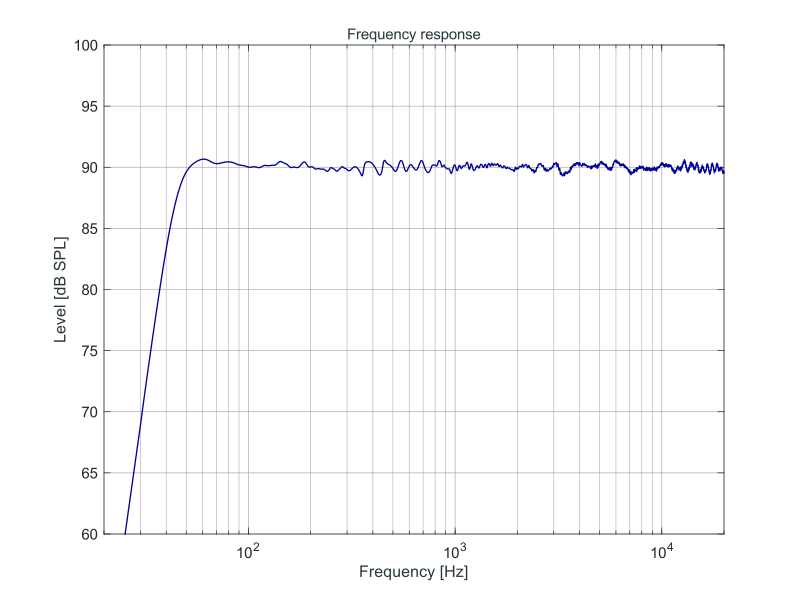
Kittenlabs has a writeup of using Room EQ Wizard to measure impulse response of your specific speakers to create a proper correction. The results are pretty dramatic on a GPD palmtop.
https://kittenlabs.de/blog/2025/04/06/gpd-pocket-4-speaker-d...
If you haven't watched the video btw, I highly recommend it. It's quite amazing how much difference a bit of software can have.
I've always wondered with this, how do you know you're not just measuring the frequency response of your mic?
https://www.allaboutcircuits.com/uploads/articles/CCTB_PUIME...
In contrast, small speakers, especially non-round speakers with plastic diaphragms that are commonly found in laptops, have pretty wild response curves, something like this:
https://www.bestartech.com/wp-content/uploads/2020/09/FRC-BL...
I am skeptical about measurements done using the laptop's microphone, though. These microphone arrays are often designed to be very directional, some laptops have bottom-firing speakers, etc.
For most cheap computer speakers and headphones, you can make them sound better for music and gaming simply by boosting low and high frequencies. And for speech, you often want the opposite...
Or skip both and assume they're "neutral enough"
Noting too, I didn’t find my profile for Framework 13 to be optimal for Framework 13 Pro. I’m still tweaking there, and frustratingly didn’t track my tweaks, but will try to remember to diff at the end and publish the output.
One thing I haven't figured out is how to switch profiles automatically when going from speakers to wired headphone. They register as the same audio sink!
Another important integration point would be the system volume control. If you could EQ your speakers to near flat response, and then apply loudness based on the volume control, you would get great sound at lower volumes without compromising the quality at higher volumes.
I do this currently with EasyEffects equalizer and loudness filters, but for best quality I need to keep the speakers and system volume at preset reference level and control the volume from the loudness filter volume setting.
Interesting article (audio processing should be a standard OS feature), but I wish we'd stop doing this. Speakers were never subjective (unlike earphones), they’re supposed to be flat – “equalised”. At least if you want to hear the thing as it was mastered.
I think it just hurts consumers in the end, as it validates snake oil in the form of various ”enhancements”, like image processing on TVs. It makes stuff really hard to compare and much easier to sell shitty hardware.
Not that I’m opposed to improving shitty hardware with software, – quite the contrary – it’s just the murky subjectivity that irks me.
This was me.
Never had a problem with typical eq/effects and even dabbled in dsp/synths but was defeated by EasyEffects. My attempts at basic tweaks had terrible consequences. I'm sure it was pebkac but the experience felt buggy e.g. my attempts to reduce some painful treble caused the bass to vanish, adjusting volume caused static not loundness etc. Most of the modules have more cryptic numbers than I know what to do with giving the feeling of being trapped in an algebraic equation.
However, downloading some community presets and the results were excellent. Some tiny nudges from there were within my idiot grasp.
fortunately its not large enough to notice unless you already know (i.e. problem for me but not for thee) AND fortunately MPV .conf can set audio offset globally to sync everything nicely, so its not bothering them; but i disable it if im going to play games where i need split second audio cue/reaction
the lack of vst support though, seems like a terrible oversight. obs audio filters with stacked vsts and routing filters can unironically do this programs job better because of the vst support, and depending on the setup choices, with better latency too
For example: https://www.benashby.com/resources/pipewire-vst-carla/
Additional latency can also be dealt in ways that are probably good-enough for streaming/local media. Just make sure the audio output stack has a fixed latency and then adjust Kodi's audio offset to work with it.
thank you for the resource!
Here is one for a recent thinkpad p1 gen8, no app necessary.
https://github.com/chergert/thinkpad-p1-gen8-pipewire-config
MacBook Pro 16’s are great but most others suck.
Analogy: air quality.
What is clean air is objective. Perfumes and aromas are subjective (one man's rose is another's skunk), but they objectively worsen air quality.
0.2% of WHAT?
Now I am about to dig back into my Bitwig DAW, something I haven't done for many years, and dealing with all the issues around clean vs EasyEffects-modified sounds is daunting.
https://github.com/antoinecellerier/speaker-tuning-to-easyef...
All speakers have resonances that add to the sound in ways that frequency response, alone, does not measure. All speakers also have imperfect dynamic response. All speakers have imperfect impedances, which can matter quite a lot to the power amplifier that drives them. All speakers have non-linear phase response. All speakers have different dispersion characteristics.
All speakers then operate within acoustic spaces (like a room in a house) that introduce even more variables.
[1]: https://professionalsupport.dolby.com/s/article/Dolby-Atmos-...
Neumann KH 120 II: https://assets.sennheiser.com/assets/Frequency_response.svg/...
Genelec 8351B: https://images.ctfassets.net/4zjnzn055a4v/3dFPEuC54NYv52ad7J...
I don't think this has been true in my lifetime, at least. Some brands being known for "warmth" vs "brightness" is ages old, before the idea of audiophile earbuds was even a thing. At the extreme end, you can go back at least 40 years to see people with dedicated sub outputs and massively-oversized non-flat subwoofer setups.
But well, that's about sound itself, not all the other stuff like design that people may care about in a loudspeaker.
Is this incorrect?
Speakers don't; a "good" speaker setup with eyes closed and no wind/perceptible airflow and no smell and truthful thermal radiation surroundings is effectively indistinguishable from the real place.
Like, literally.
It's not _possible_ with earphones because you can't not feel their presence without being numb on a good bit of your head.
There are various "ideal" EQ targets for earphones depending on what your model of an ideal audio source is. They all start with a flat response speaker, from then you can model:
- Two speakers right next to the listener's ears. (flat)
- A single speaker 1 metre away in the x axis, in an infinitely-sized anechoic room. (free field)
- Two speakers 30 cm away pointing to a plastic torso at a 90° angle, in a room with reverberations. (B&K/Harman)
- A spherical room lined with speakers, point listener in the centre with no reverberation. (diffuse field)
- An infinite wall of speakers 1 metre away in the x axis. (another method for free field)
- etc
My definition is pretty much the same as yours here, but I know quite a few people who hate listening to music on anything with a relatively flat frequency response.
While any microphone might be able to provide some ballpark info which corrections to start with, laptop mics will be especially poor. Laptop manufacturers consider conferencing the primary use case for mics so they're intentionally placed and oriented to minimize hearing the laptop's speakers. More recent laptops feature far-field mic arrays which often apply DSP processing in hardware such as equalization, acoustic echo cancellation, spatial beamforming and dynamic multi-band compression with little or no control provided at the OS or app level.
If you care about audio it's worth picking a calibrated measurement microphone. It's one of those tools like a multimeter or colorimeter that are just good to have around. Even ~$100 buys a quite good reference mic you can use with REW to improve output from laptop and PC speakers but also home theater audio. If you have or can borrow one of the calibration mics bundled with Denon Audyssey-equipped AVRs, you can download a community-created REW profile for it. Since it's cheap and analog (3.5mm output), it's not as good as any real measurement mic but if you've got one already, it's better than nothing for measuring relative frequency response. However, if you also want to measure things like absolute dB you'll need to measure the input gain of your sound card's ADC with an SPL meter.
These are the ones I have been using. I've generally stuck with the lappy_mctopface variant. I have no idea about the naming, but these presets have been good enough for me without much messing about at all!
In any case, you probably got stock Ubuntu. Anything different from that would mean you have no chance of reinstalling it and getting the same experience, or installing Fedora (which is also officially supported) and getting the same.
I'll bet you a beer that if we had examples of each in a room and spent the time to iterate upon setting them up in the most-optimal of ways that can be concocted, and then went through all of the motions of doing controlled, equatable, blind A/B/X listening: We'd still find that we prefer one loudspeaker system over the other.
And our preferences might not even agree, and that's OK. :)
Said convergence happens for tonality: people do prefer neutrality as in lack of linear and nonlinear distortion (thus relatively constant directivity in order to get said neutrality when the reflected and direct sound sums).
Where there's still some considerable variation is the amount of directivity: some people prefer it wide to get stronger late reflections that give a sense of envelopment and others prefer it narrow to remove more of the room from the global sound, to hear more of the recording (like headphones).
When you know the reference, you are free to break the rules. Otherwise you're just fumbling and drifting around.
Humans are given two brain hemispheres for a reason.
One of the things I often try to impress upon others during $day_job is that it is important to always know and appreciate (and seek to find, and perhaps enhance) the very best way to do a thing.
It's not that we can't cheat. It's not even that cheating isn't sometimes adequate or permissible -- or, sometimes, necessary. Sometimes the most-proper way to achieve a thing within the confines of the constraints is to very deliberately cheat in a defensible fashion.
Like a Wilkinson combiner/splitter when used in the bidirectional RF space: It cheats. (It also works within its limitations and has great value in some applications. It's not universal at all.)
In some cases, cheating even requires review by an engineer to approve a particular method in a particular application.
But when we don't seek to know the best, most-right way to do a thing then we can't even recognize when we're cheating. When cheating and gettin'-'er-done is typical, fast-and-loose becomes the norm instead of the exception, and that's just doing ourselves (and the job, and the company, and the client) an unwarranted disservice.
And that does ultimately is just fumbling and drifting around, just as you succinctly suggest.
But standards aren't the be-all, end-all rule. At least when safety isn't a concern: They should be flexible to preference when preferences exist, and that preference extends beyond salt appropriation.
I once made an accidental purchase after a long day at work where I bought feta instead of the ricotta that I intended to buy. My family was predictably hungry when I got home and realized the depth of my mistake. So I built that lasagna anyway with the "wrong" cheese in the intermediate layers, and it turned out so excellent that I will never make lasagna any other way again. It's really lovely, and it was entirely the result of fumbling.
Or: Chicago, vs NYC, vs Detroit. These guys will never agree on what the best pizza consists of, but most of us can find an example of a pie in any of those regional styles that is lovely and satisfying to us.
It's very easy for me to accept variability in the norms of foods, and of painting styles, and of audio system implementations. I can't define a perfect guitar, or a perfect piano. These are all things that I think deeply involve emotional (perhaps even irrational) personal choice. There can be more than one way, and it's OK. We don't all appreciate the same tastes, sights, and sounds. The variability is a feature, not a bug.
But meanwhile: It's very difficult for me to accept variability in, say, electrical systems. There can be an established and objective best, safest, most-defensible way. And the method behind the walls is not the kind of thing that usually elicits an emotional response from the beholder while they plug in a lamp in their new place, so the best way can win.
Being both a technician and a musician, I couldn't agree more.
The technician in me strives to have as flat, transparent and precise audio reproduction system as possible, with the single purpose: to make what the musician in me does translatable to every other audio system out there, which may very well be quite imperfect, but still intimately known and adapted to by its listener - and thus reproduce my music without surprising the listener in a bad way.
(Funny enough, after many years of chasing that ideal, I'm much closer to it with balanced armature IEMs than with a pair of professional studio monitors at 100x the price!)
An analogy in graphics would be a display with neutral color reproduction that has as perfect black as possible and white as bright as it's sane to have.
It's a never ending quest of course, and it's the creator's one, not spectator's. Which is basically "give me pure silence and transparency so that I know precisely how much sound and color to add". How much is added is a dogma for one and total freedom for another, and that's a completely different story.
From a spectator's point of view, everything becomes much more subjective and roots more in psychology than anything else.
I always remember that interview of a vinyl mastering engineer for the Kompakt label, who said that the art of an audioengineer is that of persuasion. "This sounds awesome, trust me :)
And then, the reconstructive abilities of one's perception also mean a lot.
There's a wonderful passage from the Hesse's Steppenwolf, where the protagonist listens to a gramophone record, noisy and bandlimited, of an orchestra playing a piece, deeper and deeper until he manages to hear the original sound and intent of it through the veil of the record's imperfections.
I shall season the food on my plate however I please, counselor. :)
Also, I'm pretty sure that even in your case, the changes you want to make are material dependent and neutrality would be more to your taste if you don't want to turn knobs with each album switch.
Now enough seriousness, if you're amongst the people who still do so, I'll look at you the same way I look at American tourists putting ketchup over all their dishes or people going to an art gallery with tinted glasses =)
You haven't established that there is a general preference, though.
And meanwhile: Audio systems of every variety still usually come with some manner of tone controls for people to use. And when people make adjustments, they aren't seeking to find alignment with someone else's published idea of a good time.
Most people wouldn't know what a frequency response chart is even if someone rolled it up and hit them on their head with it. They aren't targeting things that they have no knowledge of.
> Also, I'm pretty sure that even in your case, the changes you want to make are material dependent and neutrality would be more to your taste if you don't want to turn knobs with each album switch.
Nope. I usually set my own listening systems to my preference and then leave them alone, although the more-proper stereo does have what I call a Ministry button that I engage when listening to Ministry.
So yeah, anyway. Standards. I did once put together some Python code to implement an ISO 226 equal loudness contour that worked with a hardware DSP and recomputed the curve based on the real-time position of a physical volume control.
Maybe Fletcher and Munson did have it right for what they were doing back in the 1930s, but that didn't make their work applicable to what I was doing in 2025. It was a fun exercise that taught me quite a lot, and which ultimately turned out to be a mistake.
> Now enough seriousness, if you're amongst the people who still do so, I'll look at you the same way I look at American tourists putting ketchup over all their dishes or people going to an art gallery with tinted glasses =)
Oh, yeah. Ketchup on ham sandwiches, and on eggs. Ketchup on cantaloupe. Ketchup in tomato soup. Ketchup on popcorn, and in my coffee. I garnish my martinis with ketchup.
When I drove by a Heinz ketchup factory last weekend in my giant American car, I was overcome by emotion and had to pull over. The juxtaposition was just too majestic and beautiful to behold, with the ketchup plant on one side of the road and the fertilizer distributor on the other; like the whole circle of life, all in one place. I sobbed softly for several minutes before I regained sufficient composure to continue.
Please do yourself a favour, since you seem actually interested in the subject, and pirate this somewhere: https://www.routledge.com/Sound-Reproduction-The-Acoustics-a...