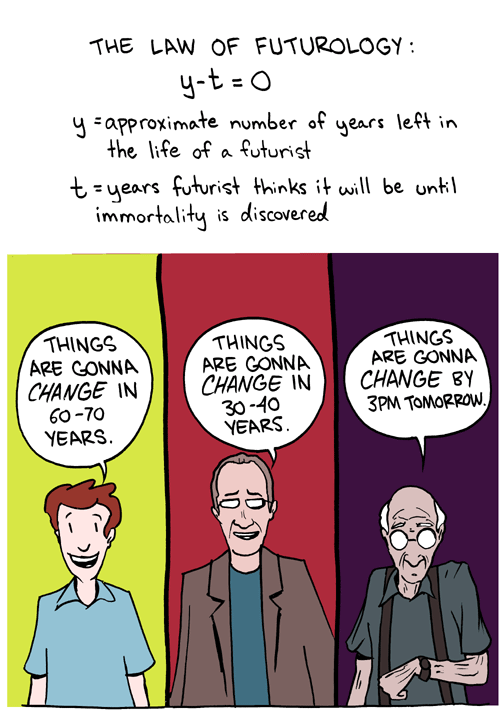
Also consider that the economy isn't rational. Our economy should have tanked several times by now. AI should have fallen apart by now. Meta, Google, Microsoft should have declined. Instead it's record profits. So don't try to make predictions by being rational.
Think about the world before the 2017 "Attention Is All You Need" paper.
Did anyone predict that paper, what preceded and followed it?
Nope.
Same case now.
Maybe the word "prediction" is the problem; "guessing" would be better.
OK, what the heck. I'll make a prediction too:
You better buy SpaceX stock now. The way things are going in the US, the only way we build AI data centers at scale will be in space. Politicians have turned data centers into punching bags to be used to gain votes. We can't build power plants and people are being led to believe all kinds of things. Regardless of which, if any, are true or not, the rate of construction of AI data centers in the US is and will be seriously constrained by realities on the ground.
Hence my prediction: It's all going to space.
Even if you believe they can get cost to launch 1KG down to 100 bucks... (current falcon heavy is $1550) you still have the problem with all those solar panels.
1GW of space AI requires... 1 GW of solar to power it.
Current manufacturers of space solar is 1-2 MW &.. space solar aint cheap. $100 per watt. They estimate each spacex will be 250 kW. So.. $25M just for the solar for each satellite. Yeah you can use less efficient / cheaper solar, but then your weight goes up.
Also... Ground AI datacenters haven't nailed down how quickly GPUs depreciate. Accountants claim 6 years while CRWV says it's longer and most realists say it's shorter. It's based on how quickly GPUs will improve. Which is QUICKLY.
In space you'll have to depreciate GPU, all supporting hardware including the satellite, electronics, solar panels, and launch costs. On the ground it's just the GPU & you can even sell the old one down.
ground based AI needs power. $FRVO is an interesting ticker if you believe in their technology. Just announced a deal with google yesterday.
One correction: SpaceX makes their own solar arrays. The cost is nowhere near what you quoted. Source: I worked for SpaceX for a few years.
Also, you can generate a lot more power in space per unit area due to not having the limitations created by our atmosphere and weather. It's continuous generation at 30 to 40 percent higher per-unit-area radiation. Generation on earth is roughly an inverted parabola (on a good day without clouds and weather) that, at best, if you integrate the area under the power curve, delivers 66% of the total equivalent energy say, a nuclear reactor, could deliver during the same period. So, once you increase radiation from about 1,000 W/m2 (impossible to achieve on earth due to weather and other realities) to 1,400 W/m2, 24/7, no weather, etc. The scenario quickly becomes vastly different.
Geothermal is very interesting, thanks for the ticker, I'll look into it.
All that said, I think the US (and Europe, if they care to survive) needs to have, as a top national priority, a massive program for the construction of nuclear power plants.
A few years ago, I ran through an analysis of power generation needs to convert our entire fleet of vehicles to electric power. That required at least doubling our power generation capacity. This was the equivalent of having to build 1,200 nuclear power plants, each producing 1 GW 24/7.
This is impossible to achieve with solar, or wind, or the combination.
So, even if we decide not to care one bit about AI data centers, we need to double our power generation capacity (and infrastructure to deliver it).
Add AI data centers to that equation and the number could easily climb another 600 nuclear power plants.
Here's the problem that a naïve conversation with an LLM will not uncover: Humanity and Politics.
Could we embark on such a massive energy-generation project? Yes, absolutely.
Is it realistic? Nope. Not even close.
In other words, we can do it but it is impossible...which sounds like an oxymoron until you consider that we have lots of examples of projects that are absolutely plausible that, once they contact political and government reality, quickly become impossible. The best-worst example I always grab is the California high speed train disaster.
He's created a huge following (and is presumably making a lot of money) from pushing a hardcore AI-skeptic narrative, and I can't blame him for seeing that opportunity and running with it. We're ultimately all responsible for recognising these people and weighting their advise as necessary.
Additionally, from a public reputational perspective making bad predictions simply doesn't matter. In finance we're all aware of perma-bears who will predict the sky is about to fall, and when it doesn't just argue that the disaster is still coming, but is taking longer than expected, or that some unforeseeable thing happened which has compounded the risk but has for now kicked the can down the road.
So ultimately, it will be very hard to say Zitron is wrong unless he starts time-boxing his predictions, which I don't believe Zitron has done for obvious reasons.
That said I don't listen to him much at all. I've tried to listen to him a few times, but it's become evident very quickly that he doesn't understand the technical details enough to be making the predictions he's making and seems way too emotionally invested in the arguments he's pushing without good reason. I have strong personal filters for low-quality sources like Zitron – if someone raises enough flags I avoid them like the plague.
And I say this as someone who started as a doomer, and is increasingly a pessimistic pragmatist (“LLMs have value as tools, but not nearly as much monetary value as the main players believe they do”).
I get it though: for those of us who grew up alongside the net and tech sector, who loudly decried M$ greed for ME/Vista/8/11 but celebrated them at XP/7/10, who remembered when Google’s “Don’t Be Evil” was spoken with serious reverence, the current era of tech feels toxic and nauseating. Current AI is a prime target for that discontent, as are the companies whose motives very clearly aren’t societal progress so much as reality authoring and authoritarianism. In that vein, Zitron is magnetic because his entire position is “you’re right to be mad and they’re all going to die from hubris without you having to actually do anything”, which itself panders to the human desire for personally preferential outcomes sans individual effort.
Properly picked apart though, and he has as much substance to offer as the ardent boosters: a handful of “trust me bros” with a smattering of distractions to wind you up, but never actually address your concerns or questions.
I knew that somewhere in the future, something has to give because you can't just go around saying anything without losing some credibility. You still have some ardent followers in his cult of a subreddit.
But just to be clear: Ed is part of a bigger problem in tech journalism which is characterised by extreme pessimism and excessive skepticism. It is not correct to view Ed in isolation rather to see it as a part of the culture in which he can thrive.
[1] https://news.ycombinator.com/item?id=48447549
[2] https://www.theargumentmag.com/p/ais-biggest-critic-has-lost...
But from that point on they basically assumed this role of what financial punditry call perma-bears, people who constantly predict financial doom. It gets clicks and sells subscriptions, which is probably why they do it. But from that point on their predictions weren't very good. If you constantly predict doom then every now and then you'll look like you were a genius, but it's just survivorship bias. People discount all the other times you were wrong.
I don't know a whole lot about Zitron himself. Didn't he get big calling BS on cryptocurrency stuff that actually was BS?
The problem is that AI isn't cryptocurrency. This is very real.
I do suspect there's some bubbly stuff around it. I think data center construction looks very bubbly, especially the totally ludicrous amount of permitted planned data center construction. I bet no more than 20% of that ever comes online. I'm sure there's some AI companies that won't make it, and a bunch that are overvalued. But AI as a whole is real, not just hot air.
I would reply the same regarding this article. Nearly all of these refutations are unconvincing.
The claim: "I believe we're reaching the upper limits about what generative AI can do and how accurate its outputs can be."
The rebuttal: "Zitron's argument at the time was that hallucinations were as good as they were going to get, which meant that AI performance is capped at 2024 levels. Both the overall prediction and the mechanism were wrong. This one seemed wrong at the time, in that I noted here in 2024 that you can make AI code halfway decently by just putting it in a loop and having it run until the code compiles and tests pass"
Putting an LLM in a loop, burning tokens, and thrashing against a compiler and test suite is a ridiculous way to say that hallucinations have been "solved". Please. This is absurd.
In 2004.
And he'd been talking about it before then.
People thought Max Keiser was a crank; instead he made detailed predictions based on his intuitions, limited insider feedback and cold hard facts. He couldn't say exactly when it would happen; he laid out some horsemen you could expect for the apocalypse and this was one.
The thing about a bubble is everything is fine until it isn't. And it's worth observing that key parts of what Zitron is discussing has been covered in the WSJ and FT.
It's all very well posting numbers to "disprove" him when what he is pointing out is that the AI hype train is delusional and the costs are buried.
But Zitron is directionally correct, I think, particularly with regards to Oracle, where things he has said have literally come true.
Frankly as a Brit I remain amused at how much Zitron winds Americans up just by being himself — sweary, vulgar, rude, catty. And since non-Brits can't read Brits, Luu has to engage in pretty immature character assassination about it.
> He found a niche in anti-tech grift, and is now exploiting the niche for all he can.
I think it's really, really, really important to have a contrarian opinion out there, even it's a voice howling in the wilderness. Even if most of his predictions are wrong. Even if he swears a lot and gets a bit ranty at times.
Personally, I think he's going to be mostly right in the long term about the AI bubble, but mostly wrong in the long term about the effectiveness of AI (i.e. I think it will have a net-positive effect in the long term).
I always keep in mind the Gartner Hype Cycle [0] is true, and we're still on the initial slope up to the Peak Of Inflated Expectations.
Maybe he is well meaning, but it's pretty common these types are just milking an audience that they dialed in on with zero regard for integrity or honesty.
Also, Google's recent profits are boosted from including SpaceX. $94.18 billion.
https://finance.yahoo.com/markets/stocks/articles/google-par...: On Aug. 6, Alphabet filed its 13F with regulators covering its second-quarter trading activity. Given that SpaceX went public on June 12, Google's parent company is now required to include its SpaceX holdings in its quarterly 13F.
Zitron is never right but he exists so that media can claim to be balanced.
Zitron is just, like Dan Luu says, wrong about everything and doesn't care anymore, he's in the business of extracting money from his engagement.
I will say, the first part Mr. Luu says about big tech not being out of ideas is pure horse shit. Anyone who has worked in big tech knows that leadership at those companies can have no idea what they are doing and still be successful in earnings or the stock market. They are sometimes successful despite themselves.
So why do we carr exactly?
> Now, if your CEO has never heard the phrase Ralph Loop, oh man, you are less than 30 days away from your next promotion. I'm not even exaggerating. Walk into his office, close the door, and say, hey chief, been experimenting with something. It's called Ralph Loops. And I think it could change literally everything. And he's gonna say, what's a Ralph loop? And you will say, give me $18,000 worth of API credits and I'll show you. Now you won't actually do anything, because you can't do anything. Because nobody can, because nobody knows what they're doing. But by the time he figures that out, you'll have a new title, and equity bump. [...]
> Talk about automation constantly. Nothing arouses the slumbering capitalists than the mention of automation. Drop names too, bro. Like talk about specific team members you can automate out of existence. Be like, yo, I automated Gary, bro. Tag Gary in the message. Tag him in Slack in a very public channel. Be like, yo, I just automated @Gary. His function has been Ralph Looped. And tag your CEO in the same message. You think you're getting laid off after that?
But for the bloombergs and other podcasts I would have expected them to do a bit of research. I honestly think with the amount of doubling down he's been doing that he's a grifter.
I'm not Ed's biggest fan, but he's been pointing out some very important things for quite some time now, regarding the ludicrous over-investments going on around so many companies that are completely and utterly devoid of profits and will likely never have any.
Would love to see broken down counter example of public company.
So far Chegg and Duolingo have been devastated. Surely they could cut costs drastically with AI?
You also dont have to pay.
That’s what HN sells these days. Fake bot comments to prop up wannabe celebs and startups
“You pay, we spray”
I am not all in on AI, but the discussion requires nuance. Zitron does not have it because he is interested in attention and not discussion. The article deconstructs his antics really well. So again thank you. I really appreciated this part
> To make the case that these things are dying, he pulls on minor issues that are not positioned to cause the very large changes he suggests are about to occur. For Meta, he cited some kind of alleged MAU drop for Facebook. Rather than use Meta's own MAU figures or any kind of revenue or profit numbers, he seems to have used numbers from Similarweb. My experience with 3rd party tracking numbers like this is that they're quite inaccurate and generally useless for anything other than a rough order of magnitude comparison, making the Zitron's cited decline meaningless. FB stopped reporting MAU publicly in December 2023, but most estimates have FB MAU increasing over time and the numbers Meta does report show generally increasing usage over time for their products; Zitron cherry-picked an outlier low estimate to make his point.
Yes he is a classic cherry picker.
These companies are all heavily buoyed by their investments in AI which is essentially an oroboros of money.
Can I try?
> But when people bring him up, they're of course not generally citing his anger
Wrong.
> Google has been increasing the relative priority of revenue over the user experience over time
Wrong.
> I'm curious what people do after being on the wrong side
Wrong.
Some of the claims categorized as "wrong" are also completely true, such as training hitting diminishing returns. New models are barely an improvement and most people I know stuck on Opus 4.6 over any newer one for example.
Exact same thing for the claim "the fact we're running out of high quality training data and we're hitting the walls of scaling laws, in the training paradigm, these models aren't getting better. What we're seeing today is pretty much what they're always gonna be like".
If anything, model performance has regressed in actual use (i.e. not benchmarks) for the past half a year.
OK, but the first instance of a claim of diminishing returns was in February 2024, when GPT-4 was the best model available. Do you really think improvement since then has been minimal?
1 - Their numbers have also exploded, so I have no idea of any general rule.
You don’t have to spend effort proving him wrong. Just don’t read it and move on with your life. Regardless of which “side” of AI you’re on it’s kinda ridiculous how much effort gets spent on screaming gotcha at this one commentator.
So then we should be calling Dario out every time he opens his mouth, right?
No reason really. Just very sleep deprived and want to multitask in between agentic feedback.
Some people obviously want AI to fail. Some people obviously want The Magic Machines to win.
https://247wallst.com/investing/2026/08/17/alphabet-meta-and...
Good critique of LLMs & the companies behind them is hard to find, and it is harder when people gravitate towards this sort of thinking.
> For example, with a style that could be described as the opposite of clickbait, Simon Willison has written what I suspect is the most widely read blog among programmers for the past 3-4 years (in the same way that, at various times in the past, Joel Spolsky or Jeff Atwood or Steve Yegge seemed to be the most widely read programmer among programmers). Among programmers and other serious users of AI, I would guess that Willison has a larger audience than Zitron.
I have no idea Simon Willison is the most widely read blog among programmers. I truly have no idea, and I've been programming for just a decade.
A lot of Simon's blogs posted here are when new LLM models are released, on how good are these LLM models create pelican riding a bike using SVGs. Nothing particularly interesting to me.
I truly have no idea why would people be interested in blogs about LLM creating pelican riding a bike svgs every single time a new model is released. Maybe its a proof of AGI/ASI for some?
I guess to me, Simon Willison will always be the "create-a-pelican-riding-a-bike-using-svg-dude".
This is one of the most important learnings one can make from working in professional environments.
also statements can be interpreted many ways:
"Meta is dying" was countered by "Meta's revenue has increased since Zitron said that". OK, but 1) revenue/profit is only one measure of "not dying"; 2) what's the time scale? Nokia and Xerox were highly profitable companies that dominated their industries, and any prediction that they would go out of business at their height would have been laughed at, and yet, it wasn't too much later that they pretty much did.
So from that standpoint, I guess it would make sense that a personality like that would now have ended up at the AI topic.
I would like to see a comparison with predictions of the pro-AI bubble and their hit rates though. This writing feels as selective as it tries to paint Zitron as.
the analogy to Ehrlich was strikingly apt
Collapse of entire economies will result on a scale that will eclipse the great depression. And it wont be because AI revolutionized anything. AI will become a dirty word to never be uttered by anyone in the human race after.
The author attempts to virtual signal as impartial but fails horridly.
US has 1.5x the money supply since Covid. This means everything has to go up 1.5x to reach the same parity from before. eg inflation. All corporate earnings are going to inflate as 1b yesterday is 1.5b today.
There is no whete for these mega corps to go. They dont know how to grow. meta becoming well meta with the vr crap is case and point. meta blowing billions on a few hyped AI people is the nail.
Other than cloud, microsft/google aimt doing anything. xbox? nope, hardware? nah. It is all attention economy or selling the pick axes for it.
the only mega corp that still seems to be moving the needle is apple which i think speaks volumes.
Eds point is that AI tam or expectations are insane full stop and he admits coding has a use just not as big of a tam. Gen ai in art, music, etc did not take off at all esp compared to code. this makes sense, no one pays an artist 500k/year. their time is worth little compared to coding.
Where he is wrong tho is that this is not new. there is always a hype cycle of nonsense that screws the little people. what is new is the level of polarization. it feels like ai psychosis right now in ways that remind me of crypto but worse because ai is actually useful so people are even more insufferable.
that'll obviously never happen. it's wishful thinking and venting tbh. that's why i like listening to his stuff.
it's better than reading the wholly AI slop docs my CEO keeps sending out
E.g. a company of the size of Meta/Google/Ms may very well be dying and still producing numbers that look like growth for the next few years.
---
Also, how in the world is a Jan 2025 prediction that "I believe we’re at peak AI" getting a simple "Wrong"? How are we deciding what "peak AI" is here?
---
Or, "July 2025: I am not trying to be dramatic, but it's pretty easy to come to the conclusion that Cursor is going to die" -> "Wrong (Cursor gets a $60B exit)"
So Cursor can't die once its been acquired? See https://news.ycombinator.com/item?id=49486172
---
"August 2025: These models have clearly hit a wall where training is hitting diminishing returns" -> "Wrong"
I guess this is just trolling at this point? This is like a research paper tier question, "wrong" doesn't cut it.
---
Very unimpressed with this analysis. Extremely poorly done, and pretty clearly not impartial at all. Shameful. Like, the guy does sound wrong to me, but the analysis is terrible nonetheless.
One annoying side effect is that YouTube's algorithms will always try to force feed you more of the things you last searched, to amplify your biases and send you down the doomscroll rabbit hole. So if you search for Zitron, next time you visit you'll be flooded senselessly with naysayers, contrarians and skeptics from all courses of life.
If the frontier labs suddenly found themselves unable to compete with cheap open weight models running on widely available compute, then one might expect the frontier labs to be the only ones exposed to that risk, while a chip-manufacturer like nvidia could thrive in either environment. A partnership or commitment from the chip manufacturers to the frontier labs could change that. Whether that kind of inescapable connection exists is hard to predict without a lot of specific modeling, and at this point I'm inclined to think that neither chip nor datacenter demand is going to drop any time soon, and that the commitments would be unwound before a company like nvidia is threatened.
Zitron implied 2 years ago that OpenAI would collapse by now. How's that bubble popping going? All NVDA+memory co+frontier lab numbers are accelerating
And to be clear, a bubble popping doesn’t mean that AI goes away forever.
What it does mean is that we’ll see some kind of economic crash or recession, and we’ll probably see at least one big company fail or go bankrupt/restructure.
OpenAI is the company in most obvious peril.
I happen to think that Nvidia is in a more perilous position than they appear. Their hardware advancement pace is relatively weak and they’re in a crypto-like hardware bubble where they’re one technology breakthrough away from a complete collapse in demand for their AI data center solutions. They’re also doing a lot of sketchy hardware financing schemes.
TL;DR: Ed is directionally correct, but it's anyone's guess as to the exact timing.
In the meantime I'm not going to complain about subsidized credits from the big labs. :-)
I've spent a lot of time with Duolingo learners. They're all pre-A1. You're just lying to yourself to make yourself think your phone addiction isn't "that bad." Take a real language class.
Personally, I don't bet in rigged games, which is what all the circular financing is.
Frequently we'll hear from Amodei that AI is 6 months or 12 months out from replacing Software Engineers. Or we'll hear that their model is safe when regulators step in, but suddenly it's too dangerous and hacked its way towards its goal when other companies claim the same.
What they have in common with Ed Zitron is that they are both trying to sell you something.
Zitron is saying that the hyperscalers had no genuine growth opportunities, so they're using the AI bubble to achieve growth. The fact that they've continued to grow for a few years doesn't contradict his point, and Meta's steadily decreasing profit margin certainly doesn't look healthy.
The current AI build and boom has done wonders to their bottom lines in the immediate, but even Wall Street has its limits, and it sounds like there’s decreasing appetite for such CAPEX builds without associated proven revenue. That might kill some companies outright, but more likely it’ll force the major CSPs into the churn cycle that much faster.
Luu also fixates on Zitron mentioning Prabhakar Raghavan, but then proceeds to agree with Zitron's core point that Google has intentionally degraded it's search product to maximize revenue. Maybe Raghavan is not solely responsible, but it seems fair to hold him accountable for trends that accelerated under his leadership.
AI is a big field. Hating on AI is like hating food because you don't like broccoli.
Robotics AI that replaces high risk labor and even low risk repetitive stress labor is nothing but a win for humanity.
> Wrong (Zitron continues to write despite repeatedly being proven wrong)
Technically he didn't say he would stop if he was proven wrong.
Ed Zitron mostly covers the costs of data centers, circular spending, and predictions of large the market for AI has to be to justify the data center expenditures.
I was disappointed this article didn’t really cover Zitron’s main arguments.
Maybe a paid article placement? I don’t know, but I was dissapointed: I read Zitron’s material and I wanted to see good counter arguments to his rants about costs of data centers, circular spending, and predictions of large the market for AI has to be to justify the data center expenditures arguments.
He is making predictions with specific timelines. No one is forcing him to do that. It is reasonable criticism to say he is make poor predictions.
What likely resonates is AI really does feel like a science experiment. There is clearly real value here. The problem is that the economic value has yet to catch up with the technological value. And yet the claims coming from AI companies have the unmistakable energy of a state-fair entrepreneur standing beside a suspicious knife yelling, “You have never seen anything like this before, it slices it dices...!”
I think Ed goes too far when he compares LLMs to garbage. He’s tried them, had a handful of bad experiences, and apparently decided the entire technology belongs in the round file. But much of what humans do is essentially trial and error with better PR: apply some logic, see what happens, adjust, try again, and continue until you eventually solve the problem.
If you can get an LLM to reliably do that, you can solve certain classes of problems dramatically faster.
e.g.
>April 2025: "It also, at this point, is pretty obvious that generative AI isn't going to do much more than it does today." >>Wrong
Is generative AI really doing much more today relative to 1.5 years ago? Sure there have been sone improvements, but i feel like nothing fundamental has shifted in that time period. Nor would i really expect it to even if the statement was false, but it seems too early to tell.
Shouldn't society have a clever name for people playing these roles by now? Something catchy, insulting and based on truth might help call this out easier. I would throw influencers in there too, they are writing/video-loggin/podcasting for the same money outcome.
- Hyperscalers like Goog, Meta, Msft invest cash in Anthropic, OpenAI, in exchange for equity
- The ongoing investment actually boosts the valuations in the Anthr/OpenAI (new raises are done at higher valuations), so the valuation of the Hyperscaler's existing investments in Anthr/OpenAI increases, which gets recorded as Other Income in quarterly earnings
- Much of that invested cash will itself come back (circularly) to the hyperscalers as revenue since Anthropic and OpenAI spend a lot of money via datacenters etc.
On Other Income phenomenon, see for example, https://www.ft.com/content/be97df0a-76b1-4cb0-9ba4-d1117d8d1...
Also, there's apparently lots of off-balance sheet debt. For example https://www.ft.com/content/a0a07cce-6d19-4b1e-a73b-9855a06ba...
But taking claims from Sundar about 750M gemini users in 2025 at face value is disingenuous. This basically includes everyone who owns an android phone and opened a Gmail and Google search, translate. Congrats, you are gemini user now. Every product has received AI "feature", like your android assistant offering to listen to you while the screen is still locked by default. Dan's only sources are press releases of the AI companies. As I'm reading this, he dedicates at least 3 paraghraphs showing how Ed is wrong. And keeps coming back to it again and again. Okay so we are both refuted and proven wrong, but is that really the extent of AI use? Is this the revolution? Replacing existing function with inaccurate AI sourced from reddit posts?
I've read a number of both blogs. I'm not gonna watch Diary of CEO video. Yes, models have gotten crazy good in 2 years. Still the same failure modes. Dan's writing here comes across as same type of gish gash he rails against, minus the entertainment value.
I don't get why people make such a big deal off bears and bulls. Everyone is on one of these sides at every investment they make or liquidate.
My point is: all analysis is contingent, there is no point in saying bulls or bears are chronically wrong or that they should beat the market to merit being listened to.
For example, one of his first big criticisms of Ed is Ed's claim that Meta has a dying product and its a dying company. Do I really need to look at the numbers here? Or should we look at the companies actions and history WITH the numbers included?:
- Metaverse was a complete and total disaster and forced upon the company by a CEO who is clearly completely out of touch but infallible within the company.
- Facebook is a bot riddled, AI slop haven, used only for special cases and is basically unanimously hated by the next couple generation of users. Users who are critical for revenue if the serving ads to bots scam ever implodes.
- Meta's successes seem to be solely on knowing who to buy and have failed for a decade to innovate anything.
"Dying" is not the same as "dead". As someone else has said, but I have forgotten who it was, Meta is a "mature" company trying to be young and sexy again when they should focus on their existing products.
How does anyone come away from all this with a business, where we hear all of the horrible things about their internal culture, that an AI pivot to be anything but a trend following desperation move? Then the author addresses but shrugs off entirely the fact that they now hide their Monthly Active Users. I think all of this context is pretty fucking important to think about with the numbers, especially since Meta is trending down when we get the totals for the year. Zitron's point, again, still tracks because you can list a portion of "profit" but it is too early for 2026 since they intentionally use misleading numbers. I would be very interested to see what the first half of 2024 and 2025 profit numbers were before the total year calculation. Either way, Meta's dump into AI is a huge gamble from the company that must pay off.
I don't know. I think this guy does not like Ed Zitron, which is fair. I see a man pointing fingers at someone while doing the same things he is criticising: Taking the speculative and sensational as literal and using it as some sort of gotcha to be speculative and sensational themselves.
This did give me a good chuckle
document.getElementsByTagName('main')[0].style.maxWidth = '39em';when those valuation gains are in turn the result of circular financing schemes (a bakery giving out money so that people buy bread from it), we're getting to a dangerous situation
Whether it matters we don’t know yet, but it’s a fact worth noting. A better article might have tried to argue why it doesn’t matter
https://www.acadian-asset.com/investment-insights/owenomics/...
Yes the investments do increase GAAP, but these are seperate line items from revenue which is what is listed in the article.
Alphabet is the biggest winner in this department, it's investments gain/losses for the same period as in the article was:
2023: -$1.45B
2024: +$2.24B
2025: +$24.90B
Yes thats a lot, but compared to it's seperate revenue growth of nearly $100B in the same period, it's not that much.
The more interesting thing is the needle and if the bubble will run into one.
What has improved isn't the models, it's the harnesses.
Give GPT-3.5 a 1M context window and a modern harness, and you won't see any meaningful difference with Opus 5.
It's a bit hard to try with such old models, but for example I use Opus 5 / Fable at work and Sonnet 4.5 at home (because it's free via Amazon Q), and there's absolutely 0 difference in performance. None. Obviously 4.5 is only a year old, not 3, but try with any older model that has a decent context window and you'll get the same results.
In fact I'll go further than this and say that models are currently regressing. Opus 5 is much much worse than Opus 4.6 for example, and it's clear that Anthropic (at least - I don't use OpenAI models much) is just tokenmaxing rather than optimizing for performance.
>models are currently regressing. Opus 5 is much much worse than Opus 4.6
I'm in sheer awe at these takes. Literally beyond parody.
It's just a question of what the entertainment is. Some people feel good about being told "we were being hoodwinked; there are lizard people" and others feel good about being told "you'll be 100x healthier and good looking if you take these supplements" and others feel good about being told "these people are evil demons who are stealing your water" and others feel good about being told "these idiot rich people are going to lose their shirts" and so on and so forth. It's like how I like slice of life shows and hate horror movies and my wife likes horror movies.
In a sense, the misinformation gambit of LLMs did not come fully to fruition in the West (as much as it has in 3rd world WhatsApp forward land) because the locals were already a fertile ground of poor epistemic hygiene and well served by human providers of misinformation. Hacker News itself only has some hundred thousand commenters or so and even this requires a practice of aggressive information curation to prevent unrepentant misinformation repetition nodes from polluting one's belief set.
For him, it's enough to be right once, even in 3 years from now.
Tech companies invested in AI: AI is amazing (so good, it might kill us all, help?), and the ROI is going to be amazing.
NVIDIA specifically: We will allocate cash in strange deals that makes it looks like we're making investments but actually we're buying sales from those companies as they'll spend the money back with us, and everyone seems to think that's OK because the share price is going stinkers.
Cynics: AI is a scourge on society, and the fiscals are circular and a scourge on the economic stability of the planet.
The more nuanced argument I take is that Zitron is right about the circular finances and hyperinflation of valuations, and wrong about the utility of AI to help people. The Tech companies are just outright wrong about the finances, but right about everything else. And, NVIDIA's time will come, and it won't be pretty.
None of this requires me to believe that if Ed says something it must be true or false. It's just another data point, and he does uncover information I can't find myself that checks out. The fact he is wrong about the functional utility of AI or that he's getting super focused on hyperscalers when the real issues are in Oracle and NVIDIA, I can live with.
Zitron has a somewhat ranting style. Luu's passage on Google search for example just nitpicks on the person that Zitron allegedly named as responsible for the decline of Google search.
The real issue of course is that search quality clearly has gone down. What does Luu want? A "study"? Everyone can see that. The person is not the issue.
This is a highly selective analysis of Zitron's writings that focuses on a couple of mistakes. People need to understand that any normie will understand the difference between rants, numbers and speculation in Zitron's essays. They are not written for autists who talk of "priors" and "evidence".
While reading this I was thinking it would be interesting to see just a few examples of Zitron predictions that he got right. Since you appear to follow his work, do you know of any?
In April 2025, Zitron wrote [1] "I am sick and tired of everybody pretending that generative AI is the next big thing." This was at the time when AI coding tools had already gone "mainstream" with devs, and pretty much everyone was using tools like GH Copilot, Cursor, or something similar.
So I replied with this observation, saying how, at least within software engineers, AI is being adopted faster than any technology before [2]. To stay objective, obviously I brought receipts: sharing how, based on an older survey I ran, ~75% of devs in that survey said they used AI coding tools. Zitron made fun of the small sample size (216 people), blocked, and pretended like AI had zero PMF anywhere in the world.
I stopped taking him seriously since then. And I'm wondering ever since: does he deliberately only look at numbers and facts that he can tell the AI doomer story around? Or is it more that he finds that there's not many people who are "informed sceptics", and decided to play this role?
[1] https://x.com/edzitron/status/1916903519594156407?s=20
[2] https://x.com/GergelyOrosz/status/1916906481686921483?s=20
BTW, the tool I used to block HN is called Foqos, which, of course, I heard about right here on HN. Based on my screen time reports, I got back about 2 hours per day average after blocking all my favorite sites.
The best part is the spreadsheet, which makes him sound like he's just sloppy, but danluu specifically says he's being deliberately misleading elsewhere, like the opposite of hanlon's razor now? So is he being deliberately sloppy in his spreadsheets or is he just incompetent? I suppose both is a better read but you need more proof for the "deliberately misleading" line and the spreadsheet frankly is danluu's best evidence beyond the list of failed predictions which is less striking in my mind.
While I think he's probably wrong on the timing, which clearly has been wrong since 2024, it doesn't really address the greater critique, which is that ai companies and nvidia and memory manufacturers need revenues collectively in the trillions to make their investors whole. That is still unsustainable such that it's been called out by other investors and financial journalists.
Does Dan Luu still work at Nvidia?
> I had ChatGPT give me a list of predictions (with no attempted tilt towards correct or incorrect predictions) and then I skimmed/read the posts that ChatGPT linked to.
yeah alright
> If I really thought about it, I probably could've found something better to do with the time
Extremely likely.
> And yet, it would seem that my fact checking process is a lot more thorough than Zitron's.
Dan says in his post he fact checked with Chat-GPT and Claude, so: lmao.
You don't say.
- the existence and severity of the financial AI bubble
- the claimed efficacy of AI in terms of its utility vs the actual observed utility
- whether the net good provided by AI outweighs its very heavy costs
I find the section of listing a bunch of selected "predictions" and just saying "Wrong" to elucidate very little. Not that a sentence is sufficient to provide explanation, but Dan stops even doing that bare minimum partway through and just saying "Wrong" full-stop. The reasoning is left up to the reader I guess?
How is it wrong? What was the actual thesis behind it? Is the underlying idea wrong or just the specifics on execution? Was there undetermined factors that mled to the wrong prediction? What can we learn from those factors in order to update our model?
We saw that even though the underlying financials in 2008 were trash and lots of people knew they were trash, things didn't quite collapse in the time frame or way we expected, because an unknown part is how much shenanigans companies can do to extend the runway.
As an example, credit ratings agencies didn't drop ratings to match reality because of customer relation incentives, which is a factor that is not easy to account for and strongly affects the timing of the collapse.
I find the positive reactions to this blog to be confusing. I feel like I learned nothing at all, which makes sense considering under "why write this?" he says "I got four hours of sleep and my brain wasn't good for much of anything and I saw someone posted a screenshot of a reddit post dunking on Ed Zitron's prediction record."
Also, back when elon had bought twitter and had been firing people left and right, it was prophesied that with such inept management the company was going to collapse very soon. I thought it was obvious it would collapse. But that has not happened (yet, but it's been quite some years), and the service seems to be holding up after some initial shakiness.
I have seen some wild failure modes from people who are outsourcing their thinking to LLM. Amendments to clauses that don't make English sense. Multi-paragraph long replies in emails that say nothing specific to the issue at hand. Responding to questions with "AI says this" (but I asked you, not the LLM). Leadership wants us to embrace AI but there is no product for the layperson, it feels like everything is front end + generic prompts + $LLM_API_key. People want to make customer service bots that have access to personal data.
I feel like software devs are so lucky in that at least people in your field can see an LLM for what it is and harness (no pun intended) it appropriately. As a lay user, no such luck. Leadership and purse strings are far removed from IC work and don't understand why an AI product wouldn't work, they've heard otherwise in their circles, you had better make it work so that they can claim to have delivered an AI transformation this year.
Enter Zitron.
Zitron is a woo-pushing grifter (his product: his stance on AI). Even without examining his reasoning or the accuracy of his predictions, Zitron is hard to listen to. Mostly, he shouts out a constant barrage of bare assertions that his research is thorough and irrefutable and the doom is coming and ever "AI booster" who disagrees with him is an idiot, all the while without actually spending time arguing his point.
But Zitron feels like one of the few people actually pushing back against this craze.
I would very much like a better argument for a position that I support, please and thank you.
It seems like investing in tulip bulb futures to me.
From there everything split into two factions, which I’ll dub as believers and non-believers. From there, it has entirely been a cult following despite the evidence showing that models and agents have legs for software development.
FWIW my post history would show my extreme skepticism, and to an extent I still am. I think the real power of models isn’t the model at all but the harnesses.
Either way I think he lost the plot and runs on vibes himself. I also think this whole AI movement is going to have their 2000/2008 moment before the phoenix rises from the ashes.
All tools, AI included, have a business end and as long as you point that away from yourself you will be fine. But to properly apply it (rather than as a faster way to make a huge mess) takes discipline and being methodical. It was never different.
If they were doing so well why the layoffs? Why the tightening both in salaries and perks and work life balance? Why so many choices disrupting morale for their employees?
The problem with judging Alphabet and Meta on aggregate performance is that their advertising businesses print so much money that they can invest everything in a boondoggle and coast when it blows up. Zuckerberg burned $100,000,000,000 on the metaverse and it didn’t make a dent.
That said, Alphabet and Meta are borrowing against their future advertising profits to fund their AI boondoggles. If the advertising businesses keep growing then they’re somewhat insulated from their own missteps but the reliability of the advertising business depends on companies having money to spend on advertising.
The metaverse was mostly self-contained and the failure had zero consequence for the broader economy. AI on the other hand, every major fund is investing everything into AI companies. Every advertiser is using subsidized AI tools to generate hyper specific adverts. If this all goes south, who knows how advertising spend will be impacted.
Google specifically are backstopping billions in data centre build out costs. They’ve committed to spending, like, all of their cash to data centres. If the market gets nervous and funding disappears, Google are deep in the hole.
Anthropic “invested” $50bn in data centers to be built by Fluidstack who raised a billion dollars from Situational Awareness who used their Anthropic ownership to raise money to fund these investments. Google are backstopping much of the Fluidstack build out, i.e: if Fluidstack goes out of business then Google is on the hook for $10bn+ in costs. And Google’s Anthropic investment makes up like $100bn on the balance sheet. So, Anthropic fails to live up to expectations and fails to pay Fluidstack who can’t pay their suppliers which puts Google on the hook to hand over tens of billions in cash while at the same time their biggest investment is going down the pan.
The top line numbers don’t really do justice to the scale of the risk. You need to look at the long term commitments they’re making.
Was this hit piece prompted by Zitron being mentioned in the tech scene lately?
https://lwn.net/Articles/1091245/
I don't know. If you post walls of text and ramble on like Luu, perhaps you are sitting in a glass house?
It is ironic that Zitron is accused of having a cult following whereas Luu clearly has one, here at least.
> list 50 predictions by Ray Kurzweil that he made before 2005, the date he made the prediction, and whether to not his prediction was correct. If it was correct, give some proof.
Of the 50 that were listed, 43 were correct, 7 incorrect.
Sorry which test results? The gamed benchmarks?
But this article is not nearly as impartial as it claims to be. It interprets all Zitron's claims in a narrow and overly-literal way. Missing the point and refuting a technicality.
For example, looking at the last 3 year's revenue/profit growth. This tells us nothing without looking at a larger context. Has revenue growth slowed down? Have profit margins compressed? What makes up the income and has that changed? Etc.
I think anyone being intellectually honest understands that these tables alone don't refute Zitron's claims that big tech are "dying and thrashing around" which is something that could take many years and easily hide under these kind of top line / bottom line numbers. (Maybe further analysis would refute the claim, but that analysis is not present here.)
Or Zitron's claims that AI capabilities are "reaching the upper limits" back in 2024. I don't think even Zitron would disagree that AI capabilities have grown since then, but that doesn't refute his point. How long the "reaching" takes and how wide the "upper limits" are is completely up to a subjective interpretation, which this post makes no attempt to even explore.
By all means dunk on futurists. But at least steelman their positions or you look just as biased as them. (Although maybe I am off base and this bias is meant to be clear from the start by admitting to pro-AI predictions all the way back in 2015.)
If your point is just that there may be an AI bubble, then yes the fact that it hasn't popped yet does not prove it wrong. But that's not what Ed Zitron is saying; he's making very specific statements that happen to be wrong time and time again.
As many said in the comments, it's common for doomers to keep predicting a crisis, every month and every year and so on, until inevitably a crisis does occur and they claim they were right. That's not how it works.
1. Conversational AI - this is ubiquitous now, but not sure it's increasing at any significant rate. At least my personal usage has leveled off. Also probably not a significant driver of per token demand relative to code gen. More a driver of subscription revenue.
2. Code Generation - this is the big killer app, which I suspect has driven most if not all of the last year's revenue growth for Anthropic and to a lesser extent OpenAI. Now, I doubt we can extrapolate that growth given 1) how quickly and completely CC has been adopted by the industry and developers and 2) how corps are reigning in spend
3. Image and Video Generation - this honestly strikes me as more of a trifle/novelty than anything else. Granted I'm not a visual artist but I don't see it being a killer app anywhere to the extent of code generation.
4. Physical AI - this is the wildcard for me, but also beyond my ability to conceptualize its effects on demand. I suspect a proliferation of self driving and autonomous robotics would be a huge driver of compute demand but who knows how close we are to proliferation?
I have heard multiple breathless press releases warning that the end of white collar work is "just 6 months away" and that people not using the latest Mythos/Fable/Whatever model will be hopelessly left behind.
1. Zitron claims model capability has peaked 2. Zitron claims AI lab growth (user and revenue) has stalled.
In the first case, TFA refutes by claiming 'wrong' repeatedly, which does not convince me of anything. If anything, Zitron is probably right in this regard, since the majority of progress in recent LLM tech has been setting up of guardrails to cajole the models using 'agents'.
In the second case, numbers are given showing growth, directly refuting Zitron. However, I'm giving Zitron the benefit of the doubt, given the old saying - market can remain irrational far longer than you can remain solvent. As long as people can be convinced that the sky is falling, rational predictions rarely pan out.
… I mean, this feels slightly irrelevant? Orion _does_ seem to have been demoted from 5 to 4.5; that they later released something they felt they could reasonably call gpt5 feels slightly beside the point there.
I think the worst thing that happened to him was AI skepticism becoming a political position. This gave him a captive audience - as long as he says what they want to hear, which means that he can never ever concede that he might have been wrong or that AI might actually be progressing or having successes.
This is not conducive to good prediction long-term - rather it leads one to a state of cognitive dissonance where one's chosen enemies must be simultaneously terrifyingly powerful and incompetent dunces. The propagandist's disease.
He used to be really thoughtful and funny about the topics he took on. And I realize that's pretty standard for a critic. But now he just keeps digging deeper and deeper, getting more things wrong post after post. His posts have grown to probably 3x the frequency and 3x the length of when he was talking about stuff like Google tanking their Search business by bringing in the Ad guys.
He really used to be a "little extreme" with some really grounded viewpoints. Now it's more like he's performing the "angry british guy" in order to maintain his impression count and audience.
It reminds me a LOT of that Eli Schiff guy in the design world. A mediocre designer who couldn't get untangled from one specific design style, who figured out that anger drives clicks. Schiff became a "design critic" who eventually fell down the alt-right pathway and ended up becoming a pariah. I'm not saying Zitron is gonna turn into some right wing nutjob, but he's falling down the nutjob path right now in real time by consistently staking out the worst ungrounded takes and continually doubling down on them.
Look at his incentives. It makes more sense.
A lot of people desperately want AI to be a nothingburger. Thus, they will seek a second opinion that just so happens to line up with their existing one. Wishful thinking at its finest.
Thank you Ed!
To pick a specific piece of public information to support my claim: the previous SVP of ads quit immediately before the coup to start a subscription based search engine.
One nonpublic piece of information: basically every member of search leadership was pushed out within two years of his ascension.
It's interesting how he has pivoted from denying that LLMs are useful to accusing frontier labs of Enron-scale fraud.
I suppose it's the natural pivot you have to make when your whole business is an anti-AI newsletter that costs $7 per month.
Dan Luu's analysis of Kurzweil is in this article: https://danluu.com/futurist-predictions/
In the "Appendix: detailed information on predictions" he lists the predictions, and their truth or lack thereof. He was using a list on Wikipedia: https://web.archive.org/web/20170225013846/https://en.wikipe...
For example Kurzweil apparently predicted in 2019 that:
> Blind people wear special glasses that interpret the real world for them through speech. Sighted people also use these glasses to amplify their own abilities. Retinal and neural implants also exist, but are in limited use because they are less useful.
> No
Note that if Kurzweil makes a prediction that an event will occur before year X, and it happens in year X + 1, that still counts as a wrong prediction.
Can you get your un-named source to provide a detailed list of these predictions as Dan Luu did?
If someone predicts in 1999 predicts self driving cars by 2020 and it happens in 2030. That seems different than predicting something we see no indication of ever happening. Like if they predicted 2020 and it happened in 2021 is that a fail. To me, no. The prediction is that the tech will exist at or around that date, not that the date is exact. Claiming it's a fail for being 1 second late is not a rational position and not at all in the spirit the predictions were made.
There's also issues like being directionally correct. Example: Someone says computers will be in everything. You can say "there's no computer's in fruit!, FAIL!" or you can look at the explosion of IoT devices and decide it was mostly right?
I get 17% correct if you're absolutely strict, 64% correct if you're charitable
2009
* Most books will be read on screens rather than paper.
The charitable interpretation is that most reading happens on screens, not paper. This is true today.
* Most text will be created using speech recognition technology.
False
* Intelligent roads and driverless cars will be in use, mostly on highways.
False in 2009, False in 2026 but directionally true. If you live in an area with Waymo you see them all time. I've driven down Olympic Blvd in Los Angeles and had my car surrounded by 5 Waymo cars at once. So is this false because it didn't happen by 2009 or is at least directionally true because it's happening, we see evidence of it happening, vs if we saw zero evidence then we could 100% say it's false.
* People use personal computers the size of rings, pins, credit cards and books.
rings, pins and credit cards, no, books, true. Smartphones are smaller than books. Maybe you could make the argument those are not personal computers. I think that is debatable. Even then, you can by PIs or Mini-PCs that are book size.
* Personal worn computers provide monitoring of body functions, automated identity and directions for navigation.
Arguably true. phones provide directions for navigation and are worn in pockets. Fitbits came out only a few years later. Id is not automated though.
* Cables are disappearing. Computer peripherals use wireless communication.
Arguably true. most laptops, all phones, most mice, keyboards, joypads, etc. are all wireless.
* People can talk to their computer to give commands.
False/True. Was possible was not common. That said, Siri shipped in 2011 so 2 years off.
* Computer displays built into eyeglasses for augmented reality are used.
False if you mean mainstream.
* Computers can recognize their owner's face from a picture or video.
Face ID shipped in 2017. Is that to far off?
* Three-dimensional chips are commonly used.
I'm not sure what this means.
* Sound producing speakers are being replaced with very small chip-based devices that can place high resolution sound anywhere in three-dimensional space.
False,
* A $1,000 computer can perform a trillion calculations per second.
True, happened in 2008 with the ATI Radeon HD 4850
* There is increasing interest in massively parallel neural nets, genetic algorithms and other forms of "chaotic" or complexity theory computing.
Happened in 2012 so 3 years off
* Research has been initiated on reverse engineering the brain through both destructive and non-invasive scans.
Based on the actual words, this is true and was true before the prediction.
* Autonomous nano-engineered machines have been demonstrated and include their own computational controls.
False
...continued...
I don't care if the claims are correct or incorrect. I just think the tone of the article is dishonest about its own impartiality and fairness, because it doesn't even attempt to interpret the claims in any way except the least favorable. If you want to be persuasive, you should refute a claim using the most favorable interpretation of that claim possible -- this does the opposite.
On the overly-literal / narrow thing, I think thats the culture around evaluating predictions overall. Like, all those posts around christmas where people make predictions and evaluate how last year went. The rigor is the norm.
I'll quibble with the term rigor. I think the article contains the strictness that word implies, but not the thoroughness.
Is he, though? It seems to me that a lot of his predictions were surprisingly close to the mark, especially given how long ago they were made.
I encourage anyone interested in this to read On Bullshit by Harry Frankfurt, the best popular philosophy work in a long time.
The rest is noise, I don't care what minor predictions he was wrong about, he called the big trend back when nobody else could make a trendline.
The question is whether he sincerely believes his own predictions or if he cynically is aware that you can create a career for yourself being a guy who says bombastic clickbait-worthy things people emotionally want to be true, instead of measured assessments of reality.
Problem is, you wouldn't know Ed Zitron's name if every piece he wrote basically said "AI might be a bit overhyped short term but will have lasting economic impacts." Booooorrrring.
The reverse is also true. OpenAI and Anthropic aren't going to get much media attention if they don't make silly claims like "all white collar jobs gone in 2 years."
And no, this isn't a new problem due to "the algorithm." Media has always been like this. Zitron is just another Peter Schiff with younger skin. The problem is human nature in general.
Hence why AI isn't going to kill media. We don't actually want sober, rational assessments of all available information from hyper-intelligent LLMs. This is unsatisfying. We want emotional validation, drama, adversarial identity and spectacle. Truth is rarely what we are seeking.
Except that the AI industry leaders actually have skin in the game/are in the trenches and competing in the market. Ed Zitron wants you to subscribe to a newsletter so that you can read doom and gloom and...?
If you invested based on his advice, you'd have missed huge gains and/or lost money.
And I say this as a person who thinks most of the "AI industry leaders" are ethically questionable, at best, and ethically bankrupt, at worst, and that the stock market should be approached with caution due to valuations.
Both Zitron and AI execs have good points, but both are trying to sell you something. The murky truth lies between the two extremes.
IMHO, having Zitron around is a counter to the AI leaders. Is he the best? No. Is he the loudest? Yes.
I'd like to see an example of this.
I think Altman and Amodei have been quite sober with their actual predictions. They've said things like "models can now do white collar work" but haven't yet said it is the end of white collar work.
The closest actual quote to this was in In March 2025, Anthropic CEO Dario Amodei told a Council on Foreign Relations audience that AI would be writing 90 percent of code in three to six months, and essentially all of it within twelve months.
I think that he underestimated how long it takes for technology to get uptake but in terms of capabilities he was perhaps 6 months out. I'd say that Fable class models are definitely capable of writing essentially all software, and that was released June 2026.
> In a remarkable interview with Y Combinator in November 2024, Sam Altman, CEO of OpenAI, shared a vision that could redefine the technological landscape as we know it. Altman confidently revealed that OpenAI has a clear roadmap for achieving AGI by 2025.
https://www.tomsguide.com/ai/chatgpt/sam-altman-claims-agi-i...
Now Altman is claiming it'll be this year for sure: https://www.msn.com/en-in/news/other/sam-altman-makes-bold-a...
> .... and in 12 months, we might be in a world where the ai is writing essentially all of the code. But the programmer still needs to specify what are the conditions of what you're doing; What is the overall app you're trying to make; What is the overall design decision; How we collaborate with other code that has been written; How do we have some common sense with whether this is a secure design or an insecure design. So as long as there are these small pieces that a programmer has to do, then I think human productivity will actually be enhanced
I think one of Zitron’s problems is that his moral righteousness has blinded him to how embarrassingly incorrect he is about the AI space.
It’s similarly hubristic with the benefit of shielding from his adversarial framing.
I'd be amazed to see a source proving that statement. There's never been a retraction around the AGI claims for example as far as I'm aware.
But the core prediction was not crazy for “coding as typing code”, which at most big tech companies is at roughly 100% automation now.
If by “coding” you mean the full SDLC then we are not automated yet.
I think failing to account for the diffusion delay was an actual prediction error, since that is a property of every technology in history.
And of course it really has changed everything! But that was not all that a lot of people were prognosticating.
No such mechanism for social media personalities. You can be wrong 90% of the time, and your audience will still praise you for the 10% of the time you were right.
This is not a comment directly at you, because I understand where you're coming from, but I think this attitude shows how far leadership and our expectations of the professional class in America have deteriorated.
My expectations are inverse to yours. I don't care if a commentator makes a claim that's wrong, if they keep being wrong people will stop listening. (In theory. Jim Cramer still has a job so who knows, really.) I certainly don't expect a commentator to have accurate internal information about a company.
CEOs on the other hand should be expected to be honest and accurate in their claims. The information a CEO shares should be accurate so that investors can make informed decisions. Instead, we seem to accept CEOs who act as salesmen first and leaders last.
If a CEO claims a product will be out later this year, and the stock goes up, then they announce actually things are delayed, and the stock still goes up, what is actually being rewarded here?
The fact that you're holding him to a higher standard than fabulously compensated professional c-suite officers whose products are used in matters of life and death is... kinda weird?
Altman and friends are mainly actually making and delivering AI. If they also hype their timelines/valuations, they also seem to make directional progress on the goals.
Zitron’s problems are more subtle. He benefits financially from his own claims, while also touting his impartiality and capacity for objective thought.
You don't have to like them, use them, or consider them "good enough", but the idea that models haven't gotten better in the last two years is ridiculous.
Is there any objective measure that shows this?
Would we use examples such as his Feb 2024 claim "I believe we're reaching the upper limits about what generative AI can do"?
> 2. Zitron claims AI lab growth (user and revenue) has stalled.… I'm giving Zitron the benefit of the doubt …
Is there some date by which you'd say it'd be fair to evaluate whether Z’s claims are true (without the benefit of the doubt)?
You mentioned revenue - would we use claims such as his 2024 claim that the companies no longer knew how to grow? But that in 2024, 2025, and 2026 both the companies revenues and profits have grown at double-digit rates each period?
You also mentioned users - would we use claims that "Sundar Pichai wants Gemini to be 'used by 500 million people before the end of 2025, 'a number so unrealistic that someone at Google should have been fired, and that someone is Sundar Pichai", where Gemini then hit 750 M users?
Or by what measures should we evaluate whether Z's claims are true?
I think atomic weapons peaked during the trinity test. The subsequent creation of bigger explosions by packing more fissile material does not meaningfully improve the technology.
Since LLMs are a generative technology, let's use a generative skill - painting. There are tons of brilliant painters, all with their own styles. What I think is consistent among master painters is their effortlessness in their craft. Honing a skill makes subsequent attempts less effortful.
To me, LLMs are more like atomic bombs than master artisans. To get better results, add neural nets. What would be meaningful to me, is to constrain models to a fixed amount of compute, run them on any of the copious amount of benchmarks, and see if they get the same scores at increasingly faster speeds. This, at least to me, signals mastery.
On the date for evaluation, I will set my own prediction instead, that AI labs will not become profitable, local models will drain their moat.
Taken on its own, I will concede that Zitron's predictions are wrong, but it is exactly why I bring up market irrationality. The multiple rounds of funding is propping up the unsustainable business model. Without it, user numbers and revenue can't grow.
I forsee real innovation in the AI space after the bubble pops.
Just this morning, I had to read through an LLM response about how a PC8-M5 fitting has a high flow rate because it connects to an 8mm tube, completely ignoring that the threaded M5 on the other end will only have space for a 2mm hole, so it still seems quite similar to the LLMs of 2020.
I am certain that plugging a circa 2023 model into a 2026 harness would be a pretty frustrating experience. Yes, you could code a bit with AI in 2023, but models are just much better at it than they used to be. And smaller open models are leaps and bounds better at it than they were three years ago.
Don't get me wrong, I'm using local coding agents myself with varying levels of success and frustration, but the models themselves behave similarly to their siblings from 2020.
The infrastructure improved, that includes the data. I have a pet theory that if they took the earlier models and retrain it with the data they used to train the latest models, we will get a similar result.
I am an engineer, I have about 15 years of experience. I have been using AI in my job since mid 2025. Over that time it has gone from being an interesting toy that could kind of help but would often hinder, to being an absolutely explosively powerful tool. Just from personal experience it is the thing that has improved the most of any of my tools in career. And over that time my spend on AI has sky rocketed.
You don't have to believe me, it's obviously just anecdotal, but for anyone in the same position as me (And there really are lots of us), to claim model capability peaked in 2024 is just staggeringly dumb. It'd be like claiming electric cars peaked in 2008. I don't know how further to convey this to you.
It may very well be the case that the financial side is a bubble that horribly bursts. But the technology is real and the claims Ed has made are just wrong.
I'm the same as you sans 10 years of working experience, with similar experiences using LLMs. The distinction I would like to make is that it's not the models that are improving, but rather the infrastructure around them. It started with prompt engineering, then chain-of-thought, then mixture-of-experts, now harness engineering etc. These, I think are what's driving LLM complexity, not the model.
To bring back to your electric car analogy, the electric motor peaked early on, but was not quite useful as a car until advancements in battery density, charging technology, regenerative braking were made. These are all the infrastructure needed to improve the viability of owning electric cars, just like the infrastructure was needed to make the models useful.
To be honest, I'm much more excited to see development of infrastructure around local models than seeing the arms race between AI labs. At least the former benefits the end user in a transparent way.
Luu's post includes a (long!) list of specific predictions that aren't "exacerbated"; they're simply wrong.
Luu's point isn't that AI is going to succeed or that the "AI bubble" will never pop. It's that these predictions are all wrong. If you agree "directionally" with Zitron, all that means is that you're skeptical of AI. That's a totally reasonable position to have, but it has nothing to do with whether Zitron's predictions are good or bad.
It could be "tulip mania" or it could be "the internet".
Luu analyzed the numbers instead of just reacting to hype.
Specifically:
>> Oct 2024: OpenAI's forecast of $3.7B revenue in 2024 and $11.6B in 2025 and $100B in 2029 are absurd, "a statement so egregious that I am surprised it's not some kind of financial crime to say it out loud"
> Wrong (2025 goal exceeded, 2029 TBD but not an egregious financial crime level of implausible)
>> February 2025: Anthropic making $34.5B in revenue 2027 is "is laughable on many levels, chief of which is that OpenAI, which made around twice as much revenue as Anthropic did in 2024, barely made a billion dollars from API calls in the same year."
> Wrong (whether or not they make that in 2027, their 2026 ARR greatly exceeding that makes the 2027 estimate non-laughable)
e.g. when he suggested Anthropic may be fudging their revenue numbers / projections - which was actually due to him making some careless mistakes in a spreadsheet
He has built a following of people that want to hear his extra skeptical views. And even if he changed his mind about some things, he cannot admit it, as that is not what his followers want to hear from him.
It's rare that people make the news and build a following by saying a very balanced, down to earth opinions... unfortunately.
Just gets you disliked by both sides, "certainty sells".
Some folks would prefer a confident wrong/simple answer over a "well it depends/is nuanced" answer.
I listened to one Zitron interview on YouTube and my home page was immediately crammed full of similarly foamy-mouthed AI critics. (As well as plenty more Zitron.) And it's suggested some people with un-nuanced pro-AI takes, too. But what the algorithm has never, not even once, given me is a sober voice that calls attention to the nuances.
Humans are built for fighting and killing the rival tribe, not for pondering whether the other tribe might actually be correct. We are exceptional for even being able to overcome ourselves enough that the outcome of "fighting and killing" can be minimized in the large.
I don't think that's true - over the years he's changed his mind from "LLMs are useless slop machines" to "LLMs can be useful when applied wisely".
For instance in "The AI Hater's Manifesto" he says:
> It just came to me — the problem that I have with most people using LLMs is the delineation between outsourcing work and outsourcing thought. Those using LLMs to write little scripts or BQL code on a Bloomberg Terminal are inoffensive. [...] A tool being used as a tool to do tool things — in many cases involving the LLM writing a little 30-line Python script! — is not a problem, though it’s also not a trillion-dollar industry that needed to steal everybody’s art and writing.
Similarly, in "The More You Buy, The More You Lose":
> Sidenote: The only truly useful use case I’ve found is on the Bloomberg Terminal’s ASKB feature, which takes natural language and turns it into BQL code to make requests of Bloomberg’s datasets. It’s genuinely useful!
You can perhaps say that he underestimates what the technology is capable of (or, conversely, that other people overestimate LLMs) - but that's a different kind of conversation.
The other...
EDIT: I do find it amusing when I write these types of comment, then suddenly realize the irrational man childs of the far right nationalist republic ethnostatists think they're the rational ones.
It is a political issue in the sense that the discussion around AI can't avoid material and cultural issues. Ed Zitron definitely has an ax to grind and I'm personally turned off by his hyperbole, but I don't think something being a political issue means it's not worth discussing. I've also noticed the pro-AI crowd pivot to accusing people of not having actual reasons for hating AI, being victims of Chinese propaganda, etc as a way to avoid actually talking about specific issues that people have about AI and DCs.
I'm not even sure it's political. I think it might be a religion now. He doesn't think that AI is bad, he believes that AI is bad.
Ultimately one cannot separate technology or science from politics, it's inherently political
I'm not sure I have the force of will to not succumb to it. I think the only way to avoid it is to be so sure of the thing you are doing that the audience reaction is not the key metric by which you measure your success.
Ideally we would reward expert opinions on track-record, instead of how they make us feel. But we don't. Also ideally, the expert's conclusion wouldn't impact their ability to pay the rent (as long as it's correct), but again, that's not the world we live in.
I've got some bad news for you.
but it's subtly different, because incompetence is not weakness.
This is why I always consider the agenda of an author, Ed Zitron’s agenda is to make money from subscribers who read his writing.
I used to think he was just early on some of this stuff but the sheer amount of content he produces its clear he's just cashing a check.
20 bucks subscription a month, dario, you ain't fooling anyone with above-room-temperature IQ (Celsius). Even the expensive subscriptions - we know that's not the real price. And the limits, bumping up prices every two weeks and so on, just to keep the lights on while draining investors... Zitron's claims are pretty impossible to deny: the moment those companies go public, the real prices will need to come out of the shadows and end up on your monthly bill.
At the same time I fail to see the real world benefit to this, even in software: it's like comparing Lego (before they began their anti-consumer bs) to cheap Chinese toys. The moment you look at them side-by-side, you know which one is a premium product and which one is a cheap Chinese toy. While I have been a big supporter of open source since I was a child, I was never biblical about using open source - if some proprietary piece of software does a better job than the open source one - fine, take my money. Not anymore. I see the abysmal state of cyber-security as a direct consequence of slop. Slop-written code, slop-reviewed code, tests pass(also slop), ship it. Yeah, I'm not trusting you with my data, the hell with that, I'm self-hosting everything, adios. And I sure as hell don't trust the ai-bros for anything either.
And there's another thing: Microsoft was clear about it: github is constantly down because they can't handle the load. App stores are bumping up developer fees. Anyone can slop together a todo app(which was never hard to begin with). It's still a winner-takes-all economy - no one is going to install a todo app and migrate from Google/Apple just because. So the 1000 todo apps released daily will simply be a hole in the pocked of the people who slopped them together and another reason to be paying 500 bucks for 64 gigs of ram and another 500 bucks for a 2tb nvme. Raspberry pi's started off as educational platforms for 35 bucks and their commitment was to keep them at those prices. That aged well, right? If I decide to upgrade my uconsole, I have to pull out another 350+ bucks for a raspberry pi. All thanks to the sloppification. The bubble can't pop soon enough and frankly I don't care what it takes down with it.
You're right that he doesn't explicitly say enron-scale fraud, that's just what I came away with from reading the article a while back.
I look at the rapid rise and decline of OpenClaw and get the impression AI has not really found any foothold among average people.
> Claiming it's a fail for being 1 second late is not a rational position and not at all in the spirit the predictions were made.
I would keep to the level of precision the predictor themselves claimed. If the predictor said an event would occur at “23:59:59 UTC” it would be fair to criticize them for being a second late. If the predictor claimed an event would occur on a day, fair to criticize them for being a day late, and so on for all units of time.
If a predictor says an event will occur in 2019 but it occurs in 2020, yes that is incorrect, the predictor could have hedged by a year if they wanted to. Why is it the observer’s job to do the hedging rather than the predictor’s job?
> Someone says computers will be in everything. You can say "there's no computer's in fruit!, FAIL!"
While I disagree about the timing, I agree slightly that there is some nuance regarding phrases like “everything”, “everywhere”, “popular” and so on.
However there is a way out for the predictor: use a more specific phrase like “used by over 20% of the US population” instead of “popular”.
Once again (and this applies to the entire page of comments not just yours): why is it the observer’s job to do the hedging rather than the predictor?
On to the specific predictions…
> 2009 * Most books will be read on screens rather than paper. The charitable interpretation is that most reading happens on screens, not paper. This is true today.
I disagree with the charitable interpretation, there has been plenty of writing outside of books for decades and a person like Kurzweil getting their books published would know that. If the prediction says “books” instead of “writing” it should be judged for that choice.
> * Intelligent roads and driverless cars will be in use, mostly on highways. False in 2009, False in 2026 but directionally true.
Even if the prediction were true in 2026, 15 years is a long time to be off. A person who decided not to get a driving license thinking that driverless cars are right around the corner would be disappointed. That’s a silly way to behave mainly because when making a decision like that, people have other sources to turn to than Kurzweil.
And where are the “intelligent roads”?
> * Computers can recognize their owner's face from a picture or video.
> Face ID shipped in 2017. Is that to far off?
Compared to 2009? Yeah that’s absolutely too far.
* Blind people wear special glasses that interpret the real world for them through speech. Sighted people also use these glasses to amplify their own abilities.
False
* Retinal and neural implants also exist, but are in limited use because they are less useful.
True. They do exist.
* Deaf people use special glasses that convert speech into text or signs, and music into images or tactile sensations. Cochlear and other implants are also widely used.
False but again, you can get your favorite LLM to read the screen to you today. So directionally true?
* People with spinal cord injuries can walk and climb steps using computer-controlled nerve stimulation and exoskeletal robotic walkers.
False? Though I think you can find examples of this research demonstrated
* Computers are also found inside of some humans in the form of cybernetic implants. These are most commonly used by disabled people to regain normal physical faculties (e.g. Retinal implants allow the blind to see and spinal implants coupled with mechanical legs allow the paralyzed to walk).
False
* Language translating machines are of much higher quality, and are routinely used in conversations.
A few years late but arguably true, go look at all the tourists getting around using Google Lens and built in translation.
* Effective language technologies (natural language processing, speech recognition, speech synthesis) exist
True, but a few years late?
* Access to the Internet is completely wireless and provided by wearable or implanted computers.
Again, the words are in absolutes "completely" but is mostly true. Most people wear a smartphone and it's wireless
* People are able to wirelessly access the Internet at all times from almost anywhere
Same as above
* Devices that deliver sensations to the skin surface of their users (e.g. tight body suits and gloves) are also sometimes used in virtual reality to complete the experience. "Virtual sex"—in which two people are able to have sex with each other through virtual reality, or in which a human can have sex with a "simulated" partner that only exists on a computer—becomes a reality.
True, this exists and existed in 2019. Not common.
* Just as visual- and auditory virtual reality have come of age, haptic technology has fully matured and is completely convincing, yet requires the user to enter a V.R. booth. It is commonly used for computer sex and remote medical examinations. It is the preferred sexual medium since it is safe and enhances the experience.
False, it has not matured.
* Worldwide economic growth has continued. There has not been a global economic collapse.
True
* The vast majority of business interactions occur between humans and simulated retailers, or between a human's virtual personal assistant and a simulated retailer.
False, but it's happening a few years late
* Household robots are ubiquitous and reliable.
False, though Roomba
* Computers do most of the vehicle driving—-humans are in fact prohibited from driving on highways unassisted. Furthermore, when humans do take over the wheel, the onboard computer system constantly monitors their actions and takes control whenever the human drives recklessly. As a result, there are very few transportation accidents.
False, but arguably directionally true. My 2021 Tesla (2 years late) has saved me from accidents when it took control. I've lived in SF and LA where Waymo is common. But, no, it's not most
* Most roads now have automated driving systems—networks of monitoring and communication devices that allow computer-controlled automobiles to safely navigate.
False
* Prototype personal flying vehicles using microflaps exist. They are also primarily computer-controlled.
True? Drones (computer controlled) that can carry humans exist and existed in 2019. They are not common. Maybe you're stuck on the world microflaps
> Humans are beginning to have deep relationships with automated personalities, which hold some advantages over human partners. The depth of some computer personalities convinces some people that they should be accorded more rights.
True in 2023-2024 so just a few years ogg?
* While a growing number of humans believe that their computers and the simulated personalities they interact with are intelligent to the point of human-level consciousness, experts dismiss the possibility that any could pass the Turing Test.
Not sure, plenty of experts claim current LLMs have passed and plenty claim they haven't. So at most this was a few years off
* Human-robot relationships begin as simulated personalities become more convincing.
False. No human robots yet
* Interaction with virtual personalities becomes a primary interface
False
* Public places and workplaces are ubiquitously monitored to prevent violence and all actions are recorded permanently. Personal privacy is a major political issue, and some people protect themselves with unbreakable computer codes.
There's a lot mixed up in this one. Lots of work places and countries have tons of surveillance and for many personal privacy is a major issue.
* The basic needs of the underclass are met. (Not specified if this pertains only to the developed world or to all countries)
False?
* Virtual artists—creative computers capable of making their own art and music—emerge in all fields of the arts.
Arguably just a few years late.
2019
* The computational capacity of a $4,000 computing device (in 1999 dollars) is approximately equal to the computational capability of the human brain (20 quadrillion calculations per second).
False (though if we're taking FP4 it's only 1 order of magnitude off9
* The summed computational powers of all computers is comparable to the total brainpower of the human race.
False
* Computers are embedded everywhere in the environment (inside of furniture, jewelry, walls, clothing, etc.).
The charitable interpretation is this true. There are plenty of all of those things. Jewelry (apple watch, Oura ring, Walls = LED lighting systems, furniture = message chairs with apps)
* People experience 3-D virtual reality through glasses and contact lenses that beam images directly to their retinas (retinal display). Coupled with an auditory source (headphones), users can remotely communicate with other people and access the Internet.
These special glasses and contact lenses can deliver "augmented reality" and "virtual reality" in three different ways. First, they can project "heads-up-displays" (HUDs) across the user's field of vision, superimposing images that stay in place in the environment regardless of the user's perspective or orientation. Second, virtual objects or people could be rendered in fixed locations by the glasses, so when the user's eyes look elsewhere, the objects appear to stay in their places. Third, the devices could block out the "real" world entirely and fully immerse the user in a virtual reality environment.
False, though all of that has been demonstrated
* People communicate with their computers via two-way speech and gestures instead of with keyboards. Furthermore, most of this interaction occurs through computerized assistants with different personalities that the user can select or customize. Dealing with computers thus becomes more and more like dealing with a human being.
Charitable version is Siri, Alexa. And arguably it's clear it will happen with LLMs so not far off.
* Most business transactions or information inquiries involve dealing with a simulated person.
False in 2019 but seems directionally true in 2026. So many businesses use AI chat and or AI customer service. Even the DMV is now AI.
* Most people own more than one PC, though the concept of what a "computer" is has changed considerably: Computers are no longer limited in design to laptops or CPUs contained in a large box connected to a monitor. Instead, devices with computer capabilities come in all sorts of unexpected shapes and sizes.
True? Most people own a phone and a smart TV or a phone and tablet, or a phone and watch or a phone and video game system.
* Cables connecting computers and peripherals have almost completely disappeared.
Arguably false, otherwise I wouldn't have so many cables.
* Rotating computer hard drives are no longer used.
Directionally true. The average person has a phone, tablet, PC, TV, PS5, Switch, with SSD, not rotating HD. Hard drives are still common in data centers and geek media hubs
* Three-dimensional nanotube lattices are the dominant computing substrate.
False
* Massively parallel neural nets and genetic algorithms are in wide use.
True in 2026, No idea if it was true behind the scenes in 2019.
* Destructive scans of the brain and noninvasive brain scans have allowed scientists to understand the brain much better. The algorithms that allow the relatively small genetic code of the brain to construct a much more complex organ are being transferred into computer neural nets.
No idea
* Pinhead-sized cameras are everywhere.
False, but if you want to be charitable, cameras everywhere (Amazon Ring, Google Nest, etc...) are everywhere.
* Nanotechnology is more capable and is in use for specialized applications, yet it has not yet made it into the mainstream. "Nanoengineered machines" begin to be used in manufacturing.
No idea. It's true it's not yet made it into the mainstream. But there are many "nano-materials"
* Thin, lightweight, handheld displays with very high resolutions are the preferred means for viewing documents. The aforementioned computer eyeglasses and contact lenses are also used for this same purpose, and all download the information wirelessly.
Arguably true. The majority of phones have a very high resolution display and it's where most data is viewed. The 2nd part is false.
* Computers have made paper books and documents almost completely obsolete.
Again, charitably, the majority of text and documents are not digital.
* Most learning is accomplished through intelligent, adaptive courseware presented by computer-simulated teachers. In the learning process, human adults fill the counselor and mentor roles instead of being academic instructors. These assistants are often not physically present, and help students remotely.
False, maybe directionally true. I know lots of people and kids that LLMs, not humans to learn things.
* Students still learn together and socialize, though this is often done remotely via computers.
True. Tons of children socialize remotely. They also learned remotely (COVID)
* All students have access to computers.
True? Does this fail on the word "all" or does it pass because it's mostly true.
* Most human workers spend the majority of their time acquiring new skills and knowledge.
False
What event did people compare Enron to, before Enron became 'Enron'?
It's probable we're witnessing an entirely new fraud, we just don't have all of the details yet.
Suggesting that an entire industry is in cahoots to invent and participate in an entirely new fraud-like scheme, including companies that have lots of wealth and growth and much to lose from such an exposure...seems awfully conspiratorial, don't you think?
I’m going to be so happy once these morons ipo. No point in running the ai spam accounts at that point.
That's not a great summary of what happened with the invention of the H-bomb.
And if you take it as a given that AI will never be any better than ~~now~~ a year ago, and that anyone who disagrees is an idiot or a liar, then that pretty much demands that the entire AI economy must be as fraudulent as he imagines. Which, while it serves his purpose of serving up AI-skeptic invective slop well, doesn't actually model what's going on, which is speculative investments that have the potential to generate extraordinary returns.
August 2024: "generative AI is a dead-end technology that has peaked”
July 2024: "Generative AI models aren’t getting more energy-efficient, nor are they getting more “powerful” in a way that would increase their functionality"
Nov 2025: "the fact we're running out of high quality training data and we're hitting the walls of scaling laws, in the training paradigm, these models aren't getting better. What we're seeing today is pretty much what they're always gonna be like"
There are other examples too from his prose of talking about how they are barely useful but I don't want to dig it up
He does say that pretty often in interviews. That doesn’t change his thesis but that‘s one reasonable reason people dismiss him, he has often said that AI is useless when considering the externalities. And he will sometimes take a shortcut and just say „it’s useless, doesn’t do anything well“, which is of course way too simplified.
https://danluu.com/futurist-predictions/#:~:text=flowing%20i...
https://hn.algolia.com/?dateRange=all&page=0&prefix=false&qu...
His core observation is that the unit economics of openAI and anthropic don't actually yield enough profit to pay off the huge debts that these two companies have incurred, and that as a result all the debt they've taken on will have to be written off which will trigger "the hyperscalers" to themselves suffer huge losses (likely wounding google and microsoft and destroying oracle).
He is rather more negative about the utility of LLMs than lots of other people (myself included); but his overall view of
  1. they're not completely trustworthy
  2. they're really expensive to train
  3. it isn't obvious that anyone's willing to pay the full freight for the resulting product
  4. lots of large orgs "that should know better" have gone far down the LLM "AI" road because they're looking for "the next big thing" when they should be pivoting to "mature, stable" companies instead of "hypergrowth" companies.
  5. there's lots of debt and obligations and no obvious way for all of it to be paid off from revenues from openai / anthropic.
Elsewhere, people have pointed out that many of the "FAANG" companies have shed lots of people and driven lots of profits, largely on the back of internal use of LLM tools. That doesn't necessarily contradict the skepticism that anthropic and openAI will succeed, and given all their obligations, if they fail it'll be a big mess.
But again, big Z doesn't do himself any favors when he rants about "failsons" or whatever.
Like they're digging a gigantic hole and Ed's up the top saying if you keep digging the hole will collapse (+ a whole lot of unnecessary swearing), and then a bunch of people jump into the hole to brace it and say "nuh uh, see we can keep digging" but really it's just postponing the inevitable and increasing the number of people who will be destroyed when it all crashes down
Zitron continues to boast of a predictive record entirely unblemished by accuracy.
We can debate whether the level of investment in AI is excessive and what any malinvestment will eventually cost when the market has to recognize it.
But Zitron is selling you a $70/year subscription to a newsletter that constantly reminds you that AI is a bubble and the technology is worthless. The AI people aren't selling you the same thing Ed is.
And let's be honest here: it's not like Zitron has any credentials of substance that are relevant. He's not an accountant and constantly demonstrates that he can't read a balance sheet or financial statement, doesn't understand basic account principles, etc. He's not a technologist, so he can't speak credibly to AI tech and how it's being used. He never worked in AI, even in a non-tech role, so he has no first-hand experience that's unique.
Basically, he's a former PR shill who, from what I can tell, saw an opportunity to profit by hitching himself to the AI zeitgeist as a naysayer.
I'm sure his grift is keeping his bills paid, but anyone taking action based on his doom and gloom thesis has missed out on one of the biggest investment opportunities in history. And just to be clear: this is not to say that stocks will go up forever, that valuation concerns aren't legitimate, or that there aren't aspects to AI infrastructure financing that are a bit concerning. But if you had ignored Ed from the minute he started whining and sold all of your AI investments tomorrow, you'd be much wealthier.
So, much like current US politics, we're left with hype on both sides. That's all that gets the clicks/attention, and little balanced analysis in the middle.
Zitron is one of the loudest voices and he attracts attention because his thesis is so black and white: it's all a scam, there's no value, it's all going to $0, the sky is falling.
As a PR shill, he was obviously clued in to the fact that a lot of people prefer black and white, oversimplified and bombastic theses. To buy into Zitron's ideas (and pay him $70/year), you don't need to understand how AI works. You don't need to understand the difference between capex and opex. You don't need to know how to read a balance sheet or financial statement. All you need to do is believe that everything is a massive fraud.
"Correct" is not the word you're looking for here. More like "very effective". His strategy for manipulating human attention is very effective, but the correctness of his strategy isn't relevant here, so I'm not sure why you're bringing that up.
Autistically pretending the world is rational and not factoring this in is just as false as Zitron’s predictions.
https://www.youtube.com/shorts/QMhtTO3u61A https://www.youtube.com/watch?v=L_ueDUrkOlQ
Examples of acknowledging he was wrong
No, the whole thesis is XYZ likely fail because REVENUE RECORDS is not enough to dig out of hole relative to MAGNITUDE MORE SPEND. Saying Zitron wrong because XYZ made $2 for every $10 it spends revenue needed to justify spending. Fixtaing on the $1-$2 is misdirection/innumeracy, the thesis is in reaching the $10 relative to time, i.e. that $2 has to be $10 in X time, but the current velocity suggest it will not be.
I agree with Zitron directionally on accounting, I in fact disagree with him on AI... I am extremely AI pilled, i.e. I think there is a future where AI is worth trillions and will capture large swatch of economy. The transformation will be extreme, unlike any past revolutions... but the accounting suggest that future isn't coming in time to rescue current AI incumbents from finance blackhole, which some may survive, i.e. bail outs, nationalization... but the $$$ suggest however we get there, there will likely be massive $$$ corrections involved irrespective of adoption.
> Altman claimed that AGI could be achieved in 2025 during an interview for Y Combinator, declaring that it is now simply an engineering problem. He said things were moving faster than expected and that the path to AGI was "basically clear."
"AGI" isn't a useful term because - as noted in the article you linked - people disagree about what it means. Also his actual claim here seems to have been that the path to AGI was "basically clear."
That isn't a prediction that can be falsified.
> Altman claimed that AGI could be achieved in 2025 during an interview for Y Combinator, declaring that it is now simply an engineering problem. He said things were moving faster than expected and that the path to AGI was "basically clear."
He was wrong that AGI was "now simply an engineering problem".
He was wrong that the path to AGI was "basically clear".
And if you want to play definition games and start waving your hands around and accept the claim "oh well actually we don't really know how to define AGI now", then he was wrong to claim that the path to AGI was "basically clear"!
Even if you play that game, it's still simple: either he was wrong about the path being clear, or he was wrong about the destination being clearly definable. That's still being wrong.
> He was wrong that the path to AGI was "basically clear".
Why do you say that?
For context, Jensen Huang says:
> "For many tasks, we could say that we’ve already achieved AGI... I think of all of those milestones…they’re kind of senseless at this point.[1]
Even if you disagree with that, Altman's statement seems more about the idea that "more data + more compute + transformer based neural networks" will get us to something called AGI.
I think that statement is true. I guess you don't.
> if you want to play definition games and start waving your hands around and accept the claim "oh well actually we don't really know how to define AGI now", then he was wrong to claim that the path to AGI was "basically clear"!
No - because I think his and Jenson's definition means we have achieved AGI.
So it goes back to my point: this isn't falsifiable.
[1] https://mashable.com/tech/nvidia-ceo-jensen-huang-says-agi-a...
Zitron and a whole lot of people on HN were trying to claim this was a nothingburger or at least no more important than the invention of IDEs up until Dec 2025, and then all of a sudden everyone quietly shifted what the "reasonable" opinion was. If I were those people, I'd spend more time taking a look at what was wrong with my priors than look outward.
> If you are going to look at this and say “actually it didn’t” because of its Enrontastic accounting treatment, I also need to warn you — that identical guy in the bathroom is actually a thing called a “mirror,” a reflective surface that is showing you a reflection of you, not another person who is dressed like you and copies everything you do. I can’t imagine how scared you’ve been, and hope this has helped.
That’s his weird writing style, so I’m not 100% sure, but I don’t think he literally means that OpenAI is committing Enron style fraud. More of a stylistic way to say it’s a mess
Both Altman and Zitron are the opposite of Frankfurt’s bullshitter, because they both appear to evince genuine care for the truth value of their position.
(Frankfurt is very subtle about this, in that he distinguishes the kind of performative lying you’re suggesting as distinct in moral and rhetorical content from bullshitting. The liar wants you to believe a specific thing; the bullshitter wants to regale you.)
(Frankfurt’s characterization of the bullshitter rests on not just the truth value being absent, but also on the bullshitter’s misrepresentation of what he’s “up to.” I don’t feel that either Zitron or Altman is misrepresenting what they’re getting up to.)
I can't really judge Zitron, but when it comes to Altman, I have absolutely no idea how you arrived at that assessment. In my view, he's clearly dishonest. I’ll remind you of his attempt to use government intervention to erect barriers to market entry for his competitors. Or his claims about AGI being just around the corner—claims that haven’t come true so far and were clearly aimed at investors. I’ve never heard a single statement from this man that struck me as honest.
Swapping those words changes nothing about that sentence.
The article "engages with Zitron's work"; the post you responded to merely extended the discussion to speculate on why Zitron might be producing it.
(btw, for the record, I'm an AI-hype skeptic and _also_ an AI-head-in-sand skeptic; as far as I can tell, both sides are full of malarkey.)
>What follows may be an Enron-Lehman Brothers hybrid, one that leaves unbelievable destruction in its wake, an avoidable systemic risk empowered and enabled by a kneecapped media industry and sell-side analysts incapable of seeing further than two quarters in the future.
He also mocks the financial statements from the companies in a way that alludes to them being fraudulent (from the OP):
> February 2025: Anthropic making $34.5B in revenue 2027 is "is laughable on many levels, chief of which is that OpenAI, which made around twice as much revenue as Anthropic did in 2024, barely made a billion dollars from API calls in the same year."
Wrong (whether or not they make that in 2027, their 2026 ARR greatly exceeding that makes the 2027 estimate non-laughable)
Wrong (2025 goal exceeded, 2029 TBD but not an egregious financial crime level of implausible)
The numbers being cited is ~100B is well within accounting/ledger maxxxing tricks relative to current pool of investment. Luu is not analyzing number's he's just listing and believing numbers, and analytically entirely avoids the core Zitron thesis... once you tap out of easy investor $$$, FAANG warchest, accounting tricks... where is the rest of the order magnitude more $$$ that justifies existing spent relative to time frame coming from?
[1] is a reasonable discussion of DC cost models, which calculates depreciation as part of the annual cost.
> here is the rest of the order magnitude more $$$ that justifies existing spent relative to time frame coming from?
That money comes from long term debt (ie bonds by public companies[3]) and new investment into neo-cloud companies (ie, IPOs like 4).
The justification comes revenue. Eg, the NScale IPO above[4] has $51B in long term contracted revenue with an annual run rate of $500M.
[1] https://epoch.ai/data-insights/ai-datacenter-cost-breakdown
[2] https://www.cushmanwakefield.com/en/united-states/insights/d...
[3] eg https://www.yondrgroup.com/newsroom/press-release/yondr-secu... (but you'll find lots of similar bonds issued)
[4] https://dealroom.co/news/143730-nscale-eyes-september-us-ipo...
Counterargument: As advancements in transistor densities slow down, the rationale for increasing depreciation cycles makes more sense. As the performance gap between new & 5-year-old hardware continues to shrink, then the need to replace older hardware similarly shrinks, justifying longer depreciation cycles.
The economic logic is if current spend vs revenue gap is not sustainable... hardware prices / margins will revert towards mean. That $10 hammer will be compared against a $2 identical hammer (margin reversion/compression)... or worse, a $3 future hammer that does $4 / past $20 of work. The future player who only paid $2 can charge much less... i.e. simply paying $10 limits ability to price competitively. The future player who pays $3 has 50% more compute than incumbent who paid $10. The important DC TOC consideration, is in world where DC cost regress towards mean, opex > capex... so merely continuing to use that old $10 hammer is losing MORE than buying a $3 better hammer, i.e. the asset is economically stranded, it is COSTING MORE to run old hardware than simply buying new hardware. It's MORE than economically useless and $10 past purchase price not just sunk cost but dragging down balance sheet as amortized liability aka it is full write down / loss.
Apart from every software engineer I know building almost completely with AI now there have been numerous projects posted on HN that are AI coded.
There's also Claude desktop which is famously all AI built and very widely used.
Yes, all of which are toy projects and get criticized every time they are posted. On actual serious projects, not someones pet home project, I've only seen "vibe coding" used in very low risk places like small UI components. And even then they are generally heavily tweaked after the fact.
My anecdotal personal experience seem to agree with the general sentiment I see here on HN. Some people or companies do it, but with generally heavy criticism.
- that you don't know most people in the world
- that some of the people you know are using these tools because they were forced
?
Of course.
To be clear, the claim was "all software is still built by humans coding"
I know this all software claim is false because I've seen it. Proof by example.
> that some of the people you know are using these tools because they were forced
Irrelevant to that claim.
A lot of infra is vibe coded nowadays too.
Even prototypes are contributing to the speed of software development. Many people vibe code throwaway dashboards around the main platform which gives a lot of insights.
Looking back, he’s great at selling a future of possibility as long as you don’t track all the errors.
> Later in Kurzweil's article, he says:
> > "So what does the future hold? By 2019, we will largely overcome the major diseases that kill 95 percent of us in the developed world, and we will be dramatically slowing and reversing the dozen or so processes that underlie aging."
> [...] I really do expect to put cancer, heart disease, the major infections, and the degenerative disorders in their place. But do I expect to do it by 20-flipping-19?
It's hard to be optimistic when it's been those 13 years plus another 7 and somehow measles is back again, although I admit that's one isn't a pure technology-problem.
[0] https://www.science.org/content/blog-post/ray-kurzweil-s-fut...
If you scroll to the appendix he grades individual predictions.
One of Kurzweil's close-but-no-cigar failed predictions was "neural nets and genetic algorithms," killed off by the conjunction and being a couple years too early (2009 for increasing interest, and 2019 for wide use).
We've got things like 2009 - "Computers can recognize their owner's face from a picture or video. No." And ok, sure, but that has happened by 2026 and we have more than 2000 years of recorded history of people making predictions.
I don't think that situation reflects at all badly on Kurzweil except that he doesn't explicitly say he has a 15 year error bar. Which, yes, technically inaccurate, but it seems quite likely nobody would be talking about him if he spent that much time exploring the minor caveats.
And hitting him for the "and genetic algorithms" is verging on pedantry. Ok so genetic algorithms aren't a civilisation-level success that appears to be reshaping the fate of the species in the same way neural nets are. He was right that learning systems were going to be huge and he was off on a detail.
I'd say that 7% accuracy is on the low side and 86% on the high side. Looking through the list I'd put it more at 50-60% personally. For me that still means that I'd much rather hear about what he has to say about the potential future than most other people.
It's very easy to say 'person X made a highly specific testable prediction, while respectable people said nothing like it would ever happen, and it only 90% happened, so person X was a fool unlike all the respectable people', but it's a trap. In reality Kurzweil was directionally correct about most things, overspecified the details, and had optimistic timelines in the way that everyone has optimistic timelines about everything.
Can you give some examples of predictions he got roughly right where this applies?
(Not a gotcha, I'm genuinely interested, because this is the key for me when thinking about whether to give credit for 'close' or 'right but early' predictions. If you're predicting things that most others have dismissed as impossible, or nobody has even thought of, then it's pretty impressive and interesting when you turn out be even roughly correct. (I'll still ding your credibility if you are overconfident about dates and details, but I'll do that while paying plenty of attention to what you say next.) If you're predicting things that are already suspected to be possible, though, and what makes you stand out is your confidence and your timelines, then I'm not going to be very interested when some of your predictions turn out to be fairly close to the truth.)
Someone in deep debt backstopping with maxing credit cards is not dunking on outside observer saying this arrangement ultimately not sustainable. The article is nitpicking over short term micro/liquidity when ultimate macro/solvency. Now maybe there's plenty of credit cards to max out, but systematically someone is going to end up holding the bag, and politically that could be public socializing costs. If folks want to use article to dunk on Zitron short term forecasts, it's whatever, but I think important to point out it doesn't refute his long term thesis around fundamentals, which again does not mean fundamentals cannot be overridden by non market means, but that's also a crux of the long term thesis - in lieu of correction/market clearing, we're going to see non market interventions to save current model from its fundamentals.
I definitely look for libraries which are handcoded and I consider them to generally be of a much higher quality, but it increasingly seems like high performance / critical infra is going to move to formal proofs rather than hand coding
That's not a credible scenario. Developers can either make changes by hand, or by asking an LLM, which is the common process when there is a downstream failure. Humans dont metaphorically throw their hands up and say "well the tool doesn't meet our expectations at every scale so we're not going to use it". Granted, most developers scale back how much they rely on it based on experience (good and bad).
> many industries that don't trust machine generated code in general.
I don’t live on a coast and I have a large and broad social network. I don’t know anyone who still mostly codes by hand except the small amount needed to preserve some aspect of their skills. I’m sorry to say that if I did I’d consider them foolish. Even a very restrictive workflow where you used an LLM to specify granular edits you intend to make is vastly faster than doing it by hand. And the level of test coverage and depth you can achieve now is simply life-changing.
It’s much more likely that you are not a professional, or you are the one in a bubble.
I have come to understand that LLM generated code, even when carefully reviewed, ends up being hard to review as time progress.
This is because when you are coding yourselves, you get a first hand sense of the complexity creeping in. Then you refactor some stuff to keep complexity in check. LLMs does not "feel" such friction, and will happily keep adding on complexity until meaningful reviews are impossible beyond a certain point.
At this point, you need an LLM to review the changes and at that point, all bets are off.
Any that value correctness over speed. Banking, safety critical embedded work, aerospace work, etc.
> Why wouldn’t careful human code review and extensive test coverage suffice?
Because anyone who has been in the industry for a while knows that code review is not a substitute for intentionality and understanding when writing the code. To properly validate a change you must fully understand the intention behind it and the design at play, and then check the changes made against the system design. That is best done by a human subject matter expert (this is the role which software developers have traditionally filled, for anyone new to the industry).
> I work in one of the most conservative and highly regulated industries in the country. My company and every single one of my peer companies I have knowledge of has transitioned to almost exclusively 100% LLM-generated code (with plenty of human review).
That's called "being in a bubble".
> I don’t live on a coast and I have a large and broad social network. I don’t know anyone who still mostly codes by hand except the small amount needed to preserve some aspect of their skills. I’m sorry to say that if I did I’d consider them foolish.
And I think it's foolish to let your coding and critical thinking skills atrophy like this, but you do you.
> It’s much more likely that you are not a professional, or you are the one in a bubble.
Not even worth a reply.
> That's called "being in a bubble".
I have connections in most of the industries you named and I can promise you that they are no different. I don’t particularly care whether you believe me, but I encourage you to self-examine to understand whether what you are saying is what you would like to be true (I do too!) or whether it actually is.
I can see in the future in school or on the job. Oral testing is coming back. You’re gonna have to explain everything you are doing at some point to your teacher/boss or to a panel of your peers in detail.
It's pretty clear in how people talk about billionaires: They must somehow conclude that the people most successful within a system that rewards certain things are not competent because the things the system rewards are not what they think the system should reward (it is fine to believe the system rewards the wrong things, but people walk straight into denying that those people have skill even within the system, or they claim that skill within the bounds of the system does not reflect any "real" skill - totally ignoring that elites tend to stay elites even through, say, Communist uprisings).
Hence how someone can say that Musk is "dumb" with a straight face.
It's the grown-up version of nerdy kids hating "the jocks" in high school. We're all just a bunch of dumb kids. Maybe obsolete children, but still children when it counts.
That said, Elon Musk celebrated cutting funding that fed starving children and supported cancer research by waving around a chainsaw on stage. The richest man on earth did this because he wanted lower taxes... for himself.
When Anubis weighs his soul against the feather it's likely to completely destroy the scale.
He's also just saying what he thinks people (the general population) want to hear ("AI won't take your job").
My point was that he’s willing to acknowledge that he was wrong, that is what the clip shows. Also can you read minds now?
‘He's also just saying what he thinks people (the general population) want to hear’
Have you? He's clearly saying that it's society's fault if GPT-4 didn't lead to the great replacement of software engineers he predicted rather than the capabilities of the model. He's acknowledging absolutely no fault of his, rather blaming sOcIeTy for his own failures and lies.
Do you think misrepresentation has to be consciously deceptive? That it feels insincere to the person doing it?
(I have to admit a bias when it comes to Frankfurt: I don’t think On Bullshit is that convincing. In particular, I think Frankfurt doesn’t do a good job of motivating the connection between bull sessions and bullshit in his strong sense, and many of his examples - like the Pascal/Wittgenstein one - don’t demonstrate misrepresentation either.)
Because he was wrong. That's how it works.
> For context, Jensen Huang says:
>> "For many tasks, we could say that we’ve already achieved AGI... I think of all of those milestones…they’re kind of senseless at this point.[1]
This statement is nonsense. It's Artificial General Intelligence that was promised. Not Artificial Some Things Intelligence.
> Even if you disagree with that, Altman's statement seems more about the idea that "more data + more compute + transformer based neural networks" will get us to something called AGI.
His statement was wrong. I don't care what other ideas you want to read into it, he was incorrect about AGI arriving in 2025. That's all there is to it. Twist it into a knot and smear butter on it if you want, wrong is wrong.
> No - because I think his and Jenson's definition means we have achieved AGI
Yeah they can twist definitions all they want. I don't really care. We have seen that LLMs and transformers have not delivered AGI, and they certainly didn't deliver it in 2025.
> His statement was wrong. I don't care what other ideas you want to read into it, he was incorrect about AGI arriving in 2025.
No
Sam Altman never claimed we'd get AGI in 2025. That is Tom's Hardware incorrect headline.
Altman's quote is:
"I felt like we actually know what to do like I think from here to building an AGI will still take a huge amount of work there are some known unknowns but I think we basically know what to go what to go do and it'll take a while it'll be hard but that's tremendously exciting I also think on the product side there's more to figure out but roughly we know what to shoot at and what we want to optimize for that's a really exciting time.."
See here: https://youtu.be/xXCBz_8hM9w?t=2327
It's not Altman's fault that people misreported him.
Interviewer: "What are you excited about in 2025? What's to come?" Altman: "AGI. Excited for that."
I don't know if that counts as predicting it would be here in 2025 or that he's just excited to work on it in 2025
Things can look stupid when we don't understand them, but there has to be some intelligence somewhere at some point even if the arrival of wealth then suffocates it with sycophants. If Musk or Trump or GWB were all *merely* the idiots they're often mocked as being, chances are we'd never have even heard of them. They almost certainly weren't even "merely average".
Now, stupidity that arrives after the bank balance reads a billion dollars, that's terrifyingly powerful.
Instead, the smarter rich people stay out of the press. And the only reason we hear about them is because they were always very stupid.
2. You don't understand. Trump is successful because of his stupidity, selfishness, and vile behaviour. Not despite it. In 2016, the Republican primary field had 20 or so candidates on a wide range of reasonableness. Trump crushed them all, because he most represents the average Republican voter. If he were more intelligent, or if he cared more about anyone other than himself, they would not have voted for him. His arrogance, lack of intelligence and morals is quite literally his strength because it's what makes him so relateable to the American masses.
Irrational means stupid.
Stupid can win for a very long time, and in the end the "loss" is born mostly by bag-holders.
They're not infallible, but modelling them as complete idiots that just happened to get lucky is also... Not really consistent with reality, as far as I can tell. These people might not be good people, but they're good at playing a certain kind of game.
2020-2050: Phone calls entail three-dimensional holographic images of both people.
This is totally possible. We could even do it on phones with fairly mundane consumer technology. We can do it with glasses, even. People just don't care. The prediction has yet to land but in spirit is correct.
Centuries hence: Computer intelligence becomes superior to human intelligence in all areas.
Anyone doubting that this will be true within centuries is nuts.
2009: People can talk to their computer to give commands.
At most a couple years early in technicality, and in spirit over a decade early.
2009: Computer displays built into eyeglasses for augmented reality are used.
True today, if not a particularly popular product, and later than suggested.
2009: A $1,000 computer can perform a trillion calculations per second.
Definitely true today. I think this was basically on time, too.
2019: Most people own more than one PC, though "computer" no longer means laptop or box-plus-monitor.
Freebie.
2019: Most learning is via adaptive courseware presented by computer-simulated teachers; human adults are counselors and mentors, not instructors.
We obviously could do this today, though it might not be a great idea for the students. Early, and socially blind, but basically right about possibility.
2019: Prototype personal flying vehicles using microflaps exist, primarily computer-controlled.
Basically wrong. There are eVTOL companies aiming for this, and people do have camera drones, but the sense it was meant wasn't predictive.
2019: Human-robot relationships begin as simulated personalities become more convincing.
Early, subscale, and fought against by providers, but this is a thing.
2029: Massively parallel neural nets constructed by reverse-engineering the human brain are in common use.
Ok people will mob me for saying this, but this was more right than wrong. Definitely at least a bit wrong.
If he was often right-but-early about things that weren't even in the hypothesis space for everyone else, that would be huge, even though his dated predictions would technically be wrong. But this example seems way less exciting. Facial recognition was not a new or impossible-seeming idea, so the remarkable thing about his prediction was the part where he said "by 2009". (And yeah, 15 years is a short time compared to 2000 years, but 'recorded history of people making predictions' is not really a serious reference class for his predictions. He's a guy in the computer age making predictions about what computers will do.)
I won't generalize, but it's very rare for me to need code as most of my diffs are either boilerplate (generated with a tool or copied from docs or samples) or core logic that is mostly the translation of some design that I've already spent hours or days on. My core issue has always been incomplete specs from Product or incomplete docs for some tool/sdk/library (alleviated by having access to the source code).
Generated code is just not that useful, especially when designing the core architecture of a new project. And later it's not that useful either as the specs (why and how) is more valuable than any code (what).
You understand that this doesn't follow at all right?
The intermediaries margins can compress.
> opex low - capex premium is ridiculous right now
What does "capex premium" even mean?
Of course you spend more on capex when you build a data center than opex!
High capex matches the expected business model. If opex was high then everyone would be worried!
Investors exuberantly build $10 of housing when there is $5 of demand, builders extract $8, when they normally extract $2 under normal margins, builders raking it, but arrangement is net loses vs world where investors build same housing for $4 and make a profit. Intermediaries margins can compress but what they already extracted for current build out is already built in balance sheet.
>What does "capex premium" even mean? >Of course you spend more on capex when you build a data center than opex!
No. Historically DC opex > capex, i.e. 60-80% goes towards power... because hardware costs were relative low % of TCO. Historically without delulu AI demand, IC producers capturing much less margin and TCO of DC was much lower than it is now. It's not opex vs capex it's TCO. AI is paying $10 vs $4, when demand is $5, $10 isn't sustainable, $4 is.
Now builders will be fine in case of crash, they'll compress margins for next round of buildouts, i.e. bubble bursts, current spend proves not sustainable. This is where the crux of argument is...
Future investors post crash when margins revert towards mean will be spending $4 to supply $5+ of demand. And due to nature of compute deprecatiion (i.e. tulips) they will have more efficient hardware with less opex/capex TCO per unit of compute, with much more sustainable balance sheet. The builders are still fine with their $2 margins, it sucks its not $8. But that leaves the current investors who spent $10 with stranded assets that are not competitive with more efficient $4 future build out, i.e. current investors have balance sheet black hole that cannot compete with none bubble market force.
This does not mean AI is doomed, it just means incumbents from current tranch of bubble driven, stupid high TCO build out is most likely doomed relative to future entrants. Unless incumbant has unassailable moat, or other hedge/cards (i.e. political bailout/intervention). That is the actual argument, Zitron is saying current ecosystem economics not sustainable, not that there is not a future model that isn't sustainable. But it does mean a lot of current players are balance sheet zombies, who _should_ die. But a reasonable disagreement is reality is size of bubble + contagion risk + influence of incumbents i.e. trillion dollar companies is such that they have non market lever (i.e. politics) to save themselves... but someone else is going to be doing the paying for a model that is net loss.
The only reason we hear about Musk is because the gamble on PayPal gave him enough to then roll the dice again on a few more things, of which SpaceX and Tesla kinda actually worked.
Though with Tesla, their lifetime profits being ~= lifetime government subsidies to them and their consumers, by "worked" I mean "you can buy them and drive them" rather than it being a genuine business opportunity.
While this is a dick move, when the question is "is he smart?", it's still a positive result.
Even the creator of Claude code agrees with the sentiment that you can’t vibe code production software. [1]
1 https://www.businessinsider.com/claude-code-creator-vibe-cod...
By late December he said: "100% of my contributions to Claude Code were written by Claude Code"[1]. That's production software shipping to millions of people.
Antirez's Dwarfstar is also mostly AI written:
> This software is developed with strong assistance from GPT 5.5, 5.6, Claude Fable and with humans leading the ideas, testing, and debugging. We say this openly because it shaped how the project was built. If you are not happy with AI-developed code, this software is not for you. [2]
I'm actually pretty shocked anyone would claim otherwise. In January 2026, sure, but the world has changed since then. Many, many places are doing 100% AI code now, and yes for production code. https://www.businessinsider.com/ai-writing-all-startup-code-...
You are literally talking with a professional developer who is telling you that they don't use LLMs to write their code and that they have connections who also continue to do this work manually.
I don't particularly care whether you believe me either, but I encourage you to take a look around - your initial claim that coding has been automated across the industry is incorrect and you seem to be in denial about that for some reason. You should question where your priors are coming from, and remember that just because your circle is comprised of people who are heavily using LLMs does not mean the entire industry is that way.
I apologize for questioning your professionalism and wish you all the best. Truly.
I hate him because he is a cartoon villian, who when given enough wealth to feed the world chose to punch down instead of lifting up.
Like one can believe AI is speciation event technology eventually, but still given actual constraints, i.e. literally not enough investors for $$$, not enough hardware, not enough infra over xyz time horizon that these companies carrying stupendous debt and mathematically guaranteed stranded / deprecated compute infra is only digging themselves deeper vs future competitors. Sure AI can eventually capture 30% of GDP and knowledge worker's life time achievement is worth a few $100 of compute or a few pennies in thinking sand. But ultimate winners is probably going to be some future startup that pays pennies for thinking sand not incumbent who paid magnitude more and simply can't operate profitably due to balance sheet.
His point isn't that Google or Meta are doing well or have bright futures. Luu is generally critical of tech giant engineering and product culture. He's critical of Google in particular in this very article.
But the point of the article is that it's not enough to have directionally satisfying vibes. If you made concrete forward-looking predictions and they're catastrophically wrong, that matters. If you make backwards-looking predictions that were literally wrong the moment you published them, that matters even more.
"Did you read the article" is a frowned-upon response on HN. The better way to write that kind of response, per the guidelines, is "the article mentions that". So: the article mentions that.
> it's not enough
It's enough for some of us, like his broad predictions that work on timescale of business cycles seem directionally correct. Even considering we're dealing with fast hardware deprecation cycles it will take years to play out especially with investors and incumbents burning through accumulated war chest. Luu seem oblivious to notion that companies with trillions in market cap can certainly out manipulate fundamental short / medium term market sanity. Part of Zitron's rant I find similarly compelling is the danger of dismissing directionally "satisfying" vibes because $$$ can capture reporting distort reality, which is only going to lead to bigger/more painful correction because directionally "correct" was dismissed as merely directionally "satisfying."
He is not, though. He precisely points to imprecise predictions, decontextualize them so he misses the point of the ones this thread is focused on, analyzes them with even less precise rationales that don't really rebut the prediction, and points suggestively (enough that you seem to have got that suggestion) that this rebuttal destroys the main prediction of every Zitron piece, while saying otherwise several times at the end of the rationale.
Zitron's predictions aren't all very good, but this article isn't either.
But Zitron isn't just blogging about how we're in a bubble. The assertions he makes are not minutiae, he basically continuously says that all the big SW firms are walking corpses. He's not having a rational conversation about the long term prospects for companies who invest in AI. There is a population of people who (rightfully) hate Google et al and want them to fail, and he just stokes their anger and frustration.
He doesn't add anything substantial, and (as the article indicates), even when he brings economic figures into the conversation, he's frequently wrong or misrepresents them.
...huh? How is it "not rational"? He's saying that, based on the financial information available, it appears AI doesn't actually make very much money given the capital investments. To the point that there may never be AI ROI.
I'm not sure how much this or that "prediction" matters. His arguments would be just as strong without them, perhaps stronger because they wouldn't give folks like Luu something to snipe at.At this juncture, the analysis seems sound. AI costs an absolute fortune and appears to make very little money, comparatively.
Is that irrational? IDGI. One needs look no further than Oracle to see a company in dire financial straits.
- They've all been compelled to build the same horribly expensive AI infra, to serve similar models that have no ability to lock-in customers
- Google Search has to compete with LLMs
- Meta hasn't demonstrated a credible argument on how they're planning to use AI. AI 'friends' would kill their business model. Their saving grace ironically is that people absolutely hate interacting with AIs. Same goes for other AI assistants.
- Hyperscalers have to compete for the same hardware as AI companies, driving their costs up
- AI turned out to be excellent at both porting software to more optimized stacks and deleting the 'prestige' of building these ultra-inefficient microservice containerized stuff. I haven't read a single article about somebody bragging about this stuff. When it comes to tech (which is not AI), usually its about Zig, Rust and going native.
- So if customers really start feeling the heat of rising costs, they have a realistic path of optimizing their compute usage by using AI to rewrite the worst-offending components. I think one of the few things in which AI has demonstrated measurable economic value is rewriting software in Rust to be more efficient
Emphasis added, since having a horribly expensive AI infra allows offering enterprise contracts, which is a form of lock-in and has been pretty lucrative for GCP/Azure/AWS.
No. Net income is up quite a bit and profit margins maintained at Microsoft, Amazon, Alphabet, and Amazon. Meta net income is flat, but they are maintaining profit margins.
If you take this to be his argument, then dan’s numbers are more consistent ed’s claim.
This is about as far from "tweaking their numbers" as you can get. It's a standard way infrastructure-heavy industries structure their investments and people would be asking questions if they didn't do this!
> hyperscalers opted to lengthen the depreciation timelines of their GPUs.
Yes and so they should! GPU depreciation timelines used to be 3 years!!
Google is famously still running 10 year old TPUs at 100% utilization, and 10 year old H100s are worth more now on the second hand market than they were when they were bought.
H100 spot prices have only dropped from $5 in May 24 to $3.20 now despite the release of the B200: https://semianalysis.com/gpu-pricing-index/
Well, it's enough to throw off standard EBITDA accounting and allow firms to report fictional earnings numbers. A standard story has been that companies have beat their Q3 estimates, only for their stocks to go down.
I'm pretty sure your claim about TPUs is similarly exaggerated, only a v1 (barely) qualifies and would have no utility today.
The other is that you are in a bubble and have been convinced that the leadership of the world’s premier superpower are below average intelligence, along with 70-80 million voters. The former is not something an intelligent person would believe, you have thrown out serious analysis for political theatre and memes and should rethink how you view the world. Now stop to consider that maybe actually half the country has a totally different worldview, and that their leadership, having reshaped global politics, is actually full of intelligent people who are cold and calculating. I know it’s harder to stomach, but just consider it for a moment.
Being propagandized into extremism does not require anyone to be a total idiot.
Everyone is susceptible to propaganda and populism.
Subset, propaganda is not strictly required for most of it, only for why e.g. Jan 6 didn't disqualify him.
Given what words mean, approximately 122.3 million US citizens eligible to vote ought to be below average.
When you say bubble, I'm inclined to agree, though for reasons that I suspect are uncooth to say out loud: we here are a bubble of smart people, so to us normal looks dumb.
I think he will be remembered for the decline and the loss of influence by America across the world that will be his legacy.
I think I was talking about A100 prices (which are still only 6 years old) and conflated a few different things there.
But A100 rental prices have climbed since 2024 (as far back as free account records show on https://semianalysis.com/gpu-pricing-index/).
Coreweave has announced they will keep A100s in use until 2029 which will be 9 years old then. I think that is where I got the 10yo number I had in my head.
On TPUs, I was also wrong on that, but less so. The quote is:
"seven and eight-year-old TPUs have 100 percent utilization."[1]
That was last year, so 8 or 9 year old TPUs now (assuming it is still true). Slight exaggeration there and I wish I'd looked it up before posting.
Despite this, my point (that 3 year depreciation schedules for GPUs was too short) remains correct I think.
[1] https://www.datacenterdynamics.com/en/news/google-says-tpu-d...
You think we are in a bubble and that AI won't pay off for the companies investing in it.
While I'm sure there will be companies that invest badly the problem with your prediction is that the public hyperscalers (Google, Amazon and MS especially) are already seeing returns from their AI investments.
Look at the revenue growth - that is actual dollars coming through the door.
Oracle had record revenue and profit in the most recent quarter.
That's quite a long way from "dire financial straits"
https://www.theregister.com/ai-and-ml/2026/07/01/oracle-outl...
It seems like the author of this piece hasn't.
He says:
> Stock market bettors aren't sure they like these odds. The company's stock is down more than 40 percent in the last month
The stock is down because of the increased interest load and the impact of that in the next couple of quarters, not because of doubts over Oracle's viability.
If there were significant doubts over its viability it would be down a lot more than 40%!
If my cousin kept ranting about my other cousin was going to go bankrupt and fail and it was 3 years later and their income was up 2x I think I’d stop listening.
I worked at Google from 2016 to 2022 and agree with everything he says and you say, modulo the companies who are 2-3x on revenue and profits are going to 0. I worry that both of you have found a real problem but misattributed it, and insisting emotional arguments are the same as rational prevents you from participating in real fixes (ex. metas problem isn’t AI, it’s that they have a god-king CEO who cannot be deposed and monopoly profits. Imagine a twin of you and Zitron but instead of AI it’s 2020-era VR. If they weren’t focused on how their emotional argument was fine, they’d be your compatriots in noticing something’s off in Big Tech. Instead, we don’t hear about them because that battle was fought and lost years ago, and they lost credibility due to imagining Meta was going to 0)
We'll see when they go public. Until then all these press releases are strategic messaging...
Of course not, but private investors get to see their books and investors are lining up to invest.
You can do that, but then you’re no longer discussing his predictions. You’re discussing your predictions, and your own positioning.
Those differ from Dan’s essay, which engages with the literal text of Ed’s numerous predictions during 2024 and 2025 which are demonstrably invalidated by their measurable outcomes.
Depends if you care about the "prediction" part or if you care about the assessment of the situation (regardless of date).
If someone in 2000 said "the subprime mortgages market is a bubble and will blow no later than 2003", they got the prediction wrong, but their assessment would be right.
You can say "AI will be able to _____" and be right 99.9 times out of 100, but the question is when.
You can say "The AI market will go to 0" and be at least directionally right eventually.
But none of it matters if you get the timing wrong.
It doesn't make sense to split it though. Their assessment is that it's a bubble AND that it will blow no later than 2003. It's a single statement.
And it matters, because if all you're doing is saying there's an AI bubble then it's harder to prove you wrong but you also don't stand out and won't get a lot of credit for it. A very large number of people are saying the same thing as you, so who cares.
People like Zitron stand out because they go further than others and make detailed statements. Which happen to be wrong.
If he got MSFT's cloud revenue growth wrong for this year, how much of that is selling shovels to OpenAI and how much is circular?
- a list of predictions that are entirely wrong, from A-to-Z, and are not even resembling what ends up happening
- a list of predictions that are wrong, but where the underlying points are in fact interesting and have some predictive value, and it's just the "last step" that is wrong
For example, one person might say "oh it's raining in Dallas therefore I should buy some TI stock". And we'll say for sake of argument that they say that even though it's nice and sunny in Dallas at the moment.
Another person says "Oh its raining a lot in Idaho and that is going to increase potato yields and therefore I will buy McDonalds stocks cuz fries will be cheaper". In this hypothetical it turns out McDonalds buys all their potatoes from ... Kansas or something instead (and it's a specific kind of potato in a completely separate market)... but Idaho potato yields _did in fact go up_.
An even more straightforward point: the iphone 3GS comes out in 2010, people are very hyped, someone looks at how RIM _still_ hasn't gotten its shit together and declares "RIM isn't going to to be able to stay profitable 18 months from now, they're gonna have their lunch eaten".
Turns out that RIM still made a healthy profit in 2010. and 2011. And 2012. 2013 was their first loss in a while... and then it wasn't until 2014 that they really got kicked in the face.
The prediction was early, overestimated how long of a tail RIM would experience, but how wrong was it? Was the prediction of some utility?
I'm saying this... it would be helpful if _some_ more AI companies flamed out. In some sense he does himself no favors by focusing on the corps with the biggest war chest instead of the various AI companies that spend a bunch to go nowhere fast and then have just disappeared.
Wrong enough that the utility is seriously diminished. Predicting a specific quantity dropping to a specific level at a specific date is a lot more valuable than saying “those guys are cooked”.
And even if some minuscule utility existed: why should predictors be so coddled by their observers? We should be demanding more rigour from predictors rather than looking for new and creative ways to forgive them for their folly.
Here's an actual prediction I made about a year ago: LLMs have to demonstrate that they make productivity gains that explain the costs or economics will make this problem solve itself, via higher energy cost and loss of business/productivity.
That prediction is unbound in the time horizon but it's bound by conditions that explain the triggers and how they will behave. Such prediction is useful. Hell, I could even make a prediction on why the timeline can't be bound while making a prediction on the timeline: I predict that in the next 3-5 years this will have to solve itself, because there's a limit on how much money irrational actors can pour onto something that have limited value. 7-10 years is way too much. I at least hope their coffers are that deep... if this drags on long enough, at some point people are going to want a change
> August 2025 https://www.wheresyoured.at/how-to-argue-with-an-ai-booster/ : "These models have clearly hit a wall where training is hitting diminishing returns"
> Wrong
It was my understanding—and I'm no expert, so if someone does know better please correct me!—that indeed by the second half of 2025 training, and also post-training reinforcement-learning stuff, both hit seriously diminishing returns, and the thing that is continuing to scale well or pretty well is inference. See eg. https://www.tobyord.com/writing/mostly-inference-scaling . And in fact in the quoted and linked article https://www.wheresyoured.at/how-to-argue-with-an-ai-booster/ Zitron comes up with something which looks like a recognisable explanation of this:
> Because model developers hit a wall of diminishing returns, and the only way to make their models do more was to make them burn more tokens to generate a more accurate response (this is a very simple way of describing reasoning, a thing that OpenAI launched in September 2024 and others followed).
> As a result, all the "gains" from "powerful new models" come from burning more and more tokens.
AFAICT the other drivers of recent progress in LLMs have been: ploughing in lots and lots of specialised training data custom-made at piecework websites https://www.youtube.com/watch?v=4pG3SJQPAwk ; and work on harnesses and the like. AFAICT neither of those makes false the claim that "[t]hese models have clearly hit a wall where training is hitting diminishing returns" either. Similarly, even if some big new advance does cause training or post-training to start scaling like gangbusters again in 2027 or 2028 that wouldn't make the quoted statement clearly wrong: Zitron would clearly like you to infer that there won't be any further big advances soon in LLM training, but the quoted statement doesn't clearly make that claim. (Even if he had made that claim, and it did turn out to be wrong, it would be a relatively forgivable error, more on the "cloudy crystal ball" than "misstates currently known facts" end of the spectrum.)
So: it seems that Luu took a fairly specific, objectively judgeable claim from Ed Zitron; and that claim was ... correct?; and Luu instead rated it "Wrong" without further elaboration. It seems that Luu interpreted the quoted claim as saying something like "model progress has ceased"; but it seems that's not what that specific claim (as opposed to whatever other things Zitron has said at other times and places) said.
>> Wrong
>It was my understanding—and I'm no expert, so if someone does know better please correct me!—that indeed by the second half of 2025 training, and also post-training reinforcement-learning stuff, both hit seriously diminishing returns, and the thing that is continuing to scale well or pretty well is inference.
I'm not an expert either, but while I do think for a bit it looked like ~all the improvement was inference-time scaling, it hasn't stayed that way. Mythos/Fable is likely a very large model (ex: it knows many things without searching) and this is probably part of its high level of capability, and the companies have started doing very large amounts of RL (which in OpenAI's case led to the HF attack).
No, the models are just more intelligent. GPT 5.6 Sol can do more in fewer output tokens than any model from late 2025. Test-time compute isn't the only lever the labs have for scaling. This is among the two major things Ed has gotten laughably wrong in his technical predictions (that TTC was the last resort to make models better, and that synthetic data wouldn't help)
Ed Zitron is just one AI crash away from being known as the guy who saw this coming. Everything else he has said can be completely wrong, he just needs to be somewhat correct on a minor crash.
Most people will read the post as going over all the falsifiable predictions and none of them panning out, since after the chronological prediction list it says "After this point, most further predictions that I saw were either non-falsifiable or resolve in the future".
If Dan is reading maybe he can clarify?
Some guy wrote that he’s grumpy because he couldn’t sleep and decided to dunk on an internet personality he doesn’t like, it’s not the ceremonial placement of the ur-kilogram
Oh it's not just the author's opinions. They're the opinions of a bunch of LLMs he checked, too. Much better.
Dan Luu did not engage on anything more, than a disorganized wall of text, ranted like a teenager using toxic personal attacks, while obsessing over calendar errors and a placeholder in a spreadsheet. If this is what passes here for a smart engineer...Lets analyze his post in a more logical and analytical way:
- His entire argument is based on the naive logic that because LLM execution speeds or benchmarks marginally improved over the last 24 months, the entire trillion dollar investment cycle is justified. A short window of venture subsidized chip buying...tells you absolutely nothing about the multi decade debt structures, physical infrastructure depreciation, and power grid constraints that dictate whether a capital heavy business model survives.
- While he whines about Zitron numbers, fails to provide a single! macro level equation to address the real financial threat. NYU finance professor Aswath Damodaran for example, explicitly warned that the current AI build out is an asset heavy, debt funded run up backed by private capital markets. Unlike the dotcom boom which was equity funded and contained to tech shareholders today AI infrastructure burdens companies with a massive $80 billion in CapEx per gigawatt, meaning a monetization correction will trigger widespread systemic debt distress and loan defaults across the real economy.
"Aswath Damodaran: Big Tech Has No Idea How AI Pays Off" - https://news.ycombinator.com/item?id=49229981
- Luu and this HN crowd, today in a mob mood...completely ignore the highly unstable plumbing of the sector growth metrics. Patrick Boyle is a quantitative finance professor and former hedge fund manager, and has meticulously mapped out the mutual dependence the entire AI boom. Big Tech companies are pouring massive venture pools into AI startups, which are then contractually bound to hand that cash right back to the hyperscalers to buy cloud compute. Analysts have identified more than $800 billion in these arrangements:
"Why Wall Street is ignoring big tech's debt" - https://news.ycombinator.com/item?id=49230630
- The worst of Luu logical failure, is ignoring ( on purpose? ) were Zitron numbers come from! They come from some very disciplined institutions, which Luu completely ignores. Citigroup quantitative analysts project cumulative global AI CapEx hitting $9 Trillion through 2030, with maximum global AI revenues ( not profit...) covering less than 30% of that expenditure.
- To break even on the physical infrastructure currently under construction, the AI sector needs to generate over $2 Trillion in annual end user revenue by 2030. Total actual revenue generated across the ENTIRE global AI sector today sits at a fraction, around $150 billion.
- Anthropic in a hysterical push, to make it to public markets, before the bubble bursts, recently claimed their addressable market is 30 trillion... the whole of US economy. Are we getting a post from Luu on that? This of course this ignores that MIT Professor and Nobel Laureate, Daron Acemoglu, mathematically proved that while 20% of all labor tasks are exposed to AI, only about 5% can be automated profitably due to upfront enterprise systems integration and the high financial burden of constant human in the loop verification.
"A new look at the economics of AI" - https://mitsloan.mit.edu/ideas-made-to-matter/a-new-look-eco...
- Dismissing the AI bubble thesis, because you found a spreadsheet typo in a newsletter, and ignoring the other voices who are aligned with Zitron core premise, means you are also dismissing the research of a Nobel Laureate in economics, the Dean of Valuation, veteran hedge fund managers, Barclays, S&P Global, and Citigroup. Arguing that "the models are hitting benchmarks" while ignoring that the physical balance sheets and enterprise budgets cannot support a multi trillion dollar infrastructure build out, is exactly the type of Dunning Kruger this corner excels at....
Ed Zitron is correct, despite the clumsiness or unpleasantness of his message delivery, and this community reaction, will be an historical record of the AI bubble crowd madness.
It took years to take down Maddoff, and more to take down Bear Stearns. It will take maybe 5 - 10 years of "Ed Zitron is wrong posts here" until Anthropic and OpenAI have to be bailed out by the US government, but the day of reckoning will come. The end of this universe is all tax payers will own a piece of AI and will pay for it with increased interest rates for the next 25 years...
"Marginally improved"? Are you really going to sit there tell me that an appropriate way to sum up the difference between the AI we had access to in Sep 2024 and the AI we have access to now, is "the benchmarks marginally improved"?
Btw., projections are just that - projections and I am not sure Acemoglu proved things mathematical (as in a mathematical proof) but rather within the context of a model/assumptions.
That financial markets/innovation can outpace the actual innovation is also not some new insight, but that alone doesn't necessarily make for a useful prediction.
If Patrick Boyle, Aswath Damodaran, and Daron Acemoglu have more accurate reporting and predictions about the upcoming decline of the AI industry, maybe those are voices who should be elevated over Zitron.
But that's not what he's saying. He's making very specific claims that are indeed proven wrong. You can't honestly say he's correct, and the burst of an AI bubble will not be a reckoning.
Unfortunately, the market can stay irrational (far) longer than you can remain solvent.
In any case... I doubt Anthropic, OpenAI and xAI have any kind of moat that can justify a bailout. There is nothing truly unique either of these three possess, and certainly not against the free competition mostly from China or from Facebook that anyone can self-host.
Who will get the bailouts instead is the pension funds and other investment vehicles that have been force-fed crap AI stock like foie gras geese.
AI by itself, is surprisingly polarized; Ed Zitron even more so.
Incompetent and dishonest are characteristics that follow from this professional work, adequately describing an individual who continues to make poor predictions, analyses and false statements refuted by past events.
Far from “shitting on” Zitron
One of the easy ways to evaluate this is: how has he taken being incredibly wrong about his extremely confident predictions over and over and over?
Typically with people like this, they completely shrug off being super wrong. It's barely even a blip on their radar, and even bringing it up is a good way to get them to immediately attack you to deflect attention from how bad their predictions or assertions were.
If you're constantly making predictions on Topic X, and said predictions are consistently, wildly wrong, and you never actually grapple with that or acknowledge how wrong you were in the past, then that's, at the very least, intellectually dishonest.
But by all means, someone link us to his blog posts where he goes over his wrong predictions without excuses or deflections. I'd be happy to change my mind.
1. Revenue if anthropic and openai is unlikely to grow to the high levels they need to pay for their commitments. Many of their heavy users (coding) will eventually offset a lot of usage to more efficient and cheaper open weight models. I know of people in a company I was at that spend thousands of dollars a month on tokens. I am sure that what they're using it for can be substituted in large part by way cheaper models.
2. A lot of corporate AI usage is being pushed by management that doesn't really understand the extent of its useful, and just wants to call themselves an AI-first company.
3. If this datacenter build-out proves to be beyond the actual demand, there might be a big economic crisis as to how much of the financial system is getting tied up with it (insurance money, private credit).
Whether openai and anthropic actually die, I'm not sure. But I don't think they'll be the next big tech companies. I think eventually they'll be absorbed by others.
The whole thing I think, can be summarized as: LLMs will be commodity like. And it's price will go down and eventually will run locally, it's not at all clear that this will bring AGI and that it's worth infinite amount (or trillions) of investment ahead of the actual demand or the AGI level do-it-all-for-you AI being reached.
These tech giants need AI to continue to grow, and that growth at the moment seems to be coming from just two AI companies who are burning a record about of investments. OpenAI has raised nearly $200B, that is more money than Australia's tax revenue.. and they are getting further from being profitable as Chinese models are getting better and much cheaper.
The article linked seems right, but you have to take these morbid analogies in a very specific way, and assume that the only way to measure these companies is revenue/profits/money rather than their products.
I wish people would hold actual professional media economists to the same standards, along with journalists who just repeat press releases without actually challenging statements. His main argument has been the numbers don't make sense, and can't see how this won't end badly for a lot of people.
We have people telling us the next recession being imminent all the time. Others told us that NFTs were key to the future of art. That's the pundit way. If you want accuracy, you become like Charlie Munger, have maybe 2, 3 really good insights througout your career, and hope do to well using the insights yourself, not by being a pundit
A frustrating thing about Ed Zitron is that he sometimes breaks news - gets hold of leaked numbers that nobody else has, for example - but he then wraps those numbers in his own extremely biased commentary. This makes it much harder to evaluate how credible the new information is.
Not challenging him was a mistake in hindsight, and I own it. Going forward I will no longer be helping writers/journalists with a clear anti-AI bias.
Take out the 'anti-AI' qualification, and you've got a decent general principle.
It just shows he's done zero research on the things he talks about all day. Radiologists are using them, ad firms, artists, translators, law firms, auditors... It's hard to think of a white collar firm not using them.
Growth isn't a valid rebuttal, unless we can also sus out how much of that growth is tied up in circular financing of AI projects. We have a pretty good idea how much of Nvidia's valuation is tied up in the AI craze, it's a bit harder to tell with the megascalers....
Lol, I appreciate the sprinkling of well timed humor in an article that is mostly straightforward facts and analysis.
This was a good one.
And provably, he did. He wrote until then, and continued after. Since he never stopped writing, he met the challenge.
He's now free to stop writing whenever he wants and still not fail that statement. ;)
You are confusing an imprecise prognosis with a false diagnosis. And The funniest part is that "he keeps writing, therefore he was proven wrong" contains no actual proof that he is wrong.
In one of his posts a few months ago, he went on a weird tangent about the CEO of ServiceNow talking about sales planning and whether his teams are "on plan" or not. For people who haven't spent time in or around sales, this is an extremely common shorthand for quota tracking.
Ed's rant about how impossibly weird and inhuman the framing was revealed how little he knows, and cares to know, about the mechanics of the businesses he claims to profile. Yes, something like "on plan" is jargon, but a shred of reasonable journalistic curiosity (a Google search) would explain what it means and how it's a normal statement for a career-sales CEO.
This is precisely the sort of feedback an LLM could provide him before he hits the publish button, funny enough.
P1. AI is useful powerful and (P1a) will continue to get more useful and powerful at the same rapid pace it's been improving
2. AI companies are very profitable, and (P2a) will be wildly profitable (eg $30T TAM) in the next few years
These are completely separate. But in practice people seem to be either proAI (both true) or anti AI (both false). P1 is clearly true and I find it hard to take anybody seriously who says otherwise. P1a... Who knows, gotta hit a wall sometime. P2 I'm way more uncertain about (especially P2a) but it seems like people like Zitron reason backwards from hating AI.
Whenever you'd look up anything pertaining to China's future, you'd inevitably find your screen plastered wall to wall with thumbnails of a photoshopped Xi Jinping, tears streaming down his face, next to large impact font text reading "CHINA WILL COLLAPSE IN X DAYS", with X varying from 1 to 30. Much like Ed Zitron's predictions, these events obviously never occur.
IMO Ed is entertaining and I don't believe much in LLMs, but I personally don't really care what happens next with it or what happens at all, the world will continue to spin.
Let's not pretend they didn't get it from somewhere.
https://www.wheresyoured.at/measures/
Now ORCL is back to $140.
I found this in two minutes via a search engine, but the star blogger Dan Luu apparently cannot handle that. I'm not a regular Zitron reader, but incidentally this blog post that came up in the search is several levels above Luu's post.
Zitron gets the big picture right.
> Although Zitron's past predictions have generally been wrong, maybe he'll be right about something in the future. Perhaps some of these companies will have valuations decline for some reason. But, even if there's some kind of massive AI crash and OpenAI and Anthropic go to zero, in terms of the societal impact, if on top of that, some other event occurs that prevents further progress in models beyond whatever AI labs have internally right now, that's still going to result in a fair amount of change. Which companies are successful will change who gets rich, but particular companies failing won't stop changes that fall out of current or next generation model capabilities from happening; it just moves around who benefits the most.
> If Zitron ends up being right about some company or other collapsing, that's pretty uninteresting to me compared to how capabilities have developed and will develop, where he's been wrong to date. It also happens that he's been wrong about the financial predictions he's made to date, but that doesn't really interest me, though I included a number of financial predictions for completeness.
Not sure how you can "get the big picture right" while having many egregiously wrong predictions.
And for personal use, I can count on a single hand people I know who pay for an AI subscription, and of those people nobody pays for more than the $20/month plan. And they all just use it as search or maybe to vibecode some one-off party game they use once and then throw away.
I don't know a single person who has done something like run Openclaw or leaves coding agents running on their laptop open all day.
I think his contribution to the discourse is the bigger picture. These companies are going into potentially economy-wrecking debt over a speculative future that looks much foggier than the last two previous technological booms.
https://danluu.com/futurist-predictions/
Yet, in this case, he takes the marketing numbers at face value, not being an expert in AI financing, while those who know more, can spot the sleight of hand, just like he can when it comes to semiconductors.
> BTW, a funny thing about Gemini hitting 500M users being "so unrealistic that someone at Google should have been fired, and that someone is Sundar Pichai" is that Zitron has also (incorrectly) said that Google doesn't know how to grow, and that as a result they're shoving AI everywhere. Dennis Snell pointed out that, if Zitron takes his own statement seriously, Google can make Gemini's user numbers go to any number it wants by doing the exact thing Zitron said they would do, sticking AI everywhere.
> You can't actually take Zitron's statement about Google's lack of growth leading to AI desperation seriously and also take it seriously when he says that Sundar is committing some kind of gross malpractice by naming a number like 500M users.
Other than the Gemini usage numbers, which are the marketing numbers being taken at face value?
Regardless of whether you love LLM’s as technology, the financial realities of Anthropic and especially OpenAI really does not look good. They have a massive expenditure that they need to keep going in order to make profits, which at least in terms of OpenAI are horrendously behind. Zitron published these numbers together with Financial Times, so you gotta give him that at least. Meanwhile the CEO’s talk all kind of nonsense and give their own predictions to get more investors money to fund what might or might not be the biggest bubble in the history of finance. I certainly do not hope this happens, since the consequences would be horrific. But there is likely to be a some sort of correction in horizon, since the models will plateau and they will run out of money at some point.
Let me finish with my own prediction. I think a lot of people are going to lose a lot of money some time next couple of years.
What I’ve stopped doing is reading him regularly. It feels hard to parse the factual from the obviously exaggerated.
I get he’s frustrated. We all are. But I’m not sure letting it out that much helps making the very urgent case he’s making.
If you look at the sub reddit r/betteroffline where these people gather and worship Zitron, most people there are economically motivated. Most of them want AI to collapse so they can invest in stocks when it's cheap or they hope AI doesn't take their jobs.
I share this less to take a shot at Ed but more so that you all know to ask this if you ever hire a PR person.
The entire AI industry, especially the vested interests, are often full of shit, sure, but the sheer amount of misunderstanding that has surrounded the economy and its relation to AI has been mind boggling. There is much bologna being accepted as reasonable or even standard by HN comment sections.
That, and he has a nice way of speaking like everyone's gone mad but you and him ;) Have to admit I have enjoyed his rants, and there are certainly true things about them, here's another nice one for you lovers and haters alike! [0]
[0] https://www.linkedin.com/embed/feed/update/urn:li:ugcPost:74...
AI Economics for Dummies: https://www.mcsweeneys.net/articles/ai-economics-for-dummies
I think something similar is happening with e.g. Amodei's predictions of mass unemployment due to AI. It won't happen in the immediate term, because deficit spending removes the economic incentive for firms to pare down their workforces.
All that said, I don't think these people are "wrong," per se. They're just early. When the sh*t hits the fan on all this, it's going to be a big problem. And, for example, companies whose primary business is collecting money for Internet ads will come face to face with the reality of how low value their products are. I have some insight into this, as I work for such a firm, and I know the true extent of the bot traffic out there.
I use AI every day as I assume everyone else on Hacker News does. Will the S&P 500 drop 20%? I have no idea. If you know, please let me know so I can adjust by 401K.
Eh, not to be rude/crass... but that would be inaccurate, if not hopeful. Myself and others don't, despite mandates; in fact, I aim to see this 'left behind' promise we heard years ago. Short of writing the at-will employment paperwork for HR myself, I'm not seeing it.
Escalations continue to fill my days. Turns out, people are somewhat correct: results matter. I'd say moreso than the tools we 'choose' (or skip, in this case). My null on the token scoreboard remains unnoticed/inconsequential, the work I've done has not.
All to raise a bit of timeless advice from Wu-Tang: diversify.
I'm sure I can make a lot of accurate predictions. It doesn't mean I'm worth listening to, if people can't distinguish the accurate from the inaccurate in the moment.
Reminds me of a tactic I've seen often amongst both critics and shills on fads. An OpenClaw fanatic on Youtube comes to mind. He makes opposing claims in different videos. One of them has to turn out to be true, and he trumpets his successes ("Look, I predicted this!"). Only a few notice he also predicted the opposite.
Just look at the other thread about Zitron and his Enron comparisons.
That's relevant because if you make a thousand predictions, a few of them might turn out to be true. That doesn't mean you're good at making accurate predictions.
Ed Zitron doesn't say that AI doesn't work, that its impact on the world will not increase. He's basically saying that (1) the current data center investments are based on unrealistic revenue projections and (2) hyperscalers are using accounting tricks to move around "money" in a circular way to make it look like more money is already flowing to AI.
You can believe all of that and still believe that AI (as in "LLM based services") work, are useful and will probably see their usefulness grow even more. Just not in the magnitude necessary to make the current investments make sense.
Maybe there is someone out there positive on AI itself and calling out reasonable objections to some of the extreme things. But that's not Zitron.
He's said variants of both of these things before! That's the point OP makes too, people say "He doesn't say that" or "But what about this" when he's said a million, sometimes contradictory things.
Definitely less extreme than he used to be.
Ive seen him say it does work pretty consistently? He also talks about other things that are more interesting, but he still says it doesnt work
You can believe all of that (I do) and see that Zitron is a liar and an influencer.
Take this one example of a user with 15 Codex subscriptions ($3k) generating $60k in API-equivalent usage per month: https://hraness.com/writing/my-girlfriend-asked-me-why-i-hav...
“there’s a once in a lifetime discount happening at the OpenAI Intelligence Depot, and I brought 15 shopping carts.”
We have to understand current usage with this behavior in mind, there are tens of thousands of people just like this author who are intentionally generating as much usage as possible on their subsidized plans because they feel compelled by some need to get free intelligence.
The only reason these expensive models are generating so much usage is because they are so heavily subsidized. Pragmatic users will shift to cheaper models which will hurt per token revenue, yes, but huge volumes of usage is going to just disappear because there isn’t the demand when it isn’t being subsidized. Less revenue per token and less tokens.
https://tokscale.ai/leaderboard a small sample of just 2k users have generated over $100m of API-equivalent usage while paying closer to just $1m.
Case in point, claude code seems hell bent on increasing usage at all cost. Which makes sense in the growing phase (get people hooked) but it does not make sense given the hardware shortage. So, which is it?
His predictions though? I don’t think I’ve ever read anything from him to get his read on how things will play out.
Just because one makes the wrong predictions does not mean that the data used to make them was wrong. A lot of people seem to dismiss his reporting because of his takeaways
I saw a commit in the repo at work that edited a few config files and a dictionary.txt file. "co-authored by Fable"
The data center build out will become a matter of national security, and will be backstopped by governments.
The question is not whether you should have datacenters, or the most advanced chips, or the ability to build the most capacity. But do we need all this now? Will there be enough demand? People want to make profits form this thing, and what's being pointed out is that maybe there won't be enough demand to generate profits for all this investment.
Neither appears to be on track to long-term profitability specifically once you take into account depreciation on CAPEX.
On top of this the “productivity gains” from AI across the board seem to be a very mixed bag. The pitch from these companies has been huge gains in productivity and automation and although there is anecdotal evidence some people are able to do that, the broader studies seem to show marginal gains in most cases.
This is unfalsifiable. AI is juicing the tech majors’ growth. And in the modern economy, it may be necessary for them.
But did Disney need the internet to grow in the 1990s? No, probably not. Did streaming give it all kinds of new growth victors? Yes. And would ignoring the internet for that last three decades have probably killed it? Also yes.
This might be true in a true, free market without monopolistic collusion and the abandonment of antitrust regulation and enforcement in the US.
In many cases people don’t switch to something else because there isn’t an alternative. Or because they don’t know how to change the defaults that come installed on their computer. Or they get a big scary warning if they figure it out and try.
I would have a hard time believing anyone who said Google was competing fairly and not juicing their numbers with Gemini. Like with search and ads, they have a lot of vested interest in profits and little regard for much else. There’s no reason to. Almost all safeguards on corporate behaviour have been taken off in the last bunch of years.
Google jumped at renaming Lake Ontario.
Of course they’re going to shove AI mode as the default on search and claim every user loves it.
I think this incorrect diminishes the success of product lock-in and also doesn't consider that the world is moving more and more into concentrated wealth where consumers have less and less to offer. Google's financial success could be sustained or even continue to grow with fewer ad buyers targeting fewer people.
> Google is not dying just because you personally have a feeling the results are worse than before and there is no definition of dying that would be consistent with Google's current state.
Again, "dying" is being used as a proxy for financial success. I don't disagree that Google/Microsoft/Meta will continue to grow their revenue or even profit, but I do argue that their products are becoming worse for consumers. That may or may not lead to real competitors, but that is a whole other regulatory capture discussion.
> If Google were to die they would die the way Yahoo did, because a competitor was demonstrably better than them and everyone switched off.
I think you mean "die" here in a product/usage sense, which I think their current path seems to be going that way, but I think it will matter FAR less to Google/Alphabet than it did too Yahoo.
This might be true 20 years ago where Google had one true product, Search. Since then, they have diversified and got their fingers a million pies.
I don’t think you can get true competition with the way MS,GOOG,AMZ have grown. You’ll get a duopoly, or maybe a triopoly.
You do understand how drugs work right?
Might be true.
But here is another angle, thinking about the people I know that are not in tech or avid gamers, which I would say is still easily the majority of people.
Most are basically addicted to Instagram, Youtube etc.. Meta and Google owned companies, same goes with OS's, I can't think of one person that considered linux as their daily driver (other than unknowingly through phone).
Have you really failed in this case? Not at making money and living a decadent, hedonistic life, if that was your goal, but yes at being a good human being, one who is good to others and is worthy of their respect, admiration, and support.
But more importantly, companies aren't people, they can't be unhappy or happy. They're like fire, you don't ask what the fire wants, you ask how to make it useful.
At least if you have the population by your side, you wouldn't have "guns, gold, potassium iodide, antibiotics, batteries, water, gas masks from the Israeli Defense Force, and a big patch of land in Big Sur I can fly to" [1]
They are all willing to risk everything to see if their bet on achieving "singularity" fructifies. I don't see us getting anywhere close (at least with the current tech).
[1]: https://futurism.com/the-byte/openai-ceo-survivalist-prepper
As a decent human being? Absolute failure. As a supervillain? Complete success.
You mean increase the -$2.50 lost for every $1 in revenue, or the $2Tn in debt disclosed 60 pages into the reports as a footnote.
Let us be clear, the only "growth" is in the LLM ectoparasite living rent free in peoples imaginations. The fact is when (not if) the peak of inflated LLM use-case expectations corrects, a lot of the industry won't survive.
Facebook has a founders-syndrome problem, and a product line catering to creeps. Note most normal people aren't creeps, but the ones that are creepy will buy creep-ware at a rate necessary to sustain the founder creeps ego.
https://en.wikipedia.org/wiki/Founder%27s_syndrome
Google hasn't built a successful product in decades, and acquired most of its successes like YT. There are 3 reasons this occurs, and 2 are related to corporate cult culture. One would have to fire 70% of the company to fix that problem, and one day someone will have to do just that.
>wish people would hold actual professional media economists to the same standards
OpenAI will go public soon, and the hype-cycle can finally settle down.
https://en.wikipedia.org/wiki/Gartner_hype_cycle
LLM do have basic utility in search and pattern recognition, but only the delusional believe it will hyper-scale unconstrained forever. =3
So far, OpenAI and Anthropic have raised more money. You might even be able to argue they've achieved some breakthroughs and unlocked some markets.
Regarding his predictions: The jury is still out because Ed isn't actually making the falsifiable time-bounded predictions you think he's making. He's good at making his readers think he's putting his neck out, but he's really not.
When you remove all his rhetoric and veneer, his conditional predictions are actually somewhere between bearish and cautious.
It's mostly theatre.
Which leads me to a criticism of the piece: several assertions are described as “Wrong,” with no explanation or citation, which are not obviously wrong to my mind. For example, the assertion that “DeepSeek has commoditized the [LLM]” is at least debatable. It is a prospect that the major labs seem to have at least considered.
People who don't need a salary look at the situation more objectively and, in general, can see that a lot of white-collar work is in peril.
Yeah uhm so I'm not sure if you've like seen the world recently, but uh.
Yea
DJIA - All time high
Unemployment rate - Near all time low (for last 20 years)
Number of US small businesses - All time high
US GDP - All time high
[Sources]
https://www.bls.gov/charts/employment-situation/civilian-une...
https://www.sellerscommerce.com/blog/small-business-statisti...
Markets can remain irrational longer than you can remain solvent.That's quite the conflation, and a very subtle way to tie a claim that's still unresolved to one that is to try and make the first one seem wrong with no evidence. Recessions are almost guaranteed in our system, they're a part of a cycle. Unless you think that the Great Recession was the last one in history, saying the next one is 'imminent' would be correct for any other viewpoint. We just don't know when it'll officially start.
Peter Zeihan
What? Zitron is getting a lot of media attention by repeating the same takes hundreds of times. He's not a general pundit.
They’re not the same take. Predicting collapse thirty days from now for three years running isn’t the same take, it’s a series of wrong takes.
Seriously, I expected more slight wrong before I read the article. Why do people trust someone who can't add numbers correctly to make predictions?
https://www.wheresyoured.at/exclusive-openai-financials/
https://www.ft.com/content/e15b0d7e-ff6b-4f16-ba7a-4068feddb... (https://archive.ph/pAIEa)
You can think of yourself and draw your own conclusions (or we have completely lost the aptitude since "ai" started off?). You don't have to agree with Ed, or even follow his conclusions.
It's wild to me how much Ed is criticized while pathological liars like Musk and Altman are glossed over.
(Disclosure: I pay for Zitron's publication for the capital figures and exclusives he gets his hands on, I do not pay attention to his interviews, we are fact finding, if he wants to perform, I am not bothered, I've seen the performers on the other side, just keep the facts coming for ground truth)
> For example, when Timothy B. Lee looked at a spreadsheet that Zitron used to create a projection of Anthropic's revenue, he found, "He doesn't count February 1-10, counts March 1-10 twice, counts August 21-October 21 as one month instead of two, and doesn't count October 21-November 1. [another commenter notes that his spreadsheet also contains February 30] ... Ed claims he tried to compute Anthropic's revenue for 2025 and came up with $3.6 billion, suggesting some funny business [but the numbers work out once you fix the errors]"
You seem to live in a bubble where these people are worshipped ... :-(
But apart from that, I guess that's always the learning? Journalists (or people labeling themselves as such) often have their own story they want to tell, and usually do so by building it out of little blocks of reality stacked together to form the desired picture.
I would predict a similarly frustrating experience being equally probable even without the "clear anti-AI bias" attribute set.
BuzzFeed News incidentally was how I first came across Ed on Twitter from his tech PR work about 9 years ago, back when he was writing guest editorials on Gizmodo about Person of Interest (which is very very funny in hindsight). It's from the heart that I'm a bit bummed out that things turned out this way.
The predictions were predictions of revenue. Circular financing of AI projects does not create revenue for OpenAI, Anthropic, Meta, or Google. Only Nvidia benefits from it.
Predicting revenue growth will stall and it does not was wrong.
A startup raises $50 million from OpenAI and Anthropic to finance API calls to OpenAI and Anthropic that they are using at a loss who in turn spend that money on compute with Microsoft and Google who in turn invest in Anthropic and OpenAI who then invest the startup using the startup’s revenue to value it… the cycle repeats.
There are multi-billion dollar valued startups invested in by OpenAI and Anthropic with hundreds of millions in ARR that are spending 90% of their revenue with Anthropic and OpenAI.
Situational Awareness, the fund that recently imploded, invested tens of billions into AI companies using their holdings in Anthropic to help finance the investments…
This could all work out fine in the long term, we’re all just speculating at this point, but the circular financing is absolutely making it to revenue because capital invested into startups is used to fund growth which is achieved by subsidizing costs incurred with OpenAI and Anthropic.
There’s speculation on both sides and certainly Zitron is on the extreme end of the anti-AI side with the most cynical speculation but it is indisputable that none of the megascalers are open about their AI financials. Hence, we are all speculating endlessly. If only there were published financials then the speculation could end!
The obfuscation of financials doesn’t necessarily mean something bad is happening, it could be a competitive advantage for Google to be secretive about how cost effective their TPUs are or for Microsoft to hide how much revenue uplift they’ve experienced by adding AI to 365.
The datacenter build-outs are all majority (>50% ownership) financed by other companies, with a shell company owned by the hyperscaler as a minority owner. The data center then grants the hyperscaler an exclusive leasing agreement, and because the shell company is a minority owner, legally, it's not their debt.
The only reason this has worked is because there's such a long delay taking delivery on GPUs. When these capital allocators start paying for GPUs in data centers which haven't yet broken ground, then we'll see a very visceral market reaction. Some of that has already happened, but there's enough momentum that it can be absorbed and dismissed as an anomaly. But with governments unexpectedly passing moratoriums on data centers everywhere, it's only a matter of time before there's no data center to offload those GPUs to. That's when the music stops.
I believe that was Zitron's central thesis and why he started reporting on this. It mirrors the mortgage-backed securities situation that led to the 2008 GFC, except with even fewer guard rails to prevent financial calamity.
Investors are very savvy and keenly aware of what's going to happen. There's just zero incentive to pull the fire alarm and risk being blamed for crashing the market. If you're wondering why everyone's running toward the exits instead of treating these tech companies as 10+ year investments, you have your answer.
If by AI we mean LLMs, the question looks a bit different.
[1]: https://quoththeraven.substack.com/p/the-real-ai-crash-will-...
https://www.baldurbjarnason.com/2023/ai-position/ https://illusion.baldurbjarnason.com/
As with most things, most people are somewhere in the middle, as the silent majority. You only see the comments of the strongly aligned, which are also the most emotionally motivated to comment.
The internet is not real life.
There are a myriad of people out there who have brought up genuine issues that AI presents, or preexisting issues that AI is exacerbating.
This series of articles is perhaps the best long form critique of AI as both a technology and an industry I've encountered [1].
[1] https://aphyr.com/posts/420-the-future-of-everything-is-lies...
I didn't know he'd had a long history of mispredicting AI quality and growth of companies like Microsoft and Google.
After watching this space for a long time, I think the growth angle is... untested.
All the FAANGs were slowing down after Covid. They boomed as the money printer went brrrr, then they plateaued. They've also kind of covered a lot of their potential their main total addressable markets, with the big exception of clouds, which probably have at least 5 or 10 years of growth as workloads are still being moved away from on-premise. Maybe ads, too, since TV is still around and big and there are probably a bunch of other holdouts I'm forgetting.
Then, FAANGs started reaccelerating around 2024.
Part of it was due to internal reforms, basically, layoffs shaking some things up.
But I suspect the bigger part has been AI, driven by CapEx and all sorts of other things. The problem with the AI growth is that it's highly opaque. We don't really know who the actual clients are. It is <<extremely>> likely that for Oracle (OCI), Microsoft (Azure), Google (GCP), Amazon (AWS) their direct customers are just OpenAI and Anthropic. That's it. It's likely that 70% of the AI growth is just 2 companies. That can't be healthy, it's also likely extremely risky.
Just the fact that the new cloud growth is so opaque is worrisome.
- safety critics who think AI can take over the world like Yud (I find this the least credible but still valid)
- Bernie type of critics who think AI can cause widespread job losses
- Ruxandra Teslo who thinks AI can remove meaning which I feel is the most serious one [1]
What are not valid
- environmental like emissions and water usage
- AI is useless and it will take the economy with it because it is a bubble
- AI spreads misinformation and causes societal damage
- AI is trained on copyright (are we really on this side of the debate ?!)
Water usage, sure. But emissions has plenty of reasonable concern.
There are the various xAI data centers have/are running using mobile gas turbines.
In general, the extreme amount of power is going to put pressure on the grids. I hope this leads to the world doubling down on renewables to offset it all, but is that going to happen? Hell, the US actively paid [0] to stop a turbine project.
- AI centralizes power in the hands of capital, rendering those who can afford compute hardware vastly more capable than those who cannot and thus increasing social stratification
- AI is generally trained on the creative output of humanity without those who train it giving back proportionally (copyright "rules for thee, not for me")
- AI breaks social processes built around the idea that TRYING something is inherently a cost in time or effort, such as filing a legal claim or sending someone a threatening letter. We haven't made the social changes to punish or charge people for using every appeal/option/application, so this makes asymmetric-effort tasks like applying for a job really bad in the interim
- AI use makes it harder to develop the ability to critically think for yourself, especially among those who most need to develop that ability
- AI produces large amounts of mid-tier content, making it harder to discover exceptional human-created creative content produced after AI started to exist
- AI leads to distrust in remote communication, increasing cynicism and breaking social bonds generally. This is NOT your point about "AI spreads misinformation" - no matter whether it's true or not that AI can be used to produce misinformation, having people doubt each other is a harm
- AI demand crunches hardware and time availability for other adjacent markets, such as computer gaming, construction, 3D graphics production, etc. This harms both hobbies and professions in those fields having to cope with rising prices and lower availability of materials
- Everyone is using the same or similar AI, leading to a homogenization of culture and process across humanity. This is perhaps a mixed blessing, because humans are capricious, but less variety can be viewed as a harm
I will also say I personally hate seeing "job loss" said to mean "wealth loss" or "people starving". The goal of life isn't to have a job, it's to be well and happy. If you can be well and happy without a job, great, so it's really painful to me how people don't even see those things are not the same.
Those are two very different things, and the former should be a serious concern. If AI does indeed become a double-digit percentage of electricity usage as the AI labs themselves predict, then it becomes a significant contributor to emissions, full stop.
> - AI spreads misinformation and causes societal damage
> environmental like emissions and water usage
There is real crisis with warming this year, yes the plan to consume staggering anounts of energy and make environment worst in the process is valid criticism.
> AI is useless and it will take the economy with it because it is a bubble
If it turns out to be true, a lot of innocent people get hurt. Valid.
> AI spreads misinformation and causes societal damage
As valid as criticism of facebook was valid the whole time. And yes, facebook made world into worst place.
> AI is trained on copyright (are we really on this side of the debate ?!)
100% valid.
> safety critics who think AI can take over the world
Not valid, that is bullshit. If you think the word is wrong suggest polite word that says the same.
Its silly to say hes just early, when his predictions give specific timelines that don't work at all
- "so egregious that I am surprised it's not some kind of financial crime to say it out loud" — on OpenAI forecasting $11.6B for 2025 (https://www.wheresyoured.at/exclusive-openai-financials/) actual: $13.07B. source is his own scoop (https://www.wheresyoured.at/exclusive-openai-financials/)
- "artificial intelligence has three quarters to prove itself before the apocalypse comes" — Mar 2024
- "If OpenAI doesn’t either reduce their $8.5bn operating costs to $1bn or less and raise at least $5bn in the next year, they will die." — Jul 2024 2025 costs: $34B
- Generative AI “isn’t getting much more efficient” (Jul 2024 ). OpenAI’s frontier-model API price fell from $30/$60 per million input/output tokens for GPT-4 to $4/$20 for GPT-5.6 Sol, alongside major capability gains.
- “I would be shocked if [Musk’s] wealth doesn’t return to something more like he had in 2019 or 2020” (Dec 2022 ). Musk is now worth approximately $873 billion , several times his wealth when Zitron wrote this.
He goes on to specifically discuss how unrealistic $100B by 2029 is given that OAI is structurally unprofitable.
The fact that you’re skewing your misinterpretation of what he said so much shows your own bias I’m afraid.
on this specific point: tokens aren't fungible between models right? Like the argument Zitron makes is that improvements in output are due to, glibly, using more tokens to get there. We see people turn on new models and instantly use up all their tokens.
Like the actual measure is more something like "for this specific task, did it cost less now to do it than it did 3 years ago with these AI pipelines" right? The token pricing isn't actually relevant in that discussion.
By that metric, so was Nostradamus. The apocalypse is coming for sure, we're just quibbling about the timeline.
Realistically, timing is everything. You don't need to get it precisely right, but you also don't get a pass if you, for example, keep predicting an imminent recession through a decade of unprecedented growth.
This was said in February 2024. This is months before GPT-4o released. GPT 4.5 was released a year later.
I don't know anyone holding on to models of GPT 4.5 caliber, yet know 4o. ChatGPT 4o and 4.5 score 8 and 14 points on Artificial Analysis benchmarks. [1]
For perspective, Qwen 3.6 27B, which can be ran on single GPU setups, scores 3-5x that on modern benchmarks.
I don't know why anyone would even make a claim like that in the first place. It's like saying "Computers are never going to get faster". I feel like we could run out of sand and still have faster machines over time. Just a silly thing to say.
[1] https://artificialanalysis.ai/?models=muse-spark-1-2%2Cgemin...
But there are enough signs of trouble that could happen soon: Oracle debt is junk. OpenAI might not be on a viable trajectory to IPO. One or both of those could collapse the lower quality data center companies. Zitron is probably overconfident about a crash in the short term. Probably.
Zitron is fairly clear that nothing is going to happen for a year or so — he says himself that he thinks there's another round of funding possible for both OpenAI and Anthropic.
Vs of course Nvidia: $302b sales, $197b op income.
Oracle was never as big of a deal as that brief market cap run implied. The herd pushed it up for no reason.
The comparison to Apple, Microsoft, Google and Amazon are pretty similar. Oracle fits in their pockets too. Who cares if their debt is junk. Ellison has nearly wrecked that ship on numerous occasions over the decades. He went on an elaborate acquisition binge in the previous epoch, buying his way to the next stage (preventing Oracle from being market-eliminated, or acquired), and that was an incredible mess that took a long time to sort. He's doing the same move now, trying to spend to stay on the board as the world rapidly changes under his feet.
FTA:
> Note that I didn't attempt to catalogue statements that are nonsensical or were simply factually incorrect statements at the time, such as his December 2024 claim that “Generative AI's products have effectively been trapped in amber for over a year.” January 2026 claim that "[models are] basically the same as they were a year ago. They have the same efficacy". Zitron has not only made forward-looking statements that AI capabilities will not improve, he's also consistently made backwards-looking statements that capabilities have not improved which, while obviously false at the time, seem to play well to his base (along with his other false statements). If you connect all his statements together, it's implied that AI had the same capabilities in January 2026 as they did in December 2023 (and if you connect later statements, it's actually implied that capabilities in August 2026 are the same as in December 2023, though to be fair to Zitron he frequently contradicts himself and has also admitted to limited improvement at times).
The whole point of making predictions is timing. I can tell you the US dollar will continue to devalue (a 100% accurate prediction). But it's a worthless statement unless I can tell you when and how much.
For example saying in 2024 that LLMs had peaked. That’s not early, that is already, definitively wrong.
If his issue is that he is accurate on something shady going on with the finances of AI companies but the effects are mitigated due to government intervention, he should say.
Your explanation gives him more credit than I think he deserves. He has been unambiguously incorrect many times over the past years in the time scales over which he makes predictions.
In general, claiming that a prediction is just early in an unfalsifiable claim. It allows no admission of being incorrect whether you are correct or incorrect in a given moment. If you are right, then good, you've made a correct claim. If you're wrong, just claim there are clandestine corrective forces keeping the disaster you are predicting at bay. Either way you make it out clean and still have some sense of legitimacy.
Google's 500 million Gemini-user goal had an end-of-2025 deadline. Zitron called it so unrealistic that Sundar Pichai should be fired. Google reported more than 650 million monthly users by October.
"AI had already peaked" is also a claim about the state of the technology at that time. Agent and coding benchmarks moved sharply after it. The fact that every technology eventually peaks does not make a past claim that it already peaked correct.
The bubble may still burst. That would validate the bubble thesis. It would not retroactively fix the prediction record.
btw Zitron has the only fan base that has come after me with doxxing and death threats so far. Truly misery loves company!
If it does not burst it will be because specific efforts have been taken to deflate it in the face of concerns like those he is raising.
The bubble may not burst for example if the securitization of AI debt really happens. Then when it happens it won't be an "AI bubble" that bursts, it will be a full-on collapse of the US economy. Like when 2008 happened it wasn't really about mortgages anymore.
https://www.crisesnotes.com/sigh-no-ed-zitron-ai-bond-issuan...
The problem is you have the vise of a stock-market decline on one side (something basically everyone thinks is impossible), and AI-induced unemployment on the other side (something a lot of commentators, including Zitron sometimes, seem to think won't happen). Those two things in tandem would be worse than 2009 by a multiple. I doubt the US government will be able to bail it out.
Tim O' Reilly
I think it might have helped a little but I never fully bought this argument. I don't think I've ever bought a product which was advertised to me online and I was using some of these platforms for years. I'm probably a liability to them; using up compute but not clicking on ads or buying anything.
Also when I ran social media ads many years back, I never got any users out of it. It literally seemed like mostly bot traffic back then; I can't imagine how bad the situation would be now with LLMs.
The problem with conspiracy theories is more that they have a ratchet-like quality where counter evidence reaffirms the theory in your view and you can only ever get more confident. We should have been increasingly skeptical of gravitational waves to some degree as we failed to demonstrate them, even though we didn't abandon the hypothesis and it ultimately prevailed. But if you adopt a wrong idea, and people try to demonstrate that to you, and you take that effort they're putting forward as a sign that you are correct and they must be hiding something from you, it will be very difficult for you to realize your mistake.
So, as long as you are less certain than you were before, I don't think rolling your prediction over into the future is necessarily conspiratorial or a mistake.
"AI “definitely is, in the short and medium run, a force that increases both natural rates and potentially price pressures,” Arellano said. But other shifting pieces of the U.S. economy appear to be significantly offsetting the effect of AI investment, for now. If accelerating AI investment were to outpace the residential slowdown—or if rates were to fall and residential investment rebound—spiking aggregate investment would mean strong demand and even more upward pressure on rates."
https://www.minneapolisfed.org/article/2026/how-is-ai-influe...
It's the same thing in the end. Bailouts don't come from outer space, we all pay for delusions of few.
As someone who has used LLMs heavily at work and at home in various serious experiments, I agree. It still requires heavy babysitting and a lot of its limitations wrt context length are fundamental, not something that’s going to be easy to overcome.
>But do we need all this now?
Did people want to make profits from the nuclear arms race? I'm sure some did, but it was not really a requirement.
The bottom line is there is a theoretical capability of AI which is effectively a super weapon that can be deployed against your competitor. If you think that is a possibility, even with a low probability, you should probably have a giant AI-related build if you are the US or China.
“One of the major AI companies will collapse”
“OpenAI and Anthropic”
“one of these companies has to die”
AI Bubble 2027 — Ed Zitron, Aug. 27, 2025
The last 5 ones in the list read "Wrong" and seem reasonable. The first thing after the list is "After this point, most further predictions that I saw were either non-falsifiable or resolve in the future".
He wasn’t being imprecise, he wasn’t “correct in spirit”, he was DEAD WRONG.
Sad state of affairs. You cannot reason with these people.
That's the theory, but I feel like enough people have heard of him by now to be aware of the numbers game being played.
https://finterm.ai/blog/big-tech-hidden-debt-fact-check.html is one good explainer on that.
I follow Zitron but the way he talks has been grating and it is even more obvious how biased he is when he has guests on. As if he's trying to lead them into agreeing with his more extreme claims.
That being said, why does this blogger get a pass at this criticism of just being blanket "wrong" when the point of the quote is still very much valid in context? It seems to be the same in the next article, quoted from Ed's blog with the same point. Is this more evidence of being "wrong" or did he correct a previously wrong value and came to the same conclusion (which seems reasonable to me in context)?
It seems like this blogger is guilty of the same criticisms he has against Zitron. They seem eager to find where Zitron is wrong, exaggerating the value of when he misses the mark and without looking at big picture. Then they make sensationalist claims based on those findings.
Personally I am way to the left of Ed Zitron, I actually think he isn’t doom and gloom enough.
My personal prediction is that whatever happens the people with all the money will find a way to spin the narrative in their favor and history will judge people like me (and Ed Zitron) as having been wrong.
no, they have an alternative - abstinence. And yet, large majority overwhelmingly chooses not to abstain. Therefore, it does not matter what they say, because actions are the truth.
That bubble was also manufactured by reckless financial engineers.
And those who warned early were ridiculed:
https://markets.businessinsider.com/news/stocks/who-is-nouri...
"When he spoke of an impending housing crash at the International Monetary Fund that year, the audience chuckled, the New York Times reported."
'"He sounded like a madman in 2006," IMF economist Prakash Loungani told the Times, after inviting Roubini to the IMF conference that year. "He was a prophet when he returned in 2007."'
Not everyone who spoke about house price risk was ridiculed, btw.
It seems unambiguous in this context.
> That difference is being subsidized by billions of VC dollars.
"History never repeats itself, but it rhymes." -- Twain
Doordash and Pizza Arbitrage - https://news.ycombinator.com/item?id=23216852 - May 2020 (514 comments)
> I cut this deal with my neighborhood Italian restaurant! I texted the owner about being miffed they hadn’t told me they were on DoorDash. He replied. They aren’t. We compared pricing, and found the prices advertised are way off from what the restaurant charges. So I placed a $5,000 order to the neighbourhood homeless shelter. DoorDash paid him over $20,000, and I get free pasta for the rest of the year. (My neighbours have also partaken.) Glad to know it’s scaling. SoftBank has assembled a unique concentration of stupidity for itself.
What if, in the DoorDash example, the pizza shop was itself venture backed and selling pizza at a loss to win customers and using this 20k revenue as a basis to raise money?
IMO, all the narratives we were exposed to around privilege before and after COVID were a cover up of this fact that we have a two-class system which is explicitly creating this condition. The issue is at the system design level and goes far beyond "technology putting people out of a job". The privilege narrative was classic communist-style "accuse your enemy of what you're doing yourself." It was literally the privileged few preemptively accusing the unprivileged masses of being unfairly privileged in order to take control that narrative before it was used on them.
Page 24 of Amazon's 2025 report for example https://www.sec.gov/Archives/edgar/data/1018724/000101872426... separates AWS from the rest of the company.
Or Google/Alphabet's 2025 report https://www.sec.gov/Archives/edgar/data/1652044/000165204426... page which breaks out search revenue and YouTube revenue.
So the previous statement that "As public companies, the megascalers publish pretty detailed financial reports" is incorrect and irrelevant to the question that was asked.
Non-rhetorical answer to your rhetorical question, but:
The near future of the political right wing of the USA is dependent on the Ellisons staying afloat to create an impervious right-wing media sphere that would survive the end of Fox.
The Paramount-Skydance/Warner merger is now delayed until 2027. Trump/the GOP needs that merger to go ahead, but if Larry's debt position worsens it really might not.
So you can expect the executive branch to push for the USA to backstop Oracle's debt in some way, whether directly or indirectly (taking some sort of stake in OpenAI to allow it to guarantee Oracle gets most of its money, for example — anything to get the credit rating back up).
It will be the first stage of this becoming a problem for the American taxpayer.
that or "Angry but doesn't know much"
I don't agree with everything he thinks, but I think I agree with him more than I do Sam Altman or Jensen.
If he says AI is changing work in some places but not-at-all in most… that’s defensible. Or at least we can look at that. Did he say it about the llm offerings from one or two providers or about (broad gesture) all AI efforts, everywhere? Etc.
Certainly it’s changing sw development work. It’s less clear, most everywhere else.
- LLM’s potential and capability are dramatically overstated
- Business leaders are either driven by the Emperor’s New Clothes effect, or the legitimate fear of stock price or valuation drops, to admit it.
- The amount of money being dumped into this industry will never pay off.
He’s snide and condescending, to the detriment of his message. I can completely understand why people aren’t interested in listening to him. However, straw-manning his stances by oversimplifying or flat-out making uninformed assumptions about them isn’t a useful response to what he’s saying.
Frankly, this industry squirts out enough bullshit to smother an active volcano every single day. If you think Ed isn’t credible, I sure hope you dismiss the industry leaders just as readily.
He’s a scam artist. So is Altman. The correct answer is to not listen to either one, at least not on a regular basis and certainly not as a source of truth.
> straw-manning his stances by oversimplifying
He literally lies about numbers. The spreadsheet errors the article describes are either gross negligence or simple evidence of lying.
That has only been a cornerstone of his thesis for the last 10 months or so, once Claude Code and Codex began making gobs of revenue. Before that the cornerstone of his thesis was "nobody will ever pay for AI" and then he silently pivoted, without acknowledging any error, once it was clear that was not true.
This is what bugs people about Zitron and why people aren't listening to him. He's has repeatedly been proven wrong, and every time it happens he just silently moves the goalposts and never admits any mistakes. It's fine-- actually, correct-- to write someone off once it's clear that every time they get disproven they'll just move to a new thesis instead of reflecting on what went wrong and what assumptions might be fundamentally incorrect about their thinking.
That's why many are tech illiterates and don't know what folders and files are.
The old folks, who are retired and dying according to this thread, mostly grew up using local applications with direct control between UI/UX and action.
Disney invested billions in dot-com nonsense.
Starwave [1]. The Go.com debacle [2]. (Pets.com [3]!)
I think they even built a data center in Orlando.
[1] https://archive.seattletimes.com/archive/19980501/2748296/di...
[2] https://www.cnet.com/tech/services-and-software/disney-to-sh...
[3] https://www.cnet.com/tech/tech-industry/go-com-shapes-allian...
The popping of the investment bubble of AI, that might kill Tesla and SpaceX, perhaps also Anthropic and OpenAI, but most of the tech giants won't be all that badly hurt.
It's not the predicting that's important to me, it's the assessing.
I don't care if it will do X in 2 or 5 years.
I do care if something IS "X", and we should correct course to not get the bad outcome associated with X (whenever it might come) or not.
It depends on what type of thing you are predicting and why. Even something as simple as "Enron will implode" in 1995 has very different levels of usefulness if you are planning to short a stock versus figuring out what stock to buy and hold in your retirement account.
It's like cutting out the prostate from all men at age 30 to prevent nearly 100% of prostate cancer.
So a win-win. Market multipliers rarely end up well, bubbles or not.
>It's like cutting out the prostate from all men at age 30 to prevent nearly 100% of prostate cancer.
It's more like cutting steroids from all men, and letting them build strengh naturally over time by training.
We have made efficient frictionless markets a holy cow. The appropriate response is not to eliminate them.
The better part of "rapid value creation" is not the rapidity.
I dont think Zitron has predicted anything 5 years too early. 1 or 2 at the outside is probably the limit.
I remember during the original internet boom the people who were given the most shit were the ones who predicted the bubble popping a year or two early.
Zitron fits quite neatly in this category: most of the predictions of his Ive seen that are "wrong" are things which could still happen and things where he gave wrong timelines.
Realistically identifying a bubble and the stupidity associated with it just requires an ability to do the research and see through bullshit. identifying even roughly when it will pop really needs a crystal ball. Mass human delusions do not collapse in a predictable way.
I think you can be even more precise here, because “AI” can be a wild success, and the Anthropic and OpenAI product strategy can blow up at the same time. Transformers, LLMs, and harnesses are all technologies with amazing utility like many machine learning methods before them. But there may be no moat that justify the current investments in “AI” - I would reckon if there is no proper moat for OpenAI and Anthropic they may be 100x (give or take an order of magnitude) overleveraged. That’s still a pretty catastrophic bubble given the figures we’re discussing.
VR still has a path to utility / viability. Meta (Zuck) just made an absolutely terrible product strategy around it. That can’t be overstated. Just atrocious judgement on display.
Given the rumours that Anthropic will copy SpaceX with value-by-TAM, I suspect they'll be overvalued even if they did have a moat.
My standard example for why not to price a stock by the TAM is how Wikipedia's not valued at [number of people online] * [peak price of Encyclopaedia Britannica].
> VR still has a path to utility / viability.
Perhaps, but IMO it's a new form factor of games console, nothing more than that.
And the Meta vision was broader, "the Metaverse", without really exploring what that would look like in practice rather than as piece of SciFi world-building ripped equally from Snow Crash and Ready Player One.
i think we're in that (quite long) stage with AI right now where most halfway smart people "know" but they're still invested due to the greater fool theory and still talking their book.
I haven't noticed any uptick of trash papers in quality journals, or even on the arXiv. I know submissions are way up to all the journals, but peer review appears to still be working to filter out obvious junk.
And yes, papers being written in understandable English is important. Most scientists around the world are not native speakers of English, and now they can all suddenly write in perfect English.
What we find is sobering. Submission volume has risen by 42% since November 2022. At the same time, submission writing quality also began to decline at the end of 2022, with Flesch Reading Ease (a standard measure of writing quality) 1.28 standard deviations (SD) lower in January 2026 relative to January 2021. Submissions that are heavily AI-generated account for nearly all of these trends. The quality of reviews has also dropped sharply since November 2022, driven by an increase in heavily AI-generated reviews. These reviews, in addition to being of worse quality, are also narrower in their emphasis, focusing more on theory and less on data. In short, more research is being submitted, with more AI writing that is lower in quality—not better.[1]
Peer review is unpaid work that we do (often on nights and weekends) because peer review on our own work is so valuable. Spending hours going through a submission and then realizing that there are hallucinated citations is infuriating as it is a waste of our time! If you haven’t spent enough time with your work to even get the references correct, then a.) why should we spend time reviewing it for you, and b.) what are you hoping to accomplish with the submission in the first place? Learning from reviews requires reflecting on your work, and you need to spend time with your work in order to do this.[2]
[1] https://pubsonline.informs.org/doi/10.1287/orsc.2026.ed.v37....
[2] https://geospatialml.com/posts/reviewing-ai-slop/
[3] https://arstechnica.com/science/2026/08/peer-review-is-overw...
https://www.ycombinator.com/blog/ai-startupschool
I am a realist, I understand the cult of personality, etc. Just like I wouldn't spend a moment trying to talk a Catholic out of their faith. I have no feelings on the topic, this can only last so long based on capital trajectories.
For me, HN ist rather some kind of counterweight/counterbubble where not everybody is insanely critical and cynical about Elon Musk and Sam Altman. :-)
Gonna start using that one
Edit: I am not asking for anyone to be overly critical of those I mention. Facts and evidence are objective, feelings are subjective.
Find Your People - https://news.ycombinator.com/item?id=44074017 - May 2025 (283 comments)
Because the former, as P.T. Barnum pointed out, is just free advertising. And I see far more of that than the latter. Now, if and when their various empires collapse there will be no shortage of people pointing back and saying "all the signs were there", but in my everyday life (obviously just a single point of anecdata), it feels like I see a lot more coverage of them as "bad people" than as "bad at what they claim to be experts on".
https://hackernewstrends.com/?q=Musk&q=Altman&from=151234560...
Profiling Hacker News users based on their comments - https://news.ycombinator.com/item?id=47473086 - March 2026 (86 comments)
(simonw's work I cribbed off of)
You are mixing up valuations with liquid cash and you're also making sweeping statements about how those startups are spending their cash. A majority of a raise is not spent on AI compute.
Situational Awareness blew up because they used leverage to invest, and leverage is a great way to blow up any fund even if they were directionally correct about AI.
Revenue numbers are vastly inflated compared to pre-AI but these startups aren’t keeping the money. Profits are worse than ever before. Startups with 30 employees that reach $100m ARR in 6 months are not banking $90m or $80m or… they’re just passing that money straight through to OpenAI and Anthropic.
If startups aren’t just funnelling all their funds raised straight through to OpenAI and Anthropic, where is this combined $100bn in revenue coming from? Who is paying for it? My spend on software certainly hasn’t gone up in a post-AI world. My company is spending less on software now.
OpenAI have stopped being so reckless with their cash investments which is why they appear to have slowed down but they’re still investing millions in huge numbers of startups through token allowances. They invest $2 million in every YC startup (or did a few months ago). There’s an entire market of reselling these tokens!
https://mlq.ai/news/openai-and-anthropic-pour-up-to-800m-a-y...
Hell, I’ll go one step further and bet they book these credits being spent as revenue.
I work with AI startups and scale ups on a regular basis as well as plenty of more old school companies, all of whom are spending money on AI models, because they are getting insane value from them.
This idea of the revenue for OAI and Anthropic coming from “circular financing” is just bizarre wishful thinking coming from AI doomers with zero financial literacy.
The revenue numbers reported by AI companies (not just OAI and Anthropic) isn’t being driven by Nvidia at all, in fact, the numbers wouldn’t add up if you thought that was the case. The revenue being brought in by AI companies is far, far higher than the sum of any investments from Nvidia.
The AI doomers just can’t handle the idea that AI is actually incredibly valuable and every company is using it and increasing their use of it every month.
And yes, I see this every day in my job and with every company I work with.
No. For the same reason listening to Jim Kramer to get market data is a bad idea.
There are other, better sources for those data.
Looks to me like I can run Claude Code without being able to afford my own datacenter.
> - AI produces large amounts of mid-tier content, making it harder to discover exceptional human-created creative content produced after AI started to exist
That it does, but I think the real social evil is bad recommender systems. eg YouTube is basically on a mission to drive me insane because it literally only recommends me a) reviews of espresso machines b) video essays by autistic people about Mario 64 c) PBS scienceslop about how quantum physics is super mysterious. None of these are even what I watch, but they're also not what I want to watch.
Well, unless of course you want to train your own LLM, or do some biochemistry (and increasingly just regular health stuff) or cybersecurity. These capabilities are not made available for plebs like you or I.
Until Anthropic bans you from using their data centers, at which point you cannot run Claude Code at all. Welcome to being a have-not (at least in a world where only genAI-assisted coding is acceptable).
He who controls the GPUs controls the world.
Markets don't just pre-plan their behaviour three years earlier and act it out lock-step. Other circumstances can change. By now, the world's financial press has covered some of the scariest aspects of this, and the situation has evolved.
There are other moves (the OpenAI/Blackrock AI debt securitization idea for one) that could delay it even further.
Zitron, I get the impression, has moved on to talking about the horsemen of the bubble apocalypse — talking about banner events that would need to happen for his predictions to be true. This is safer ground for a forecaster, because every forecast affects the future.
His shorter term predictions have not all failed by any means: he described Oracle's woes before the ratings agency downgraded them specifically because of OpenAI.
But most of his predictions will be irrelevant if the insane securitization plan happens. Because it will stop being about an AI bubble then; the worst risk will be the collapse of the entire US economy. It will need a different kind of analyst.
Me, I don't really care either way. I'm not on the cloud AI hype train, I don't work for a YC company, I'm not an American taxpayer so I will not be directly on the hook, and as Americans like to point out, the UK economy is behind on the whole AI thing so (unlike Ireland, which the USA will 100% leave to fail) we are ironically insulated. Maybe a couple of small British investment banks will fail and a pension fund or two will default.
For the most part we'll just watch the flames.
I do enjoy watching a Brit — albeit an ex-pat — upset a bunch of po-faced AI evangelists. It’s like “Itanic” all over again.
I think he is directionally correct. My own impression is that the bubble will burst at the worst time, and so my assessment is that, given the way this is entangled with the functioning of the USA as an economic power and with the future of the US political hard right, it will therefore darkly but poetically burst sometime around Labor Day 2028, which is the worst possible time.
The most widely accepted estimates (though I disagree with them) are that Anthropic’s margin on API inference is ~70% from which people extrapolate what their token usage would cost via the API and compare that to what their plan costs.
https://newsletter.semianalysis.com/p/anthropic-3q26-profit-...
(edit: better link https://newsletter.semianalysis.com/p/anthropic-growth-and-b...)
re: increasing usage with resets, it’s because they’ve overblown usage and need to show that usage is growing ahead of the IPO. They’re increasing usage on fixed price plans without increasing the cost, the only plausible explanation is they have unused capacity. If they were capacity constrained then the last thing they would do is give away more usage for free.
A lot of people are using Claude and ChatGPT for all kinds of minor things at work, and they probably wouldn't be if they were paying the true cost of the product. And this is all the while their work product is suffering because AI is not a great fit for a lot of use cases.
No they did not. Dario has repeatedly stated if they stopped training new models, they would be very profitable.
“The majority of the cost is inference, not necessarily the training of the model.”
It's not an assumption when the companies hosting the models publicly announce that they're subsidizing costs.
Ignoring current state of shortages, the interesting part (for me at least) is how much a SOTA token costs on current hardware if you exclude the costs for paying for current TSMC shortage and without factoring in the cost of new datacenters being rushed and renting hardware from your competitors (who are also supply limited).
The "actual" cost is of course also relevant and interesting but it is another thing entirely.
The former does not pass the smell test when there are random providers selling tokens for competitive open weight models.
What do I have to lose? I'm just going to get decrepit and die anyway if it doesn't work out.
But predictions need to be specific and falsifable. If not, its just rag-chewing over a beer (luv that shit, but i aint predicting on taco tuesday). If they arent falsifable, then its not a prediction.
I think a lot of the HN comments generally can be described as one camp which cares about and enforces the rigor of predictions and trying to direct limited ear-time to voices which tend to get predictions right, vs the other camp that puts more weight towards directional accuracy.
But I take your point, and I only brought up the o3 example to emphasize that people on both sides of the booster/doubter debate can be prisoners of the moment. There are boosters eternally convinced that the utopia (or armageddon, for the doomer-inclined) is either already here or imminent, and there are doubters eternally convinced that we have reached the peak. One of them will eventually be right, but neither has been yet. You can’t fault one of them for calling their shot if you’re not willing to see it happening on the other side.
What if (almost) everyone is right, that their work really is more difficult to automate than others realize?
This could be the lesser minds problem. Based on it I am doubtful most knowledge workers are as immediately replaceable as everyone suspects.
In my experience, people who believe that some white collar industry can easily be automated with AI usually don't work that same role or even that industry, and suffer from Dunning-Kruger bias. In my line of work, I'm desperate for Claude to actually do a better job at not producing a big mess, and it's failing terribly.
I don't work in law, but I feel like I barely need a lawyer if I can ask an LLM to interpret a contract for me. I don't work as a physician, but why can't I just cut and paste an MRI report and ask Claude what to do. I'm no plumber, but it I take a picture of some fixtures I am thinking about replacing, Claude will give me some items to add to the shopping cart from a plumbing supply store.
In all cases Claude was super confident and it wrote what felt really rational.
But in my experience it gets things right, in some amazing ways, but it gets things wrong, in shocking ways.
Everyone thinks it's someone else's job that it'll automate.
https://www.cnbc.com/2026/07/29/openai-cfo-sarah-friar-tells...
OP is way overinterpreting something we don't even have verbatim in a way that unfortunately resembles what they're rightly accusing Zitron of.
I think the most likely explanation is that the CFO misspoke and intended to say something more like your quote, or perhaps she spoke correctly and was misquoted. But without audited financial statements, all we have is speculation, and there have definitely been times in the past when executives of major companies made intentionally misleading statements about their revenue. (In fact, this thread began with a question about why you can't just look at the numbers, and here the answer is that nobody has reported the actual revenue numbers this comparison is based on.)
Not at all. Journalists in general have a very poor reputation and Gaming/Tech journalists have an even poorer reputation. I have regularly found various stories to be incorrect and/or so poorly reported that I could spend all of 5 minutes doing a web search and find the original post / video or article and at best it is often misleading.
Sometimes life has a sense of humor
Like.. they surely had valid pieces, but I remember them also being the ones smashing the system and trust to pieces by being very social-media-engagement-native (for the lack of a better term).
__
The LLM as this beautiful straight man default human simulator tells me that BuzzFeed News was some kind of investigative journalism daughter company of Buzzfeed the destroyer of worlds, and with that these would for sure be two unconnected entities, not to be judged like that.
And, for all legal intents and purposes, I am of course sure it is completely right. I could almost bet that this exact trick is why there even was a legit journalism daughter company with the same name in the first place.
So that one could well-actually all the bad words away, by pointing at it and either saying "Hey it's a different thing!!!111" or "Hey but we're also doing good work in that branch!!!!1111". Always depending on which is more opportune. Association or disassociation.
__
Anyway. I do believe you that your friends were trying to do the right thing.
I just have doubts as to why the place they were in even existed in the first place.
Certainly to enable them to do great journalistic work, but maybe not because the corporate superstructure actually cared by heart about great journalistic work.
At least I do not see it around no more, which might indicate that it outlived its corporate usefulness as a moral shield.
Could've reworded that to not trigger this response, but then it would not have been accurate to my workflow, which is a higher goal in this case.
As it is now, it reflects the exact path of thinking that happened. Could've retconned that through the edit feature of course. There are no restrictions to that. But then it would be more "convincing" but less true to reality.
__
Beside that, neither "lecture someone" nor "who just made you aware of the topic that you are lecturing him about" is accurate, but it is accurate enough (storytelling and all) to again let the LLM run with it.
To me, that’s not only not a credible stance, it’s immensely stupid.
The only way anyone could logically take that stance in the face of all the evidence otherwise is if their entire livelihood depended on it.
Oh… wait.
But AI is extremely powerful for scientific research, and is massively increasing scientific output. It has side-effects that will have to be dealt with, like an increase in junk submitted to the journals, but there are ways to deal with that (the simplest one would be to use AI to screen out obvious junk).
So no, science is not "shooting itself in the foot." AI is a massive boost for science, but like every new powerful tool, it has side effects. The biggest side-effect in the long term may be that AI does all the work for us, but we haven't crossed that bridge yet.
Can he predict the future? No. Can he pretend to be able to predict the future? Yes.
If you realise you're bad at something it seems immoral to keep charging people for it.
What else is Zitron doing that he could be evaluated on, besides making predictions that turn out to be wrong?
Zitron twists and misreports a lot of facts where they should know better.
CEO hypemen knowingly conflate Ambitions for certainty
These companies subsidizing green energy expansion, because it's now the cheapest power to expand.
These companies are going to help "correct" the widespread problem with utility monopolies, in the US. Datacenters are deploying their own power generation, partly because power cost no longer aligns with power generation costs. This mismatch is motivating research into local nuclear power generation [1] (which is almost certainly an effort to force the monopolies, rather than actually deploy).
[1] https://www.reuters.com/legal/litigation/big-tech-puts-finan...
The point is not a few users you can point out, it wouldn't prove anything. The point is that you claimed that Musk and Altman are "Pathological liars like Musk and Altman are glossed over". I would say that requires at least sentiment analysis that an extremely high percentage(90+%) of hackernews users match that description. And that is simply not what I observe when I use this site. My feeling is that sentiment for Musk and Altman are neutral at best.
I realize we've both been in this community for a long time but I think one of the things I find about participating in Reddit and HN communities over time is that, I stop both being able to separate the truth of a matter from the argument itself and I stop being able to conceptualize the people in the thread as people and not mouthpieces for argument. There's a special toxicity that arises on these sites, where the argument becomes the main issue at hand and I see a conversation as a large conflict between world views. I may be projecting my own feelings here, but think it's worth contemplating these hot button issues elsewhere and responding in a lower temperature forum more conducive to actual discourse.
> and think that perhaps your time would be better spent elsewhere
Open to ideas, propose where. I have...looked extensively for work with meaning and am coming up short. Mods have my email if you want to reach out. I am always open to being proven wrong and/or updating my priors. What needs to be built that is also worth building? I am always happy to contribute my time, energy, and resources to meaningful causes and work. I have done my best to be interesting to people who can provide opportunity, and yet find opportunity in the scope of meaningful work in short supply.
FWIW I've decided to view sites like HN and Reddit as "intellectual junk food." There's a feeling that one is engaging in intellectual betterment by using these sites, but in practice none of the outcomes valued in intellectual output fall out of reading and posting a lot on these sites. I can't tell you what you should work on; every human who wishes to be creative struggles with this problem.
Ultimately very few problems can be solved by talking endlessly about them, whether that's online or in real life. I suggest just trying to actually make solutions to problems if you want to use your time that way. Talking with others can be a great way to get energized about solving problems, but doesn't take the place of actually solving them.
How can it do that?
Unless you consider natural gass green energy, it's quite the opposite for the moment. This is because the AI build-out is about speed, not cost-effectiveness. That is why xai's Colossus I & II were illegally running gas turbines, and Google recanted its pledge for data center renewables targets.
This point is about power generation companies accommodating the new power demand. It's true that the power companies are keeping coal and gas peaker plants running, that they planned to retire. But, actual additions are all green [1].
And, step functions are inefficient, always, so "for the moment" isn't so unreasonable. Dataceners are something like 100 million tonnes of CO2 per year, where cars are 1,800! So, this isn't some world ending emissions, within this moment. Everything is trending green. Why? Because it's cheaper (thank you China).
Xai using gas turbines is closer to my second point of side-stepping monopolies (improperly in that case), but is also just one example. See previous link for very long term, and all the datacenters using green energy, mid term.
Everyone will do what's cheapest. Luckily, China has made that solar power. We just need to get the monopolies off their asses, and put some of their record profits into actual power expansion. Lucky for them, everyone blames the data centers for all of this. Where I am, the single power company has already raised rates so much, in preparation for electric, that it's more expensive to fast charge an electric car at noon than to buy gas, with a planned 10% increase over the next few years. So, they're dodging criticism too!
https://www.siliconvalley.com/2026/09/01/us-battery-installs...
I fundamentally don't think it is wrong to increase emissions as long as you consider the tradeoffs and externalities. Every single action you do in life has externalities - if you start opposing all of them then what really is your point? You just hate people doing stuff.
If you think emissions are so harmful, try putting a number to it. I implore you to do the exercise and convince yourself or me or others and suggest that the pros don't outweigh the cons. I'm half predicting that the conversation will end in dubious claims about tail risks and world itself collapsing (I hope you don't do that).
I don't think AI is uniquely harmful for the environment given the value it provides. Hell, it can even contribute to accelerating renewable resources and increasing efficiencies overall. There's way more to lose by slowing down AI because of emission control than to gain by reducing emissions.
You can just flip this around and ask why is slowing down AI to control emissions harmful? What numbers that don't make tail risk claims are you providing for this?
>You can just flip this around and ask why is slowing down AI to control emissions harmful? What numbers that don't make tail risk claims are you providing for this?
Slowing down reduces the value it provides to humans, that's clear to me and you I hope.
If AI works out as proponents would make you believe, then either you'll see masses of people out of a job - for which society is unprepared. Or you'll see a big, society-wide productivity boost. Read: consuming non-renewable resources on this planet even faster (not just energy).
Society as a whole would benefit if rollout would slow down. Give us time to reflect on those 2nd-order effects & how to address them. But instead we have the opposite: a crazy race with big AI labs trying to out-spend & out-do the other guy, ignoring externalities everywhere.
> why should predictors be so coddled by their observers?
I suppose that in the RIM example the predictor correctly identified causes and concerns. The timelines are off. But highlighting the causes are interesting to me, as a datapoint.
If someone says "hey there's a problem here", you can somewhat independently look at the problem and validate its seriousness on your end.
Some people in this thread are like "well the value is in the prediction", but from my perspective I'm thinking "the value is in the causal analysis". Because if you merely think the timelines are wrong you can easily just change numbers around.
Obviously Zitron is not "always right", and isn't getting all causal analysis right IMO. I do think he's bringing up things though.
In 2024, if Ed Zitron presented all his analysis of AI companies without the specific “model capabilities have peaked this year” style statements that Dan Luu scrutinized, that would be more honest and provide the value you are looking for.
Similarly for the RIM example nobody would have to claim that RIM would fail in a particular year, or that “RIM is cooked”, they could present their data about the present without any projection.
It's also way harder, and the added value isn't that great, if you're not interested in playing the stock market.
As an example, explaining why the 2008 crisis was structurally bound to happen is probably more valuable to a policymaker than knowing whether it would start in august or september.
In the case of the 2008 crisis, specific knowledge of the timing could matter for buying or selling a house.
In the case of technological predictions, specific knowledge of the timing could affect whether you want to take a university program in a given field or join a certain company.
If a predictor can’t help with picking stocks or making big decisions, then what are these predictions for, entertainment? Actually an HN comment on Dan Luu’s post about futurists really did suggest that futurists are practically entertainers.
Not sure how you constructed that specific sentence from my message.
My point was that most big decisions aren't that sensitive to small timing changes, like stock market can be. Your examples highlight that point: few would change their university choices depending on the knowledge that a future event will happen one year earlier or later.
Likewise if you're signing a 30 year mortgage, knowing vaguely that the housing market is precarious is still valuable even if you don't know if it'll collapse tomorrow or in 6 years: you'll be on the hook either way if you sign today
RIM is dying in the next four years -> useful for life planning.
Anyway, i just wanna get on record that i predict an ai bubble pop event in the next 12 months.
Certainly possible, but I feel like you're very much going out on a limb predicting anything that soon. The market can stay irrational for a surprisingly long time if there's enough money floating around.
But I would be stunned if we don't have an AI bubble pop sometime in the next decade.
If it happens on Sep 2nd 2027 you'd be wrong though.
So, if we're being pedantic, I'm not wrong until Oct 1st 2027 or later. But I'm also wrong if it happens this month ;)
Because prediction is hard and no one is so good at it that they won't make errors like that.
Yes, one day, we'll have a recession. It doesn't mean the doom prophets were correct.
the s&p doesnt tend to go down until a recession is either imminent or happening, and modern economic policy may even prevent that due to the vastly expanded wealth disparity
the unemployment rate isn't really the tool it once was--if you include two groups that count as "employed" by the US unemployment rate--people seeking full time jobs but working only 1-34 hours a week, and people earning below the poverty line (under 26k pre-tax anually), the functional unemployment rate climbs to 24.9%--higher even than any month in the post-covid period of 2022-2024 (inclusive).
yes, more small businesses than ever, but growth last year was almost non-existent. and it generally proxies vs able-bodied adults, which would have seen an increase larger than the businesses.
gdp is high but much of that is ai company shuffle and debt-to-gdp ratio is rising once again--now the highest it's been since the 2020 massive covid bump
birth rates are broadly down as well, likely stemming from cost of living, and birth rates do tend to predict recessions.
it's fine to point at numbers but they don't really mean anything in isolation
The only problem is after a few rounds of this the currency becomes worthless, and we’re well on our way. Inflation is a major component of those numbers rising.
There are no lenders outside or inside of the US for $20 trillion in new debt over the next decade. Monetization is the only path. If you mean lend the US money in regards to holding or using USD (while it's being debased as it is now), then sure.
And if the world tries to shake off the USD, well, Iran & Venezuela (oil transactions assist USD dominance) would like a word. I'm not suggesting defending the USD reserve position via military action is moral, I'm suggesting it's certain to occur.
> First, the favorable impact of the artificial intelligence investment boom on economic activity and earnings will likely diminish significantly in 2027. That’s because what’s relevant for growth is how much investment is increasing, not its level. The increase in investment in 2026 will almost certainly be the peak. There aren’t sufficient resources — construction workers, electrical generation capacity, or chip manufacturing capacity - to increase investment by the same magnitude in 2027. Nor are the dominant hyperscalers likely to have the free cash flow and balance sheet capacity to sustain a bigger increase in investment in 2027 compared with 2026.
> Second, as the growth of investment spending slows, the growth in earnings of hyperscaler suppliers will falter, profit expectations will diminish and price-earnings ratios will shrink. The “picks and shovels” providers will suffer a double whammy - slower demand growth and profit margin compression. On the way up, higher demand leads to wider profit margins that sustain equity market valuations. On the way down, the outlook for earnings deteriorates quickly as the shortfall of demand relative to expectations is exacerbated by a collapse in profit margins.
> Third, as the investment cycle matures, the focus will shift to the returns that the hyperscalers are expected to earn on their massive investments. I suspect it will be difficult for the AI hyperscalers to generate sufficient revenue ($2 trillion or more per year) to generate the returns needed to justify an AI capital base that is likely to reach $5 trillion.
(I'd encourage you to read the entire piece, it was written by Bill Dudley, a former president of the Federal Reserve Bank of New York, and is too much to quote in its entirety)
Nearly 25% of U.S. workers are functionally unemployed, economic analysis finds - https://news.ycombinator.com/item?id=49403381 - August 2026 (7 comments)
42% of adults rely on their parents for financial support - https://news.ycombinator.com/item?id=48937288 - July 2026 (274 comments)
49% of young adults live at home, up 12 points since 2019. An economist says the fallout will reshape marriage, kids, and home-buying - https://fortune.com/2026/07/09/half-young-adults-live-home-f... | https://archive.today/1uB8d - July 9th, 2026 (Federal Reserve survey: https://www.federalreserve.gov/publications/2026-economic-we...)
The housing crisis is pushing Gen Z into crypto and economic nihilism - https://news.ycombinator.com/item?id=46079617 - November 2025 (4 comments)
Why millennials feel hopeless about the economy - https://news.ycombinator.com/item?id=46062082 - November 2025 (15 comments)
Most Americans don't earn enough to afford basic costs of living, analysis finds - https://news.ycombinator.com/item?id=44119317 - May 2025 (9 comments) [Report: https://www.lisep.org/mql]
https://en.wikipedia.org/wiki/Lies,_damned_lies,_and_statist...
Someone could now of course say "hey, but are your sure that these are really the metrics we should be looking at?", which could then be countered with a "well of course! This is how one measures a recession, no?"
And that could go on forever, achieving absolutely nothing.
My point is that any discussion of how a large, complex company is doing requires making judgment calls about which numbers are more or less reliable, do or don't matter, etc. This is especially so when it's a private company that has not yet any kind of meaningful disclosures. So if you don't think Ed Zitron's judgment is sound, there's no good way to adjust his commentary for that and "just look at the numbers", because the numbers have been filtered by his judgment even if they all came from accurate underlying sources.
Real money, or credits?
I also contract in the startup space, and many of these startups have pretty much their entire infra bill covered by AWS/Azure/GCP credits, and all of their AI spend covered by Anthropic/OpenAI credits.
Theoretically they'll spend real money on those things down the line, assuming they find product-market fit, but who knows how many of the current crop of startups will reach that point
You presume to know my position but you do not. AI is an innovative new technology that is radically changing how we build and use technology and will continue to do so. That doesn’t mean that trillions of dollars is going to be spent on it. Despite the penetration all technology has in our lives, most companies are barely using technology from 20 years ago because implementation is a nightmare. Businesses are risk and cost averse, better the line item you know. And so, most companies could be radically improved not by human-level intelligence, or even dog level intelligence, most companies just need macros that are easy to implement. Most companies could 10x their productivity without AI! After all that’s what startups have been doing for the 20 years pre-AI, that’s been the YC investment thesis (which has worked very well).
My position is that AI is a radical step forward in technology that pragmatic businesses will benefit from handsomely by using cost effective models. A middle of the road local model that can trigger tools is more than most companies need. The frontier models by the frontier labs are a complete waste of money outside of the most extreme edge cases.
Conflating “the technology is incredible” with “companies will spend trillions per year on the technology” is ridiculous. Your argument about usage says absolutely nothing about the financials yet you’re dismissing the AI “doomers” (people who are pessimistic about the financials, not the technology) on that basis.
If you look at what we know of the financials of OpenAI and Anthropic it is impossible to come up with a financial case to justify the trillions of dollars in revenue needed for the AI booster’s vision of the future.
How much money does The JavaScript Company make? How much money did Docker make? It’s like the AI boosters who argue for the financial case have forgotten the last 20 years. The world of technology is built on open source, it’s built on companies that made a huge impact and failed financially. Docker led the way with containerization, one of the most influential technologies of the last 20 years, and the company almost went under multiple times. We constantly gripe about how unsustainable open source is. Why is all this suddenly different? Why is making an innovative new technology suddenly guaranteeing trillions in revenue? How many trillions of dollars were invested in data centres to build Docker containers?
https://xkcd.com/2347/ why will AI infrastructure be any different?
If you think I lack financial literacy, please explain where the money is going to come from. Please make the financial case for trillions of dollars being spent on AI over the next few years. Keep in mind that the reason technology has been so profitable over the last 20 years is because of the margins, software is basically free money. AI is not free money. AI is very expensive money. Also keep in mind that the current (rumored) revenue of Anthropic is primarily made up of the most expensive use case (generating millions of lines of code) being paid for by rich tech companies which does not represent the wider economy. A factory could revolutionize their operations with a middle of the road model they could run on local hardware. Hell, they could revolutionise their operations by hiring a single competent software engineer who understood their business. AI is so compelling because we, technologists, have failed to deliver for most businesses, not because businesses need frontier AI.
Bets are meaningless but feel free to stake a claim here to how you think things will be 4 years from now and we can return to review. I’ll stake my claim: AI will be more impactful than ever while Anthropic + OpenAI will have less revenue than today. And we will all be thinking “wtf were we thinking building all these data centres?”
It's coming from regular companies spending their own money on using AI. I.e. Profitable companies deciding they want to use AI for various reasons and spending their own revenue on said AI, whether it be Claude Cowork, OpenAI ChatGPT Work, OpenRouter, Nebius Tokenfactory, models hosted on BaseTen, Fireworks, etc, tools like Lovable. Or every piece of cyber software which are ALL using AI heavily these days.
It's really not as complicated as AI-doomers like to make out, they seem so confused somehow that existing profitable, successful companies are spending larger and larger amounts of their revenue on AI. It's not circular by any definition.
So anyway, this whole worry about "where the money comes from", is kind of funny. Where does the money come from to hire employees? Where does the money come from to pay for Cloud bills? The money for AI will come from the same place, it's not some big mystery. Total cloud/compute spend in the world is well over 5T per year, including all cloud and colo spend.
AI is basically both taking up software spend, dev salary spend, white collar officer worker spend, hardware spend, general IT spend, etc. And if you sum up all the budget associated with all company software, personnel, white collar workers, etc, you end up with a much bigger number (probably 10-20T or more most likely).
So the idea of total AI revenue being in the trillions, it's pretty simple, and will happen over the next couple of years, just like happened with regular servers and cloud.
People like yourself downplaying AI reminds me of people both downplaying the internet ("it will never make money") and also the original launch of cloud providers (AWS originally), "no one will ever trust the cloud not to lose your data, why would any pay for AWS" etc etc).
Both sets of folk were radically wrong, and the AI-doomers will be wrong this time too. Capabilities will increase across the board, amazing applications will be built (already happening), and people will want to pay for these products. People are ALREADY paying huge amounts of money for these products.
Who do you think is paying for Lovable? They are probably the fastest growing startup ever from 0 to 1B valuation because less technical people LOVE using it and have zero issue paying for it. But AI doomers will somehow dismiss Lovable as somehow getting "circular financing", when loads of small business owners I know love the product and spend 100s of dollars a month on it!
It's going to be funny watching the doomers over the next two years when none of the big AI companies goes bankrupt and keep growing in revenue. But but but the circular revenue!
Apart from the brief "tokenmaxxing" craze among the big tech firms a while back, is there any evidence that profitable companies are cutting their own margins in order to spend on AI?
Regarding the cloud infrastructure comparison, it is not at all comparable. During the time I spend writing this comment, my device will make thousands of requests and connections to different servers for all sorts of reasons. During the time I spend writing this comment, my device has interacted with an LLM exactly zero times. The throughput of internet infrastructure is not even in the same universe as the throughput of LLMs at their most wildly successful. How many times does Lovable's AI run per month for their average customer? A few times? The repeated, continued value Lovable delivers to their customers is in the interactions that occur between their customer's customers and their customer's apps. A Lovable customer can love Lovable and have huge success with their Lovable app while using zero tokens per month.
You should be comparing AI to a product that eventually became commoditized, not comparing it to an entire category, e.g: shared website hosting. Shared website hosting was very expensive to set up 30 years ago. Over time, it got cheaper and cheaper, now today it is commoditized, the major brands have all consolidated, companies have gone under, and technological innovations have completely reshaped how websites are hosted. Who still uses shared website hosting today? Websites are bigger than ever, web servers underpin the economy, Stripe alone has web servers that process trillions of dollars... how much money is there in web servers?
> Capabilities will increase across the board, amazing applications will be built (already happening), and people will want to pay for these products. People are ALREADY paying huge amounts of money for these products.
You're so caught up in the technology that you're oblivious to the economic reality. The capabilities, the amazingness, the excitement, that isn't how money is made. The most cheap and boring technology (like web servers) are fundamental to our economy. AI can be all of these things, it can have incredible capabilities and be amazing and have so much excitement and radically reshape our economy and be fundamental to every business... and make no money.
You, like so many nerds, cannot seem to separate technology from business. Business is boring and simple and based on principles that have stood the test of time. Business doesn't run on excitement, it runs on numbers. Shopify powers most ecommerce, Shopify is one of the most important companies in ecommerce, Shopify is wildly successful, Shopify's revenue... $12bn. Stripe's revenue, on trillions of dollars in payments... less than $10bn. Shopify and Stripe are wildly successful and very important companies that are involved in trillions of dollars flowing through the economy and you're suggesting that AI is going to do 100x more revenue than them?
Tailwind CSS is used on probably half of all major websites today. The creators of Tailwind recently announced they had to lay off everyone because the company was struggling to make any money despite usage growing every single day. WordPress, which (supposedly) powers half of all websites is operated by a company that is struggling too. Google and Meta, some of the most profitable companies in the world, almost all of their revenue is still from advertising that has barely changed in 25 years. Google make hundreds of billions of dollars from... showing videos, technology that existed 25 years ago.
And so, that brings us back to the circular revenue argument. Right now, Anthropic and OpenAI have ~$50bn revenue each because of circular revenue, because of investors subsidizing, because in this experimental period, everyone is throwing shit at the wall to see what sticks, nobody wants to be left behind, they're digging for gold.
If you want to make a compelling argument for why AI will impact the economy, that's one thing, but to argue that Anthropic and OpenAI are going to generate trillions of dollars in revenue from it is an entirely different argument altogether. They're completely independent. One of them is a reasonable argument (of which people can debate the extent) but the other is absolutely batshit and indefensible.
> It's going to be funny watching the doomers over the next two years when none of the big AI companies goes bankrupt and keep growing in revenue. But but but the circular revenue!
I bet that Anthropic and OpenAI's revenue will be less than $100bn each in September 2028. At their current rate of growth based on the ai boomer takes, it should be well over $250bn each by the end of 2027.
You might choose a different timeline for Ed’s outcomes. Okay: those are now your predictions, not his.
Zitron has done us the favor of including timelines with his predictions, so that Dan can invalidate almost all of them.
I left Microsoft during the windows 8 cycle in large part because I could tell nobody knew what the hell they were doing, which is an objectively true statement about the time and place. My dad happened to buy Microsoft stock at that same time and did very well with it.
That's the paradoxical problem that I think all big tech has. Poor decisions by incompetent people, met with inexplicable financial success.
The US typically adds that much annual GDP every 16-24 months at this point. The notion that somehow the gigantic ~$31 trillion economy will fall apart if the outsized deficits don't continue, is very absurd.
The exact same things were said of the Bush deficits. The US economy was supposedly dead in 2009-2010. Here in 2026 the economy is 50% larger inflation adjusted and it has left most of Europe in the dust. The housing bubble contagion was much worse than anything we're sitting on now with AI spend.
Why do I say $1 trillion instead of $2 trillion? There are plausible scenarios where increased taxes bring down the deficits (the Dems will take the House + Senate + Presidency, we'll see how much taxes go up), there's no plausible scenario where the deficits go away completely.
The federal government has spent the time since 2009 lighting the furniture and the house on fire to support unsustainable increases in domestic standard of living by effectively mortgaging the future. The problem we have dwarfs anything that was happening during the Bush era.
Likely the difference between you and me is this: I'm 50 years old, already wealthy from tech, and planning to leave the US. You're probably still trying to earn your way. Sadly, I'm pretty sure we've pulled the ladder up, and folks like you are going to reap the whirlwind, as they say.
That means his predictions were either wrong, or meaningless.
Sure. They’re in the same category of wrongness as Zitron. If someone said they follow the newsletter of a guy who claims we’ll never have a recession again, I’d quietly note that.
The source you linked says: "Friar told staffers that annualized recurring revenue in July was higher than in the second quarter as a whole."
If we're charitable that means they annualized the quarter, i.e. multiplied by 4.
Which, if both measures are ARR, just means that a single month outperformed the average of three months, which is something that happens 50% of the time. Something you can opportunistically say whenever the coin flips the right way.
The less charitable reading is even worse, that one month's revenue times 12 is more than three months worth of revenue. Because duh.
Neither of these makes any sense.
“In an internal meeting with employees on Wednesday, finance chief Sarah Friar and board chair Bret Taylor touted OpenAI’s revenue growth and addressed competition with Anthropic, CNBC has learned.”
But the figures she is comparing are the revenue proper, not the growth per month.
Fair enough, I didn’t.
> most big decisions aren't that sensitive to small timing changes
That makes sense for a single year at least.
The natural gas plants that XAI used were not additions?
Xai did it because grid power is too expensive, because power companies are enjoying record profits at the expense of the environment and your wallet.
This is only possible when the prediction is outside the system.
Inside the system, betting can change outcomes.
For example, that french dude that bet on a prediction market what the temperature would be, then broke into the weather station at the airport with a hair dryer. The prediction was still specific and falsifable!
Can you give an example of what a good/proper prediction might be, even in a hypothetical universe, in this schema? Does one "predict" when they play blackjack? Or is there a different concept for that kind of thing?
This is a spectrum of course: a prediction that OAI will collapse is probably right as _eventually_ all companies come to an end, but under that interpretation, the prediction is useless. It's more signal / useful / falsifable to say OAI is going to collapse around/at <year> due to <thesis>.
Anyway thats my two cents. Its fine to outline forces and trends, but when you make predictions there are useful (better, falsifiable) and useless.
Bad (form) prediction: OAI is gonna be wobbly in a bit Good (form) prediction (could be totally wrong): OAI as we know it today is going to collapse due to running out of money around/at 20xx.
And sure we can be pedantic about detail, but the litmus test is: is the prediction useful if you had a crystal ball and you could know if it was true/false a priori?
Now what happens if that prediction is published in a popular, widely-consumed way?
Pundits and analysts who are widely read, talking about a prediction that OpenAI will run out of money by a given date, will change when OpenAI runs out of money.
This is why directional accuracy is more valuable.
People who "make predictions" are like psychics. Unless those predications are uncannily good – in which case we call that person an analyst – we can assume that the person is either wilfully lying, or that they're stupid.
Ed's predictions have so far failed to come true. I don't think he's stupid (but I might be wrong). That leaves me feeling like he's the psychic who knows exactly what they're doing. They're telling a gullible audience a story they want to hear because it's a nice way to earn a living.
Comparing him to the CEOs of companies who produce incredibly useful products used by millions is facile nonsense.
Sure sounds a bit like Altman though ultimately, the audience being VCs
Because climate change stands to be the biggest market failure in history. You need to show that the rapid scale out of data centers is going to reasonably offset the current trajectory we're on.
Proof?
“The ultimate commons problem of the twenty-first century—global climate change.” -- Robert Stavins, Harvard environmental economist and climate-policy expert.
“Climate change, an externality that is unprecedentedly large, complex, and uncertain.” -- Richard Tol, Prominent economist specializing in climate-change impacts.
“Climate change is a global public-goods externality whose formal resolution requires an unprecedented degree of international cooperation and coordination.” -- Martin Weitzman, Harvard economist; pioneering scholar of climate risk.
“Climate change is the Colossus of all global public goods.” -- William Nordhaus, Nobel laureate and pioneer of climate economics.
“The problem with climate change is that there’s a market failure.” -- Joseph Stiglitz, Nobel laureate and former World Bank chief economist.
In short, financially they are still running on hype. Quite a lot of operations are being paid out of capital, not revenues. So they have to keep selling a dream to keep raising capital. Next stop: IPO.
One pony’s trash is another pony’s treasure, so I guess here one persons pedanticism is another persons hobby.