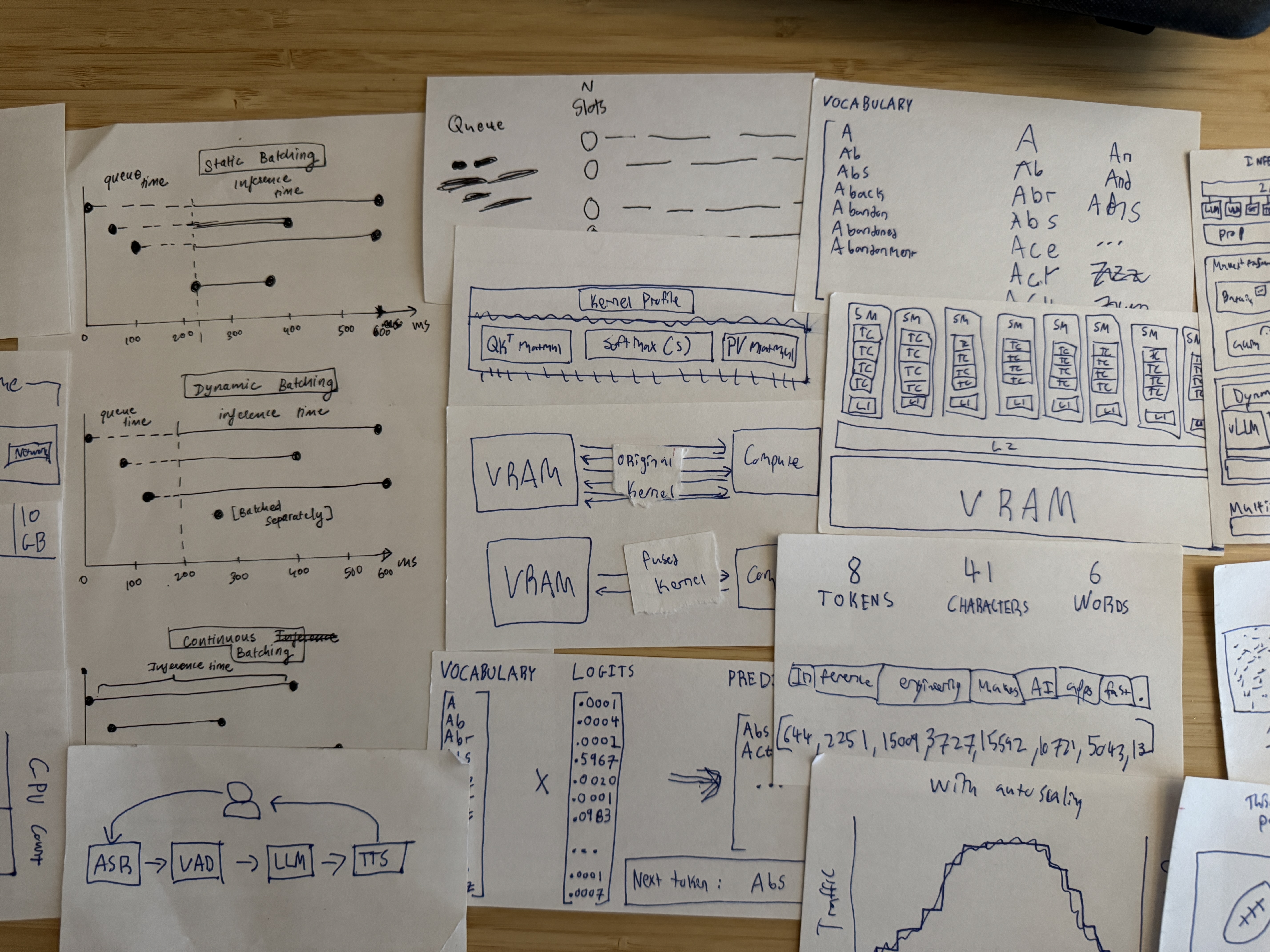
The efficient frontier of LLM inference(baseten.co) |
The efficient frontier of LLM inference(baseten.co) |
I would define a "frontier model" as offering the highest degree of intelligence at any cost, or without regard to cost. The frontier today is clearly Fable/Mythos, with the "efficient frontier" at Opus/Sol.
>In the AI industry, we borrowed the term “efficient frontier” from economists. We use it to talk about managing tradeoffs, most often the tradeoff between cost and capabilities for models. A model is a “frontier model” if it offers the highest degree of intelligence at a given cost or size.
Datacenter hardware is expensive and there's shortage of it but llama.cpp is slow/unoptimized for concurrent use, while vLLM/SGLang easily crash on non-common setups (things like, if you do pipeline parallelism for RTX5090+RTX4090, they will randomly crash with RAM caching enabled or select wrong kernels because they usually assume that every rank is the same device type; they also don't support Q5-Q6).
For me what's most interesting is to optimize inference for lack of good datacenter hardware and how to optimize for it best. I've been running an AI server in the office, and so far I've find these techniques most important for concurrent use on cheap hardware: pipeline parallelism (to accomodate for PCie), RAM caching (to quickly restore contexts into VRAM), speculative decoding (including domain-specific ngrams, they already can speed up code generation considerably without the overhead of a draft model), good kernels highly optimized for a specific device, support for Q5-Q6 (almost as good as Q8), FP8 contexts (more context to fit), paged attention (for better VRAM utilization), prefix caching, continuous batching (this is the default everywhere).
So far the main bottlenecks have been llama.cpp's poor VRAM utilization for contexts (you either have fixed-size slots, or use unified KV cache where each request attends to attention from all other requests and then unnecessary portions of attention are masked out), and lack of decode/prefill segregation: when a request starts prefilling a long context, all decoding threads slow down to like 5 tok/sec. On the other hand, vLLM/SGLang feel superbuggy if you don't run them on some officially approved node like 8xH200
As a computer engineer, it’s always interesting to see optimizations applied at different levels of the stack.
Speculative execution became pretty popular in the 90s, eventually used in basically every x86 design.
Then in the mid-2000s the Speculator[0] paper brought that concept to distributed systems, which we’re still seeing work on[1][2].
Everything old is new again (:
[0]https://www.cs.princeton.edu/courses/archive/fall07/cos518/p...
[1]https://www.usenix.org/system/files/osdi25-shen-weihai.pdf
[2] https://www.microsoft.com/en-us/research/publication/distrib...
A transformer that generates tokens based on pre-training? We could call it a GPT for short.
You could possibly in-pronciple detect what a model with a censorship filter was actually saying, but not really. The signal is weak and needs lots of samples to get anything worth having. You just don't have that level of control to set things up.
That's because it's just "guess and check" not some deep universal insight.
Within LLMs, and even inference naturally, there are many other potential parameters that one might optimize: Unsloth typically shows a Pareto frontier for size of a quantized model versus KL divergence. Others trade total concurrent tok/s against single-stream tok/s. KV cache size, context length and context coherency are other trade-offs that are closely related to inference. Total intelligence is usually a defining characteristic of a "frontier model", with cost (per token or task) as a salient trade-off. Cost is one parameter that is implicitly fixed by the "throughput versus latency" analysis: using a GB300 versus Radeon R9700 moves the curve enormously and probably changes the shape of it. Lots of threads here argue over local vs cloud inference regarding cost efficiency, often with privacy and control as competing objectives.
the absolute most impactful improvements for inference comes at architecture design time. I firmly believe everyone who cares about impacting model efficiency should look there
But overall yes the fundamentals of LLM performance optimization have been remarkably stable over the last few years.
I feel like P/D dissaggregation will be the next big one for providers, as prefill tends to be compute bound while decode mem bound which I guess each will have a different type of node
Inference techniques either move a deployment along the latency–throughput frontier or push the entire frontier out, creating more efficiency to allocate.
I think this presentation says more about what knobs you can turn and in what direction the outcome will move (it may be worse than a competitor) than it says about frontiers.
The images start out looking like this: https://philipkiely.com/images/blogs/how-to-write-a-book/des...
The efficient frontier of LLM inference is a line, not a frontier.
this is a frontier:
https://upload.wikimedia.org/wikipedia/commons/e/e1/Markowit...
no matter how good is something a smart person writes down, a pleb will come along and try to hang on its coattails.
If you want to steal an idea for this, steal indifference curves, they'd make more sense.
The efficient frontier of portfolio theory is also a line. Not sure I get your point here.
> In practice, the efficient frontier is very jagged. Rather than a smooth, continuous line between outcomes, small changes can have big impacts. These cutoff points are often unintuitive and must be discovered empirically through sweeps.
> However, quantization introduces a new set of tradeoffs between quality and serving efficiency. This is a particularly jagged frontier, where a large degree of improvement to serving efficiency is possible with little-to-no reduction in model quality, especially when using microscaling floating-point number formats like MXFP4 and NVFP4.
Would appreciate ideas on how to explain in greater depth
I think you could if the client supports tool/MCP calls.