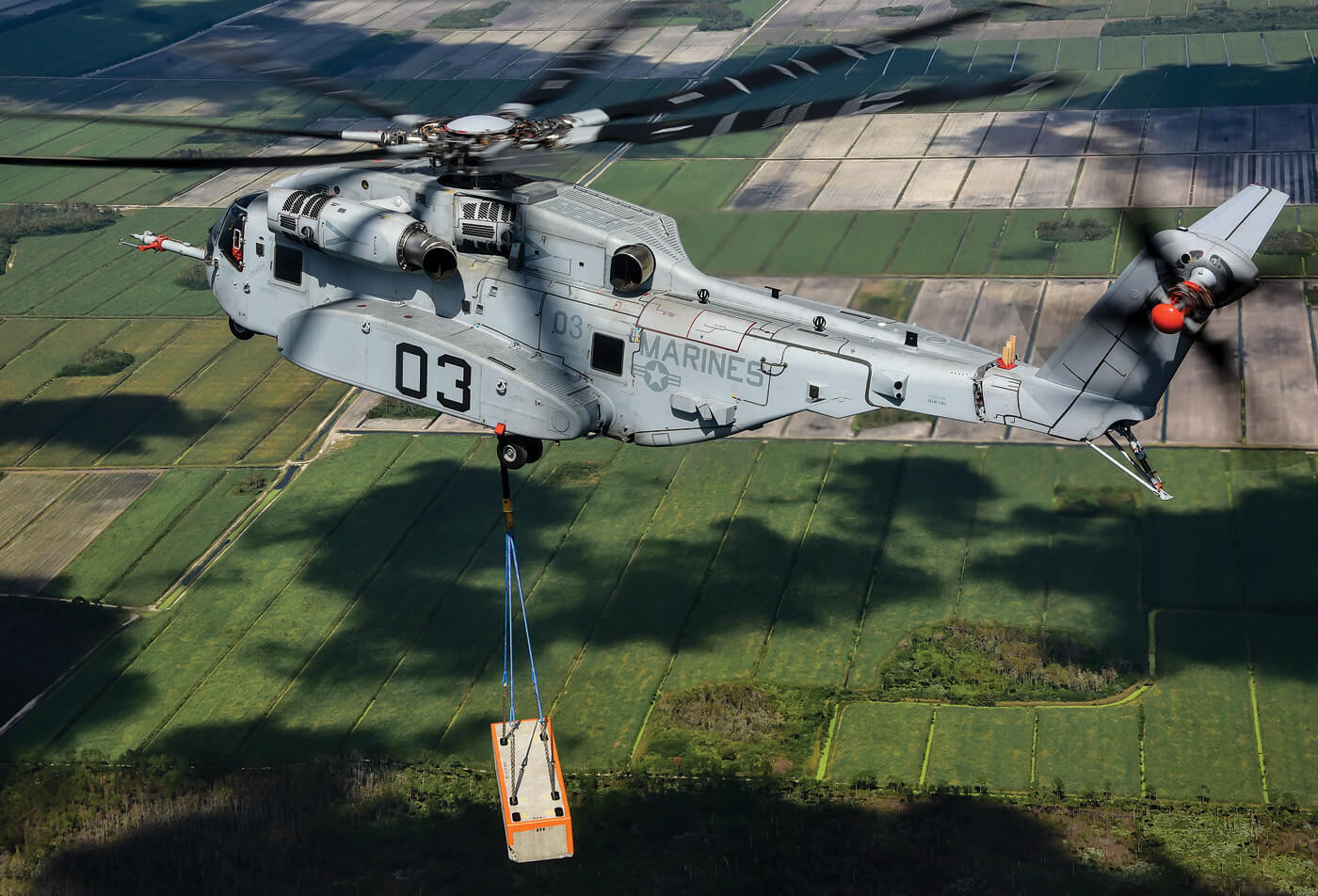
The Helicopter with Radioactive Blades(hackaday.com) |
The Helicopter with Radioactive Blades(hackaday.com) |
The video at the bottom explains from 7:50 in. Gas pressure pressing on a spring holds a radiation shield in place. If the gas leaks the shield moves and the radiation can be detected.
MH-53E maintainer here. The system is IBIS (Inflight Blade Inspection System) and the little pods are BIM (blade inspection monitors). The box is pretty obvious sitting just behind the main rotor on the deck above the center engine. I found a random picture on the web:
And:
The IBIS devices provide in-flight warning of blade failure on various models of helicopters. One device is located on the root of each blade attached to the rotor. The IBIS detects a decrease in pressure in the blades of a CH-53 model helicopter. Any cracks in the blades will result in a decrease in air pressure in the blade. Such cracks could result in structural failure in the blade, thereby resulting in a potentially dangerous operational situation for the helicopter, such as a hard landing and/or injury to the craft and/or personnel up to, and including, death. Each device contains approximately 500 microcuries (18.5 MBq) of strontium-90 (Sr-90) in the form of a rolled metal foil, encased in a small stainless steel protective cylinder about the size of the press button on a ballpoint pen. The external radiation level of the IBIS is 0.8 mR/hr at 3 inches in the normal (shielded) mode, and 75 mR/hr at 12 inches in the failure (extended) mode.
Wireless systems aren’t used for opsec reasons.
The blades are a foot wide and 30’ long, so five of them carrying 25,000lbs is about 1psi of pressure. 3x that for a laden Stallion. I guess I expected it to be a lot more because, from the perspective of the rotor blade, it is in a very windy regime.
The other major open question for me is with the cracks. The system implies there is a non instantaneous progression from unbroken, to having a small crack on the surface, to having a crack large enough for nitrogen to escape, to having a crack so large that the rotor blade fails. I’d love to know what sort of timeframes sit between each of these phases.
Boss: we need to transmit 1 bit of information indicating pressure loss from a spinning rotor blade to the main body of the helicopter. The blade spins too fast for electronics to work properly.
Engineer: What if we make the blades radioactive when they depressurize, then point a Geiger counter at them to detect if that happens.
Boss: ... where did you say you got your degree from?
Having no domain knowledge of the problems of detecting cracks in blades, this sounds like either a genius solution to a super hard problem, or unnecessary complexity.
https://en.wikipedia.org/wiki/Hydrazine#Gas_producers_and_pr...
https://pmc.ncbi.nlm.nih.gov/articles/PMC12542269/
https://aviation.stackexchange.com/questions/23417/why-is-hy...
First you usually go "WTF, why would they do that ?" but on a second look it usually makes perfect sense & is quite an elegant, if unorthodox engineering solution.
A friend's cousin was a CH-53 pilot out of MCAS Miramar. One day, he was telling us, someone didn't properly secure one of the (chairs? racks? don't know the rotorcraft term...)in the cargo hold. The doors were open, and they were flying above the desert at a few thousand feet when...one of the aluminum & webbing chairs got sucked out the window and hit a rotor.
The number & intensity of the warning lights in the cockpit, and the accompanying alarms when that happens is pretty spectacular. The pilot knows right away.
> The CH-53 Sea Stallion first entered service in 1966
1966 is Cold War era, so, I think, an idea that a military helicopter would have to fly in an area that has been recently nuked wasn't totally inconceivable...
Huh? So it's not really in use today as much as hasn't been retrofit out. Those are very different. This also doesn't read well. Maybe rewritten without proofreading
I think it's the "so elegant" part that's wrong. It's not still being used today because it's so elegant. It's still being used today because the old helicopters haven't replaced it.
JohnU says: "It’s all fun and games until helicopter crashes and what should be a minor incident turns into a nuclear emergency where you have to call very specialized decontamination units to remove radioactive material from the site."
Alan Reid says: "unless they shoot ’em down on your own territory
then you don’t have a helicopter but you have mini-hiroshima to clean up."
How much Strontium-90 do they think these things are carrying?
Do they have smoke detectors at home (I hope so...)?
You should never read the comments.
This is how the web used to work.
The Strontium-90 is a beta radiation emitter.
The external radiation level of the IBIS [is] 75 mR/hr at 12 inches in the failure (extended) mode.Gamma: Halving distance in the low hundreds of meters.
Alpha: Goes a few centimeters.
Beta: Goes a few meters per million electron volts. Most sources don't go above a few million electron volts.
Neutron: The only one with good penetration, halving distance around a kilometer for high energy neutrons. But note that there are few sources of neutron radiation other than fission.
Thus unless you're flying into fallout it's not much of an issue.
But, the radiation detector is on the upper surface of the rear fuselage. Hypothetical Beta particles from the ground will strike the underside of the aircraft and not the detector.
Beta particles typically only travel a few meters in air before they lose most of their energy.
especially with all the nuclear tests they were doing for decades?