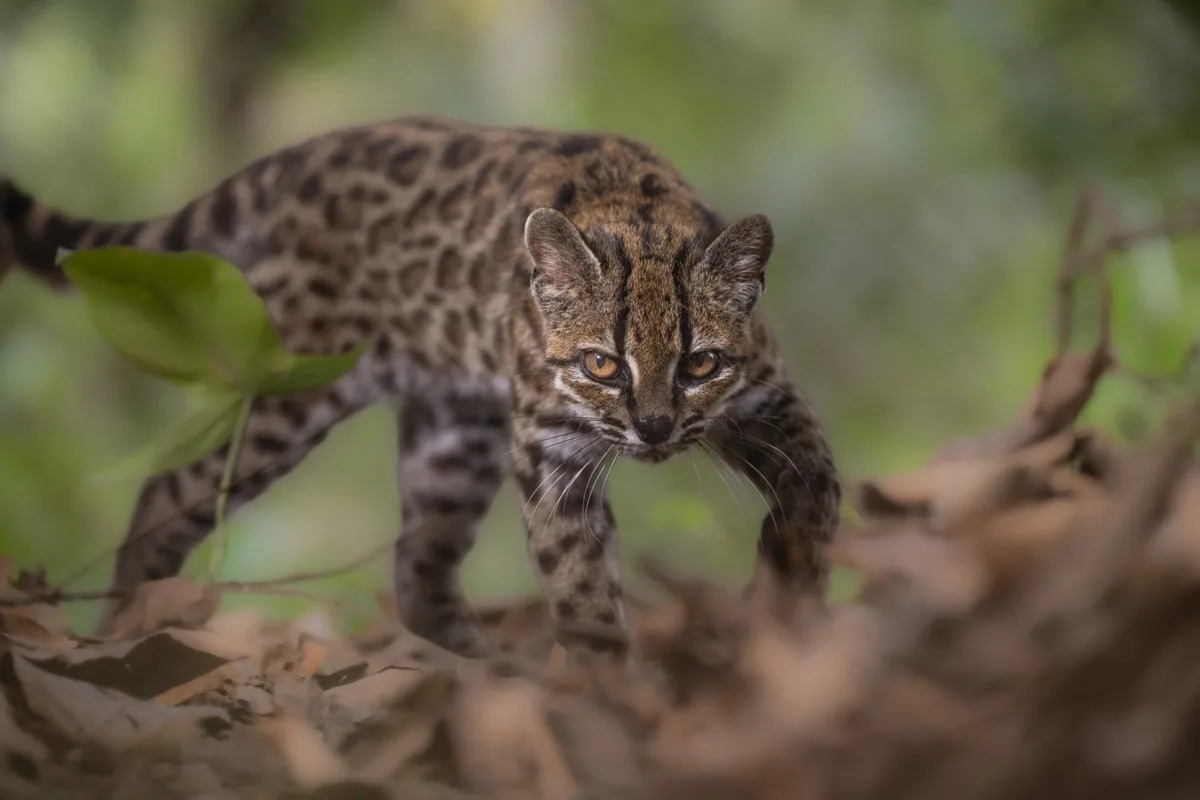
The first new cat species discovered in 100 years(nationalgeographic.com) |
The first new cat species discovered in 100 years(nationalgeographic.com) |
Personally I thought the internet would have been a bigger threat to their readership.
Bonus pics: https://www.newscientist.com/wp-content/uploads/2026/09/SEI_...
https://media.zenfs.com/en/live_science_953/73a4cafd69e9e863...
https://media.zenfs.com/en/live_science_953/1fea354ba7a8db69...
https://thepeninsulaqatar.com/get/maximage/20260917_17896627...
Someone has been typing quickly...
Still needs some work!
Also, they're only 3-4 lbs!
This particular one was actually being kept in a house because someone confused it for a "pretty housecat". After a while, the owner realized it didn't want to be tamed and contacted someone for help.
Also, it's the only known one in existence. Hard to start a breeding program unless they find more.
do not underestimate cats.
(Maybe a few years ago, I might've thought "great Photoshop job" instead...)
Great, so people will find a way to have it as their pet in horrible living conditions.
I'm curious if the locals knew it was distinct from other similar species, e.g. Oncilla/L. tigrinus, or if tilcayo is the locals' name for a broader set of 2+ visually similar species?
Also an amusing disjoint between it being called "tiger" cat but having leopard spots. At least the latin name is more on point.
The conquistadors referred to the jaguars as "tigers" - they certainly aren't lions - and that custom stuck around for long enough for this to become a tiger cat!
-Wikipedia
https://en.wikipedia.org/wiki/Kodkod#/media/File:Leopardus_g...
So around 2.8 million divergence-years. Going by wikipedia, the divergence between lions and cave lions is much less:
> Genetic analysis of ancient DNA has revealed that while closely related, it was a distinct species genetically isolated from the modern lion (Panthera leo), with the genetic divergence between the two species estimated at 500,000 to 1 million years ago.
( https://en.wikipedia.org/wiki/Panthera_spelaea )
Theoretically, that's anywhere from 18% to 71% of the divergence. (The same page also notes that fossils of this species can be about 700,000 years old, which is philosophically interesting in combination with a divergence date of 500,000 years ago.) These are "comparable" in the sense that any two numbers can be compared, but it's not something you would usually say when one of the numbers is 50% larger than the other one. Even less so when it's 400% larger.
We have just got normal house cats, that we call cats. They're very cuddly and they're great for keeping the mice under control.
Somewhere in the forests of deepest Borneo is a civilisation only recently reached by primitive Westerners, who don't know how to make fire and cook food using only sticks and rocks, and who cannot tell the difference between the blackish-blue berries around 15mm that are good to eat and the blueish-black berries around 16mm that are spectacularly poisonous, and only know things like how to make jet aircraft and rifles and the Rolleiflex 2.8FX camera.
Wandering around their village, high in the mountains, are cats the size of Galloway bulls, terrifying looking things, teeth the size of cucumbers.
"Oh those? Yes, we call those 'cats'. They're very cuddly, and they're great for keeping the feral hogs under control."
(and for some Australians some of the time, "ps ps fuckin ps, ya cunting cat!" of course. ;- ) )
Tch tch tch
At one point in the book, several of the characters are in South America looking for a jaguar. They ask the synesthetic mage of their group (each character has a different magical background)...
    “Got anything to call a jaguar?”
    Rider purses his lips. “Well … there is one incantation. But I’m not sure it’ll work. Even the most skilled thaumaturges can’t pull it off more than a quarter of the time.”
    Sturgeon shrugs. “May as well try it, Al.”
    Rider nods. “Okay. Be quiet, everybody.” He rolls his head on his neck, holds up his arms. Takes several deep breaths. Opens his mouth. Intones, “Here, kitty kitty kitty … here, kitty…”
Chloe throws a clot of mud in his face as Rider dissolves into whoops of laughter. Everybody shakes their heads in disgust and they troop off into the green.In my youth I witnessed a smallish adult puma (mountain lion) successfully harvest a nearly adult cow elk while I was hiding. I was also hunting, but focused on a bull elk somewhat further from me. It was astonishing the speed and total quantity of violence that an 80-100lb cat delivered in only a few seconds on nearly 500lbs of prey. The cat had an alomost perfect attack angle, and the combination of slash, grip, puncture, and throttle toppled the cow elk, and it ran out of resistance in very short order. I had not even seen the puma before the attack started, and I expect a trained attack housecat would practically appear out of nowhere - from behind a couch or a curtain or off the top of a refrigerator, and it would become an 'I need stitches' situation too easily.
Its probably a good thing that most housecats are pretty much impossible to train beyond 'use a litterbox' and 'stay off the kitchen counters', if even that.
My cat is very well trained to have his harness put on, since he knows it means going outside. He'll jump on the stool and give me a "hurry up already" look and a meow if I don't move fast enough.
The first time I put it on was not so... inviting, though it was a great impression of a Tasmanian devil.
(is there a francophone different one?)
If you choose to trail run in mountain lion country, a bell may scare off bears, but may have the opposite effect for mountain lions. Stay aware, don't wear headphones or zone out on the trail.
I have seen three separate stalk and harvest events, the cow elk was my first and closest. My second was a wild burro colt. The the third was an old javelina (collared peccary). The second was by far the scariest, as the puma actually bit over the mouth and nose of the colt and suffocated it.
Fear is the correct emotion with regards to these wild animals. If you want to see one, the Arizona Sonora Desert Museum (really a zoo, in spite of the name) is the best and safest way I know about. I would never willingly try to find one in the wild unless i had a hunting permit for one, and I'm not inclined to do that.
https://www.seattletimes.com/seattle-news/two-attacked-by-co...
Getting old now, so walking in the woods alone is something I don't do anymore, even though things are a lot more developed nearby.
lol moment was when we with a girlfriend playfully fell down on sofa, but the then master-of-house siberian 6kg cat considered that a threat to me.
he jumped ~3m claws open, smashed a desk top lamp, shredded the gfs' top and basically opened up her back before I could stop him.
I mean I don't doubt you, I just thought Brits just say "here kitty kitty" because that's what I usually see in movies and TV shows and so on.
It's funny what you miss when you're not embedded in the culture of a place since birth...
I still do that today, and it works better than pspspspsps. When I was young, if my cat was outside on the porch I could click my tongue and he'd come running from a half block away. What a good kitty he was.
The trim-color house cats refers to all calicos... calicos are white spotted tortoiseshell cats. The "is orange or black" is a X linked gene, so you can have XoXb... and then the x chromosome inactivation kicks in and some groups of cells are activated orange and some are activated black.
But (not white) spots and variations of color get into things like the Agouti gene ( https://en.wikipedia.org/wiki/Agouti_coloration_genetics ). A tabby cat (black and tan, or orange and darker orange) has no sex linked characteristics.
For a deep dive into the genetics of Agouti and how that influences cat fur colors, http://messybeast.com/genetics-agouti-and-corin.htm
Side bit - the wiki page for X chromosome inactivation shows a picture of a tortoise shell cat. https://en.wikipedia.org/wiki/X-inactivation
http://messybeast.com/tricolours.htm
And white spots gets into interesting questions of embryonic cell differentiation http://messybeast.com/bicolours.htm
The "why are there large splotches of color with a calico cat compared to the much more mottled color pattern of a tortoise shell cat?"
http://messybeast.com/genetics-index.htm has a deep rabbit hole to go down (and that's for domestic cats... http://messybeast.com/wildcats-index.htm for the other cats).
you can have a calico that's not plain female but it's through random rare dna quirks. anyway, that link above i'm sharing because it's interesting.
I think not all of them categorically refuse to be pets, but they're noticeably more aggressive and less affectionate compared to housecats.
If you don't raise them with humans since they are born, they can't be tamed.
Clearly you are not a cat person ... the question is not if it can be tamed, but how quickly it can tame the humans around it ... ;-)
Unfortunately while people are going wild as if someone found a never-before-seen cat, this is actually more “after genetic analysis we now know that the tiger cats that everyone already knew about in Bolivia are actually a different species to the ones in Brazil”.
But that’s not very exciting so people and news outlets seem to be running with the story as if nobody had ever seen one before.
I mean, the dude tried to feed it "noodles, rice, and eggs" so I'm not sure if he'd be able to tame my very own house cat, even starting from the house cat's current stage of being entirely tamed.
Some animals are just harder to tame and remain ferocious more than others. But behaviour of animals is adaptable and most animals learn.
https://en.wikipedia.org/wiki/Roar_(film)#Injuries_and_set_d...
https://edition.cnn.com/2018/02/28/africa/woman-killed-lion-...
FTFA: "The man took the animal home, believing it to be a domestic breed. But after about a year of living with the clearly wild animal, he realized it would be better off at a sanctuary."
They don’t go outside (they can’t really, it’s too busy by the road here and they’d decimate the wildlife, but I live with it because ultimately we’re doing them a huge favor by giving them a home, post-rescue) so I am sure that has something to do with it. Perhaps infantilism is keeping them in this pack headspace? But even then my mother’s cat — rural, murderous, tough tabby tom — treats her like a god and the rest of us as an annoyance.
They antagonise each-other most of the time, but they also support each other in times of stress. If one goes to the vet and the other doesn't, the initial reaction is hissing and being a dick. Then, after a few minutes, it's licking and comforting.
I don't like to anthropomorphise too much, but they definitely look out for each-other. Equally, they definitely annoy each-other.
Those and lions are the only cats known that don't mind to tolerate friends and non relatives around in their territories, cats clearly enjoy the company, form hierarchies and share food. Hyaenas and mongooses are related with cats and definitely social also. Lingsangs on the other way, are solitary.
Cats are the perfect killing machines (apart from maybe sharks) :)
It doesn't look like it wants to be petted. I stay clear.
They may be unique - a super-successful predator that has persuaded a more dominant species to look after it by looking cute and feeling soft and making relaxing noises.
The rest, of course, is history. Now he’s a big 20lb goober of a cat who is positively enamored with my wife. The feeling is mutual.
Now she has been with us for years. She’s very loyal to me, dismissive to aggressive to anyone else. Not sure why me and not my wife, but hey :)
She basically sleeps next to me all the time, both when I work from home or at night. She’s 14 now, no medical issues.