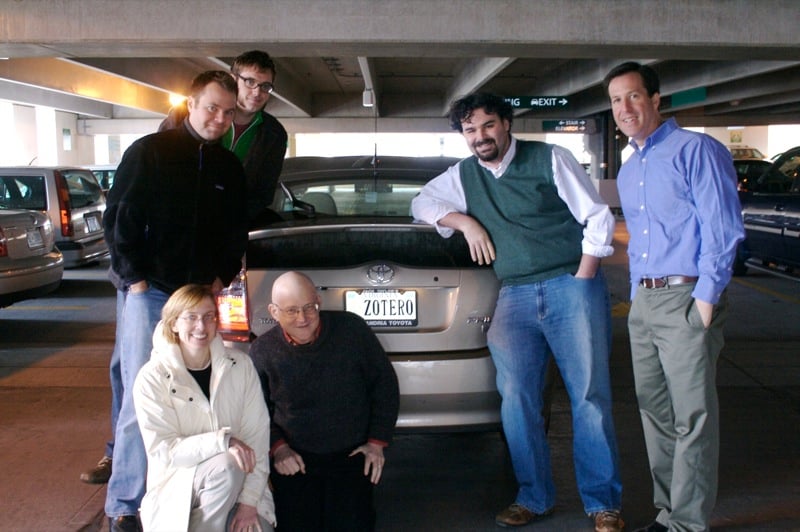
The Slow Formation of Durable Software(newsletter.dancohen.org) |
The Slow Formation of Durable Software(newsletter.dancohen.org) |
This post is about Zotero. https://www.zotero.org/
If you are not an academic, you might not know Zotero.
It is such a pleasure to use. Every app should be like this.
I read everything in it, including books I'm going through right now from https://teachyourselfcs.com/
It also does an amazing job of taking snapshots of posts. I use it all the time to grab posts from HackerNews so I can mark them up.
And it automagically syncs everywhere across devices and lets me store way too many files on the web like the ADD packrat I am, without breaking a sweat.
In short, this software just works, and it works well. So when somebody behind Zotero talks about how to develop software, I listen.
And it's a fun post with some history. You should save this post to Zotero, and then read it.
AI doesn't preclude this. In fact, it can help accelerate parts of it.
He's describing the typical big project lifecycle:
- Examine the landscape
- User research (how they use existing software, what their frustrations are, etc)
- Brainstorming
- Early ideas and prototypes
- Refinement, user feedback
- Solidify the vision and high level process design
- Choose technologies
- Design & architecture
- Plan out phases
- Build phases, then test them with users
LLMs are great at research, and great at prototypes. Once you have your design, they're good at coding as well. They're also good at distilling user feedback.
It can also slow it down as people get distracted experimenting with features they can build quickly.
People say that agentic development is great because you can churn out so much so fast. But that doesn't mean that any of it will be truly good and reliable.
The things that are truly insightful and solid end up being used exponentially more, which makes the linear cost of extra development time (asymptotically) insignificant in the cost/benefit equation.
> “… we could not have accelerated Zotero’s conception, because we did not know exactly what we wanted, and so could not have written coherent prompts for an LLM.”
A surprising proportion of software products, maybe even businesses today, are solutions in search of a problem.
Sometimes that’s okay, but only sometimes. And being a solution in search of a problem requires you to get everything /else/ pretty much perfect if you want to succeed.
The fact Zotero paid attention to what people wanted, and gave it to them, and were market oriented, is demonstrably a big part of their success.
It is MUCH easier to make something people want, than to make them want something you made.
Rapid prototyping is an amazing opportunity afforded to us by AI. But some people use that potential to spend even longer on a more developed prototype that they are too attached to to get feedback on!
speed kills quality. it’s literally impossible to make anything good fast.
we know this, and it still applies to software. while we may be able to make things faster, they will never become good (or great) without an incredible amount of care, patience, and joy from its maker.
there are no shortcuts to quality. it will always take a lot of time to make anything good.
Your comment made me think two things:
• Sometimes constraints make things better, and ‘speed’ can occasionally make you prioritise the things that actually matter so you deliver stuff that counts
• Sometimes, thinking longer about something doesn’t get you closer to the correct answer. You can rearrange and refactor and rewrite and redesign, but you won’t always get something objectively better than what you originally came up with. It’s still your thoughts, your brain and your ways of working that shape the output (and they haven’t changed).
Investing more time to make something better should be a conscious decision. Perhaps it’s one people decide against for the wrong reasons.
But sometimes things need something other than time and effort spent to make them better.
https://assets.buttondown.email/images/93382906-4996-445c-81...
is just of some passionate academics working on a project with no real economic or social media incentives driving it.
LLMs are excellent at making prototypes though. And prototypes can be an excellent way to stop yourself from implementing the wrong features in the first place.