Hummingbird – A fresh take on music notation(hummingbirdnotation.com) |
Hummingbird – A fresh take on music notation(hummingbirdnotation.com) |
On a side note, I think a majority of the arguments I've read against it aren't very good ones. I see most of them boiling down to, "it's different, I don't want to have to learn a new language". This is what I said when I was learning standard music notation. I can see the issue of its anglo-centricness, but even that is a minor detail. One doesn't need to understand the words "above" or "below" to be able to associate the symbols with the notes.
I don't think a fair critique can come out of a quick glance at the hummingbird website. I'd be more interested to hear what people say after a few months of working with it.
My opinion:
* It is very nice to see someone trying to improve something that's hundreds of years old. This is an excellent teaching tool. Words cannot express how better it is!
* It is a poor tool for the live performer. When performing live, you already know the piece. What you need is visually clear, bold, guidelines. You also want to answer "I'm playing this now, what's next?" very fast; and to do that you need a clear visual relativity. I don't think Hummingbird does that well with the collection of small nuances and decorations.
I'm a classically trained pianist and an engineer, and I get why tech-minded people are frequently tempted to hack western notation, but notation is that way for a reason, and it isn't what prevents people from becoming skilled musicians. It's talent.
A notation that would solve this problem, would be great progress.
But this Hummingbird notation does nothing to help with this problem.
Although this might be an easier way to visualize and teach music for young musicians, it might be harder to translate to traditional music as one gets older.
Whether it helps one when reading music is another matter. I remember learning to play an electric organ as a youngster with a book of sheet music that came with the organ; being aimed at beginners, each note head had the note letter written inside it. Hummingbird is basically using the same idea, just replacing the letter with a symbol. It probably does make it easier to learn. Whether it would be of any use for an experienced musician, I kind of doubt. (I certainly outgrew expecting the note head to contain the note letter, myself.)
The redundancy helps associate the name and position.
I don't think I would prefer it in this case. The extra note name information is visually noisy and detracts from the shape of the line, which is mostly what experienced musicians see. The shape of the line, the absence of sharp and flat marks, and remembering what key you are playing in, covers most of your reading.
But, I, for one, am annoyed by the english language needing both grammatical structure _and_ a question mark to express questions ;)
When I read a score, the first thing I need to know is which harp to pick up, and whether it will be playable at all on this kind of harmonica.
Looking at the Hummingbird notation, how do I figure out which harp to play? I have to study the whole piece to see which sharps and flats it uses, and then translate that pattern back into a likely key for the piece. After I do that, I have to go over the sharps and flats a second time to understand which ones will be normal notes on that harp and which will be bends or overblows or impossible.
I guess I could look at the end to see what note it resolves on, but that wouldn't tell me whether it's in a major or minor key. And even if you told me what key the piece is in, I'd still have to study the entire thing to sort out which of the sharps and flats I can ignore and which I have to worry about.
Switching to the traditional notation, I can see from the key signature that the piece is either in Eb major or that key's relative minor, and I'd use the Eb Melody Maker for either. Also, I can see at a glance that all the notes in the treble clef follow the Eb major scale except for those E naturals in the middle. Those would be trouble, but the alto part looks easy enough.
It may not turn out to be a good harmonica piece anyway, but I immediately know which harp to play. And other than the accidentals, I know the notes will be the ones in my scale, so I can start noodling with it right away.
Traditional notation isn't great for a diatonic harmonica player. I don't really think in absolute scale notes at all, since I change harps to change keys. I think in terms of relative scale notes. Letter notes may be anywhere on a harp depending on what key the harp is, but the tonic is always going to be the draw 2, blow 6, and blow 9 regardless of the key.
So the ideal notation would be one I could always transpose to match the key of the instrument I'm playing. Maybe Hummingbird would be OK if it was only used on computers and always transposed on the fly. But give me a printed score and I'd be lost. At least with traditional notation I've got a chance.
[1] https://www.google.com/search?q=melody+maker+harmonica+tunin...
1.) "Traditional is fine. it's not broken": Neither were text-only command line interfaces. But GUI's are just easier to learn for most people.
2.) I am indeed a professional keyboardist, have been playing and reading traditional notation since age 7, and I also teach 25 students a week still. I know theory like the back of my hand, and can talk modes, b9 chords, and 12-tone rows all day long if you like. Jazz and pop are my thing and I play to lead sheets more often than not now a days. So I know this fro m both angles.
3.) We do have key signatures. They're at the start of each song in plain english. no need to be cryptic with symbols.
4.) Relative pitch notations seem like a good idea, but they really aren't. The function of a pitch is honestly pretty subjective and changes frequently in a song. Not to mention, they'd be much harder to learn, especially for young students. Relative pitch is an abstraction, and abstraction is the luxury of experts.
5.) Why not use a chromatic staff or other such layout? Because we actually wanted some adoption. Most other alternate systems have failed because they're SO different that they are completely alien. Ours is "backwards compatible", and also if you did want to switch over to traditional from Hummingbird, you could, and it's not that crazy.
6.) Why not use colors? Because music still gets printed and photo copied vey often, and will for at least another 5-10 yrs. And color printing is still 7x more expensive.
7.) "You can't hand-write the symbols". Yes, you can. It is slower, but our point is that most music is printed off of notation programs today, so hand-writing is usually reserved for small edits, or writing fragments from scratch. This is still completely fine even with an unsharpened pencil with Hummingbird. I have done it with my students many times.
8.) "Picking out lines and spaces isn't that hard" - If you spent time around kids you would be SHOCKED at how bad their spatial reasoning is before about 9-11 yrs old. It is really hard for them without a ton of frustration. That frustration often leads to them thinking they're "bad at music". That turns them away, and it shouldn't have to.
I know there's other stuff, but just not enough time...
Thanks.
But good luck anyway finding something that helps students learn music more easily. It's clearly a goal worth fighting for!
I think I prefer the way it looks in traditional notation, and I think music might be more intuitive to write as such – but heck. Always be innovating.
This reminds me of EMACS -- it's going to take a lot of mental work for me even to begin to understand the strengths and weaknesses of this.
Even if it were better, beats me how you'd actually get people to give it a chance.
I'd disagree about the precision of note lengths and tempi being a problem, though, simply because humans aren't very good at keeping exact time. I mean, ask someone to count off exactly 60 beats evenly divided over the course of a minute. What about 80? 100? 133? The speed at which you count off is highly dependent on your heart rate (and possibly state of mind). So assuming we have an exact tempo, what's the likelihood a note length within it is going to be played with that same amount of precision? Well, it's all up to the musician's ability to interpret the composer's intentions, which is much the same as what we have now. In fact, there are ways even now to specify exact bpm (even if we can't exactly express slight tempo changes). The notes themselves are estimates, but fairly good ones at that, and they're effective enough to get the point across to the musician.
As for exact note lengths, I mostly agree with you, except for certain pieces of modern music (EDM, for instance) where the meter is fairly rigid but the note lengths are off from the defaults. It would be nice to be able to represent that accurately.
I dunno, I already learned how to read sheet music, so maybe I'm biased, but my gut reaction is that it's not an improvement.
There's also the fact that Treble (G) Clef and Bass (F) Clef are a perfect fifth away from Middle C, which reinforces the importance of perfect fifths in the system of major keys, but I suppose that's a small consideration overall.
above: a below: b
etc
So to start off, it's not really a valid criticism to complain about Hummingbird's alleged emphasis on absolute pitches as opposed to relative pitches. Honestly, I can read the notes without giving a crap about note names. I mean, are the circle-names that distracting? The visual position of pitches is still consonant with traditional notation, so it's still maintaining the relative spacing you would expect. Additionally, the new accidentals are at least still on the left where you'd expect them to be.
As far as why this is better than the "teaching notation" [1] of today, it should be obvious when you zoom out a bit: the current system simply doesn't visually scale. That example's quite difficult to read without looking at staff lines. Reading a letter name from inside a note head is impossible unless you make everything "Fisher-Price"-sized (i.e. unmanageably huge). I mean, good luck reading this [2] at any distance if it had note names inside. Sure, by the time you get to the point to be able to play that sort of piece you shouldn't need note names, but if we're discussing notation, Hummingbird is definitely better than "teaching notation" in that respect.
On the other hand, we have some new issues that are introduced:
(1) Lack of stems or beams. As others have noted, this really is difficult to use to scan pieces quickly before/during sight-reading. They've missed the point with proportional spacing, because there are pieces with really horrendous spacing that are still actually readable. However, getting rid of beams makes thinking about rhythmic patterns harder, because now you have to look in two places to find rhythm grouping (in their version of "beams") and rhythm (with that squiggly crap under the "note head").
(2) Not to mention, this results in another readability issue when it comes to notes shorter than a quaver (8th-note): scaling. I cannot tell the difference between 16th and 32nd notes when I zoom out even a little; the curves all smoosh together. And WTF is with those rests? They're completely unreadable at the same zoom level. Traditional notation, however, makes things obvious because the flags are a clear indicator of the length of the note. In fact, I can zoom out 8 times farther in traditional notation and see note lengths EASILY.
(3) This brings up the issue of lower visual information density. I'm not buying that this will help non-visual learners. I mean, where's the auditory or tactile feedback here? Not to mention, this hampers visual learners too, because traditional notation manages to make all the visual cues large yet it still takes the same amount of space. Hummingbird depends too much on minimalism, and turns fat, thick beams into anemic lines, and heavy, bold accidentals into awkward little markings. I'm not saying that this is an issue that is confined to Hummingbird; badly typeset traditional scores, particularly computer-generated scores, suffer from this as well. I'm saying that at its best, Hummingbird is on the same level with respect to clarity as incompetent traditional typesetting.
(4) Why did they get rid of dotted notes? I mean, functionally, a half-note tied to a quarter-note is the same as a dotted half, but notationally, they are used differently. The former would be used in simple duple to represent 1 beat + 1/2 beat, 2 beats + 1 beat, etc. and the latter would function better in simple triple or compound meters, where it might represent a whole measure or a whole beat, respectively. Either way, this type of rhythmic grouping is absent from Hummingbird. I mean, there's a reason why most typesetters don't go around using triple-dotted half notes every time there's a dotted half tied to a dotted eighth; it's less readable.
(5) The abstraction in the note names is weird. If you're going to abstract note names, why not just use position? Why do you have to learn a system using circle-symbols that no one uses anyway?
(6) Yeah, that key sig thing is really a non-starter. Although I do have memory lapses regarding the key signature at moments, it's still important, for the same reason that knowing harmonic and melodic progressions are important, namely that you know how the notes function in relation to one another in the piece. If you want to scan a piece of music and write a harmony for it, or do anything to it besides just reading it, the key sig is almost a necessity.
(7) This might become a non-issue in future versions/revisions, but what about other notation for ornamentations and other musical aspects in general? Slurs (look a bit like rests, and violates every sense of notational consistency as a result), certain chords (if you want to typeset two adjacent notes, normally you just shift one note head to one side; Hummingbird makes that impossible), multiple voicings (how do you mark separate voices if you can't use stem direction b/c there are no stems to work with?), trills (not the "tr" mark, but the wavy line that sometimes follows or replaces it; looks a bit too much like a bunch of 8th notes tied together), tremolos (if there are no flags, how do you write a tremolo?), Bartok pizzicati (which look remarkably similar to 16th rests and sharp symbols), tuplets (how do you express a tuplet if there's no stem? Then the tuplet bracket looks like a beam, and the tuplet number might as well be a fingering), acciaccature/appogiature (there is no concept of note size, so notating grace notes is impossible), glissandi (they look like beams -- is this getting old?), and articulation marks (many of which are too close for comfort to random symbols that I won't bother enumerating here).
I mean this huge post is just scratching the surface of the fundamental issues with Hummingbird. By all means, find a way to improve notation, but if the intent is make reading note names easier, don't sacrifice literally everything else. If I was given complete control of Hummingbird, revision 2 would be identical to traditional notation, except for the note heads. Yeah, there would still be scalability issues, but the change wouldn't castrate the notation as a whole, it would allow a very smooth transition to traditional notation, and at the very least those circle things are ignorable by professionals. The final issue, then, is how do you differentiate half notes and quarter notes or tremolos... Ah never mind, it's just a mess already. And don't forget, we have a better two-century old version of this proposal already [3], but some shapes still look a bit too similar to one another...
TL;DR Hummingbird is equally fast to read, but is less information-dense and scalable, and invalidates many aspects and necessary facets of current notation, which all combined introduces unnecessary headache for everyone who's not a newb. Can't comment on behalf of the noobs, because it's been a while, and you can't really imagine what it's like to not be able to read notation when you actually can.
Also what guy designed those samples with GRAY staff lines? They blend into the white background waaay too easily, and makes Hummingbird harder to read. I mean, that traditional F-C-F quarter note triad looks like an F-(B? or C? or D?)-F triad in Hummingbird.
[1] http://lilypond.org/doc/v2.14/Documentation/f8/lily-13872c43... [2] http://lilypond.org/doc/v2.12/Documentation/user/e3/lily-bfe... [3] https://en.wikipedia.org/wiki/Shape_note
>>>> This is the most stupidest idea I have ever come across. <<<<
It's very nature is wrong on so many levels that my head starts to hurt, seriously.
And to offer people, who never got the current system taught well and who have been waiting for something else that would presumably make their lives easier, a sort of "easy-way-out" solution, rather than attacking the real problem at hand, is so cheap and just so wrong that I feel sorry for all seconds spend thinking on this bullshit rather than on how to improve the overall teaching/teachers quality.
Forget this crap. Teach the current system the way it's supposed to be teached, learn it the way it's supposed the learned and the reward will be lifelong priceless knowledge and skill.
Also, how do you notate tuplets?
First, why not just put A, B, etc inside the circle? That's easier than these hanging-chad symbols. But mainly, do musicians read music by translating the symbol (position) to a letter and then the letter to a fingering (for example)? I expect instead, they translate directly from the (relative) symbol (positions) to a fingering. That's what I did after just a few days while self-teaching piano.
>There are multiple cues to the same information. Everything has both a symbol and spatial element, for all kinds of thinkers.
Generally, I think this kind of redundancy is a bad thing. While programming computers, we usually agree that there should be one and only one clear way to accomplish base tasks in a language. When storing data, consistency is essential.
You are obviously not a Ruby programmer. ;-)
All string functions contain options in the method name and as arguments, so everyone is happy!
  s.match_i("foo", insensitive=True)
  s.split_r(",", direction=-1)
s.replace_ig("dog", "cat", insensitive=True, global=True)They should look at adding rendering support to http://www.lilypond.org, which is basically TeX for music rendering.
If they had that, all the music in http://www.mutopiaproject.org would be rendered in their format for free.
Tex for music rendering does exist: musixtex http://icking-music-archive.org/software/musixtex/musixdoc.p...
Wondering why that was, for fun I decided to try and come up with some different approaches to representing math and music to see if I could better understand why there's so little variety.
It turns out that it's incredibly hard. With math (at least basic arithmetic and algebra), after you mess around with the basic symbols, there's not really many other places you can go with how actual equations are structured without losing lots of the easy-to-use mechanical features that modern notation supports. In a few ideas I essentially recreated a parse tree, which made reducing the sides of the equation relatively simple, but moving things across the equals turned into a nightmare.
With music the obvious alternatives fall into a couple categories:a system for each instrument, something that can succinctly capture the expressive bits of a given instrument (fingering, bowing, vibrato, etc.) and throw out bits that don't work on that instrument (vibrato on a piano, pizzicato on a wind instrument etc.), but it gets impractical stupidly fast. The other alternative is a universal system like we tend to use today, but you end up with all kinds of space wasting piano roll-a-likes or hard to read while playing encodings like A2--B#2--C2--
This will probably not replace current notation, but it represents quite a bit of creativity and at least a noble attempt at doing something which most of the people on earth haven't managed to do (almost all musical traditions in history essentially exist in a state of verbal transfer). I think it's cool and has lots of great ideas.
Maybe it would be helpful if instead of the front page demoing the most complicated excerpt you can conjure up, it demonstrated some simpler (well known?) music in both your notation and traditional notation.
I also have quite a few quibbles with the specifics and usability of this notation, but this is not the place for that.
There are multiple cues to the same information. Everything has both a symbol and spatial element, for all kinds of thinkers.
That doesn't strike me as a positive, really. I look at it thinking I must be missing something, especially witht he above, below and C symbols.
Quite a lot of musicians have their own 'private' notation and I'm no exception, I have shorthand for ideas that go in my notebook and which would make little sense to anyone else. Traditional notation is pretty awful in a lot of ways, but I'm afraid I don't see any real improvements here - it's still uninformative rhythmically, and still promotes chromaticism over scale degree.
I really can't see what the benefit is. Although I don't like traditional notation and can't sight read, at least it's consistent and reasonably easy to learn. This is no worse, but it's not so much better that it's going to cause any significant number of people to switch. People who play acoustic instruments that need to sight read will still need to be able to do so with traditional notation so I am having trouble seeing how this will get traction in that market. Guitarists already have tab as an alternative, drummers have drum grids, and electronic musicians use piano rolls or things like hex maps, to the extent that they use written notation at all.
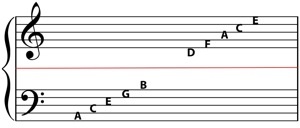
* Add 1 line before bass clef (E) and one line above treble clef (A). That way, both treble and bass clefs become the same (EGBDFA). There's really no reason for your brain which just learned that the 3rd line on the treble clef is B, to suddenly be D on the bass clef... WTH?! This way, the 3rd line is /always/ B!
* Make note-head shapes include its flat/sharpness. Again, there's no good for your brain to have to remember that F is reaaally F#, or be scared of that key sig with 6 flats. Instead let's say a round note is natural, square is sharp, triangle is flat (or some such). Suddenly the note-head /shape/ carries all the info needed for immediate recognition and no on the fly translation is necessary.
* (less radical idea) A third one is writing piano music vertically, like japanese. Why? Because the piano keys are vertical while the music is horizontal. If you turn the music 90 deg clockwise, from left to right the keys match up with the notes from low to high.
Of course if you're a naturally good sight reader, none of this stuff matters, but my gut feel says these will be improvements for new comers.
I liked the symbols as reminders (I still have to count All-cows-eat-grass or f-a-c-e sometimes), when I was unsure of a note it was quicker to think of the reminder, but still the position was primary, unlike other versions where the notes are labeled with their letter name (which makes it impossible for me to actually pay attention to the notes) it was just a hint.
But after I played through the song a few times, it felt a little "busy", it was more work to filter out the symbols. It also seemed a lot harder to count the rhythms with this notation (maybe this is just because I have more practice with traditional notation). Finally, I feel like this gives less of a sense of the overall flow of the song -- the ties and the phrasings.
As a sort-of-beginner, my reaction to this was that it didn't simplify things much, so I wouldn't want to invest the time in learning this and not being able to read the vast amount of preexisting music out there. On the other hand, I wish I had some of these cues when I was first starting.
I'd love to see this not as a replacement to traditional sheet music, but as a standard was to annotate traditional music for beginners. The symbols as hints in particular would have been great. I think this is a great idea but trying to do too much, just a small tweak to any language system is a huge undertaking (and can have huge results). But I'm glad someone is trying. Maybe it's because I'm older now, but learning to read music has felt much harder and more frustrating than learning to program computers.
http://musicnotation.org/systems/ – a list of various notations
http://twinnote.org/ – TwinNote, a notation. One trait it has in common with many other notations is a chromatic staff: the distance between notes on paper always exactly corresponds to their difference in pitch, so accidentals are not allowed or necessary. TwinNote comes with template files for the open-source music typesetting program LilyPond, so music written in LilyPond format can automatically be printed in TwinNote.
https://www.google.com/search?q=alternative+music+notation – more about music notations through Google
But I find the symbols confusing in their own way, and not because of the language barrier others have mentioned (they're just a mnemonic, the words cease to matter after a certain point and other mnemonics can probably be devised for other languages). I find them confusing because I think there should be a progression to them. And the progression of A and B I find doubly confusing, because in music the notes go up, but in this the darkened part goes down. I look at a B and intuitively think it's an A and vice-versa.
I think I'd prefer a system where they look like clock hands, more or less. A is 10:30, B is 1:30, C is 4:30, D is 7:30, E is a slash going through 10:30 and 4:30, and F is a slash going through 1:30 and 7:30. I think I'd find that more intuitive. (note: all diagonal so they don't conflict with the spacial lines)
I would hate to handwrite with this during composition.
The sharps look like a guy flipping the bird. And the flats look a guy with a fist, ready to fight. Funny but a bit distracting.
The focus on pitch letters (abcdefg) and lack of key signatures reveals a weak music theory foundations. The key says what scale to use and then you think about the relative positions, you don't think about the letters.
It feels a bit like training wheels for reading music. Maybe thats the real purpose?
Theory: people prefer infix to prefix or suffix notation because it more closely mirrors the Subject-Verb-Object patterns of their native languages.
Corollary: lisp feels awkward because it doesn't map cleanly to native language thinking.
Lojban is mostly SVO as well.
I tend to think it's a more general effect where humans actually want a certain amount of irregularity in their languages/notations, to act as markers or error-detecting codes of some sort. e.g. "he", but "him" in accusative case. But who knows; English gets by with "you" being both singular and plural...
Music notations - systems of analogies between visuals and sound - are tools for communication. If you have some new concept to communicate, inventing a suitable notation for it is a great way to gain recognizability for the concept. This holds with music notation as well as mathematics (ex: http://en.wikipedia.org/wiki/Graphic_notation). If you have no new concepts to communicate, inventing a new notation is like changing all the words in the python language to other words. Some things may be easier and others harder, but overall, the change isn't worth the trouble for most.
If there are no new concepts to communicate but there is a new medium to work with, that needs to be taken info account. Legacy notations were invented with the constraints of the media of the times they were developed in - in this case, paper and ink. There is no need to be bound by old media constraints when you're making something that has to be learned fresh anyway. Notice how hummingbird still does everything in black and white? We've had color displays for ages now (even on paper), so why not map note names to colors? Why map time to space when we've had dynamic displays for ages now and can just map time to time itself, or a mixture of time and space. Why should every instrument player see the same notation? Why can't we adapt the display to suit the instrument?
Guitar Hero, Dance Dance, the Japanese drumming games in arcades all illustrate what "notation" can be using an interactive medium. The would-be-musicians don't read paper notation. Learning the display is so easy that they just pretty much pick up the controller and begin playing. For other kinds of "notation" that can help the fresh ones, check out the iOS apps by Smule (Note: I don't have anything to do with Smule. I just like their work.)
Sure, it has been working fine for many years, and a die-hard fan of C++ would come up with many criticisms of anything new: No pointers? It's for beginners only. Garbage collection? I can see the programmers that created it are not very proficient. Etc. etc. etc.
And you know what? There are really great programming languages that do many things differently and also work very well, or even better than C++. They are not perfect, but the traditional way of doing things (C++ or the standard music notation) was not perfect either to begin with.
So, I hope people experiment more and more with new notations, and maybe they will improve the standard notation or even replace it someday.
Every note has to have a line that extends its full rhythmic value past the notehead -- you can't just write 10 circles to say "this big chord fills the whole measure". Every accidental must be marked on the note -- so if you're writing a piece in C# major and it doesn't diverge from that key, you're going to have to notate the accidental on every single note.
EDIT: they do allow key signatures; they just don't mention it in the example or intro video.
And every notehead's shape varies based on the pitch class (i.e., C, D, E, etc.) -- so except for "E"s (empty) every note head has some decoration you'll have to do... you can't just make a spatter of dots/stems with a slash over them for eighth notes.
For some music, this seems like it would be a bit more work (mainly the varying noteheads); for other music it'd be a serious problem.
Standard notation for guitar music also suffers from the "where on the fretboard do I play this" problem -- sometimes there are hints (like finger numbers), but often you just have to try a few options and see what's best... which is rough going if you're trying to sightread a piece you don't know yet.
TAB notation, of course, fills in the missing info on suggested finger placement, but omits other essential info (rhythm!), so by itself that's also broken....
I have a tendency to play a note and then my eye moves to the next note--and I take the value of that note as how long to let the prior note play before playing the next note.
If you can help my mom put an Ipad on the music stand instead of a song book she has to manually flip through while playing you might just win another customer. Right now, when i do a jam session with her (I play guitar) she literally has to stop playing piano to flip the pages. She does this 3-4 times a song which is quite jarring. The humble paper song book and conventional notation system could use a 'shaking up', and you guys have started innovating this problem, so thanks!
I could easily see this becoming the tabulation (tabs) system for that piano and other instruments have not had to date.
Well done!
The answer is: I have no clue, I think we do not actually account for flat and sharp when doing solfege.
Or better put: "si" was changed to "ti" in UK to be able to read chromatic alterations without ambiguity. Most of the latin and slavic world ignored this, AFAICT.
But full discosure: I know very little about music, music theory or music history, I just have vague memories of reading about it.
Removing the key signature is not a good idea. When playing in G major, the sharp accidental on the Fs is not put at the beginning of the line just to avoid printing it in the score. Rather, it fits there because when I play in G major, I put my brain in G major mode, in which case it would be distracting to have an accidental on every single F.
Similarly, writing a special symbol for each pitch seems it would get heavily in the way of transposing on the fly. The position already encodes the pitch, and the ABCDEFG names kind of get in the way of understanding the melody, which is more about relative intervals than absolute values.
And what does the little parenthesis on the length line mean? For half- and whole notes it seems to mean it doubles the length (a quarternote with one or two parentheses), but for sixteenth-notes it seems to indicate that it halves it (an eighth-note with a single parenthesis mark).
I also question removing the stem of a note. I have a feeling that is one of the stronger queues for reading rhythm. Spacing is not very important, and indeed especially in dense scores for solo instruments, that need to have few page turns, notes are often just spaced as tightly as possible.
The author also recognized that the beams on eighth- and sixtheenth-notes (e.g. in the left hand) are very important rhythmic cues, and replaced them with that horizontal thing with the arrow on the left. This is a bit hard to read though when there are no stems to link them to the note and the pitch interval is big.
The part about it being easy to write by hand looks good, and made me feel good at first. Then you realize that hand-written traditional notation is quite different from typeset one, just like handwritten text is very different from printed text. Drawing all the little balls and filling in the halfmoon C, up and down thingies seems tedious, when traditionally one writes a simple dot or a little slash instead of the note head.
Whenever I teach key signatures this is the biggest thing I try to impart: key signatures are more than just accidentals, they define the roles each pitch plays.
sight reading is hard because of the cognitive work involved with translating, say, eight notes at a time into the appropriate finger-patterns, rhythm and pace; or translating fewer notes but at a faster rate. i don't see this making it easier.
i'm not sure why they would bother. anyone who finds sight reading too tough, might not really ever need sheet music, whether they do it by ear, or just listen to music. my friend has a disklavier - incredible. robot plays the piano better than i ever could. it makes me wonder why i still bother to try and play, and then i remind myself that every feeble attempt i make is intrinsically satisfying to me, so i keep trying.
About hummingbird, it's amazing. Really, I found it strange in the first minute. Then I got it
Why? My major peeve with traditional notation is the lines above and below. And I never know what are they talking about after adding some lines above the stave.
About the key signature, 100% agree.
As pretty much all students, I thought the key signature just meant which notes are always sharp or flat ("oh these guys want us to use more black keys - BORING")
It took me some time to get it. It's not about flat or sharp, but as they said it, it's 'G Major mode'. Then you feel everything is clearer. It's like going from understanding words in a phrase to understanding the phrase.
What the particular notes in that key do (their role, as you put it) is a property of that key.
I looked at hummingbird, and it took me 30 seconds to memorize the symbols, and now I can read any hummingbird note sheet easily.
I would say this is a big win. Same feel I got when I saw Tau, mathematicians might argue it's incorrect, but for me, I don't care, Tau made math easy for me. Hummingbird makes music easy for me. That's all I care.
About transposing, you got a point, I think there should be apps that do it for you (e.g. convert MIDI files to hummingbird notation, I'm sure we'll see a few of these as Show HN sometime soon)
Hummingbird feels like a crutch to me. Hiding key signatures stunts your understanding of how music works. Forcing time to be marked explicitly as well as by altering spacing places odd constraints on typesetters. Humans use several subtle visual cues¹ to read music quickly and efficiently, and hummingbird just throws them all away.
I'm not sure this is worth the overhaul.
1: http://lilypond.org/web/about/automated-engraving/software
I think it's bold and interesting, but ultimately I think it hasn't got legs.
In fact, it's so useful to state the key up front, I might even suggest the opposite; base the notation on relative pitches, as in "movable do" solfege. Then we could replace "all F's and C's are sharp" with just "do is D". Of course, there'd be tradeoffs to this as compared to the traditional notation, but it's fun to think about.
It's funny, before I read your comment I wrote a longwinded harmonica player's lament elsewhere in the thread, and I was thinking the same thing: A relative notation would be perfect.
My immediate thought once I figured that out was "this depends on English". For speakers of Japanese or Russian or French, can you find easy to remember words that can go with the first symbol, and that start with an "a" sound?
I actually found the terms extremely confusing. At first I thought the above/below referred to sharp/flat, but that didn't turn out. I couldn't even come up with concepts for dot and groove.
I know how to read music, but I'm not very good at it. I'll say that the idea of giving each note it's own shape seems like it could fix the problem of losing my place and having to count lines/spaces to figure out what a note it.
The thing I've never liked about musical notation is that the X axis has nothing to do with time. A staff can have 8 32nd notes and then a dotted half note. Those first notes take up 1/4 the time but 3/4 the space. While it would take more space, I find a consistent relationship much easier (such as piano roles or Guitar Hero note charts).
What about for those being exposed to music and its notation for the first time? What if you had never had a concept of putting your brain in G major mode.
But if complete beginners are his target audience, it begs the question why stop there? Why maintain the use of the staff at all.
(Of course, caveat, I've been playing piano for 20+ years as a hobby. Maybe the ties to the traditional are really not a big deal.)
This is a very valid point.
Certainly the learning process for children can be improved a lot. Really, a lot. But I think it is important to integrate it with the actual notation from the beginning, as otherwise you will hit a wall when you want to play a bigger variety of music that's only available in that format.
http://www.hummingbirdnotation.com/songs/Fur%20Elise%20(Fina...
Musical notation needs to be spoken-language-free.
It was invented for the Chromatone, a keyboard that eliminates black and white keys and treats all keys the same way, similar to a guitar fretboard. http://muto-method.com/en/index.html
Transposing then becomes easy because every scale has the same shape.
However, I do like the fact that accidentals in traditional notation say something important: This note is out of the scale you are playing in. This is usually audibly very noticeable, so it makes sense to have it very noticeable in the score as well.
The three line system could be enhanced to show the notes that are in and out of the scale slightly differently, e.g. with color, or the size of the note-head. This would still have the benefit of being easily transposable.
Also, maybe you could make your feedback constructive by providing ideas, alternatives and suggestions instead of just ripping it apart but adding no value or solid suggestions beyond that.
The point here is much bigger and more significant than any of your individual criticisms.
The point is this - these people are rethinking the problem of notation, and redesigning it from the ground up.
I think their approach is totally badass, and I love the fact that someone is tackling this!
Pointing out flaws IS constructive criticism. This happens all the time and it bugs me:
person A comes up with an idea person B gives good reasons why it's flawed person A - the one who wants to innovate - says that fixing those flaws isn't his problem, and that person B should fix them.
WRONG.
The person who generates an idea, the person who wants to do something new, is the one who is responsible for brainstorming, finding problems, finding solutions, and pivoting as needed.
To say "your criticisms should be bundled with solutions" just raises the bar on criticism, and when it costs more to generate criticism, you get less of it.
We should all encourage criticism, and then we should make finding solutions OUR problem.
In the end, I judged that (valid) criticism is better than no criticism, despite the negative feeling of being the guy that just "tears it down".
But yes, classical notation could certainly use some refinements.
The current notation has been in use for hundreds of years because it works. The notes are large, bold, and easy to recognize and also easy to write. Memorizing GBDFA, EGBDF, ACEG, and FACE is not that difficult.
This new notation has many egregious flaws. Removing the key signature is one of them. Not only does the key signature allow for instant recognition of the pitch and tones used and a general idea of what the piece should sound like, but it also makes writing sheets that much easier for arrangers and composers.
Second, who thought it was a good idea to replace the accidental signs with squiggly marks? A huge step down in usability, I'm afraid. Maybe in sevenths and chords with very close note spacing, but unless you're playing Death Waltz, it is not a problem (usually).
Also, the Consumer Reports-esque notes are also distracting and don't serve any purpose. If I saw what is an "E" on this note, I would play it for 4 beats -- that is, assuming that this is in x/4 time. It's more confusing for longtime music readers than musicians, but it would still throw off many, I'd guess. At any rate, however, if you can't memorize the staff lines and spaces, you aren't a musician. Period.
The uselessness of this notation is compounded by the fact that practically no instructor will be willing to give up a notation that has been in use their entire life, and also for centuries.
Do I see this being successful? Maybe, in small circles (no pun intended). But the harsh truth is that the current notation is easier to write, easier to read, and more efficient.
Case closed.
Reforms to musical notation are like the frequent attempts we see to create visual programming environments "So anyone can program!". They're based on a fundamental misunderstanding of what the hard part is. Learning the syntax of a programming language is trivial compared to learning the abstractions of programming; Likewise, learning to identify note names and durations is trivial compared to learning to think intuitively about music theory.
Just because something is new and unfamiliar does not mean it has to be scary. Just like fountain/feather pens are no longer all that widely used to write musical notation in a format that made sense for utensils, why does musical notation have to remain stuck in the past and cannot evolve?
There's no way to show phrasing(especially important for figuring out how to phrase 5/4 or 7/4 time), triplets, and I'm not sure how slur/tie notation works(especially because dotted notes are presented as tied notes... not ideal since they're technically not the same thing).
Probably because I'm used to reading the tradional notation, I had a hard time deciphering theirs. There's a reason why, after centuries, the standard notation is still relevant. You basically need 3 elements to play an instrument: height (pitch), length (rhythm) and power (dynamics). And I can't imagine a better way to translate these informations than a traditional score.
But I appreciate any attempt to revisit musical notation, like the one that spawned the guitar tablatures, which is incredibly simple and easy to learn.
I'm concerned by Hummingbird's readability. Though each symbol carries multiple (and sometimes redundant) informations, I feel like there's a lot of noise. Also, drawing these symbols requires some high precision and I fear that handwritten versions will render some confusion, especially the small rest and rhythm symbols. I often scribble some music lines on a piece of paper, and I rarely have issues re-reading myself.
On a side-note, using English-based mnemonic hints ("Empty" for E, "Full" for F...) will hinder its portability across other countries, especially Latin ones where Do-Ré-Mi-Fa is more widely adopted.
[1] http://www.johndcook.com/blog/2011/11/11/simple-versus-easy/
However I must say that I just don't get it. Every example I look at appears significantly more complex than the standard notation, and harder to discern at a smaller size. One place I can see it really struggling is on copies. Music tutors spend a lot of their time copying music sheets, and I suspect this would be quite difficult to read on a low quality reproduction.
Standard notation has survived for hundreds of years. I'll be the first to admit it's not exactly easy to get your head around to begin with, but once you understand the rules it becomes apparent as to why it is the way it is.
* The pitch shapes encoded in the notation are fun and probably help learning, but I think they'd be distracting past a certain point. They don't convey any extra information that the staff doesn't, and if they didn't match it's one more thing to trip up on.
* The sharp and flat signs are way too subtle, compared to the traditional accidentals. I'm not going to see those when I'm sight-reading.
* This is also true for the eighth notes and shorter. Those flags are tiny!
* No key signatures?!!
I love that someone's playing with ideas for notation, but this notation is worse for experienced musicians because it makes important information harder to see at a glance. (Yes, sure, I'd get used to new shapes, but the distinguishing marks on the page are smaller?!!)
I can't comment on whether it'd be easier to learn, but this is notation you're going to be using much longer than you're going to be learning it. Optimize for long-term usefulness.
Also, if you've only learned this new notation, you'll be unable to read any of the 99.99999% of music that has been published in the conventional notation over the last few hundred years. It would be pretty limiting, somewhat like learning to speak a language that's only spoken on a small island in the Arctic Ocean.
Musical notation can definitely be improved upon.
On the down side, I am very surprised you decided to redo music notation, but keep to a 7 tone diatonic graph structure.
One of the most counter-intuitive things about sheet music is it assumes a 7 note scale, making the graph inaccurate: the space between B and C are displayed visually as the same as the space between C and D when that is not the case in any physical realm, and it makes transposition harder than it needs to be.
In my view, the 7 note scale assumption is a horrible, frustrating, legacy, like having to learn DOS before being allowed to operate an iPhone.
7 note scales are a misleading assumption not only for any "modern classical" composers, but also for any blues, rock n roll, north indian classical music ...
There may not be an easy solution to address all this, but I am curious about the reasoning behind your approach.
Also, in the first measure, beat 1 of the base clef, it's hard for me to tell whether the bar sign for sixteenth notes applies to the very first note. I have to try to gauge the vertical alignment without the help of the traditional vertical bars extending from each note.
Finally, the mnemonic symbols for each pitch seem superflous to me. Once you've learned the staff they just amount to irrelevant visual adornment, IMHO.
"Easy to learn" might not equate to for "easy to use by trained musicians."
If you want to give it a listen: http://www.radiolab.org/2012/dec/17/man-became-bliss/
I tend to be a little skeptical of attempts to make "pure" forms of communication, because I think there are bound to be trade-offs, as in any engineering endeavour. I'd rather see schemes that are optimized for a particular purpose. What would a language oriented toward scientific and technical communication be like? How would currencies designed for ecommerce work? How would a calendar for global organizations work?
I'd much rather see methods of improving the readability of standard notation, by adding colors, interactivity, or anything along those lines -- but not replacing standard notations (for accidentals, note flags, etc.) without really, really good reason. The further your system departs from standard notation, the less valuable it is automatically, so for a departure even as far as hummingbird (which is still obviously related to standard notation), the value it adds already needs to be huge just to break even....
Think about the choice you're making for your student -- instead of getting started learning standard notation, you're starting them down another path of reading music; the moment they leave your studio or classroom and walk into a music shop (or even another music class), they will be completely lost.
There's a lot of sheet music freely available online -- whoops, not for your students, though.
There are also a ton of apps, interactive sites, online tutorials, software, etc. that can help music students master all aspects of music performance, analysis, and even composition. Well, some students. Not yours.
I know this sounds harsh, but it's a bit like attempts to fix the English language. Everyone knows it -- English is horribly irregular; every rule of thumb for spelling has a million exceptions; there seem to be more irregular verbs than regular ones; there are obsolete tenses only used in some common phrases and nowhere else. But if we fixed the problems -- even if we just regularized spelling and nothing else -- the first generation of students using the new system would be a bubble in a world that used "old" English. If we successfully rode out the change, after a century or so all new documents produced would be in new English... but anyone interested in reading anything before the switch would be at the mercy of automatic translators.
It sounds like a dystopian novel where an autocratic government wants to cut their population off from all knowledge of history.
I looked at the sample pieces and liked that they had simple and complex pieces to look at. As I went through the simpler pieces the notation was easy and fun to pick up. When I looked through the more difficult pieces I felt like I spent more time analyzing each symbol to figure out what exactly it was saying. They were "overloaded" in a sense to me.
I feel that if I'm sight-reading music (or haven't practiced it much which is the more likely case) that this would fatigue me having to parse so many pieces of information for a note. It made me realize that one of the things I appreciate about standard notation is that you have a defined set of symbols with minimal overloading and that you're marking it ("annotating?") it up to make changes to it.
It's an interesting experiment. I just don't think I could get used to it for complex pieces.
Some of thing I feel like it fails to capture:
1.key changes- eliminating key signatures makes key changes less obvious which is important to realize as it is important as to how you play the piece.
2. Phrasing- the visual shape of the notation seems very vertical to me, which works for some pieces but would drastically change the way I play certain pieces.
As well the following don't have any example and their current notation would likely conflict with the proposed notation: ornaments, tone of a note(staccato, marcato, slurs, formatta etc), dynamics
I'm intrigued by a new kind of notation for music, however I feel like while this maybe more approachable it won't work for high level performers, and having to learn a new notation if you reach a high enough level kind of renders the notation kind of useless to learn.
http://www.essential-music-theory.com/images/grand-staff-spa...
Instead of difficult to read/write symbols which map to letters, which map to pitches, why not just use the letters themselves?
I would totally love to just learn with letters written on the staff. And over time, maybe my sheet music app could randomly replace letters with black filled circles, and then eventually with standard music notation.
"Long notes are longer; sharps point up and flats down." - Having notes take up more space is about the worst possible thing in the world for me; as a pit musician, the last thing I need is more wasted space on a page, giving me more page turns to deal with while I'm changing instruments and key signatures.
"...rhythms have the same spacing" - I don't know what this means. Rhythms don't have spacing. The spaces between the notes has nothing to do with the music that's played.
Then there's the fact that all current musicians would have to re-learn how to read music. Perhaps someone can tell me what's drastically broken about the current system? I'm not saying it's perfect - I don't believe any system is perfect. But it's worked pretty well for the last few hundred years.
If you're using a real device, page turns can be automated or eased. The device can listen to what you're playing (tempo shouldn't be too hard to pick out) and turn pages appropriately. Or, you could use a foot pedal or what have you - perhaps your phone.
Apps for this sort of thing already exist, though I don't know how good they are.
Don't get me wrong. I am always fascinated by new approaches for doing things and new musical notation is a fun idea. But not in this case. Practically speaking, they don't improve anything at all.
Conventional notation is not broken or something.. Imho, it is actually looking pretty great typographically, and works fine in practice.
They could make new notation that works better on computers, to be used in music software, such that it is easy for typing using a keyboard. That could be a real improvement.
Also I've been trying to get used to Don Ellis quarter tone system, and work thru haskell school of music (fantastic book, for anybody interested not just in notations, but production, composition and capture(A/D conversion/DSP etc. Also shoudl read books by Gould and Read someday:
http://www.amazon.com/Behind-Bars-Definitive-Guide-Notation/...
http://davidvaldez.blogspot.com/2012/09/quarter-tones-by-don...
One thing to understand about music is that the letters are meaningless, as learning by letters restricts you to playing in a certain fashion. For some reason letters got introduced, I don't know why, but all that matters is the distance between notes.
Not learning letters first allowed me to easily transpose into any key since the LETTER DIDN'T MATTER.
Cool idea, but has some serious limitations in real music, the obvious one being transposition.
Ni-Pa-Vou-Ga-Di-Ke-Zo-Ni
The pdf is in Greek, but has been annotated with English notes throughout. It also contains embedded mp3 resources so you can hear what the notation is showing.
More details can be found: http://www.byzantinechant.org/notation.html
Including video tutorials: http://www.byzantinechant.org/tutorials.html
Traditional notation: 16th notes are tied together, with the tying actually serving to reinforce the duration of the individual notes while indicating that they should be played as a group.
There's obviously a difficult learning curve for many people, but others who are already proficient argue that the rewards of learning standard music notation are worth an extended effort, if that's what it takes.
The thing I've noticed most about sheet music as I'm learning it is that it's compressed. It uses different symbols and techniques to say the same thing in a smaller space, and reuses space and symbols more efficiently by applying modifier symbols at the beginning of the staff and elsewhere. It allows notes on lines and spaces instead of just spaces or just lines. Tighter, smaller, more on the page. Changes in pitch can also be indicated by modifier codes next to the notes, sharp and flat, allowing further combinations with only 2 more symbols.
So I have to learn to decompress the information at the same time I'm interpreting it. Tricky! I do stop and wonder if this compression algorithm is the right fit for humans. I don't buy the argument that continuity with the volume of existing sheet music is a good reason to never develop an alternative. But any alternative needs to be much better on some metric that outweighs continuity. Otherwise we should just keep hacking the learning process with color coding and mnemonics and whatnot.
It's funny, I was talking to a friend about my struggle to learn sheet music and music theory, and he said "It seems hard at first but you'll start to get it pretty soon." And I said "Yeah, it's sort of like math in that way." To which he replied "oh, I don't know about that, I can't do math. I've never been good at it."
Perhaps not surprisingly its similar when you learn a foreign language, for a while you see a word, translate it into your native language, and then understand it. But once you "get it" or reach a certain level of fluency, you read the word and you just know what it means.
When I started playing Trombone I would see a note in the stave and count lines or spaces to figure out what note it was, and then play that note on my instrument. There were actually two translations going on, one from music to note 'name' and then from note 'name' to instrument configuration. At some point however it changed and I stopped seeing a 'B' or an 'A' or a 'C' and instead saw instrument positions (and alternates) so that playing stopped being a translation exercise and simply became execution.
The other interesting thing is that looking at the sheet music I heard music. And that was when everything clicked together because initially I could play things "by ear" by recreating the same sounds in my instrument that my ear was hearing, and now my eyes would see the music, my ears would "hear" it, and my fingers would make it real. Notation stopped being an issue until I tried to play keyboards :-)
The circle of fifth, musical modes and any advanced form of transposition, alongside the basic theory involved in cords, their components and their succession are necessary for a musician. [1]
Technical proficiency does not make you a musician, just like being able to type really well doesn't make you a programmer if you can't...read code.
[1]: This may not apply for percussionists, but even there, playing together with others necessitates the same understanding.
Side note: it's per se
It is not necessarily just because "it works". Learning conventional music notation is optimal only in the same sense as learning a conventional language is optimal - i.e. it lets you communicate. That it is convention is more important than "it works". The human brain is adaptable enough to learn strange things like touch typing on a QWERTY keyboard.
There are some good things about traditional sheet music notation, but that doesn't take away the fact that it's bloated with historical baggage. It's really not terribly efficient at communicating the 'essence' of music, it's just that we've all gotten used to translating piano notation into practical [insert_your_instrument_here] implementation in our heads. It's neither a useful 'source code' for other instruments to interpret, nor is it an efficient 'byte code' to describe the fundamental elements of music.
That's not to say that I have a solution to these problems of course (yet -- been working on my own project for a while that will eventually try to address this), but the issues aren't hard to spot, and they certainly seem like areas that can be optimized. And there will always be the problem of adoption, but I don't think that's even an argument we should bother raising until somebody proposes either a system that's either truly an upgrade, or a system that starts getting so much traction and starts fracturing music notation without any added benefit.
Personally, I sympathize with the aims of this project here, and think some of the ideas are clever, but considering how many things it changes, I don't think it really adds much efficiency when parsing/writing it in return. It actually strikes me as odd why they wouldn't just move to a chromatic grid system if they were getting rid of key signatures, that way they'd just eliminate accidentals all together -- or if not, then just combine them into one, since the key is a big reason for why they even have 2 designations in the first place. Which brings up the point that those symbols are all really quite complicated to be able to parse very quickly; the controversial 'note names' especially, but the accidentals really did not have much of a reason to be changed other than to just look 'fancier' -- which just makes them harder to parse, and to draw (IMO, but I have terrible hand writing).
Oh well, I wish them the best anyway. This isn't a terribly progressive field so I'm just glad to see anything happening.
You overvalue the importance of your analysis.
This means that accidentals need to be distinct from sharps/flats in the key-signature, and in particular an explicit natural on deviations from the key signature is also helpful.
But it doesn't. And that's why tablature notation is far and away more widely used these days. Old-style musical notation is horribly designed and is gradually dying a natural death.
As you say, most tabs don't include much information besides pitch and order, but can include guitar-specific ones, such as bends or slides.
It's possible though to write good tabs, such as the ones available in Guitar Pro (http://www.guitaring.info/uploads/software/Guitar%20Pro/Guit...).
Tabs' major appeal is that there's no learning curve: what you read is almost a physical representation of what you play. And it only requires a text editor to write, and can easily be published and shared on a website.
In e.g. Jazz jam sessions, good sight readers can definitely figure out what to play from lead sheets consisting of chord symbols + melody, and in terms of information, those are equivalent to guitar tabs + melody.
Admittedly, there are also books only giving tabs/chord symbols + lyrics (or sometimes not even those), and for this form, I agree that your assessment is valid.
It syncs tabs with real audio recordings so that you get the usability of tab plus the rhythm and phrasing cues from the real recording.
(1) Hummingbird translates length in a trivially superior way to standard notation. No contest imho.
(2) I would say it does a somewhat better job on pitch as well. Both have huge shortcomings so I can well imagine far better systems.
Dynamics is a push so I'll say Hummingbird is an improvement in translation. I don't think it's a big enough improvement to climb the mountain of inertial standard notation has in it's favor. I'm typing this on Qwerty keyboard too, yep.
http://www.conknet.com/~proscore/samples/lgcplxpiano.gif
While it might have some minimal value for beginners, you might as well teach them real notation.
Let me present a metaphore.
You're in charge of the foreign language curricula in, say, Japan. You can offer either Esperanto or English but not both. Esperanto is easier to learn, but English is infinitely more useful.
If you just found out about this from HN, then you didn't have ANY time to get familiar with it.
Plus, your knowledge of traditional notation put you already at a disadvantage. You could only compare it with a control group study, or after you have spend as much time in this, as it took you to be proficient in standard notation (e.g 1-2 months at least).
You also lose the "wall of black notes" warning you of deadly fast notes up ahead. ;)
He choose to use the C, D, E... system that is not the norm (the norm, maybe not in US I guess, is Do, Re, Mi...)
And then create graphical representation of words starting with those letters.
Except this works only in english.
How a portuguese speaker for example would associate the dot thing with D or Re? It looks like neither, at most it looks like a dot (that in portuguese is "ponto", thus starts with a P)
Or the above and below? Below in portuguese is "abaixo", thus starting with a A, so you have to teach someone that A actually means B.
To me this new notation might make sense in english (maybe), but in other languages is even more arbitrary and silly (and tedious to hand-write)
Also, properly typeset standard notation is proportional anyway.
The drawback is that this notation is less compact. But, it's the best notation for teaching beginners.
I'm trying to figure out how Hummingbird notation is any better than "piano roll" notation or simply putting letters on the staff. It's definitely a cool idea (infovis-wise), but I think it needs to be user tested: standard vs. hummingbird vs. letters-on-staff vs. "piano roll"...
I think Hummingbird's goal is to become an alternate standard of global music notation, based on the fact that it resembles the traditional one (and actually uses it as a base). But Hummingbird also has its flaws (that I mentioned in another comment).
honestly this makes me want to re-try to learn piano with this type of notation. perhaps even a notation that would let me focus more on the piano and less on deciphering the notation.
brilliant in its simplicity, thanks for sharing.
The key is to make it fun and easy in the beginning, so that piano players don't give up! Then, make it harder once they are motivated to learn.... and you can show them why standard notation is more expressive/compact/better than the letter notation they started out with.
With software, the view can adapt over time as the player becomes more comfortable reading notation. If the sheet music was displayed on a tablet, eventually the little letters could disappear.
This could be a nice set of "training wheels" for beginner pianists.
I mention editors because the arguments about learning one often have to do with the trade-off between expert efficiency and expressiveness and the painful learning curve (for many). And because that's honestly what the discussion reminds me of, whether or not it's a perfect match :)
I mean, any notation editor knows the pitches/timing/etc encoded in the score, and it should be able to trivially show it to the musician in a customized way - transposed to the instrument, if neccessary; with or without fingering information where applicable; and in custom/wierd notations like this one.
Of course, printed/photocopied scores can't do that, but we're not in stone&paper age anymore and can fix things to improve functionality.
I know there are a lot of judgement calls in typesetting music, but that's true of text too, and we have some pretty good algorithms for doing so these days.
All that said, I have a lot of reservations about this particular notation, but I think there's certainly room for improvement even inside the current system. Letting the back catalog of work hold notation back isn't healthy.
It is enough if machines can translate the existing sheet music to the new system.
I much prefer someone to criticize my work, rather than sitting quiet just because they can't think of improvements. After all, I'm probably much more likely to come up with a solution than they are, and the reason I didn't is just because I didn't think of that problem.
I mean, many people have gotten used to that language, but there obviously can be a far simpler way to represent the same timing information than the first line of that pic.
And the example you give is not THAT complex - try to represent any interesting polyrhythm drum pattern in traditional notation, now that will be an excercise in futility.
The hummingbird is not a good enough solution - it's a step in the right direction and another step sideways; but we need to go much further to improve both ease of reading and ease of learning music.
To use a programming analogy, the current music notation is like if everybody had to learn programming through COBOL - it works, it's usable and widely used... but still, using a better, cleaner language for the same concepts would obviously bring benefits to all new users; even if it's of no benefit to all the current experts who already know the current notation by heart.
Standard notation, QWERTY, English, Facebook, etc. are all flawed in many ways but to replace them you can't just be 1% or 5% better; you need to be an order of magnitude better. No one cares about learning Dvorak for 5 more WPM but if people could double their WPM the world would switch.
If this had that much of an impact on you, and if this has the potential to encourage others to learn notation, I'd like to see a full study of how hummingbird compares to the regular notation.
Tempi and volume are usually given in Italian, aren't they?
I've worked with intermediate-level musicians who are skilled at regular sight-reading, but who struggle to learn to transpose on the fly. A relative-pitch notation might be like requiring everyone to "transpose" all the time, forcing them to learn this skill before they can proceed.
On the other hand, maybe you'd teach it differently. Instead of learning transposition as carrying around an offset to add to each pitch, you'd learn it as carrying around a scale to which the relative pitches would be mapped. I wonder whether this would be easier or harder to learn.
When you get beyond that, "mapping relative pitches to a scale" is, IMO, the correct approach. The "offset to each pitch" thing obscures what's really going on, as if they were all weird derivatives of the key of C. I can see how it might be harder, among other reasons because you have to understand how a scale works more clearly, but I suspect it would be worth it.
Of course, it's hard to really know without getting people to switch for a couple generations.
We already use relative notation for most instruments. Trumpets, Clarinets and Tenor Saxophones typically read notation where Bb is equivalent to C on the page. What you'll note we Don't do, is change our relative pitch between songs.
No. Relative pitch is Very Hard, because as a musician, my hands don't play relatively. When I see an Eb on a notation sheet, my body knows how to play the note without me thinking about it, and it has to, because sometimes you can have notes flying at you with a rate of 32 a bar. This does not leave time to translate between the relative abstraction on paper and the absolute pitch of my instrument. It's not just harder.
It's much, much harder to train your brain and body to be able to map the same object on the page to twelve different body positions, depending on some variable that changes at random between songs.
Also remember, that different pitches have different textures, otherwise we'd never play in a keys other than C.
Scales are a function that acts upon the set of pitches used in music. A C major scale has the pitches C, D, E, F, G, A, and B. A G major scale (function) has the pitches G, A, B, C, D, E, and F#.
"Mapping relative pitches to a scale" is nonsensical. A scale (function) is an absolute set of pitches, immutable.
There are two forms of solfège (do, re, mi, ...): fixed and moveable. In moveable the first pitch of the scale is always do. In fixed the pitch called C is always do. Watch "The Sounds of Music" to learn the solfège for a major scale, it's the do-re-mi song. There are other syllables used for the three minor scale forms. To my knowledge (admittedly not complete) Italy, France, and perhaps England used a fixed-do system, whereas the rest of the world uses a moveable-so system.
I felt exactly this way learning to read music. The score just didn't present enough information fast enough for me because I hand't learned to build the context in my head and spot the relations. I fumbled about with alternatie notations, extra notations etc. I finally settled on colors. I wrote a small program to color the dominant, subdominant etc. and then printed it on my color printer. This helped me immensely and I didn't take the dead end road of learning alternate notations that would shut me out of all written music everywhere.
Some windmills should be tilted at, some should just be left alone.
I wonder if a suitable analogy would be like underlining all capital letters in a selection of prose - useful for the neophyte, chaff for the slightly experienced onwards.
robot plays the piano better than i ever could
Apart from the personal enjoyment angle, robots also can't detect the mood of the audience (yet) and play to suit.
The one place I could see pitch symbols being slightly beneficial is when notes are either way above or way below the staff. But even then, after some deliberate practice these can be recognized pretty quickly as well.
Regarding relative position. On a piano the relative position of notes on the staff almost directly correlates to position on the keyboard. On a stringed instrument this is VERY far from the case. As i proceed up the scale on a simple instrument like the bass i will proceed right on the neck on one string, then drop down a string, shift left, proceed right on that string, drop down a string, shift left, proceed right on that string. So you've got back and forth, and up and down motions to keep going in one direction tonally. On a guitar the strings aren't all tuned evenly so the back and forth on the neck changes depending on which strings you're switching between. On the Ukulele the top string is higher than the string below it so you end up jumping UP strings rather than down, AND the strings aren't tuned at even intervals. So you've just got a big jumble of movements.
Don't even get me started on the totally unintuitive nature of woodwind fingerings or how they are almost totally disconnected from what's going on on the staff.
In short, the relative positioning of notes on the staff is good from a tonal perspective but crap from a finger perspective on most every instrument except piano.
It's all about recognizing when to build tension and when to resolve tension.
Yes, the roles that the notes play is defined by the key, but if you don't mentally make the switch, you'll often perform things poorly because you don't anticipate where things are going correctly.
Or at least that's how it works for me, at any rate. Take anything I say with a grain of salt. I can't sight-read much at all.
That's not really a problem once you build the muscle memory, though.
It's the same thing as touch typing. With enough practice, you know that finger placement X will produce note y, the same way you know where the keys on the keyboard are.
This is why I mainly worry that a relative-pitch notation may present a steeper learning curve. Advanced players typically need to be able to think at least somewhat in both relative pitches and absolute pitches at the same time anyway. Absolute pitches because that's what many instruments demand, and relative pitches, because that's where a lot of the meaning is, which informs other aspects of the performance. But it typically takes more practice to learn to think in both ways at once.
> Also remember, that different pitches have different textures, otherwise we'd never play in a keys other than C.
I did propose that pieces could indicate their intended key.
A musician is usually able to use both. The A/B/C/D/E/F/G is used even in European notation, for chords and stuff.
>How a portuguese speaker for example would associate the dot thing with D or Re? It looks like neither, at most it looks like a dot (that in portuguese is "ponto", thus starts with a P)
He would either have to learn 7 words in English, that almost everybody in the planet under 30 already knows, or just learn the visual shapes, which are distinct and take about 10 minutes to memorize. It's not as if "Do, Re, Mi" means anything in Portuguese either.
The fixed Do system isn't even much covered in basic college-level music theory in the US (to my recollection); I doubt most performers will know much about it.
About asking the Portuguese musician to learn 7 English words, and switch from fixed Do to the C/D/E system... well, the problem is not that it's hugely difficult, but that it will seem like a foolish choice to music teachers. Who would teach this new system?
The benefits of the new system have to be huge and obvious if it's going to gain any ground, because the existing system is everywhere.
Tell a teacher that "here's a new system! Only a miniscule fraction of extant sheet music is available for you and your students, you'll have to re-write all of your teaching materials, and you'll have to force your students to learn the American C/D/E system with English-language-only mneumonics!"
It doesn't sound like a winning argument to me.
Which is different from learning position on the staff, how?
It's different in that the visual shapes stay constant in all "clefs" as well as up and down the pentagram.
So a D below middle C looks exactly the same like the D above middle C -- something which is not true for the regular notation, where you have to count the pentagram lines the note is in, or how many lines below or inside the pentagram.
So the new system retains the position-on-stuff and ADDS another visual cue for the same information (the shape of the note).
For those studying music theory in the English-speaking world, A-G is the norm. (German has H as well.) That being said, I've only ever met musicians from the commonwealth... I will not comment on other languages and whether or not they use solfège since I've no experience in that area.
If it's because the symbols (ABCDEFG) aren't universally recognized, then you shouldn't be basing your language off of them in the first place.
What is required is a sequence of length seven (for convenience) that allows sharp/flat prefixes and time length suffixes. Circles are merely one option.
If written by hand, there will be ambiguities between C, Dot, Empty, and Full. I think a graphic design artist had too much fun with this project...
Actually, most trumpets, harmonicas, and many classes of flute are restricted to diatonic scales. You'll have a hard time finding a chromatic trumpet outside of a museum.
There's more to music than western chromaticism or indeed harmonic theory.
The chromatic trumpet is an invention that allowed us to escape the trumpets natural harmonic series (Those being the notes a trumpet can play in a single valve position) before valves were invented by drilling holes along its tubes.
Wikipedia is not the best place to learn music theory, and knowing music theory is as useful as knowing a list of rules for programming best practice.
Also, I was playing and recording music since before wikipedia even came into existence, so dial back those assumptions.
This is kind of a confusing statement to me. Most instruments called "trumpets" where I come from are valved instruments which are fully capable of producing chromatics. (Maybe this is technically incorrect and we should be properly calling them "cornets" or something, I don't know.)
My point is, you certainly don't have to go to a museum to find one, and I expect, in a museum (of history anyway), any trumpet you'd find would be more likely to to be valveless and non-chromatic.
That's not true at all. One can have a deep understanding of all the elements of music you mentioned without knowing any traditional notation. Maybe it's understood in terms of modular arithmetic and fractions and visualized as such, or visualized in terms of a piano or an abstract spiral structure or not even visualized at all. Traditional notation is only one possible representation (an a fairly arcane one at that); others are certainly possible and don't preclude deep understanding.
Tabs for guitar and bass are just one example of a deficient mode of notation, since they cannot provide all information necessary to play something.
If you want to forego all notation, however, understanding theory becomes even harder than with a deficient notation. For that, you'd have to solely rely on somebody's ear in order to explain roots, scales and afterwards more complex topics. The only other option is teaching visually, which ist somewhat possible with a guitar, and somewhat possible with a piano, but is not transferable to another instrument afterwards.
You are right that tablature by nature does not cover rhythm and that is a gap that won't even get you to muzak. However, there is nothing about classical music notation that makes it an ideal form for representing all forms of musical sound. How would you notate a Jay-Z or Skillrex song?
That's pretty narrow. Some people aren't visual thinkers and don't need to see something on the written page to understand it. I personally know several musicians who have a deep understanding of music theory, but don't read music. You can explain and understand modes, transposition, chords, etc without having to write it down.
"don't" or "can't" read music? I think this is a critical distinction. If the answer is the latter I would still argue that they cannot have a deep understanding of music theory, since a major component of music theory is generally accepted to involve understanding notation.
Edit: I can accept that there are many aspects to music theory that go beyond just notation, but I am skeptical of 'deep understanding'.
Edit: I do otherwise agree with you that a full musician should understand much of the theory of music, and not just be able to repeat a group of notes that they heard (that is, they should be more than just a human tape recorder).
That attitude makes you an ass. That might be blunt, but it's true. I can't imagine someone who is actually musical thinking that for even a second.
Adding more visual cues isn't necessarily a good thing. 'Counting lines' is what you get when you're a neophyte at reading music, and is chaff for the more experienced. And when you're playing a complex piece of music, you want to minimise visual clutter.
Hah, yes, sorry. In my language it's called "pentagram" (which means "five lines" literally). For some reason I had the idea it was the same in english. Well, after all, other words like "harmony" and even "music" were borrowed in English as is ;-)
When I clicked this I was hoping for a notation that describes midi values against timbre (filters, distortion etc), and blends it with traditional notation, I think that is a missing link between old and new - but rewriting accepted notation for generations? That's like replacing a-Z with some sort of base 26 number and saying its easier to learn.
Dream on. You could show controller automation lanes as digital audio workstations do, but those are only as informative as they are consistent with some scheme like General MIDI and a standard sound architecture. Once you start resampling or using modular routings any kind of timbral notation schema goes out the window.
I've seen attempts at this, and if you email I'll try and dig you out a reference but the particular book I'm thinking of is in a box in my attic right now. However I can't say I've found them very informative. When I think about timbre I think about the whole synth architecture and program it in my head, for many timbral ideas it's just a matter of walking up to the synth later and dialing it in.
Most electronic musicians stick with simple diatonic scales or within modes, at most switching in and out of relative minor. Harmonic complexity and timbral complexity don't go very well together.