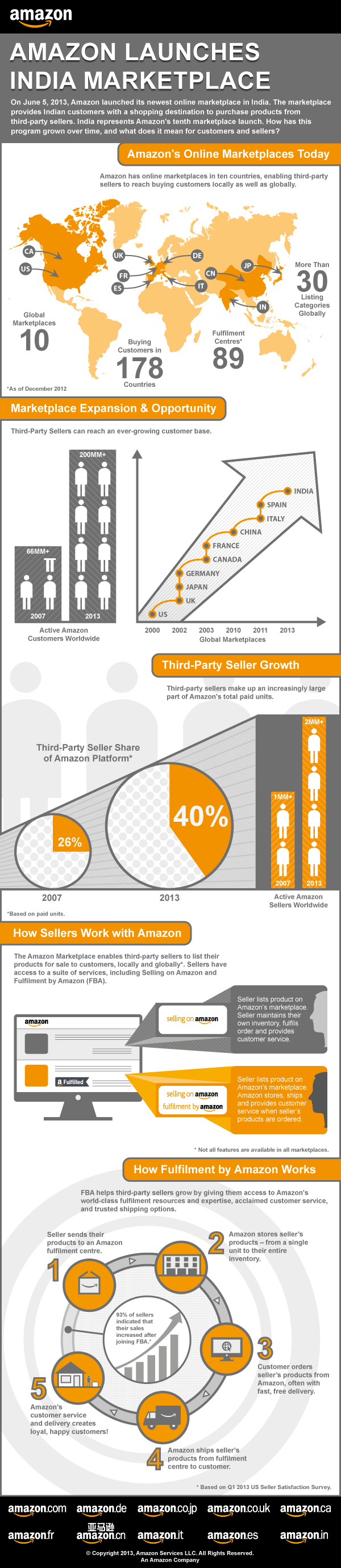
Amazon India is now live(amazon.in) |
Amazon India is now live(amazon.in) |
Two friends have started a sort of startup for books and movies and their inventory is comparable, though with a shitty interface for which I have shamed them many times.
Instead for now they are an intermediary. The end customer pays Amazon the money who passes it onto the actual seller (after taking some commission). Amazon might even handle the logistics for some sellers. But the transaction is between the marketplace seller and the customer.
Until Amazon is granted approval to become a seller on their own right, their impact on Indian e-commerce will be much more limited than it would be otherwise.
There are a lot more fundamental issues in ecommerce space.
(1) Low penetration of credit cards - Banks have slowed down considerably their efforts to market credit cards. RBI regulations don't help either. Besides both of these, people have a negative feeling towards credit cards. So credit card usage is low. Cash is king and debit cards and direct bank transfers are next.
(2) Payment is a pain. Paying via credit card, debit card or bank account goes through a two step authentication process which is fraught with failures. There are multiple sites through which payment is routed => Seller site -> Payment gateway intermediary -> Bank site -> (enter password to authenticate payment) -> Back to intermediary -> Back to seller site. This long chain is breaks more often than not. And when it breaks, it becomes a pain to get your money back. Buying something online, especially for some one new is a heart-in-your-mouth experience. Again, RBI guidelines prevent any change in the payment process. It is easier to use Cash on Delivery (CoD).
(3) Two and three means that most customers prefer CoD. But CoD is a pain for merchants. There is no guarantee that customers would end up completing the sale. Most purchases are impulse purchases. But in case of CoD, you receive the product after 2-3 days, long after the impulse is gone. So the rejection rate for CoD sales is high compared to Credit/debit card sales.
(4) Logistics is another nightmare. The companies do not have scale and are quite expensive compared to the cost of goods sold. They are also not reliable. Delivery management and providing customer support for late/missing shipments forms the bulk of support cost. So any medium/large ecommerce company starts its own courier service. Suddenly these companies are not just ecommerce companies, they are also managing a completely new and different business.
(5) Low internet penetration and usage.
(6) Wafer thin margins. The margins are already thin. It is spread even thinner by offering free shipping. Shipping used to be free for any product of any cost. Its only now that companies have started charging for shipping. These thin margins mean companies won't be breaking even any time soon. Its a long haul game and its going to leave quite a few dead companies in its midst.
Its inevitable.
Here's an article quoting Snapdeal CEO as saying that inventory model is dead in India: http://www.livemint.com/Industry/D2Xufph6zu7w9ZYg8Ze0dM/Snap...
For example; with Amazon in the UK and can order before about 5pm (often later) and have it arrive tomorrow. That even works for some marketplace sellers.
Is there comparable service from Indian retailers?
(I ask out of genuine interest to see how the markets compare!)
(Note #1: I have gotten some items the next day, but it was out of luck. If you live in Mumbai, New Delhi, or Bangalore, this will happen occasionally that the warehouse on the outskirts of the city will have the product and you'll get it the next day. But it's just not close to guaranteed.)
(Note #2: I heard or read something that Flipkart, often known as "India's Amazon", will soon be offering expedited shipping for an additional fee).
a) You franchise out "ecommerce" physical shops. This is a physical location where customer can come in surf ecommerce websites and place an order.
b) There is someone at this shop who will collect money on behalf of ecommerce websites. This could be cash credit debit whatever. Make these shops available at every nukad (every street). Hell give other shop owners these ecommerce terminals (just like sim card selling process or prepaid minutes fulfillment process) .
c) The packages are shipped to this shop or your home. Since these shops are conveniently located, near train stations, in airports, malls, picking up packages is not an hassle.
d) serve complimentary hot tea while people are shopping.
The actual order is fulfilled at an warehouse just like amazon.
Screenshot: http://i.imgur.com/Og9xMtn.png
Policy: http://www.amazon.in/gp/help/customer/display.html/ref=mk_ss...
Think "amazon.co.tw/password_reset.php"
Addresses that most "western" countries consider expected (ex. 1 Apple Loop, City, State Zip) don't exist here. Companies literally print on ads "On ____ Road, near ____ Terminal behind ______ City, State".
If Amazon somehow figured this out for India delivery - they'll do great.
Lastly, a 30 day return policy (or any return policy) is unheard of here. Electronics, clothes, anything I bought here strictly said no returns no matter what (even if defective).
30 day return policy? Check out flipkart.com, amongst others.
This pulls in a web font (woff) to display ₹. If Javascript is disabled it shows up as "Rs" instead. A fair compromise instead of images everywhere.
They'll probably get to it eventually.
India also has loads of tiny convenience stores, I think this is an excellent idea. It also simplifies the logistics. The eCommerce company only has to build out a supply chain to the convenience store instead of having to deliver to each customer or rely on the Indian postal service.
(I have lived both in India and Japan)
The amount of delivery people in Beijing, especially near lunch time, is quite impressive.
If you are saying that Japan is still very much a cash based society, what percentage of transactions are done in cash and what percentage are done via mobile phones, judging from your personal day-to-day experience?
These days anybody who can order things through internet, actually orders things through the internet.
Just wondering if you are an Indian or if you are staying India?
I would go for it.
It looks promising.
Indian book prices, especially for foreign books which are published in India, is quite low.
http://www.flipkart.com/feynman-lectures-physics-mainly-mech...
Price: Rs 236
http://www.amazon.com/The-Feynman-Lectures-Physics-Vol/dp/04...
Price: USD 38(about Rs 2100)
That's almost a 10 fold difference. The paper quality isn't good, it's mostly paperback[1], but paying 10 folds for a hard cover isn't worth it. Books which aren't published locally(imported) are an issue. Prices are too steep compared to books which are published here.
http://www.flipkart.com/algorithm-design-manual-0002/p/itmdy...
Price: Rs 5163
[1]: In the examples above, both books are low quality paperback books.
One way competition reduces prices when sellers start undercutting each other in the first case. That doesn't apply to books in India. No one is making astronomical margins on books which can be cut down.
The other reason prices reduce is when competition leads to reducing production cost. It can be because of expanding market, technological improvements, improving supply chains.
Amazon may be able to make some difference in establishing better supply chains. But beyond that I do not see how they can help reduce the book prices in India. There has already been enough bloodbath in the online book retailing in India, so lack of competition is hardly an issue.
The "end result" thanks to "protectionist legislation" is not as straight forward as people imagine.
If it was wouldnt Alibaba have been allowed to buy Yahoo ;)
Because of this they had to separate Flipkart.com and their frontend operations (WS Retail).
The VC money is now invested in Flipkart.com which is a marketplace similar to Amazon India. But they are pretty well integrated with one of their sellers (WS Retail).
Secondly, It creates an environment where a lot can be learn't from others.
The current environment for start ups in India is in large part due to inspiration, effect and to an extent competition from the silicon valley.
Banks/credit card companies have their payment APIs[0] open to parties they deal with (usually) payment gateways(now don't ask me for public methods and web service URIs) ->> payment gateway firms[1] deal with the banks and have access to those APIs ->> merchants/sellers[1] deal with payment gateways ->> customer checks out on seller/merchant's website ->> is redirected to (usually) payment gateway's portal where basic card/account credentials[2] are entered ->> is redirected bank/card's secure authentication page[3] ->> user enters login/password ->> is redirected back to seller/merchant's page with success/fail message.
[0] You might have to get in touch with some bank and/or payment gateway.
[1] When the seller is big, sometimes, they are themselves the payment gateways. Some PG examples are Citrus, Billdesk, SBI,CCAvenue(the shittiest) etc.
[2] Here in India the basic credentials include card number, exp date, name, CVV. In the USA these same basic details are more than enough for final purchase - sometimes even minus the cvv.
[3] Usually Mastercard's NetSafe or Verified By Visa etc.
Given the scope of their 3P seller business in other markets (say, the US), this constitutes a much larger entry into the market than some comments are making it out to be.
Many stores still do not take credit cards.
A lot of convenience stores will take credit cards, most will take Suica cards (mass transit cards pre-loaded with money). Some vending machines will take Suica cards.
Mobile phone payment is kind of a hassle and requires a credit card as well as a phone that supports it (osaifu keitai). Not all phones do.
Cash is still the preferred method of payment online too -- three of the four options are basically cash: bank transfer (done with cash at an ATM or online if you use a bank that supports it), COD, and payment at a convenience store.
(Way off topic) Japan can be quite strange with banking and ATMs as well. Unlike, for example, the UK, your ATM cards usually will only work on the ATMs of your bank or perhaps in some convenience stores.
For example, my Citibank card only works at Citibank ATMs, and 711 convenience stores, but won't work at a MUFG ATM. You also get charged for withdrawing money outside of "office hours" at an ATM, and some ATMs stop working after 2100.
It was a little bit of a shock moving from London where I walked around with 10 pounds in my pocket to Tokyo where withdrawing and walking around with 500 dollars worth of yen seems pretty normal.
If you are in a metro then you get the item shipped next day. I've shopped with Flipkart, Myntra etc and this has always been the norm and when usually it becomes 2-3 days it's because your stuff is being sent from a warehouse in another metro. As I live in B'lore Myntra has almost always done 1-day shipping or 2 at most.
You want your items to be shipped to a small town? There's a problem. You want to ship it to your parents in a very small town or rural area? Forget it!
There are other services like eBay India, which has recently, started 3-4 day shipping. Earlier for them it was 7-8 minimum as standard. Deal sites like SnapDeal etc follow the same minimum 7-8 days golden rule.
Sites like IndiaPlaza are plague. You get your stuff in months or fortnights and then you congratulate yourself.
The thing is there are so many options in India, even on smaller scales, for online shopping and people actively use them where they best deals. In USA when I try to buy sth, to get it via a friend who is coming form USA, I have more or less one option - Amazon!
Do you have an idea (or know someone who does) as to
1. How is the Shipping Label (with tracking# if that's feasible) generated?
2. Which are the major couriers picking up the packages from the small ecommerce shop locations and delivering them?
3. Is the Indian Post Office a major player at all (in the US, the USPS is the largest ecommerce delivery company...bigger than UPS, FedEx and DHL combined)
I don't think Indian Post Office is good option for courier stuff like a mobile phone, or a book.
But they are pretty good if you want to send a money order, letter or a registered post.
For others, this is how it always happens here in India.
On the other hand when the books are priced well. There is actually sweet spot for which Indian consumers will happily pay. For example I can quote of Rashmi Bansal's books. Especially 'Stay hungry, Stay Foolish'. It was priced so well, I hardly saw any pirated books on the footpaths people were more than happy to buy the book.
Compare this to say with a book like "Seven habits of highly effective people' there was a time when hawkers on the footpaths would have something 100 copies always stocked because the original book was expensive and pirated ones sold like hot cakes.
You won't believe this, a while back I would visit Avenue road in Bangalore and one round with foot path hawkers could give you a hint on the best sellers in the market currently.
Funny thing about that book, you can buy it legitimately at ~90 and even street vendors(pirated copy sellers) usually sell it at 50+ and people still buy :-) I think they never got that taste of that feeling when you read a book, hold it your hand, travel with it and then over the time appreciate the crease on it and dream passing it over to your bloodline hoping they would love reading books.
Anyway, I still feel bad having to pirate any book or film or songs. Very bad. Though my next statement is technically incorrect but there are times I can't avoid pirating a book.
I have reduced my music piracy. I've reduced/ the number of songs I listen to around ~ 7GB (almost all of them 320kbps or 8-20 MB on an average). Out of them around 4GB I've purchased and to be honest a lot of them is from Flipkart's 10 day freebie bonanza, but I've purchased from other sources a lot and I must say that A 7-9 Rupee DRM free song is a deal sweeter than saccharine so I like a song and I buy it. I can even go a lot more if the cost goes directly to the artist or most and I do it. Like Indian Ocean's music. I hope in a few months I'll not have any pirated song on my pc or phone. I use Spotify so that also covers a lot.
I've not have any good and affordable[1] alternative for fils. I hope sth like Netflix/Hulu comes up in India or even a good DVD/BRay rental online shop which offers quality with a price. The ones we have don't have many worthwhile films int heir inventory.
Yes, you are right - pricing does affect privacy, in a positive way to check it. However there are people who would just pirate! Piracy is imprinted on their minds and they never bothered to check whether it's a necessity and or is there a mid-way like a friend who stopped using WhatsApp the day his 1 yr trial was over, he just had to pay INR 55 for another year. Though I should have been this judgemental, still active in piracy myself.
[0] Publisher, distributor, agent etc
[1] Again, this is my point of view and someone else can just say I can buy the movies at INR 500 a dvd and this is just an excuse to pirate.
Books which are published in India are quite cheap(especially if they happen to be popular). Most of the pearson books are LPE(low price editions). Books from other publishers which are published here(marked for the Asian subcontinents) are cheap. Foreign books being cheap is the norm, not the other way round(unless they are imported).
But most of the novels, and other books that I know are definitely expensive.
Text books are not the only books. And of course it also depends on the definition of cheap.
But pirated books sold on by footpath hawkers sell like hot cakes only because many foreign best sellers are generally expensive.
I know most of the things can be bough cash-on-delivery. I was responding to "high priced items viz. laptops" can't be bought cash-on-delivery.
And it used to decide to crash from time to time and then it would simply stop streaming and buffering and you couldn't do anything about that.
There's a new player in town CatchFlix. Haven't checked them.
There's also BoxTV which worse than them all.
And range sucked in all of them.
I don't have special shops to buy books for free, and I am not referring to LPE editions only. I am saying most of the foreign books are LPE whether explicitly or implicitly. They do compromise on paper quality, printing and covers.
> But most of the novels, and other books that I know are definitely expensive.
An average novel costs me 350. That is by no stretch expensive. Sure you can get a "lord of the flies"(or may be not; I mostly see Chetan Bhagats and Sidney Sheldons) on a pavement for 50 bucks, but that doesn't mean 350 is expensive.
> But pirated books sold on by footpath hawkers sell like hot cakes only because many foreign best sellers are generally expensive.
Pirated books are cheap doesn't mean most of the foreign books aren't reasonably priced.
Surely if you measure cheap by what starts at 350 rupees. A lot of things get cheaper.
You keep changing stance - most foreign books are not cheap(they are), technical books aren't the only books(no they are not; fiction is cheaper, non-fiction is a bit higher), and lastly 350 isn't cheap. Doesn't my very first comment in this thread has 236 termed as "quite low"? If your basic objection is 350 isn't cheap for most books, why bother with the needless arguments about foreign books and novels.