IBM opens up Power chips, ARM-style, to take on Chipzilla(theregister.co.uk) |
IBM opens up Power chips, ARM-style, to take on Chipzilla(theregister.co.uk) |
All I see in the actual announcement[2] is marketing hype (not news) about software that already exists ("open firmware" == U-Boot, "open software" == linux) and hardware that has been licensable for years.
[1] http://en.wikipedia.or/wiki/Power_Architecture#Licensing
[2] http://www-03.ibm.com/press/us/en/pressrelease/41684.wss
I don't think this would change anything, though, there's not enough gain to justify an architecture switch for either hardware or software people. And that's a damn shame. I cut my teeth on PowerPC and I couldn't imagine a better way, it's a beautiful architecture. Altivec STILL makes intel's vector processing look like a toy.
BTW, if you want to roll your own ARM you have to negotiate for an architectural license.
I didn't know Power chip business still existed.
x86 is likely something like the 4th or 5th largest chip architecture by volume shipped today. Last estimate I've seen was in the 360 million range per year, maybe as high as 400 million.
That's after ARM, likely to ship 3 billion this year, MIPS and PPC probably in the 500+ million range each unless there's been massive unexpected changes over the last year.
X86 gets all the attention because it's on desktops and in laptops and because Intel is disproportionally important because their revenue is several times that of any other CPU manufacturer because nobody else ships nearly as many high end chips (e.g this puts Intel at 7 times Qualcomm, at second place, in revenue from CPU/MPU's last year: http://www.xbitlabs.com/news/cpu/display/20130521205843_Inte... )
And for the surprise contender, it is unclear where the 6502 architecture falls: It ships in "hundreds of millions" a year according to Western Design Centre). Note that this might very well largely be in the form of licenses for embedding the cores in custom ASICs or in FPGAs, so whether you'd want to count that is another matter (as an example, some Amiga's had keyboards with an embedded 6502 core + PROM and a tiny amount of RAM). It's possible that some of the other extremely low end 8-bit CPU cores that are still being used as micro-controllers might also ship volumes like that.
I've seen no indication that Sparc is anywhere in the running
POWER stalled in the performance/watt category around the time of the Power Mac G5: unfortunate, since this was around the time that performance/watt was starting to be considered a real thing. That hurt the architecture's standing terribly. But it's still around.
Also, the main thing with the PS3 was the Cell architecture which was going to appear in every type of device from TVs to mainframes and make the rest of the processor industry obsolete.
In the beginning it had a lot to do with toolchain support, these days I think it's a combination of force of habit and the fact that you can fry an egg on an x86 floating point unit.
And both ARM and PowerPC outsel x86 by a hell of a lot more than a factor of 2. It's at least a factor of 10, and that's almost certainly low too. x86, in terms of units sold, is an extremely small market.
Big data still requires a lot of power to move it.
Costs more than the Raspberry Pi though.
Admittedly it was a smidgeon more expensive than the Raspberry Pi.
They're making a kajillion PPC based processors for the Xbox 360, PS3, and Wii, so it's not like they don't have designs for current manufacturing processes. The chip in the 360 can't cost more than $50 today, and if stripped down (2 cores vs. 3), clocked less aggressively (1GHz vs. 3.2GHz) could probably be cut to $25 or less.
http://en.wikipedia.org/wiki/Common_Hardware_Reference_Platf...
Yeah, no.
Some more competition for Intel x86 and some widespread availability of Power machines (that don't cost a bazillion dollars) has felt like a pipe dream for years, and I'm not optimistic now...
I would hope not for a personal FPGA... that's hilariously unenforcable.
The [PowerPC] 603e processors also power all 66 satellites in the Iridium satellite phone fleet. The satellites each contain seven Motorola/Freescale PowerPC 603e processors running at roughly 200 MHz each.[1]
There is a radiation hardened version called "RHPPC" based on PowerPC 603e made by Honeywell & Freescale. RHPPC is equivalent to the commercial PowerPC 603e processor with the minor exceptions of the phase locked loop (PLL) and the processor version register (PVR). [2]
[1] http://en.wikipedia.org/wiki/PowerPC_600#PowerPC_603e_and_60...
F/A-18s also use PowerPC processors in the Advanced Mission Computer (AMC) avionics.
For some reason that was the first thing that came to mind, reading your comment ;-)
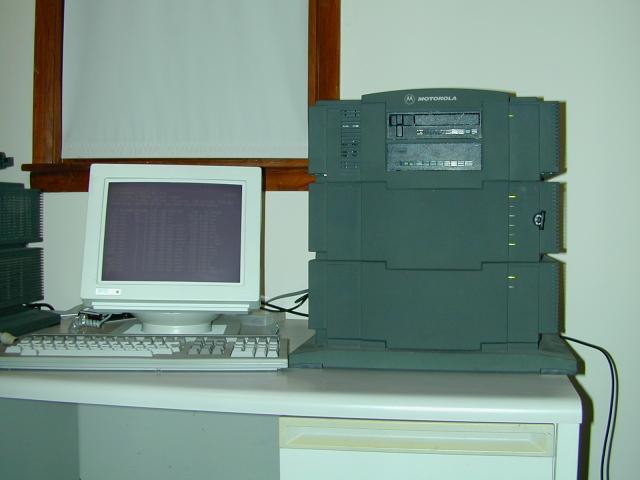
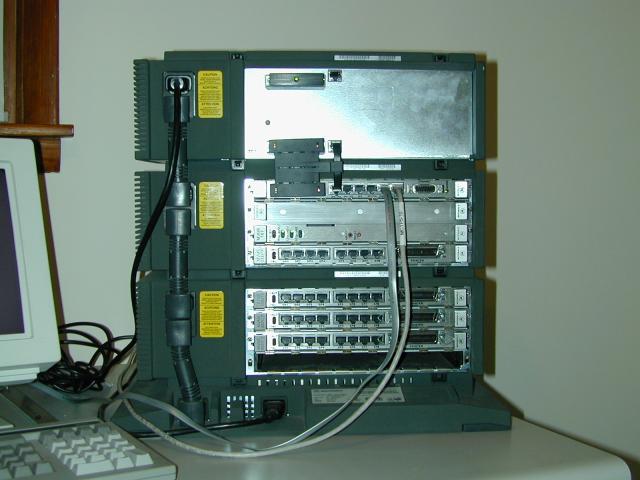
The M88K system had big vertically stackable blocks with ribbon cable connectors at the back between the units for power and data. [1] [2] One unit consisted of a tape drive and a floppy drive. The floppy drive was actually SCSI and very fast (over 100kb/s when most floppy drives top out at 25kb/s). I can't imagine how much that drive must have cost.
The system arrived in a massive box and for some bizarre reason they stuffed the empty space with O'Reilly books. There were lots of "read me first" and "read me first" for the read me firsts. I ignored all of them.
About a year later the machine failed. It turned out there was a filter by one of the fans and one of the readme firsts told you to clean it once a month. Eventually the system had overheated and shut down.
We also had a Data General system that used the m88k. They called it the Aviion which was annoying to read and type. The DG folk we dealt with were by far the nicest out of all the vendors. Both the DG system and the Motorola system ran lightly modified SVR4. It was basically Unix of the time, and worked just fine.
The Motorola system ended up acting as the office server for various things because of its high spec. Hold onto your chair - it was blazingly fast at 40MHz, and had a whopping 64MB of memory. At one point we spent a thousand pounds to get a 1GB hard drive and used it as a Usenet server.
[1] Front view: http://www.openbsd.org/images/mvme187-1.jpg
[2] Back view although the system I used didn't have that much networking http://www.openbsd.org/images/mvme187-2.jpg
If you want to run 3 cpus lockstep, verifying each other's results, the PPC world already has the infrastructure. This and other similar things make it an easy choice for some applications.
So, it isn't that PowerPC is doomed from a technical standpoint. Instead it's all about money, business cycle stuff. Less sales means less R&D. Less R&D means you fall behind of the competition. IBM doesn't really have the heavy hitters they used to in the chip business (Relative to Intel/ARM/TSMC). If you want the newest flashiest tech, you can't really use their fab - that sort of stuff.
Every chip technology node is getting more expensive for foundries, which means the chip market will likely naturally converge to a small number of players.
[1] http://research.cs.wisc.edu/vertical/papers/2013/hpca13-isa-...
The P5 was a contemporary of the G5 (although the G5 was really a P4). But it wasn't quite the beast the P6 was.
Before this, the idea was that RISC was simpler to implement and could be optimized more easily, ultimately be more cost effective. What wasn't factored in was how good Intel is at optimizing, and how hard they'd push their process, beating the RISC side despite all the disadvantages CISC had.
Now it's the GPU that's eating Intel's lunch, high performance floating point code on the CPU is several orders of magnitude slower than a high-end GPU, so Intel's trying to fight back with their "pile of CPUs" strategy (http://en.wikipedia.org/wiki/Larrabee_(microarchitecture)). It's not working out very well so far.
Historically, it has been my experience that pretty much all the non-x86 platforms the compiler and hardware specific optimizations tend to have a pretty dramatic impact. Intel just has so much code and existing code streams to factor in to their designs for new hardware. Maybe this has changed. It's a hard road if mismatched or non-hardware optimized binaries are slow and pokey and hardware specific optimized binaries are competitive. Come out with a great 64bit ARM core that can run nearly all ARM binaries with decent performance (clearly, excluding stuff that needs custom hardware..) and ARM could be pretty disruptive.
I was there and it didn't! TBL did development on Next. There were some text mode browsers that worked on Unix only. The popular graphical browser was Mosaic[1] which started out as Unix/X windows only. It was run on Sun, HP, IBM, SGI etc workstations (32 bit).
At that time popular Windows was still 16 bit. It didn't even include TCP/IP with various third party stacks (for a price) and later a Microsoft stack for Windows 3.11 for Workgroups. Some brave people did start porting Mosaic but it was hard because a completely different GUI API and semantics was needed, as well as dealing with the cramped machines compared to the 32 bit workstations. It was late 1994 before these ports became somewhat usable.
Netscape was formed around then, and the big difference was they made their code portable to multiple guis from the very beginning (a lot easier than retrofitting it). By 1995 every platform had to have TCP/IP and a web browser to be relevant. The web spread because no one was in charge, and everything had to work everywhere on a wide variety of screen sizes, operating systems and user environments.
ie it was the diversity of systems out there that was the cause, not that you could buy the PC architecture from different companies.
In shipped units, MIPS is quite likely either second after ARM, or third after ARM and PPC.
MIPS was estimating an expected 500 million units for last year, I believe - I don't know if they met it. PPC has been estimated in the same ballpark.
Unless Via's x86 sales are far higher than expected, x86 is likely below 400 million units shipped a year.
Can you explain that? Because I cannot make any sense out of it.
The clones were possible because IBM due to various business, legal and other stuff could not stamp them down. So we got to the point where computing penetration was fast and high enough for the whole net thing to make sense.
I just hope people realize that the Internet was the most compelling and most popular way to "get online" even before there were significant numbers of PC clones on the Internet.
Specifically, although it was technically possible to give a Windows machine a direct TCP/IP connection to the Internet, if you were using a PC clone to access the internet before July 1993, you were probably using the PC clone to run a terminal-emulation program (e.g., Kermit) to log in to a Unix shell account.
(I chose July 1993 as the date by the way because that was the month in which the New Yorker ran the cartoon, "On the Internet, nobody knows you're a dog," which was the first reference to the Internet in a mainstream publication that seemed to arouse the interest or the curiosity of large numbers of readers.)
The half-watt microcontroller replacements still need custom builds, but the chips used in top-line smartphones can now all run the same compiled OS and apps. They are going to do a 64-bit transition soon, it will be very interesting how that will turn out.
As to RISC vs CISC, well, it's true that x86 instructions are decoded to micro Ops inside a modern processor but the fact that the instruction was complicated does have a cost even for a modern processor. The act of just decoding four instructions in a clock cycle and transforming them into uOps is quite a bit of work, on the same order as finally executing them if they're simple additions or such. And the uOps that make up an instruction have to be completed all together or else when the processor is interrupted by a page fault or such it will resume in an inconsistent state. And the first time you run through a segment of code you can only run one instruction at a time since figuring out where instruction boundaries are is hard, though you can store the location of those boundaries with just another bit per byte when they're in the L1 instruction cache.
On the other hand, complex variable length instructions mean that you don't need as many bytes to express some piece of code both since you're using less bytes per instruction on average and because complex instructions mean you sometimes use fewer of them.
Of course, Intel is the biggest CPU vendor out there and has correspondingly large and brilliant design teams working hand in hand with the most advanced fabs in the industry.
Now, there are many RISC instruction sets that have taken on x86 before, but they all attacked it from the high end, from upmarket. Doing just the opposite of what ARM is doing now. Will it succeed in dethroning x86 from the low end the way x86 did to it's rivals? Who knows. But I think that previous fights don't tell us much about this one.
Of course, "Intel is doomed" (and "Microsoft is doomed") have been staples of clueless fanboy hype for 40 years. I'm still waiting for one of them to be right....
If you remove people who connected through work from the definition of ordinary users, then AOL or Compuserve might have had more ordinary users than the Internet, but not vastly more. There were at least a dozen ISPs offering shell-account-style access to the internet in July 1993, Netcom, Best, Panix and The World being big US-based ones.
You may recall the huge impact that AOL had when it connected to the web. AOL also bought Netscape, which had been a dominant force in the early commercialization of the web (along with Windows 95), before taking over Time-Warner.
And consider that that in July 1993 Usenet was still much bigger and more important than the web. The web grew very quickly, but it takes a while to grow from zero users. (To help jog people's memories: Netscape Communications -- as "Mosaic Communications Corporation" -- was not founded till April 1994. Altavista opened to the public in December 1995.)
We've gone very far from the topic of this comment section.