What coding mnemonics do you use? What weird coding things do you have to use statements for or other weird tricks to remember? I can never remember < or >, and only remember that < is less than from years of typing (i=0; i<30; i++). |
What coding mnemonics do you use? What weird coding things do you have to use statements for or other weird tricks to remember? I can never remember < or >, and only remember that < is less than from years of typing (i=0; i<30; i++). |
"public static void Main(string[] args)", which is the default method signature for the main method in C#, is a hip-hop beat. SQL statements are always metal tunes. Javascript is usually indie pop.
Rapping arbitrary chunks of code could be a fun after-hours conference game.
"squared circle" aka []() aka [word](http://link)Perhaps a mnemonic which only really works in the North East of the UK where 'class' is colloquial slang for 'good'. Also not very good if you smoke pot, I guess.
I didn't know for sure, but I had that feeling knowing that most of the English language is borrowed from others, and not the other way around. (http://www.etymonline.com/index.php?allowed_in_frame=0&searc...)
I have dealt with this by conditioning myself to always read < as 'is less than'
Fortunately for both of us, he had been diligent about making backups and din't lose his entire thesis.
I'm sure I spent many hours fixing bugs caused by getting < and > wrong.
":link, :visited, :hover, :active"
margin: (T R B L)Although I can never remember the 3 parameter verision
margin: (T R&L B)
'Naughty Llama Holidaymakers Book Lovely Vacation Homes from AirBNB'
= N.L.H.B.L.V.H.A = 'not Love Hate but Las Vegas Hells Angels'.
<sdmkun> tar -xzf merc.tgz what the fuck
<sdmkun> how the fuck do you people remember this shit
<bucketmouse> just think with a german accent
<bucketmouse> XTRACT ZE FILES
tar - [create] [verbosely] [a g/bzip'd compressed] [file named] foo.tgz (from) input_dir
tar -cvzf foo.tgz input_dir
Your version doesn't seem as 'fun', I guess zcat and PIPE are just hard to rhyme along to.
Another thing that was particularly hard to get naturally was the ternary operator. It didn't sink in easily until Jon Skeet said pretend the ? is indeed a question. If the answer is 'yes', this will happen.
The symbol for a diode is something like this: --|>|--
Now, which one is the Anode, which one is the Cathode
Very simple, the Anode has an A in the drawing (left side, turned 90 degrees), the Cathode (K) has a K, right side, upside down in the drawing
.shift - makes it smaller. Shorter word than .unshift
"Shift" will shift everyone up one, bumping someone off the start of the row.
Rhyming reminder of which axis is vertical, and which horizontal...
1 < 2
4 > 1
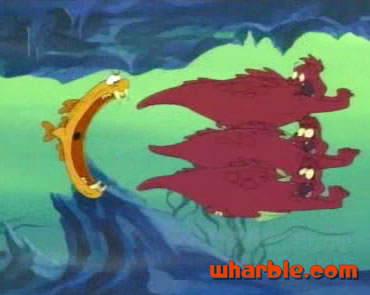
If they're eating less, they're not happy crocodiles.
http://wharble.com/sites/default/files/Snork-Eater_Eater.jpg
But I never know which one is "smaller than" or "bigger than", I have to think a little bit
so if you are trying to remember what order the arguments to strcpy go, it's
strcpy(x,y) is like x = y
Look, Joshua Foer says that emotional imagery is more likely to stick...
ln -s "what you want," "where you want it"
$(CC) -c $^ -o $@
ReturN - R before N
I've always thought it's because of carelessness
< > Numbers are cruel and ruthless :)
When little, my brother used to mix up the words "more" and "less" while speaking. I don't doubt someone could mix up > and <.
At some point I realized it's possible to memorize it visually, since then I never mixed it up again
Anyways, the classic mnemonic for that was simple - for < and > the wide part contains more 'thingies' than the narrow part. They're actually taught before numbers or together with numbers, like [pic of four strawberries] > [pic of three strawberries].