arson, robbery, burglary, kidnapping, sexual assault, or a class 3 felony sexual assault on a child
If somebody or a group of people are participating in these activities and somebody ends up dying, they should certainly be held liable for murder due to the reckless and malicious nature of the crimes being committed.
a facility whose operation is a business and the more residents the more the business makes.
tell me.
why would a business ever want to not have a guaranteed permanent paying member?
solve the problem that led to the person doing what we do not like.
unless that problem is unique to this specific individual, removing the person will not stop the problem manifest on another individual.
we here are all smarter than this.
That's how irrational and absurd this law is, the Taliban look like humanists compared to that.
Really drives home the idea that in some ways, America really isn't like the rest of the western world.
Burglary is a terrifying experience that can leave the victims with life long PTSD. This man is lucky he wasn't immediately shot to death by the occupants. Every day he spends in prison alive is still a gift after that.
It follows the War on Drugs in the USA. As an outsider (Irish living in London) I found it genuinely eyeopening on a topic I knew next to nothing about. For example did you know that the only difference between cocaine and crack cocaine is the addition of baking powder and heat. Although the later will get you 100 times the sentence of the former. There are 19 year olds being put away for the rest of their lives for the possession of a few grams of this stuff.
I don't care what stand you take on the legalisation/criminalisation of drugs, that is insane!
Instead of trying to reduce the rate of reoffending once released, it seems many states go out of their way to marginalise convicts so that virtually no law abiding avenues of employment remain for them. Talk about a vicious circle. That's not evening taking into account the effect of incarcerated parents has on the generation that follows.
http://www.isthmus.com/forum/viewtopic.php?f=35&t=58211
Of course no analogy is perfect, but this one gave me pause.
Seven out of every ten black men never went to the ninth grade
Didn't have 50 dollars and hadn't had 100 for a month when they went to jail
So the poor and the ignorant go to jail while the rich go to San Clemente"
     -- We beg your pardon America, Gil Scott-Heron
        from the album The First Minute of a New Day (1975)
/genuinely curious
The three-strikes law significantly increases the prison sentences of persons convicted of a felony who have been previously convicted of two or more violent crimes or serious felonies, and limits the ability of these offenders to receive a punishment other than a life sentence. Violent and serious felonies are specifically listed in state laws. Violent offenses include murder, robbery of a residence in which a deadly or dangerous weapon is used, rape and other sex offenses; serious offenses include the same offenses defined as violent offenses, but also include other crimes such as burglary of a residence and assault with intent to commit a robbery or murder.
So, since speeding is not a felony, it has no relevance here. Shoplifting might be a felony, but it would only invoke three strikes if you already had two prior felonies which also happened to be violent.
By the way, I'm not defending three-strikes laws, just describing them. I think they are a bad idea. I also think the ACLU is whitewashing the records of a lot of the people involved here.
I think the problem is that on a manifesto a three strikes proposal looks very good especially for those concerned about law and order, the reality is these horrible injustices..
This part struck me. There was grellas' comment on the Google vs Authors Guild thread were the judge decided to go against the 'mechanical' application of the law and took time to come up with a sensible interpretation to handle the case. It's crushing to think about a mother of two in prison for life for a crime the judge itself thought wasn't worth the sentence, potentially leaving her kids in the hands of an abusive husband (I hope they got sheltered at least)
I can't imagine reading this and not feeling tears well up.
No sense of what I would call humanity. From what perspective does this make the world a better place?
What am I missing about being human that this fits into that I don't understand?
Take land mines. I've heard that they play a critical role in South Korea's defense, which was a major reason Clinton didn't sign. Military experts talk about how it's an effective tool that, when used responsibly, can benefit civilians more than harm them.
They also kill and maim people.
Intellectually, both sides seem reasonable to me. Of course, emotionally, one is passively helping people (or so we are told), while the other is actively harming them, so, ya, I lean towards being anti land mines. But, I fundamentally can't shake the feeling that I have no clue what's going on, so maybe I shouldn't be too quick to judge.
The vast majority of people who are raised in USA public schools.
That is an appropriate reaction, but the ACLU's focus on life without parole sentences grossly understates the savagery of US sentencing schemes. Tens of thousands more inmates are serving life with the possibility of parole for non-violent crimes. These inmates may very well never be released, and if they are they will have served so long that they will never be able to recover.
In Nevada, for example, 1 in 5 prisoners is serving a life sentence with the possibility (but no guarantee) of parole. Our version of the 3 strikes law, which is used in several other states as well, enables any three felony convictions to qualify an offender for a life sentence. This can and has included repeat drug offenders (including those who were not dealing), those committing multiple relatively minor property crimes (vandalism, theft, etc), and those with multiple DUI's that never resulted in accidents.
Simply put, US habitual offender laws defy all sense of logic, humanity, and reason. The political will to change this does not exist within either of our major political parties, so the problem is likely to expand over time.
It would be less biased to show statistics for the kind of people sentenced under the three strikes law, but that wouldn't tug the heart strings as much. California's law is particularly dysfunctional, because it applies to any three felonies while most states limit their laws to serious felonies. As a result, about half of three strikers in California are in for non-serious or non-violent predicate felonies (burglary, robbery, and drug possession). But in other states the law is more limited. For example, the Georgia law only applies to: (1) Murder or felony murder, (2) Armed robbery, (3) Kidnapping, (4) Rape, (5) Aggravated child molestation, (6) Aggravated sodomy, or (7) Aggravated sexual battery.
Besides that, what you're missing is that nobody is really intending for these specific, cherry-picked, people to be kept in jail for their whole lives. Their sentences are the unintended consequences of three-strikes laws that offer no discretion to sentencing judges.
When legislators voted for these three strikes laws, with public support, they were thinking of people who are "irredeemable." Hardened convicts who end up in jail on three occasions. What they didn't count on was the fact that there are people living on the edge who rack up a number of felony convictions for relatively minor things even though they're not the kind of hardened criminal legislators were thinking about. If you live in the ghetto and have friends who engage in gang activity, it's pretty easy to get drawn into some bad behavior that results in a couple of felony convictions, so that "one mistake" later in your life can bring you under the three strikes law.
Why don't these laws get repealed? Because Americans are really not sympathetic to people living on the edge. Ordinary people don't live in the kind of circumstances where they might wander into a felony conviction from a minor lapse in judgment. They don't have drug dealer boyfriends or friends who try to recruit them into burglarizing a house. It helps that 75% of people sentenced under California's three strikes law are black or hispanic (45% are black despite only 6.5% of the state population being black). Americans are particularly unsympathetic to racial minorities living on the edge.
I think sentences in the U.S. are deeply dysfunctional, but I hate this sort of publication by the ACLU. It makes people who support sentence reform seem dishonest by cherry-picking the edge cases, instead of trying to paint an accurate picture with statistics.
It would be less biased to show statistics for the kind of
people sentenced under the three strikes law, but that
wouldn't tug the heart strings as much.
People are even more unmoved by accurate pictures painted by statistics than they are of "minorities living on the edge". That's the problem here. The ACLU is trying to relate to people on a human level so that they can build some support. So what if they end up producing something very biased? Is this a scientific paper in peer review? I think most people are aware of the fact that the ACLU is a civil liberties advocacy organization and that this naturally biases towards the left wing.
   Ordinary people don't live in the kind of circumstances where
    they might wander into a felony conviction
dont fool yourself into think the legal system is anything other than a tool for oppression and control
When that starts working I'm sure advocacy groups and politicians might give it a try.
AFAICT, it's about neurological differences, not racial or cultural differences. White people with low IQ or poor impulse control get shafted just as hard, they are just a smaller proportion of the population. Gypsies and trailer trash are just as screwed as minorities of color.
If you manage to find the very rare employer willing to overlook a felony conviction, there's also the challenge of finding an apartment with a criminal record (apartments can and do reject ex-cons from leasing).
Never mind the emotional hurdle of reuniting with family (if you're lucky), and the huge challenge of socially re-integrating with society.
After all, even if three-strikes is reformed, that almost certainly wouldn't be reapplied retroactively.
I need to do something, something meaningful. Sure I send a few bucks every month to a few charities but that just makes me feel worse, like I'm loosely patching holes of my guilt with plaster that will fade the next day.
What can I do? I don't belong here. I'm just another waste of space.
You can also shift to work for an institution which is genuinely trying to do good, such as the World Bank or a not-for-profit. Or you can do what you can from within your own organisation to get them to be working to improve the world rather than take advantage of it.
(1) http://blogs.hbr.org/2013/11/what-problem-will-you-own/
<update - my apologies, there is a registration requirement for the article. The lightbox appears after a little wait, so you should be able to read it>
Isn't everyone? Why is working 18 hours of labour a day inherently more valuable or useful to humanity, the planet, the universe, anything? Why is someone struggling inherently a better, more worthy person than anyone else (and by what standards?).
Would you really prefer a world where everyone has to struggle to survive, because that's where it sounds like your comment is leading.
The feeling of guilt is an echo in your head. It's not actually an objective measure of your worth, it's not really some outside deity judging you and finding you unworthy, even if it feels like it is. Because of this, there's no saying there is anything you can do to assuage your feelings of guilt if you go with them. Maybe it's a while loop that says "while (bad_things_happen_anywhere) { feel_guilty(); }". You ask what to do as if there's bound to be a corresponding "if I do X then I can feel less guilty" pattern in your head waiting to be triggered - but maybe there isn't.
What you can do is work on it as your problem, your suffering, your mental issue that needs addressing in your head. You're not unhappy because the world sucks for a dirt poor person. You're unhappy because of a "be unhappy" thought stuck in your head. Don't change the world to stop this suffering, change your thoughts.
Being poor is not a moral flaw and I see people everyday go out of their bed and try to win most of their days. Still people manage to find happiness within the most dire constraints.
You cannot do everything and nobody expects to. Take comfort in that. We are all doing out bits to repair the world (There's a wonderful Hebrew phrase for this: Tikkun olam).
But when you have the means, go travel. Meet the others who occupy this world, who have different perspective of living, who struggles with different things that you do. They will be happy to meet you.
Consider: if we can write the software that cities, states, and even the federal government uses to do it's job, then we can also have a material impact on transparency, usability, etc for the users.
Take the judicial system. It is badly underfunded, especially in California, which has the largest civil court system in the Western world. What if an enterprising group of civic minded programmers simply wrote awesome, free, open software to run a state courtroom, complete with a self-help web interface?
Such a project would not necessarily be fun. But it would be useful, and it would arguably contribute greatly to society.
Don't do it from a place of guilt, find something that you feel passionately about, cut back on the meaningless and lucrative tinkering and start tinkering for your passion. Your most valuable contribution to the world is your time, arrange your life so that you can spend as much time as possible, without burning out, on something meaningful to you.
It's hard. It's not just giving $10 to Oxfam (which you should do anyway), it's a real dedication of time and care. But you'll meet people, you'll support something you are passionate about, and you'll have a lot less time to think about how you're a waste.
But what you describe does not sound like an honest or clear assessment of the world. It sounds more like depression. Which is real and serious and treatable.
The world is often tragic. It <em>is</em> wrong to live comfortably and be willfully ignorant to tragedy, but it is not wrong to take care of yourself and make yourself whole. So, yes, seek something meaningful to make the world better, and start by taking care of yourself.
> Anthony Jackson has a sixth-grade education and worked as a cook. He was convicted of burglary for stealing a wallet from a Myrtle Beach hotel room when he was 44 years old. According to prosecutors, he woke two vacationing golfers as he entered the room and stole a wallet, then pretended to be a security guard and ran away. Police arrested him when he tried to use the stolen credit card at a pancake house. [...] Because of two prior convictions for burglary, Jackson was sentenced to mandatory life without parole under South Carolina's three-strikes law.
Emphasis mine. I can't get too worked up about a system that sentences this guy to life in prison. What would be the point of letting him out? He knew he wasn't supposed to walk into other people's hotel rooms and take their wallets. At what point does society get to tell people "you know what, knock it off"?
> After serving two years in prison during his mid-twenties for inadvertently killing someone during a bar fight, Aaron Jones turned his life around. He earned an electrical technician degree, married, became an ordained reverend, and founded the Perfect Love Outreach Ministry. Years later, Aaron was hired to renovate a motel in Florida, and was living in an employee-sponsored apartment with two other workers, one of whom had a truck that was used as a company vehicle by all the co-workers. Jones decided to drive this truck home to Louisiana to visit his wife and four children. When Aaron's co-worker woke up to find his truck missing, he reported it stolen. Aaron was pulled over by police while driving the truck.
I don't understand this one at all. Shouldn't the truck owner have testified on his behalf? Declined to press charges?
I made a cursory effort to look up the case itself, but I have no idea how to do that.
I don't think you can look at this in a vacuum - you need to see these punishments as simply another manifestation of this attitude. This is not a "this group vs. that group" thing; you may find this among "fire and brimstone" Democrats just as often as your "Limburgh Republicans".
I've often said the difference between these groups is: given 100 people asking for a free meal, the liberal will take satisfaction in feeding 99 hungry ones; this type of conservative will fret over the one person who "got away with" getting a free lunch he could have afforded himself.
(Side rant: these people tend to be among the loudest Bible-thumpers, and think "the Good Lord helps those.." is an actual biblical passage.)
Rehabilitation as a way of dealing with miscreants doesn't work in the US for the main part because there is too large a segment of the American populace who feel that these various programs equate to giving them a reward for bad behavior. Why should they (the convicted) get a free hand with job placement when no one else is "being coddled"?
(The wonderful quote "born on third base and thinks he hit a triple" always comes to mind here.)
So you see, Americans understand perfectly well all the logical and economic aspects of this issue. The fact is, it is built into our culture to punish people. We get satisfaction from it. We're not after what's best for the country, we're after revenge.
It's ugly, but I've been around for many years & I stand by that statement.
"taking a wallet from a hotel room" - we blame it on the court appointed lawyer. He's already been convicted and sent to jail twice for burglary and he continues to break into other peoples places and steal their stuff. Poor guy just took a wallet from those rich vacationing golfers. Screw that. If I was there I'd be scared to death. How many times do we let him keep doing this. Stop doing it stupid.
"stealing tools from a tool shed" - oh he was just riding along. sure he was. already been convicted multiple times for burglary. The fact that he desperately misses his children does not make him less guilty of continuing to break into other peoples places and taking their things. Stop doing that stupid.
"borrowing a co-workers truck" - i think there is clearly more to this story. generally speaking, people don't normally drive other people's trucks 3 states away without letting them know. If it really was harmless, i'd expect the other guy to not press charges or testify on his behalf. Hey guys, it was just a misunderstanding I thought someone else took it. Also, "inadvertently killing someone" is a really nice way of saying he beat the shit out of someone in a fight and the guy died.
Perhaps some of these don't deserve life, but I don't really have that much of a problem with it. Maybe we could lower it to 20-30 years, but I have no problems with escalating penalties. If you are a productive member of society this isn't a problem. These mini-articles are all worded as if these people didn't do anything wrong and just made a tiny mistake this one time and now they are in prison forever. Not the case. Most of them made pretty big mistakes, and they made them repeatedly.
The problem is in the increasing meaninglessness of the term "felony". If they limited it to grievous crimes, there wouldn't be much controversy.
Also, it's weird to have something presented as "news" when The Simpsons covered it satirically about 15 years ago:
I would. The primary purpose of prisons should be rehabilitation. Giving life sentences doesn't take into account that people can change.
It's worth asking what is going on here. I'm no expert on law and punishment, but it seems like the U.S. is throwing more resources at the problem (perhaps prodded by for-profit prison lobbyists) and getting poorer results. The cultures are too similar to explain this away by saying Canadians are inherently less violent. As Canada considers harsher prison sentences and expanding prison capacity, it's imperative to understand if this will produce the intended results.
[1]http://en.wikipedia.org/wiki/List_of_countries_by_incarcerat...
[2]http://en.wikipedia.org/wiki/List_of_countries_by_number_of_...
[3]http://en.wikipedia.org/wiki/List_of_countries_by_intentiona...
Now, think, really picture, what a 3 year sentence would do. How hard it would be to recover from losing those years.
Now picture a 5 year, 7 year, 10 year, 15 year sentence. There is a reason Norway generally restricts its sentences to 21 years for even the most heinous crimes. The sentencing here in the US is truly draconian. It only seems proportional because we are measuring relative to what is already going on, so in context this stuff seems "not that bad."
The US is leading the world in incarceration and the privatization of prisons is a big contributor to the problem. Corporations have a financial incentive to incarcerate more people and lobby to keep strict drug laws.
Meanwhile we make jokes and laugh about things like prison rape. I believe we will look back at prison rape the same way we look back at slavery. How barbaric are we that we think that's somehow okay?
For things to change, we’re going to have to change public perceptions and start demanding change. I wish we were a little less eager to deprive people of their most basic right to freedom.
http://en.wikipedia.org/wiki/Incarceration_in_the_United_Sta...
In non-privatized states, you generally have a prison guard union. The prison guard union lobbies for more prisoners and gets more money. Simple as that. A non-monopolistic prison corporation spends their own money lobbying, and all the other prison corporations get to reap the benefits. Classic collective action problem.
http://www.volokh.com/2013/01/10/the-effect-of-privatization...
http://www.volokh.com/2013/01/11/the-effect-of-privatization...
That made me laugh - thanks :)
http://en.wikipedia.org/wiki/Sentencing_in_England_and_Wales
I understand that we don't have the kind of problem that a8da6b0c91d mentioned here: https://news.ycombinator.com/item?id=6743406 however I really don't understand the common sense of the US judicial system.
If I were to be caught breaking some computer misuse act against a UK company it's more than likely a slap on the wrist would be handed down to me. Abuse a US corporation and I would expect extradition and 10 years or more in one of your comfortable prison cells.
Also compare the US and UK prisons themselves.
UK: https://www.google.co.uk/search?q=uk+prison+cell&espv=210&es...
US: https://www.google.co.uk/search?q=uk+prison+cell&espv=210&es...
They claim to be the leader in a lot of things when it's plainly not true. Unfortunately, the only people that believe the marketing spin are those inside, or those in the poorest of countries. Everyone else knows it's a crock of shit.
On the other hand, I'm perfectly OK with some criminals dying behind bars, such as the recently sentenced Whitey Bulger, and so are most other people. By making the headline about the undesirability of custodial life sentences in general, they'er losing a large chunk of their potential audience straight out of the gate.
Do human rights actually mean something in the US?
I wonder why that is... Perhaps this attitude has something to do about it?
>We have a large underclass of people capable of destroying whole communities.
Where "large underclass of people" means black, latino and generally poor, and "whole communities" means cozy, middle class existance.
And destroying means "stealing a wallet from a hotel" or "borrowing a van", clearly acts that should be punished with life sentences.
Does anyone have any data to back this claim up?
To my foreign eyes, infrastructures and poverty levels in the south east of the US definitely made it feel like a 3rd world country.
http://en.wikipedia.org/wiki/List_of_countries_by_GDP_(PPP)_...
Edit: Also 3rd world is a bit hyperbolic. Even the bad areas of the southeast aren't comparable to most of Africa and the real 3rd world.
EDIT: missed the other almost identical reply :-)
Ironic that that country, along with its New World cousin the USA, claimed ideals of freedom so strongly. Much more so in the USA. Mandatory sentencing has it's place it can be argued. This seems antithetical to first principles however.
"Patrick had no violent criminal history and had never served a single day in a Department of Corrections facility" - Right, but he obviously had a drug problem since he did NA in prison and probably got in trouble previously, just not enough to go to the Department Of Corrections facility (what his crimes and punishments were are left as an exercise to the reader)
The other stories have similar issues. Blame it on the abusive and threatening boyfriend, not the previous drug convictions and a three strikes law. Life in prison for borrowing a truck from a friend that accidentally reported it stolen?
Look, innocent people get in trouble for things they didn't do. Not innocent people get in trouble for things they didn't do, but were just in the wrong place at the wrong time due to the other things that they did do. It's an unfortunate part of the system and I'm all for things that minimize overcharging and punishing innocent people.
But anyone who can't read between the lines on these is either a sap or just believing what they want to. They even led into it with a statistic about race to soften you up. There are three strikes laws for a reason. There's massive amounts of context missing from these. It's a shame, I generally like the ACLU and what they do, but this is awful.
i think the way our country approaches the issue of drugs is not only pointless but down right dumb. about as dumb as breaking the law 3 times when you know that there's a three strikes rule on the books. i just don't have sympathy for people that can't learn from their mistakes. these laws are in place for a reason, these people knew they were in place, and now we're all supposed to feel bad for them about their decisions making? sorry, i don't buy it.
as for celebrities, i don't think we can really model the entire country around how they're treated. i'd prefer they be treated like everyone else too, but money buys lawyers and not all lawyers are created equally.
It is obvious (to me) that some kind of exponentiation would be more effective. 2x - 3x elongation per offense would be plenty harsh, harsh enough for the offender to understand it's going to be much worse each time, without it having to be life in prison.
EDIT: On second thought, formulaic sentencing is bad. Sentencing is hard, consistency is hard, but to remove human judgment and discretion from the sentencing process seems obviously wrong.
If they're not a danger to society, they do not belong in a box.
I'm going to be honest and say that in general I am anything but a compassion. I have every bit of sympathy, however, for (relatively) innocent people being victims of things like bureaucracy, human stupidity, laziness, or sheer scumfuckery. It's hard for me to imagine what was going on in those judges' heads, but chances are it's something I despise.
This one was the worst for me:
> When he was 22-years-old, Lance Saltzman was charged with breaking into his own home and taking his stepfather’s gun, which his stepfather had shot at his mother and repeatedly used to threaten her. He was convicted of armed burglary and sentenced to prison for the rest of his life.
It sounds like he broke into his stepfather's home, stole a gun and likely because of his criminal past got the book thrown at him. Breakings law is bad enough, but doing it while armed will get the book thrown at you.
I'm not saying mandatory minimums are right, they aren't. Why have judges if you aren't going to let them do the judging.
However, these stories don't seem to pass the sniff test.
EDIT: A few more important details about Lance..
"In March 2006, when he was 21, Saltzman came home to find his stepfather, Toni Minnick, and his mother, Christina Borg, were in a heated argument. His stepfather took his gun and pointed it at his mother. He fired it near her. His mother called the police. Police seized the gun then returned it to his stepfather days later. There were no charges filed. Again, his stepfather pulled the gun on his mother and threatened to kill his mother.
Saltzman decided that his stepfather should no longer have this firearm. He was likely to shoot and kill his mother. In June, he removed the gun from his stepfather’s bedroom and then sold the gun, according to evidence, to “feed his drug addiction.” It was later used in a burglary.
His stepfather found the gun missing and notified the police. Police found the gun “in the possession of the young man who had committed the burglary.” Saltzman was then charged with “armed burglary, grand theft of a firearm, and being a felon in possession of a firearm—all for breaking into his own home and taking his stepfather’s gun.” Police also found cocaine in his car and he was charged with possession of cocaine."
Would you consider these people so dangerous that you would personally build a small concrete box and forcibly keep them inside for many hours a day for the rest of their lives? Or, is that how you would treat your children if they committed some minor, nonviolent, kinda-maybe-bad act?
No reasonable person would - the moral decision above is clear. Would you pay for someone else to do this?
We are brothers and sisters in humanity, and we elect people who write these laws and treat fellow people like this (and/or refuse to reform the US Sentencing Commission). We are to blame.
For example, California's 3-strike law counts non-violent felonies, which sweeps up a lot of criminals into 25 year sentences that they don't deserve.
"The California law originally gave judges no discretion in setting prison terms for three strikes offenders. However, the California Supreme Court ruled, in 1996, that judges, in the interest of justice, could ignore prior convictions in determining whether an offender qualified for a three strikes sentence." [1]
But these so called "mandatory" sentences are not actually that, it's just that most judges simply don't have the guts to stand up for justice. A judge can use their discretion in setting sentences, but then can be challenged if Government can show the sentence is unreasonable. While following the guidelines is presumed reasonable, simply not following the guidelines is not presumed unreasonable.
Lois Forer was a judge in Philadelphia facing just such a decision, and he explains the process better than I can [2]. In the end, the man he tried to save was resentenced by another judge to serve the balance of the "mandatory minimum" five years. This is a system which is ultimately perpetuated by the judiciary.
I don't blame the legislature for enacting laws that get them re-elected. I do blame the judges for letting a sentencing law unjustly destroy some peoples lives.
[1] - http://legal-dictionary.thefreedictionary.com/Three+Strikes+... [2] - http://www.thefreelibrary.com/Justice+by+the+numbers%3B+mand...
http://en.wikipedia.org/wiki/Eighth_Amendment_to_the_United_...
I gather that at the federal level, minimum sentences are now once again considered recommendations; but that hasn't filtered down to the states yet.
http://www.forbes.com/sites/jacobsullum/2013/08/15/barack-th...
I am against prison or jail for any non-violent offense beyond fines or 'outpatient' like corrections, they cost much less and might actually help. They keep the individual contributing and don't subject people to a further life of crime locking them up, especially drug offenses when it is really most likely an illness or a non-issue.
If, when they gave a sentence, they reported the projected cost of that sentencing maybe some of this would change?
Things to try to help this:
1) Create common sense filters for sentencing so non-violent criminals or repeat offenses serve no more than x amount of years for a crime or remove jail/prison for non-violence altogether.
2) When sentencing is handed down, the projected cost of that sentence should also be read with the sentence except in extreme cases of violent sentencing. All non-violent sentencing should have a price right next to it so people understand what it really means. i.e. caught with a small amount of drugs = 10 years * 30k per year = 300,000 to put this person away for nothing. Right after that it lists their projected income and loss in taxes. Then a net benefit total which in this case is probably around 500k of economic value for this one offense.
Stupid events like this wouldn't happen if we changed this: http://www.nydailynews.com/news/national/video-shows-man-dyi...
Technology changing society is another side to this. In the past, laws were not only there to dissuade people from doing undesirable behavior but were also more lax and harder to get caught. Nowadays everything is tracked and aggressive laws are now problematic because it isn't just a dissuading factor anymore it is a certainty. If there is something that probably shouldn't be illegal but is based on this past we could be in trouble. So all laws or things like this with non-violence being locked up and a private prison industry run amuck, we need to change drastically soon. People are human and they can mess up, our systems for corrections sometimes mess up the rest of their lives for one momentary lapse of reason.
I know this is a bit of a 'libertarian fantasy', but I think the constitution ought to be amended to contain something like the following:
1) No person shall be subject to any criminal penalty exceeding one year of incarceration or $300 in fines for any non violent offense relating solely to the possession, sales, distribution, manufacture, or purchase of an intoxicating substance.
2) The purpose of this article is to limit the scope of criminal penalties that may be applied to "non violent drug offenders". It's provisions shall be interpreted with such intent in mind.
3) This article applies to all jurisdictions with the Several States, the United States, and any territories or possessions thereof
4) Any forfeiture of assets resulting from the conviction of a "non violent drug crime" must be limited to:
a) The intoxicating substances constituting the "core element of the crime"
b) Any asset materially and predominantly used for the manufacture, production, and possession of such substances.
Provided that such seized assets do not also have reasonable, fundamental, predominant, and legally authorized uses. In such case any seizure must be subject to the provisions of "eminent domain".
5) Congress, or the states, acting within the provisions otherwise authorized by this constitution, may adopt measures to ensure assets actually used in the commission of a "non violent drug crime", when not seized in accordance with this constitution, are only used in accordance to lawfully authorized purchases.
... Why? Why can't they be brought out of their situation? I know some have been in there for 22 years already; but, why can't they be helped from this? I just... it doesn't make sense to me
he woke two vacationing golfers as he entered the room and stole a wallet, then pretended to be a security guard and ran away
Crime is often impulsive, irrational. Now this guy had poor impulse control and started from a difficult position in life. He then did stupid things like petty crime. The loss to these golfers was probably $100 - balance that against the cost to society of a life in prison. I disagree that's a worthwhile trade or is protecting society to any significant degree. It costs huge amounts of money, throws away a life that could be turned around, results in disproportionate and inhumane punishments, and doesn't even help the victims. This is little better than deportation for stealing an apple.
The US has 1.6 million of its population in jail, and that figure rose very rapidly in the last few decades, probably due to laws like this and jailing people for minor drugs offences, I'm not convinced that has saved US society any money or even made it much safer.
https://en.wikipedia.org/wiki/Incarceration_in_the_United_St...
Ultimately, the point of letting him out is that he is still a human being who deserves freedom unless we can show some very good reasons why he doesn't. What would be the point of keeping you out of prison?
Sure.
> Once we agree that there is a line, then it just comes down to which side of the line a particular crime is on.
I actually don't find this to follow, because your example is exceptionally poor. I don't favor speeding tickets at all; as far as I can see, they're just a way for governments to capriciously collect extra revenue from people without giving it the politically unpopular name of "taxes".
Repeated-burglaries guy is obviously opting out of functioning in society. If the cost of keeping him out of it exceeds the cost he inflicts by his presence, I'd say we should keep him incarcerated and spend less, not just tell him "OK, burgle all you want".
Is that seriously the best fucking option you can come up with? A massively expensive revenge-trip that causes far, far more damage than the theft of a wallet?
Perhaps there's some kind of much, much more effective way to get him to stop taking things that don't belong to him. I say perhaps; of course there are. Lots, that are cheaper, more effective and build a better society; but no, (parts of) the US is happy doing this. Cutting off its own nose to spite its own face and destroying a life in the process, behaving like children.
If we have to pay to keep a criminal like this off the street, then I'm OK with that. We're paying for protection.
Not to mention, there's lots that could go wrong with lacking the 'impulse control' to enter someone's hotel room.
You're thinking about this the wrong way.
First, ask yourself: Why is there the justice system and prisons?
The answer: To reduce occurrence of crime.
Now why are prisons meant to help reduce crime? By scaring people into not committing crimes? That obviously doesn't work, especially when many people live lives so bad that they can't see a way of improving their lives but by committing crimes, which is pretty much all the people in that document.
Now how would you actually get those people to stop committing crimes? The document actually shows that:
Educate them. Once they know enough to actually be able to meaningfully participate in modern society they see life entirely differently.
Only problem is: These people have reached that point and are barred from actually acting upon it.
http://www.theguardian.com/world/2013/nov/11/sweden-closes-p...
The primary way prisons reduce crime is by people who commit crimes.
The problem is generally their personality. Habitual criminals are impulsive, aggressive, and bad at thinking ahead.
It's unfair to expect everyone else to put up with a lifetime of offenses, even if each one isn't particularly horrible individually.
The point of prisons is to provide a place to isolate people from society that have been deemed not fit for society (permanently or temporary.)
Neither one is there to reduce crime. They're reactive not proactive systems. Society uses them as examples to deter future crime, but that does not make that their job.
Maybe, just maybe, the ACLU account is deliberate fuzzy on the details? It's difficult to conciliate the claim that the accused "borrowed" the truck with the allegation that the co-worker found the truck missing.
At what point does society get to tell people "you know what, knock it off"?
If you believe someone deserves life in prison for two burglaries and a case of theft, you are being inhumane. You need to change the system or these people, such that they don't feel the need to steal. That takes time and several moments to check whether it worked. Hell, most countries don't even have true 'life in prison' sentences and they manage to be safer than the US.
Personally, I would rather just be shot and get it over with, than spending 40 years with no personal freedoms. You are literally condoning a fate worse than death for non-violent offenses with a relatively small impact on the victim. Please take a step back and listen to what you're saying here.
What baffles me most is the idea that someone can value 'stuff' so much that the resulting damage (be it emotional, financial, or practical) justifies such a harsh punishment.
Sure, 'stuff' can be important. If someone cheats you out of a large sum of money that you've been working hard for, the damage can be considered large. But I don't think that's what we're talking about here. And even then I'd say 40 years in prison is way out of proportion.
30 years in Louisiana is just over 2 years in new york city.
What could have happened: Aaron requests truck for a day from room-mate. Room-mate agrees. But the company finds out about it and frowns. Mate says Aaron stole the truck, out of fear.
There are any number of ways this might have happened; and perhaps the case docs talk about it. But, in any case, life sentence seems harsh.
This is the ACLU; they are both biased and good at spin.
(Which is not to say they are quacks, but know what you are dealing with)
How do you end up concluding that petty theft is a good reason to torture this guy for the rest of his life? People do things they're not supposed to all the time.
I suspect it had something to do with driving a "company vehicle" to Louisiana from Florida, without telling the actual owner of the vehicle. There are some details missing obviously.
His prior convictions were armed robbery, negligent homicide, and issuing worthless checks. According to the ACLU, the docket number for the LA court of appeals is supposedly: 2000-KA-2117. I couldn't find anything on it though.
in most cases, i think details are pretty important. here, not really.
let's say he straight up stole the truck. does he deserve life in prison? doubtful
> Declined to press charges?
Also, i'm pretty sure this isn't a thing. Only prosecutors can decide whether they want to press charges in criminal cases.
Yes, but it generally helps if they can produce someone who says "yes, my truck was stolen".
> in most cases, i think details are pretty important. here, not really. let's say he straight up stole the truck. does he deserve life in prison? doubtful
This is reasonable, but I think the details I wondered about are important to another issue, that of "how the heck was this guy jailed at all?"
Lacking any other evidence, I tend to lean toward the theory that he did straight up steal the truck, and the ACLU is whitewashing him, which (a) is weird, since they're not apologizing for much less sympathetic prisoners, and (b) implicates a third important issue, "can we trust the ACLU to describe its own cases?"
They should have locked him up for life.
That said, I don't think these attitudes arise because Americans are bad people. America genuinely has a crime problem. London's murder rate is about 1.2 per 100,000. Chicago's is 15.9 per 100,000, while places like New Orleans and Detroit are around 50-60 per 100k. It's not particularly surprising Americans are less sympathetic than Europeans when it comes to punishment.
There are cultural aspects that have developed to support certain behaviors within an economic setting, there is plain ignorance, but all these can be addressed with proper economic support for the impoverished populations.
In California, LA stands as the biggest source of the 3-strikers[1], order of magnitude larger than other urban centers. Part of this is the sheer size of the population, part of it is the size of the economic strata occupied by the majority of 3-strikers. Of the 6.5% (is this even accurate?) "black people" you reference, what % live in utter poverty? Of the 55% of non-black 3-strikers occupy the same strata?
I don't have a source of these statistics, but to me it seems very intuitive that you will find that the vast majority come from the same economic situation, and race plays less of a difference than you might think.
As for the suburbs, I fail to see the reasoning - are you proposing that we limit the free choice of people of where they want to live? Most people I know who chose to live in suburbs and endure horrific LA traffic did so not because they do not want to be next to other races, they did it because they want their children to have a yard to play in and breath fresh air. Schools with a smaller classroom size are an issue too, but that goes back to the economic situation - large lots/more expensive houses result in greater tax income and therefore better schools.
Race is simply the most identifiable trait. Everything else, you have to actually work at finding root causes, this is why people gravitate to issues like that - it's easy, it's horrific and everyone immediately knows the solution. Unfortunately, that is also why we have made very little progress on the issues, despite making the subject socially-radioactive. Instead of feel-good/feel-bad rhetoric, it would be nice to see a tangible plan for improving the economic conditions in the blighted parts of LA for a change... If that happens, I'm willing to wager that crime will drop with poverty, and such horrific stories will become non-existent.
[1] http://www.lao.ca.gov/2005/3_strikes/3_strikes_102005.htm (2005 analysis, so a bit out-dated)
(Of course the flaw in this thinking is that punishment does not always prevent criminals from committing a crime).
If you take a defective part & try to fix its deficiencies, it has a better chance of fitting back into the machine it was intended for.
If you toss it into a box full of other rusty parts and let it sit neglected for several years, it is more likely to come out rusty & more defective rather than useful. If we were discussing machine parts, no one would ever argue otherwise.
If your entire policy is based around putting that part back in the box over and over, then blaming the part for being bad & eventually throwing it away, then you're not being honest about trying to fix the part.
A country that is as full of smart people as the US is, that has accomplished as many things as that country has done, and that cannot come up with a system better than what it has, cannot be honestly trying to "fix its parts".
I say it is that way because people are not interested in fixing the parts; that they simply want to throw them away. They want punishment, not improvement.
Please, please take a step back and read what you wrote. Now, for each of those instances you described, please assume this is your uncle, brother, cousin etc? Do you still feel the same?
No one is saying these people did nothing wrong. The main issue is that the punishment does not fit the crime. That's it. Simple.
Where do we draw the line? Obviously for you the line is ok where it is at. But, frankly, all these cases, I have an intuitive sense that the punishment does not fit the crime. There are many people, I would assume that also have this intuitive sense.
Why is this? I would make a guess that when I see someone like Martha Stewart getting less than a year in prison for securities fraud and someone "taking a wallet from a hotel room" getting life, well, it just doesn't jive right. Obviously this is just one example. The unevenness of it makes it wrong.
Imagine someone pricking you with a pin. And doing it repeatedly. For years. The crime is tiny, but you'd anyway want him to stop permanently.
So the question is what do we do with people who commit small crimes as a lifestyle, and have proven repeatedly in practice that our rehabilitation doesn't work on them? On one hand, harsh punishment doesn't fit the crime, but on the other hand, allowing to continue to offend all the time (we locally had an underaged teenager that was caught stealing 20+ times in less than a year, but was always released because the legislation doesn't expect imprisonment in such cases) is stupid as well, since it hurts victims.
What should we do with such people? I've no idea. Exile from society seems somehow appropriate, but we can't do that.
Also, you should re-read what I wrote. I also said that perhaps these don't deserve life, but "a long time" does seem reasonable.
Finally, how is securities fraud worse than breaking and entering? How is securities fraud worse than "inadvertently killing someone?" Really? Yes yes, I know we hate the 1%. Terrible rich people. Insider trading is not worse than breaking and entering or killing someone. Come on now.
The punishment certainly does not fit the description of the crimes given. But what were "the crime[s]", and how accurately have they been represented in the descriptions given in this article?
It seems to me that the article has been written to be lenient with the truth, so I think it's acceptable to question the truth about the crimes represented here.
We should have more information about these specific crimes before judging these specific cases.
As the document points out, people who raped or murdered, sometimes more than once, can leave prison after 5-15 years, depending on behavior. Meanwhile those people listed will never be able to leave, even if they spend 50 years with impeccable and absolitely perfect behavior.
Does stealing a wallet justify sitting in jail for life? No.
Does getting caught committing your third burglary? Well, that's a much more interesting question and everyone is obviously entitled to their own opinions. But no one is entitled to completely twist the facts and then demand everyone agree with them or feel sorry for their own positions on it.
In America, I have no doubt in my mind I'd steal to pay for an operation on my kids. Hell, I'd rob a bank at gunpoint if it came down to it.
In Canada, I just walk into a Hospital.
[1] I don't have kids but got at some point seriously sick and broke.
We generally take care of our people and don't use the prison system as part of the social safety net to the degree the US does. Ironically, in Montreal in the winter, you pretty much have to kill someone to get sent to jail if you're homeless.
Also, it's not so much Canada as Stephen Harper.
Keeping prisons empty means that you educate prisoners about what they did wrong and how they can change there behavior.
Unless the goal is to make them suffer for their entire life as punishment; in which case, why not just torture them? That seems like it would be more efficient.
I'm legitimately curious as to why one would support prison if one does not believe that society should aspire to transform criminals into better, law abiding citizens.
I find three strikes to be to strict. But if they've proven unwilling or unable to reform it's preposterous to let them out of prison.
Deterrence. Not that trying to reform criminals is a bad idea, but it's not the only goal of the system.
Because evidence might come up later that proves them innocent. Because killing someone deprives them of all of the rest of their life, whereas life imprisonment offers them some fraction of it.
I actually do think there are some people we should just hang-- after due process, of course-- but definitely not everyone who has a long sentence.
Also, a "life" sentence usually just means 20 years in the US, for whatever reason.
Lots of people from similar backward countries are perfectly OK with this.
I mean, if I recall correctly you even still have the death penalty. Heck, it's only like 4 decades since you ended racial seggregation (in paper).
Hopefully, in 3-4 decades you'll turn to more modern and humanistic views on justice, catcing up to most Western European and Skandinavian countries.
Meanwhile, some can cheer and advocate for minor BS changes to laws like the gay marriage (talk about a upper middle class issue, if there ever was one), while others rot in prison for "crimes" such as the ones described in TFA, blacks constitute the lion's share of prisoners, prisons are turned into private for profit enterprises, 16 year olds are sentenced to death, SWAT teams get employed for BS offences, etc... Talk about not seeing the big issues...
Let's save the jail space for murders, pedophiles, rapists, and violent offenders then put money into programs to rehabilitate folks.
1) I still get mad when I hear other small government folks who are ok with this crap. I'm against the death penalty because it costs too much and I don't trust the government to be 100% right.
- Many former judges are prosecutors. Prosecutors are trained to get the maximum 'sustainable' sentence. This means looking at what the law says and enforcing it. Fault: legislature.
- If the law says that sentences should or must be X long, sentences are going to be around X long. Outside of the 3 strikes system and the California Supreme Court's ruling, how is this the judiciary's fault? There is a severe lack of empathy among the public, legislators, and in the judiciary for sure, but the legislators passed the laws.
- How much, really, does sentence length have to do with re-election? Maybe a few really informed voters on either side will vote on the sentencing issue only but I really doubt this.
If you mean, with the voters? Almost nothing.
It you mean, in the ability to get votes in the next election through adequate funding? It means a lot.
The prison union (among others) is a heavy, heavy funder of politicians here in CA (and I assume other places). Obviously they benefit from having more customers^Hprisoners; hence, politicians are willing to vote for legislation in their favor, to keep the money flowing for the next election.
This should surprise no one.
I find it somewhat ridiculous as a species we even consider writing into the absolute law of the land anything to do with growing or selling plants that aren't fatally toxic. And even then, you don't need to say "don't sell toxic plants" you just need to say "don't hurt or kill other people with toxic plants". Or in general.
And the point is the general - don't be specific to intoxicating substance. Better yet, ask why the fuck someone is in jail without committing some violence. Implicit to a crime being nonviolent means all parties engaged (including those unknowingly, because committing fraud can still be a felony because you are harming the unknowing parties you actively lie to and deceive to benefit from).
If all parties are privy to something, you really need to sit back and ask why the hell you are throwing people in jail for participating it. If there are no losers without bringing police and prison sentencing into the picture, you are probably doing it wrong.
But I really hope something like this isn't worthy of a constitutional amendment. If anything, you should seek out and fix the direct empowerment in said document that enables rampant abuses of the legal system like this in the first place. Or you need to ask how the hell enough of a majority of your citizenry support it that may call into question the functioning of democracy, because if there is nothing wrong with the system then the people are to blame.
People don't seem to be able to imagine just how bad life is in the third world for the majority of people.
And frankly, sorry to put it so bluntly, but here's a thought people should think about. Given you are a third-worlder, would you want to be one of the exploited or one of the non-exploited. Given that in practice most third-worlders still choose what job they want, the answer is obvious : with very few exceptions, people want to be one of the "exploited". Visit a third-world city, turn a few non-approved blocks, and you'll understand why.
Btw: one of the things that amazed me about Cairo is that they've created a "fake" city center, where the poverty you see is almost absent, in a way that I've seen nowhere else. So in Cairo, you definitely have to turn a few non-approved blocks.
I thought it really funny to be so "politically correct" when speaking of black people, yet quite happy to refer to "people with less color" as "trailer trash."
That's not all. Roughly 80% of those convicted for possession of crack cocaine are black, only 10% are white [3][4]. Yet crack cocaine usage within both races is about the same [5].
If you analyse conviction rates vs use for different classes (rich vs poor), I bet you'll find similarly outrageous numbers.
1. http://famm.org/Repository/Files/FS%20Brief%20History%20of%2... 2. http://en.wikipedia.org/wiki/Fair_Sentencing_Act 3. http://www.usnews.com/news/articles/2010/08/03/data-show-rac... 4. http://www.huffingtonpost.com/2013/09/17/racial-disparity-dr... 5. http://www.icpsr.umich.edu/quicktables/quickconfig.do?34481-...
I tend to think the answer is evidence-based reform. Check out what works and do more of that. As far as I can tell, the best results are had by rehabilitation type systems.
* What I mean by this is it might be a tautology that someone locked up in prison forever can commit no more crimes, but I'm not sure it's as simple as that. If you lock someone up:
a) You deprive their community of that person. Maybe their children will now become criminals.
b) You deprive their community of their spending power and work. Maybe it will become poorer.
c) They have the chance inside prison to share experiences with novice criminals and teach them how to become old hands, increasing crime when their cell-mates get out.
Now if that person is a negative on all the above values, maybe there is a point in not letting them out. Maybe they have broken homes, never work, and teach others about crime anyway. But that's not the person I'm comparing them to.
I'm saying the criminal in their community has a negative effect on society. Putting them in jail makes it zero. Actually rehabilitating them makes it positive.
If we could get rehabilitation to work, everything gets better. Personally, I think evidence from round the world suggests this is possible.
Do you think the US system offers sufficient rehabilitation mechanisms to make the case that rehabilitation doesn't work?
Personally, I don't. To European eyes, it looks revenge-heavy, and rehabilitation-light.
http://www.studyineurope.eu/study-in-sweden/tuition-fees
http://en.wikipedia.org/wiki/Unemployment_benefits_in_Sweden
It's a good book, is what I'm saying.
I assume it's a crime to talk about hypothetically committing a crime?
I also don't live in a surveillance state right now.
It's not humane and it restricts liberty - but it's more humane and less liberty-restricting than the corrent "solution" of permanent imprisonment.
The sheer lack of imagination and knowledge you exhibit is astonishing. If I don't think it's smart to imprison him, I must want to cut his hand off? Let me guess; you're a US citizen and you don't travel much, so all you've ever seen regarding prison policy is identical US politicians posturing over who can be more "tough on crime"?
http://www.theguardian.com/society/2013/feb/25/norwegian-pri...
http://www.theguardian.com/world/2013/nov/11/sweden-closes-p...
The former will kill tons of non-soldiers and persist long after the war is over. The latter will kill NK soldiers moving south and can be easily collected in the event they are no longer necessary.
Ah, yes, complexity explains everything from the role of private oil companies in Iraq to the ties of the Bush family with the Bin Laden family.
> But, I fundamentally can't shake the feeling that I have no clue what's going on, so maybe I shouldn't be too quick to judge.
I think a very safe way, given the histoy over the last decaded, to form an opinion, is to consider everything the US defense industry-slash-ministry proclaims an outright lie and only accept very small points as true when they have been verified.
The problem is the other extreme of not expressing an opinion where you have reasonable doubt will lead to leaving the discussion to everyone else. And there will always be a huge crowd of people who will voice their very uniformed opinion no matter what.
Even worse, you become extremely susceptible to malign publicity tactics. For example I would not see it beyond the US government[1] to argue with South Korea's defense even if the land mine treaty explicitly had an exception for these well cataloged mines in narrowed down locations [2]. They would of course word their public statement carefully so they can later refuse to acknowledge a causal connection between the two in case their bluff is called.
[1] And my government on other topics.
[2] I'm assuming the best case here. I don't know how the mines along the border are actually distributed, or even if there are mines at all.
You could do a lot of other things (or rather not do them), but it might cost you your political standing.
So point being - playing the moral high card, as the US do around the world, should not follow the line from a Genesis song:
"Do as I say, don't do as I do..."
At least in my humble opinion (the same goes for my Governement, the German one by the way.)
Perhaps you think what North Korea does is the proper way to interact with the world, perhaps you think that the US should be the moral lead for countries like the Sudan, Rwanda, Sierra Leone, Afganistan, and Croatia instead of the moral follower.
http://www.theatlanticcities.com/jobs-and-economy/2011/11/co...
The National Research Council's "Understanding Crime Trends Workshop Report," eds. Goldberger, A. and Rosenfield, R.
It's tricky to isolate other social trends in the research though. Steven Levitt did a major study of prison overcrowding legislation, which can suddenly change incarceration rates if the legislation is successful, but not if it fails, a bit of a coinflip not directly connected to social or demographic shifts. He found evidence of a link under these conditions.
Levitt, S. The effect of prison population size on crime rates: evidence from prison overcrowding litigation.
Obviously those aren't the only two studies on the subject, it's been a focus of criminology research since it's been a discipline. Levitt followed up with a good meta-analysis that covered ten different explanations for the reduction of crime over the last few decades:
Levitt, S. Understanding Why Crime Fell in the 1990s: Four Factors that Explain the Decline and Six that Do Not. Journal of Economic Perspectives, Winter 2004. pp 163-190.
He cites John DiIulio (ie, DiiuLio) in that work. DiIulio has written a lot on the subject as well, usually arguing that incarceration rates have an impact on crime rates, but adding the nuance that three strikes laws rarely do much good.
Crime rates are very complex, and tied to many complex factors. Incarceration rate appears to be one such factor.
If that were the case, the US, Cuba and Rwanda should be the safest countries in the world (all near the top in incarceration rates) and Sweden one of the worst. The opposite is true if you look at (for example) homicide rates. I'm not sure there is any evidence of even a good correlation between higher incarceration and lower crime.
What does that even mean?
You realize there's a virtually unlimited supply of people that could potentially qualify to be locked up because they are criminal for violating some more or less arbitrary law, right? Are you proposing locking up each and every one of them to get to a crime-less nirvana where all criminals are behind bars, and everyone outside is perfectly pure and honest?
The fact that there are people here defending the idea you should be sentenced to life for 3 offenses like stealing a wallet makes me sick. He who is without sins throw the first stone, some of you saying things like this would probably be in jail yourselves if this kind of 'justice' was the norm
If we made wearing socks a three-strikes-eligible law, the same people would go to prison. Normal people would adapt, impulsive and dull people wouldn't. American criminal law is basically a test of certain neurological abilities. If you fail the test, they hit you with the banhammer. Psychiatrists would be cheaper and better, but democracy produces popular myths, not rational plans.
That said, please consider a counter-theory to your theory: Due to the fact that many people imprisoned for long terms do end up obtaining their GED and one or more vocations, it seems quite probably that american criminal law is a test of education more than one of genetic factors.
I don't find it so odd that cost varies - consider land price, cost of living (for prison staff), heating (much more expensive in northerly latitudes), and so on.
I should have mentioned that states like NY als have more extensive rehabilitation programs (which cost money); on the upside, as far as I recall NY has one of the lower rates of incarceration and recidivism (but I might be wrong, don't feel like delving into the stats right now).
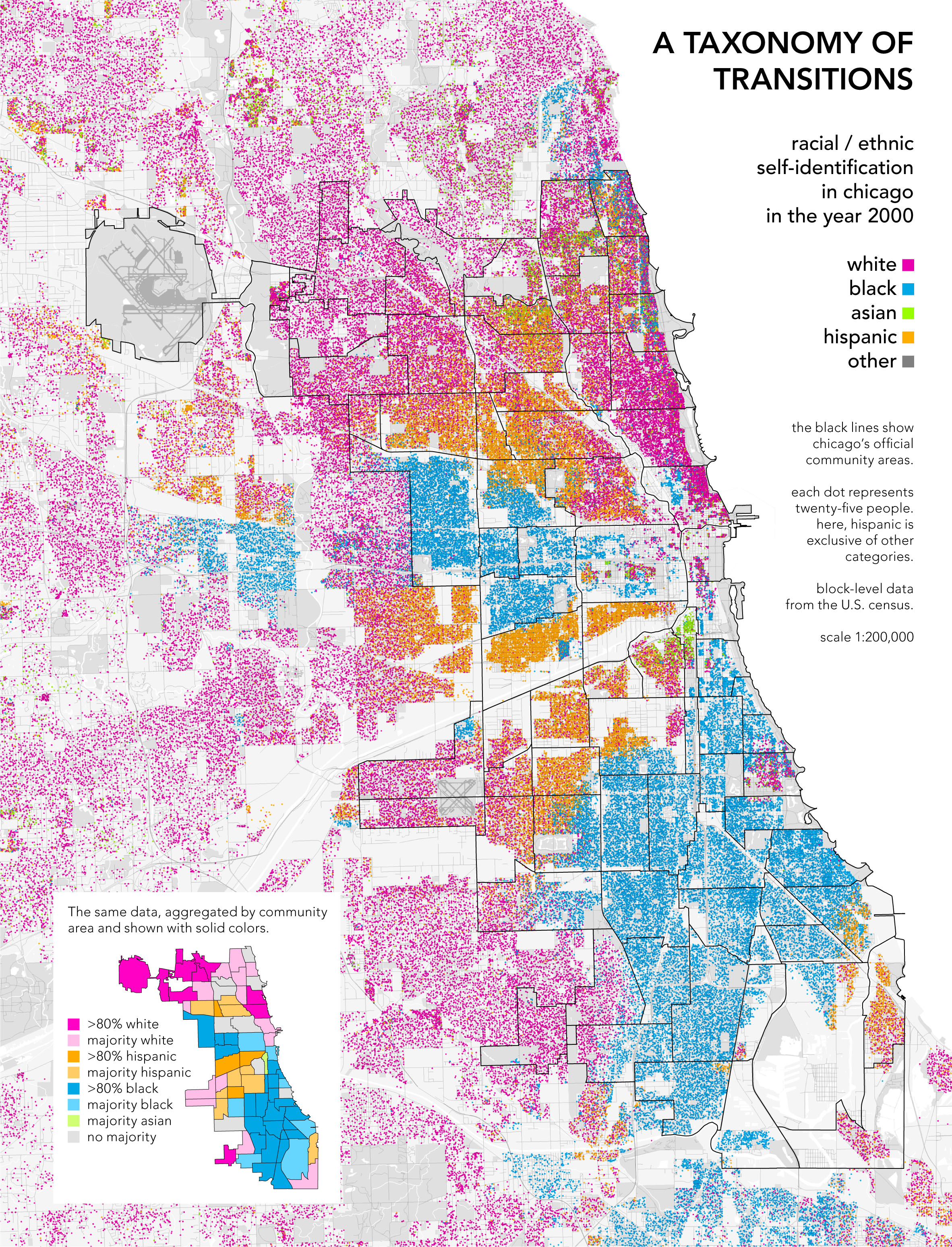
Americans are fascinated with race because our cities look like this: http://www.radicalcartography.net/chicagodots_race_big.jpg.
Moreover, it's hardly unique to Americans. Racial and ethnic conflicts are common across the whole world. The U.S. is still dealing with a legacy of slavery and desegregation that ended only recently. When the Governor of Alabama promised "segregation now, segregation tomorrow, segregation forever" Bill Gates would've been about eight years old. He would've seen on TV when Governor George Wallace physically blocked two black students from enrolling in the University of Alabama, and had to be moved aside by a National Guard general under the orders of the President. This isn't ancient history, it's a sociological blink of an eye.
Other western countries have to deal with the legacy of their repression of particular ethnic groups, but the U.S. is unusual in that its repression of blacks was particularly brutal and long-lived, ended very recently, and left a very large number of disaffected people among the population of the country (12-13%). The treatment of the Irish by the British might come close, but is mitigated by physical separation. What would the politics of England look like if London was 40% Irish, confined largely to ghettos in the city?
> To me, economic situation is much more important here.
In the U.S., race and economic situation is inseparable. That's the legacy of segregation. When Bill Gates was a child and going to school in the 1960's, most of America's black children lived in the South where they went to segregated schools, ate at segregated restaurants, etc. Economic segregation is a natural consequence of this very recently ended racial segregation.
> As for the suburbs, I fail to see the reasoning - are you proposing that we limit the free choice of people of where they want to live?
No, my comment is descriptive rather than prescriptive. Suburbs are segregated, by race and socioeconomic status. Voters living in the suburbs never see the impact their support of particular criminal law policies have on poor people and minorities, who disproportionately live in cities.
This is a race map of Detroit and its inner suburbs: http://cdn.all-that-is-interesting.com/wordpress/wp-content/.... The Detroit metro area is 70% white, but the city itself is 80% black. How much exposure and insight do you think those red dots have into the lives of those blue dots? When those red dots vote to support criminal policies that disproportionately affect the blue dots, do you think they even get any feedback about the ramifications of their decisions? This is the impact of segregation and suburbanization. People naturally have trouble empathizing with people who are different from themselves. Suburbanization exacerbates that natural phenomenon. People have particular trouble empathizing with people who live somewhere else that they never see or meet or interact with on a daily basis.
Yes, on average black population is at an economic disadvantage when compared to white. Yes, there are historic reasons for that. But the problem is not that they were disadvantaged, but that they stay disadvantaged, much of it through somewhat self-sustaining social processes.
What I mean by self-sustaining, in this case, is the cycles of criminal activities/violence many of these communities are gripped by. The three strikes law hurts these communities the most not because they are black, but because the economic situation is such that people are compelled to steal or commit other crimes. Not only that, but it is socially acceptable to be involved in criminal activity. Both make repeat offenses more likely.
On the flip side, the suburban voters are acting very rationally. It's all in how you ask the question. "Should a repeat rapist be prevented from hurting anyone else?" Most people will answer yes. "Should a person convicted repeatedly of serious violent crimes be prevented from hurting anyone else?" Again, most people will answer yes.
Now, break these statements into what lawmakers and law-enforcement can actually implement, and you get something a long the lines of "people that commit multiple felonies should be sentenced to life without parole". Then the same lawmakers start expanding what a "felony" is to include non-violent crimes, and so on... Everyone appears to be acting somewhat rationally, but the end result is a lot less clear cut.
What we really need to focus is changing the economic situation, then the cultural aspects will follow, and only then we will have fewer stories like this and fewer victims in general.
We can't change history, but that doesn't mean we can't look to history to understand how the present got to be the way it is. Moreover, just because history has happened and we can't change it doesn't mean it doesn't have ongoing repercussions.
> But the problem is not that they were disadvantaged, but that they stay disadvantaged, much of it through somewhat self-sustaining social processes.
The problem is that they were enslaved, and then actively repressed. Those are facts that have repercussions in the present. Anecdote: my grandfather was trained as both a doctor and a lawyer, and was a wealthy man. My family didn't inherit any money, but my mom inherited an education from a private tutor and I grew up hearing about him and being shaped by those stories. Well the grandfathers of black people alive today were systematically repressed, denied education and denied economic advancement. What kind of stories do black kids grow up hearing, and how do those stories shape them in the present? The problem goes far beyond economic disadvantage. It's one thing to prevent a group of people from accumulating capital. It's another to destroy their social structures, actively prevent them from bettering themselves, and use the authority of the state to segregate them from the majority population. That results in cultural devastation that goes far deeper than simple economic loss.
> The three strikes law hurts these communities the most not because they are black, but because the economic situation is such that people are compelled to steal or commit other crimes.
Crime isn't a simple function of economic status. There is a wide variety of crime rates within communities of identical economic status. Crime is a function of social cohesion, the vitality of social structures, community respect for authority, trust, etc. Those things are deeply tied up in race as a result of the legacy of segregation. You don't think there is a difference between a poor black community and a poor white community when it comes to respect for authority? When that authority was, until just a few decades ago, fighting tooth and nail to maintain segregation and repression?
It would be great to shut down the private prison industry but let's be realistic about the extent to which lobbying dollars influence the maximum sentence in legislation nation-wide. I would attribute long sentences mainly to poor thinking.
I don't find the death penalty especially sui generis for that reason.
This is not an improvement over killing him.
I also lived in Louisiana; besides New Orleans, what I've seen are old decrepit roads that haven't been restored in decades, public transportation only used by the very poor and mentally ill (very often correlated), neighborhoods next to the university campus that I've been told to never cross for risk of getting shot, almost half of the people being dramatically ill (overweight), lifeless minuscule downtowns. And heck, even New Orleans is still a shitshow.
Present all the economic arguments that you want, as someone who has lived in both places, a lot of the south of the US feels like a terribly dreary place to me. And I've lived in plenty of places, and have found things to like in all of them- this is not just me being close minded, I just found the south of the US to be in a terrible state for being a part of the world's leading superpower.
I've been living in California for many years now, which is orders of magnitude more pleasant and which I love in many ways (although rife with flaws as well; notably the shameful income gap in Silicon Valley).
I am not up on the psychology of adults who look at suggestive pictures of children, but I don't think that is healthy.
1) some 17 or 18 year old having consensual sex with their 14 to 17 year old partner is not something I count. That should be a parents discussion and not the courts. 100 years ago, that was marriage age.
Just keep in mind the World Bank is considered by many as an instrumental part of a quasi-colonial system of institutions that is set up to exploit the third world through their advocacy for unfavorable debt and a certain economical bias.
I'm sure they also do some good, but they are at least a somewhat ambiguous organization.
Does the US gov't say that everyone else should abandon land mines?
You're painting a picture that's not connected at all with the information we've been provided and you're using it to support your personal stance.
Yes, the ACLU article is presenting their story in the opposite way; but just because they're painting these people in a positive light doesn't mean that they're hiding a series of continual, unrepentant actions of which these particular crimes are the ones they were caught for. In fact, in one of the cases, the article argues that the judge didn't want to give the sentence that he gave, but his hands were tied by standards.
Should you get life for your post, which shows poor judgement and no ability to restrain it?
There's a reason we don't let victims decide criminal penalties.
What is happening lately? The quality of discourse on this site has become absolutely atrocious.
True, but the process for determining what criminal penalties should be is heavily based on "imagine you're the victim".
To be fair... that makes him no different than a lot of Americans. Though he may be in the minority here on HN.
Piss off the right person, and you may find yourself getting pulled over on some deserted road where officer Clancy "discovers" a felonious amount of a controlled substance concealed in your car or on your person.
Vast majority of white/asian people in this country are so far removed from that life that chance of getting underserved felony is as likely as getting hit by lightning. It can happen but definitely not three times in the row.
Oh FFS, don't do that, it just encourages them to treat visiting whiteys as walking ATMs, which is bad for their tourism industry long-term.
Stay at hotels, eat at restaurants, take taxis, but don't encourage the obnoxious hawkers, no matter how young they are.
I'd suggest that any startup worth its salt is actually offering something of real value, not explicitly a charity case, so the analogy completely breaks down. I fully support encouraging the startup ecosystem.
And I'm not even sure about using a term like "top down". Hotels really do employ locals, as do restaurants, and by patronising them you send a strong signal of support to the local tourism industry. With that assurance they can make plans, invest, advertise, expand. It's not about making the rich richer, not at all. Giving a small regional tourism industry the confidence to plan for the future is a wonderful thing.
So, you only want your money going to the wealthier families, many of which are foreign?
Street hawkers may be annoying, but they also represent the most basic form of entrepreneurial spirit.
If you or I got even 6 months in jail for stealing a wallet, I am pretty sure it would feel like "a long time."
This business of decades or life imprisonment for property crimes is draconian, we have just collectively lost perspective.
IMHO.
It merely proved a correlation between mental ability and educational success in the current educational system.
It does not show whether the cause of crime is the actual lack of mental ability, or the failure of the education system to properly prepare them for adult life.
In other words: You've not shown that more effort to educate people would result in the same crime levels as with the current effort.
It would contribute to the system that is perpetuating these kinds of injustices. Recall that a good portion of these people serving life sentences for non-violent crimes are in state prisons. How is helping them build their software systems going to find justice for a man in jail for life for stealing some tools?
By the way, this is not a rhetorical question: I'm honestly trying to understand this point of view.
1. In the courtroom. These people could have received a faster, more painless, and more just trial. The proceedings could have been more open, easier to search and data mine, and hence easier to react to faster. Additionally (and somewhat science-fictiony) I personally would like to see us experiment with alternative juries - particularly much larger, distributed juries. If justice can't be crowd-sourced, then I don't know what can.
2. In the legislature. Although the creation of bills is an intensely collaborative process, too often the details are delegated to underlings, and those details are seriously misinformed by the facts. So one piece of software that is needed world wide are better document collaboration tools that are tied to accurate sources. The legislature in particular should be obsessively concerned about how the justice system is applying their laws. Better visibility into what's happening, in real-time, would make the legislature a) more aware and b) more responsive to injustice.
Forced placement in a facility for treating mental illness until his doctors determine he is sufficiently well to be reintegrated into society, followed by a public-service program as societal (note: not personal) recompense for his actions. That would be after the first time, though, not the third. Because this person needs help and is plainly not getting it--and he will never get help in an American prison.
But because enough people are more interested in vengeance than justice--and your posts pretty firmly demonstrate that you're in that camp--it will never, ever happen.
I'm not interested in vengeance, and nothing about my post suggested I am. I don't want people who are a danger to society to continue to be a danger to society. If I was one of the people interested in vengeance, I'd have said something like they should get raped repeatedly with a broom in prison. I didn't, I just said they should be locked up. Nothing vengeful about that at all. I just want them to not be near my loved ones.
Putting someone in a concrete box where one's safety is utterly left up to chance is nothing but vengeful and retaliatory. It is designed to inflict misery and nothing else. It saddens me that this obvious fact escapes so many of my fellow Americans but I've become resigned to the fact that those of us with privilege are just kind of shitty human beings when it comes to anybody unlike us.
insider trading - traumatic to no one. I'm not sure what these "damages" you speak of are. Someone wanted to buy or sell stock, and an insider bought or sold it. Sure, they have more information, but someone always has more or different information. carl icahn and warren buffett have more information than me about a lot of things. yet we trade on the same market everyday. many economists argue that it should be legal, and it is a victimless crime. "Other critics argue that insider trading is a victimless act: a willing buyer and a willing seller agree to trade property which the seller rightfully owns, with no prior contract (according to this view) having been made between the parties to refrain from trading if there is asymmetric information. The Atlantic has described the process as "arguably the closest thing that modern finance has to a victimless crime""[1]
i can't imagine how someone can suggest that insider trading is a worse crime than breaking and entering.
also, FWIW, if you want to get mad at insider trading, don't get mad at martha stewart. She went to jail for it. Get mad at the fact that it is completely legal for politicians to insider trade. I mean WTF. They get non-public important information on a regular basis and for whatever bizarre reason we decided that they can trade on it but nobody else can. WTF?
[1] - http://en.wikipedia.org/wiki/Insider_trading#Arguments_for_l...
When the whole Enron thing went down a few years back, my flatmate at the time lost her job, as an accountant in the UK as a result of that.
Anyways, let's agree to disagree on this.
He didn't get life for stealing the truck. he got life for stealing the truck in addition to the 2 other convictions. It's also not "any severity," but felony level severity. You can argue that the line in the sand has been drawn in the wrong place, but the line in the sand is for bad offenses. Stealing a chocolate bar is not a felony, it is a misdemeanor (pretty much everywhere as far as I can tell. Generally speaking, shoplifting is not a felony until is it several hundred dollars worth, usually $500).[1]
You can argue that the "felony" label is too broadly applied to things that aren't "that bad." You can argue that life is too harsh of a punishment. Those are reasonable arguments. But in general, felonies are "severe" and not comparable to speeding tickets or chocolate bars.
>Realistically if the first two strikes were horrendous the person would already be put in jail for life and a long time. There would be no opportunity for a third strike. By your logic, the courts got it wrong the first two times and now they are getting it right with the life sentence.
I'd say it's more along the lines of we'll give you a couple chances, but only a couple. 1, go to jail for awhile and think about what you've done. 2, I told you not to do that and you kept doing it anyways think about it longer. 3. Dude, seriously. We warned you, and now we've had enough.
Some felonies on their own are in fact worthy of life. Murder someone and you generally get life. They idea behind 3 strikes is that on their own maybe they aren't worth that long of a sentence, but they are bad and we gave you several chances.
>Also, I am sorry, personally for me 20-30 years in jail is as good as life.
perhaps. how about 10-15? I have no idea what the "right" amount of time for any crime is. All I'm suggesting is that it isn't that unreasonable to have that time scale for people who repeatedly prove that they aren't being productive members of society.
[1] - http://examples.yourdictionary.com/what-are-examples-of-felo...
Does it? I can think of any number of civil liberties which I would associate with the "right" wing of American politics. Right to bear arms, for example, freedom of speech and religion, right to life. The "stand your ground" phenomenon, a very American thing, is definitely right-wing.
It seems to me more that the "right" and "left" have adopted certain civil liberties for their pet causes, and the ACLU, a left wing organisation for sure, advocates for their favoured issues. But let's not confuse that specific organisation and their agenda with the general concept of "civil liberties" per se.
The ACLU, for example, was a leading plaintiff working to get the Citizens United ruling in favor of freedom of speech including corporate advocacy. The same ACLU is a strong Second Amendment supporter.
And the NSA reform bills in the Congress have about equal support from both parties.
Could you tell me specifically what definition of "strong supporter" you're using here? I can't think of any reasonable one that would make your claim true. Supporter, maybe.
But a "strong supporter" is not someone who endorses a watered down version of the Second Amendment, and then spends zero effort defending infringements of that.
People sometimes like to paint their side as "for freedom" and the other side as "wants to restrict you", but the reality is far more complicated, changing issue-by-issue and occasionally covering legitimate tradeoffs where both sides might be considered "for freedom".
The ACLU Is a Conservative Organization - Noam Chomsky
When government says Jump, they respond with "How high master" , the government says "Give me 50% of your labor" they say "Yes Master"
The vast majority of people, not even white/asian, just people, are useless sheep being lead complacently to slaughter
That's not the least bit true, in my experience. I've watched them come over from where their families are working and attempt to sell trinkets, then go back to their families (or friends' families).
As for "crap", yeah, it's crap. Because you don't give children appliances and automobiles to sell. It's no different than the stuff you'll buy from American children going door to door, trying to raise money for their school.
I think you're really looking down your nose at people. You have a choice when traveling in areas like this. You can either act like you have to guard your precious money from all these street urchins trying to cheat you, or you can simply accept it as part of the experience traveling in a very poor area, and embrace the reality that you can make some small difference in an individual's life.
You talk as if denying individuals some income is somehow helping their long-term tourism. Yet Thailand, which is decades ahead of Cambodia in terms of development and wealth, still sees foreigners as wealthy, pesters them for sales and rides, and they have a very healthy tourism industry in spite of this. A country can't force its way into a $500/night resort industry. Thailand has tried for years, and it's not happening anytime soon. Cambodia doesn't even have a reasonable highway infrastructure.
> Hotels really do employ locals
To give an interesting regional example, are you aware that the Thai island of Koh Phi Phi is controlled by the Chinese mafia?
The wider issue with buying stuff off Cambodian street urchins is that you really don't want to encourage a state of affairs where the most aggressive child beggars/vendors earn far more than their parents... and then need kids of their own once they hit their mid-teens and no longer appeal to tourists' sympathies.
The fact that they even have to do this speaks volumes.
That said, with three strikes laws, you don't need to resort to sob stories. The statistics are evidence enough: about half of three strikers in California are in for non-serious or non-violent offenses. That's much more persuasive, to a rational thinking person, than a few examples of people who fell into the edge cases of the system.
The problem is not convincing rational thinking people. Are there really some nontrivial group of informed rational people without an ownership stake in a private prison company who genuinely believe that three strikes laws are good policy?
The problem is not the rational thinking people at all. The problem is politics and rational ignorance. It's the swarms of busy people who don't have the time or the education to understand the statistics, who consequently go back and vote for the people who enacted these laws.
I get where you're coming from. The world would be a better place if all policy decisions were based on evidence and reasoning rather than emotion. But when you have the prison lobby heaping the corpses of teenage girls on their side of the scale, you need to put something visceral on the other side to shock complacent people into realizing that something is very wrong here.
Politics is a popularity contest. It's important that the side with the best argument wins, but how do you get that to happen when people have limited time and limited resources and the winner is decided by voting rather than correctness?
Irrational emotion bred these laws, they will only go away via the same pathetic process. The ACLU is just playing the game with their appeal to emotion.
What if you are the next edge case in this system? with nobody to remember that you even exist, if its fair..
Just one person beiyng this edge case is enough to put the whole system down.. as every engineer knows this is what we call a bug, and can make the whole system irrelevant, and work agains its own purpose..
And that is what happens to the justice system.. the worst thing is that its all about property.. its f#$% stupid.. its unproportional, and minimize that is pure lack of humanity.. and its the real reason why things are still working that way.. because if you are not one of those "edge cases" you really dont care
And thats so many human lifes wasted, not only the people behind bars, but also their families, how they kids will grow up.. how can they support their families..
If we get, say, 1000 edge cases every year - then it's completely acceptable unless you can provide another system that will have much less edge cases. And if you're not sure, you don't switch until you are sure. If you simply "switch off" the system, then you get random 'mob justice' which whill have much more problems than the current situation.
I know, now the problem lies with these judges having poor decision making skills... if only there were a process to removing or overriding their decisions.. like an "appeals" process.. or a way of electing new judges and "voting" them in and out of office...
Neah, that's crazy talk.. we need absolute maximum/minimum sentencing guidelines like three strikes so we can keep those privatized prisons full, and making money.
If anything the system still has too much discretion (in the hands of police and prosecutors) that lead predictably to discriminatory outcomes.
> Repeated-burglaries guy is obviously opting out of functioning in society. If the cost of keeping him out of it exceeds the cost he inflicts by his presence, I'd say we should keep him incarcerated and spend less, not just tell him "OK, burgle all you want".
So reckless, dangerous driving is part of being a functional member of society, but 3 (apparently) non-violent and (in the scheme of things) minor thefts over 44 years gets someone thrown in jail for the rest of their life. That could be 30+ years on the dole. We (the taxpayers) are paying for his feeding, his clothing, his medical, his guards, his shelter. I seriously doubt another 3 thefts over the remainder of his life is worth that cost.
Having had 5 laptops stolen in one hit - because I was updating staff that weekend and the guy got lucky - the cost of changing passwords, and the nagging feeling I may have missed something somewhere and I may get hit with another internet theft....
Then the feeling that the guy(s?) were in my house while my partner and I were sleeping. Na. People who do this need to be taken out of society.
For the speeding point, you can kill people at 30mph if something goes wrong with the car or you do something stupid.
Wow.
- Driving below the speed of surrounding traffic is much more likely to cause an accident than driving at a "high" speed. The speed of traffic is essentially always above the speed limit. (Which might itself give you pause in characterizing it as "reckless, dangerous driving".)
- Reckless, dangerous driving is an independent offense, which can be (and is) charged separately from speeding.
2) For someone who wants long sentences for other offenses, it seems odd that you don't see that control of speed (particularly on city streets, my view on highway speed limits is different) and ticketing of speeders is also a pretty effective mitigator of reckless driving on those same streets. It doesn't stop it, we'll never stop crime until everyone becomes a saint (IOW, never), but reducing the occurrence is a nice tradeoff.
Now that that's out of the way, care to respond to the part where you suggest the cost of life in prison (to the taxpayers) is worth preventing 3 more non-violent burglaries (if he keeps to his average)?
On the other hand a guy who has comitted 2-3 non violent crimes in his life because hes probably broke and has mental issues. I am not saying thats ok, but spending the life in prison for that? He wouldnt even have to go to prison for that in the country i live in.
You do realize that it costs $40,000+ per year to incarcerate someone, right? So to meet your justification for imprisonment, this guy would have to be an excellent criminal. Why not just give him $40,000 per year and let him be free? He'd probably not need to burgle anymore.
As I understand it's substantially more than 40k GBP per year per prisoner. If the American system is costing less in the order of half what we're paying it must be absolutely horrendous.
Which is a side point to the absurdity of whole-life mandatory sentencing. It's incredibly expensive and pure vengeance; there's no way the cost to society in cash or emotional harm terms is minimised by spending MILLIONS of dollars depriving these people of their liberty for decades. So why does the Land Of The Free do it? Short, often community based sentences with strong rehabilitation would be orders of magnitude cheaper and have a very similar effect on the ultimate crime rate.
If we did this, I suspect we'd see a sharp rise in burglaries.
As to the figure itself, another commenter noted that the low end of prison costs seemed to be Lousisiana, in which operating a prison cost $13K / year. That would make the per-prisoner cost much, much lower than that.
Sure many countries are horrible places to live compared to the United States, but if we ignore our problems as you would have us do, that might not always be the case.
Our founding fathers knew from the very start that government is but a necessary evil. One that requires constant monitoring and modification in order to keep the power in the hands of the American people, which is where it belongs. Patriotism is about loving one's country, not worshipping the government.
I don't agree with every criticism of the United States that appeared in this thread, but I do agree with some of them.
(Down voted for pointing out where to get the stats - very funny - must be DOJ folks)
Freakanomics has a long section on it that contradicts Gladwell and I am inclined to believe the Freakanomics since they back it up with stats.
This isn't scientific but It just seems like the 70's had a very chaotic vibe with a lot of external stuff hitting the US. The economy wasn't strong and we were going into a massive transition (factory -> office). Nixon (scandal & economy) and Carter (personified weak) didn't help a whole lot. A lot of in decline thinking causes a lot of unrest and crime.
I would rank most tough crime laws as a cause not a cure.
Probably best to just assume it was an accident. I've done it more than once on mobile.
Does anyone know of any research showing that the decline in murder counts is primarily due to harsher penalties?
(I want to also mention that he debunks quite convincingly the theory that the decrease in crime had anything to do with legalizing abortion.)
[1] see Freakonomics
He fled out of fear of long-term incarceration, for actions that ordinarily would indeed deserve such harsh sentences.
Mostly true, I suppose, but I remember this : "TSA loudspeakers threaten travelers with arrest for making jokes" : http://www.youtube.com/watch?v=lkWPMeLSk6M
Yes, the US has freedom of expression, and you can claim whatever you want about the government (you can even lie). But if you yell 'fire' in a theatre with 500 people and 1 small exit, or 'allahu akbar' in a TSA line, you deserve to get sued and punished for that. That is not legally considered to be freedom of expression.
Personally I don't find that very controversial. If you lie to get someone else's kid into your car, that's not freedom of expression either. Lying to private security during an emergency is not freedom of expression either. Reporting a bomb threat because you have a math quiz is not freedom of expressoin. If you commit fraud on a contract, that's not freedom of expression either, whether or not "it was a joke".
[1] http://en.wikipedia.org/wiki/Shouting_fire_in_a_crowded_thea...
Here in the US, we strive to bring partisan politics into every discussion.
I'd also hope that after your "long time of 6 months in jail for stealing a wallet" you'd realize that it was a poor choice and not do it again. Certainly after the 2nd time you were convicted and sent to jail it should sink in right? If 3 times isn't enough, where do we draw the line?
This phrase is repeated often in this thread, "draw the line," but some people will not conform, some people will commit petty criminal acts, for a lifetime. IMHO that is no justification for locking them up indefinitely.
Think of marijuana legislation, one minute you can be locked up for life, the next minute it is legal. No matter what the crime, there is an element of subjectivity, fashion, culture, in what punishments we apply. Yes, some people may not rehabilitate. But that fact alone doesn't justify life in prison. Or even a severe sentence.
Compassion is real. It is important, even when it is inconvenient, even for people who suck.
At least, that's how I see it.
After, say, 100 wallets stolen how do you prevent the next 900 victims from suffering? The victims have absolute rights for protection and compassion; but a repeat offender has intentionally chosen to throw away whatever ties with society he had. There's a social contract about things we do and don't do to each other; we generally don't take others stuff, don't hurt each others and we show compassion to others in our society - so if you repeatedly choose to break the social contract, by taking others stuff and not showing compassion; then why should others show compassion and refrain from hurting you?
If someone can go to my house and take my stuff, why should I be forcibly prevented by police from going to his house and taking his stuff?
If someone is an unquestionably repeat offender, then preventing future crimes is a mandatory goal; respecting the offender is important but, if we can't do otherwise, it's optional. If there is a more humane way to solve it than permanent isolation from society (life sentence, permanent mental institution, execution or exile), then I'd like to hear that and would greatly support it.
The strong aversion to politics was one of the things I liked about Hacker News. A lot of political issues are important, but they always turn discussion sites into dull point-scoring. Hopefully the moderators clamp down before it's too late.
And I don't see any reason for these stories not to be on HN. Human rights matter for everyone.
When I say something doesn't belong on Hacker News, I don't mean it's unimportant or doesn't matter. I just mean that it isn't what this site is for. There are many, many stories that are relevant and important to me personally that are still not appropriate for every site I go to.
Think about it this way: Would you go on a My Little Pony fan site and post this stuff there? Human rights are just as crucial for My Little Pony fans, but it's easier to recognize that they aren't appropriate for a single-topic site. Hacker News is not a single-topic site, but it is still a site with a focus. If you look at the guidelines, politics are explicitly called out as being off-topic.
Three-strike laws exist to quench the mob's appetite for blood (as public execution is sadly no longer acceptable, the mob has to settle for life sentences), and get politicians get elected on a fearmongering & repression platform. But on a humane level, it's not far removed from judicial amputations.
Not every "mentally ill" person is curable, nor can every mentally ill person be trusted at an attempt for re-integration with society.
Funny how you're defending the right of serial rapists to seek help and therapy while you "resign yourself" to the fact that people who don't "get it" are shitty humans.
A huge part of our crimes are things that are hurtful to society and unfair, but completely natural for dominant primates to do to other primates in their group - i.e., take their stuff for own benefit, or violently attack a competitor. Doing evil stuff is evil, but most evil stuff isn't mentally abnormal, and isn't really curable.
Also, crimes such as 'stealing to feed your family' do cross the line, but are neither sign of mental ilness or even evil. Sure, it hurts others as well - but it is a completely sane decision to prioritize suffering of you and your family over wealth of others; if there is a lack of proper social support and a real necessity, a mentally normal person can easily be stealing 365 days a year.
what do we do with "You will certainly have an incurable segment of the population who, after actually being treated by professionals and educated, cannot integrate with society"?
Also, what do we do with those that are extremely violent and prone to escape? It seems reasonable that a tougher layer of security is warranted in some cases.
>"Putting someone in a concrete box where one's safety is utterly left up to chance is nothing but vengeful and retaliatory."
First, I'm not convinced that our prison system is quite as bad as that statement. It seems a bit of hyperbole to me. I'd agree that it certainly isn't great, but perhaps not quite that bad.
Also, it seems that we don't really have to disagree about anything, you are just reading too much into what I've said. I'm in favor of trying to rehabilitate people, and I'm also in favor of improving our prisons. I'd classify someone convicted of rape several times as "an incurable segment of the population who, after actually being treated by professionals and educated, cannot integrate with society."
I also think there are way too many people in prison in general, specifically in relation to the absurd war on drugs. I suspect we agree on that.
>It is designed to inflict misery and nothing else.
I think it is designed as punishment for crime. That mostly seems reasonable. I think while we're at it, we should work to try and rehabilitate them better than we do, but no need to put them in a penthouse suite. Part of it is deterrence. All crime is not mental illness. I promise you that. Much of it is committed by highly intelligent people who just didn't expect to get caught. Much of it is committed by not very intelligent people who just didn't expect to get caught.
Where serious crimes like rape and murder (but not manslaughter) still come with heavy sentences (like 15-25 years) but in a place where you can be rehabilitated so when you get out it doesn't come to a second strike. (Also, the fact that rapists often get sentences under 10 years in this country is pretty ridiculous, and is what allows them to actually get around to committing the crime 3 times. (15 year sentences 3 times starting at age 15 would make you 60. How are people committing 3 rapes in the first place?)
Basically I'm fine with the 3 strike laws as long as we fix the root problems in the first place. (And also fix the definition of felony to not include non-violent, non-serious crimes).
That wasn't the topic.
The topic was the claim that the ACLU is a "strong supporter" of the second amendment. Do you know a definition of "strong supporter" that is appropriate for the ACLU's actions regarding the Second Amendment?
No, I don't want to hear about how great the ACLU is.
No, I don't want to hear about the ACLU really does support civil rights.
No, I don't want to hear about how their position on the 2nd amendment is reasonable.
No, I don't want to hear about all the other people who can protect the second amendment.
I want something responsive to my question: in what sense is the ACLU not just a "supporter" but a "strong supporter" of the Second Amendment?
Don't have anything to say about that? Then please stay out of the discussion rather than changing topics and blurring the issues. Thanks.
The topic of this thread is actually that we have a lot of people serving life in prison for non-violent crimes.
Your post is now 8ish levels deep and asking people to prove that the ACLU is a strong supporter of 2nd amendment rights.
This seems like a pretty big topic change and blurring of the issues.
Let's stop with the farce: your complaint is that you don't like their interpretation, and so you choose to change the topic and blur the issue on a completely different thread to grind that ax of yours.
http://www.popehat.com/2012/09/19/three-generations-of-a-hac...
Summary - the case involved was not a principled exception to free speech, but the diametric opposite; a judge basically ruled that you can't criticize the government during wartime because it would undermine the state.
> Holmes, writing for a unanimous Supreme Court, affirmed Schenck's conviction on the theory that this expression could be punished in wartime even though it merely urged "peaceful measures such as a petition for the repeal" of conscription, on the theory that the government could suppress speech that might interfere with the draft.
Read the case before you quote it. American Supreme Court has done a lot of injustices in its time. And this is one of the more egregious once.
Does your opinion change if it is spoken in English? Or is it just Arabic? Should it be taken more seriously if a person is wearing a turban or not? Or maybe their skin color… does that matter?
Honestly, I didn't (and don't) expect that to be a controversial prediction.
So the more-generous question is, would being at least 5% better off financially reduce crime more than the 50%-shorter sentences for crime would increase it? I have no idea.
Food for a year is barely even noticeable in $13K; if they cost $5 / day to feed that would come in under $2K / year. Where's all the money going?
Finally, I've also said that life might be excessive, but significant jail time is reasonable.
How do you differentiate a "supporter" from a "strong supporter"? If I firmly believed that the First Amendment only protects pro-government speech, and filed the occasional legal brief in defense of those prosecuted under this interpretation, would that make me a "strong supporter" of the First Amendment? Would you talk about how crazy wicked cool it is that a nutty right-winger like me paradoxically has a thing for protecting the first amendment?
Or, to avoid the issue of weak interpretations of amendments, how about if I had the "normal" 1st amendment views, and had a "pro-Bill of Rights" group that spent only a token amount of effort protecting infringements on speech (or the other 1A stuff), and never to represent any such client? Still a "strong" supporter? Or just a "supporter"?
Oh come on. I've lost my license for what you'd call DUI - made a stupid decision to drive the 1.5km back home from a pub, got a 1 year ban and a hefty fine. Yes, it was a stupid thing to do and I deserve what I got, but attempted murder? Don't be ridiculous.
At most repeated DUI is criminal negligence, and negligence on the part of whomever supplied the offender with the vehicle. It should be met with driving bans and escalating punishments if those are ignored. Life imprisonment is an amazingly harsh and expensive over-punishment for a stupid but usually non-malicious crime.
So, yea, murder. That's how serious DUI (or texting behind the fucking wheel) is.
Unless you cause a accident, then you can get attempted murder, or murder (depending on the outcome).
Then people will say: "Oh, but the driver had no intention to murder someone." here the most common argument from the judge is: "someone that knows that driving under influence is dangerous and do it anyway, is taking full responsability for the fact that it might accidentally kill someone, thus it is not accidental, since the person is on purpose gambling away with other people lives."
TL;DR Breathalyzers are based on dubious science, system is unfairly tilted in favor of conviction. Guilt is presumed & punishment issued even before trial.
http://en.wikipedia.org/wiki/Drunk_driving_in_the_United_Sta...
I was just saying that attempted murder is when you actually attempt to murder someone. It's not the same, not at all.
As a whimsical thought experiment, care to explain why the other 60% of fatal accidents should not be classed as criminal negligence by one party or another? : P
edit: since this got a few upvotes, I'd like to expand. I'm in my late thirties; I got my drivers' license in the early nineties. I was never really educated on drink driving the way people are today.
I didn't take it seriously enough. I thought it would be OK; I didn't know the risks properly, and I certainly didn't know the penalties. I had no idea that being a couple of times over the limit led to a 20x+ increased risk of accident. Maybe I was stupid to not know that, nonetheless I had never properly internalised that fact.
Maybe everyone here is smarter than me - it certainly seems like that most of the time - but I am not completely stupid, and my internal risk profile was totally wrong about this. If you're of a similar age as me - earned your license decades ago, in a more permissive time - I beg you not to make the same mistakes I made. Drink driving is never an option. It is not even on the table. You are endangering yourself, the community, your reputation, and everyone you love. Catch a god damn taxi, like I wish I had done that night.
Drink driving - not even once. From one hacker to another. Please.
The goal of this idea is to encourage you to not attempt manslaughter with your vehicle, so if you were faced with life imprisonment perhaps you would think long and hard before you do it the third time.
Look, I can see your point of view. There needs to be a deterrent, yes. Locking someone up and throwing away the key, though, should be reserved for only the most heinous offences. In my opinion, you should not be able to achieve that using only a six-pack, a car, and zero dead bodies.
There has got to be some other solution that doesn't utterly ruin the person's life, and the state's finances.
This is the worst part of excessive penalties -- that people think they would actually be effective. Most defendants have absolutely no idea what the penalties are until after they've been charged with the crime, which makes any deterrent effect of increasing the penalties quite impossible.
Even if you ran some kind of expensive continuous education campaign (which naturally can't work for every category of crime because there are so many types with such complicated penalties that no one could keep track), you're assuming that people engage in planning. If people planned ahead then they would all have a ride home from the bar in the first place.
Then again, death is an amazingly harsh and expensive punishment for an innocent who happens to get killed in a driving accident with somebody who's drunk...
That said, attempted murder doesn't really fit. Attempted Manslaughter or something like criminal negligence (of the sort that endangers people's life) maybe?
That kind of ruins your simplistic little moral diorama, doesn't it?
Party of the second part (indignant): But condition C holds!
What's your point?
This guy obviously has issues and they need to be looked at; locking him up has no use whatsoever besides 'making the public feel safe'. While it makes things less safe; if I know I'll go to jail the rest of my life, i'll make sure to kill the people in the room so I have a chance of escaping; what have I to lose? This guy didn't think like that, but with this kind of strangely harsh punishment, why would I hold back on any crime I commit?
Also, I believe you are implying that the guy from the OP got life in prison for the single burglary. I appologize if I get it wrong but in case you really are: even OP says it is not so. It's been his third strike i.e. he had been convicted for two more violent/gun/drug related crimes before (more burglaries in his particular case).
Break my door down in the middle of the night? I may blow your head off.
Big and important difference.
What I haven't seen yet is a comparison of cash, not to the cost of imprisonment, but to the cost of getting a job. That is, if someone is in prison for 200 days, that costs a few tens of thousands of dollars to the US taxpayer, so the arguments being advanced in these threads say "this should be a response only to someone who is stealing $10,000 from us, otherwise the government is taking much more from us in taxes than the guy was taking from us in crime." That makes some amount of sense. It ignores certain problems (like "who do the taxes come from?" and psychological damage from getting mugged and so on), but it does have some core "thrust" to it.
On the other hand, to be an effective deterrent to crime, you'd figure that we'd want to make the crime net-unprofitable; that is, you'd want the 9-to-5 job at $7/hour to be a more profitable way of living than stealing $100 wallets. So this would suggest that for an expected number of 100 wallets stolen you should really incarcerate for, say, 2 years or so, so that the original crime "really doesn't pay", in the sense that you lose job-access for a total sum of more money than you gained. (That punishment might also have to be increased if the chance of catching someone who steals 100 wallets is not 100%.)
You work for a month? You get a month's rent and food. You're in prison for a month? You get a worse bed but a bit better food - the lack of freedom sucks bigtime, but financially there's no difference.
Think about a routine drug user (say, heroin addict) who regularly (daily/weekly) performs theft to sustain the habit - car radios, shoplifting, maybe an apartment if he gets a chance. It is a very common scenario in many places, if the user can't quit (or always restarts a few months after therapy/quitting) and the needed drugs are all illegal & expensive; as the only real non-crime [here] alternative they have is prostitution and many of them consider theft as the more pleasant option.
Even a small, friendly village community who know everyone and help each other would likely vote [for laws] to imprison him in order to stop the behavior. Rehabilitation is another option, but the idea is that after 3-strikes you have to admit that your rehabilitation (however good or bad it is) doesn't work and you have to do something else.
Or think of a genuine kleptomaniac. Unless it's successfully treated, you still need to take some measures to prevent repeated crimes.
As a society we realize that certain risks will always remain, and due to bad luck accidents will always happen: We accept that and live with that. What we do not accept is behavior which unnecessarily endangers a person's life. It's perfectly reasonable from a moral point of view to hold people accountable in proportion to how reckless they are acting.
And yet we have media organizations saying things like:
" Washington (CNN) -- A common benchmark in the United States for determining when a driver is legally drunk is not doing enough to prevent alcohol-related crashes that kill about 10,000 people each year and should be made more restrictive, transportation safety investigators say.
The National Transportation Safety Board recommended on Tuesday that all 50 states adopt a blood-alcohol content (BAC) cutoff of 0.05 compared to the 0.08 standard on the books today and used by law enforcement and the courts to prosecute drunk driving.
The NTSB cited research that showed most drivers experience a decline in both cognitive and visual functions with a BAC of 0.05. "
Of course we have a decline in cognitive and visual functions - that's what a depressant does. At any dose. So long as we have drinking as a major societal institution, and we have bodies that slowly process alcohol, and we have an automotive-mobile culture, there is some nonzero number of deaths we will prefer to tolerate every year due to drunk driving, whether it's 1,000,000 or 10,000 or 100.
---
While there may be some distribution of how well people deal with a certain degree of drunkenness, the basic objective fact that we possess to measure impairment is BAC. Limits vary geographically and through history - in the US we have had experience with thresholds at 0.05%, 0.08%, 0.1%, and 0.15% in various eras and places.
A BAC of 0.01% doesn't significantly harm anyone - it is barely detectable. A BAC of 0.05% poses some minor statistical increase in danger, and is generally the minimum people seek out to 'get a buzz'. A BAC of 0.1% indicates moderate impairment - about what you thought, several times more dangerous. It's only when you get to a BAC of around 0.2% that it becomes 20x more dangerous. At a BAC of around 0.3% and up, on the other hand, one generally loses consciousness. Death from alcohol intoxication (assuming no complications) occurs at an average of about 0.45% BAC (that is the approximate LD50).
Are we seriously suggesting letting people do this if they think the goal is just ? It seems so. I shudder to think what the consequences of that would be.
Maybe we should create a "politically correct NSA" that spies on everyone who might be involved in unpopular politics ? How about spying on every company and violently extracting their labour practices ? I'm sure quite a few European unions wouldn't mind doing that (and at least in .be and .nl that would be a legal grey area, illegal but not punishable).
>Are we seriously suggesting letting people do this
Do what? Expose evidence of government corruption? It is written in the law that this is exactly the case. There are numerous examples of the failure of the laws meant to protect us from this scenario.
> if they think the goal is just ? It seems so.
There is no justice in following unjust laws.
>I shudder to think what the consequences of that would be.
An informed electorate? Backroom-dealing politicians have to work harder to conceal their works? We should be so lucky.
The law does not permit breaking the law to further expose corruption though. That is the role of an appointed (and trained!) inspector general. Or, if necessary, a special prosecutor.
It would be one thing to reveal evidence of wrongdoing that one happens to fall into as part of their normal duties. Going further beyond that is illegal for good reason, as otherwise those who are impersonating high-ranking officials for purposes of espionage would be literally indistinguishable from those impersonating the same officials for to "dig for dirt".
Put another way, if your logic applied Google would have not merely the right, but the obligation to constantly scour through their GMail archives, G+ private messages, and everything else they have access to, for evidence of wrongdoing. Is it your position that Google should be doing this?
This is actually a significant part of why we have trial by jury (according to some; others argue that it's just silly); they can decide that the accused did commit the crime and still return not guilty.
Yes, I'm seriously suggesting that following orders contrary to good conscience is immoral and illegal, but luckily the better part of the world agrees with me in the precedent set at Nuremberg.
It's not what happened, it's the idea of one man standing up to the state that strikes fear into their hearts.
Don't underestimate Chinese political sophistication, especially amongst what we might call the middle class (a <10% minority in China). There is a common feeling, if not outright belief, that a strong government is necessary to hold the country together, especially during its current transition period with its massive inequalities. I am no expert but my impression is that the people who do know - the middle class educated, with internet access (firewalls are trivial to get around) understand or at least play along with the idea that from a stability point of view, some information is best not fully shared.
I see some interesting parallels between Chinese political censorship and the debate about the NSA revelations, by the way. Both are about concealing information of great public interest in the name of some alleged greater good. The only real difference is that the events in Tianenmen Square happened outdoors.
Beijing University from what I understand is where China's elite school (when not schooling overseas)
HN, in contrast, is mostly known in educated circles and so does not attract as many trolls and idiots as Reddit does.
I think DUI three times is particularly heinous. Maybe life in prison is excessive, but the third time you do it you are well aware that it is potentially lethal, and the punishment should be on the level of attempted manslaughter. If that gets you nailed with some three-strikes thing, I think your argument should be against the three-strikes aspect.
But my original point was to disagree that DUI is the same class of crime as drug use in general, since it's incredibly dangerous for the other members of the public.
It is hard to disagree with you about the third-time DUI. I guess I am against "automatic" laws in general; it reeks of populism and "tough on crime" rhetoric, ignoring the human variables - see above article for examples. Trying to legislate judicial discretion out of the equation is, to me, a foolish idea.
Couldn't agree more on the drug use issue. They should not even be in the same category of crime.
update: thanks for the link, it led me down an interesting path of "attempted manslaughter" reading. eg, from http://boards.straightdope.com/sdmb/showthread.php?t=645716
> in Virginia a few traffic offenses can be classified as attempted manslaughter. Such as, speeding well above what classifies as reckless driving or driving sufficiently intoxicated. I think the reasoning is that if one were to kill someone under those circumstances it would be manslaughter, and any reasonable person would know that excessive speeding or driving drunk carries a high risk of killing someone even though that person isn't exactly trying to kill anyone, therefore, even though they didn't kill someone, they still basically attempted to in being so careless. IOW, you really should be charged with manslaughter, you just were lucky enough to have no actually killed anyway
> I think different jurisdictions probably punish those actions similarly, they just may call it something other than attempted manslaughter, like maybe reckless endangerment or whatever.
Reckless endangerment - I admit that strikes me as a better term, although I now understand the reasoning behind "attempted manslaughter".
Perhaps I'm misguided, but it seems to me that its more fair to impact the life of the offender than it would be to allow an innocent person to die.
Fortunately, there are more than two options. The best idea I can come up with would be to permanently suspend driving privileges for anyone with a second DUI conviction.
I cannot tolerate anyone who would plow around our roads in a 2,000 pound bullet and either be drunk or looking at their phone.
> Burglary is punished so severely because, like you said, the end result can be much worse than just stealing property.
Also you:
> We don't punish some future consequences. We punish dangerous and harmful behavior.
Please help me make these two statements make sense together. In this case, the severe penalty is only justifiable with a view of what might happen or what might have happened (that he might steal again, that he might become violent in future thefts, that he might have hurt those men). Now to the first might, I'll grant it's actually pretty likely. But to the second might, it's hardly clear, every summary I found suggested none of the past thefts or youthful cocaine charge (possession? couldn't find specifics) were violent. And the third might is the justification you offered in the earlier post. Which means, what, punish people for how bad their crimes could have been rather than how bad they actually were? I was in a car accident (my fault, rear ended a guy), it could have resulted in a fatality had it been at higher speeds (we were, at most, moving 10mph), should I be treated as if I had committed vehicular manslaughter?
What might happen in a crime ought to be irrelevant, what did happen is the important part. And again, in this case it appears that violence didn't enter into the equation. Might the victims have felt there could have been violence? Sure, but fear of violence (in this case he didn't even threaten violence, he came up with a lame story and ran off) is not the same as being the victim of violence.
Also, we don't punish every possible outcome of every action. We, however, punish more likely and more harmful (= more dangerous by definition) outcomes more. In your example, if you had been at higher speeds or if you had been drunk you'd had been punished more even for the same outcome.
>What might happen in a crime ought to be irrelevant, what did happen is the important part.
You are free to believe this. I hope you vote libertarian to remove all kinds of licencing (starting from driving and ending with medical), various safety inspections, crimes like stalking, conspiracies to commit other crimes, blackmail, death threats etc.
The Inspector General is empowered to break the law? Or is that a bit of a bait-and-switch?
This is a very silly bit of circular reasoning. The State has effectively made it illegal to expose The State's own illegal conduct. You suppose we should all ignore the State's lawbreaking, because it took Snowden's lawbreaking to expose it, as if citizens are to be constrained by judicial rules of evidence?
Or, are you invoking the "not my job" excuse for abdicating one's responsibility as a citizen (to hold the State to account for its actions). We've had this argument before. I remain unmoved by your opinion.
>It would be one thing to reveal evidence of wrongdoing that one happens to fall into as part of their normal duties. Going further beyond that is illegal for good reason, as otherwise those who are impersonating high-ranking officials for purposes of espionage would be literally indistinguishable from those impersonating the same officials for to "dig for dirt".
I would have hoped that the NSA were competent to the degree that a Snowden wouldn't have been able to betray the them so thoroughly and completely. Hawks such as yourself ought to be especially furious at the level of organizational incompetence made evident by Snowden's disclosures. Even after being personally embarrassed by my government's shameful conduct in spying on everyone, I am again embarrassed by its obvious lack of competence. It apparently hopes to ensure the security of The State with thuggish threats, and nothing more. It must change or it is destined to fail.
>Put another way, if your logic applied Google would have not merely the right, but the obligation to constantly scour through their GMail archives, G+ private messages, and everything else they have access to, for evidence of wrongdoing. Is it your position that Google should be doing this?
Except that logic does not apply to Google, nor have I attempted to apply it to Google; because Google is not an agency of the State, especially not a part of the Judicial Branch, and therefore not the arbiter of the law in this country. Even if Google were an agency of the State, they still are not empowered to violate citizens' rights under the Constitution.
Are we going to argue that you're a murder if you drink to excess while your keys are still in your pocket? Because that's when the decision was made, not when you get in your car drunk. At that point, its not you making the decision.
Well, no. Turns out that alcohol's effect on behavior is strongly dependent on culture and/or expectations:
First, the existence of a bad policy somewhere does not excuse the existence of similar bad policies everywhere. You can't justify the penalties under the CFAA by comparing to the penalties for crack cocaine possession, because they are both excessive.
Second, you'll notice that your discovery (if such a prohibition for arsonists indeed exists) breaks the analogy with a prohibition on driving for those convicted of a DUI, because it isn't a prohibition on all fire, when it is a prohibition on all driving. Which makes your argument the straw man, because a prohibition on large public fires is a minor inconvenience, whereas a prohibition on burning fuel to heat one's residence, like a prohibition on driving whatsoever, is a life-altering situation that may require you to find a new job and residence while doing very little to combat the evil in question supposedly justifying the restrictions.