Winamp shutting down on December 20th, 2013(winamp.com) |
Winamp shutting down on December 20th, 2013(winamp.com) |
(tears)
Anyway, why are they shutting down?
I don't know what the status of XMMS2 is, but it's a client-server model like MPD.
The GTK2 fork of XMMS, Beep Media Player, is reported by Wikipedia to be discontinued; the BMPx fork of BMP has also been removed Debian. Audacious is another Linux music player with Winamp skin support, it is actively maintained.
Perhaps somebody should do a Winamp2-compatible MPD client for nostalgia purposes.
That said, it's sad to see the name go.
Associated web services sounds a lot like Shoutcast.
AOL wants to double down on stupid journalism. Winamp is a distraction.
"Winamp, it really whips the llama's ass!"
Well... no more...
Perhaps AOL hoped they would have their own itunes and it would self support the player development
It's my favorite media player.
It was the first media player in its day that payed every file you threw at it.
It has never disappointed me since.
I really wish the owner would opensource it though if he doesn't have the time to maintain it I'm sure there's hundreds of thousands of people who will.
I wouldn't call it an end of an era though, I feel like Winamp's era ended several years ago.
Now the only program Windows users still use in this day of age that I can't understand is shareware WinRAR. Seriously. (Who hasn't been using 7-Zip for years?)
Would be a tragedy to lose all the brilliant work that's been created over the years, even if I don't use Winamp anymore.
Either they didn't end up finding a buyer or they did and the buyer is taking the tech private (cheaper than staffing a product and paying for bandwidth costs). I'm guessing it is the latter.
I remember downloading a song in 15 minutes off Napster when my family first got an ISDN line. Oh man 10-15kbs was screaming.
This was my go to music player before I moved over to Play Music and then Spotify.
I remember switching to Linux and being frustrated by XMMS because it wasn't Winamp, although it tried to be.
Alas, I doubt anyone involved in open-sourcing anything is still there.
A really lean music player wouldn't use more than a dozen MB of resident memory (after whatever libraries need loaded, but since i run KDE Clementine isn't bearing the blunt of Qt loading) but Clementine intentionally caches a lot of information to make the UI lag less and make transitions seamless.
Here are some comps for those interested... http://smokinggun.com/projects/winamp/index.php?id=0
iTunes and Windows Media Player are both monstrosities, and while I appreciate VLC for playing video, I've never been inclined to use it as a music player.
http://arstechnica.com/business/2012/06/winamp-how-greatest-...
Made a couple people rich (well deserved) at least.
Skins are coming soon, they're still scraping :)
A couple of years ago I used OSX for about 6 months. One of the more minor reasons I was relieved to uninstall it was that I never found a music player I really liked. Let's face it, iTunes is crap even on the OS it was meant for!
On Windows, look no further than Foobar2000. It's not a super-sexy looking player (although it can be if you put some work into it), but it is eminently functional. It does practically anything you can want (with extensions), has an easy to figure out but powerful interface, and is audiophile-grade. This lives on my HTPC, which interfaces with my stereo, so it's what I'm primarily used to. Love it! There's one extension (foo_httpcontrol) you can add that allows you to control your stereo from any networked device (there are a few android apps designed to work through this interface), which is handy for flipping through music while reading in your comfy chair or sitting on the porcelain throne!
On Linux, Amarok. Sexier apps come and are abandoned to become bug-infested swamps of suck, but Amarok has been going strong for a very long time. I often try newer music apps, but Amarok is the default on KDE for a reason.
Linux users: look for Audacious or DeaDBeeF. They are the best Linux alternatives to foobar2k.
Notwithstanding that Real Player was quite popular in Asia, a few years ago, during the portable media player years.
VLC is the same for me for video. Fast and plays almost all formats plus its open source. Winamp should have been open source to further its usage and development.
Edit: Will this affect Shoutcast?
LET'S CRAWL WINAMP SIDE AND SAVE A HISTORY OF GREAT SOFTWARE.
Lol i think this should be in computer museum or something =/
Winamp, I'll miss you so much, I know that "justin can't code it" sometimes, but I still love all your team, your product, your efforts, Thanks for being with us with our teenhood!!!
P.s and what about winamp shoutcast? this was only ultimate radio solution in the whole web!!
I doubt it, but the odd HTML in the title and lack of any other information makes me doubt it's authenticity.
Saddest to me, is that I can’t think of today’s equivalent, a widespread and useful app that encourages its users to tinker and easily modify the interface.
Is there a reason why they'd want to shut down the company rather than selling it for cheap?
I'll miss the old days of 1999, using winamp to play my latest Napster "acquisitions".
For myself, I generally just use mplayer or music-on-console (moc) nowadays. It gets the job done with no fuss and no mess.
I'm guessing AOL has looked at all this and sees $$$ for both the business risk as well as maintaining software which they have deemed does nothing for their company goals. As a result, they are better off focusing their limited resources towards efforts which do further their goals.
The decision of whether to continue a product line within a large corporation is very, very different from whether or not a product line could keep a small business afloat. If you're a small business, the only question is "are we making payroll?". Within a large, diversified corporation, you have to ask if a project is as valuable as your alternatives. Mom-and-pop's with a sustainable business can't and don't say, "Yeah, this is profitable, but it'd be more profitable if we dropped everything we're doing and put our resources towards a different sector entirely." But it's entirely feasible and rational for a large corporation to look at it's hundred sub-businesses, axe the ten least profitable, and put the people to work on the ten most profitable.
I'd be a lot happier if modern corporations were small, narrowly focused beasts, and not the monstrous conglomerations we have instead.
This comment is brought to you by https://archive.org/details/software
    Domain Name.......... winamp.com
      Creation Date........ 1997-12-30
      Registration Date.... 2009-10-03
Expiry Date.......... 2014-12-24The simplicity is great. I have a single NAS containing my entire collection connected to some speakers. In another room I have a rasp pi connected to a different set of speakers which streams the music being played via Icecast2. I can control the music in either room using pretty much any device connected to the network (PC, laptop, pi, tablet, phone), and also stream my collection when not at home.
I don't know of any particular client that's similar to winamp or itunes, but there's a lot to chose from[2], although many of those are a bit dated.
[1]:http://www.musicpd.org/ [2]:http://mpd.wikia.com/wiki/Clients
however, I also use plex connected to my roku for other media needs. But, I often find when on the go I will use plex on my phone primarily for music...or a superior remote for the roku...
http://sheepfriends.com/index-page=billy.html
Unfortunately, it looks like the site's downloads are unavailable right now (suffering from nostalgia overload?), but it's definitely worth checking out:
    * tiny -- like, 500K
    * gapless playback
* 100% controllable by keyboardThese days I just use zsh and mplayer though. Apparently all of my use-cases sum up to "play one or more albums, perhaps shuffling them first". I've given Clementine a shot, and it is quite like Amarok use to be, but now it all seems like clutter.
Sad to see the old folk go though.
Audacity and XMMS 2 both were a lot worse for some reason (like slower, weird bugs, needlessly unneeded server/client model, ...)
In XMMS 1, you can have 10000s of songs in the playlist (i.e. your whole harddisk), and jump to any of them immediately by just pressing the "j" key and typing part of its name, and it remains blazing fast.
Not sure how Winamp was these days. I remember it was good at version 2, then starting from version 5 ("2 + 3"), it became bloated.
Foobar2k. http://www.foobar2000.org/
Unfortunately it does not support the Mac Play/Pause/etc keys. I'm staggered that such an otherwise well put together application lacks such basic functionality.
RIP Llama
Lightweight
Unobtrusive, customisable, highly functional UI
Fades out tracks when u stop (to not have a harsh cut off waveform)
Its what I currently use. Current build will probably run on windows for a loong loong time to come tho.
Back then I had a ton of curiosity but development skills. Tinkering as did with Winamp and other programs like edonkey and Bit torrent compelled me to create and then learn how to turn my web ideas into reality.
Thanks Winamp for helping me get going!
It just works for me. Controls in the systray (deal breaker for me with other players), brillant mix of media library and playlists, the Bento skin is very decent etc.
Once in a while a shoutcast radio or a trippy Milkdrop session.
I get that people use Spotify now. I'm not in the cloud yet but I see the appeal.
I switched to Winamp lite when they started adding "bloat" features like media library, video playback, etc. It plays music and it does it awesomely. It's likely I'll be using it for 10 more years.
I supposed I've only been installing the <3.00 version anyway, so I can stick with it, but still...mixed emotions.
Maybe it is already usable enough for you.
It looks something I've been looking. I'll give it a try.
Thanks for the extra effort on keeping it 10.6-compatible!
I was another pretty recent convert to Winamp after using it in the 90s then switching to Linux, but it still does the job _fast_ if you still keep a big hard drive of MP3s.
For the skin: http://gnome-look.org/content/show.php/Winamp+Classic+Skin?c...
For the player: http://audacious-media-player.org/
Lots of great online radio (and formerly video) was Shoutcast.
This will affect a lot more people than the Reader shutdown, and in a way that hits the pocketbook for those that have devices that depend on Shoutcast like my Yamaha receiver. I wonder if the outcry will be as strong?
I honestly haven't been into any of the skin options since version 5.. but the player has been awesome. This is really a shame.
I think you ought to file a bug, because it's supposed to work.
[1] http://audacious-media-player.org/ [2] http://audacity.sourceforge.net/
Although it's 10 years old (!!), it's still the best music player available: lightweight, fast, responsive, and kept simple.
I had hopes for the Windows 7 Media Player. But it turned out to be a dreadful experience.
  Me: Can't I pause that song by hitting space?
  WMP: No, there are no keyboard shortcuts!
  Me: I wanna play all the songs of this folder!
  WMP: Ok, but I'll mess up the order! By the way, are you interested in purchasing
  more songs from this artist? Cause I got a VirginMega link just right here!
  Me: No thanks...
  WMP: Why not? I mean, iTunes gets away with it, why can't I?
  Me: I just want to play some music.
  WMP: Really?? JUST that??
Me: I wish.Anyone have a Mac player they use with similar philosophy/featureset to Foobar?
If so, where can I download it and where can I donate to whoever wrote it?
iPods led to iPhones, which led to iOS development and Macs, to the point that there are no more Windows machines in the house and I haven't done Windows development in about five years.
All kicked off by the fact that MSFT couldn't make a software music player that didn't suck.
For a ten-year old Winamp I'd have my doubts about Unicode support at the very least.
Multiple playlist tabs, though, are great. Fortunately Audacious has them too.
It looks like 2.90 was when they added video support:
"added integrated full featured video support (NSV and DirectShow (AVI,ASf,MPEG,etc))" -- http://forums.winamp.com/showthread.php?t=130748
- I can pause/unpause with space.
- The song order remains after I drag in the folder.
- Right after the very first start (i.e. on clean win7), it asks you if you want to see ads of songs of similar artists you listen to.
At least it's a real application that I can download and own for myself, and doesn't stop working just because it's no longer being supported.
This is a great example of why I don't move all my data to the cloud, or use browser-based apps for things that matter to me.
Hopefully they'll release the codebase to the world.
Maybe it's just that it's what I learned to use first, but for a scattered library of downloaded music across multiple languages, etc., I still haven't found a clearly better solution. It was trivial and fast to find the songs I was looking for, either by filename or by ID3 data, and get them playing.
I suppose that it turns out the world has changed and this isn't how most people consume music anymore, and the writing's been on the wall for a while. But it's incredibly sad to see that model of media consumption finally dying with a whimper. I'm not sure if there are even any modern alternatives for Windows that still optimize for a large library of local music with poor ID3 data quality.
Winamp worked. It played all your MP3s without any of the other fluff. It played your music in a very lightweight program. What was also nice was this was before every program auto-updated; so you'd manually have to go update it; except, the newer versions were adding features, not fixing bugs. If you thought Winamp was fine, there was never a need to upgrade. I remember never upgrading Winamp until way into my college years.
People have mentioned it, but I didn't change to foobar because I always used Winamp. Even when they made the modern UI, you could (and can) still go Classic. Computer space and performance weren't issues because the extra bells and whistles are easy to never use.
Only a few weeks ago did I make the move from Winamp to foobar; and it was only to see the difference. Initial thoughts are I don't like how it displays my music; but I do like the shuffle since its playing songs I never hear.
Honest Business Model We offer a good product at a fair price.
We don't spend money and effort on marketing, complicated piracy protection, or other things that do not directly improve REAPER and the user experience.
We think the good will generated by playing fair and being responsive to users is more valuable to our business than short-term profits.
More than that, it's one of the few pieces of software I still use every day that can provide an anchor all the way back to my mid-teens when I was first getting seriously involved with computers.
Its death sort of marks an end of an era for me :'(
Same here :(. I pirated it for so many years and it was the first license that I purchased after being able to afford it (after getting a job).
I would really like to know why :(. Winamp is one of the very few companies that I feel deserves many more pennies than they asked for.
Thanks for all the skins and memories!
Then they started branching out and worked with skinnable UIs, then went totally crazy and built things like ShoutCast, streaming music over the internet was a crazy idea at the time. Amazing group of guys that built that and were willing to learn anything and put incredible amounts of time and effort into a project.
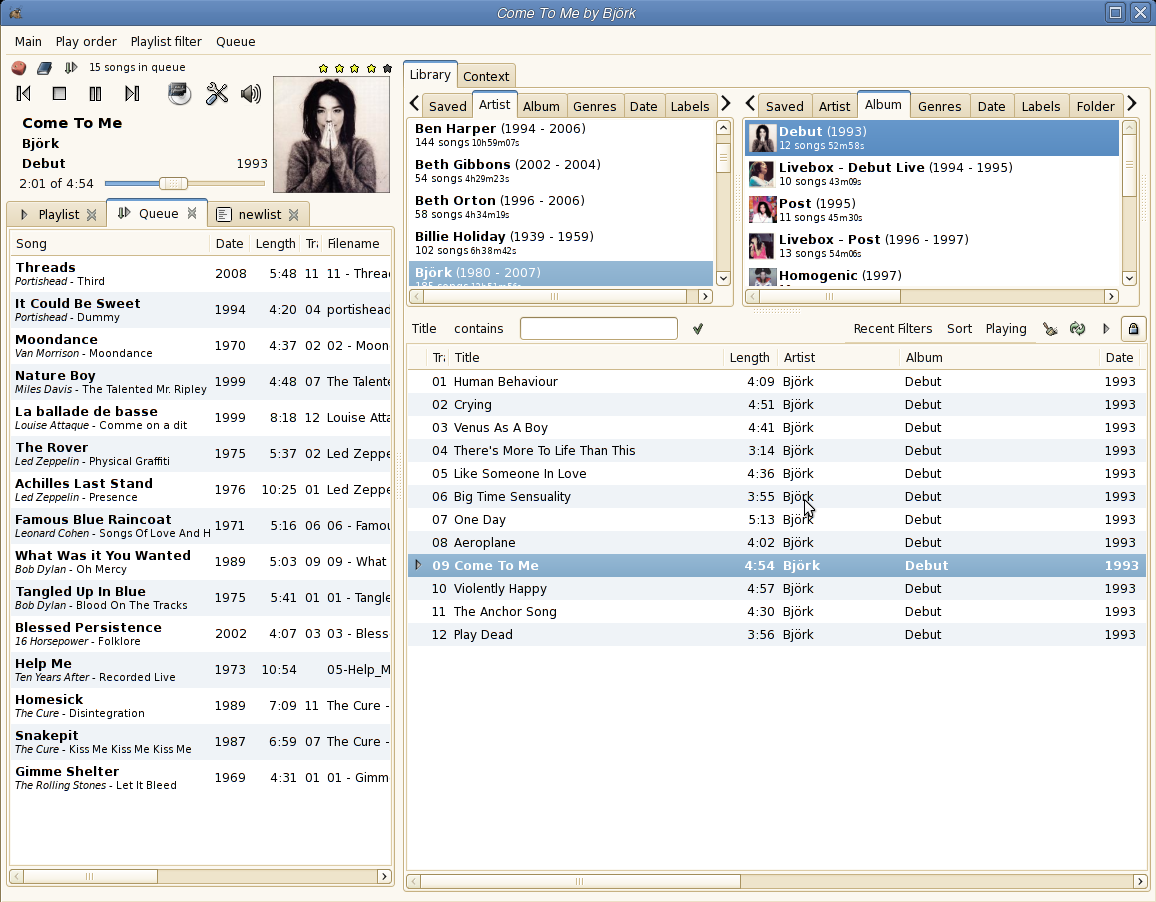
For anyone else looking for the same thing: the one that I ended up choosing was http://gmusicbrowser.org/. See http://gmusicbrowser.org/screenshots/ListsLibraryContext.png.
It probably lacks some of the advanced stuff you would want, but I use it as I still do with Winamp: setup keyboard hotkeys to execute audacious -[rft] (skip around in songs from any app), load a folder (or folders) of songs and play them. Throw on ProjectM and you have a poor man's substitute for Milkdrop. And there's Shoutcast support as well.
The UI runs in skinned mode (pictured above) or in a more traditional mode that doesn't look out of place on your desktop.
It's a cross-platform music player backend C library. It's meant to be generic enough to be the backend of any music player.
I use it as the backend for Groove Basin [2] which just might hit milestone 1.0.0 around December 20.
[1]: https://github.com/superjoe30/libgroove [2]: https://github.com/superjoe30/groovebasin
There are a bunch of other flaws in MPD's design which I've carefully fixed in the design of libgroove/groovebasin. I know because Groove Basin used to be an MPD client until I got stuck by all of the issues and then finally ripped out MPD and wrote my own backend to use instead.
I have a WIP blog article that goes into more detail about this stuff. This Winamp article might just be the kick in the pants I need to get it finished :)
I strongly associate winamp with the early days of P2P, when I was just a teen and got fascinated by the possibility of, at last, getting (at 5k/s; way better than nothing) all those songs from a foreign music TV channel that never played in the local radios... and using Winamp to play them. But it's not just nostalgia: what makes Winamp such a great piece of software is that I still use it every day and it doesn't show its age.
Now I have every song I could possibly want to listen to in Spotify, which is magical in another way.
<title><div id="ad_play_300"><script type="text/javascript"> <!-- adSetType("F"); htmlAdWH("93301178", "300", "250"); adSetType(""); //--> </script></div></title>
It's a shame - seems like it died because it doesn't have a content purchasing mechanism forced on the user.
I used Winamp everyday. We shared music from dorm to dorm on the campus network. Everyone had Winamp. Parties had a dedicated Winamp computer with all the playlists with music available from the campus network.
We searched the net with Phoenix (now called Firefox) or Opera to find all the album art work. We installed beautiful Winamp skins and was amazed at audio 3d-visualization plugins that Winamp offered.
Winamp was early on handling multiple audio cards. I had dual audio cards, one just for Winamp connected to my HiFi equipment and the other for the rest of the Windows sounds connected to the computer table speakers.
Early with global hotkey support. Plugins that showed GUI popups of the music playing. Fraunhofer codec support. And it was super fast.
And I still remember the uproar when Winamp 3 was released. True fanboys stayed with the Winamp 2 release for many years, the classic.
Sad this has to end, but Winamp never successfully adopted to a world with full fledged media library players like iTunes or Windows Media Player. Back in the day we used Windows Explorer (or Norton Commander) to cataloged all our music and soon a community based naming standard convention of music was "created" by mutual agreement.
And then came music streaming.
Bye Winamp!
// A pro license owner
<title><div id="ad_play_300"><script type="text/javascript"> <!-- adSetType("F"); htmlAdWH("93301178", "300", "250"); adSetType(""); //--> </script></div></title>
Is the title an Ad?
But there is one victory from AOL, the spinoff off Mozilla. You would think they could do the same with Winamp
Winamp's goodbye might go in a similar fashion to Sonique's. Slowly and quietly. Sonique was a music player that was bought for about $20 million by Lycos (back in the dot com bubble days) and then shut down after it plateau'd in development and execs realized "dude, it's just a media player". It had a huge community (but no where near as big as Winamp's) and literally a TON (hundreds and hundreds of pages) of really amazing skins and visualization plugins. The site was shut down without much notice.
You can still download the lastest stable versions of Sonique on a fan site and it'll still work. I have a feeling that's how Winamp will be. Unless the developers release the source code.
We live in the future.
It was WRT CPU power. I remember having to use some specially compiled for 486 player to just barely be able to play mp3s. Before that on my 386-40 I was below real time.
I'm pretty sure this is what I was using:
http://packages.debian.org/squeeze/mpg123-oss-i486
This was the days long before P2P, using binaries usenet groups. Or ripping songs yourself, which took quite a long time indeed (like 10 or 15 minutes per song?)
My understanding of the process is that code is written in a language that must be compiled. After it is compiled, it is then "packaged" into an installer file, whose internals cannot be examined. After it is installed, it then consists of a directory full of files which help run the program, but these can still not be examined.
Is it true that the code cannot be seen at all these stages? No way to reverse engineer it?
And by open sourcing, an experienced person could see ways to break the code by causing infinite loops, creating false helper files, using a fake "mp3" file, etc?
Music is a great use-case for keeping data in the cloud. You can have a consistent music library and can use any player client-side. Personally I prefer the spotify "all-you-can-listen" model, but I have a bunch of MP3s that aren't on spotify that I seamlessly stream from dropbox (either to winamp or the spotify client, which allows you to sync local files).
Off the top of my head: You tie your data to one provider instead of simply physical media, you lose discoverability (will your kids browse your album choices 30 years from now?), exporting/importing quality is at the mercy of the provider (for example Amazon dropped several dozen mp3s when I migrated a few gigs to Google), and of course you place your data at the mercy of a business, (is any tech company eternal and/or always interested in providing cloud services?)
The cloud is way overdone, after giving a variety of services a go over the last few years, I'm actually pulling back.
Yes, but ideally, when it's your cloud. Just because all these major cloud players can just stop their service on their whim.
Since when? For start it drains battery much faster. Oh and you know, it does not work offline!
It is hard to "surpass" something that meets my needs perfectly and has given me no issues for over 10 years.
There's also a plugin called Chipamp which ensures you have all the latest plugins required to play video game music files (nsf, rsn, usf, psf, etc.). This is the best PC tool for listening to video game music.
I like the isub app for iphone, but there are android apps too: http://www.subsonic.org/pages/apps.jsp
I find subsonic works best with a friend or two participating. A miniature music club if you will.
If you already have a large library, you can use beets to organize it in a separate database (this is our current project) http://beets.radbox.org/
If you're a linux user then 'audacious' is a good/similar replacement to winamp IMHO.
I switched to using quodlibet some time ago. Can't remember why (simplicity, the right views, stuff) but now everything else seems sucky.
Sad to see it go...
IT REALLY WHIPS THE LLAMA'S ASS
My desktop still looks very much like it did in the 1990s...
End of an era. Sad day.
Foobar 2k works very, very well.
[1] http://www.mediamonkey.com
[2] Autoplaylists are only available for the Gold version.
I've been off windows for a few years now but I used to use Media Monkey (http://www.mediamonkey.com/) for managing a very large collection of poorly tagged music I'd collected over the years, lots of live recordings and whatnot. It's definitely not as clean a player as winamp was but it did manage the library / tagging bits quite well. It seems to still be active so may be worth a look.
As soon as it started getting features that would support this, the technical audience saw it coming a mile away and never adopted the required usage patterns needed to leverage such a monetization strategy. And not just because they wanted to avoid paying for music, but because the service model is just a pain in the ass compared to the self-service model.
"It could have been Pandora" ignores the fact that Pandora basically sucks and people just tolerate it. People want to be in control of their software despite what the business fucks running "IT" think now, conceptualizing a "service" where none is needed, trying to pull infinite profit from such trivial functions such as routing packets correctly or parsing compressed audio and routing it through hardware to a speaker without pointless and pathetic DRM algorithms trying to detect time-skewed copyright audio.. sigh. by setting the bar so low that people think that shitfuck-suck software is what you have to put up with unless you have "long term support" or other wedges into your conceptual/computational sovereignty to do something as simple as publish a document and expect it to be readable on another computer in 10 years, a problem that was solved 200 years ago is now the cutting edge of business technology and development, fueling well known multinationals such as Apple, Microsoft and Amazon.
Computing never was meant to be a platform for economic revolution, it just abstracts away paper work. You still have the exact same problems as with the internet as without it. I won't say the internet bubble is over until the world is actually simpler with computers instead of way, way more complicated and outright retarded in many aspects.
NO, WINAMP DIDN'T FAIL, in contrary, economic motivations failed to make Winamp suck, failed to steal a public resource and public work. Failed to co-opt the direction and passion of artists. AOL failed to capitalize on selfless engineering that actually solved a problem the correct way, it failed to corrupt the best solution with advertising indicators and economic feedback loops built into a market, shoehorned into an audio player. It failed to take us back instead of forward, like technology is supposed to.
I think the clearest indicator that WINAMP is a success, is the fact that XMMS exists, the fact that people use version 2.x without AOL's "support", 10+ years since release. It's a simple idea: a media player that supports plugins via a standardized API. (a real standard, not a "living standard" business-oxymoron) People still use it, for business and personal usage, and it doesn't tax them to do it, any more than a screwdriver taxes you, but not like the way a "service" taxes you.
Regarding Winamp, I've always loved it's tagline "Winamp kicks the llama's ass" (or was it butt?).
EDIT: He's also been working on an audio player called Boom: http://perkele.cc/software/boom
Instead, diversify and maintain. I use iTunes Match, Google Music and keep everything locally as well as a backup on my server. It all happens automatically when music is added to the local library. Nothing is lost, and redundant access is gained.
Now I prefer smplayer for videos and foobar for music. Although I've been a heavy Rdio user for some time.
Software, while a "teeny little bit", is often the bit I find lacking and needing change.
Rock over London! Rock on Chicago!
Thank you for the tip. The facet plugin is great - exactly what I wanted.
the other component i use is the ipod manager i forget what its called but you can find it easily. it lets you add/delete songs pretty easily & if you use flac/wav/whatever it can even convert to mp3 on the fly if you set up the encoder right. that way you can keep lossless on comp but have mp3 on ipod without making an mp3 directory
Some users have started kindly informing the hellbanned posters that, for whatever reasons, don't seem to notice that no one ever responds or upvotes their comments.
If I may get on my soapbox (if I wasn't already), I find the whole thing symptomatic of Silicon Valley's culture of networking hell and reputation management. It's a policy of elitism; a policy that disenfranchises in the name of some fictional notion of quality; a policy that demonstrates just how rotten the tech industry is at heart.
Why do I go that far? Because community culture is indicative of so many things. This is the community and atmosphere that pg set up, that pg creates, moderates, and maintains.
pg may not be formally 'responsible,' but he's certainly at the head.
Because I'm an asshole, but not enough of one to get hellbanned (at least on this account), I am in some state of suspension: an artificial delay imposed on every request.
(That's what I don't get about HN's moderation: what, did you think I wouldn't notice that you're essentially trying to herd me like chattel? I stubbornly keep this account kicking out of simple contrariness.)
You're right (to continue going slightly meta), it's a policy of elitism, but in the same vein as Wikipedia. They too are still around as a result.
Side note: Quality is quantifiable to a degree and is by no means a fictional notion.
Until network will be more reliable and faster than my hdd, there is not much to discus.
If you are concerned with minimizing monetary loss rather than preserving working copies of your media [1] you can treat that as an argument for choosing a media provider that allows you to pay a monthly fee. If (when) their service gets discontinued you switch to another one; the only problem you would face is migrating your favorites, bookmark, playlists and the like [2].
[1] Which makes sense when the specific things you want to access (watch, listen to, read, play, etc.) are not rare and can be found elsewhere.
[2] Incidentally, this is something you could offer as SaaS. Edit: See http://resp.in/, http://www.getunify.com/, the FOSS project https://github.com/mauimauer/portify, etc.
I don't think this is a good strategy, you are putting yourself at the mercy of content license negotiations that are done by a bunch of idiots with their heads up their asses that you have absolutely no control over. There is no guarantee that the music you "rent" from one service will be available for you to "rent" on another service.
I have Ctrl-Pause bound to Play/Pause, Ctrl-PgUp to Previous and Ctrl-PgDn to Next.
This isn't Wikipedia, it's a discussion forum--and the discussion pages on Wikipedia are moderated fairly and openly.
I didn't mean that quality as a whole was fictional, I meant that the notion of quality this policy is attempting to enact was fictional/unattainable.
Flame wars still happen. People still complain about the nastiness of HN comments. It's a discussion forum: angry conversation is what it's for.
Hellbanning does absolutely nothing to improve 'quality of discourse,' it just makes this place nastier.
My own opinion on hell-banning or any other forms of account "punishment" is that it is, as you say, cowardly and ineffective, as long as the user has no idea that it has occurred. Either inform the user, or completely ban the account. Otherwise you're leaving people screaming into the wind when you could just tell them no-one is listening.
Telling somebody "you've been banned" will make them upset. Some people get severely offended and they want to fight. So they go and create new accounts and start over, or they seek revenge in other ways. It can be very time consuming to deal with. Granted, this will still happen because some people will realize that they've been hellbanned, but the ones that simply get the impression that people aren't responding to their trolling will get bored with it and go away. Which is a win.
I'm also an Rdio and Netflix subscriber, but running Plex on my server allows me to 'roll my own Netflix' and stream movies and music to my iPad or other computers, or even from my server to any computer in the web browser. I'm happy.
Edit: Rebooted phone and it works now. Holy shit this is cool, and I can even share my media library with friends!
i just have an apache serving all my videos and a bookmark on any device browser. click and play. for android i use mx player.
https://github.com/ampache/ampache
https://web.archive.org/web/20130302160313/http://ampache.or...
https://web.archive.org/web/20130306044144/http://ampache.or...
Within the last year the project ditched their website in favor of just using github. However, strangely they didn't migrate any the content from their website to it.
Ugh.. lost me. I don't run Java anything anymore.
As a JavaEE architect/developer, I whole-heartedly agree that you shouldn't run Applets in your browser anymore. In fact, unsigned applets will no longer run after January of 2014, which will break a lot of the banking infrastructure and a couple important client applications at my day job.
Java may not be amazing, but it's hardly "so bad I literally won't ever use it."
There's no reason that The Cloud and Owning Your Files has to be a binary choice. The Cloud can be a great compliment to your local file storage, rather than a replacement for it.
Another example: store your music in Dropbox, which clones it to all your devices (where applicable), and then use Tunebox (https://itunes.apple.com/us/app/tunebox-dropbox-music-player...) as your frontend. Now you have a 'cloud' music service where you control the content, someone else handles the distribution, and everything is cloned locally on all your machines (for your other players to use). Then you can trivially back up your music files from Dropbox to a local backup (or a third-party backup service if all you want is some form of company-independent redundancy.
[1]: http://owncloud.org
Also with music, I point blank refuse to let music turn into a subscription based service. I still buy CDs when something agrees with my ears and listen to them.
I also quite happily transcribe things to sheet music and play it breaking many a royalty and public performance law. Fuck 'em.
There are plenty of us CD buyers left :). We're just not as noisy.
physical media has enormous problems for anything besides long term archival use.
I'm also glad my music is on physical media every time I don't have to pay insane rates for a couple hours of wifi on a flight just to listen to my music, or when I'm killing time somewhere where cell service is spotty at best.
I don't yet live in the future where access to the cloud is a given, and I prefer my devices don't become completely useless without a data connection.
Edit: My primary physical media isn't a pile of CDs—I have plenty of those too, but stopped carrying them the moment I got an MP3 player. Now I carry almost my entire collection on my phone and a whole lot more than that on my laptop. I see nothing wrong with having copies of things in the cloud (remote backup FTW), but I'm not about to take a shotgun to my local disks.
for those of us that consider music as art that is precisely the point, especially re: children browsing their parents collections
Before you ask - yes I used to be running xbmc, minidlna, etc. previously. No, they are nowhere as good (actually, to rephrase, the client-server model is not xbmc's focus, which is completely wrong IMHO).
"Because I have a resource limited platform in which I cannot handle many dependencies."
Subsonic on a Cubieboard is a dreary task.
Limited resource platforms can run java just fine - but large software with many dependencies, sure, that's a valid concern.
Plug shit into PC, two way sync. WinPhone and iOS do this fine.
That used to be the case, but the newer versions actually phone home and verify the license.
I fully realize many web sites and services are implemented in Java, that's not what I was talking about. I will not install or run anything that needs Java. Period.
Who cares if he still uses some website that is build on servlets server side, or if his tv/car/fridge has a Java running CPU? That's totally besides the point.
Java is not "everywhere". In fact it's getting nowhere fast (including it's use on microcontrollers and devices). The only exception is server side, where it's also not what it used to be these days...
I'm sure, at amazon prices which is a fair approximation including CDs, you didn't spend $100,000 on them either.
This is really not a problem. Well it is but only greed created it.
Putting this down to greed? What an incredibly short sighted, ignorant thing to say. Perhaps we should have stopped at black & white feature phones because only greed could mean we wanted to access the whole internet on the move?
It isn't a "solved problem" because there are still issues with the solution.