The Weight of Rain(style.org) |
The Weight of Rain(style.org) |
The whole thing is great, I'm glad I stuck with it past the first few images to see where he's going. These bits stuck out though and his work is so often things I wish I had thought of.
Here's an especially great pair:
But isn't that true on earth too (to a much smaller degree)? As long as the sun's radius is larger than the earth, then sunlight will fall simultaneously on more than a half of the earth's surface, no?
I don't know the apparent size of the star in question here -- ah, the paper (http://arxiv.org/pdf/1312.3943v1.pdf) gives it: 46.5%. Compare that with the apparent size, or angular diameter, of the Sun as viewed from Earth: 2 degrees. About the size of your thumb at arm's length.
Your mileage may vary, but if I extend both my hands out, touch the thumbs together, and spread my thumbs and pinkies as wide as I can, that's roughly 20x wider than my thumb. Imagine that as the Sun looming in your sky.
https://en.wikipedia.org/wiki/Umbra
The dark region of the shadow is called the umbra, the partially shaded region is the penumbra. This effect is probably most widely associated with solar eclipses, where the Moon passes in front of the Sun. Where the Sun is only partially obscured, the Earth is in the penumbra. Totality exists within the umbra.
In some orientations of the Moon's orbit, it's further from the Earth (and hence smaller relative the much more distant and constant-sized Sun), and despite the fact that an observer is directly behind the Moon relative to the Sun, totallity isn't observed. This is an annular eclipse, where the Sun forms a ring around the Moon.
Here's a rough diagram I sketched up in Autodesk Inventor:
http://i.imgur.com/u9Xjqsa.png
We have a "planet" with diameter 0.275 unit and a "star" with diameter 1.0 unit. If their centers are 1.0 unit apart, then you can clearly see the extra part of the planet's circumference that is covered by the star's light. If you increase their distance to 10 units, the two lines connecting the circles get closer and closer to becoming parallel, but they will never become parallel because the star is larger than the planet.
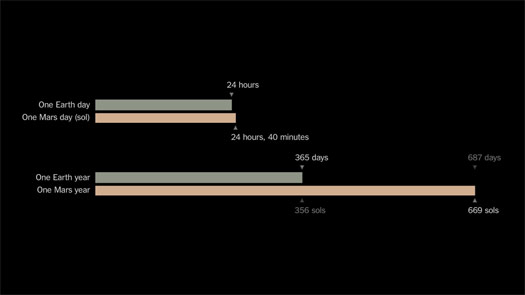
As an offtopic aside, the Mars day/year slide ( http://style.org/visualized/images/weightofrain_34.jpg ) made me think we should really build a "second home" (or vacation house, or mountain cabin).
Perhaps mountain cabin is the appropriate metaphor. It's another 70 million km up the Sun's gravity well. If we take solar energy supply as a feasibility criterion, it's 43% of what we get on Earth. (Data courtesy of http://idahoptv.org/ntti/nttilessons/lessons2000/lau1.html )
HN would become a much better place if the comments are more insightful and represent the perspective of the person commenting :)
If you want to make HN a better place, why not try to lead discussions? Certainly that would be a better technique than going around telling people that their silence would improve the community.
People have said a lot of things to me online, but I don't think I've ever felt as insulted as I do right now.
I managed to mis-read from Wikipedia: "The angular diameter of Earth's orbit around the Sun, from a distance of one parsec, is 2″ (two arcseconds)." Somewhat lower on the page we find: "The table shows that the angular diameter of Sun, when seen from Earth is approximately 32 arcminutes (1920 arcseconds or 0.53 degrees), as illustrated above."
So, if my initial estimate of "thumb at arm's length is the size of the Sun", then my "two hands spanned" is about 4x too small ... woah. Hold your arms out at a 45° angle. That's about the size of it.
That would be ... a lot of star in the sky ...
I also should've trusted my first impression on the 0.5 degree as well. I believe I knew that. Hasty verification fouls memory.