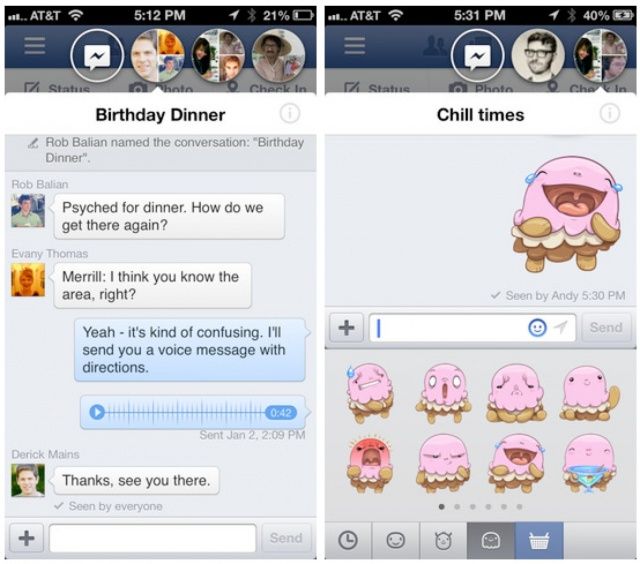
- Chat
- Shared content (news feed/photos/etc)
- Events
I wonder what the world looks like in which each is treated as a separate product with a common login. I imagine that the size of the user base goes up, but total usage could go down.
I know many people who don't have Facebook because they don't like the constant distraction of its shared content core, but would be open to using it for chat and events (if only because everyone else is). At the same time, there are probably existing users who haven't abandoned it yet because of events/chat, but would like to be less distracted by the content stream. If someone could install only Messenger and Events, effectively opting into those two products and out of Paper, it's not hard to imagine a sizable subset of the Facebook population doing exactly that.
They're focusing on the market below EventBrite, small free events and small venue (i.e. tech user talks) that may require a small fee.
It's really refreshing to be able to just say "I want to attend that event" and for it to be a few clicks rather than an arduous check-out process.
Note: Whilst they have a "browse" button at the top, they've started by providing stand-alone pages that act as a flyer and mini-promo site for the event... this is a tool with great potential, not a fully mature product. Example of an event page http://attending.io/events/how-to-market-through-influencers...
http://unicornfree.com/2014/fuck-innovation-take-2-the-obvio...
Everyone I know has Facebook and uses it frequently. No one I know uses email unless absolutely necessary. No one I know is interested in recreating identities and friendship mappings across a bunch of discrete apps.
- FB probably recognizes that a Social Network is at its core a directory of connections and the ability to message/talk to each other. Until now it took a backseat to over-shared content, when it should have been the other way round.
- This app could serve as the foundation for the next FaceBook. Once you strip down an app to its essentials, you can very carefully add features based on data and the lessons learned.
- We are moving towards more selective, opt-in types of engagement, as opposed to carpet bombing with the content feed. For example, there are only a couple of dozen people whose feeds I care about. Those are most likely the people who I interact with or message often. What I want is the ability to mark certain people as "interesting" so that I see their statuses, instead of having to "hide" everybody else. (add:) Same with groups, follows etc.
How many years of hype did it take to bring us to this moment, where we realized we had reinvented ICQ/AIM?
I know, I know, I'm being reductive. There is also a sort of Geocities thing bolted on. You know, like Friendster and Myspace
I was never around for the Friendster days(I was a Livejoural user through and through, damn it), however the reason I suspect MySpace lost out is that they did do the GeoCities thing. Everytime I see people complaining about a new Facebook layout, I always think, "Is this worse than the best MySpace page?" Answer is always no.
It's not that we're reinventing ICQ or AIM or MySpace or whatever, it's that we're refining the, oh god I hate using this word, "experience" of using it.
Does Facebook have random flash things pegging my CPU to render a cube in 3D with my friend's vacation photos on each face? Does Facebook have auto-playing music? Does Facebook have the option of setting the page's colors to be hideously garish?
I also think Facebook is realizing this, and they're trying to retool their business away from Facebook this website you visit, to Facebook a thing where all of these neat services are wired up to. I don't know if they'll succeed, but at least they have the sense to know they're not going to be on top forever.
The problem with social media (which leads to the demise of every implementation in around 7 years) isn't the media, it's the social.
The problem with social media is modeling degree of interesting. Everyone joins a social media site because the people in a defined group (however that is implemented) are interesting. Over time people join the group, and some leave; alas, those joining tend to be less interesting than whoever was there (and attracted participants), the interesting people tend to leave because they're surrounded by ever more uninteresting people (and find more interesting people elsewhere), traffic increases, signal-to-noise ratio decreases, average level of interesting plummets, people leave because it's boring, cycle repeats elsewhere. Insofar as the site is a directory of connections, participants find their list is dominated by people they don't know/care, but as nobody wants to perform the cruel step of actually sever connections, nor wants to spend the considerable time required to do so, they leave for somewhere fresh (hey, the old account is still available if they want to contact someone, but that ends up just being neglected). Eventually one leaves a trail of abandoned accounts, still active but ID & password - even the site itself - forgotten.
FB has tried to solve this with some algorithm filtering thru activity of friends, leading to a disjointed slate of postings which is interesting enough to casually browse, but suffers from a still low S/N ratio and leaves it almost impossible to find an interesting post short of scrolling thru hundreds of disorganized items. Result is an experience just interesting enough to keep people checking FB, but not exactly useful.
"Upvoting" helps identify interesting posts/users, but that's the decision of the voters, not the reader.
So...someone creates yet another social media site, using some new tech to change the media or voting or ranking or filtering or something ... and it all goes thru the same social media lifecycle, dying when the S/N ratio reduces the activity to little more than yet another directory of connections.
Give me a way to filter those who are interesting to me, with some visual gradient that I can read or skip sections of as I read based on momentary whim. HN's gradients are a useful step, but in the wrong direction: I don't just want the bad posts faded out depending on how many object, I want the higher ranking posts more visible (not just in position but in gradient, as sometimes great high-rated posts are positioned low just because they respond to some mediocre parent); sometimes the most down voted posts are interesting for visceral "train wreck" appeal.
Figure out how to find out what/who I find interesting. Keep what I see interesting, and I'll stick around. Otherwise, it's just the next ICQ directory.
The discrete separation of Facebook apps may solve the problem that companies like Yahoo are facing (to some extent): The sum of the parts is greater than the whole.
If you want an 11 minute read, I covered this at great length in a blog post two weeks ago on Medium: https://medium.com/p/b3c97b87a183 (4.4K views and counting).
It's not fun to use anymore -- I'm always getting these stern warnings about new privacy policies, and they are always screwing around with the timeline.
For example, now the Facebook gods have decreed that I will view the vapid posts of acquaintances who insist on posting "look how happy my family is" pictures, and buries posts from people whom I actually interact with on Facebook.
> Similarly, there’s a logic to giving Paper some more features, or “bloat,” as engineers derisively call such additions. Although it’s awkward to cram more information into a hidden tab on Paper — if birthdays are so important, why aren’t they in Paper’s main news feed? — the additional information also helps Paper live up to its billing as a place for news and stories from your social graph. For some people, birthdays and invitations are a vital part of that news stream, even if, for others, such information is trivial or better placed in the core Facebook app.
1. The Events and Birthday features were planned before Paper was announced. It's not feature bloat, it's a "second release" feature planned ahead of time.
2. Paper is optimized for a high-quality reading experience, especially longer content, as evidenced by the meticulous attention to detail in the text rendering and the horizontal scrolling. Birthdays would take up a lot of space in the story stream for relatively little content (and how would you order it within the feed, anyway?). Look at the birthday indicator on Facebook WWW, and tell me a name and three words are worth a screen-sized card in the stream. I would be very skeptical.
3. Birthdays arrive regularly and in chronological order. The Notifications jewel is the best place for these things - people also visit it regularly and there's a chronological ordering to it.
As for Nearby, the argument is flimsy. Changing strategy doesn't have to mean sabotaging in-flight development. Perhaps Nearby was developed before or during planning for the shift to the new strategy.
edit: was reacting to "meticulous attention to detail in the text rendering"
Another UX edge case is when you hit Messenger directly, there's no backlink to Facebook. That's kind of blah.
I tried it out briefly, and IIRC had some trouble with chat notifications still coming from the main Facebook app. I could turn off notifications for it, but that'd kill all of the other notifications too. Making chat only in Messenger would solve this, if they haven't fixed it already.
Lastly, if the worst happens and the core FB popularity declines, this new app could live a VERY long time. The only thing close in competition is GChat, but considering how popular WhatsApp is and its powerful reach into mobile, this could be the dominant chat platform going forward.
I think it was a smart move.
As soon as any social startup rises to the sky, they would grab it. Since the social itself is worthless in terms of making money, so anyone would easily get acquired, because they don't have any other choice, and definitely acquisition by Facebook, Apple, Google or Microsoft is and was their only business model.
http://cdn.cultofmac.com/wp-content/uploads/2013/04/Screen-S...
Honestly, it's brilliant, and the sole reason I use Facebook chat for most of my communications.
I still get the notifications in my original FB app, but when I press "messages," I'm taken to the Messenger app.
I'm surprised there's still not a Google for events.
Absolutely. What's going on in Berlin next weekend? To answer that question depending on my interests, I need to check half a dozen different sites, none of them very good or filterable in useful ways.
I want to do more fun and interesting stuff, you want to promote your event. It seems like an obvious opportunity for anyone who can at least improve upon the clunky Web 1.0 interface of existing sites.
I am thinking of making my prototype more human involved. For example, users (like you) could list the sites they often check for events, and maybe give the system some cue on how to extract the events from those sites. Another approach is MTurk which is something I'll try next.
I think this one is similar. Aggregating all of these events for all of these niches from all of these websites is just both so obviously needed and so obviously difficult that no one has wo/man'd up to do it (at least as far as we know).
I have lamented on this one since at least 2007 when Yahoo bought that startup that was trying to do exactly this (can't remember the name).
One day it will happen and the world will be quite a bit better. Obviously :)
FYI, this is a feature, not a bug. One of MySpace's early differentiators was that it allowed fake profiles, unlike Friendster.
Another differentiator was the extreme level of customization available, which as you note, resulted in a lot of lag because most people do not even realize that could be an issue.
No, Facebook has successfully homogenized the identity of individuals. Every person's page is the exact same professional-looking franchise restaurant. BORING. It wouldn't be the worst thing in the world if people could make their pages individualized in a thoughtful way. Few people are asking them to allow Flash or go full MySpace. Perhaps instead, a library of curated themes, or even fully custom CSS (that could be turned off), a la subreddits.
If you want all of that, build yourself a home page. Tumblr and Livejournal did it right by offering ways to view someone's account with out their idea of what good taste is. Still, between NO customization and customization, I'll take the bland option.
It works great on Reddit for subreddits because if you get it wrong, you can just move to another subreddit or find a moderator who knows a thing or two about CSS.
I can't just up and find friends who aren't fucking colorblind.
For the same reason we joined ICQ in the first place. Hype, incremental improvement, playing with new toys, and some of our friends were there but not on the previous thing we used.
ICQ did suck. It sucked the way most things suck: given the environment and state of the product at the time of release, they sucked less than other things on at least one metric.