Uncharged phones, laptops to be banned on US-bound flights(nzherald.co.nz) |
Uncharged phones, laptops to be banned on US-bound flights(nzherald.co.nz) |
A laptop with a fully charged battery can cause a lot more havoc over the Atlantic ocean than one with the drained battery. Presumably you could bring in a couple of extra batteries as well, because it's going to be a long flight.
If they're worried about someone building a bomb into the insides of a laptop that you can't turn on, then hasn't that been pretty much the core of airport security since its inception -- and pretty much a problem solved to all practical extents since several decades ago?
I mean, that's why they've been scanning all cabin baggage for decades to see if there are guns inside radios or tanks of interesting liquids inside some suitable item. They've been looking at the x-rays of laptops for twenty years, and now they suddenly start worrying about bombs being built into one?
And why aren't they worried about the cargo baggage which also contains electronic devices that are potentially uncharged? If they can spot bombs in the electronics in your big baggages without checking if they boot up, then why can't they do that for your cabin bags?
Unlike water bottles that you can dispose, this is going to be a big problem. You just don't leave your laptop or phone at some airport: you simply don't fly.
This makes absolutely no sense whatsoever, and the sickness spreads to airports outside US. This means we soon can't fly with uncharged electronics in Europe either because the same security gates can allow someone to board a flight the USA.
I'm just wondering who is it that benefits from all this? Where does the money go, who are the people who can push these endless rules and regulations for their own gain because there sure as hell isn't a gain for anyone else?
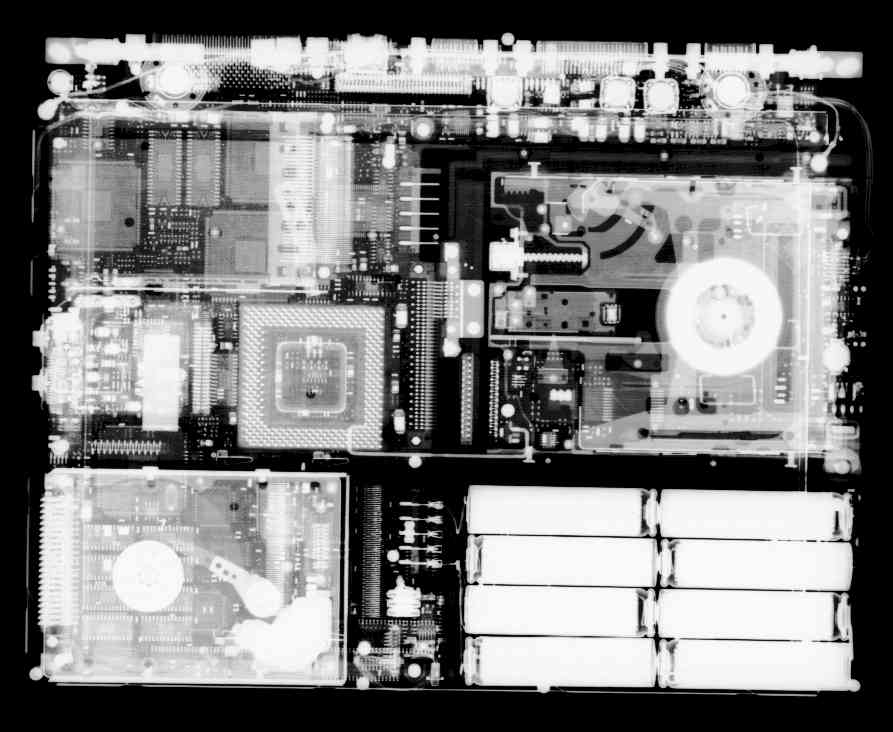
Batteries on laptops and cell phones look like a big opaque block on x-rays[0]. And 6 grams of PETN can do a lot of damage[1].
New intelligence indicates that the AQAP bombmaker responsible for the underwear bomber and the printer bomber has figured out how to replace the battery with a bomb. It's not visible on x-ray, and it's sealed so it won't trigger the explosive trace detection equipment[2] either.
> And why aren't they worried about the cargo baggage which also contains electronic devices that are potentially uncharged?
Presumably these devices would need to be held directly against the fuselage as the underwear bomber failed to do[3], so they'd need to be carried by a passenger instead of in a random location in the baggage compartment.
And it's not about whether the battery is charged, it's about whether the device has power at all. Naturally TSA countermeasures are trivially circumvented. Replace the optical drive with a second battery, it still powers on even if the first battery has been replaced with a bomb.
Some reports say they're looking to surgically implant a device under the skin[4]. How do you screen for that?
[0] http://www.petergof.com/x-ray/images/profiler.jpg
[1] http://edition.cnn.com/video/data/2.0/video/world/2009/12/28... (video)
[2] http://media.cmgdigital.com/shared/img/photos/2012/08/11/8d/...
[3] http://www.slate.com/articles/news_and_politics/explainer/20...
[4] http://www.bangkokpost.com/news/world/418791/spotlight-on-qa...
Because you can't swap in a live battery in mid-flight if the device is stuck in the cargo hold, of course. I'm not sure what's so terrible about this, since most people will have a charger with them anyway. If their device happens to be out of battery but they can plug in the charger and demonstrate its safe operation, there's no problem. Indeed, this doesn't strike me as anything particularly new, rather an old story being recycled as churnalism.
http://www.tsa.gov/press/releases/2014/07/06/enhanced-securi...
What I meant that if I build a bomb into a laptop, and use its battery space to contain the explosive so that it looks 99.99% the same in the X-ray, I can just put the bomb in the checked in baggage and have it in the cargo space while not having to show anyone that the device doesn't boot up.
But if they can already detect bombs built into devices such as laptops for checked-in baggage — which they obviously(?) and presumably do — then why can't they detect these bombs similarly for cabin baggage? They could just do that instead of asking the passengers to boot their devices.
Whelp. Better ban shoes too. Otherwise terrorism.
I have an external battery for my X220 which I use on long flights. Just out of curiosity I calculated the equivalent energy in TNT which the batteries hold. It was about 220g. And Li-ion are known for their explosive discharge.
That being said: http://xkcd.com/651/
What about laptops?
I do not think this is about security, so much as it is about punishing people who make it impossible for the relevant officials and spooks to snoop on the devices.
To pick an example from today: http://tompride.wordpress.com/2014/07/06/daily-mail-journali...
I may be paranoid, but I could imagine the TSA offering little charging stations so you can get enough juice to turn the phone on, and from there it's a short leap to imagine that the other side of that "charger" is going to be something that sucks down as much information as they can from the phone.
From my understanding, they already can make sort of "notes" on your file - including books you have in your luggage, that sort of thing. It's not that crazy to imagine that they'd distribute some simple juice-jacking equipment if people are very frequently wanting to plug in.
If there was a real motivation to secretly snoop on every phone that passed through a TSA checkpoint they'd come up with a better excuse that would allow them to plug in every phone- or they would more likely just be upfront about it. They haven't really tried to be sneaky about any other invasive screenings, to my knowledge.
If you look at an x-ray of a laptop or tablet, it's obvious where the batteries are, they're regular shaped objects much denser than the circuitry in the rest of the device.
If you mixed explosives with something to make them denser to x-rays (so that they look like lithium masses) and shaped them to look right, you would avoid the only really effective screening tool available. If you can do that, then sealing them and cleaning off residues to keep from setting off explosive vapour detectors would be trivial.
This way, they can verify that at least some of the batteries in the device are real. It still wouldn't prevent someone replacing some of the cells with explosive and wiring the rest to give the right voltage but less capacity but doing that would require custom battery controllers which is another step up in sophistication. Every step up in sophistication is an opportunity to intercept terror networks.
I hope this comment didn't put me on some watch list.
Honestly I won't even be mad if this were the case.
Also... does anyone know how many people were caught trying to smuggle explosives on a plain until now?
I believe exactly 0 caught by TSA. Given their job performance they should have all been fired by now and the department closed.
FBI and even regular passengers have in 10 years or so caught and stopped some terrorists. TSA hasn't claimed a single person they stopped red-handed with a bomb.
All they did was waste years and years of productive time, abused, molested people, stole goods expensive and cheap alike and so on.
It is a self-perpetuating cancer (not unlike any other large organization) that now that it has been created will come up with further excuses to stay in business.
At least FBI is smart enough once a while to find some feeble minded brain-washable idiot and entrap him (groom him) to make him buy chemicals for explosives and then claim "oh look we have prevented deh terrorism!" and throw the idiot in prison for life.
TSA isn't even competent to do those false flag like activities. It is a pure cancer spreading and consuming resources.
The somewhat more realistic problem is steal one of the zillions of fake plastic cellphones from zillions of cell phone retail stores, fill it with coke (the sniffing kind, not the drinking kind) and carry it across. Well, the drug sniffing dogs might get agitated about that. Prescription pills, perhaps.
Of course, as people have pointed out, you could rig the battery itself to explode, or if you just need to turn the thing on, you could replace 95% of the battery with explosives and just leave enough power to turn it on and off. Like I said, it doesn't make any real sense, but there's a superficial argument for doing it this way.
Essentially, yeah. If you can't turn it on, it could be an IED disguised as a cellphone. (Or so the TSA seems to think)
Of course it's all just pointless security theater. I keep waiting for the general public to realize that these sorts of measures are useless wastes of money and demand they stop. I fear I'll have a long wait.
(Edit: TSA not NTSB)
http://www.bloomberg.com/news/2013-07-22/lithium-power-seen-...
They've already succeeded in making air travel vastly more painful than it has any real right to be.
I can only imagine the chaos if an extra, pre-security-area screening is introduced.
Presumably the idea is that techniques used to convert a laptop or phone into a bomb would render the device inoperable. It certainly seems like a harder task to make a bomb that is also a phone, rather than a bomb that used to be a phone.
How they plan to mitigate phones with bad batteries I have no idea- it's fully charged coming through security, but 30 minutes later, it's completely dead? Must be a terrerist [sic].
Always expected that people who 'loaned' my iOS lightning charger where terrorist.
Can we please remove this from the frontpage of HN until we have another source? I know a bunch of people are going to take the headline as fact without researching the source.
http://www.dailymail.co.uk/news/article-2682478/Airports-fac...
http://www.ibtimes.co.uk/us-restricts-uncharged-electronic-d...
http://www.theguardian.com/world/2014/jul/06/tsa-cellphones-...
http://news.sky.com/story/1296197/us-restricts-electronic-de...
http://www.tsa.gov/press/releases/2014/07/06/enhanced-securi...
http://www.dhs.gov/news/2014/07/02/statement-secretary-johns...
Otherwise, that Macbook Air is going to have to go in the bin along with the bottle of water and the toothpaste sonny jim, and there's nowt you can do about it.
(Wonder how long that will last - possibly until some celeb has their over-worked iPhone taken off them, and causes a social media stink).
That's a Hollywood movie plot.
If you wanted to mask it on X-rays, put it in a Play-Doh canister. It's not that damned hard to fake things out.
The terrorists, so much as they exist, aren't doing these things. Laziness? Uncleverness? I don't know why. But protecting us from imaginary threats by making our lives miserable is disgusting and intolerable.
> This way, they can verify that at least some of the batteries in the device are real.
If they can do that, what prevents them from putting a small battery in that will power it for a minute to get it past the check point?
Again, it's fucking stupid to try to protect the airlines from Hollywood movie plots. First, they never seem to happen, and second the misery the protection causes outweighs any possible benefits.
More people died in bathtubs that year than on September 11th. If they wanted to save lives, we'd have a war on bathtubs, not a war on terrorism.
I was in Europe on September 11, 2001. I turned on the TV after a busy day and at first thought it was showing a disaster movie, until I changed the channel and found the same thing.
More people died in bathtubs that year than on September 11th. If they wanted to save lives, we'd have a war on bathtubs, not a war on terrorism.
This is not correct. 1/10th as many people died in bathtubs, although a similar number died in all drowning accidents (some of which are the result of heart attacks or other incapacity suffered while in the water, making the exact cause of death hard to establish): http://danger.mongabay.com/injury_death.htm Of course, we don't have to look far to find things that are more deadly than terrorism in the aggregate - motor vehicle accidents, for example, do kill a lot more people than terrorism does.
But what your argument fails to address is that accidental deaths are highly distributed and largely uncorrelated while terrorist activity is concentrated and systematic. The qualitative differences are huge, just as there's a huge difference between being hit by a pound of sand (not painful unless some of it gets in your eyes or you inhale it) and being hit by a rock of the same weight (painful and with much greater potential to be fatal). As well as the immediate economic and personal losses, catastrophic events also tend to set big changes in motion. It's highly questionable, for example, whether we would have invaded Iraq absent 9-11 and it's equally unlikely that we would have invaded Afghanistan.
Of course that doesn't mean we should organize everything around the very low probability of terrorist attack or any other concentrated risk factor, but to ignore the multiplier effects of concentration is also facile.
As other people have pointed out, the only use this order has is to prevent uncharged batteries from stopping the inspection of the data on a device.
Realistically it would be hard to kill more than 25-50 people, and the media coverage would consist of footage of ambulances, sober-faced people in uniform, and crying friends and relatives. Look at the history of conflicts where bombings were common, like Northern Ireland, and you notice that crowds don't necessarily mean mass casualties. The most deadly bomb set off during the Irish troubles was at an outdoor market in a town called Omagh, and killed 29 people - but that was a car bomb. Also, in a terrestrial bombing there are also tales of heroism as people help each other, emergency services turn up to help, and so on, which dilutes the sense of horror and helplessness. You could see that with the Boston bombing last year, which was ultimately more effective in drawing people together than it was in terrorizing them.
A plane blowing or otherwise falling out of the sky is a much bigger deal, because it will almost certainly mean the death of everyone on board, plus it has the potential to cause considerable destruction on the ground. Even excluding terrorism, there was high awareness of the Air France plane that crashed in the Atlantic and of course the Malaysian Airlines plane that mysteriously vanished earlier this year. In a terrestrial bombing, you might be unlucky and die, but you might also be lucky and suffer only superficial injuries, or be able to make it to safety, or whatever. In an aerial disaster you and everyone else are basically helpless because if the initial disaster doesn't kill you the fall will. Situations involving helplessness and inevitability are a great deal more frightening to people in general, more so when multiplied by a large number of people.
Maybe that's shaping my views when I think that the number of deaths isn't the only goal of terrorism. Rather, it's to scare and inconvenience people and the authorities.
Let's say "only" 20 people died. I think that would result in yet more security checks. I'd love to be wrong on this, and maybe that's why an attack like this hasn't happened to date - to paraphrase you, it'd be pointless.
I guess looking at it coldly, we should just be thankful that the on-the-ground expertise dies in every attack.
The real reason this doesn't happen is that there are almost no terrorists in the US in the first place. There is plenty of opportunity, whether it's airport security lines, sporting events, or simply using one of the sixteen thousand trivial ways to get contraband past the TSA. The only reason planes aren't constantly falling out of the sky and our airports aren't all smoking craters is that essentially nobody is truly willing to carry out such attacks in the first place.
Nobody is going to put themselves out of a job by saying, "Ubiquitous security screening doesn't work, as every countermeasure we come up with has obvious counter-countermeasures. Thus, we should shrink this agency by a factor of five and refocus our efforts in other areas."
But they can't just ignore threats either, because that gets you hauled in front of Congress the next time something happens. Thus, they ride a line of carrying out countermeasures that don't really help, but which are enough so that they can go to Congress and say that they did everything they could.
That's exactly the reason why I bring stuff in with me. If they're valuable or fragile, I would never check it in.
Given the sheer quantity of hardware thats ever existed and the workflow I don't think this is a serious possibility.
I know pretty much every piece of ham radio gear every constructed has at one point gone thru the xray for "dxpedition" people. Along with pretty much all consumer electronics. It would be a heck of a lot simpler to mod a COTS radio from Radio Shack.
A big rolling suitcase full of powerful explosives and shrapnel set off in a security line at peak time in a large airport would be way worse.
I gave you an example of a car bomb that killed only 30 people even though it was set off in a crowded market. Have you ever seen a car bomb go off? I have, it's huge. What's your basis for assuming that a suitcase bomb is going to be so much more devastating?
Certainly there is plenty of opportunity, but you're making a chicken-and-egg argument by saying there's very little terrorism, therefore security is a waste of time. I'm saying that that the payoff for the risk involved is not enough for most people.
And if that's not enough, do it again, and again. One security line bombing a month until the end of time would be fairly easy and would cause complete chaos.
I mentioned the northern Irish terrorist problem because I'm from Ireland and later lived in London. One bombing a month does not cause complete chaos, it just pisses people off and creates more public support for stiffer security measures, more intrusive surveillance and so on.
I suggest you step back from your assumptions of what would happen and look at available documentation of what actually does happen in countries with long-running insurgencies or terrorist problems, from the UK to Sri Lanka to Colombia, cases of actual disasters (whether engineered or accidental) at airports and public transit hubs.
You misunderstand my argument. I'm not saying that there's very little terrorism, therefore security is a waste of time. I'm saying that many of our security measures are a waste of time because they don't stop terrorism, and I say this because they're trivial to bypass. That terrorism is so rare in this country is not because of agencies like TSA, but because there are approximately no terrorists to be stopped in the first place.
In places where there are a lot of terrorists, they carry out bombings pretty regularly. Regardless of whether you think it's effective, they clearly do. Yet they don't do it in the US. And it's not because TSA is stopping them, nor is anybody else set up to stop those sorts of attacks that regularly happen in places like Iraq. The only reasonable conclusion is that they don't happen because nobody here wants to carry them out.
You're mixing up cause and effect here. Invading Iraq/Afghanistan is not a reason to put a lot of effort into counterterrorism. It's a reason not to.
The US is like a country that's allergic to bee stings. The immune system is constantly finding new ways to fight bee stings harder and faster than before. And when we point out that the vast majority of the damage done by bee stings is actually done by the immune system's reaction, the counterargument is that we suffered a lot of damage in the last bee sting, so we need to react.
Imagine a "keep calm and carry on" reaction to 9/11 instead of the panic attack we actually had.
Yes, the differences are huge. And we should work to make them not be huge, instead of using the huge differences to justify making huge differences.
Imagine a "keep calm and carry on" reaction to 9/11 instead of the panic attack we actually had.
There is no country on earth that would respond to an attack of that scale with equanimity. You seem to forget that 'keep calm and carry on' was thought up as part of morale-boosting publicity campaign to be deployed as a response to the outbreak of war in 1939, although the plan was not put into practice. http://en.wikipedia.org/wiki/Keep_Calm_and_Carry_On
Please try looking at actual historical examples instead of imaginary ones.
I don't understand why you think I "forget" anything or that my example is "imaginary". I am proposing a response and using a well known phrase to illustrate it.
I disagree that 'it's going to happen whether or not we want it.' In the abstract yes, but again you're back to saying counterterrorism is pointless. I also disagree that 99.9 of the damage is self-inflicted although a high percentage is. US reaction to terrorism is actually mild by comparison to most countries. The UK is festooned with video cameras and terrorist suspects are subject to different detention conditions from regular criminals. In Spain you can expect to undergo security checks when taking a train. Perhaps you could furnish some examples of countries that have a more laissez-faire approach to terrorism for comparison.
As for 'keep calm and carry on' I urge you to look into the historical provenance of the phrase. For one thing it was dreamt up as a campaign to reassure a population facing total war, and for another it was shelved at the time (despite some 2 million posters have been printed) because officials realized it was patronizing and unresponsive to public concerns.
Terrorists are in short supply, while methods of attack are essentially unlimited. Effective counterterrorism will attack what's in short supply. In other words, it needs to look for terrorists, not attempt to stop every single conceivable method of attack. The former can be useful, the latter is fruitless.
How many countries have carried out something as catastrophically stupid as the 2003 invasion of Iraq in response to a terrorist attack? If you want a country that took a milder approach to terrorism, given that, I'd say "all of them". Yeah, we didn't completely trample over everybody's civil liberties, we just killed a ton of people, put the government in deep debt, and wrecked the economy.
Also, did you really use "terrorist suspects are subject to different detention conditions from regular criminals" as an example of how the UK reacted worse than the US? Have you not heard of Guantanamo Bay? How many people did the UK hold indefinitely without trial because they were too dangerous to be released but could not be convicted of a crime? (To be clear, this isn't completely rhetorical. I wouldn't be surprised if the answer is not zero. But I also don't think it's in the hundreds.)
I don't know why you persist in thinking that I'm somehow unaware of the origins of "keep calm and carry on". Again, I'm merely using it to illustrate an approach, not saying we should replicate the conditions under which that phrase was conceived.
As you are surely aware, we don't have a reliable method for distinguishing terrorists from everyone else, notwithstanding the best efforts of intelligence agencies engaged in various sorts of spying. Targeting particular attack vectors is of course less than ideal, but if one receives a credible tip along the lines of 'agent X will attempt to transport a 'battery bomb' onto a US bound flight this month' then you can't blame security services for trying to leverage that information. There may even be a second-order purpose for announcing it publicly, eg to instill paranoia among potential terrorists about the leakiness of their OpSec or suchlike. So no, I don't think that such specific directives are necessarily pointless.
How many countries have carried out something as catastrophically stupid as the 2003 invasion of Iraq in response to a terrorist attack? If you want a country that took a milder approach to terrorism, given that, I'd say "all of them".
I might point out that the UK, and a lot of other countries joined in the invasion of Iraq. As for Guantanamo bay, I don't think that's an appropriate comparison. Most people held there were either captured in Afghanistan and a few kidnapped and subjected to 'extraordinary rendition', of them in the context of a hot war. I'm talking about people arrested on suspicion of terrorism, ie neither the Tsarnev guy in Boston nor any of the various would-be terrorists nabbed by the FBI over recent years have been sent to Guantanamo (despite calls for that some ultraconservatives). In terms of judicial process, they're subject to the same regime as any other person detained on suspicion of criminal activity.
In fact, the UK government did imprison a group of men indefinitely and without charge post 9-11 (although the law in question was overturned a few years later because it was in conflict with EU human rights law): http://www.liberty-human-rights.org.uk/human-rights/counteri... Britain is about make some legal history with its first secret trial (http://www.thestar.com/news/world/2014/06/12/core_of_uk_terr...). Looking farther back, for several decades Britain dealt with its terrorism problem in Northern Ireland by removing the right to a jury trial for many offenses (http://en.wikipedia.org/wiki/Diplock_courts) and for a number of years by internment (http://en.wikipedia.org/wiki/Operation_Demetrius - note that almost 2000 people were held prisoner without trial, quite a few more than Guantanamo Bay ever held).
Now, I wouldn't expect you to know all this - I grew up over there so it's easy for me to cite examples. But instead of rudely asking me if I've ever heard of Guantanamo Bay, perhaps you might acknowledge the possibility that I know what I'm talking about. I could dredge up a variety of examples from other countries in various stages of socioeconomic development, but since the UK shares a language and a common legal heritage with the US it seemed like the most obvious point of comparison. I stand by my argument that the US response to terrorism, while of questionable effectiveness, is not nearly as unusual as you seem to think. Indeed, in comparison with prior actions of the US it's fairly mild, sad to say; consider the Japanese internment of WW2, or historical punitive campaigns that would be regarded as genocidal war crimes today, such as the Phillipine-American war of 1899-1902, or for that matter the Vietnam war. Historical awfulness is no justification for bad governance today, but nor are today's problems as bad as you suggest.