Japanese Farmer Builds High-Tech Indoor Veggie Factory(gereports.com) |
Japanese Farmer Builds High-Tech Indoor Veggie Factory(gereports.com) |
Another interesting idea would be to create solar panels that only convert the lost spectrum into {electricty -> required spectrum} [3]
[1] http://bernardkatz.com/wp-content/uploads/2012/07/spectrum-o... [2] http://www2.estrellamountain.edu/faculty/farabee/biobk/pigme... [3] http://mitei.mit.edu/news/transparent-solar-cells
<<
Solar is ~20% efficient LED's are less than ~40% efficient so you would need more land area for solar farms than you save by growing indoors. On top of that you need to pay for all your capital costs. There are other issues, but if this was close to cost effective you would be seeing this in Iceland which gets little sunlight in the winter and has cheap energy costs. Instead they use suplimental lighting inside green houses to boost production.
>>
I thought the vertical stacking makes more efficient use of the light than the single layer you find in a farm or green house. It means that even though the light is produced inefficiently the vertical stacking is intended to cancel out that inefficiency by using the light more efficiently. Moreover, the optimization of the plant's exposure to light through automated means adds to increased efficiency in the plant's use of the light.
If every grower did this, it would (or could) destroy Monsanto's business model. I love it.
[1] http://www.bloomberg.com/news/2013-03-10/fukushima-seeks-rev...
In the US I don't see this helping with common food stock (wheat/corn/cotton/soybean/tobacco/...). I could see this used for presentation foods (foods we judge more from looks) since you can control everything so much more you will likely get more products that can demand a premium price.
Another good point is reduction or elimination of e coli & other pathogens caused by livestock runoff & workers shitting in the fields.
That's a real agricultural industrialization.
Now that might be recoverable via reductions in waste and lower water consumption (see article) but it isn't automatically a net win, it might be a net loss overall. Need data.
Also: 'He is also able to cut discarded produce from 50 percent to just 10 percent of the harvest, compared to a conventional farm. As a result, the farms productivity per square foot is up 100-fold, he says.
By controlling temperature, humidity and irrigation, the farm can also cut its water usage to just 1 percent of the amount needed by outdoor fields.'
These are serious productivity gains, but, as you say, they have to be balanced against electricity use.
From a personal point of view, I strongly support this type of growth for a couple of reasons: more food for less cost, cities gain food independence, natural land use and abuse gets curtailed dramatically. Now if we could only switch more people (me included) to a vegetarian diet.
Now that cannabis growing is legal here in Washington, though, it will be interesting to see whether outdoor growing can compete. The advantage of being able to precisely control your plant's growth cycle is pretty significant even compared to getting your power for free from the sun.
http://online.wsj.com/news/articles/SB1000142405297020355030...
Outside of eating meat, B12 comes only from growing vegetables in proximity to mammal manure... it's not necessarily such a bad thing as you make out.
That said, I would not be surprised to see some farmers in the central valley move to more green houses given their water rationing.
A more immediate opportunity would be placing production close to the area of consumption. The developing and developed world will fail to address their problems with diabetes and obesity induced diseases as long as the population has limited access to fresh produce. Being rich in NYC or SF it is easy to take fresh produce for granted, in some major urban areas even if you are rich fresh produce is virtually non-existent.
* I hate that term. So clumsy-sounding.
This could be huge in cities with abandoned/run down industrial districts that have been hard hit by globalization.
He/She = They
His/Hers = Their.
Him/Her = Them.
There are other issues, but if this was close to cost effective you would be seeing this in Iceland which gets little sunlight in the winter and has cheap energy costs. Instead they use suplimental lighting inside green houses to boost production.
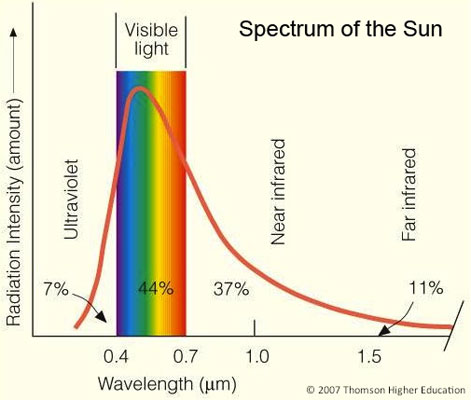
45% of the light is in the photosynthetic active wavelength range in a normal farm vs ~20% solar panels w/ transmission conversion losses etc + 40% LED = ~8% of the incoming light is now useful for photosynthesis.
So, you need a huge increase in efficiency ~400+% just to break even.
PS: Not that their using solar power, but it's still worth considering.
As you can imagine the price of land is quite different...
PS: They have had rice subsidies over 700% and it's still not cost effective to convert more forests to farmland. Growing food in doors works due to subsides but it's hardly necessary.
  Sunlight > photosynthisis (45%)   = 45%.
  Sunlight > solar cell (22%) > conversion, storage, transmission (90%)
  > LED (40%) > photosynthisis(100%) = 8%
1. http://online.wsj.com/news/articles/SB1000142405297020355030...
Generally, a mix of irrigation, fertilizer, better breeds, and greenhouses are the best option for boosting yield. Mix in more marginal land as needed (Note: ~68.4% of Japan is covered in forests.)
Greenhouses for example let you have a longer growing season and pack plants more closely together when their young. Which can let you have an early harvest and then use that same land for another plant or a plant with a longer growing season. Closer to the tropics you can often get 2 or 3 harvests a year. However, they have significant capital and labor costs.
PS: Now, we can try and figure out how a Dystopian future can feed say X billion people but we are a long way from needing indoor hydroponics.