Gog.com Now Supports Linux(gog.com) |
Gog.com Now Supports Linux(gog.com) |
Give it one, three, five, ten or fifteen years. When will these proprietary binaries stop working?
I look forward (probably in vain) to the day when game developers want their games to be playable by anyone on any system, any time, even long after release. Played by everyone. I mean, who wouldn't want his work to be loved by everyone and forever? Why?
Freeing the code is a first, inevitable step.
I don't think developers are the problem.
I've played World of Warcraft a lot. It's a game that has affected tens of millions of people directly, and hundreds of millions indirectly (through WoW's influence on other games, game models and so on). It has built careers, businesses, companies, and so on.
Yet one day, it'll close down and nobody will ever be able to play it. All that'll be left will be the game files - 3d models - and a lot of screenshots.
Sad.
In reality, the game has gone away. Every time a new expansion has come out and reset everything millions of people had their old game taken and were given a new game. And sometimes, they didn't like the new one, and sought the old one. And even if it is illegal, the market is providing their demands. There are even a few open source projects for server cores to run WoW on.
I actually think it'd be really exciting for someone to write a compatible client for a 3D game like that and release it. What would FreeTF2 look like? The idea of multiple clients implementing a proprietary game netcode and all simultaneously playing together is really interesting to me, at least.
This has happened with Second Life but only because Linden Lab explicitly facilitated it. They actively encourage third-party developers and release the code of their official reference client. Second Life The Network is also basically just a bunch of scripts and textures coming down the pipe so it's easier to implement than say an unofficial client for an FPS or RTS, which is very likely much more opaque.
> I don't think developers are the problem.
It depends on the project. So I guess big commercial titles have other problems. Smaller groups though -- whether indie game studios or just individuals making freeware games (Dwarf Fortress, anyone?) -- they're usually what the developers make of it. And it very often is the case that the developers do not care about others' freedoms or portability and all that. It's too much work, nobody uses that platform, we don't care about minority users, whatever. The same old excuses, which are mostly BS.
Try boot a 2004 Linux in Qemu without using kvm, kqemu or the like. Play a game in it. For the heck of it, try emulate a machine with a different ISA.
Am I the only one who just gave up because of video and sound driver issues? That's for 3d, of course - as stated above, everything in a window manager usually works just fine.
That said, this is awesome news, maybe I'll come around to try dualboot again (after many, many years) because it could be easier to get my Radeon working under Linux than some of the other chips (especially on laptops) in the past.
Just speculation ;-)
It's been working great for me. I haven't tried Crysis or FarCry yet, but I can play Half Life 2 at maxed out settings at 60 fps steady and stable. I play a lot of older games, but Bastion, Shadowrun Returns, Rust, Beatbuddy, Fez, Portal (2), Dust, Civ5 all run beautifully. I realize these aren't latest power games, but considering the topic I think this is ok.
Then again, I am very, very comfortable messing around with drivers and settings. Every time I upgrade the kernel I have to recompile my drivers (using AMDs Catalyst beta 14.6 currently). I don't mind, but you might.
http://www.phoronix.com/scan.php?page=article&item=linux316_...
This seems to suggest that Nvidia's drivers are vastly superior on new OpenGL 4 features, though they do come from Nvidia: http://www.phoronix.com/scan.php?page=article&item=amd_apite... It's probably cherrypicking benchmarks a bit, but cherrypicking shouldn't have that dramatic results... Seems like I'll be sticking with Nvidia.
With this and steam linux edition, the future looks bright for linux gamers.
Playing colonization on linux this evening :-)
I read on the forums they're wine wrappers though (officially supported, but still). Native ports would be the best, of course.
I wonder if they've made the games work (if they didn't already) by hacking DOSBox, rather than the game.
Obviously, one can't support "Linux" - that's abstract shortcut title for plethora of various GNU/Linux-based OSes. Yet, I think Tux is universally recognized symbol for those.
PS: don't know why you get downvoted. I wish it was possible to flag unwarranted downvotes...
Performance is still not as good as on Windows though. For example I can't play Dota 2 because of low fps on linux but on windows it is playable.
Laptops and wireless are still definitely a big issue. I think desktops have a much better chance of working. Whether they work as well as Windows or not is a different question.
No issues here. I guess you may be running AMD hardware hence the video drivers issues, but I haven't had sound issues in games for years.
Same game on Windows, likely no problem to fix.
Issues for sure still happen with Linux gaming. Many games are fine though, of course.
This is great news, why care about the small, completely irrelevant things? Why make it look like the Linux community is blasé, whiny and will complain about anything?
The funny thing with multi-screen gaming on Linux is that the "default" target SDL picks is not your primary monitor, it is the monitor on the left. It doesn't matter what input order its in, or anything else, I can reconfigure my screens however I want but "full screen" always means leftmost panel.
I'd also say having the source doesn't mean it's portable. The code might have a number of legacy dependencies (references to old DOS libraries etc) or even weird code tweaks specific for that platform (eg the Pinball game bundled with earlier versions of Windows wasn't ported to Vista because the source was in 32bit assembly) which would mean a direct port would be less practical than a reimplementation.
If developers / studios wish to release the code for research or academic curiosity, then kudos to them. But I don't think old games necessarily need to be open source.
It's far from negligible, especially if you're not using a platform which supports dynamic translation of x86 code. Even so, you can easily run into performance issues. There are many dosbox games that run like shit on my PC, which is only four years old.
> I'd also say having the source doesn't mean it's portable.
You're right, and I'm well aware of the fact. Which is why I said giving people the source is an important first step. If you read my other comments in the thread, you know I know that the game's developers can also affect the portability of their code, if they care.
> which would mean a direct port would be less practical than a reimplementation.
Sorry but this is very uncommon. Even with weird unportable dependencies, it is almost always easier to take existing code and port it than to completely rewrite it (reverse-engineering the original in the process). If you think otherwise, you're grossly underestimating the amount of work it takes to reverse-engineer and make a game.
> I don't think old games necessarily need to be open source.
Games do not need to exist in the first place. But people want them (this is why GOG exists). People also want them to run well on their computers (this is also why GOG exists). Why shouldn't people enjoy old games, just like they can enjoy old books and movies? This is what GOG attempts to let them do. Why shouldn't game developers agree? Why not make it easy for people to enjoy their work any time? Why should games bit rot to hell? I'm talking about all games, not just old games.
I brought up an old game as an example because it shows off what open sourcing the game can do. There is a vibrant, active Doom community to this day. New map packs are being made, new source ports are being made, new mods are being made. There's new stuff and there's improvements to the old stuff. And it really makes a difference. I don't think the current community could exist if we only had DOS Doom. I know for a fact I wouldn't be playing it anymore.
My PC can't even run it in dosbox well enough. Performance is an issue.
And yes there are other old games that are very difficult to run properly on anything modern. If there isn't enough community around it to hack around all these problems, these games will slowly be forgotten. It's sad.
> If developers / studios wish to release the code for research or academic curiosity, then kudos to them.
Do you really think research and academic curiosity is all the source is good for? Maybe you do not care about old games and all the new games that have spawned as a result of old engines being made available to us. That's fine. But for a lot of people, it's much much more than a code museum. People really do play source ports of old games, or new games that are built on the sources of old games.
EDIT: If someone knows of a port or reimplementation of the original System Shock, I'm interested. I'd love to play the game, but not in dosbox, and not without some UI tweaks.
Also, I have reverse engineered games before. Albeit on a very small scale. I've also ported existing code on a number of occasions. I'm aware of the positives and negatives of both methods. Sometimes though, it's just easier to reimplement something than port old incompatible code to a new platform because the old code might have the graphics calls embedded in with the core game engine, and what not. Thus meaning that huge chunks of the core game engine would need to be rewritten regardless. Or in instances where the core game logic is written in 16bit assembly, so couldn't be ported regardless.
I'm not saying having access to the source isn't an advantage, what I'm saying is that sometimes it's not always as much help to the port as you claim with your generalisations.
Edit, freeing the art and sfx resources would be a massive help in almost all instances though
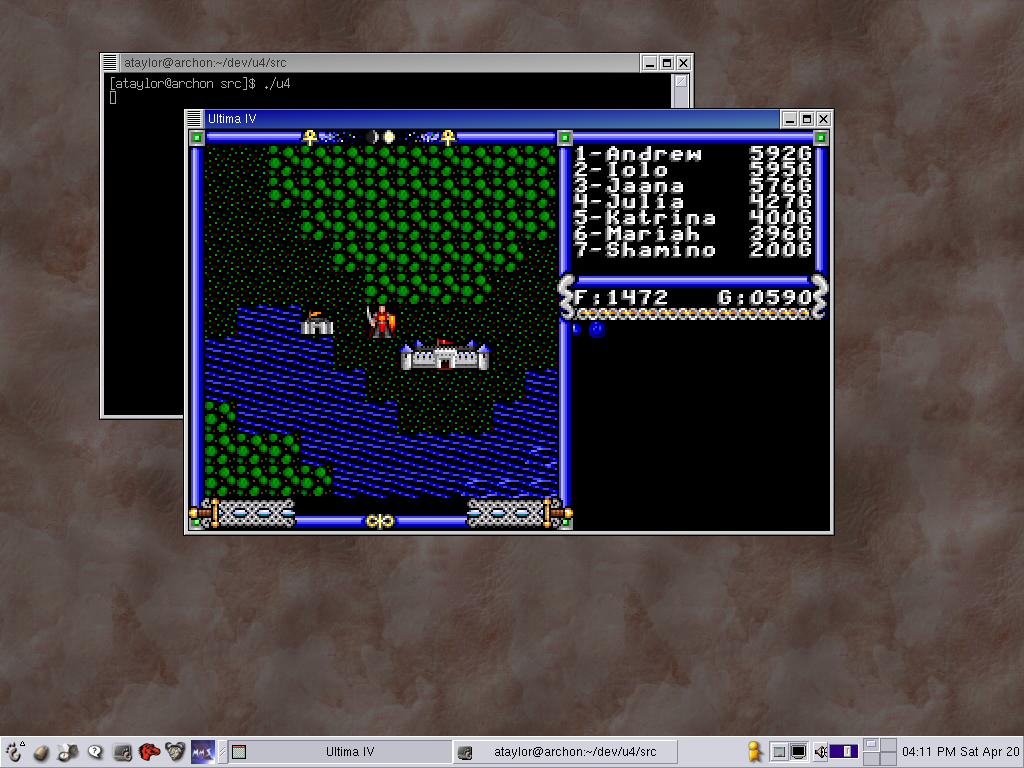
Ultima IV Updated graphics, native port:
http://xu4.sourceforge.net/images/shot3.png
Obviously it's harder with binaries; and these games had significant parts written in assembly anyway, so it's easier with games from the 80s than modern games.
It is very easy to wave BS to software developers. Now try to earn a steady income from FOSS desktop software.
Giving users the source so they can help themselves has nothing to do with landlords and supermarkets. It can get you more money though, by increasing the user base and making more happy users. It can make your game sell for much longer. Doom still sells, and people play it on the weirdest of platforms. And if the developers cared enough, they'd learn that it doesn't necessarily take much effort at all to make code easier to port. But you do have to care. If you don't, and you write code under the assumption that you won't and nobody else should port it, then the result won't be very nice.
So maybe you could still play Doom on dosbox or in a VM, but I don't think it'd sell much if they hadn't given the source that allowed people to create legal ports for modern systems, with features that make the game more enjoyable. People still enjoy Doom.
Does not follow. There is no evidence that you can make more money by simply open sourcing your project. In fact, judging from the number of popular, widely used open source projects reduced to begging for donations, it's precisely the opposite. You may simply be assuming as true the same excuses that pirates use to justify their piracy, saying "Hey, I'm giving you free advertising!", completely overlooking the fact that 1) advertising in itself does not feed the creators, and 2) they're primarily advertising it to people just like them, who'll also simply pirate the product.
Look at the companies making the most money in software. Then look at the companies making money from open source software. Note: not companies that use open source or open up some of their non-core code, but those whose primary product is open source, such as Red Hat. There's a few orders of magnitude of difference in revenues. This despite Linux running the vast majority of servers on the Internet and in data centers. Why is this?
While open source proponents like to live in an ideal world where everybody shares their code and collaborates, the harsh truth is that the vast, vast majority of the world will take what it can and give nothing back. That is not conducive to building a viable business when by open sourcing your code, you're essentially make your product even easier to be taken for free.
Freeing the code is a first, inevitable step.
This is what id has done with the Doom and Quake series. These games still sell! And we can play these games on whatever platform, with whatever custom features, because the source was released and people picked it up and made it work and improved it.
You're completely overlooking the fact that freeing a game's source code is completely different from making the entire game free. Business continues as usual: they sell the actual game, which people need to actually play it.
Companies whose source code is their entire core product are completely different. You cannot make a relevant point by talking about their problems.