OS X 10.10 Yosemite: The Ars Technica Review(arstechnica.com) |
OS X 10.10 Yosemite: The Ars Technica Review(arstechnica.com) |
Dock, is 2d until you roll over it, then icons pop out of it and it looks like it is 3d.
This is it, Apple is the new Microsoft. Frankly, and I can't believe I would ever be saying something like this but Windows 7 now looks better and more consistent.
I know these reviewers cannot answer this question, I just want to point out that it's the only relevant question for me. Given Apple's track record, this release will most likely cause my MBP to crash more often, but I want data on that. I want a review to actually explore this angle as opposed to simply talking about features that honestly mean nothing to me.
For example, open a lot of windows (20 terminal windows, 5-6 projects in Sublime, a bunch of browser windows used to test apps), turn on mission control and it just crashes every single time. I haven't done more test to figure the exact number of windows until it crashes but I know that it does for my workflow.
Admittedly, I tend to have more windows opened than most people, but then again that's what I have 16GB for.
I've also noticed that while expose was always smooth, mission control just doesn't work for me. If it doesn't crash it's dog slow, especially if it switches from integrated GPU to dedicated GPU just when I open it.
Stop presuming, get facts. OSX Mavericks is known for its crashing problems.
Example: http://venturebeat.com/2013/10/25/apples-new-os-x-mavericks-...
The only issue I have is with the trackpad going out from time to time but a quick reboot fixes the problem.
Would've happily avoided the beta but the only way to screen record directly from an iOS device and the Apple-recommended way to create preview videos for the app store involved Yosemite and iOS8.
> really long pauses anytime I try to save a simple document for the first time
Is that actually what's happening, or is it a really long pause when trying to show the open/save dialog? I have a couple of NAS volumes mounted, and if I run an app with a Recent Documents entry that lives on one of the volumes, and the NAS is asleep, then the app will often pause when trying to populate the Recent Documents list. This normally happens during open/save. Previous versions of OS X did it too, though I feel like Yosemite might trigger it a bit more often for some reason.
1) before plugging into display, open lid and wait for login screen to appear
2) before unplugging display, open lid and wait for laptop screen to turn on (normally I keep my laptop closed when connected to the display)
If I deviate from this the laptop crashes or goes into some odd state.
Is it risky to upgrade to Yosemite? When starting up cold, I sometimes have to force-shutdown the computer 30+ times before it will get past the Apple logo screen without going grey or black. I'm not sure if such a major software update is a good idea given the circumstances.
I had to take it in. And pay $550. Even though it's clearly a common problem, if not a design problem, something similar. Go check out the big apple support log on the problem.
I lost two weeks of productivity, because they failed to fix it the first time (it got worse).
If you have GPU panics, and you don't get your hardware fixed, you get what you deserve. Sorry for that. It's hard to get to a repair center or genius place? Sorry for that too.
Nothing to do with 10.10.
I've installed 10.10. It's running nicely.
What should you expect? Look through Ars' list. The changes are updates to the on-board apps - none of which I use (message center? no. Mail? no. etc). There are additional internal APIs for IOS tooling - good for the long term, nothing for now.
Mavericks was an important release. It treats multiple screens in a sensible way - finally addressing a weakness inherent in macs since '85. There has always been the Special Screen with real estate taken by the menu bar, no matter how many screens you have, you drag the cursor back to that screen over and over.
10.10 is not Mavericks.
In 10.10, you'll see some newer, cleaner fonts and icons, that's it.
For future reference, if they botched it the first time, you should call Apple corporate and yell. They messed something up in a repair for my work laptop once and it took one phone call to get a new one immediately. I had to make it clear that it was their fault and I had to have it for work and school, but they were super accommodating (and the new one worked like a charm).
FYI, there are OS distributions that do not crash. My sound card sometimes doesn't survive a hibernation but that's a known hardware fault. Not that a OS level crash would lead to any data loss.
Yes, I have heard that LepriconSoft's UnicornOS runs quite well on the Hypothetica-9000 processor but everything else has the same real-world problems with faulty hardware and drivers.
You might have a stable setup but that's also true of well over 99% of Mac users – they just also don't tend to go on forums and say “Yeap, everything's still fine here!”.
Its also weird because I have no media now. I have the discs it came with somewhere but that will also be Lion 10.7? Or possibly Snow Leopard. The re-install is going to be a bitch for me. UGH!
Some of the issues were resolved by removing Soundflower as it was conflicting with VLC. But they still do happen.
It crashes daily if I use Parallels and regularly when using Spotify.
edit: Mid 2012 Air, 2GHz i7, 8GB ram
Apple's mobile OSs have a way of obsoleting older hardware. I'm curious to know if their desktop OSs are trending that way as well, or if they're making performance gains instead.
"Hypervisor (Hypervisor.framework). The Hypervisor framework allows virtualization vendors to build virtualization solutions on top of OS X without needing to deploy third-party kernel extensions (KEXTs). Included is a lightweight hypervisor that enables virtualization of the host CPUs."
Any news on if anyone is actually using this yet? Stability matters a lot more to me than raw performance in VMs, so I'd be very keen to know if Parallels/Fusion/VirtualBox have adopted this--assuming that it would actually improve stability or, if not, what the pros/cons are for using Apple's own Hypervisor over a third party's.
https://developer.apple.com/library/prerelease/mac/releaseno...
I would guess this is a way to allow a VM app to be distributed via the existing App Store rules
Learned a cool trick tonight: Yosemite was taking a while to install, so I did some googling and learned you can see the installer's log by typing CMD-L during the install process.
If any of you are thinking of upgrading and use Homebrew, it sounds like it would be in your best interest to have a look. I'm holding off on upgrading until I see some early-adopter reports, but I'll certainly be following these steps when I'm ready to take the plunge.
I hope something like this is possible on Yosemite at some point in the future.
Near the bottom of page 3, just thought it was funny considering today's 5K iMac announcement.
http://gizmodo.com/5938452/a-trick-to-make-using-an-external...
Now no dice... anyone know a way to keep the screen off with the lid open?
To execute in Terminal:
sudo nvram boot-args="iog=0x0"
To undo in Terminal:
sudo nvram -d boot-args
Once you type it into terminal I believe you need to enter your password. I then restart my machine. Now the TRICK is to either restart your machine with the lid already closed (hit restart then slam the lid!) OR turn the machine on for the first time (then quickly slam the lid!) once you are past the login screen you can open the lid.
I'm tempted to try a test install separate from my regular install after getting burned on that last time.
I'd hate to upgrade to Yosemite and have everything go to hell though. Is it possible to downgrade if I have problems?
Sometimes it won't detect the screen, so I have to unplug and plug it back again. If the screen is off the Macbook thinks there's still a second screen...
They really botched that thing.
What is funny about Yosemite, many dialog boxes remind me of KDE.
Anyway, it did help me know what to expect in Yosemite so thanks John.
I also discovered the "purple" full screen button from yesteryear - I much prefer that to the fullscreen arrows in Mavericks, and dislike the new default "FULLSCREEN" behaviour of the zoom button. Fullscreen makes the menubar and all that sits in it (MenuMeters, clock etc) useless. On a laptop, the indicator about the battery is kind of important to me, and I don't find the clock distracting or require it to be removed in order to help me read text on other parts of the screen. I think it is a foolish move.
Apple seems to have given up on core upgrades addressing performance, the ancient filesystem, and needs of power users after 10.6. And there’s still stuff that I could do on a NeXT in the early ‘90s that OS X can’t do.
They've done two things wrong with Spotlight. By moving it down from the top of the screen, that immediately reduces the number of results that can be seen. Then if that wasn't enough they further limit the quantity of visible results by not allowing results to flow to the bottom of the screen. A double whammy if you will.
I can live with a slightly slower experience (yes, my indexing is done) but reducing the result count for absolutely no good reason is unacceptable.
And yes, I know I can scroll down.
Edit: Oh and while I'm complaining, please tell me which one is selected: http://i.imgur.com/Szj3Yag.png
I was quite impressed by 10.10 from the Keynote a few weeks ago, and I'm looking forward to experiencing some of that. No iPhone so can't enjoy that level of integration, but perhaps my iPad will be happier.
Meanwhile I have a Nexus 5 on order, and I'm debugging problems with my Linux PC's new motherboard. Certainly Linux on a roll-your-own hardware platform is a different world from the slick, smooth Apple experience. I like both for what they can do but the Apple is becoming my go-to front end while the Linux machine is becoming more of a server and back-end tool.
I really don't need the grays/white/blacks of past operating systems. The initial setting for my quick bar just looks horrid, little icons on a dark gray background.
Everything looks so 16bit. I understand it bleeds through the background color, I would just prefer to have no background on the dock and have the icons float
On top of that, there are serious performance issues with the built-in Japanese IME, although I'm not completely sure how much of this is new, and I experienced a bug where WindowServer would randomly start hogging CPU, which may or may not be related to said IME.
Given all these problems, I'm surprised that the general consensus seems to be that the performance is good. But maybe I'm somehow a special case. (The Safari issue is the most egregious - is it that many OS X users don't use Safari in the first place?)
With Yosemite, even my 3 year old iMac is doing way better.
Safari has always been slow for me until this release.
The trade off is that I really hate the way Yosemite looks but I can live with the tradeoff.
Note: all my machines have 12 GB or 16GB of ram
Oh, and the .0 release will, if the pattern holds, have shit perf in some common situations. I presume because apple doesn't test for that.
His attention to detail is great, though, no doubt about that.
Also, there's other very good straight to the point reviews. John Siracusa's review is not supposed to be a TLDR laundry list of changes, there's no point in being trapped in the reviewed product and forget the things that led to it.
A few of the things he talks about regarding the UI changes are already on Windows, but he talks as if they're a new invention. While he might be talking to a 100% Apple audience, I think it makes him look silly that he doesn't mention they're not Apple-original features.
Eg. windows that are semi translucent with the background blurred came with either Vista or 7. That annoying animated focus circle is in Office 2013.
Not a Hypercritical or ATP listener, huh?
My view is that that digital design has matured to the point where designers no longer feel they have to wow users with lots of effects and visual flourishes, allowing for a more purpose driven design. My hope/opinion is that is here to stay.
Also, it's kind've ironic that you can now have a 5k display to show off your flat, monochrome circles...
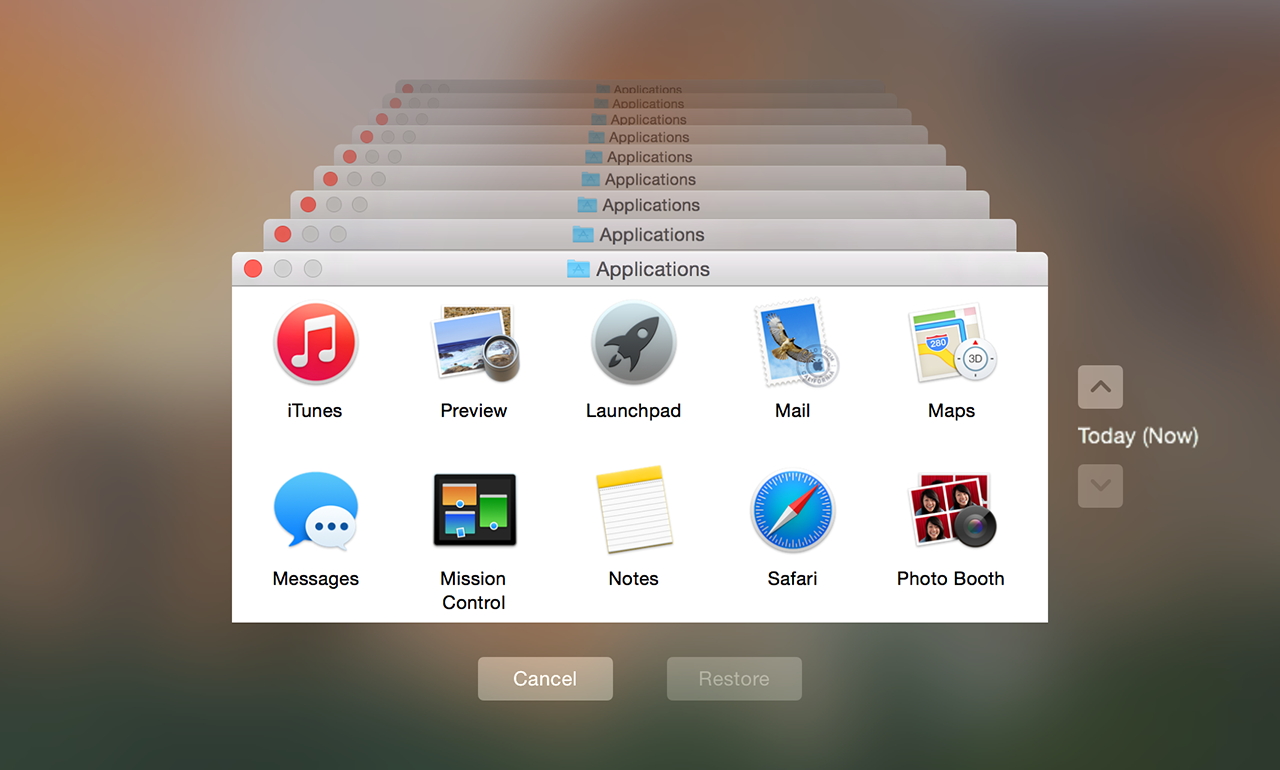
http://cdn.arstechnica.net/wp-content/uploads/2014/10/time-m... | http://cdn.arstechnica.net/reviews/os/mac-os-x-10-5.media/ti...
So moving on, cloud looks like a safer approach to backup because no friction. Yes, data security, etc. From a public service POV, though, for 99% people out there, I bet the trade off is hugely favorable to cloud stockage vs local disk failure.
So now - is iCloud drive sexy enough to want to use it? Actually that's more like the problem, it's definitely not.
One of the things that has always turned me off from OSX is how it looks. I must say Yosemite is the first mac OS that actually looks appealing to me.
Mavericks beachballs on a way faster machine more often than it ever did on snow leopard. I miss that os.
I used Xubuntu or Fedora (dev), Windows 7 (Office), and OS X (XCode) for hours every day for years. I had two self-built machines running Linux, a laptop and a self-built machine running Win 7, and OS X running on a Mac Mini and later a MBA.
Since then, I've also had another desktop and a laptop running Win 7 and Win 8 (though enough coworkers use GDocs now that I've stopped using Windows at all).
Both Linux distros and all OS X versions (from Snow Leopard to Mavericks) have crashed countless times on me. How much they crashed has varied a lot between setups.
Windows hasn't crashed for me (or any of my friends or relatives for whom I'm their IT guy) since Vista came out. It's also never crashed on my old Mac Mini, which is my HTPC setup now.
Whatever you think about the finished products or companies behind them, it's really just a matter of testing and incentives. Windows 8 was tested for 1.2 billion hours before it was released, for example. Microsoft can do things slowly, but when they release something, it has to be rock-solid for their enterprise customers.
OS X, for Apple, isn't a moneymaker and its stability/security obviously isn't much of a priority. They didn't even give it a significant design refresh in years. That's how little they care about it.
The latest version of Ubuntu's desktop edition will ship with at least one head-slapping, show-stopping bug, even though it has a company backing it.
That said, in my experience that means it's caught up with OS X. I've had maybe one kernel panic in years and that was caused by a VMware driver bug. This has been true for most people I know.
The only people I know who have problems are either the ones who install a ton of low-level extensions (Windows or Mac) or a couple of Linux laptop users faced with the option of either having really slow GL performance or using indifferently maintained binary blob drivers.
But your argument holds, stable, well tested, non-fancy software is the way to go regarding stability.
Yes my OS might be boring and my Desktop UI looks like 1999 but I can say in good faith that my system never crashed on me.
[1] http://www.microsoft.com/whdc/images/device/wddm_timeout.gif
On Friday when I went to reboot, after coming back up it spun overnight without finishing the boot. That started a process which took three days to get Internet Recovery working, restore from Time Machine and then upgrade to Yosemite and finally ditch that awful beta. Absolute waste of time and when I could least afford it.
The long saving times and visual glitches have disappeared with the full Yosemite by the way. Phew!
As for I/O, last time I checked, the Recent Documents list is actually being loaded on a background thread, but the main thread is where the UI for it has to be populated. Normally the list would be loaded before the main thread goes to access it, but when the load is blocked by e.g. my NAS waking up, the main thread ends up waiting on a semaphore.
It is rather unfortunate, since nothing I'm doing actually needs to see the recent documents list. And if you're going to say that the main thread should be able to simply indicate that it's still loading, and refresh the list when the load finishes, then I completely agree. But I would not be surprised to find that the relevant code here is many years old, possibly written in C, with no maintainers, and not having been touched in those many years, so there's probably little chance of it being fixed :/
My previous MBP went ~2 years of very heavy use without a single crash, and my 2012 MBA has only crashed once, right after I installed google hangout stuff.
kextstat | grep -iv apple
http://appleinsider.com/articles/14/05/13/apple-remains-mum-...
http://www.macrumors.com/2014/08/21/lawsuit-2011-macbook-pro...
Apple should have issued a recall and replacement program for this early 2011 MacBook Pro GPU defect a long while ago and now it's come to this.
I don't think Steve Jobs would call the impending lawsuit bad luck, he'd call it bad karma.
It's still much too long to go without a computer, but it's worth it when you realise you've been coding for three hours and haven't lost a single line of code to a crash.
That being said, before I got the part replaced, upgrading to... was it snow leopard? the latest version of OS X, anyway, increased the frequency of the issue by rather a lot. So, possibly, hold off on your update?
I've looked into this a bit more and it looks like my comment is entirely unhelpful: mine is a mid-2010 MBP, so while our issues look similar, they probably are not. Sorry about that, I should have checked before.
I think I went through two MBPr 15" machines before I got one that didn't have the problem. I still think it's possible some software I had was triggering it initially, but once it happened a few times, even a clean install with nothing on it could trigger it. Was very frustrating.
I wonder if the most recent VMWare version would help.
Apple has a bigger problem where they're popular enough that every release has a ton of people who post subjective problem reports but rarely provide repeatable benchmarks or failures. They're definitely not perfect but if you see a report which doesn't have a specific test with the exact steps needed to duplicate it, it's wise to assume it's an urban legend.
It'd be educational if someone like Apple or Microsoft shipped an update which changed only the version number and then recorded feedback, particularly since there would be e.g. some percentage of people who had something like a recent hardware problem which they hadn't noticed and assumed was caused by the update.
I'm sure I'm missing one but I can't remember any OSX release being associated with performance complaints.
From windows XP to 7, the windows default themes and colors where disturbingly flashy and "in your face". OSX was more bland but aqua was still kitch and unneedingly strippy. iOS6 app's ultra textured or "realistic" interfaces were the peak of that trend IMO.
In the real world, not everyone likes kids playroom colors, nor grandma's 60s style wallpaper, nor steam punky design, nor green-blue metalic robot parts. Personally I like MUJI style clean and clear design, and I feel like it took that much time to have a core of people to value cleanness and simplicity in computer UI design as well.
I'm sure there have been at least some regressions in some aspects of some user performance measurements, but it seems really clear at this point that it hasn't been a catastrophe… or even a significant problem.
Also, it's a bit much suggesting that it's flat design that's what's responsible for smartphone uptake. If that was the case, then hell, it was skeuomorphism that exploded the market in the first place.
It's not like we're abandoning everything, it's more about discovering new ways of doing things and then mix and matching until we get to something useful and coherent.
This explicitly states that your warrantee for this very specific issue is extended to 3 years after date of purchase. I doubt you purchased a 2010 MBP in 2012...
Still, if this looks like what you're experiencing, get a genius bar appointment. It's free, and they have an automated diagnostic system that detects this specific issue (and others). If it's the same one, you might be able to talk yourself into a free replacement.
"I managed to fix this by going to the Virtual Machine Settings, clicking Advanced, and then checking the "Pass power status to VM" checkbox."
Haven't tested extensively, but I haven't had a crash in the past day.