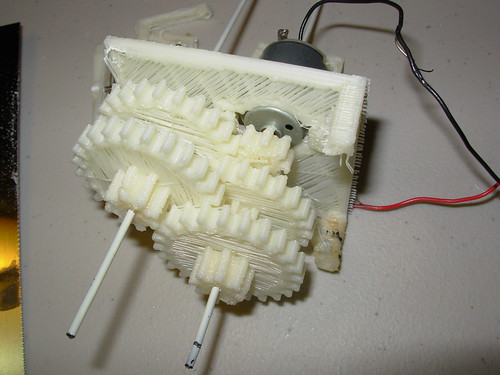
Underactuated Rotor for Simple Micro Air Vehicles(modlabupenn.org) |
Underactuated Rotor for Simple Micro Air Vehicles(modlabupenn.org) |
Really cool video on the mechanical ignition timing control in a delorean to control emissions. Explanation of ignition advance at the end: https://www.youtube.com/watch?v=ge1GwepqtK0
"How about we just add a simple device that associates the pitch of the blade with the torque, and let a computer figure out how to spin the motor to get the pitch we want? No linkage!"
Yeah, that is dang clever.
I assume you mean the motor rotation angle. It's probably not a brush motor, but a 3-phase synchronous motor. That means instead of having a commutator to apply the voltage to the coils, a computer switches some FETs to apply the voltage. In the simplest case, the rotor is assumed to follow the applied voltage waveforms. In a more typical system, the rotor position is estimated from the applied phase voltages and measured currents (usually via PLL or a sliding mode observer).
If you mean "how do they determine the blade pitch?" then the answer is that they don't need to. The controller - weather that's a computer with inertial sensors, or a person watching it - will just manipulate the amount of torque variation until it gets the response that it wants from the copter. Much like you don't actually need feedback of your cars gas pedal position so long as you have vehicle speed feedback.
This means either including a crankshaft and optionally a system of gears to route the rotational power along the axes you want the rotation in, or ducting the output of a jet turbine in some way that drives the rotors. In addition, there are different limitations with regards to the time required for a given change in RPM as compared to an electrical motor.
My impression is that a lot of the complexity in conventional helicopters (and flying machines in general) stems from the limitations of combustion engines. There's a reason that you very rarely see vectored thrust in conventional airplanes, for example.
Of course, if batteries and electric motors become sufficiently powerful, this changes the dynamic and it will become possible to design electric aircraft that re-evaluate the traditional design restrictions. This is one of the reasons that the rapid progress of electric cars is so exciting.
With full sized helis, it takes a long time to spin up the rotors to speed before the pitch is changed to take off.
I don't see a specific reason why this wouldn't scale. I do wonder what changes in load do to the system though. If it can't handle changing loads without messing up the blade dynamics, it would only work for fixed payload systems like camera platforms.
http://www.smithsonianmag.com/videos/category/history/the-se...
Directional control is achieved by leaning, the gyroscopic forces from the dual rotating blades creates inherent stability without any feedback system. They are like segways of the sky. Reports say it only took 20 minutes for a non pilot to learn how to fly it. These machines are incrdible and I don't understand why more hasn't been done with them.
A late 1970's version called the williams x jet WASP added a cruise missle turbojet for more horsepower, and was coined the "flying pulpit".
People here might also be interested in the Mosquito Air helicopter as well. It falls into this ultralight classification and is a kit you can build in 200-300 hours. It costs about $30,000...
I'm not a mechanical engineer, though.
In a way this is similar: they start with two actuators that seem very limited in what they can accomplish: you can only speed them up and down. By modulating the speed of both motors in sync, they are able to control that cheap rotor mechanism they came up with, achieving 6DoF [3]
1: http://en.wikipedia.org/wiki/Pulse-width_modulation
It's a cool idea. Human size helicopters would love to avoid all that blade-pitch complexity. :)
[1] an axially-symmetric imaging system could compensate easily, e.g. a panoramic system.
The issue when flying is that they balance as if they are on a ball. You need to constantly adjust the controls to stop from "falling off the ball". Go the wrong direction and you speed up the rate at which it falls. When it is facing away from you, that's not very hard. When it is facing towards you everything is backwards. When you are turning, the correct direction to stay balanced is constantly changing.
Automated systems can do this automatically for you though, so a drone-like autopilot in a standard helicopter could make them as easy to fly as quadcopters. Traditional helicopters are still mechanically complex though. This system looks to fix that. And this would be more efficient than a multirotor.
I'm currently on a quest to design highly functional robots that can be made with just a 3D printer and a minimum of external parts - so far only bearings, motors, drive belts, batteries and electronics are the non-printed parts needed. I make everything so that it fits together by interlocking or with minimal use of some coarse printed fasteners.
Since nothing needs to be bought from the store that won't be useful if the design changes, it is trivial to iterate and build a newer version.
My hope is that with developers worldwide working on improvements, injection molded versions of the parts would become obsolete before the mold was even cut.
When it comes to manufacturing, 3D printing is a whole different ballgame. No other manufacturing technique can make so many complex parts without human intervention. This means it opens up all new possibilities for how we manufacture things - like continuous iteration of shipping hardware.
Injection moulding is only lower cost when you want to buy something that is already mass manufactured or millions of identical things. Up to about 10,000 units, 3d printing is cheaper.
Experiment and explore without the wait for Mr. FedEx.
These other components look printable too. Right now I am making 3D printable robots that don't need any non-printed parts aside from motors, bearings, and drive belts (and batteries and electronics).
So these definitely should be printable at home.
Locomotives need lots and lots of torque at zero and low speeds. This would otherwise necessitate a huge transmission. Plus, the weight penalty for a train locomotive isn't nearly as severe as it is for any kind of flying craft.
Other commenters have mentioned a hybrid system, with a relatively small electric motor that generates just the instantaneous torque changes needed for the control system, but the majority of the power is supplied via direct mechanical linkage as in today's helicopters. That might be viable, but I'm not sure. The weight and complexity penalty for the old control scheme isn't so bad when scaled up, but is really bad when scaled down.
So a hybrid scheme (like in a Prius) might be practical, by my estimation.
The 3D printed robots will be for some tutorials we will be launching. Other than that, I've been continually procrastinating about making a website for my personal projects, but I have a lot. If you dig through my youtube account at the original link, I have some other project videos there.
Notable ones are: The robot I made when I was in High School: https://www.youtube.com/watch?v=8FJu1eL_dYs&list=UUxTluifYa_...
An app to interface with some cheap helicopter joysticks (and not shown - I could fly the heli with an app on my phone). https://www.youtube.com/watch?v=gq2x3DVq7gs&list=UUxTluifYa_...
Lighting a campfire with thermite: https://www.youtube.com/watch?v=7pu-R_IHirE&list=UUxTluifYa_...
A demo sketch I made for 3D printers: https://www.youtube.com/watch?v=KEH7Ji4a3Ss&list=UUxTluifYa_...
The time I was on G4 TechTV: https://www.youtube.com/watch?v=J2R-TlBomnQ&list=UUxTluifYa_...
My stuff on thingiverse. http://www.thingiverse.com/tlalexander/designs
Not currently represented online are some of the robots I have made, the Tesla Coil I made when I was in High School, and the gas powered hovercraft I made in 8th grade. :)
For typical FDM/FFM printers like the hobby ones you see everywhere, there are chemicals that can be used to smooth the print out.
I use my parts for robot prototypes where the function of the part is more important than cosmetics, so I don't worry about the grain. If I want a nice part though, I can use very fine layers.
as a side note, this looks like kind of a cool way to smooth pla prints, for which up till now there wasn't really a great option.
http://hackaday.com/2013/02/26/giving-3d-printed-parts-a-shi...
So at 0 degrees, increasing torque will, say, increase pitch of the "right-hand" blade while decreasing pitch of the "left-hand" one. But at 180 degrees it will be the opposite. This has the presumably beneficial effect of allowing the craft to climb by simply increasing rotor speed steadily (it will "wobble" a bit but in a spiral fashion which will let it climb without too much inefficiency). Put another way, this means that increasing torque at 0 degrees but decreasing it at 180 degrees allows an asymmetrical pitch to be maintained at a rotational speed which can be seen as constant (over the long term).
In other words, your intuition falls down because the mechanism is not as symmetrical as your brain wants it to be at first glance. Symmetry is an intuitive and attractive for mechanical systems, but it is actually limiting in many cases, and this is a great example.
------/ || /------
When the rotor applies more torque than the current angular momentum of the blades, the blades lag behind the central hub, pushing them the same direction against their hinges. On one side, that increases the blade pitch. On the opposite side, it decreases the blade pitch. The motor could also apply a slight braking force, to pitch the blades in the opposite direction.
The flight computer determines the correct timing at which to apply more oomph to the drive motor, which translates to the same effect as a mechanical swashplate due to the angled pins. The total energy imparted to the blades over a single rotation remains the same as with a motor operating at constant torque.
One disadvantage is that you will need a motor that is capable of applying more maximum torque, because you won't be running it at 100% all the time, but with a sinusoidal power level that will go both above and below that steady level. The other disadvantage is complexity in the computer controlling the motor. The advantage is mechanical simplicity.
It's a great solution for reducing mechanical complexity in mini/micro sized UAVs, though.
The added cost of batteries at even today's prices could be worth it for the decreased mechanical complexity of the rest.
If all we need to do is change the torque of an electric motor, that can be done essentially instantaneously even at high power levels.
Power storage may continue to improve, but it will take a long time before you hit the energy density of fossil fuels; the difference between batteries and fossil fuels is something like a factor of 10 (actually greater than that, but electric motors are more efficient so let's say 10 for the sake of argument), and it's improving much more slowly than Moore's Law, doubling maybe once every 10 years. That means if those trends continue (and there's no guarantee they will), you're looking at 30-40 years before the energy density allows electric helicopters to be competitive with fossil fuel powered.
For cars, energy density isn't quite as important, as the weight of the car is not the dominant factor in its efficiency (it does have an effect, but the aerodynamics, engine efficiency, transmission efficiency, tires, etc. all make a big difference too). But for a helicopter, every pound you add to the batteries is another pound you have to lift, so energy density of your power source is quite important.
So, if trends hold on battery technologies, it will come about eventually; but I would put money more on the decades timeline than the years timeline.
This is a material science question. A material may exist that has the right combination of flex, strength and lets also not forget durability. I am a mechanical engineer and crack propagation and cycle fatigue would be a major concern for a joint like that at large loads. There are all kinds of amazing tricks material scientists know how to play to combat these types of problem.
I think this could be scaled up if material to make those flexure joints exist.
With a regenerative approach, you'd probably need very little net electric power.
How do you define "terrible precision"? Is there a fixed scale in which precision goes from "terrible" to "okay" to "very good" to "excellent"?
If I'm building a telescope mirror, I guess I just ask the manufacturer for "excellent" precision, and they know what to do?
How do you classify "better results"? It is the smoothness of the part, the strength, or the cost at 5, 50, or 100,000 units? Why do resin casting when I can do lost wax casting?
Can you tell me, which manufacturing method is the best?
Oh sorry, we haven't talked about what we're making yet. Seems any discussion of tools to fabricate things is senseless until we've established what we want to make.
I'm designing a robot anyone can make at home. I mean actually, that is what I am doing as I type this comment. (well, I was designing it. It's printing now.). I want a robot that can be customized by the user. I want it to be as cheap as possible for someone who does not have access to anything more than basic electronics and a 3D printer. I want people to be able to design upgrades and test them.
Do you think I should design it so I can CNC molds that I use for resin casting? That is, after all, what you suggested.
But then, when I CNC something it takes a loooong time. First, I would design a part completely differently if I was going to CNC it versus print it. And if I was going to CNC a mold for casting, I would design it a third way still. If I am going to CNC a mold, I need to figure out where the parting line will be, and how all the molds will fit together. Some parts are impossible to cast, so I have to make sure not to design the part so as to be impossible to make with my chosen method.
Once I decide to CNC a mold, I need to source raw material that is as big as my part, but not so big that I waste a lot of material. I'll need some way to grab it in the CNC machine, so typically I choose material a little taller than my part. Ultimately it depends on how I specifically choose to make this part, and isn't strictly defined by the part's size or function.
To order raw material, if it was on short notice, I would need to go to the material store. In silicon valley across from the Fry's off Brokaw there is a place called Campbell Metal. Campbell metal is a large warehouse full of people and metals. The metals are sorted by size, shape, and length, and the people who work there tend to those materials - taking orders from the front office and cutting short pieces out of long bars. The cost of my material includes the cost of living of those people and the cost of the overhead for the large warehouse all that material is in.
Once that material is on order, I would need to program the machine to make the part. That involves figuring out the steps in order that I will use to take that raw block of material and turn it into my part. Simple parts may have 2 or fewer steps. Most have at least 3. Each one is a separate program. Once I've manually defined the toolpaths to use to make the CNC machine hollow out a block of steel or aluminum, including choosing how to send the tool into the metal, how fast to spin it, how quickly to move it, what depth and width of the tool should make a cut, I can begin to set up the machine to cut the first step. This involves taking all the right tools from the shelf, out of hundreds of possible tools, and loading them into one of the 24 tool pockets on our machine.
The machine, a HAAS VF-2SS, cost my employer around $90k. They sell a couple million dollars a year in custom made tools, so they could afford to pay this off over 5 years. I was pretty lucky to get my hands on that every day.
I could go on about the casting (get a scale, mix up material by weight, cast it), but I hope you see my point.
There is no "best" technique for "makin stuff", because every part is different. When I designed a waterproof housing that was sent 3km underwater to deal with the Deepwater Horizon oil spill, it was made from super thick aluminum with steel reinforcement. But when I designed the power button for our custom android tablet, which included software I wrote to help lift a nuclear cooling tower, I used dinky Delrin plastic for the part. There is no one best material either.
3D printed parts have certain properties. 3D printers have some limits. But what they lack in quality they often make up for in simplicity. If I had decided to print the part above instead of cast it, I'd have just made sure the thing was full and then hit "print". When I need to change something about the design, like I did this morning, I repeat that process. Iteration is a million times easier with 3D printers, which means designers can spend more time refining their parts.
For the robot I am designing, anyone with a 3D printer and the most basic of electronics can build a robot. I know where 3D printers are strong and where they are weak, so I design my parts to take that into account. They are chunky, and I leave a lot of room for the wide tolerance of home printers, but the parts work.
My 3D printer, when poorly adjusted like it is now, can hold maybe 0.040" of tolerance on a part. When I worked at the machine shop, my day to day realm was within 0.005" tolerance. On a critical part like a bearing seat, we'd add another zero to that. But there are guys making semiconductors with moving parts like DLP chips that would laugh at those tolerances. Even the guys cutting gears on their worst day would have bested my best try, because our basic $90k CNC machines had laughable quality compared to the "real" stuff.
Everything is relative. Even hand carved bricks can build a pyramid - with the right designer.
With that said, I don’t think you looked at the resource I linked, which has some great advice for using a CNC mill to make high-precision parts via resin casting. Nothing in its advised method involves milling metal. The design involved might be slightly more difficult than designing parts for 3d-printing, but it’s not inordinately more difficult.
I personally find home-3d-printed parts to be very slow to print, expensive to print, ugly, brittle, and entirely ineffective for many things I’d want to do with them (art projects, mechanisms, housings for electronics projects, small pieces of furniture, etc. etc.). Everyone I know who has tried to do 3D printing at home spent much more time fixing and babysitting their machine than actually making stuff (and most were ultimately unsatisfied with the quality of their prints). The process is by no means “simple”.
- For a one-off part, it’s often possible to directly CNC mill something out of plastic, wood, or some other material that is vastly superior in quality and can be made just as fast or faster than a 3d-printed part.
- For trickier shapes or stuff you’re making multiple copies of, the resin casting process in the link above should often be pretty effective. Compare https://farm5.staticflickr.com/4049/4501639683_37351127de_o.... to http://farm4.static.flickr.com/3487/3703543046_b9588e64b6.jp... or for a detailed point-by-point comparison see http://lcamtuf.coredump.cx/gcnc/ch1/
- Sometimes a few flat pieces of wood, sheet metal, or acrylic cut on a laser cutter or waterjet, or using manually operated tools is a better option than CNC milling something.
- For certain other parts, I’ve seen reasonable results ordering from Shapeways or some similar place.
There might well be particular cases where home 3d printing is the best answer, but nothing that I’ve personally run into.
In any event, do whatever works for you!
As to materials, literally, every month, there are new materials coming out. At this point, I can use my desktop reprap to print ceramics, PET, Nylon, ABS (to just name a few), and all sorts of hybrids/specific compounds of these plastics designed for 3d printing. Nylon, PET, ABS are good enough for probably ~90% (very rough guess, sorry) of most of the plastic products in your home, it's probably good enough for most of the products I (and many others want to make).
As to precision, that's also quite wrong. The printers are quite precise. They're not as precise as the $75,000 CNC Mill that will get me .001" accuracy, but the truth is that most people don't even need .01" accuracy. And my printer cost me $500, quite a large cost premium there in terms of accuracy (ignoring the importance of cutting metal at this time).
As to doing CNC at home. Even a quite crappy homemade CNC mill, built on a real "mill"(something like a g0704) (not the laughable (to me) desktop mills that have come out recently, which are glorified dremels using similar methods of driving the axis' as a 3d printer, which you can cut aluminum at atrociously slow rates) is going to cost you at least $3000 (machine tools are expensive, not just because of the actual mill, but all the tool holders, bits, cutters, precision vises, calipers, etc. etc. that you also need to make it useful). So yes, a CNC mill is great for alot of things, but that homemade CNC mill isn't really going to hold .001 accuracy either, unless you spend a lot of time working on it and you really know what you're doing.
I'm not going to continue on with this argument, but it seems like your view of 3d printers and CNC milling is quite naive.
You are quite right that the cost of operation is quite a bit higher though. Bits, collets, spindles, etc really add up. Even with wood, all the tooling is made of solid carbide.
subtractive machining has its benefits though. While printing can make some unattainable shapes, subtractive machining gives a nicer variety of materials, and can be faster.
as to the more mature technology now, CNC definitely has 3D printing beaten, at both scale and precision. Hopefully soon, we'll be able to 3D print carbon fiber parts and then we'll have a real 3d printing boom.
I guess we’re done here then.
But while prices on CNC mills are getting cheaper, I'd argue that they aren't declining in price the way that 3d printers are (my reprap cost me $400, my makerbot clone $550). A mini-mill still costs more than it did 10 years ago, with very little improvements to what it does (better motors, electronics, that's about it.)
But to put it simply, I agree with you. Subtractive machining has it's place for sure, but so does 3d printing. But to say that 3d printing sucks, period, is just silly and ignores all the benefits that 3d printing provides. I believe in using the right tool for the job. Sometimes that's old school machining, some times it's 3d printing.
I'll add two quick, somewhat off topic points. It's now (apparently at least, according to GE) easier for them to additive manufacture turbine blades made out of inconel than it is to subtractive manufacture them. I've never had to machine inconel, but from what I've heard, it's quite the difficult thing to do, and most places that machine it, try to cast the part as close to net as possible to make as little machining as possible to do so. But this is something that truly shows the advantages of 3d printing that (might) be better than the traditional way of machining.
The other anecdote is my own. The other day, I was making a part, and for shits and giggles, I took the blueprints, made the part in CAD, printed it out on my 3d printer, and just the act of holding it in my hand and looking at it really helped me think about how to go about machining it out of steel. Most people think "On, CNC is easy, you just throw the file on the machine and it makes the part." It's not that easy, and I was just doing this part on a manual machine. But having that part in my hand really helped me make better decisions on how to best machine the part itself. I thought that was a neat little aspect of 3d printing that I would have never even thought of using it for.
1) I am very aware that machining and casting makes higher quality parts. My point is that for all mechanisms there comes a point where the quality is "good enough".
2) The printed gears you linked to have abysmal quality. My 3 year old printer has made vastly superior parts. See this thingiverse part, with many high quality print examples from home printers: http://www.thingiverse.com/make:17409
I also used to be of the opinion that CNC machining was so superior as to render 3D printing useless. I looked at those stringy prints and said it would never be useful. But then, I slogged for years making CNC machined parts (see some examples of my parts here: http://www.tlalexander.com/files/portfolio.pdf ) and eventually decided to buy a 3D printer. I make more stuff now than I ever did when I had daily access to a CNC.
But as far as quality - notice how that stringy gearbox you linked to still seems to work? Sure, one is more photogenic, but the goal of a gearbox is to transmit power not win a beauty contents. Meanwhile I have been using a printed gear on my 3D printer's extrusion system for over 2 years with no sign of failure. The application is low speed but medium torque, and I see no wear or signs of weakening. The printed gear satisfied the requirements of the mechanism.
When I think of 3D printing, it reminds me of manufacturing in the 1940's. Parts were clunkier then, like the seat hinge on an old Volkswagen Beetle. But clunky works - often better. Newer techniques might make smaller hinges, but the one from the old beetle still works well. Sometimes higher quality isn't necessary to make something. A designer may choose to make something clunkier so that it can be made at home on a basic printer.
Another example- I use this coat rack and lamp mount every day: http://www.thingiverse.com/thing:16485
My long rant about CNC machining was meant to highlight the huge amount of labor involved in machining things. It takes a lot of human skill to write a CNC program (I do expect that to eventually change though) and more labor to set up the machine to get the first part made. In the time it would take me to CNC something I can print a part while I eat a sandwich or run some errands.
Of course 3D prints are slow to produce, but that is counteracted by the fact that it takes less of my involvement to get the parts made. It takes less overall effort to produce a part by print than by machining.
I mentioned metal but the entire story I wrote applies to plastic machining as well - just replace "Campbell Metal" with "Professional Plastics". They're both across from the Fry's off Brokaw.
I totally don't expect most people to have "run into" a time where home 3D printing is best, but you can still do thought experiments. 3D printing is far more accessible to most people than CNC machining is. As home machines get better and we gain more critical mass of users, we will see more designers who take advantage of the stuff that can be made at home. That's what I'm doing with 3D printable robots, and luckily I have a good intersection between people who want to make robots and people who own a 3D printer.
I would say the two key differences between 3D printing and machining is that 3D printing takes zero skill to operate and zero or near-zero labor. Not all home machines have delivered on the ease of use promise of course, but that is an issue with the machines, not the process.
My point is, no other manufacturing technique is well-suited for use at home aside from perhaps laser cutting. The value in printing is of course not the quality of the parts, but the fact that it is a type of manufacturing accessible to consumers. Imagine if Dyson provided printable replacement parts for example, and you can begin to see the value.
Every manufacturing technique has trade offs. A single print takes longer than machining a single part, but with less set-up. Time to first part can often be lower on a 3D printer.
In this newfangled bird, we use some combination of GPS sensors, an input which is presumably a touchscreen (with all the associated latency, plus wireless), and a speed controller which has to adjust multiple times per revolution of the rotors. For some information on why this is tricky, start here: http://en.wikipedia.org/wiki/Nyquist_frequency