Tesla Motors Announces a New Home Battery(offgridquest.com) |
Tesla Motors Announces a New Home Battery(offgridquest.com) |
I recall Apple made some purchases or investments in these products.
House-sized UPS systems are a thing. An expensive thing, mind you, though I don't know how expensive.
1.) Whole house UPS 2.) A way to take advantage of significantly lower night time electric rates.
TANSTAAFL
https://duckduckgo.com/?q=lithium+pond+photos&iax=1&ia=image...
Mining is mining. There isn't a "green" form. Tearing holes in the earth is not the worst ecological damage or the great health risk. The big problem is the water...and it will run downhill from the Andes and wherever else Lithium is mined and into the Ocean.
    The house off the grid is built on
    industrial infrastructure.
The house off the grid is built on
industrial infrastructure.
I helped my parents build their off-the-grid house. It's solar-powered, but uses batteries for backup storage. It collects and filters rainwater, recycles and purifies its own sewage, and is made mostly of recycled materials (in the style of what's called an "Earthship," but with a more traditional, house-like form factor).
Did industrial infrastructure come into play? Of course. We used cars and trucks to get stuff there to build with. We used machines and materials produced in the modern world. What difference could that possibly make? The house is still much less ecologically destructive than the vast majority of dwellings worldwide, both in terms of ongoing damage and initial construction.
It's possible to create buildings today which get all their electricity from the sun; which require no industrial infrastructure at all for sewage, heat, or clean water; and which cost much, much less than earlier housing models. That's an amazing improvement.
All tech's based to some degree on tech which came before.
The isn't even close to being true. The majority of dwellings worldwide lack what you would call basic utilities and are constructed using local materials, many of which are recycled.
Perhaps you meant the West?
Even then, it's not true. Solar panels, batteries, modern insulation, etc ... these create a ton of pollution during manufacture. Not to mention drilling wells and installing septic tanks as opposed to hooking up to public utilities.
The fact that lithium batteries aren't the greenest combined with the fact that you can't even live 'off the grid' in a grid tied system is a big uphill for these batteries.
A solar panel installer told me that if I add a battery backup to my installation, then at least it'll still charge the batteries during a power outage.
Another group of people who are protected are firefighters. In a typical residential installation the power meter also serves as the service disconnect. Response protocols include pulling the meter before many other life saving and property preserving operations. Live equipment and conductors operating from a second source downstream of the meter are a serious hazard to fire fighting personnel.
Solar panels are a particular hazard because the sun doesn't have a disconnect, many firefighting operations involve working on the roof, and fire burns upward. A collapsed roof may bring a tangle of live electrical parts down into the building and create a hazard that persists long after the fire has been suppressed.
In addition, miscellaneous loads applied to a grid can bring it down. In the Northeast US, much of the infrastructure is old and therefore less robustly engineered than elsewhere.
http://en.wikipedia.org/wiki/Islanding
http://en.wikipedia.org/wiki/IEEE_1547
https://www.google.com/?gws_rd=ssl#q=ul1741+pdf
...if you wanted to power your house from a battery-fed inverter you'd have to install an automatic transfer switch, just like if you had a back-up generator.
http://en.wikipedia.org/wiki/Transfer_switch
http://powerequipment.honda.com/generators/connecting-a-gene...
What is the difference between Battery backup and a wind turbine/solar? Somehow you are allowed to have solar and pump back to the grid, but not battery, geee wonder why that is.
Surely there is some safe way of preventing this?
If I were an electrical worked I'd treat a power line like it was live regardless of whether there is a power outage or not.
I can't find any references for your stated claim about Connecticut, however it seems deeply illogical given that a generator (which surely aren't banned), solar panels, wind, etc, all have the potential of feeding energy back to the grid in an outage. Which is why there are regulations and home inspections and all of that, to ensure that the appropriate safeties and switches are in place. Simply banning one of many possible mechanisms of generating power would be very short sighted.
Many regions that offer feed-in time-of-day tariffs are rightly trying to figure out how to accommodate battery systems, where some users are trying to game the system by charging a big battery array during low cost hours, and then "selling" it back to the grid during peak hours (at inflated, subsidized prices).
EDIT: As a reply to msandford, given that I can't reply lower -- the reason they have this limit is that the tariff price paid to home solar/wind generators is way above the bulk, "wholesale" price of power. It was created as an incentive to encourage green energy. So when you feed back their own power to them, it does them no favor given that now they're paying 2x+ what they would pay on the normal power market for power, and simply undermines the entire incentive program.
No, it's not permanently "off the grid" as it depends utterly on the whole industrial infrastructure, but it not continually tied to the grid like a power line running to a coal-fired power station.
You can't get any energy out of a battery until you put energy in ... alas more in than out per the laws of thermodynamics.
People Like to Make Up Abbreviations That Take More Explanation Than Just Spelling it Out Would.
SMH.
You can double-click almost any abbreviation (or any other word) and get a definition.
Except for the geography which prevents that from happening and is why that area has giant salt flats:
The rumor is they're about to tear it up for a Lithium mine :(
[1] http://theroadchoseme.com/the-uyuni-salt-flats-to-chile-1
- $/Wh
- number of cycles
- ability to be recycled at eol
- loss of capacity over the lifetime of the battery (or beyond!)
- safety
It is easy to beat on
- power density
- weight
- maintenance
- mechanical stability (especially for fluid based cells)
- installation cost (lead/acid requires a sealed enclosure venting to the outside to get rid of free oxygen and hydrogen)
The same batteries that work well for automotive applications will not do that well when you're building a storage cell for a house.
Lithium-ion does not have a whole lot of edge over lead-acid deep cycle gel cells when it comes to stationary applications.
The biggest issue with Lead-acid is that if you don't water them (if you use fluid based cells rather than gel based cells) that sulfur bridges can grow between the plates causing a cell to be shorted out. Gel based cells don't have that problem and are common in deep discharge setups.
So even if he sells these batteries at the break even point, he'll still get much closer to an economically viable Model 3, because the battery is such an expensive part in an electric car and this will bring the price of batteries down.
(I'm not sure if my reasoning makes sense though, because the Gigafactory isn't anywhere near finished yet, and according to wikipedia it won't hit full capacity until 2020.)
I'd love to have a battery like this to store excess power from solar panels. Returning power to the grid is a waste in both efficiency and money (you just make the power company richer).
Unless you live in Germany (where there are laws forcing power companies to buy excess energy back against peak price), a battery should be the way to go.
If these obstacles were overcome, almost everything in my house could run on DC. Most stuff either converts to DC internally, or doesn't care.
However, I don't know much about the details of battery technology, so I could be completely wrong. If traditional technologies such as lead-acid were up to the task, then someone would have already made a big business out of using them. Does that make sense?
Some day I want to look into the feasibility/advisability of a continuous automatic feed of distilled water to keep iron nickel batteries constantly topped off, and a hydrogen outgas capture mechanism (preferably passive) which takes that output of the iron nickel batteries and feeds it as the input into a hydrogen cell.
It think it will be the later one. Elon is just thinking ahead. There is nothing really new in this story. Everything is just made up. It is quite accepted within the industry, that when the car battery has a capacity of less than 70% to 80% it needs to be replaced. But what should the car company, in this case Tesla, should do with battery? Of course, it will be re-packaged and as such repurposed for other use. What other use case is there? The other use case is Solar, especially as his friend runs a Solar company. What in incident.
A big issue is that you don't get that many charge cycles, especially with lithium-based batteries. So, filling up the battery with solar power during the day, then running your house from the battery in the evening, will soon fall to pieces if the battery doesn't last a decent number of years.
Right now, if there's a storm or what have you you can lose your heat, your power, your water - everything. Its a bit like the mainfraime/terminal days - everything is centralized, and represent single points of failure for the citizens it serves.
But with energy you create yourself, and things like water recycling or indoor farms, we could go fairly far in self-sustaining units. And instead of the grid, there could be local community sharing so if your power/water goes out you can pull from a local grid. It doesn't need to be in every home, but something more distributed means more resiliency in the system overall, and thats handy in a lot of scenarios.
All that's a ways away though - but making the energy storage better / cheaper is an important step.
But I'm curious of the environmental factors in battery production / lifetime / recycling, can anyone comment on the impact these batteries represent?
Sticking the panel in a closet doesn't work, because it generally violates codes twice, once for the fact that all the clothes/random junk in the closet blocks access to the panel, and a second time for the fact that even empty, most closets don't provide sufficient clearance all around the panel to meet code requirements.
If I were building a new house, I'd consider putting the panel on the main floor and just hanging a big painting to hide it (which still violates code, but it's pretty trivial to take down a painting).
The first challenge is to make the operational cost of a solar + battery system less than the cost of buying your power straight from the grid. The second is to include capital costs in that calculation and still come out at break even or ahead.
Governments that lean too heavily on taxes or state run monopolies for energy generation should also be concerned. There are places that tax generation from sources like the wind (for example, Nova Scotia), so I wouldn't be surprised if we see solar tax appear.
Still for home use, I would prefer a large lithium pack to be outside my home.
They're about $20k each, and they only last about 4 years.
The SolarCity Battery field-test uses 10kW Tesla batteries and is leased for $1,500 upfront and $15 per month. So, if the batteries degrade, it's Tesla/SolarCities responsibility to fix or replace them.
The Gigafactory will likely reduce costs significantly.
http://www.theverge.com/2015/2/13/8033691/why-teslas-battery...
Essential problem solved?
http://www.greencarreports.com/news/1096801_tesla-model-s-ba...
It looks like you drank the tesla dealers coolaid:
http://my.teslamotors.com/forum/forums/tesla-model-s-85kw-ba...
Bad luck.
Any of the below projects, should they ever see the light of day (you'd think out of this many, at least one will make it eventually), stands a good chance of being quite superior for this application in just about every way:
http://www.eosenergystorage.com/technology-and-products/
http://www.ambri.com/technology/
http://www.ultrabattery.com/technology/
just look at this homemade battery in some audiophiles basement:
http://6moons.com/industryfeatures/roadtourlivingvoice/3.htm...
You'd have to let it charge up before going driving, but for home owners who don't drive much, that could be very cost effective.
Unless I'm missing some complication?
My ideal setup for this would be something like 20 kW * 7 days. That would fill my basement pretty easily.
Even 30 is pretty damn high. For someone living off grid with a purpose built/renovated structure ~5kwh a day gives you quite a lot to work with.
So based on 5 kW average, your electric bill is… 3650 kWh/mo? That's about 4x the U.S. national average for a household (903 kWh/mo).
Is this correct, or is 5 kW an overestimation?
Now that also provides some additional redundancy so it's not like the other 50% is entirely useless.
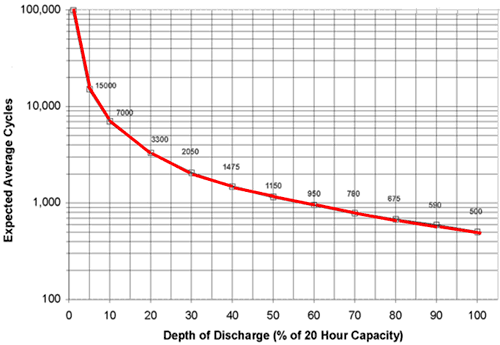
Wow, that's really short, especially with such a shallow discharge pattern.
http://www.mpoweruk.com/images/dod.gif
According to that chart (which is an approximation of course) 1400 cycles corresponds to about a 40% depth of discharge. Which isn't terribly shallow.
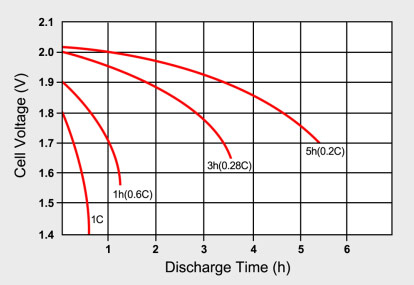
The other variable is the discharge rate, and the higher it is relative to battery capacity the worse the efficiency and also the propensity to fail early. A lot of times doubling the pack size can extend the pack life by more than two because the increased efficiency (the internal resistance is lower) reduces the depth of discharge by more than half.
http://batteryuniversity.com/_img/content/crate1.jpg
Of course it feels totally ridiculous to only use 20% of the nameplate capacity of the system, and much worse than using 40% which you can sort-of rationalize as "half" but if it decreases your dollars per joule, it might be worth it.
EDIT:
I should also mention that if you're constantly charging and discharging and you don't mind a little energy loss you should look at nickel-iron batteries. They're not terribly efficient nor are they cheap in absolute terms but they're basically bulletproof.
http://www.sbsbattery.com/products-services/by-product/batte...
no recommendation on the supplier, but funny thing, the power companies and telcos have already figured this out for reliable DC power :)
Here is an overview of estimated cost for various battery types, does not include LiPo however. http://www.batteryuniversity.com/learn/article/cost_of_power
Pros: Higher energy density, so you don't need much room for the batteries. They don't emit hydrogen when being charged like lead-acid does, so you don't need safety ventilation.
Cons: Not as conveniently recyclable as lead-acid (there's existing infrastructure for this is already in place).
The site isn't coming up for me (neither is google cache) but I'm wondering it they went with LiFePo4 batteries - they have a gentler failure mode than some of the other lithium chemistries.
Field-replaceable laptop batteries are engineered as a consumable, and runtime, weight and charging speed are given priority over long life. Laptops with integrated batteries make a somewhat different tradeoff, but still assume that battery replacement will be a maintenance expense for some users. In both cases, the expected average lifetime of the laptop itself is also a factor, which I'd guess would be about 5 years, max.
Packs for laptops make different tradeoffs vs packs for a car, or home power storage. From memory, based on some back of envelope calculations, tesla trades 15-20% of nominial capacity of the cells in their auto packs for >=4x or greater durability. Packs for home energy storage would probably make similar tradeoffs, and might get more life with less aggressive charging rates.
I live in the Ohio Valley, near Pittsburgh, so we get some of the lowest amount of direct sunlight in the US. I'm not sure if solar is viable in my area yet.
Electricity, on the other hand, has no viable localized option today. It's also the only one of these that has a significant drop in efficiency due to the distribution itself and has a significant impact to the environment.
Local power storage means that grid can balance the load between peak and non-peak times. Also, local power storage means that wind/solar now has a solution for time where power output is reduced.
Having a battery that can power a home for a week is huge, if it's affordable. This could significantly reduce power generation costs.
This is usually less than the efficiency drop involved in a round trip through a battery. It's not as big a factor as you think.
One commonly suggested (and substantially cheaper) option is to just set things up so you don't have local battery storage and just redirect all excess power back to the utility company.
The problem with that has already been mentioned. You're giving power back to the utility company at a fraction of what you purchase electricity for.
But beyond that, as power requirements in appliances / computers / electronic gadgets continues to decrease, and efficiency and capacity of alternative energy solutions continues to increase, there will likely come a time (in the not-too-distant-future) when there will [at least in theory] no longer be a need for utility companies.
In fact, from varied sources online I've gotten the impression that many countries (besides US) have substantially reduced power requirements per household where even today it's feasible (for those with sufficient roof space) to move all of their power usage off grid, and rely strictly on power generated by solar.
That's not a problem, that's how the markets work. When electricity is abundant (i.e. sun is shining, wind is blowing), it's cheap; when it's in demand (in the evening, after the sun and wind stop but people want to cook and watch TV), it's expensive.
The problem with energy storage isn't just a home-problem, it's a network-wide issue. AFAIK, current batteries aren't really able to solve this issue, in the long-term (i.e. considering the lifetime and replacement of the battery).
Not if your region was forced to subscribe to a feed-in-tarriff subsidy scheme for solar. Around here, there was a time when solar generated power earned 10x the value of the same amount of energy purchased from the grid. That multiplier has fallen thankfully, but is still greater than one.
Right now, some locations have laws and/or regulation that force grid companies to buy solar-generated electricity from home owners at fixed rates. This makes a lot of sense right now as a measure to encourage the adoption of solar, as a way to get off fossil fuels. In the long term, it might become a less useful measure, and we might want to allow market mechanisms for time-of-day-based pricing. This is already happening on the big players' market, where you see drops of the spot price of electricity at noon on sunny days. Extending these market mechanisms to individual homes makes sense, as long as home owners are empowered by technology to make use of it.
A large battery is an important piece of such empowering technology (combined with being able to set a smart policy for when to run off the battery, when to run off the grid, and when to feed back into the grid).
The grid will become less reliable over time as utilization increases, and in many cases we have fundamental limitations that make broad-scale robustness difficult to implement.
So fake it out. If I have a reliable local power source, I can easily take short outages without user impact.
Here in Scotland it's the other way round. Orkney is detached from the grid and trying to get itself connected, so it can better balance local renewable generation with the rest of the UK (and thence ultimately the European grid as a whole). Maybe they'll go to municipal batteries but the cost is still not attractive.
- How do battery charge/store/discharge efficiencies compare to transmission losses?
- How do capital investments to support returning power to the grid compare to the cost of batteries?
One thing I'm fairly confident of is that just having batteries (without solar panels) to do peak-flattening temporal "arbitrage" can't make economic sense. If it did, power companies would do it themselves and keep the profit.
They're trialling that right now in the UK: http://www.itv.com/news/anglia/2014-12-15/power-boost-as-big... http://www.edie.net/news/6/Smarter-Network-Storage-Energy-ba...
Because so far batteries have been improving in cost/Ah only very gradually? And generated grid power from fossil fuels has been historically cheap?
You can get power companies in the US to buy your excess energy. The co-op that supplies my power will set up a meter if you have your own power source. If your total usage is less than what you created they will buy the power from you (not the best rate).
They will even give you money back for installing solar cells [1].
Not anymore. The price you get from your power company has been consistently lowered over the last years, now you only get about half of what you pay the power company for the electricity you use.
Many populous U.S. states have net metering, New York and California inclusive.
In rural areas, wind powered battery storage was commonplace 100 years ago.
Perhaps if you bothered to do a little research....
- What devices do you need to supply? Often this is the true governing factor although switching regulators are very efficient and inexpensive up to a few amps. - How much current do you need to supply to a particular location (this depends on the power consumption of what you're running)? - What is the distance from the panel to the point of use? The longer the distance, the greater the voltage drop across a wire of a given size (and the higher the cost of larger wire).
As for connectors, there are only a couple of sensible answers. USB is fine for 5V/1A needs, but you're not going to want to run a bunch of 5V wiring separately from the higher-voltage wiring you're going to need anyway. The proper approach here is something like http://www.powerwerx.com/adapter-cables/usbbuddy-powerpole-1..., which will happily work in either a 12V or 24V nominal system. You can of course make other power supplies from all-in-one ICs like http://www.mouser.com/ProductDetail/RECOM-Power/R-78W90-05/?... and a small project box; larger currents and other voltages are available too, of course. These make good replacements for wall warts.
But you don't want to be wiring any of that in your house; instead, you want to use Anderson Powerpoles in a single-voltage (probably 24V or 48V) system. They are properly rated for DC use at these voltages and plenty of current (up to 350A if you need it, which you won't). They can be installed in blocks of 4 2-blade connectors in standard wall boxes, with neat, professional plates. They can be easily crimped onto appropriate-gauge wire by amateurs. They are code-compatible and safe, unlike the dangerous practice of using receptacles designed for 120VAC or some other existing local/regional standard. They provide a reliable connection and reliable disconnection, and if crimped properly they will not fray, crack, or loosen within a very large number of connect/disconnect cycles. The other low-voltage DC "standard" that is popular, the barrel-type "cigarette lighter" connector, provides only 7A at 12V, is bulky, and does not offer a reliable connection. While it is popular in automotive applications, more serious users of DC power -- the Powerpole is very popular among amateur radio enthusiasts -- avoid the barrel type connectors for these reasons.
The only real decision to make is whether to use 24V or 48V, which will depend primarily on the questions I noted above. Higher voltages are certainly possible, but watch out! Switches rated for higher DC voltages (especially at currents much more than 1 or 2A) are hard to find and expensive. Your standard "AC quiet switch" that you can buy for $2 at the local hardware store is rated for 125V AC ONLY. It is not safe to use with any DC system, although in practice it's probably acceptable for 12V systems at a hundred milliamps or so. For more practical applications, you will need to be sure that your equipment is equipped with proper switches, or no switches at all; you will also need to make sure that any hard-wired DC circuits (such as for lighting) are properly switched. Where you have flexibility in the voltage accepted by your equipment, you will need to trade off the higher cost of switches and other passive components at higher voltages against the higher cost (or voltage drop) associated with wiring at lower voltages. You will quickly learn to read spec sheets and rating stamps carefully when you work with DC.
The last thing I'll mention is that you may not really want to do this. At my location, there are often several months with extremely limited power; even the inverter's 25W base consumption dictates that it be on an hour a day or less if at all possible. For that reason, anything I have that needs smallish amounts of power continuously (such as a freezer, reading lamp, phone charger, etc.) gets DC. But in general, it's simply more convenient to use off-the-shelf devices. I can and do make my own power supplies, but I don't really want to go re-power my laser printer or table saw (which by the way has an AC-only induction motor in it). For higher-power devices, off-the-shelf is the way to go; it's much cheaper and the inverter's overhead is amortized over a lot of consumption anyway. If you have a larger system that can easily supply 100W or more on an indefinite basis, you probably don't need to bother much with DC; it'll be easier to just leave the inverter running all the time. A DC-powered well pump or freezer might be worthwhile, but I wouldn't go converting anything else. Most people are putting in enormous (to me) solar systems now; 10kW is common. With a system that large, you'll probably be fine even if it's overcast. For reference, I have 700 watts, and with endless stretches of 6-hour overcast days in winter, DC is the only way to fly. But your needs are likely to be very different indeed, especially if you have (as we're discussing here) adequate storage. The days of custom-wired 12VDC off-grid living are basically over unless your budget is extremely limited.
Solar in similar: it depends utterly on the whole industrial infrastructure, but is not continually tied to the grid like a power line.
http://www.teslamotors.com/blog/2013-model-s-price-increase
"We have received many requests for a Battery Replacement Option. We are happy to now offer this option for all three battery variants. This option will provide you a new battery anytime after the end of the eighth year at a fixed price. Prices are as follows: $8,000 for the 40 kWh battery, $10,000 for the 60 kWh battery, and $12,000 for the 85 kWh battery. You will be able to purchase this additional option through your MyTesla page in the near future."
I can't imagine that they would raise the price by 4 times. Where is the source for the $44,000 listed on the article you mentioned?
If there are 7,000 18650 batteries in a Tesla S battery pack and it's reasonable to assume that Tesla can produce (Gigafactory) these for $1 then the $12,000 seems perfectly reasonable. The current estimate for the cost of 18650s for Tesla is less than $2.
It's already been stated that the cost of a battery pack is less than a quarter the cost of the car, so the $44,000 is nothing but false. http://www.technologyreview.com/news/516961/how-tesla-is-dri...
The idea that a utility wants a heads-I-win-tails-you-lose kind of situation is annoying at best and downright infuriating at worst. If they're willing to sell power for $X now and willing to buy it later for $Y, what does it matter the method? I mean, there are people working on grid-scale storage batteries to do precisely that because utilities desperately NEED additional peak capacity when it's a hot day and everyone's A/C is on in the late afternoon. Why would it be OK for the UTILITY to utilize grid storage, but not an INDIVIDUAL?
  If they're willing to sell power for $X now and willing to buy
  it later for $Y, what does it matter the method?
For example, you can buy residential electricity for 15p/kWh [1] but sell energy from your small hydro installation for 19p/kWh [2].
Obviously, the goal of reducing carbon emissions would not be achieved if people simply charged batteries at 15p/kWh and sold it back at 19p/kWh!
Of course, this issue only arises because feed in tariffs are subsidised.
[1] https://www.gov.uk/government/uploads/system/uploads/attachm... [2] http://www.fitariffs.co.uk/eligible/levels/
Lead acid batteries cost about $100/kWh of nameplate capacity, more like $200/kWh of usable storage. At a 50% depth of discharge you're going to get about 1000 cycles out of the battery.
http://www.mpoweruk.com/images/dod.gif
So assuming 100% charge, discharge, charger and inverter efficiency (reality is more like 60% through that whole cycle) a person stands to make about $0.06 per kWh per cycle (in the UK anyhow) and they can only get 1000 cycles.
$0.06 * 1000 = $60 per kWh per battery lifetime
That's only 1/3 of the cost of the batteries, completely neglecting the capital cost of the charger and inverter and the time spent to set the whole thing up. Further, once you take the realizable efficiencies into account, it's more like $40 not $60 so they're losing money even faster.
This is a problem that -- at least for now -- LITERALLY solves itself.
There are certainly a lot of perverse incentives and inefficiencies in the current model. Even so, its either ignorant, childish, or intellectually dishonest to act like it is outrageous that a utility has a simplified pricing model that doesn't accommodate the outliers among the outliers (residential customers with large solar and battery installations), or that their overall pricing allows margin for cost recovery and profit on power they deliver, whatever the source.
:P
When you trip the breaker, the power is still on as far as the box in your house - unless it's shut off by the power company, it's just off inside the house. When you have alternative energy sources that include batteries, the same thing applies. The power from your batteries still runs through your box/breaker (via an inverter), and onward into the house. If you shut the box off, the power is off inside the house, regardless of where the power is coming from.
What's the difference?
Secondary sources of electrical power such as solar panels, batteries, etc are connected downstream of the meter, i.e. connected to the load side from the perspective of the utility provider. Pulling the meter disconnects utility service but does not disconnect the secondary sources of electrical power. The dwelling therefore remains energized [and that's the point of installing such systems].
The difficulty in deenergizing the system presents a hazard. Finding and identifying the various disconnects takes time and is subject to error: who knows what was done for convenience or through poor planning or plain old stupidity.
Even if there is a disconnect for a grid of solar panels this only deenergizes the load side of the grid. Panels exposed to sunlight remain energized. Similarly lead acid batteries maintain an electrical potential when disconnected from the load side.
There are solutions for this, it costs a little bit of money and depending on local regulations it may or may not be allowed.
So yes, you can override this and if you mechanically disconnect from the grid then you are typically allowed to operate your installation in island mode. But if you get caught backfeeding the grid when the grid is down then you will more than likely lose your hookup.
Most cheap/light inverters need an external power source to sync to and will automatically shut down if the grid is not available for synchronization purposes, which makes them compliant with the demands of the utilities. If you want to go to island mode you'll need a system that is considerably more expensive (batteries, load based inverter rather than generation capacity based) than one that can't.
When the grid goes down, your power goes down. You then have to go trip the switch in your box to shut off the power between the grid and your house. Only then can you switch on the trip for off-grid power bringing the power back up in your house.
I guess you could have some kind of a relay where on-grid power would flow right through, but if on-grid power goes off, the relay redirects the circuit to your off-grid power - I think this is the basic principle behind the automatic transfer switch. Being on vacation or "not detecting a power failure" isn't really an option because as long as there's power, the power would flow into your electrical box from the grid. As soon as the power goes out, the relay that connects the circuit from the grid to your power box would flip to your off-grid circuit. The two circuits aren't connected but your household power can run from either one or the other.
I guess if you're wanting to sell power back to the grid, or supplement your power needs, that's different, but if it's a grid vs. off-grid situation, there isn't a problem.
It's also not that strange considering the farms would often have 20+ panels generating multiple kVs worth of electricity. Afterwards he refused to put any panels on our home without having a proper micro-inverter installed.
So even if they can get the 'installed' price down to < 30% of what it is today (some corners can be cut for stationary applications) then there is still another barrier to be crossed.
All in all this is extremely exciting because manufacturing batteries at this scale will surely lead to economies unseen before but Lead-Acid has an 80 year head-start and is very hard to beat when weight and density are not a major factor.
After all the one reason why we have Lithium-ion is because of weight and power density.
Laptop and vehicles have a lot in common that houses versus laptops and vehicles do not.
Which you absolute cannot get in any market. If you could, everyone would do it because the supply cost per kWh including replacement would beat regular power company power.
EDIT: Just went back over my old calculations for this. The basic problem is that you trade off against the cost of peak electricity, not your solar.
So you can essentially assume off-peak and shoulder power is used for charging, and then you use that to offset your most expensive period. The question is then "how efficient is charging" and "how many cycles do you get from the battery before replacement".
Even at $100/kWh, the math is a near miss rather then a clear win as far as I can tell still.
It seems like the mandate was written entirely to protect the power company's profits hiding behind a thin veil of trying to protect their technicians.
If the electrical utilities cared at all about the customer they'd mandate something that allows customers to do what they want, safely.
What good is charging batteries during the power outage when you can't use them during a power outage? You can't have power connected during the power outage for fear of "electrocuting the technicians" - so what's the point in spending all this money on solar panels if the only time you can use them is while the grid is up... and you have cheap (comparatively) grid fed electricity? What's the purpose in having batteries if not to use them when the grid is down?
There's a lot of bailing wire and duct tape...or overhead power lines and wood poles if you prefer...in the grid. It's grown based on small decisions over many years. People won't put up with six years of service interruptions while big chunks are rebuilt and debugged...nor will they be happy to underwrite the cost of doing so.
Yeah, it's not the power company's fault for endangering the lives of their workers, it's our fault, you and I regular Joes, for daring to want electricity in case the power company can't supply us with any. How dare you?
If a state legislature doesn't allow backup power to be supplied to a home or business with an NEC-compliant transfer switch, there should be some kind of judicial recourse. I'd spend some quality time with an attorney before taking "No" for an answer.
I set up a fairly beefy solar/wind powered system in an off-grid configurations specifically not to have to deal with the red tape, installation and insurance requirements of being 'on grid' and I don't regret that but all of those requirements, inspections and gear made perfect sense from an electrical point of view and from a safety point of view.
Of course, since your puny little solar installation is incapable of powering a substantial portion of the grid this usually only really becomes a problem when the section that is islanded is small enough.
Some electrical codes allow you to resume powering your own circuit if you physically lock-out your connection during such an outage, and re-configure your inverter to non-grid connected mode.
You will also require a battery in such a case since the stabilizing properties of the grid (it's a very large load and acts as a huge flywheel or capacitor with basically endless capacity from the point of view of your installation).
And of course when the grid outage has been dealt with and you wish to feed power back into the grid again (or consume when the sun is down) you're going to have to undo all of this.
When I built a solar / wind power installation in Canada I decided that the net metering laws and price of power produced by renewables was so low that I scrapped the whole grid connectivity portion and invested the surplus into a much larger battery.
It felt pretty good to have power when the island was down which happened many times every year.
Why can't "all of this" be packaged into one idiot-proof box with connections to the grid, your off-grid system, and your house?
http://www.generac.com/all-products/transfer-switches/home-b...
In my case there's some significant financial incentives to stay connected to the grid (I actually get a cheque from my power company for most of the year). That'll change in another 6 years time when this higher buyback rate expires, so I'll be looking very closely at whether I want to remain grid connected at that point.
http://cga.ct.gov/2011/rpt/2011-R-0390.htm
$300,000 liability policy requirement right at the end there.
There's also similar rules for installed generators, it's not clear to me how they would treat a big battery.
This seems to me the big benefit here -- enough penetration of home backup batteries means public power generation doesn't have to be built up to provide massive peak surges. Further, trickle charging the backup batteries during the evenings/nighttime and allowing them to meet some needs during the day also means a higher net usage of generated power, so perhaps levels of generation could go down altogether.
There's also then the capitalistic angle -- if you want more peak power at your house, you can buy more batteries in lieu of (or in concert with) installing secondary power systems.
But reducing gross energy production due to higher net utilization would be a really cool thing, so long as the total cost to the macro system (considering full life of the battery vs. load taken off power plants) is a net positive.
Yeah, if your goal is to live off the grid to save the planet, that's a different story. Then the only question is how much will your Lithium based battery (mining, manufacturing, transport, recycling) affect the planet vs buying wind power from your local utility. If you want to do a little good and save a little money, putting batteries in your house is not the right thing to do. If you want to be independent of the grid in case of emergencies get a wood stove and a gas (or better diesel) generator. All around, I don't see where whole house battery backup fits into any scenario. I see data centers using these batteries, not residences.
The inverters were housed in the second half of that bunker so as far as the house was concerned nothing changed.
The whole system was capable of producing 11KW, two tandem 5.5KW inverters ganged to produce 240 V for well pumps and other large consumers (welder, plasmacutter).
It worked super good but you really had to keep an eye on the charge level when running big tools, the plasmacutter would drain the battery in about an hour.
But running the plasmacutter was the exception, not the rule so most of the time it was just powering a very low level of loads compared to most houses.
I really miss the system, and the farm it sat on.
For example, the ~70Ah battery in my truck has a cold cranking amps rating of 700A, or 8.4kW out of just one battery.
Thank you very much for the 2nd link. I was unaware any company was still manufacturing them. The last time I looked, the last company I could find that made them stopped a few years prior. I'm glad someone is making them still/again and marketing for an appropriate use.
The one odd thing is the price... for something as low-tech (relatively speaking) as an Edison cell, I'd expect them to be much cheaper. Must be the lack of competition.
The person trained to operate the manual switch was on a scheduled vacation (hurricane season in the US is six months it ain't reasonable to prohibit vacations). It took over an hour to get the system back online. Now keep in mind that all of this was with emergency services grade equipment trained professional staff and regular inspections and testing. And everybody wasn't away on vacation by policy.
Proper wiring is a necessary, but not sufficient condition. Power grid failures are many sigma events.
http://www.businessinsider.com/most-dangerous-jobs-in-americ...
I wonder if energized lines are the big problem.
(They die from electrocution at 35x the normal population rate, while the death from falls is 5x the normal population rate.)
http://www.ncbi.nlm.nih.gov/pmc/articles/PMC1568699/pdf/envh...
That's just fatalities, ignoring the other dangers like getting your arms blown off.
So you can't just add an automatic transfer switch to retro-fit this to an existing inverter, but there are plenty of inverters where an option for an external module can be purchased or where an automatic transfer switch is built into the inverter itself:
http://ww3.wholesalesolar.com/newsletter/MAGNUM-AC-COUPLED-L...
These inverters will first synchronize with the grid before they connect.
I don't really see orders of magnitude jumps in power/$. Or am I looking for the wrong thing?
http://pics.camarades.com/v/jacques/renewables/batteries/IM0...
Sold in bulk. That's a 48KWh bank and it cost about $US 5K
This is $5k for 2 kW * 24 hours. So 3 of these at $15k total would roughly replace my $700 generator + $10 worth of gasoline for emergency situations.
To truly run my house where it would be adequate at 20 kW or 24 hours or so, I'd need 10 of these at $50k. To run my house of for a week (where I live, the last major power outage lasted three weeks), I'd need $350k. For that amount of money, I can just buy a very nice house in Florida and go down there when the power goes out.
Now, if I go top of the line, I can get a 22kW generator (http://www.homedepot.com/p/Generac-22-000-Watt-Air-Cooled-Au...) for $4,700 + gasoline at $2.30/gallon where I live. This will not even require me to go out and start the thing as it kicks on automatically, much like a battery backup does.
Battery powered houses just don't make sense cost-wise, and at this price disparity it's not a question of spending a little more: $350,000 vs $4,700. That's two orders of magnitude. It's not the clean option, but given that it's standby power, I'd rather see us invest in more efficient power plants (nuclear and wind) than home batteries.
Peak shaving is if you powered your own home off of your battery pack during peak times. The whole issue is that gamers -- who are essentially ruining "the commons" and pissing in the drinking well -- are instead abusing a system.
Again, no home battery pack is helping the power company. The rates are hugely subsidized to encourage green energy. The people who abuse it simply ruin it for everyone else.
But it is peak generation, which is just as valuable.
> Again, no home battery pack is helping the power company.
Please re-read my comment where I detail the economics of pulling power off the grid at low price and selling it back at high price is actually net-negative for the individuals doing so. From this we can assume that it's net-positive for the utility company because they're basically getting "free money" from the people who aren't good enough at math to see that what they're doing is economically wasteful.
> The people who abuse it simply ruin it for everyone else.
The people who "abuse" it are paying $0.20/kWh of cost to make $0.06/kWh of revenue. That's REVENUE, not PROFIT. This is a losing strategy, it loses $0.14/kWh, at least according to the math I did.
It's entirely possible that my analysis is wrong for some reason, but rather than just stating "they're ruining it for everyone!" maybe you could rebut my reasoning or something? Just stating something as a fact doesn't make it so.
To your final paragraph -- you essentially made up numbers and then demand that I refute them. 10. 14. 1.3e12. Refute that.
The single and only reason this side discussion even happened is that I noted that some power companies will refuse to allow grid feed-in if you install battery packs, for the reason I noted.
It's much easier to save on consumption than to create capacity, especially stored capacity. You don't really realize just how much energy goes into AC, heating, washing and so on until you've lived off the grid for a bit. And then you'll quickly learn how to conserve energy. I'm currently living in an on-grid house, the old habits die hard, my computers are probably the biggest consumers here.
Anyway, if 22KW is your power budget then don't bother going off-grid without a generator.
Battery powered houses make perfect sense if you're able to conserve power, if you can't then of course it does not make sense.
Lead acid batteries cost about $100/kWh nameplate. But at 100% depth of discharge they wear out VERY quickly. We'll assume 50%. That means they cost $200/kWh in actual capacity.
At 50% depth of discharge a lead acid battery will only get about 1000 cycles before it's not very useful anymore and needs to be replaced.
$200 / 1000 cycles = $0.20 per kWh per cycle.
That's the fixed cost of a lead acid battery. Every time you charge and discharge it, you've lost $0.20 per kWh in terms of the capital cost of the battery. This has nothing to do with the price of power, but it has to do with the depreciation of the asset.
Okay so now let's deal with power cost. It's 14p to buy low, 19p to sell high. Since I'm in the US I'm going to convert that to dollars at the rate of about 1.5 which means that the MOST money you can hope to make on the arbitrage of low price to high price is $0.06
Now let us compare $0.20 per cycle of cost with $0.06 per cycle of revenue (again ignoring the fact that in reality nothing is 100% efficient) and we can easily see that this is a losing proposition. It'll lose AT LEAST $0.14 per kWh per cycle for the person trying to operate this arbitrage scheme as a business and they'll soon go bankrupt. Problem solved.
Now if the cheap power was $0.01 and the expensive power was $0.50 then they might be able to make money. But from what I understand of the power pricing, that's not the case.
If you'd like to continue to argue, please do so with actual numbers that mean something and/or are based on reality, rather than belligerent trolling. Please see this link where I previously did the analysis that you couldn't be bothered to read: https://news.ycombinator.com/item?id=9063702
You are inventing numbers from fantasy, and demanding retorts. What an astonishing bore, your inconsistent, incoherent point not in the least viable. Find a hobby.
But even then it's still good to be connected to the grid. It will serve as a backup line and if you produce more enery than you can consume, you might be able to sell something back to the grid.
Once the question is framed properly -- at least for a few million people in the US -- then the motivation for storage becomes much clearer. If you have a battery and an inverter then you hook that up and it feeds the house. And all your other power generation choices feed the battery. Solar, wind, hydro (if you live on/near a stream or river), small generator, etc.
If it costs $100k to get hooked up and then you're paying some fee for power every month it might make sense to buy the battery for $20k, buy a generator for $5k and spend $10k on a wind turbine and $10k on solar. That's $45k versus $100k which is a good chunk of change plus you can expect your prices to go down as solar panels and batteries and whatnot get cheaper, whereas fuel is only going to get more expensive.
Maybe I'm just spoiled by the German power grid. As far as I can remember I only a single blackout of 30 minutes in the last 15 years (some time around 2008).
This is increasingly how utilities are structured in Europe: You have connection charges, and usage charges, and they may be due to different companies (though are often billed together via the provider you pay usage charges to).
This has come as part of breaking up utility monopolies so that people can e.g. pick "their" electricity provider (of course in practice this just means the providers settle overall relative supply between each other).