An Open Letter to Jessica Livingston About YC's Female Founders Conference(jenniferaldoretta.com) |
An Open Letter to Jessica Livingston About YC's Female Founders Conference(jenniferaldoretta.com) |
Now I need to go reflect on why I feel disappointed it was so positive. Haha, only serious.
YC, in my opinion, is getting to a point where it can help incubate world-changing ideas that don't necessarily sell technology to consumers directly but use technology to enable more efficiency or connection or empathy (or all of the above).
Of all the presentations, Grace's was the best. I loved Grace Garey of Watsi's stories.
About how every Tuesday night, about eight or ten of the world-wide team of Watsi, in every timezone (day, afternoon, morning) would always get together for a Google Hangout to talk about Watsi.
About how she was at a busy bar in NYC with her friends and they were in the waning hours of an online contest to win $10k for Watsi. They were falling behind, and Grace had the gutsy idea to ask the bouncer to make everyone who came into the bar have to vote for Watsi on the contest site on their smartphone. They ended up winning by the scarcest of margins (1%) and the bouncer gonged a bell and the entire bar celebrated. Like Brian and Joe of Airbnb creating their own cereal, it was a gutsy move to make it to the next critical step (raising enough funds for some of the Watsi team to go full-time and all-in). And a little different.
Congratulations to the YC team on making a ripple in the pond!
The anecdote that you shared about the bar in NYC smacks of this old-world thinking:
>the gutsy idea to ask the bouncer to make everyone who came into the bar have to vote for
I'm still not quite sure if this is slavery or just tribal exculsivism. I don't know, maybe it's both?
I don't understand this sentiment AT ALL. There is no debt involved, so I don't see any control exerted through those means. And sure, they buy non-controlling ownership of others' work, but that ownership is sold freely. Not to mention the other consideration that lands on the selling side in these transactions. I don't think the sellers are making out nearly as badly as you seem to be implying.
The fuck? It's a nice anecdote about winning some money for what is ostensibly a charity!
Even though our startup didn't make it into the last YC batch, we're applying again. We love the community, we love the yc philosophy and approach to building products and we want to inspire other women just like us to apply.
Thank you for writing this letter and sharing what we all think, yesterday was incredible.
So Jennifer. Thank you. Thank you for restoring my faith in open letters. Or rather making me think hard before I pass judgement on something I've not even read.
Saunters off, with tail firmly between legs.
   39% of chemists and material scientists are women;
   27.9% of environmental scientists and geoscientists are women;
   15.6% of chemical engineers are women;
   12.1% of civil engineers are women;
   8.3% of electrical and electronics engineers are women;
   17.2% of industrial engineers are women; and
   7.2% of mechanical engineers are women.
The two highest are science, as opposed to engineering, so it could be that science in general is more women friendly than engineering, but even if we just look at the engineering disciplines on that list, there still is a big difference among them. Why would chemical engineering be much more women friendly than mechanical engineering?
Going on a tangent, I suspect areas like mechanical engineering and computer science are still "boy's clubs" due to one thing: social prestige. I feel that women are more attracted to high prestige areas like law, medicine, politics, or finance. Engineering in general is low prestige. It's akin to being a plumber or electrician plus extra educational requirements (high skill, high pay, low social status). Despite the maker movement, our culture at large still doesn't value science & engineering as much as other fields.
Popular mainstream shows like Big Bang Theory don't help. On a whole shows like this just serve to further old stereotypes of everyone in our fields as being socially inept, ugly, weirdos. Is it a surprise that most females don't want to join our ranks after seeing that?
Are there any quantitative measures on social status by occupation to validate (or invalidate) my guess?
It's a very good point you've made here.
This founder is giving bad advice to women who don't want to get pregnant causing some women to ditch contraception like condoms... resulting in unwanted pregancices.
(It is always kind of jarring whenever I see that, because whenever I think of reproductive health my first thought is "omg please please please no", but there apparently are people who want to get pregnant/have kids.)
By your own admission, FFC didn't make a big deal out of gender and is therefore doing as you ask.
Events like these are appreciated and found helpful by the women who participate in them. Isn't that sufficient grounds to be happy that they are taking place?
You mean by putting "Female" in the title?
This is plain gender discrimination.
If children are told that failure is just part of learning and not indicative of potential, they keep trying until they master the material.
Of course, if someone is uninterested in acquiring a particular skill, that's irrelevant. They may have exactly the same potential for learning, but just don't care.
We should not be trying to make people pursue careers because we don't like the statistics. People should be free to follow their own desires. They know better than "society", whatever that is.
I am very inclined to think this is mainly a matter of preference. On the other hand, maybe the situation in the US is completely different, and Slovenia is just so much more equal when it comes to sex (e.g. the unadjusted gender wage gap is only 2.5% for Slovenia).
Years later, when I was going back to college and trying to choose a major, I knew I wanted to do something with the built environment. I went through university catalogs and looked at what different majors entailed. I took "civil engineering" off the list pretty early in the process because of the requirement to take multiple calculus classes.
Women often do not have great math backgrounds. They may do fine in math up through middle school, but often start falling behind in math in high school. It is not clear if this is because of social factors or innate lack of ability. But it is a known phenomenon. So I would wonder if the ones where women are very seriously underrepresented are the ones with the most significant math requirements. If that doesn't check out, I don't know what I would look at next. But that is the first thought that comes to mind for me.
(I haven't read it yet though, only one of the linked articles in the third paragraph.)
Really, I'm sure there are millions of factors that enter into to those stats -- about one for every woman because everyone woman is unique with her own goals and tastes -- but I think the occam's razor for this topic is that men and women on average have different preferences. Would we be hunting for a root cause in social pressure or discrimination if we found women were a much higher chunk of the audience for Twilight and men were a higher percent of Avengers viewers?
The bottom line, whatever the reason for discrepancies, is in your daily professional life to treat both sexes the equally.
Given that we have a millennia-long history of gender discrimination and given that women got the vote less than a century ago, this "just" is ridiculous.
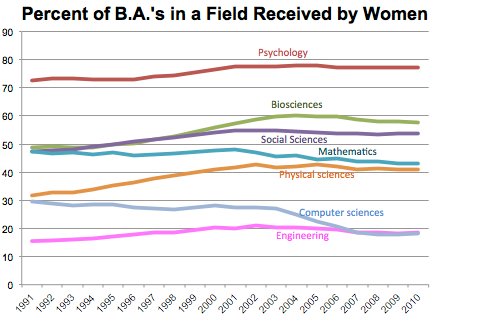
Look at this graph:
http://www.npr.org/blogs/money/2014/10/21/357629765/when-wom...
I guess in 1970 women "just" didn't like medicine or law. (That's certainly what people said then.) And now, using your helpful explanatory framework, they "just" do! It's unexplainable! Things just happen without relation to other things. Who could possibly know anything?
Why would you compare socio-economic inequalities to taste in media? That would be like comparing national budgets to a lemonade stand and asking why we don't put the same effort into managing a 12-year old's summer business.
These issues have entirely different scopes and priorities, and your comparison is invalid based on that alone.
FYI, there is a root cause in social pressure for this.
The ME departments in colleges have caught onto its fall from a popularity and prestige and are doing their best to retard the descent with classes like "Scientific Computing", "Microfabrication", "FEM", "Lagrangian Control", "biomechanics", "business in China", etc., that try to emulate the currently useful skills taught in other disciplines. The result is, of course, us students wind up actually majoring in "Engineering Undeclared" and it land us a hodgepodge sampler plate of introductory knowledge that never truly satisfies any market need. We are inferior to applied mathematicians when it comes to calculations, electrical engineers when it comes to modern machinery, computer scientists when it comes to AI and controls, industrial engineers when it comes to falsifying lab reports, doctors when it comes to biology, etc. And if we focused on traditionally ME fields like heat transfer and combustion? We'd have to Hunger Games ourselves for that one position at the local power plant in ten years when the current engineer retires.
So, unless she is passionate about cars and air conditioning, why should we be trying to encourage our daughters into a major that doesn't earn money like finance, have prestige like computers, enjoy purity like the sciences, help people like medicine / social science, pretty like art / design, satisfy her natural affinity for children and cute stuff like education, or even remain stable like law. In some ways, ME is the Titanic after it was hit the iceberg, it's a "boy's club" not because men are trying to keep women out (every department across the land is actually doing just the opposite), but because the captain and his crew are stubbornly going down with the ship while the women and children are on lifeboats so they can live another day.
Extremely watered down versions of those courses are in my curriculum. Fluid mechanics is nearly all Bernoulli's Equation and Linear Momentum. Heat Transfer is 1D conduction, basic convection, and basic radiation. Machine Design, while heavily focused on gears, was extremely watered down. Kinematics, on the other hand, has been completely dropped from the curriculum! A lot of these courses have been made easier to allow students to spend time on 'lab projects' that consist of filling in the blanks of Arduino sketches. It's a sad state of affairs.
You are spot on by stating that undergraduate ME curriculums are 'Engineering Undeclared' in my experience. I think part of this is because the 'traditional' curriculum that my grandfather and father took is 'too challenging' by today's standards. I'm not half the engineer they were when they graduated from the same department.
I think this can be attributed to several things. When my father graduated, everyone took the FE with plans of becoming a PE. I know maybe 5 other people in my graduating class who plan on taking the FE. He took 3 years of math, I took one and a half. We can't really get into 2D conduction in heat transfer because no one has the math background to handle it! The 'Intermediate Heat Transfer' I'm taking in grad school is the equivalent of the 'Introduction to Heat Transfer' my grandfather took.
My background is in science, but I work in a department with engineers of all stripes. It seems like the mechanical engineers are stuck living inside the world of their CAD systems. It's a dreary world, dominated by at most two or three software vendors making giant, expensive, training-intensive tools.
I know other engineering disciplines use tools too, but I don't think they are dominated by their tools to the extent that ME is.
While at the same time some politician and businessman is making a speech that we have a desperate shortage of engineering talent and need to open the floodgates.
I wouldn't call being a teacher more prestigious than being an engineer, nor a social worker, but there are still a lot of women who are more interested in going into those fields than into engineering disciplines.
Other studies also point to other reasons; in computer science especially, there's a very strong effect of computers being seen as boys toys, so men come into the major with more experience and more interest in the field just to begin with: <https://www.cs.cmu.edu/afs/cs/project/gendergap/www/papers/s...
The gender gap in engineering disciplines, as a complex social phenomenon, is likely to have many interrelated causes. Between lower encouragement of computers as girls toys at younger ages, the fact that there is still a bit of an expectation that men will be the primary breadwinner in the family and thus women can get these lower paying but more rewarding jobs, the fact that the large existing gender gap makes it less comfortable for women in the major, in the workplace, and so on, it's unlikely that there's going to be one single cause for it.
So, in summary, while from what I found it looks like it's not prestige but how rewarding the job is perceived to be that makes more of the difference, but that's not to say that your hypothesis is wrong, just that I found some evidence to support a different effect that at least appears to be stronger than the effect you describe.
Brainwashed: The Gender Equality Paradox https://www.youtube.com/watch?v=tiJVJ5QRRUE
The "social expectations" hypothesis fails to explain why countries with higher living standards have more polarized sectors. The idea that in a perfect world with no "social pressure" we would reach a parity between genders ignores just about all research done on the biological gender differences.
I would. There's a lot of respect for people that do these things, because they are seen as somewhat selfless (partly because the monetary compensation is so low, partly because the jobs are so essential). Aid workers share in this as well. Prestige is about respect, and there are paths to respect that don't include a lot of money or power.
http://www.npr.org/2014/11/22/365968465/after-backlash-compu...
Still I can't help but feel social prestige is still a stronger factor for females than males
> The researchers concluded that women seek to regain a sense of belonging whereas men are more interested in regaining self-esteem.
http://en.wikipedia.org/wiki/Social_rejection#Ball_toss_.2F_...
Girls mature emotionally faster than boys, which may result in them starting to care about, and be able to understand and do something about, group status and group power structures earlier than boys do.
Anecdotally, that fits with what I saw as a kid. Going into the teen years, boys tended to have small social circles compare to girls. A boy sleepover was two or three boys. A girl sleepover was half the girls in a class.
Others I've talked to report similar, and this seems to be a common enough observation that it has become somewhat of a stereotype (hilariously parodied in the South Park episode "The List").
Now let's consider how an interest in a STEM field might develop into a career. I think for a large number of kids there is a critical period where an interest changes from a spectator interest to a participatory interest, and I think that often happens around the late pre-teen, early teen years.
(This is probably just a coincidence, but it is interesting that this is around the age that in olden days boys would start apprenticeships).
Note that the kind of participatory STEM things that you can do (outside of organized school activities) as a young teen tend toward solitary activities. Perhaps, then, boys are more likely to do these things because at that critical early teen phase boys are still oblivious to the importance of group status and power structures, and so a potential boy science nerd will spend Saturday night at home hacking alone on the computer, or building a ham radio, and so on.
By the time boys catch up on emotional maturity, and start spending time dealing with group status and power along with the girls, the boys have already set themselves on the road to STEM careers.
It would be interesting to get data on people who choose a STEM major in college, and on people who graduate with a STEM degree, and on people who go on to a STEM career, and break each of those groups down into two subsets. (1) People who decided that (or a closely related field) was what they wanted to major in while still young teens, and (2) those who discovered their interest in that field in college, such as when they took a course in it to satisfy a breadth requirement and found they liked it enough to major in it.
If my speculation is correct, the first subset (people who chose their path while early teens) will be more tilted toward men than the second subset (people who found their serious interest in the field while in college).
Finally, this suggests an interesting topic for one of those "late night, been drinking or smoking dope a bit, kind of tired, let's discuss something really wild" type discussions: will HBO's "Game of Thrones" have an effect on gender ratios in STEM? (Yes, there is a chain of reasoning to support the "yes" case that is good enough to give one a decent chance of defending that position long enough for everyone to get drunk or high enough, or sleepy enough, that discussion ends).
Business (executives, secretaries) is more respectable than IT (programmers, tech support).
I would argue that nurses and teachers have higher prestige than a programmer or engineer in most parts of the country. (Let's not confuse salary with prestige)
Early childhood education has a serious bias against men. Due to social stigmas, parents of both genders are generally more comfortable leaving their young children in the care of a woman rather than a man.
I think most nursing jobs have roughly the same level of prestige as most engineering jobs. It just doesn't look that way here because this place is hyper-focused on the small subset that are high prestige.
I'm sure there's some data out there breaking out US STEM graduates by country and see how that compares to other fields like arts and sciences - that'd be a good place to start a conversation around whether or not some Western countries have a cultural / stereotypical problem.
Can you give me the source?
In regard to your final question: http://www.harrisinteractive.com/vault/Harris%20Poll%2085%20...
I think it's generational to some extend. IMO the baby boomers are particularly bad w/ regards to the stereotype. My parent's friends ask about my work as a programmer, and I suggest that their son or daughter who hasn't figured out what they want to do consider taking it up (code bootcamps make it easy, great market now, etc.), and I just get such cringe reactions from them.
But... younger generations are better, given how startups are now viewed as "trendy," and I do think movies/TV like the Social Network had a big impact.
If we focus, for a moment, on those jobs that are available to those who have college degrees, many women become teachers, but teaching is not high prestige.
There is little risk that the USA will outsource all the hospitals to China, so women go into medicine. There is little risk that the USA will outsource all the lawyers to China, so women become lawyers. There is little risk that the USA will outsource all the teachers to China, so women become teachers.
But there is a possibility that most of the engineering jobs will move to China. And I think women are wary of investing 10 years of their life learning a skill that might get sent overseas.
If you give weight to the McKinsey study, almost half of US public school teachers come from the bottom one-third of their college classes. This suggests that the best and brightest women are not opting to be teachers instead of engineers, they are choosing other jobs.
I find the use of lawyers as an example odd unless people are just downright ignorant of what is happening in that industry. For quite a while now now, there has been a glut of law school grads that are unable to find jobs. Furthermore, more and more legal work is being outsourced to India (and this trend keeps rising) or automated (like discovery).
If your assertion is true, then several years ago, when both of these characteristics of the legal profession started to occur (few job prospects after graduation and outsourcing/automation), then we should be able to observe a significant decrease in the number of women choosing to pursue a law degree versus men choosing to pursue a law degree.
Has such a discrepancy between the genders been observed in the quantity of law school applicants?
What I've observed is that women tend to go into careers that are "high-touch" and that factors like prestige and job security are lesser considerations. Teaching and nursing are the two canonical examples. The only parallel I can draw to job security, is that high touch jobs are far harder to automate and outsource. Japan has been trying with some of its robot experiments, but the uncanny valley is a high barrier to cross to automate high-touch jobs.
Interestingly this is why we see engineering/automation making doctors less relevant, while we see nursing becoming more important. Technology to aid with the low-touch aspects of medicine (the tasks doctors typically perform, such as pattern detection and pattern matching) are getting good enough that those interested in the high-touch aspects (nursing), can do most of the work required without the need to share responsibilities with a doctor.
(FWIW while society considers doctors to be higher prestige than nurses, I feel they are both equally important. IMHO, being a doctor as a profession having higher prestige is a historical anomaly since there are statistically fewer people in society who are good at the analytical work that computers now excel at. For thousands of years, sexual selection favored neurotypical minds. It has only been in the past ~100 years or so since the industrial revolution where sexual selection has started to favor sexual selection in favor of those on the aspie/autistic side of the spectrum).
Although in general it's probably true that women tend to be more risk averse.
I've always said that women are probably simply too smart to go into IT. Sitting in front of a glowing rectangle in a gloomy basement is probably not the best recipe for happiness. Cliched as it sounds, but a job that involves talking to people might be much more likely to make a person happy.
- "I'm a programmer" (people think about typing)
- "I make apps" (people think about the amazing things you create...by typing)
"I make a quality control system for a large factory" (people think about all sorts of boring things)
"I make payroll software" (people feign interest for a moment, then change the topic)
Let's keep rewriting history so that white men are to blame. It's not like they do things like land probes on comets or anything.
Let's say a conference has speakers and attendees that are predominantly white men. Should I relate because I'm a man even though I'm not white? Should a white woman relate because she's white even though she's not a man?
It just seems weird to discuss disproportionate representation through only one lens.
I don't think people inherently do. I think that lots of people actually do, and that this is a socially taught and reinforced trait just as much as sexism and racism are (and, in fact, I think it, insofar as it operates on the basis of sex and race, is a form of sexism and racism -- as it is tied to the individual judging themselves primary by the same kind of attributes -- but, unlike more external sexism and racism, isn't actively combatted because its not seen as negative, even though, in addition to its direct harms, it may serve as a foundation for the more external forms of sexism and racism.)
I can't see things being very different in the States.
In my view, a similar lament cuts across disciplines. I wish I could find an electrical engineer who understood low noise design. Most engineers forget most of their math and theory within a few years of graduating, and most design work is done by trial and error.
If you want a job that will interest/impress people at a cocktail party, that is an extremely short list of careers.
Sure. But making a quality control system is (for most people in most cases) actually boring. The same skills could be applied elsewhere for something far more compelling. But if you framed them how you achieved them - "I'm a programmer" - they'd sound like the same jobs, which they're not.
I've been inspired a book on id software and a Sarah Chipps talk on failures - both showing that with all the people who are well known for making something awesome, there are a bunch of things you never hear about they made that didn't work out. I relate to it because I've made a lot of stuff that doesn't work out. I'm not American (like the id guys), and I'm not female, but the story of struggle resonates with me.
I've been inspired by all the node people, because they were all just friendly people in 2011 and now it seems like they're all running node companies doing huge things. I feel inspired because they treated me like equals then, and I think I'd like to join them one day in having successful business.
I've been inspired by Xero, because I met their founder at a conference once, and he was a nice person from the same part of the world as me, and now Xero are huge, despite being from New Zealand (which is even more remote than Australia).
I want disproportionate representation - by people who are interested in the subject and are not just there to sell something or whatever.
I believe many (young) people will tell you that women are "just" like that, but actually mean "they are just taught to think so", because in their male position there is no need to choose are careful wording. I'm also pretty sure that, while the society at large is fault for this herd thinking about this, the parents play the biggest role in where the daughter places herself in the world.
The main reason I'm commenting is because I want to note that the entire point of the article you linked is to debunk the articles in the third paragraph (none of which I have read).
For example, clinical psychology is high-prestige and high-paying, and is dominated by women. Medical research and more generally the biosciences is another (smaller majority, though).
http://www.sheheroes.org/wp-content/uploads/2014/05/Percent-...
Can you provide an executed contract to confirm?
YC appears to have moved away from convertible notes (ie. debt) [1], but if you read closely it appears that PG said the reason was to avoid debt term limits and interest rate limits....so it's an even more extreme version of debt, just not 'debt' according to CA regulations.
[1] http://blog.ycombinator.com/announcing-the-safe-a-replacemen...
Other seed stage investors used convertible notes. These technically "debt", but only as a mechanism to keep from having to go through valuation exercises on <3 person companies that had plenty of other things to worry about.
Debt term limits and interest rate limits were bad for companies. It was not possible to have debt with, say, a 50 year term and a 0.1% interest rate. Instead, the debts had 5 year terms and non-negligible interest rates.
Warrants just give the investor the right to purchase equity at a given price some time. They are not debt.
No matter what it's called: loan, debt, warrant, convertible note, SAFE, it's an instrument that attaches to future earnings.
Answer: because understanding what happens in mice might give us some insight into similar mechanisms in humans, and it is easier to do many tests and experiments on mice.
Same goes for media tastes. Factors that lead to gender difference in media preferences might also lead to gender differences in employment (either by affecting what jobs women seek, or affecting how employers perceive candidates), and it might be easier to gather data on media preferences.
>Would we be hunting for a root cause in social pressure or discrimination if we found women were a much higher chunk of the audience for Twilight and men were a higher percent of Avengers viewers?
What is this question suggesting? Is it saying that media preferences and employment differences are similar in such a way that the fact that we do not investigate media preferences means we should not investigate employment differences?
What you are saying is different: that investigating one will give you information about the other. I don't really disagree with that. I disagree with the implication that employment differences are to be trivialized as 'matters of preference,' and thus not worth investigating.
I dont think that's trivializing the issue at all. Millions of people in the world with different preferences in all manner of things from movies to professions is hardly trivial. What's trivializing is thinking we can do some studies and find some kind of root cause of what is really an average of millions of personal choices.
I'm also going further disagree with lambda. For society at large, I feel that teachers and social workers do have higher prestige than engineers. Of course I realize that all of my opinions are just assumptions without actual data backing it up. However I do know this: the gender discrimination in both the military and finance are either just as bad or much worse, yet more women flock to both as opposed to our industry.
This is an interesting article as well that helps show that gender discrimination is also pretty bad in other industries that attract more women: http://www.usatoday.com/story/money/personalfinance/2015/02/...
Does this have to do with how you perceive men and women? Does it have to do with how you perceive these various vocations? Is this feeling rooted in personal experience(s) and memories? Can you locate those in space and time?
It's important to challenge the ways we can't help but feel, because those are stumbling blocks when it comes to understanding what motivates other people--especially people who aren't like us. Our personal experience is always a fairly small slice of human life, and I'm concerned that you're projecting things you "can't help but feel" onto two of the largest populations.
I posted this elsewhere in the thread--I don't know if you saw it, but the Harris poll actually released some numbers not too long ago on the notion of prestige in various occupations: http://www.harrisinteractive.com/vault/Harris%20Poll%2085%20...
But still, even though it cuts against some of your assertions about what is and isn't prestigious--it's a poll. It's messy. Hidden within its aggregations are the differences between what parents (of both genders) think would be prestigious for their boys, and for their girls. It hides differences between what is seen as prestigious in different ethnic, religious and regional communities. The way you "can't help but feel", whether about the people picking these occupations or the occupations themselves, is located in the messy middle of your own experiences.
There are communities where the most prestigious thing a woman can do is be a stay-at-home mother. There are communities where any occupation that doesn't pay at least six figures is an embarrassment. There are communities where going into finance is like selling your soul. There are communities where you aren't a real man unless you get dirty for a living. There are communities where academics are exalted regardless of pay, and communities where they're disdained for class, religious and political reasons.
This is all to say: The NPR article doesn't feel that way at all to me. But the way I read it doesn't mean your perceptions of the relative prestige of occupations are "wrong". They're probably quite right, given your experiences. Be open to the likelihood that your experiences don't generalize to others. Be open to the likelihood that the decisions other people make are better understood through careful consideration of their experiences than your own.
First, that's like saying "men only care about money": it's not backed by any real evidence and it is disparaging to an entire gender.
Second, that's sweeping under the rug the constant discrimination against women that is keeping them out of our industry. You are making women responsible for not choosing tech as a career, whereas they are being excluded from tech by the sort of casual sexism on display on HN (and most SV tech companies).
I feel that you're making really strong and incorrect assumptions about my posts. I never said that "women only care about social validation". Is it wrong to say that more women frown upon occupations that are seen to be held by social pariahs and outcasts by society at large? Why would an ambitious woman be interested in becoming what's seen as an educated plumber or janitor when she can aspire to become a respected high level, finance executive or powerful lawyer instead? imo it's more common sense rather than misogyny.
Also some sweeping gender statements are actually true, such as men being more prone to violence than women.
"Second, that's sweeping under the rug the constant discrimination against women that is keeping them out of our industry."
I agree that there's a ton of discrimination against women in the tech industry. But really how of this discrimination keeps women from actually joining our fields? Your argument would make more sense if there were a lot of women entering AND then leaving, but that doesn't happen. Few actually even try entering our field. Look at the military. While things are slowly changing, there are few environments more toxic to women than the military's male dominated, authoritarian atmosphere (gender discrimination is horrible, but rape that isn't prosecuted and punished is much worse); the tech industry isn't even close to being as bad. This is pretty well known to society at large, yet there are more women joining the military (and then leaving) than there are women joining the tech industry; which leads me to believe that the general social perception of our field is just horrible when the even armed forces are beating us at female recruitment. Now let's look at finance. The average wage gap in the financial industry for genders is the worst compared to other industries (about $0.70 to a $1), investment banks have the reputation of being 'frat houses', and yet more women enter finance than our industry. imo gender discrimination isn't as strong of a force for deterring women from entering a field. Gender discrimination is much stronger at affecting how long women stay active and how far they can rise within a field.
Historically there's been a ton of discrimination against women in pretty much every field. I feel that the sectors that already got 'fixed' (i.e. somewhat better than before) were the ones where large numbers of women have entered due to interest (i.e. politics, healthcare, business, legal). Those women were well aware of the toxic environment, but the interest level was so high they joined anyway. I feel that while education and company policies regarding discrimination helped those sectors, the larger female presence was a stronger force. I just don't see that in technical fields.
Well, the alternative explanation is that men are simply better at violence than women (because we're stronger). E.g. men commit more suicides than women despite women attempting more. Also, domestic violence is roughly equal (60-40), but I imagine women are hurt worse more often.
Who works on Wall Street? Hell the movie Wall Street, Boiler Room, etc aimed at?
Can we stop with the 'we are so special/intelligent' arrogance?
In the past compared to boys, girls simply aren't exposed enough to anything technical for them to discover it before their minds can get potentially tainted by popular perception compared to other fields. Is this changing? Yes. I feel that this will be much less of a problem for our children given the advent of toys like Goldiblox and even Lego sets aimed for girls. However I feel that this doesn't change the present situation for adults.
> Does it have to do with how you perceive these various vocations?
Yes because I've lived outside of places like Silicon Valley, in metros with a more conventional and old mindset.
> Is this feeling rooted in personal experience(s) and memories?
Yes outside of Silicon Valley it is strongly encouraged that engineers transition to management. It just isn't as respected outside of tech hubs and it's pretty recent. Is this changing for the better? It depends on the metro and the rate of change in perception varies.
> Be open to the likelihood that your experiences don't generalize to others.
I am definitely open to my generalizations being incorrect in many different places and times. I'm just stating what I feel is the general mass trend.
> I posted this elsewhere in the thread--I don't know if you saw it, but the Harris poll actually released some numbers not too long ago on the notion of prestige in various occupations
Looking that this poll and several other similar studies over the decades, my hypothesis has been proven wrong. Thanks for posting quantitative data. Yeah polls are subject to a lot of errors. Still, they're better than guesses based on personal experience. Logically I'm thinking that I've been proven wrong. However what's annoying though is that even in light of data, I still feel that I'm 'correct'. My gut still tells me that engineering is still seen by the masses as low prestige (outside of tech hubs like Silicon Valley). If I were to rationalize it, I would say that popular media is the main driving force behind my opinion. It's hard to ignore annoying shows like The Big Bang Theory. Ugh, I really hate that show. Another reason is that I feel the polls are measuring prestige incorrectly. imo A political office is very prestigious, yet in these polls they score so low. Why? Because the way the researchers measure prestige includes perception of ethics and generalized likability.
From the description, the people being coerced could presumably choose not to take the action, but would then be denied entry to the bar. That is explicit tribalism and creates a situation where you either join along with the groupthink or you get cast back on to the streets.
Edit: If you can't refute or contribute, down-vote.
"What is Watsi?
Watsi is a global crowdfunding platform that enables anyone to donate as little as $5 to directly fund life-changing healthcare for people in need. Watsi is a registered U.S. 501(c)(3) non-profit organization (EIN: 45-3236734)."
If these were the actions of a CEO for a for profit business your statements might make more sense, except that's not the case at all. Nobody is getting rich off Watsi and there goals are commendable.
Not to say there aren't probably other examples that would make your point, but seriously this doesn't seem like a good one to pick.
I just took a look Watsi's Transparency Report. It's commendable that they seem to be going much further than many other organizations do in opening up their financial information. However, while I found lots of patient details, I was unable to find a breakout of salaries and other payments to employees, officers, or other, only an aggregate monthly salary line item of ~66k. If their about page is accurate and there are currently 6 employees, that's about $132k/year/person. Not Jamie Dimon salaries, but still more than double US median household earnings.
Edit: Also, I'm not ragging on Watsi. I'm not familiar with them other than what I just shared above. My beef is with the behavior in the anecdote (which may or may not be accurate to what actually happened at that NYC bar) that was shared, but more importantly with the culture that people seem to be trying to emulate.
My reading of it wasn't even that the bouncer insisted they do it. More that he or she suggested it as they were entering. This is marketing, not servitude.
I know I'm out of the mainstream on this, but as a European one of the most difficult things about living in the Us is the lack of regard for personal space. Before I knew the appropriate code words I went through a stage of fending off signature-gatherers with clipboard petitions by pretending not to speak English. If you asked me to vote for something on my smartphone as a condition of entry to a bar then my first response would be to find some other place to have a drink.
>Grace had the gutsy idea to ask the bouncer to make everyone who came into the bar have to vote for Watsi on the contest site on their smartphone
I agree that it might not be quite slavery (it would depend on exactly what happened), which is why I included tribal exclusivism, which it most certainly was (at least according to the above portrayal).
Edit: Anonymous down-voters are out, in-force, tonight!
* The notion that politicians occupy high-status careers
* The notion that it's the status held by politicians that is the reason they're allowed to set national policy
* The notion that your intuition about status trumps the actual numbers for occupational prestige, which are (a) easily found and (b) immediately refute both the premise and conclusion of this argument
* The notion that most lawyers are on a track to become politicians
* The notion that lawyers would be overrepresented among politicians because people love lawyers that much, and not because the top echelons of law are disproportionately well compensated, or because those people make decades-long careers out of making connections with businesses and power brokers
* The notion that you can evaluate the overall status hierarchy position of a career solely by observing it's top echelon (here: national office-holders, and not city council-people)
Software developer and data scientist are both at the top of the list of best careers in America right now, and more people aspire to be startup CEOs than movie stars or pro athletes.
Causal modeling is a very difficult thing when you cannot perform a controlled experiment. I would be interested in your take on how you would suggest that the authors attempt to confirm or disprove this hypothesis.
Assuming you mean the authors of the documentary, I'll give you a new synopsis highlighting what it's really about: Strawman arguments abound as our intrepid documentarians drag us from interview to interview to assert that it seems people conform very closely to what our stereotypes tell us to expect of them. Obviously this must be the inevitable result of our biology! Our strawman assertion of what "equality" means is defeated! There's no way our stereotypes could be self-perpetuating! People definitely don't continue to believe in the same religions or speak the same languages or eat the same food or celebrate the same holidays just because their ancestors did! Propensity to speak English and believe in the Judeo-Christian God must also be biological destiny!
Per your last question, I have no meaningful suggestion for the authors of the video; they're going to have a miserable confirming or disproving anything as long as they insist on using logical fallacies to do so.
Look at the tech sectors in Europe and India and Asia--they don't have all these hang-ups and prejudices and misconceptions about how women's brains 'work differently' or what the biological differences might be or all that pseudo-scientific bull-crap. They just do the work.
Which is why the comparison to slavery is indeed overblown.
That said, I'm totally with you on this. At best, it's soliciting ballot stuffing.
Women don't like STEM? Change STEM so that they do. What do preferences have to do with anything? We don't have to abide by them.
Preferences are not a problem, social inequalities are a problem.
Exactly. Preferences are not a problem. Social inequalities are a problem. However, neither of those are easily directly measurable. So we do indirect measurements on things like gender participation in a given career. When we measure unequal participation in a field, I think we are too quick to attribute it to social inequalities when perhaps it is more personal preference. That's the only point I'm trying to make... My movie preference analogy confused my point. Sorry about that.
That's a proxy for socioeconomic inequality. Now what you are trying to argue is that Americans just might prefer action films. Ok... great. Americans prefer action films. But why?
So we go out there and we ask Americans how they feel about documentaries:
"They are boring. We'd prefer not to watch them."
"Because they are in English. All the good documentaries are in Spanish."
---
So when you ask why women prefer not to work in STEM, you'll learn something about the cause of the social inequality. Saying it's a "matter of preference" tells you nothing. It just sounds like you're trying to invoke a naturalistic fallacy and stop investigating.
Maybe if you invested more in good English documentaries, they would be quite popular. Maybe the preference would disappear. So it doesn't matter if there's a preference. What matters is why there is a preference.
For example in many Islamic countries like Iran women do make up a significant portion of engineering graduates (sometimes even a majority) but few end up working as engineers due to sexism and cultural expectations.
I did some Googling and what I found didn't really support your argument.
https://hbr.org/2014/03/whats-holding-women-back-in-science-...
I bet you are. I've actually lived much of my life in countries you would consider 'poor'. There is plenty of prejudice to go around.
>Look at the tech sectors in Europe and India and Asia--they don't have all these hang-ups and prejudices and misconceptions about how women's brains 'work differently' or what the biological differences might be or all that pseudo-scientific bull-crap.
Sounds like you have a lot of the world left to see.
Men and women are physiologically different. They have an intrinsically different hormonal and social development path. Their movie preference shows this well: you can't possibly think that even in an "ideal" society men and women would prefer exactly the same movies? Why would they prefer the same professions? Surely you've met some nurses and seen why it might be a popular occupation among women?
The "preference" model hints what part of gender unbalance would be present even in an ideal world, and the rest we should address. That's the point you're missing here.
Why? What are my goals? Why should I be assuming that women should not have the same opportunities as men with regard to professional preference?
>Men and women are physiologically different. They have an intrinsically different hormonal and social development path.
Obviously. But the culture of business doesn't have any innate hormonal path, so why should it conform to mens' hormones and not women's? Why can't we change the realities of STEM to create a balance?
What is it about STEM that makes it incapable of accommodating different brain chemistry?
>The "preference" model hints what part of gender unbalance would be present even in an ideal world
An ideal world would have gender inequality? Got it.
>Surely you've met some nurses and seen why it might be a popular occupation among women?
Are you serious right now? Explain this to me. Why do women prefer to be nurses? Tell me all about how nursing requires vaginas and estrogen.
"Business" is far different from the realities of mechanical engineering, industrial engineering, etc -- which go from very specific courses in education to certain work environments.
For example, take children of age ~7. Boys love playing with cars; girls do like them a bit too, but it's pretty clear they prefer simulating social interactions, specially dolls talking. Should we address this imbalance too? That would be like making a toy which is a car with a doll strapped on it's back and forbidding all other toys -- we'll achieve equality, but won't it be artificial? Will boys and girls actually be happier with their toys?
I'm not claiming all unbalance in STEM comes from preference, I'm claiming some may come, and it's important to recognize that to effectively address the situation.
Of course status is defined by caste power and social agency. What else would it be defined by? Facebook likes?
The fact that no one much likes lawyers is irrelevant. So is the fact that lawyers individually may fail to make a living from lawyering, or even that a few outliers have a social conscience.
Let me know when an engineer becomes president of the US and we can talk about the other details.
>not because the top echelons of law are disproportionately well compensated, or because those people make decades-long careers out of making connections with businesses and power brokers
This confuses cause and effect. The point of becoming a certain kind of lawyer is exactly because it's the best way to gain status and self-serving influence through that kind of activity.
Writing a compiler will never get you that kind of status, no matter what gender you are.
Nor will making a cool app.
Becoming a billionaire might. But tech billionaires tend to become billionaires because they act in aggressively self-serving ways in business and/or are well-connected, not because they're rewarded purely for being brilliant engineers.
Engineering brilliance on its own will get you GitHub stars and conferences and maybe a job or two. But no more than that.
Still don't believe me? Ask a few thousand people outside tech who their favourite engineer is.
That's how high-status engineering is.
  Obama - Law
  Bush - Business
  Clinton - Law
  Bush - Business
  Reagan - Actor
  Carter - Nuclear Engineer & Farmer
  Ford - Law
  Nixon - Law
  LBJ - HS Teacher
  JFK - Econ
  Ike - Military
  Truman - No degree
  FDR - Law
  Hoover - Engineer
  Coolidge - Law
  Harding - Journalist
  Wilson - Law Prof
  Taft - Law
  Teddy Roosevelt - History & Politics
Bullshit. Do you have a source for this, or are you just unaware of how bigoted this is? It is not 1950. I am not going to agree that "girls like dolls and boys like trucks" without some reliable evidence. I'm sure if you marketed trucks to girls long enough and dolls to boys long enough, they would prefer the opposite just fine. Here's what you've been arguing:
    Left handed people prefer not to use scissors.

    Therefore, scissor manufacturers shouldn't bother to make left-handed scissors.

    This is in spite of the fact that, when asked *why* they
    don't like scissors, they tell you "because they are
    uncomfortable to use."
I'm sorry that I'm unwilling to jump on your circular logic bandwagon to defend your obvious bigotry.
PS> I'm still waiting for you to explain why women should be nurses and men should be doctors.
You can find countless studies of gender distinction in just about every physiological/psychological aspect, just google it. (your point about handedness is very poor since humans have bilateral symmetry, unlike genders; although some asymmetric brain specialization actually seems to create some fundamental differences in the way left handed people think)
If you didn't get this after all this discussion I'm afraid you never will.
>PS. I didn't suggest women would prefer nursing to clinician work, but it's fairly obvious they would prefer nursing over truck driving.
No, I won't. I don't see any reason why I would want to 'get' something that is wrong. I'm not a stupid person.
> it's fairly obvious they would prefer nursing over truck driving.
"Fairly obvious" is your standard of truth? Oh, how rational and modern you are!
My mother is a truck driver, you know.