AMD Launches Carrizo(anandtech.com) |
AMD Launches Carrizo(anandtech.com) |
I have a 4 year old i5 laptop that can handle 100% of general office/home use. Battery life and gaming are the only two weak points. AMD aren't going to compete with Intel on battery life but with overall cpu/gpu power consumption falling it's not as big of a problem as it used to be.
Wish they weren't stuck on 28nm still. It seems like Intel will be pushing 10 before they get down to 20/22... Maybe I'm just nostalgic of my overclocked Athlon 64 but I'd love to see AMD make a comeback and the nm gap between AMD and Intel just seems like kneecapping the underdog.
Realistically they are going to be launching this against Skylake and I can't help but think all the advantages they are promoting are going to get nullified by that. (HEVC and gaming performance)
http://en.wikipedia.org/wiki/Zen_(microarchitecture)
http://www.pcgamer.com/amds-next-gen-zen-cpu-due-in-2016/
Seems like the next chip after Carrizo is targeted at 14nm fin-something.
Which, if it pans out, would put Intel & AMD on the same node for the first time in a while. Supposedly Intel's first 10nm part isn't due until 2017:
http://en.wikipedia.org/wiki/Skylake_%28microarchitecture%29
And it seems very unlikely for AMD to ever be competitive on that front.
Intel seem to be struggling though, with shrinking not working out as they planned. They've missed one upgrade-round with the delay to Broadwell, and if the rumours are correct and they're releasing a couple of CPUs and then jumping to Skylake - that's quite a hit to ROI given the investment they've put in to an 'unused' chip family IMO.
Why not?
Not sure what happens after that though.
Dr.Su did not have a good tracking record and I never got it why she was picked as the CEO, but it's not all her fault though, AMD has been in decline for years, I just hope someone will buy it before it totally collapses.
Additionally, Intel is battling with ARM/Samsung etc and the need for AMD as a competitor(i.e. to avoid monopoly litigation) is gone too.
Sigh.
With Tao3D, I keep pushing graphic cards to their limit, on laptops and desktops. This raymarching example http://www.youtube.com/watch?v=GUMqT9W5BG8 runs fine on my Macbook Pro for about 20 seconds. After that, the heat becomes high enough to throttle the system down. And you end up with a very unpleasant "fast/slow/fast/slow/fast/slow" experience as the system tries to cool down its graphic chip.
So you really don't care about PEAK performance. What you care about is sustained performance, and power consumption in that scenario (not just running idle).
OpenCL 2.0 includes unified CPU & GPU virtual addresses (SVM - shared virtual memory).
I mean look at Intel, i3,i5,i7. I can at-least guess which one's better.
Yes I do understand that Intel too has many different names that caters to different markets, yet somehow Intel’s names are far more easier for me to understand, they are far more shorter, and if I want more details about the processor I can read what’s after the "Intel-i7-xxxx" and figure what it is.
I really want to see AMD succeed, I want to have more options when I want to buy a processor.
See for example the bottom table on this page title "More Differentiation" http://www.anandtech.com/show/4083/the-sandy-bridge-review-i...
i3-2100 does have aes-ni, i3-2120 does not. i5-2300 does not have vt-d. i5-2400 does. i5-2500K does not.
In that generation, i3 have hyperthreading, i5 do not, i7 do. That's for desktop chips though, for laptops its different.
The latest generation, broadwell, was slightly more consistent. But you can never be sure, I have to look up these suckers every single time. At least Intel Ark is nice.
If you're assuming i7 to be better than i5, you're wrong. Single core clock matters. Some games are barely playable with a low clock i7, but work perfectly on a high clocked i5.
Can anyone explain how this works and why should a user want it? It seems like a DRM on your device.
Plus is anyone expecting a lot of YouTube 4K content ?
Every enthusiast cameral high end smartphone or the latest GoPro shoots 4K, more and more people have 4K displays and prices come down. So yeah, i think there will be a lot of 4K on youtube in the near future.
What? Youtube has >70% of the online video market, and primarily uses VP9 [0]. To be fair, VP9 isnt commonly used outside of google, but to discount the market leader in online video as "dead" is disingenuous at best.
[0] http://www.statista.com/statistics/266201/us-market-share-of...
I know what you mean. When I started reading my first thought was "ugh, why don't you guys just give up" which is a terrible sentiment for me to have. Carrizo looks promising but I just can't see them gaining a whole lot of market share back from Intel.
When I used to build my own computers I always picked the best processor and graphics card at the time, no brand loyalty at all. It was about the time AMD was kicking Intel's butt and it made me so happy to use the "underdog's" products. Now it's probably been a decade since I've used a single AMD processor. It makes me sad.
Intel can afford to do this because as far as it knows the "AMD competition" doesn't exist at that level. If it did, Intel wouldn't dare to price a $30 chip five times higher or replace "Core"-based Celerons and Pentiums with Atom-based ones to trick 99% of its customers into thinking it's actually an upgrade.
[1] http://www.anandtech.com/show/9125/intel-braswell-details-qu...
Can anyone enlighten me on why those deals might not be helping as much as I thought they would?
Good explanation may be found there: http://www.extremetech.com/gaming/150892-nvidia-gave-amd-ps4... "Two years ago, in January 2011, Nvidia CEO Jen-Hsun Huang told reporters that the Sony-Nvidia deal had earned Nvidia $500M in royalties since 2004. The total number of shipped PS3 consoles by March, 2011 stood at 50 million according to data from the NPD group."
(Right click a youtube video and select "Stats for nerds" to get this info)
I did think margins on any console GPU deal would probably be slim, but I didn't know it could be that slim. Seeing some hard numbers really helped.
No, the user can install software on the chip.
> Because if user puts it there, he can read it too.
Not all communications links are two-way.
Not everything gets shrunk in modern die shrinks.
What my limited understanding is that transistors might be getting shrunk but wiring connecting transistors is not getting shrunk it is still at some larger number (65nm?)
And I would argue that the driver of higher end content e.g. 1080p, 4K is not going to come from YouTube but from Netflix, Amazon, Apple and illegal content which a lot of people watch on consoles.
Nothing has fundamentally changed to see this being anything other than a repeat of what happened with H.264/VP9.
However, in the last year 25,000,000,000 hours of VP9 video have been served on youtube [1]. Maybe this is a minority of web video, but its hardly dead.
[0] http://caniuse.com/#search=vp9
[1] http://youtube-eng.blogspot.com/2015/04/vp9-faster-better-bu...
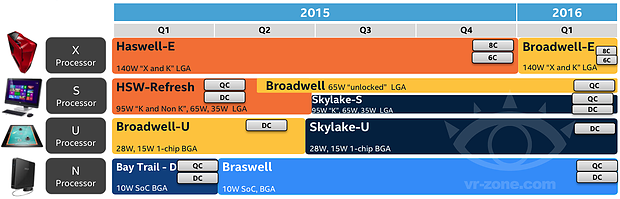
Lenovo released Broadwell laptops in Q1, it is hard to believe they will release Skylake before 2016.
I always get disappointed when I see something that CUDA specific. "Hey that's interesting machine learning package! Oh wait, that's Nvidia specific."
With OpenCL, you can develop on laptop, test on workstation and deploy on actual servers. With CUDA, you're trapped.
GPGPU developers usually prefer hardware with Nvidia GPUs inside, so you can do all this too. I wouldn't call Nvidia anti competitive, just like I wouldn't use that word for Apple. They saw a niche (HPC/smartphones) when no one thought that market to be attractive, jumped in with proprietary technology that others later tried to reproduce (OpenCL/Android) and they kept the market leadership in terms of profits by reiterating their product.