Enroute Airbus A380 wake flips Challenger business jet upside down(flightservicebureau.org) |
Enroute Airbus A380 wake flips Challenger business jet upside down(flightservicebureau.org) |
This incident brings the Reduced Vertical Separation Minima (RVSM)[5] into question. Strategic Lateral Offset Procedure (SLOP)[6] can be used used to avoid such incidents.
[1] https://www.youtube.com/watch?v=E1ESmvyAmOs
[2] https://www.youtube.com/watch?v=dfY5ZQDzC5s
[3] https://www.youtube.com/watch?v=uy0hgG2pkUs
[4] https://www.youtube.com/watch?v=KXlv16ETueU
[5] https://en.wikipedia.org/wiki/Reduced_vertical_separation_mi...
[6] https://en.wikipedia.org/wiki/Strategic_lateral_offset_proce...
On a humid day, the lowering of the pressure over the wings can basically force the air temperature at that point to lower and reach dew point temperature, essentially forming temporary clouds that are whipped around by the moving air vortices.
Once the aircraft has passed that point, the temperature generally stabilises and conforms to surrounding air temperature, which usually dissipates the temporary condensation.
The 'twirly' bits on the wingtips is basically spillover from the high pressure under the wings to the low pressure above the wings, creating that mini tornado vortex. This is also the reason that many modern aircraft have those 'winglets' on the wingtips, to try and minimise these spillover vortices which can cause problems for trailing aircraft, as well as induce extra drag on the source aircraft.
If I remember correctly, the trails from the outboard edges of the flaps are just like wingtip vortices. The airfoil's geometry suddenly changes, acting like a wingtip and creating a vortex.
> In addition to mitigating en route midair collision hazard, SLOP is used to reduce the probability of high-altitude wake turbulence encounters. During periods of low wind velocity aloft, aircraft which are spaced 1000 feet vertically but pass directly overhead in opposite directions can generate wake turbulence which may cause either injury to passengers/crew or undue structural airframe stress. This hazard is an unintended consequence of RVSM vertical spacing reductions which are designed to increase allowable air traffic density. Rates of closure for typical jet aircraft at cruise speed routinely exceed 900 knots.
Seriously, "unintended consequence"? It seems quite obvious in retrospect.
On another note, I fly every week for work, can't imagine rolling five times and engines losing power with a drop of 10k feet. That's absolutely insane. I've had engines lose power before, but it was quickly regained such that the drop was more moderate.
The wing is deflecting air downward to provide lift; this creates a volume of downward-moving air behind the aircraft.
There's higher pressure under the wing and lower pressure on top, so air from below tries to get above the wing at the wingtips. This causes circulatory motion, yielding wingtip vortices (see my top-level comment for some visualizations).
[1]: https://upload.wikimedia.org/wikipedia/commons/d/d6/US_Navy_...
I think it's also interesting to point out this is also the explanation for the trend of adding winglets to the tip of the wings.
They help reduce the wingtip vorticies, and in turn, reduce parasitic drag and improve fuel efficiencies.
I'm familiar with the roar of jets taking off. Some years back I happened to be biking past an airport, at the end of the runway, just as a passenger jet was lining up for takeoff, headed away from me. I thought I'd pause to watch.
Only as the engines spooled up did I think, "hrm, this could get loud".
It didn't.
Instead, what I heard was ... the engines spooling up. Loud, yes, but not a roar, just an increasing pitch, until the airplane started accelerating down the runway.
It wasn't until some 15-20 seconds later that I heard the familiar roar, echoing off of hills five or so miles away. That's when I realised that the whine was the sound of the turbines, but the roar was the sound of exhaust gas, streaming out of the engines, hitting stationary air and generating intense turbulence, and radiating outward in a perpendicular line to that jetwash. So I didn't hear it directly (it was moving away from me), only the reflection (as that wall of noise, now reflected off the hills, was directed back toward me.
I doubt the vortex would make any particularly loud sound, though you might hear the rushing of air. Speeds are in the tens of miles per hour rather than hundreds as with jetwash.
Woah, the soviets shot down a Korean airliner with air-to-air missles killing 269 people? Never heard that story. Crazy.
There's also an episode ("Phantom Strike") of the TV series Mayday about the incident; it's probably on youtube.
https://en.wikipedia.org/wiki/American_Airlines_Flight_587
Is another example (though pilot error likely made a bad situation worse in that particular incident).
Wingtip vorticies can sit over a runway (or even drift over to parallel runways) for minutes after a takeoff. They are very dangerous to smaller aircrafts.
The key to avoiding vorticies is to take off at a point earlier than the previous aircraft and to climb at a steeper angle (vorticies travel behind and downwards from the aircraft that made them).
Example: http://www.boldmethod.com/images/learn-to-fly/aerodynamics/a...
Helicopters can also produce serious turbulence as well!
The A380 is a lot more like 3 boxes (based on A380-800: http://www.airbus.com/fileadmin/media_gallery/files/tech_dat...):
1) A fueselage box with a cross section of 2067 ft^2
2) A wing box of ~1200 ft^2 (a very broad approximation because of engines, the actual wing box - the part of the plane where the wings meet the fueselage - and the curve of the wings),
3) A tail box with a cross section of 144 ft^2
So a total cross section of ~3411 ft^3 * 827 fps = ~3 million ft^3
Point being, the plane isn't moving 11 million cubic feet just to move forward, it pushes on a little more than a quarter of that directly. These wake effects happen because it's disrupting so much air outside of the zone it actually travels in, mostly below and behind it.
The weight of the airplane is a force downward, the air must match that force, either by throwing a lot of air with little velocity, or a less air, faster.
Also, an invisible vortex is no less turbulent for its invisibility.
Those little jets man... they're fine most of the time but what a spooky experience that was.
It's fucking wild how small of a wing can put off a sizable wake. With wingsuits, if you fly behind and slightly above a buddy, you're going to hit his burble and you're going to immediately lose lift and possibly start spinning. There's a clip floating around of a bunch of us on a training jump in race suits and one of the guys hits a burble from the group and just gets dropped a few hundred feet damn near immediately.
EDIT: Found it - http://giphy.com/gifs/cBP3YE9hf9oVa
Here's a solid article that touches on it w/r/t lift - http://base-book.com/speed-to-fly
...and here's one that's a bit more applied that has to do with how burbles affect canopy deployments - http://base-book.com/some-thoughts-on-wingsuit-openings
By contrast, the horizontal separation minima vary dramatically based on the size of the leading aircraft.
https://en.wikipedia.org/wiki/Reduced_vertical_separation_mi...
Will nearby aircraft be warned when crossing right under an A380 that they are basically on a collision course, while had it been a small aircraft it wouldn't be a problem?
Are the imperial units of measurement an aviation thing, or an American thing, or a bit of both?
Any more info on that??
A380s are HUGE, so this isn't surprising. wake turbulence is a killer
It appears that there is a section of air between 29,000ft and 41,000ft, where flights are allowed to be closer than is normally allowed. Instead of 2,000ft apart, they are allowed to fly 1,000ft apart. In order to operate continually in this airspace, a plane must be "RVSM approved". Otherwise they have to either request special permission or make a continuous climb through said airspace while complying with their usual 2,000ft requirements.
The article mentions that the A380 and Challenger 604 were 1,000ft apart. So, I would assume they were both RVSM approved. This event could call the RVSM into question.
I am always impressed at how they look like a big chunk of metal from the outside, but they are in fact mostly made out of air and very thin and light materials.
Keep your seatbelt buckled, even when the sign is off.
Case in point: Chapecoense.
- Each year, approximately 58 people in the United States are injured by turbulence while not wearing their seat belts.
- From 1980 through 2008, U.S. air carriers had 234 turbulence accidents, resulting in 298 serious injuries and three fatalities.
- Of the 298 serious injuries, 184 involved flight attendants and 114 involved passengers.
- At least two of the three fatalities involved passengers who were not wearing their seat belts while the seat belt sign was illuminated.
- Generally, two-thirds of turbulence-related accidents occur at or above 30,000 feet.
Edit: These stats do not include general aviation (private jets, etc...).
I guess it depends on (the size of) your aircraft.
In other parts of the world (with more sense) such as Europe, Australia, we're conditioned to always using it due to strict enforcement and as such it's not such a novelty.
There is a balance between annoyance and utility. I personally have no problem wearing a belt for the entire flight, including while sleeping. But I'm not to dismayed by those who leave it off, walk around the cabin, go hang out near the cocktail lounge in business class, etc...
In a car you usually fasten your seatbelt all the time so that you don't have to guess when the risk is going to occur. In a plane there's no reason not to act the same way.
EDIT: ahahaha <3 HN commenters
Global, impossible to upgrade standards that mean we are stuck with imperial units for a hundred years yet or more.
You'll hear them referred to as Flight Levels or Angels as well (Angel 15 == 15,000feet).
EDIT: there was a reply (since deleted) that indicated I may not be completely correct on stating FL200 as the lowest number used. I contend that I am still basically correct for North America, but there is some subtlety:
1. The nautical mile is an SI derived unit, now fixed at 1852 meters.
2. It's a more useful unit than the kilometer for long-distance navigation due to its historical definition in terms of arc along a line of latitude making it easy to work with on charts.
I believe the eastern block used to use meters, I doubt 300m was much more difficult to deal with mentally than 1000 feet!
If the engines fail, you still need to be able to control the plane, so there is something called a ram air turbine[1] which can be deployed out of the side of the aircraft. It is basically just a little propeller which spins in the breeze, which powers a pump, which supplies the hydraulic pressure to control the plane. So if the power goes out, you can still deploy that thing and have "power" assistance in controlling the plane.
The article says the ram air turbine did not deploy, possibly because the g-forces were holding it in, or perhaps because the g-forces or aerodynamic stresses were flexing the body of the plane so much that the turbine was held in place by the bending. So the pilots did not have "power steering" on the plane, and had to pull on the controls with "raw muscle force".
There is probably some mechanical advantage, probably both from the leverage afforded by the mechanics of actuation, and from the aerodynamics of the wing, that allow a single human to move the whole plane around. But it would still be very, very hard to control the plane without power assist, especially under such extreme conditions.
(Any pilots/aerospace engineers feel free to chime in/correct mistakes here).
The physics of flight produce a very useful convenience: the amount of force needed to effect a particular degree of attitude change (e.g. a 10 degree bank) remains the same, regardless of speed. Planes up to the size of small jets (the Cessna Mustang, for instance) use fully manual controls with no power assistance. The Challenger is a bit bigger, but even after the remaining pressure in the hydraulic system completely dissipated, I doubt more than 30lbs of pressure would have been required to actuate the controls. And the rotational inertia of the turbines should have provided at least some assistance on top of that. (I have no idea what would have happened if an airliner lost both engines simultaneously in a stall.)
Considering the Challenger's encounter with the A380's wake, it took 1-2 minutes for the Challenger to hit the wake, so the wake probably had 1-3 minutes to make the 1000-foot descent. That very roughly fits the expected "several hundred feet per minute" descent rate.
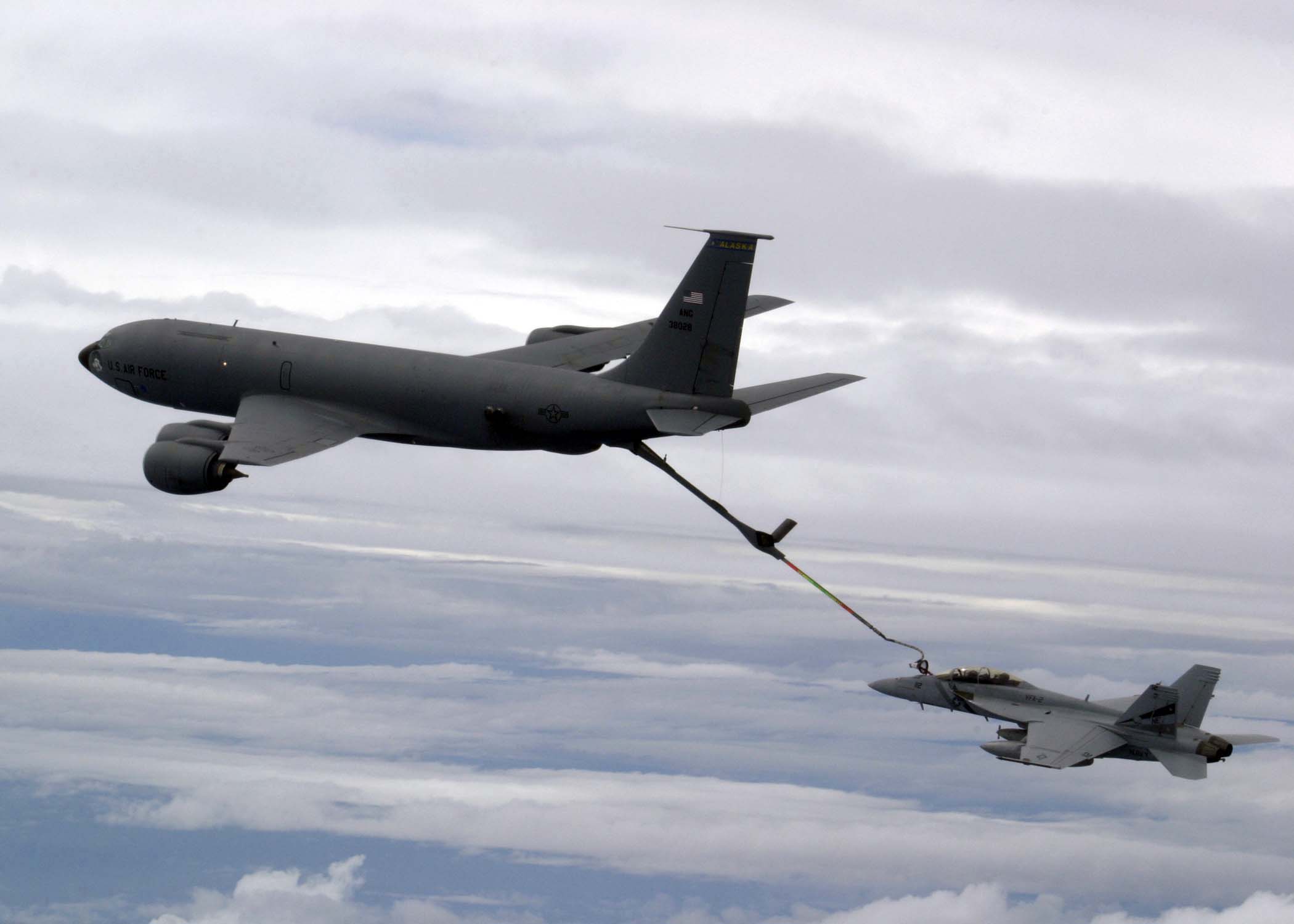
Considering the case of refueling, the wake's motion downward is much slower than the aircrafts' horizontal motion, so it wouldn't have descended much by the time it's left behind entirely.
[1] Available for free at https://www.faa.gov/regulations_policies/handbooks_manuals/a...
https://aviation.stackexchange.com/questions/9572/how-do-air...
http://cfile29.uf.tistory.com/image/145D430D4CFE23D50A5BD0
being close is relatively safe from wortexes - there still is some other turbulence to consider, but the standard turbulent flow caused by drag is chaotic so it'll shake you but will 'even out'
May I also recommend strong radiation source mishandling accidents?
It's not an approximation. I'm giving a sense of scale, not saying how much volume the plane has. The point is that while 11 million cubic feet sounds like a lot, if you put it in a big box next to the plane then they would be on the same scale.
> the plane isn't moving 11 million cubic feet just to move forward, it pushes on a little more than a quarter of that directly
That's jseip's post's problem, not mine.
https://www.scientificamerican.com/article/what-happens-when...
[1] http://www.boeing.com/commercial/737max/737-max-winglets/
Right now, it's the middle of the day (12:50p Central). There's a bit of a mix[1], but it's still predominately westbound.
The consequence of this is that most traffic will be separated by at least 2000 feet. Eastbound traffic will (generally) be at odd Flight Levels (so 29000 feet, 31000 feet, etc.) while Westbound traffic will be at even FLs (30000 feet, etc)[2]. This assumes RVSM airspace.
[1] I'm just looking at the transatlantic traffic on https://flightaware.com/live/
And all of them will avoid passing under a large aircraft at 180 degrees.
Source: my father is an airline pilot and they always take the time to learn from severe incidents.
Is there any leeway to adjust your heading slightly and then correct back?
NHTSA provides substantial grant funding for traffic-safety enforcement, conditional on the department's enforcement statistics for a particular set of safety-oriented violations, especially seatbelts. The brass encouraged us to take a minimum number of enforcement actions to maximize the chances of having the grant expanded. (It paid a for substantial chunk of our salaries and offered regular 1 1/2 overtime.)
Fun fact: At the police department, we actually had the seatbelt alarms for all of our cruisers disconnected. Being able to get quickly in and out without the seatbelts snagging on our gear was the priority at low speed. Most officers are trained to unbuckle and be ready to exit the vehicle before coming to a full stop (technically illegal.)
Making a quick guess that from '80-'08, Americans average 1MM flights/day, then odds of serious injury are ~1 in 95,000.
Odds of death are 1 in 9,333,333.
Assuming the possibility of taking 3 'average' flights/day, then you'd need to board flights non-stop for 8,523 years to die, on average. 88 years to be injured.
[1] - https://www.quora.com/How-many-people-fly-domestically-in-th...
It was hard to find good stats with quick googling, but this old source[1] suggests that blood clots during flights are the greater risk, killing at least 2,000 people in the UK per year. I suspect that keeping a seatbelt off while cruising lets you shift around more mid flight and would give a small decrease in the frequency of clots.
Still, as far as I know, the safety of standard commercial airlines is much better than both charters and private planes. Without the regulators to monitor the maintenance and pilots, it turns out people take more risks.
Sure there is. The chances of dying in a car accident are around 1% whereas the same in an air accident is, like, 100x less likely?
It's like how you wear a helmet when you're in a construction zone but you don't wear a helmet when walking around the city despite the nonzero chance that something might fall on your head. (Or do you?)
The reasons there are less accidents in the planes is not because they are inherently more safe (ever read up how helicopters work?), it comes from the rigorous rules around everything flying. The rules exists mostly because something happened and the industry set rules to make it not happen again.
You wear helmets on construction sites because the risk of something falling on your head is so much higher when people are working with loose tools in high altitudes, hanging from ropes or whatever. (And the company is responsible for your safety so will protect their asses from getting sued.)
Pretty much every traffic officer I know could find at least 5 reasons to pull over any car, no matter how scrupulous the driver.
It's an incredible feeling, lots of fun, and if you have to walk up the mountain first it's a nice nature experience as well. Yes, it can be dangerous, but it's a risk you can manage yourself. So it doesn't have to be very dangerous if one follows common advice and also don't ski where there is a high risk of avalanches.
Probably what Michael Schumacher thought to himself, back when he could still think.
Pedantic, but. Families with $1m net worth are largely late-middle-aged (newly retired) salary workers with paid-off mortgages on their median-priced houses in suburban flyover country, plus ~40 years of 401k contributions and capital gains.
They drive Toyotas and fly economy for their 1-2 yearly vacations because that's what left when the 15% 401k contribution, mortgage on 3bd house, children's educations, and groceries are paid for.
Think teachers, bureaucrats, journalists (pre-internet), scientists, engineers, doctors, and lawyers, in roughly ascending order. What you'd call the upper middle class.
There are about 8 million millionaire households in the US as of 2016 [0].
Private jets are more a feature of the Fortune 500 CEO Davos-going class. $1 million in income maybe, very different from $1m net worth. It's not generally useful to conflate these wildly different wealth levels under the same terminology.
Neither has much to do with being risk-takers, although you might be right that a higher arousal threshold desensitized them to risk. It may also be that people used to winning, on some level, expect to keep winning. Either way, we're not just talking about Fortune 500 C-levels here, plenty of people with loads of money and power did nothing to get it, and have no special qualities associated with that ability to get it.
They still often have bad outcomes.
Steve Jobs got pancreatic cancer, IIRC. Which has a pretty low survival rate, per wikipedia 5% after 5 years from initial diagnosis. So most likely he'd be dead by now no matter what he would have done.
Generally, you'll use flight levels until either you hit the transition level specified in the approach plate or ATC clears you beneath that level, at which point they'll switch to using feet and give you the QNH (atmospheric pressure at sea level) to calibrate your altimeter.
For example, the ILS/DME approach for 26L at Gatwick has a transition of 6000 ft (http://www.ead.eurocontrol.int/eadbasic/pamslight-48EDD962FD...)
From your wiki link:
> In the United States and Canada, the transition altitude is 18,000 ft.
Also, it's not like they never have no idea which airplanes are around them until they visually see the airplane. They could turn on the sign earlier if they know earlier.
If your neurological integrity isn't worth some hours in a seat, I guess that's your choice to make though.
Uh, no? "an Airbus A380-800 was observed by the crew passing 1000 feet above" http://avherald.com/h?article=4a5e80f3
> You're basically saying that we should plan for accidents
Yes, whenever possible. It should make sense, really.
> because
...because it's sometimes possible and predictable, in which case it logically makes sense to plan for it.
> wearing a seatbelt is somehow... what? Cumbersome?
Not because of that. But yes, it is cumbersome. Makes it harder to relax, sleep, get up, etc... is this really that shocking to you?
It is a little annoying when you have 20-30 minute seatbelt periods with barely any actual turbulence but there you go.
A more likely explanation is the severe underfunding and understaffing of prosecutor's offices and state court systems. Most prosecuting attorneys are responsible for carrying hundreds of cases at a time-- they have no choice but to prioritize, aggressively.
(I don't think it alters your point at all because you're still talking about constrained resources and a need to prioritize, but in traffic court in my village the PD is the prosecutor; my negotiation was with a police officer and he in turn represented the results of that negotiation to the judge. Same with everyone else's tickets. Only more serious stuff involved the town prosecutor - he was handling code violations, underage drinking, and a DUI.)
As a result, I try to call out abuse of the term millionaire whenever I see it.
http://articles.mercola.com/sites/articles/archive/2013/02/1...
http://health.usnews.com/health-news/articles/2013/02/07/ash...
Note that when looking at airline safety, you'll get misleading numbers if you go back too far. Safety has improved remarkably in the past couple of decades. In the 80s and 90s, a couple hundred fatalities per year was about typical in the US. In the last decade, the typical number is zero. There hasn't been a fatal crash involving an American airliner for over eight years, and you have to go all the way back to 2001 (November, not September) to find one involving a major American airline. Even if you include foreign airlines operating in the US, that only adds one fatal crash and three deaths to the recent total.
So yeah, there really isn't any one "the safety of general aviation." It's a huge spectrum.
Another challenge is reporting. The FAA knows exactly how many flights and how many hours the airlines did last year, but GA activity is much harder to gauge. It's hard to figure out what safety looks like when you don't have a good figure for the denominator.
The town prosecutor was handling the only DUI that day. (A town PD officer handled the lesser offenses, including mine.)
Despite the number of people who go through cancer, it's rarely brought up in polite conversation. It wasn't until I got it myself that all manner of people came out of the woodwork to talk about how someone they knew had gone through the same thing. Many of them have been using concentrated cannabis oil (which my brother also said I should do). After reading a couple of studies, it does have a positive effect on cancers, but the level depends on the type of cancer. In the case of colorectal cancers, it seems to stop the cancer but not kill it, most likely due to the CB1 receptors in the tumour being hypermethylated (as in, the gene isn't being expressed). The level of evidence isn't that of a systematic review, but it's enough for me to give it a go and certainly enough for further research. Unfortunately, the two sides of the argument seem to think that it either doesn't do anything (there's not enough evidence) or that the medical establishment is just a ruse and that cannabis cures all cancer. I prefer to use my critical thinking skills and get the best of both worlds.
I can understand why people might indulge in quackery - I've got surgeons telling me they need to cut out my rectum and part of my lower intestine, even with a full pathological response. Possible side effects are shitting 3 times a day (not so bad) and erectile dysfunction (worse). This has been the gold standard of care for 15+ years now, and the surgeons don't give a fuck about my quality of life, they just want to cut. There's mounting evidence to show this might be overtreating the problem, and that you can get away with a heavier dose of chemo with the radiotherapy. Frankly, I don't want anyone cutting anything out of me unless it's absolutely necessary, but it's hard finding an advocate who would be willing to tell the surgeons to fuck off.
I'm lucky, in this sense: I understand the research and I have access to upcoming studies (I used to work at an institute that did systematic reviews of evidence). Most people won't have such advantages, so they just sit there and do what the surgeons tell them to do, as if they don't have any options other than no treatment. If that's all the choice I got, I'd be wary of the medical establishment too.
They saw the plane, and 1-2 minutes later... bang. We already went over this.
We did, that's why it made zero sense that you said this was predicated on not being aware of the positions of other planes. They were aware of this a full 1-2 minutes earlier at least. They could've turned on the sign. The solution was totally implementable.
Your skull is vulnerable to impacts at speeds that are relatively low compared to full-speed cycling.
On a few occasions I've witnessed a cyclist panic and wobble after being passed far too closely by a car traveling far too fast for such a manoeuvre. This has caused such cyclists to wobble, inadvertently clip the curb and mount the pavement, fall off sideways and subsequently strike their head on a nearby wall whilst falling.
The resulting injury can be very harmful.
Another example of slow-speed head injury: off-road biking down a very steep incline with a loose surface. I've seen people fall and tumble at almost stationary speeds.
And, pretty much 100% of the time I go snowboarding, I wear a helmet.
What I'm trying to surface (apparently poorly) is that life, to some degree, is about managing risks. And we often respond carte blanche scenarios with exactly the same response, regardless of whether it's proportionally required.
Cycling - on road, moving fast, around anything else moving fast, at all treacherous conditions - sure, yes wear a helmet. But, casual cycling on a nice day, protected path - probably not required.
Another area of proportional risk response - portable devices on planes. At one time, end of the world if you had one on during takeout (seriously, other passengers would freak out if they thought yours was on) - and then, all of a sudden - every airport/airline in the United States lets you read your kindle, play games on your phone. People realized their responses were not proportionate to the risk.
No, bicycling is fairly high-risk in general, like skiing, or any other sport that involves a human body travelling faster than the average set of legs can walk it around. Even just going around the block a few times there's always the chance of some random events leading to an unfortunate encounter with a tree.
Of course, it's not skydiving either. And life is a series of risks, I'm not saying don't do it.
So yes you should wear a helmet while biking, but we should not make it mandatory.
In other counter-intuitive statistics about biking, passing at the red light is good for you.
"Rafi, how many of your friends have died in motorcycle accidents?"
"Pfft, nine. Buy NONE of them were from head trauma, they all died from massive spinal trauma."
Be honest... are you just playing the reference game, or do I need to be really worried?
Having personally done a header over the handlebars onto my helmet, resulting in a dented helmet and an un-dented head: yes, I'd recommend it.
    > anyone riding a bicycle,
    > even if they aren't going at
    > high-speed on road, should
    > wear a helmet "just in case"
I'm probably heavily influenced by the fact that I live in one of these places (where helmets are a legal requirement).
All I could think while reading this is "yes, you definitely should always wear a helmet!!"
I recall seeing studies showing that helmet-laws generally coincided with low use of bicycles. Places where cycling is extremely common (like Denmark and Holland) never seem to have them, and it's uncommon to see cyclists using them unless they're doing something particularly dangerous (riding in traffic, off-road, etc).
I think the cost of wearing an aircraft seatbelt while you happen to be seated is rather lower than the cost of having to wear a bicycle helmet, though.
Kinetic energy is also the reason why the flight attendants try to lock as much as possible of the loose items to the overhead bins or under the chairs.
Speed only makes a difference if your head hits something whilst moving at that speed. Or you can just fall off at a walking pace, and the acceleration between the top of your head to the ground is enough to kill you. Happened to a guy on the local trail a few years ago, as happens elsewhere as well.
I don't think one needs to be confined to the seat for the whole flight duration, but when sitting down, there is no good reason not to wear a belt either.
I kind of want the helmet-in-public fashion trend to kick in.
Hotter in summer, but they look cooler. ;-)
FWIW, I thought it was weird at first having to wear a helmet. I'm from the UK. Now, though, it just seems bizarre that I wouldn't. It's my skull! My brain is in there. It only takes one idiot, and knocking my head off concrete from 6ft up at even 10km/h sounds like a terrible idea. Anything that cushions the blow, even if that blow is unlikely, now seems like the most obvious idea in the world.
Mandatory helmets protect cyclists from injury - but make cycling less popular. Fewer people cycling means they get less exercise and increase other health risks. On average it's a health benefit to cycle without a helmet, compared to driving - and of course people are still welcome to add helmets if they don't mind them.
It's actually the reason why I don't use the bike share program, even though I have a station right next to my apartment building. I could ride it to/from the train station or the grocery store, but I'm paranoid about not wearing a helmet, and hauling the bulky thing around all day is a massive inconvenience.
I can't imagine fashion sense is much of a reason, that seems like a strawman argument commonly conjured up by helmet laws advocates.
Well, they do. Better to be a goober with an unfractured skull, though.
Regarding helmet hair, I had a colleague who had the most amazing hair spikes (think coffee cup sized), who would very carefully put a cycle helmet on every day before cycling home.
If the cops stop you (which they do, occasionally) and you are actually wearing a skate helmet, not rated for bike riding, that doesn't count as 'wearing a helmet' and you'll be fined.
(I'm sure the idea of being fined for wearing the wrong helmet will horrify some people but remember, that's the law here. The law also says you need a bell on your bike. It's rare, but the bike police do random stops and if you don't have a bell, strictly speaking, you'll be fined. Never happened to me, but it can.)
((Which, by the way - and sorry for the errata with the double-brackets - I actually support. I ride through central Melbourne. Pedestrians are a nightmare. Having a working bell is actually important. They cost $5. The law is a public service which, in this case, works. Get a bell.))
https://s-media-cache-ak0.pinimg.com/236x/09/de/53/09de53063...
https://s-media-cache-ak0.pinimg.com/736x/0a/a1/80/0aa180ef6...
If you're near Austin, the Texas Memorial Museum on the UT campus had a mounted skeleton.
I think maybe the GP is more amazed about the (self-) generated lift and assorted scale. Seems like humans have a thing for hurling self-propelled heavy metal boxes at ridiculous speeds, whether on ground, in the air, or in a vacuum.
"and then he said, 'ounces'"
Similar phenomenon to boiling water at high elevations. Walking up the mountain isn't heating the water, but the boiling point drops as air pressure drops.
The fact that air gets deflected downward is a necessary (c.f. conservation of momentum) effect too. So it's not incorrect to do the analysis that way. But it's absolutely wrong to correct someone saying that "lift is pressure" with "lift is actually deflected air".
This is clearly demonstrated by this incident. Many tons of air deflected downwards by the A380's wings had enough force to flip the unfortunate plane below several times.
The air "sticks" to the surface of the wing and leaves the trailing edge in a partially downward direction i.e the air is deflected downward by the top of the wing not just the bottom.
For a quick demo of this, hold the bowl of a spoon under a running faucet and see how it pulls the spoon into the stream.
The "equal transit time" theory that you appear to be referencing here (air over the top takes a longer path, thus it must go faster and air under the bottom takes a shorter path thus it goes slower) is a complete fallacy. There is no mechanism in physics that requires the air to "meet up" at the trailing edge of the wing.
If pure 'flat plate' theory was valid, then all those aircraft speeding down the runway with the leading edge of their wings canted downwards 20 or so degrees would result in the airplanes simply being pushed towards the ground and never lifting off...
And Boeing, Airbus et al would build planes with flat slab wings mounted at a 45 degree angle to the airflow, because that would give the maximum lift by the 'flat plate' theory, wouldn't it?
Not that I disbelieve that a flat slab cannot generate lift - but that it is probably a very inefficient way to generate lift compared to the standard aerofoil shape.
[0] - https://upload.wikimedia.org/wikipedia/commons/thumb/3/3b/Bo...
Explanation of why aeroplanes fly to airhost: https://youtu.be/AaE9j7u3XJA?t=642
From Captain to Airhost: https://youtu.be/AaE9j7u3XJA?t=1031
From First Officer to Airhost: https://youtu.be/AaE9j7u3XJA?t=1458
Hence the high pressure under the wing and the low pressure on top of the wing. The very act of 'deflecting' millions of cubic metres of airflow generates high/low pressure points. Hence at the end of the day, we could argue that the pressure differential is what is causing the lift?
Disclaimer: Not an aeronautical engineer, just a former commercial pilot.
Deflecting air downward is the way they create that pressure difference.
Get a piece of A4 or Letter sized paper and try this experiment with it [0]. For best effect, hold both the edges closest to you in each hand and twist the front edge downwards to keep it straight and prevent the paper twisting which could inadvertently straighten it. (i.e. Not with one hand like he is doing in the video).
The Bernoulli principle with postulates the Venturi effect is about the only theory that can explain why the trailing edge of the paper moves UPWARDS when you blow across the top of the curved paper.
No one questions whether the Bernoulli and Venturi effects actually exist. But airplanes are heavy and it's pretty obvious that the Bernoulli effect does not produce sufficient lift by itself.
As proof that most of the lift comes from deflecting air, I offer the fact that airplanes can fly upside down.
[EDIT] This also happens with the Oberth Effect.
The pressure explanations and the Newton's Third Law explanations are not different theories of lift. They are just different ways of looking at the same thing underlying thing.
The motion of a wing through a fluid has to conserve mass, energy, and momentum. If you analyze lift by focusing on conservation of momentum, you get the Newton's Third viewpoint. If you analyze by focusing on conservation of energy, you get a pressure viewpoint.
See: https://www.grc.nasa.gov/www/K-12/airplane/bernnew.html
The "Newton's 3rd. law" explanation treats the wing and its immediate surrounding as a black box: air flows in, and exits deflected downwards, so there has been some downwards-directed acceleration. It does not address details of that process, such as why the above-wing airflow usually generates the larger part of the lift, or even how the deflection occurs, though it is fairly obvious that some sort of deflection will result from driving an inclined plane through the air.
Regarding the law - it's illegal in Redwood City to ride on the sidewalk, but almost 100% of "Utility" cyclists (that is, people taking short trips who aren't decked out in "cyclist" gear) almost always ride on the sidewalk; and the police certainly did not make it a priority to ticket them - and given the density of police cars in Redwood City, any given cyclist traveling a few kilometers was likely to be seen by one, if not more police officers.
pushing a mass of fluid downward is equivalent to creating a net downward pressure. its the same thing, just expressed in different terms. the unit of pressure is force per square inch, for you americans. by integrating over all the area, you get the force that you are talking about.
What is this based on? My own intuition is that the risk is many times higher on a bike.
https://stacks.cdc.gov/view/cdc/13379/cdc_13379_DS1.pdf (Table 10)
You can read the HN discussion here [2], since this appeared on the front page a week ago, much to my surprise [3].
[1]1 http://ljjensen.net/Maritimt/A%20Review%20of%20Modern%20Sail...
For aircraft lift, "equal transit time" is not easier to understand than "an angled wing pushes air down, because of conservation of momentum that pushes the aircraft up".
Do the same experiment with the paper, but rest the trailing edge on a table. The air can no longer be deflected downwards, so the paper will not rise.
Another one to think about, at the air metal boundary the air is stationary on both sides of the wing. So why is there a pressure difference? Bernoulli's law is valid only along flow lines and is a consequence pressure difference required to accelerate (or decelerate) a fluid. Since in the laminar situation flow does not occur from the top surface to the bottom (minus around the tips), direct application is nonsensical. If you integrated all flow lines from all surfaces however, you would get the correct answer.
Not sure why people are looking at the situation as ONE Venturi plane. What I am trying to explain is that there is effectively TWO - and expanding one over the top of the wing leading to a low pressure effect, and a constricting one below the wing leading to a high pressure situation. I wouldn't say that both provide equal amounts of lift, but the paper experiment, and the 747 in the boneyard proves it to a point.
Extend the flaps and slats on that aircraft and I am sure the effect will be all the more pronounced.
And yes I've flown aircraft inverted too - it take a tremendous amount of forward stick to try and maintain level flight in that config to counteract the wings natural tendency to move towards the top surface.
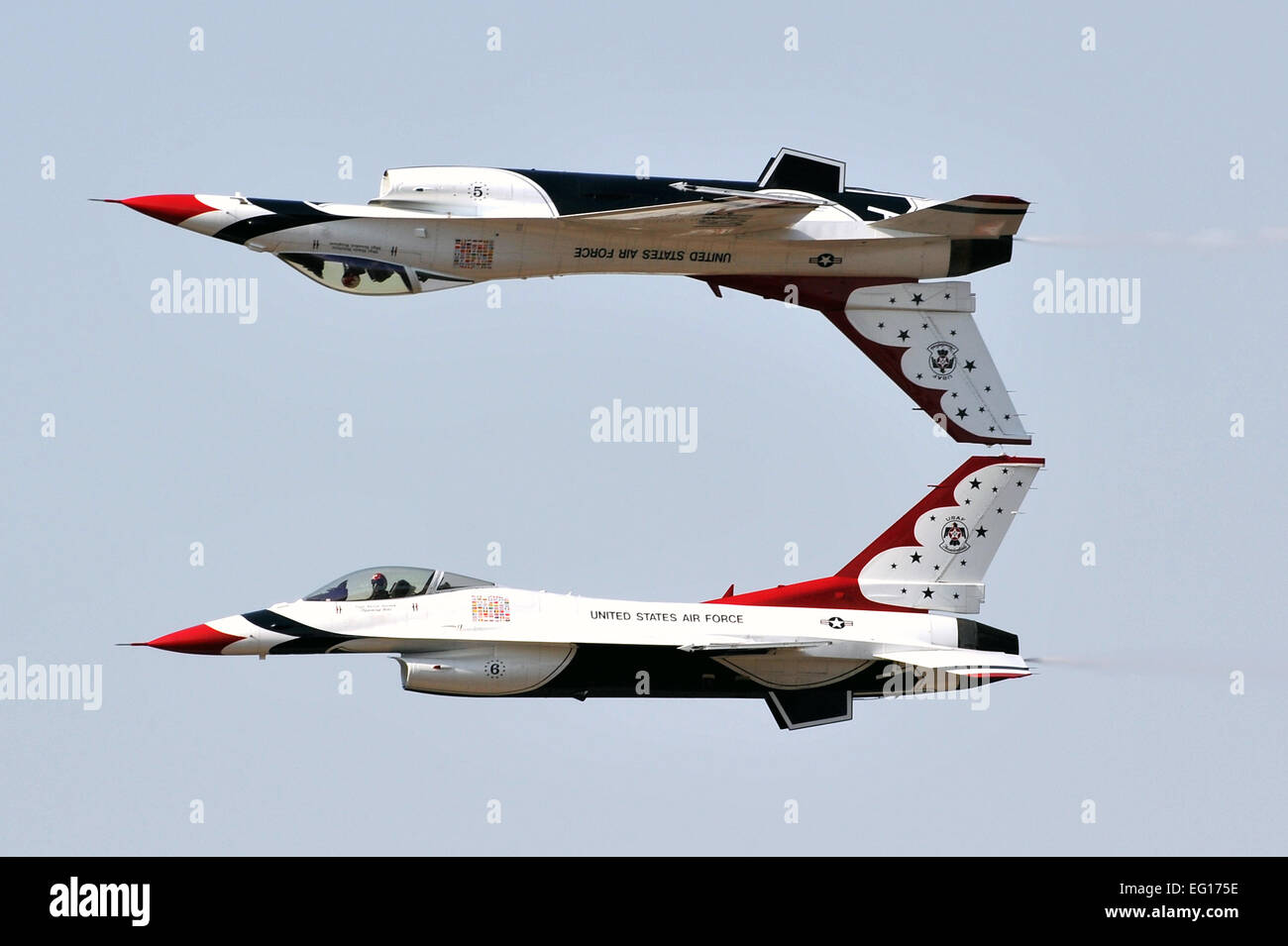
People have pointed out the "Thunderbirds" F-16s flying in the "mirror" formation [1] and not displaying much difference in AoA between the upright and inverted aircraft, but supersonic fighter usually have a straighter, almost trapezoidal shaped wing cross section rather than a curved 'fish' shape. I am willing to bet the inverted pilot has a fair bit of forward stick on though.
[0] - https://www.youtube.com/watch?v=cHhZwvdRR5c
[1] - http://c8.alamy.com/comp/EG175E/little-rock-air-force-base-a...
Yes it does. And those bullet impacts are the very definition of pressure.
The aerodynamics snobbery that you're trying to invoke is that those bullets also hit each other, so you can't make ideal gas assumptions and must model the whole system as a giant system of differential equations (c.f Bernoulli) if you want numbers out.
That doesn't change the fact that air pressure at the surface of the body is what causes the force on the body. That busybodies feel the need to argue against this bleedingly obvious point says some very bad things about the way the aviation community has tried to teach aerodynamics.
> Air isn't magic fairy dust that pushes on airfoils from a distance.
No. Like I said, it's a fluid that has pressure and velocity everywhere. At low enough Reynolds numbers, like for model gliders, you can even get away with treating it as a non-compressible fluid with decent results.
> Pressure is impact.
And contact between two objects is really about Pauli exclusion surfaces at the atomic level. So what?
Proof? Inverted flight on low power aircraft and gliders.
To whit, I've had the fortune to fly an old DH Tiger Moth biplane - on that little baby, when you approach the stalling point, you can actually see the the canvas on top of the bottom wing bulge and contort with pressure differential, and you can hear the sucking sounds as the airflow struggles to 'stick' to the wing. There is a little movement on the bottom surface of the top wing too, but not as pronounced.
I'd be interested to see in this thread, who here has actually studied aeronautical engineering, or flown actual aircraft, and who is relying on YT videos or a pure theoretical approach to come up with these theories?
Also interestingly, I believe most of the textbooks I used at flight school were filled with data from NASA and other US military branches with regards to flight dynamics etc., and here on this thread we see articles from NASA (albeit aimed at K-12 audience rather than trainee pilots) basically disproving their earlier academic research.
I studied Aerospace Engineering (PhD in Aerodynamics), and I stay out of internet conversations over "how" lift is generated. For me it is one of those topics that is just not worth debating. It seems that people get _really_ attached to their personally preferred theory of lift.
I don't think that is right. The tail wing has a different angle of attack than the main wing. On the order of one degree I think. This is so to give a self stabilizing effekt. When flying upside down you have to compensate heavily to avoid what would be a destabilizing effect.
Fair enough, it is symmetrical, but still has a lot of shape to it - only time I've been inverted was in a grob 103, and was a passenger for that part of the flight, here's the cross section of it's little sister which is also fully aerobatic:
https://en.wikipedia.org/wiki/File:Grob_G_102_Standard_Astir...
My point in the gp post was that since one can fly inverted, the shape of the wing is not the only fact. I think you and I are saying the same thing.
You can push the air hard on the underside, but on the top side, you have to gently accelerate the flow downwards, or else it forms vortices and you suddenly lose a significant fraction of the amount of air you would otherwise deflect downwards.
My point was you can still find a lot real world issues for example wing icing. So, that you need to be aware of what you are and are not simulating.
That said yeah if you're "wiping out" more than like once every few years you're doing something seriously wrong (or at least taking an unnecessary risk). I've only once had any kind of incident on my cycling commute.
Once I saw it, I had to slam on the brakes so hard my rear brake cable popped out of the handlebar, disabling the rear brake completely and I was putting full pressure on the front brake. I didn't have time to react and avoid going over the handlebars, and I hit my helmet on the pavement. (Thankfully, I did stop in time to avoid the truck hitting me).
Was I doing something seriously wrong? Yes -- I was riding a bike without a properly adjusted rear brake cable. However, this sort of mechanical issue (and any number of others) could happen to any riders who aren't much more hyper-diligent about maintenance than average.
Who knows if we'd even be having this conversation had I not been wearing a helmet that night.
From a public health perspective, evidence suggests making helmets mandatory is counter-productive, and so I don't support those laws. However, I still maintain that anyone who cycles without a helmet is fucking stupid.
Maybe we're all "fucking stupid", but by the stats someone cycling without a helmet is less stupid than someone driving, at all. There's this weird, disproportionate cultural obsession with helmets for cyclists and cyclists only.
Flying inverted in a relatively stable aircraft requires a lot of forward pressure because for the inverted aircraft's wing to have a positive angle of attack, the horizontal stabilizer has an even larger positive angle of attack. The pilot must counter this with the elevator to establish a stable ratio of lift to downforce.
Less efficient - but makes for symmetrical performance.
"Wings generate lift by changing the velocity of the flow around them" seems general and correct but the why part is pretty tricky without notions of continuity and conservation laws. And vorticity helps a lot, too.
http://ljjensen.net/Maritimt/A%20Review%20of%20Modern%20Sail...
I've contributed all that I wanted to say here, and am happy to bow out now and let the conversation take its course.
I think "It's complicated" and "Why do you need to know?" are often the only appropriate answers, as context is important. I've read some "aerodynamics for pilots" type books that from a research point of view I considered to be, to some degree, wrong. But ultimately they were _right_ in that they taught the pilot exactly what they needed to know.
In a way it reminds me of electricity. I know enough to design and make simple circuitry, but I know electrical engineers and physicists that could run rings around me at both the circuit design level and the "That's not how electricity works, you idiot!" level.