https://nationalpost.com/health/jordan-peterson-benzodiazepi...
Horrible drug.
Someone that identifies as a neuroscientist.
He knew very well but thought he was special.
The only thing special is that he went cold turkey (extremely dangerous) and had to be placed into an induced coma in Russia because no one else would do it.
Basing anything off of his antics is asinine. So weird to see people who put him on a pedestal on HN.
& benzos aren’t “horrible drugs”
People who don’t know how to manage themselves and their usage of them are horrible people though, especially when they try to cut down others who have no issues using them responsibly, which sometimes literally saves their entire lives.
considering how benzos came into existence barely half a century ago, i highly doubt not having benzos as part of one's pharmaceutical cocktail is the fundamental difference maker to one's life or death. so even to those who are now dependent on them, their long-term health will almost certainly be better served by getting to the root cause of their health issues. not saying that's an easy thing to do, but that's still the reality.
> Basing anything off of his antics is asinine. So weird to see people who put him on a pedestal on HN.
Plus, the anxiolytic effect quickly turns into a dependency, as when the withdrawal starts kicking in you're inclined to start having anxiety attacks.
Suppose you want to get off them. Now you have a significant problem. Can't quit cold turkey -- you're likely to have a seizure.
So yeah, basically opipramol and guanfacine should be what humans take as first line. Glycine is a nice obvious augmentation (kinda absurd that people forget about the second inhibitor neurotransmitter in the brain, especially since the effect feel nice and doesn't really lead to tolerance). if you have benzo neurodamage, take magnesium lthreonate which is a very potent synaptotrophic.
also fun fact: the benzo cartel was so strong it was the most prescribed drug in the world, all classes, in the 70s
Like, no shit?
That said, it's not my area of competence, so if you know _why_ opipramol and guanfacine are ignored compared to benzos and other anxiolytic, you should probably explain that.
EDIT: re: guanfacine, I know it's a second-line treatment for ADHD, it was previously used to treat hypertension, but this is the first time I hear it might be applicable as an anxiolytic. It does certainly have side effects, though not as bad as being neurodegenerative like benzodiazepines.
Your suspicions are correct. The parent comment is an example of a trend among people who know just enough about pharmacology to be dangerous: Exaggerating the benefits of less popular medications while demonizing mainstream medications. Add a dose of conspiracy theory ("pharmaceutical industrial complex") and it's a recipe for contrarian exaggeration.
The parent comment strangely missed the actual mainstream, effective treatments for anxiety: SSRIs and Buspirone are widely used for long-term anxiety treatment with significant success. They’re not perfect and you can find horror stories if you search the Internet long enough, but people tend to get fooled into thinking mainstream medications are worse than obscure ones because mainstream medications will naturally have a higher absolute number of negative reviews online than rarely-prescribed medications.
In practice, it would be rare for a doctor in the United States to prescribes benzos as a first-line and long-term treatment for chronic anxiety. They are prescribed for panic attacks and short-term anxiety (e.g. a difficult court case with an end date) but SSRIs are the mainstream treatment.
And there’s tons of reasons for that, ranging from:
- doctors that cling to the treatment they know to work (“the devil you know”)
- sheer lack of knowledge (not their speciality so they’re not up to date by a long shot)
- waiting for a few more years to have long term real world data
- pharma companies effectively bribing them by any means so they don’t look elsewhere
Long history of RX for anxiety disorders, which I eventually tapered off of and quit due to dependence.
Can attest to Etifoxine being effective without side effects, guanfacine and clonidine being mildly effective. Beta blockers never did much for me but YMMV.
There were some limited studies that suggest it is effective in helping sleep quality in people with nightmares and PTSD. Now, I don't have PTSD, but I do have a mind that will not shut off at night, running in useless circles that jolt me back awake. It does nothing for the racing mind, but my body's physiological reaction to my emotional state is lessened. I physically relax, quite literally in smooth muscle activation terms, and apparently that lets me get to sleep.
Beta blockers are probably a bit more heavy duty, but they do appear to be quite effective at treating performance-related anxieties from another small study. Shakes? Chills? Dizziness and blood pressure spikes? From the discussion I had with my psychiatrist, I think the working hypothesis is that treating the physical symptoms of anxiety is an effective intervention here, as the discomforting experiences that the initial anxiety triggers, creates a feedback cycle. (Oh god, now I'm sweating and flushed, everyone's gonna notice...!)
Treating high-blood pressure with an ACE inhibitor (which does not treat anxiety) can reduce anxiety simply by relieving symptoms that feel like anxiety.
Beta blockers have the nice effect of directly treating both anxiety and high blood pressure.
magnesium l threonate before sleep, the lthreonate variant penetarte the brain far more than regular magnesium, and it acts as a mild NMDA antagonist, which means it decrease maximal excitation. it is also a great synaptotrophic.
Personal experience, it doesn't have noticeable psychoactive effects like benzos do but does block stress response + panic.
"Mother's little helper" was a term coined during the 60s and 70s (Diazepam - aka Valium)
look at the pictures and admire the amount of saved brain volume https://www.researchgate.net/publication/221738761_Evaluatio...
You misspelled kava.
I’ve just seen a confusing amount of HN users who do speak of him in such a manner & thought I would make reference to that for context.
Dude, I've spent my entire 20s in therapy while trying various "safe" drugs to get ahold of my anxiety issues. Nothing worked. I was offered electroconvulsive therapy or daily benzos. I went with benzos. I've been taking them for years now and my life is infinitely better as a result. I've changed careers, gotten married, and traveled the world. Before benzos I was living with parents, too anxious to go across the street to get the mail.
I really don't think it's right to dismiss a whole class of highly effective and generally safe medication that can have life-altering benefits for some people. I'm okay with being slightly more retarded in my later years if it means I actually get to live a life outside my parents' basement.
- pharma companies who spend more to get the lion's share of ad time keep their brand at the forefront of consumers, consumers then ask for those medications and then don't know about alternatives because they've been drowned out
- arguably some of most effective drugs have been illegal the past 40+ years as part of the "war on drugs" (did pharma industry help make those illegal?): marijuana, psilocybin/DMT, MDMA, and even cocaine will knock people out of a depression - where it could be taken weekly or less (arguably potentially more addictive than other medications, but SSRIs with severe withdrawal symptom is arguably equivalent to addiction, the aversion to the withdrawal symptoms) - but pharma can't patent any of those, so they can't gain exclusive rights to a brand they advertise to manipulate people to buy or trust their brand over something else (so patented drugs can captured more revenue and have more profit to pay more for ad time to drown out cheaper, more effective competitors).
- etc.
I had to add the c-word, though ("causes"). The article uses it several times, so I suppose it's ok for the title. Please let's not repeat the usual "C is not C" business.
It makes me feel so relaxed.
I knew it was too good to be true.
Self PSA that probably nobody should take your opinions seriously.
Nobody should be interpreting their response (or a child’s response) to stimulants as a diagnostic indicator for ADHD. It’s also worth noting they caffeine isn’t an effective ADHD treatment (it had been studied) and caffeine and Adderall don’t actually overlap as much as people seem to think.
Also, yes-- caffeine isn't a great treatment here either. With respect to ADHD there are more effective methods.
Related research:
https://pubmed.ncbi.nlm.nih.gov/6110701/#:~:text=The%20admin....
https://psychcentral.com/blog/adhd-millennial/2018/06/when-s...
https://www.ncbi.nlm.nih.gov/pmc/articles/PMC4617411/
https://www.psychiatryadvisor.com/home/topics/child-adolesce...
How is this possible? Don't the magnesium ions fully dissociate once they come in contact with water, so that there's just free floating Mg+ and threonate?
I have made extensive research on magnesiusm forms in the past, there was a great study comparing the amount of magnesium that crossed the blood brain barrier per form. Between a form and another the difference had a lot of variation. Magnesium taurate (not threonate) was the one with the highest crossing. however this study included all forms except threonate.. threonate is known to cross the brain much more than the others and it shows in studies, the effect on synaptogenesis/ gained IQ points is huge and incomparable with other forms. The unknown is how threonate and taurate compare. I'm not aware of comparative studies for threonate but you can see e.g. https://pubmed.ncbi.nlm.nih.gov/31806980/ for absolute values.
As to why? I don't know.
Overall doesn’t seem to be worth it though.
Anecdotes like this are purely coincidental. Parents think they notice one thing, then later get an ADHD diagnosis and assume they’re both related.
Like I said, caffeine and ADHD medications don’t actually substitute for each other and have drastically different effects. Caffeine is not an effective ADHD medication, so it’s not relevant to the studies you’re linking.
Are you honestly going to claim that the many multi-billion dollar pharmaceutical industry doesn't have a financial incentive to lead people toward 1) daily use medications that gives the industry a monthly recurring revenue stream, 2) where many people on them long-term because many of them have severe withdrawal symptoms so they are very hard to get off of?
And then something like 80% of ad revenue of mainstream media in the US comes from the pharma industry - so how do you suppose that influences what news and narratives are shared or allowed to be shared to the majority of a population on the mainstream-mass media channels?
You conveniently also forgot to mention that SSRIs, for example, actually increase the rate of suicide (along with suicidal ideation) - so you're more likely to kill yourself if you take them then if you didn't take them; that is from their clinical trials. It's the elephant in the room that's been mostly suppressed from conversation for some reason, somehow - probably in large part look at my previous paragraph for one mechanism used.
Are you also claiming then you know "more than just enough about pharmacology" in order to give a more credible response? Or are you perhaps arrogant thinking you're more competent to respond - but perhaps instead you're just indoctrinated into a biased perspective? Do you work in the medical profession, perhaps even one that prescribe medications? Consumers are bombarded by propaganda, and professionals even more so.
In reality you probably don't actually have any idea what level of knowledge nor experience the person you're responding to, saying that their response is dangerous.
Reality is more complex than you're currently aware of.
Benzodiazepine patents expired long ago. Same with most SSRIs.
If you're suggesting that pharma execs are conspiring to get rich by selling people their $4/month generic Prozac prescriptions, then I don't know what to tell you. I suspect your thinking is motivated more by narratives and conspiracy theories than facts and figures.
> You conveniently also forgot to mention that SSRIs, for example, actually increase the rate of suicide (along with suicidal ideation) - so you're more likely to kill yourself if you take them then if you didn't take them; that is from their clinical trials.
You have NO idea what you're talking about and you're spreading harmful misinformation. The black box suicide warning is for the startup period and is a rare side effect. SSRIs have a net reduction in suicidal ideation.
The patient population who has been prescribed SSRIs is more likely to be associated with suicidal ideation than the general public because SSRIs are prescribed to depressed patients, not the general public.
> Reality is more complex than you're currently aware of.
I'm very confident in my knowledge of these subjects and it's clear from your posts that you've been consuming some alternative medicine propaganda. I hope everyone reading this can see that you're pushing alternative medicine concepts mixed with conspiracy theories, not actual research.
"The black box suicide warning is for the startup period and is a rare side effect."
Right, so once you kill off the people who will have that "adverse event" then it's all good!
Except, let's go to the actual clinical trials - where it shows you're more likely to kill yourself if you take them then if you don't.
So your argument seems to be it's okay if more people kill themselves by taking these medications, so long as the overall quality of life increase of the majority improves? Is that what your stance is? You're okay with more death - rather than finding and supporting/providing a solution that doesn't increase death? I'm curious how you value life?
It seems you have more of a moral framework that the "health of a society is more important than the health of the individual"? That would open up into a whole discussion on its own of how one orients and how one determines an individuals value and impact on society; I believe the individual is the most important factor, and each life is priceless - a whole universe is lost with each life lost.
Instead of saying what I'm saying is dangerous without actually citing the clinical trial data as evidence - which I'm not doing either - but I'm not saying what you're saying is dangerous and "misinformation" - if you want to stop being so shallow in your replies we can go into the actual research and data, but you already admitted the "black box suicide warning" - and where you just don't seem to care that the "rare side effect" actually results in more people killing themselves if they took it than if they didn't take it.
But you seem like an extremely intelligent ideologue, highly articulate, but who's never actually gone down into the data - and also where some people dying is minimized by you as a "rare side effect" yet without
And a statement like "SSRIs have a net reduction in suicidal ideation" is also dishonest and misdirection because you're then ignoring, avoiding mentioning there's an increase in suicide - e.g. there's a net increase in death if you take them; but yes, if you kill off all the people who will have the "rare side effect" and then your pool of people who'd participate in future clinical trials have already been pruned off, then those future trials will ; so then we'd have to get into the ethics and review of clinical trial design - which more often than not is lacking.
"I'm very confident in my knowledge of these subjects and it's clear from your posts that you've been consuming some alternative medicine propaganda. "
You're so full of yourself, it's incredible - and the double standard is hilarious.
Where's your citation of the data if you're so confident in your knowledge, and why is what your saying not the actual propaganda?
Anyone with better logic and critical thinking than you will see how your skirting actually addressing my points as well. E.g. That same patient population - in clinical trials, where you have the placebo group and the group given the SSRIs - MORE PEOPLE KILLED THEMSELVES IN THE SSRI GROUP THAN THE PLACEBO GROUP.
Your second last sentence doesn't even fit the frame of how clinical trials are done: the control group isn't the "general public" - the control group compared to are those who qualify through whatever method for the medication - but then are selected for the placebo, and less of them in that group in clinical trials kill themselves; and you don't even realize that. Are you willing to at least concede that point?
So I'm the one who has "NO idea" what I'm talking about?
And if you respond, please respond to each line so we can all see if/what you're cherrypicking and avoiding.
Or at very minimum just respond if you concede/admit to your logical mistake about putting forward the argument that the control group is the general public - when it's not - because otherwise you're so indoctrinated and arrogant that you're just throwing out terms like "dangerous" and "misinformation" as filler.
There are probably a good 6-12 books you should read on the pharmaceutical industry to open up your eyes to their shenanigans; and these books are very well written, very well researched, citing research, etc - to pre-emptively counter your shallow-weak-empty "conspiracy theorist" argument point drivel.
also, those russian researches are generally validated by non-russian working groups.
as an example, many of the favorites nootropics people experience have been discovered in russia (racetams, bromantane, etc)
Generally speaking - not great. There are some interesting Russian compounds out there that seem to do something, but they always fall way short of the miraculous effects shown in old Russian studies.
Old Russian pharmaceuticals have actually been a gold mine for supplement sellers in the past two decades because they're basically unregulated pharmaceuticals that can be marketed in the United States and other countries while pointing customers to questionable Russian studies to promote them.
If you browse Nootropics forums, you can find scores of people who tried the various compounds. Few people seem to continue any of them for very long either due to lack of primary effects or growing side effects. As I said, the Russian studies paint a very optimistic picture of the drugs.
Look at it this way: If any of these old compounds were really miracle drugs, the big pharmaceutical companies would be rushing to get them to market in the United States with some creative patented exclusivity. But none of them have taken any of these compounds past the early research phases. Similar story in other countries.
Some potentially interesting compounds, but you have to take the studies with a huge grain of salt.
Dependence-causing anxiety medication generally had noticeable psychoactive effects. EG, Phenibut, benzos, etc.
I wasn't sure if it did anything at first because I can't notice any kind of headspace change. But sure enough, if I have anxiety and feel like I might get a panic attack, taking ~100mg makes the anxiety subside.
I've also had really good experiences with Buspirone, 10mg twice daily.
You can't generalise your experience. Everybody is different and that's the doctor's job to assess whether the benefits outweigh the cost, considering the patient and their problems.
Personally, I've been taking benzos very occasionally for 20 years (never more than a few days at a time) and they helped me overcome difficult times. Never had the slightest addiction or side effects.
> Treat the cause, not the symptoms.
Easier said than done
Never even the tiniest sign of dependence. Sometimes I go months between uses.
I am also a chronic pain patient and I worry that benzos are going to get the opioid treatment.
There was a period in the mid to late 2010s where patients who depended on opioids for any sort of quality of life were taken off of their medication without any sort of alternative. It’s something that people love to gloss over when they talk about the opioid crisis, but if you knew someone personally who went through that, you know that we collectively subjected those people to torture.
I also tried a few many years ago, but they didn't really do anything for me. I think they only work if you got anxiety or something, so some underlying issue which -if chronic- is probably not a good fit. Never had any cravings since.
Even such a small dose I feel restores a sense of normality that I haven't experienced in over 10 years without them, I'm able to rationalise what I want to say, conversation flows, I feel in control. With all that said, I've been doing this for a while and have never come close to addiction and no noticeable side effects. I continue to work on the underlying causes but without them I would be much worse off.
I take it a few times a week as needed, small doses (2-5mg) and I feel that I am in control of it and could go off any time.
If you have been taking benzos for 20 years you might have an addiction. Parent poster was talking about cravings a year later.
Yes but easier comes with a greater cost.
This is widely true for broader society where we are all busy taking the convenient solution over the harder, proper way, because screw long-term.
Sometimes, you have to realise that what pharma companies list as 'side effects' are not that at all, they're effects. Think about that.
It’s harder to clear trauma, teach emotional regulation and to build a life that is healthy, yes. And, it’s a path worth walking down.
Have you been hiding under a rock? American doctors are completely corrupt and in the pockets of "big pharma". They've gotten millions of Americans addicted, and caused countless deaths and unimaginable human suffering.
Would that not mean the same to your own?
Don't. Just don't. Please.
Just a few weeks of usage can cause dependence. It is notorious for causing compulsive redosing. Withdrawal can make you unable to sleep for days, with lingering effects like panic attacks and anhedonia for weeks and weeks. Withdrawal from larger quantities can cause auditory and visual hallucinations and seizures and can even KILL you. Avoiding serious symptoms requires an excruciating taper that can take months. The effects of long term abuse are poorly understood.
"But it's totally legal, and with responsible dosing can be a potent nootropic. I'm not a drug addict, I'm a biohacker. I'm not after a high."
Yeah, That was my thinking too, and in hindsight that was immensely stupid. Please just look at r/quittingphenibut before doing anything.
Be kind to your GABA receptors.
Do not take drugs every day. For real. I don't want to victim-blame but it is wild that you expected to be able to be able to take drugs daily for weeks without withdrawals. As a rule of thumb, unless you intend to be on it forever (e.g. caffeine), you should never take anything more than maybe 2 days out of 7 in the week. Psychoactive drugs are not like aspirin, where you dabble a bit as necessary.
Phenibut is serious stuff. Nobody would say "I had only been drinking a pint of vodka every day for a few weeks before I realized I might have to deal with withdrawals."
I'm sorry, but you fucked up, with the focus being on "you". Phenibut is notorious for building tolerance fast, and having bad withdrawal.
I really really dislike it when people try dangerous things in obviously wrong ways, then act like it's society's fault that they were available. No, it's not. I've tried a lot of things over the years, and I've been properly paranoid with most of them. I'm extremely creative with treating my insomnia but guess what: I have two doctors I check with. I don't care when they laugh at me (like when I told them I'm taking 1/60 mirtazapine pill), or when they shrug. I keep checking for the moments when they say "no, that's a really bad idea", and I keep doing that even if they keep saying nothing for 10 years at a time. Because even one "no, that's stupid" makes it worth it.
Interestingly enough, a suspected GABA prodrug that supposedly passes the blood-brain barrier called picamilon has been banned by the FDA, yet phenibut is still on shelves.
GABA receptors are critical to sleep. After prolonged usage of alcohol, or benzos, sleep often becomes impossible without an ever-larger dosage.
These sleeping difficulties sometimes persist for quite a while, and sleep disturbances are one of the primary causes of relapse in alcoholics. People learn that alcohol helps them to fall asleep. Even if the quality of sleep is poor, it's substantially better than no sleep at all, as anyone who has gone through what you did surely knows.
I'd never considered that alcohol could trigger the need for Ambien. I'd presumed it was a lifestyle thing for someone who was used to being out all night.
I completely agree that benzos are bad news unless you truly need them. In my relatively uneducated opinion, I don't think they should be a first-line treatment and it's kind of a joke that they're considered schedule 4 (at least compared to things that are schedule 2 - I don't think really anything should be "scheduled"). Benzos and other gaba-ergics may not be as pleasurable as other drugs, but they're very addicting and have the most harmful withdrawal process of any class of drugs.
Phenibut and the prevalence of RC benzos (which aren't subject to the federal analogue act since benzos are schedule 4) are another phenomenon. I think people underestimate the risks of this stuff due to how easy it is to get them - especially phenibut which is sold in a lot of more "legit" websites.
I mentioned it the old doctor, but they didn't know much about it. The newer doctor researched it and was horrified by it.
Mixing them is terrible and should be avoided at all costs.
Do you ever wonder if maybe something about your situation might be different from most other people prescribed benzos? For example, the concurrent phenibut use.
Absolutely, but benzos are a temporary fix regardless of anything else. They can't fix underlying causes. Obviously people can pop a xanax every once in a while and not go crazy like me, but if you're doing that, perhaps you should look into other treatments like modern SSRI's.
Taking the Xanax allowed to me relax enough to do the work to figure out how to relax naturally. Before the Xanax I was having crippling panic attacks 24/7.
My only point is, you're a data point of one, I'm a data point of one we both had very different experiences. I don't tell people to take, or not to take benzos when they ask me, I just give my objective experience and let them make their own decision.
This is just a side note, but I’ve never heard of anything like this happening before with such a short course of benzos.
That doesn’t mean it’s not happening, and it doesn’t mean that it’s not the benzos, but because it’s an unusual outcome, have you considered looking into other possible causes?
You were taking the benzos for sleep, after all, could a different underlying cause have gotten worse or been exacerbated by the benzos?
To be clear, this isn’t to diminish or invalidate your experience, it’s genuine concern from another human.
Anxiety was the underlying cause of all of this, and I was dealing with a lot of stuff in life at the time that was causing me anxiety. So yes, it wasn't just the benzos and the phenibut. My body simply couldn't handle any anxiety and I was putting myself in situations that caused it.
And you get addicted in like a week.
Be very careful.
It didn't make me feel particularly euphoric, but I did find myself craving it the next day. Shit is fucking weird and scary.
Not sure if that's right. Alcohol withdraw can actually kill you.
https://pubmed.ncbi.nlm.nih.gov/22371848/
Conclusions: Receiving hypnotic prescriptions was associated with greater than threefold increased hazards of death even when prescribed <18 pills/year. This association held in separate analyses for several commonly used hypnotics and for newer shorter-acting drugs. Control of selective prescription of hypnotics for patients in poor health did not explain the observed excess mortality.
I've had the same bottle of Xanax around for 5 years. It's more like a "break the glass in case of emergency" type thing. Usually reserved for going to funerals or weddings of people I hate, when I can't tie my tie because I'm in a cold sweat. As the kind of alcoholic who never turns down a drink, it surprises me how strongly I don't want to touch diazepam, how little inclination I've ever had to take it recreationally, even though I enjoy it and know it can provide short-term comfort. On a lot of occasions, having the bottle in my pocket just in case has been enough.
Then again, that might be because of how strongly it reacts with alcohol, which is a given in most situations where I'd break out the Xanax...
I was finally roused to go help my brother who had done the same thing but instead of sleeping he wrecked my motorcycle and bounced his face off a tree (helmet on, he was ok).
A few minutes down the road my uncle had done the same thing but was already home--he managed to total my cousin's car (his son's car) in the driveway....in reverse.
After that I was done with benzos forever. My brother and uncle weren't though. As a result they are both in an early grave.
There is more to the story but benzos we're always central to dangerous addiction, raging drug abuse, and heroine use. Around that time my brother almost died by drowning in a bowl of fruit loops on a benzo bender. His girlfriend found him face down in the bowl and saved him--and subsequently left him afterward.
My dad (also dead from addiction) was on benzos for many years...very small dose. He was an alcoholic and the benzo+alcohol mix (I found to be a very common self medication and recreational outlet) literally destroyed his life.
I have a pretty negative and reactionary stance against the whole range of pills that people deal in. Though, my experience is one where I have never seen anyone be helped by them.
But I think they're a valid last-resort treatment for panic attacks if we're talking less then twice a month-ish range. Reason being is that they will reliably work every time, and for many people including myself just knowing we have it can prevent panic attacks. But you still need to be treating your anxiety with therapy and/or other medications (but especially therapy) - its only a last resort.
And I mean using it very sparingly, I only take it once every few months, and only the lowest dose (klonopin @0.5mg max) to take the edge off so I can work through it, not enough to remove all the anxiety.
EDIT: Oh and anyone with addiction issues should stay away from these. They work _every time_ which is so tempting to use for just mild anxiety and my understanding is higher doses then what I take are euphoric so stay clear.
Most people ignore this part.
You tell people having a panic attack not to take a sublingual benzodiazepine?
A friend of mine has panic attacks all the time. He should be on SSRI's but refuses because his anxiety is telling him that they'll destroy him. Can't do any worse than his existing anxiety though.
By all means comrade, supply UBI, universal healthcare, and quality housing for free.
The reason I was stressed in college is because I didn’t have those things and I needed to work exceptionally hard in a cutthroat stack ranked program to stay afloat. Once I was making $100k+ (I was living in SV) and had a financial cushion instead of barely scraping by - I didn’t have as severe of sleeping issues. Same with getting a partner. It was nice to share the bed with someone instead of being alone for 26 years.
Doctors prescribe stuff because that shit isn’t possible to fix by them or nearly anyone else on an individual level. It requires systematic changes to our entire economy (and dating economy for the relationship part).
I feel like this is very easy to gloss over while reading, but in actuality is quite an intense experience to have gone through. This would drive me actually insane, I don't know how to coped with it
Edit: sorry, I always assume other people have access to medication. I don't so I shouldn't have laughed.
Yeah, so there are a few gabapentinoids/gabaergics out there, and they can help a lot.
But please read everything you can before deciding on something.
Just a couple of pages of Phenibut experiences have convinced me to not try it because there are better alternatives with fewer side effects.
For people with anxiety and panic attacks, benzo’s are literal lifesavers.
This same strain also has a well known splice variant mutation in a key mitochondrial gene, NNT, that modulates both mitochondrial and macrophage function. The microglial mentioned in this paper are a special class of macrophages that reside in the CNS.
Given these comments, when the authors refer to “wild type” (WT) mice, remember these are anything but true wild type mice. Fully inbred strains always carry numerous homozygous recessive and dominant mutations (several hundred each) that often affect CNS, immune systems, and mitochondrial functions.
The results may well hold up in other strains, but I would not count on it. Do benzodiazepines affect all humans uniformly?
Would studies of other strains or types have been practical? Yes. The Thy1-GFP and Thy1-YFP lines can be crossed to make F1 hybrids. This particular transgene is also available on at least one other strain of mouse (DBA/2J).
Unfortunately, most reviewers at Nature Neuroscience are not geneticists ;-) They are typically strong molecular neurobiologists who are used to reductionist methods. They are perfectly content with submission to Nature journals that are based entirely on with N=1 mouse genome—almost always the mutant C57BL/6J inbred strain.
In my own work I try to avoid this N=1 trap. (But I have also failed ;-)
Generality and robustness of results (see quote below) should ideally be established across two or more diverse genomes before making broad claims of relevance to other species, including od course to humans.
The quote:
“We have demonstrated that microglia in WT mice alter their morphology and functions upon diazepam treatment and cease to do so in Tspo−/− mice.”
So if I were to put on my speculator’s hat for a second, having something that destroys neural connections at a local scale would probably be compensated with increased volume of noisy communication at a global scale.
And having heard ex-benzo addicts describe the withdrawal as like having your brain lit on fire, well, that tracks..
I know it's only in mice, but it's pretty scary if it also has this effect in humans even when only taking it for a few weeks. Based on the title, I was initially kind of expecting something like daily use for years.
Being bipolar, I find they are necessary for suitations my regular medication and coping mechanisms can’t handle. Without them, living a normal life would be difficult.
That said… benzos scare me. Taking one pill will calm me today, but at the expense for increased anxiety the next two.
If I go to a convention, I’ll have ramped up to my max dose around the second or third day. After that, it becomes less effective because I can’t (and won’t) increase it more. I’ve only gone five days at most and by the fifth day, my anxiety is the same it would be without medication. Coming off that afterwards is brutal.
If I had another effective option, I would use it. I’ve tried very hard to “power through” my symptoms or find alternatives during my first year being diagnosed. My psychiatrist, therapist, and friends had to just about physically slap me to use them.
My doctor very thankfully instilled a level of fear and skepticism in me from day one when he prescribed them, explaining that while they were a viable option for me in the moment, the effect begins permanently wearing off very quickly. They got me through some stuff but I was happy to stop taking them and hope I never am at the point where I need to consider them again having heard where it so often goes for people.
I don't know why benzos are used for sleep anymore. It's generally a higher dose than what's needed to manage anxiety, so there's increased risk of dependency and you build up tolerance quickly.
In contrast, something like a low dose of Seroquel is at least as effective, has a much lower addictions & abuse profile, and tolerance doesn't build up very quickly at all.
On top of which there should very rarely be any need for regular sleep aids. Chronic idiopathic insomnia is relatively rare, and any other forms should have treatment protocols that don't involve heavy duty maintenance meds.
Maybe it makes you sleepy, but that doesn't feel like a safe alternate course. Not quite as aggressive as MJ taking propofol to sleep, I'll give you.
Now here's the answer for mice.
>When diazepam medication was stopped, the effects lingered for a while but were eventually reversed.
Also when making a conclusions from this mouse model to a human is how much were they actually giving the mice… a sleep inducing dose could be small or heroic.
https://www.ncbi.nlm.nih.gov/pmc/articles/PMC6960222/
I won't jump to the conclusion that this is the mechanism, or be certain that the we are talking about causation rather than correlation, but evidence like this certainly tilts the weight towards causation.
Spoke to a psychiatrist on this one. He was saying The Lancet longitudinal study was bunk and that Xanax use was not one of concern.
I'm not saying he's correct, but he literally laughed at my objection to Xanax, including it's now very long history of use with an average dose of 6mg/day.
I still use a benzo (lowest dose lamictal) but only about once a month when I need hit the panic button. It's really not meant to be a daily use drug, scared me when a friend was prescribed it as a daily medication.
Not saying that proves anything, but it was scary.
Benzos are a deal with Satan incarnate. They can be lifesaving but they extract a terrible cost.
I also know that in many countries benzos are the more common sleep drugs, unlike the US where z-drugs are more common. I know at least one person in my family that is now 90 who has been taking benzos for sleep for about 40 years. He is doing well cognitively. This is of course very anecdotal.
I have a family member that I'm worried about, that has taken Zolpidem for several years straight (apart from minor breaks in between prescription refills because of overconsumption during the previous refill...).
Zolpidem increases risk of depression, falls and bone fracture, poor driving, suppressed respiration, and has been associated with an increased risk of death [2].
I would recommend you to seek a second opinion from another medical professional about whether this family member should perhaps slowly taper off of the Zolpidem.
[1] https://www.nice.org.uk/guidance/ta77/chapter/1-Guidance
[2] https://escholarship.org/content/qt08d9f3d5/qt08d9f3d5.pdf?t...
However, Z-drugs(and benzos as a sleep aid) generally should not be used daily for longer than a few weeks until a better solution is found. Unfortunately, doctors often do this anyway, following the path of least resistance, I suppose.
I wouldn't worry about any kind of brain damage, but I would recommend reviewing their options, maybe seeing another doctor. Lots of people can manage just fine with something like extended release melatonin, or indeed nothing.
Zolpidem is best used for a couple to regularize sleep patterns and help establish proper sleep hygiene. Trazodone at lower doses is better for long term use, especially in older patients.
the “mental health movement” ignores this and is mostly lip service. clean your room. take a walk.
no one really cares about you but you and learning how to care for yourself is so hard. i hope we can train people in proper self care so we don’t need to prescribe their life away
For example I’ve taken (prescribed) oxazepam and/or diazepam in significant doses every 6/12 hours for 3+ months, and then just suddenly stopped. Never felt the slightest urge to take the diazepam I had left in my bathroom cabinet.
But I’ve heard stories of people becoming severely addicted after consuming less than 10% of that total dosage.
So “your mileage may vary” as they say, and better safe than sorry.
NB: I am a senior network security software engineer with a B.A. currently applying for Ph.D.s. I suggest that nobody believe anything online, regardless of provenance, until 10 years after publication.
Is this literally what the doctor prescribed?
The loss of a spark can happen regardless of drug use. Work in an unsupportive environment over a long period of time, a breakup, or the failure to achieve a long-sought goal can cause a person to change over time. In addition, the underlying condition that the medication is treating may cause the effect, which could have been worse had the medication not been prescribed.
It's plausible that medications may have understudied long-term effects, but there are too many confounding causes to attribute a behavioral change to long-term medication use.
I've never been tempted to take any more than my prescribed dose, and so it's been a "healthy" relationship, but I'm working to discontinue my prescription for reasons other than this article.
Not to be one of those "well, I use it and I'm fine and aren't tempted", on the contrary - I understand fully why people would feel the tugs of addiction.
It's hard because I know I have an uphill battle to go. I use therapy and have seen benefits from psychedelics and medicinal cannabis, but it's literally a "pick your poison" battle.
But also, it's hard to have a spark when you're not able to live a normal life without assistance.
But in hindsight, I can see that this route has had it's costs and I'm excited to see who I am independent of it.
Completely lost me here. Why does the doctor have air quotes around their medical degree? And what’s wrong with treating disease? Or are you saying insurance requires unnecessary prescriptions? Because that’s definitely not the case, insurance would prefer no prescriptions financially at least and the doc is paid the same either way. Overall I think you just have an axe to grind against medicine for some reason. It’s not a perfect system but I don’t think you really know what you’re talking about and are concerned with the wrong things.
SSRIs and SNRIs have a much better risk/benefit profile. Sertraline in particular is a really effective drug. I don't really understand why other doctors prescribe benzodiazepines so frequently but I'm not doing it.
Xanax was the only thing I ever took that did more than took the edge off (or some things which just made me loopy, sleepy, and/or high), it could at appropriate dosages simply turn my symptoms off and I went about doing normal productive human things that I wanted to.
But the state that I live in, and every doctor that I've met since I moved across the country has wanted to try every other drug in the book (again) before even considering, and none have thought raising the dosage beyond the literal smallest dose (despite me being 6'2" >200lbs). It is extremely frustrating.
It's nearing a decade....
My doctor and psychiatrist recommended I use other classes of medications.
That said, the recommended dosages are basically bullshit. For anything, I'd say take 1/2 or 1/3 of what they recommend in the first few days/weeks and taper up.
But please use your own brain when taking advice from strangers.
> When diazepam medication was stopped, the effects lingered for a while but were eventually reversed.
I think you’ll be okay.
I am treated like an addict or ridiculous when I tell doctors I'd rather not "try SSRIs" or a series of strange sedating substances because they're all so afraid of prescribing something with addiction potential (and the regulators trying to stop them).
If you’re willing to take Xanax but you’re not willing to try SSRIs, you have probably been severely misled about the relative risks of each.
Seriously, the internet misinformation machine is terrible for SSRIs.
One thing to keep in mind when reading online reports of drugs is that they tend to correlate quite heavily with the liking effect of a drug. Patients will rate drugs with rewarding effects significantly higher because they literally trigger the neurons in your brain that say “this is good and you want it now”.
I've always been fervently anti-meds but sometimes when you're in a tough spot they are magical and going without is the worse alternative.
For what it's worth after 2 years of occasional use, I have no addiction at all. I've been tracking my use daily for the past year and as my anxiety has waned I've stopped taking them entirely.
It isn't like we are choosing easier because we are lazy. The reason it is easier to say is because with a lot of diseases and afflictions, we simply do not know the cause or do not know how to treat it. And honestly, it is Much better to treat symptoms than to treat nothing at all. Heck, sometimes it might mean death - like in the case of diabetes - or more suffering and disability - like with MS.
It isn't just because we are taking the convenient solution, in other words, and I find it disingenuous not to remember that we have a lot of holes in our medical knowledge and to realize that our imperfect knowledge leads to much of this.
And redefining side effects isn't really helpful. Sure, the medicine causes them, but it isn't like any researcher or doctor is trying to make you have unwanted effects. They are there because we don't yet know how to do the treatment without unwanted effects, and we still do it because sometimes those are better than the disease.
I don't think "big pharma" is innocent, mind you, but it doesn't help anyone to focus on conspiracy theories when you could be looking at things that actually happen and including other organizations that allow the abuse to continue (for profit medicine, for example).
Having a strong lever to push my sleep schedule back towards healthy even when I had, say, taken a five hour afternoon nap, was extremely useful.
Being given other things that not only didn’t make me fall asleep but let me lethargic most of the rest of the next day… and having to wait months while doctors experimented with “safer” things was extremely frustrated and led to worse effects than were feared from avoiding benzos.
Hell, I can make the same argument about exercise - is it worth the risk of physical injury, something that most people don't even consider? I'd say yes, the beneficial effects outweigh the negative ones.
I've used gabapentinoids (and am using a gabaergic right now) to great positive effects. The downsides are there but they are minor. On that note, I have been using alphaPVP for ADHD management and am happy to report it is nowhere near as scary as the media makes it out to be. A shorter lasting version of methylphenidate, basically, and better than cocaine for the purpose.
Gabapentin and pregabalin withdrawal can be scary at first, but once you know the effects and learn to taper off, they're rather harmless. In fact, the biggest danger is in not being able to buy them because the medical system won't allow it, leaving you to quit cold turkey. Second biggest danger is from the police (illegal to possess without a prescription).
I have not tried any benzodiazepines or phenibut, but I'd bet they can be managed pretty well.
Benzos can absolutely decimate anxiety reliably - and half of my panic is the fear of not being able to control a panic attack (thus the self-feedback loop into panic). The amount I take only takes the edge off which is all I need, just knowing I have it is such a massive help at preventing panic attacks it's crazy.
Newer SSRI-like drugs that block the serotonin transporter and activate 5HT1A also exist, combining the actions of both drugs.
It typically takes serotonin receptors about two weeks to downregulate, and possibly even months to see any effects on depression and anxiety. Buspirone is not like benzodiazepines that work pretty much instantly, but it doesn't come with any of the risks benzodiazepines do.
https://www.ama-assn.org/press-center/press-releases/ama-ana...
https://www.healthcarefinancenews.com/news/nearly-70-us-phys...
https://www.webmd.com/health-insurance/news/20210527/more-an...
I was on them daily for a while and eventually, even though I never really worried or got anxious, other emotions where muted as well. I felt like I didn’t need it anymore and my doctor didn’t tapper me off them correctly so for two weeks strait I barely slept and had terrible withdrawal symptoms. Having them ICE is nice but I would never recommend them to people to take daily they are just to intense.
Not interested in taking unnecessary risks either since there are better and safer drugs for general anxiety disorder.
Propranolol blocks the physical symptoms of anxiety. It stops your hear rate and blood pressure from rising. It stops those uncomfortable adrenaline rushes. It stops stress-induced trembling / shaking.
It's completely safe, any doctor will happily prescribe it, it's not addicting, and unlike benzos, it doesn't affect your cognition.
You're addicted, you just don't know it.
> it is wild that you expected to be able to be able to take drugs daily for weeks without withdrawals
If you're referring to benzos, the doctor said it would be fine. If you're referring to phenibut, I wasn't taking it every day. Maybe every few days or maybe once a week.
I smoked cigarettes for ~10 years and I went to rehab for cocaine as a teenager, I am pretty familiar with addiction. I have never exceeded 1x/weekly phenibut and I've taken weeks off for travel, studying, etc, with no problems. I use some other substances recreationally with various cadences, set according to my understanding of how the body reacts to them (e.g. LSD never more often than every 2 weeks).
It's shocking to me that some people can smoke the occasional cigarette without getting hooked, but the fact of the matter is that the psychological impact of drug use varies quite a lot according to the (person + substance) in question. Nicotine is something that happens to appeal to me a lot more than it seems to appeal to other people.
> If you're referring to phenibut, I wasn't taking it every day
I'm replying to phenthrowAway, who said he used phenibut for "just a few weeks" before getting dependent.
Amazingly potent. I considered finding applications for it, but alas, I had no use for it.
Seems like a WW2 drug like amphetamines: Sure works wonders if you’re patching up people, going through horrors like a breeze. But it ain’t a peace-time nootropic with minimal downside.
Cool world that would be to live in.
Drugs often get pulled decades after being approved, usually because the safety studies were not expansive enough to give a complete picture of the danger. For example: Varenicline.
Alternatively, (non-violent) retaliation? Seems like there's no downside for this person to be harassing you. Creating a downside might make her think twice next time.
Threatening to involve the police is a common way women abuse men. You can of course involve the police yourself but they often won't listen.
I had an ex try to create a situation where I would be framed for rape by creating fake social media accounts purporting to be me. Luckily she wasn't smart and the police saw that all the accounts were obviously created by her. Yet they still didn't help protect me from further harassment or do anything to her for trying to frame me and making false police reports.
Sad as it is, probably best to just try and ignore her and consider going by an alias online and moving house.
Probably something to that. I didn't feel much at the prescribed dose. Being curious and foolish, I took 3x. Did feel that. Socially effusive. Good sleep. There was a physical aspect. A warm glow, muscles that felt relaxed rather than stiff. Like waking up in warm sun after a particularly good night's sleep.
People without anxiety, who aren't literally and metaphorically tense, probably get far less of that. But that's what it does for a really anxious person like me, especially with a bit too much. So of course I did it again the next day.
You quickly come to long for, or believe that you're just better off, in that state all the time. But there is tolerance. It stops working like that at the same dose after a few days in my experience. So, take more. I was in big trouble within a month. That's the psychological addiction in my experience, the strong desire or preference for being in that state, emotionally.
I couldn't stop. No physical consequences but intolerable withdrawal mostly of rebound anxiety and insomnia. I eventually got off them with a very long taper. ~5 months with the dose adjusted weekly. No significant physical withdrawal. At the right dose of a long-lasting benzodiazepine, I felt like before I had started taking them, more or less. I did have to learn to deal with the psychological need to be more disinhibited than normal. If I could do that, and not escalate doses, getting off would be possible. It was, and I haven't taken any since the last dose of the taper. I think about that state and sometimes I do long for aspects of it, but they're not really cravings anymore. Only get those for nicotine.
I tend to see it a bit like “medication stabilizes; therapy heals”.
I tend to see the opioid epidemic (which is comparable to the current benzo problem) as a systemic failure. You were handed a loaded gun and no one taught you how to use it.
Our medical system is designed to be transactional, but the experience of a chronic condition is a narrative.
Psychoactive medications are fun…
Now that I think of it, a benzo actually did help me once, when I got my wisdom teeth removed. Made me a bit more calm about it. But it was fairly tolerable overall anyways.
I trust the person who told me that, but have heard a lot of benzo horror stories.
(I'm not afraid of flying)
I think it also helps that edibles take 60-90 mins to kick in, vs smoking which is pretty immediate gratification.
I would argue that taking a drug to cover over something like anxiety is exactly the sort of circumstance that usually ends up with people being addicted/dependant. If I were you, I'd start addressing those root causes ASAP.
This isn't my experience with cannabis: it does relieve anxiety but it also makes me unable to get anything done, which defeats the purpose.
If you know yourself enough not to overdo it, it's not _that_ terrible a thing; though your individual response to it will of course vary, which is where the "self-knowledge" comes in again.
I found out the hard way that L-Theanine does not mix well with bipolar disorder. I suspect it inactivated the mood stabilizer I was on.
Let us that are normal and know what we are doing keep our drugs.
Yes, caffeine and l-theamine are drugs.
I had a friend who wanted to stop smoking cannabis and got alprazolam prescribed for that by his doctor (it was in EU). In my opinion it would be better to stick to cannabis than switch to Xanax.
I myself tried talking with my family doctor about my benzo addiction. I was addicted to etizolam, a RC benzo popular at the time. He seemed not to believe me that it was possible to get benzos without a prescription, and told me that I was wrong and couldn't have a benzo addiction.
In Germany these things are really difficult to come by for these minor reasons (it's probably different for the critically ill but I wouldn't know).
Briefly, doctors have to have special permissions to prescribe potentially addictive or mentally altering substances and it's only with a special, bureaucratic kind of prescription ("BtM-Rezept").
That's why I always wonder how this can happen so casually. If I'd ask my GP for benzos for sleep problems I'd most certainly not get them even if he'd be allowed to prescribe them and reckless prescription in this case could lose him his license.
The court system is a big hole to throw money into:
1) It is surprisingly impervious to actual evidence. A woman crying on the stand, with a bunch of fabrications, will be believed. A man showing documents won't be.
2) It's influenced by preparation and money. If the other party is willing to devote their whole life into this, and you want to live anything resembling a normal life, you're basically SOL.
There isn't a magic fairy government agency who cares about this sort of thing.
I don't think there's a solution.
I was modestly famous before this, but I haven't done anything public in a half-decade because of this !@#$%.
people should only ever take opioids VERY TEMPORARILY to get through surgeries or other such things. Opioids are not for long term pain management.
Same thing with benzos and anxiety.
Nearly all opioids present the hazard of dose escalation over time to maintain their efficacy. Hence the dose escalation commonly seen with morphine, oxycontin, etc.
Most opioids, in addition to interacting with mu-opioid receptors (the mechanism of pain relief), also activate NMDA receptors, which enhance pain sensitivity. So for most opioids, there's an adverse dynamic in which analgesic activity competes with nociceptive activity, leading to dose escalation.
Methadone is one of two opioids that don't activate the NMDA receptor system. (The other is dextromethorphan, the OTC cough suppressant.) Methadone has been used very successfully to treat chronic pain, and does not exhibit dose escalation issues. Methadone has slow kinetics and does depress respiration, so when putting patients on it, dosages should be titrated slowly to avoid hazardous or fatal events. This is easily managed in ordinary clinical practice.
A close family member has been treated with methadone for chronic refractory migraines for >20 years. She transitioned to methadone from morphine SR after experiencing the classic need for increased dose. With methadone, she's had no dose escalation, no impairment due to psychotropic effects...it's simply given her a life to live.
(If you read my reply to the above comment, you'll note the significant rebound effect I suffered from codeine in that it significantly increased the frequency of my headaches.)
It has only just occurred to me to ask this question after reading your comment and my logic for doing so is thus:
(a) Compared to certain other opiates, codeine isn't a particularly powerful painkiller, presumably this is why it's been licensed for inclusion in weak amounts in combination with NSAID painkillers in a number of countries (although I realize that in some places the rules concerning the sale of these OTC drugs have been tightened in recent years).
(b) The codeine 'rebound problem' (presumably caused by its activation of NMDA receptors) could be eliminated if codeine were to be substituted with low-dose methadone in these combination painkillers.
(c) As it has little or no NMDA activity, substituting low-dose methadone may alleviate or reduce some of the overdose problem from paracetamol overdoses (paracetamol poisoning occurs when people overdose on it in their attempt to get a bigger hit from the codeine component - or when they find that the painkillers are no longer working effectively and increase the dose above recommended amounts).
(d) Again, as methadone doesn't have any NMDA activity, its effective level could be increased in comparison to that which has been traditionally considered safe for OTC codeine preparations. In essence, for an equivalent level of risk/narcotic side effects, OTC low-dose methadone/NSAID combination painkillers could be made more effective than their codeine equivalents.
Thinking quickly through this some objections are immedately clear, the most obvious being that (from memory) methadone has a similar analgesic threshold to morphine (albeit its overall effectiveness is somewhat less for other reasons).
As methadone's analgesic threshold much higher than that of codeine (perhaps by as much as five times) it's traditionally said to be highly addictive in its own right and thus significantly more so than codeine.
The question arises that given its lack of activation of NMDA receptors how effective would it be in low-dose preparations. If there is little NMDA response one would expect little addictive risk at these low leveks. Of course, the argument against that is that the higher analgesic threshold would negate the benefits as consumers could actually get bigger hits by taking larger amount of these painkillers (that argument is used correctly with other opiates such as heroin which has an analgesic threshold of about three times that of morphine).
However, as you point out, this shouldn't happen with methadone given its lack NMDA action (especially so in small amounts).
Even if it did, would we be faced with methadone addiction kicking in first or would abusers of these painkillers succumb and die from paracetamol poisoning (as they often do now with codeine combinations)?
There's another option that is also worth considering in this debate and that's the inclusion of a small quantity of atropine in OTC preparations that include narcotic drugs such as with the anti-diarrhea drug diphenoxylate (aka Lomotil). The inclusion of atropine has proved highly effective in discouraging deliberate overdosage of diphenoxylate, as beyond a certain threshold level it makes one feel quite I'll.
No doubt, the wider use of opiates such a methadone is both a complex and very emotive subject. Moreover, it worries me that the very mention of the word 'opiate' is enough to close down sensible debate on the subject. We need a much more sophisticated and nuanced approach to the use of opiates than we have at present and I can't help feel that we're not getting it because of a silly non rational approach to the problem. Mentioning methadone for instance has widespread connotations with drug abuse and these are usually negative - even though the drug is usually used to improve the lives of people.
BTW, let it not be said that I'm advocating a wider more laissez faire approach to opiate use, I'm certainly not. What I want to see is more science and less emotion in the debate.
Moreover, if you look back on my old HN comments about such matters, you'd find few other posters whose comments were more critical over the opioid epidemic than I have been. In my opinion, the behavior of Purdue Pharmaceuticals and the Sacklers has been nothing short of criminal and the fact that they have been let off lightly is a national disgrace.
I would happily trade 10 to 20 years off of my life to live the remaining ones pain-free and functional.
Edit: One of the most frustrating things I experience are doctors who don’t understand topics that guide “no tolerance” policies; for example, they are aware they hyperalgesia exists — much like the GP — but don’t really know what it is or what it’s like for the patient.
From peronal albeit limited experience, I don't doubt that opioids can cause pain they purport to relieve.
I used to take an OTC painkiller for headaches that was a combination of 500mg acetaminophen (aka paracetamol) and 10mg codeine and whilst it was somewhat effective the frequency of my headaches actually increased.
It eventually dawned on me that the painkiller and or the frequency of taking it was causing some rebound effect and that the likely culprit was the codeine - given that it was an opiate and thus potentially addictive.
I then switched to acetaminophen-only tablets and although less effective as a painkiller than the combination, the frequency of my headaches decreased quite dramatically.
I never exceeded the recommended daily dose nor did I take the tablets every day (as I've always been aware of acetaminophen's potential to cause life threatening liver damage on overdose), so my codeine intake would have been within acceptable limits (especially given the painkiller's OTC status).
That said, I abruptly switched to the non-codeine formulation without any noticeable withdrawal symptoms.
The fact that codeine could cause headache pain when taken at dose levels below that which would be considered potentially addictive has never been lost on me. I'm very surprised that the public hasn't been warned more widely about this issue.
Or realize that people should follow their doctor's advice and realize that opioids definitely can be a part of long-term pain management. Not all long-term use is equal. You can have long-term pain and long-term use of opioids without needing to take them daily just like you can use benzos for years without needing to take them daily for that entire time.
This looks like a nice bullet point list, easy to digest.
https://musiccityinterventions.com/comorbidities-associated-...
Do you also trigger while trying to exercise? I have had pretty intense panic attacks while trying to work. to the point of having dizziness, weakness, closing throat feelings, the works! Pretty shitty stuff. 15 minutes later, you are absolutely normal and feeling bummed and sometimes embarrassed as well.
I would also not wish a panic attack to my worst enemy.
What I'm trying to do now is short walks and getting more 'confidence'. I think what gets us/me is the "what if I trigger" thing.
So, going slow helps build a little of confidence. That's my current plan, at least. I know an attack is bound to happen, and I will not win every time, but I'm not gonna be deterred by it. I know exercise helps a ton.
Thank you for this reply and wish you well!
If my anxiety is okay, or even if it's bad and I've taken a SOS medicine, I literally become infinite (in strength, endurance).
Wish you well!
edit: apparently phenibut directly binds to GABA receptors, which is different than how benzodiazepines work. It also acts like gabapentin.
Mixing them was a bad, bad idea. I don’t think I slept more than 2 hours a day most of March. (My psychiatrist was not happy.)
How do you know a person you're advising over the Internet hasn't already tried?
How do you know they weren't abused as a child, or a veteran suffering from PTSD, or a rape victim or any other number of things where the root cause is probably never going to be fully resolved, just managed.
There's a tragic amount of hate for doctors in this thread, and I really mean tragic because it's going to result in someone out there not getting the help they need, because they think they and the Internet are smarter than a doctor.
The medical profession has the right answer here, which is that in general for serious psychiatric disorders, you use a combination of drugs and therapy in order to get results. Drugs get you immediate results with a higher degree of reliability. Therapy is less consistent, expensive and slow, but when it works the effects are mostly permanent and side effect-free.
Now does the US system over-prescribe drugs and is it fucked up by cost pressures? The answer is way too often 'yes,' but people are conflating this with "doctors are awful."
There are people who need the drugs now as well as people who will need them forever.
There are also worse fates than addiction.
I can only speculate at the absence of methadone as a replacement for codeine pain meds. Two things come to mind.
One is the known respiratory depression hazard presented by methadone. This is complicated by the fact that methadone's clearance rate varies by more than an order of magnitude among individuals. In clinical practice, this means that the effective analgesic methadone dose must be established slowly. This isn't a problem in controlled clinical settings with patients who comply with treatment regimens. It's another story entirely in patients who are immersed in street drug polypharmacy situations. So there may be an element of caution, well-placed or not, that biases against use of methadone in place of other opiates.
The second is what you touched on - methadone (and all opiates, really) is a complex and emotionally-laden subject. Methadone has a poor reputation from its use in detoxing opiate addicts. Mentioning that you're being treated with methadone nearly never elicits even a neutral response. I think methadone's negative reputation is a serious impediment to its use in situations where it would otherwise be the logical choice.
I don't know about addictive properties of methadone. I know that my family member, who has been treated with methadone for chronic refractory migraine for ~17 years, doesn't show withdrawal symptoms when she misses her meds. Her headaches return, but there's none of the sweating, feverish shivers that characterize withdrawal from other opioids. She doesn't experience psychotropic effects, positive or negative. The principal side effect is constipation. In at least this anecdatum, there's no evidence of addiction even after a very long term of use.
I agree there's a shortage of rational thought and a great excess of emotion around opioids. I wish the emotional charge could be more directed to Purdue Pharma, the Sacklers, and the like, who have not only killed people in multitudes, but who also have compromised progress in getting effective and safe pain relief to the very many who would benefit. Sometimes, one can only live in hope of better times.
Thanks again.
When she passed, her cocktail included 12 prescriptions. One of her doctors had prescribed her medication to lower her blood pressure while another had her on medication to raise it.
There is no way I’m going to any appointment (including my dentist) without a printed list of everything, including the dosages, instructions, and reason for being on it.
Edit: I apologize for the poor phrasing. It comes off being flippant. The reality is the American system is often broken, and it’s up to the patient to manage their own care. And for many reasons, people don’t or can’t.
What I was trying to say is, I have to do this and be diligent about it because no one else will. :(
Of course they are, that's why they seek professional help from people who have spent years studying medicine and who can presumably be trusted to understand the intricacies of the issues involved.
People are bad at handling their own auto repairs, that's why we have mechanics. They're bad at handling their own legal issues, that's why we have lawyers. Etc etc etc
It seems pretty harsh to react so flippantly to someone facing negative consequences to the advice given to them professionals. It's nothing other than victim blaming in my view.
I propose we call them, "Doctors," from the Latin word for "teacher," by reference to their role in instructing patients on the things they need to know about their health.
Hold on. We have computers and networks. In most other countries I've been in, records are computerized and there's no need to write a piece of paper that you hand to new doctors and 'get good at handling your own health care.' Even here I see some exchange across providers on a "Mychart" like app. That's a start.
But what you're seeing is inefficiency - a computerized world where you're telling people they should bring printouts of everything to all appointments seems really unnecessary a burden.
In France there's a similar system being rolled out currently, Dossier médical partagé, which is opt-in, and contains all of your diagnosis, tests, prescriptions, so that doctors can quickly see your medical history and present.
Unfortunately listening to average doctor is a recipe for illness. Doctors belong to a medieval-style guild that managed to make it illegal to heal other people if you aren't its member, and extremely hard to buy needed drugs for yourself because of prescription (fortunately it's possible now because of internet pharmacies) - the latter of which is borderline slavery.
Against all 'expert' opinion, I'm pretty on average everyone would be better off trying to cure themselves using information from the internet - or at the very least everyone on hn.
My mother had hypothyroidism and got prescribed levothyroxine. She didn't like the idea of taking it forever, and after researching the internet found out selenium deficiency can cause it too. Directed blood test found a severe deficiency. After a month of taking selenium supplements thyroid hormones normalized. Internet self-diagnosis > average doctor.
Yes, why would it take more than an internet search or two to diagnose and fix one of the most complex systems known to man? Having people spend half a decade or more studying this is an obvious absurdity, tantamount to slavery!
Beyond the sarcasm, just like you wouldn't expect StackOverflow to help you fix your company's complex bugs, you can't realistically expect to be able to treat yourself if you don't spend a good year or two researching your specific health issues.
Sure, it's a good idea to read about it and not blindly trust your doctor - sometimes they do make mistakes, assume diagnoses without testing, or even actively seek to prevent you receiving the best care for various biases. Sometimes you have a simple issue and the solution is to simply take a targeted medicine or supplement.
But a lot of the time, the problems are complex, and they interact in complex ways with other issues. For a lot of diseases there are no treatments without serious side-effects, and drugs to address those side-effects can have other side-effects and so on. A lot of symptoms are common to many illnesses, so you need a wide array of information to arrive at a correct differential diagnosis (quickly). Sometimes the differences between symptoms are subtle, and you need experience telling them apart.
Not to mention, while classes of life saving medications are highly addictive, so patient's access to them must be carefully managed to avoid making their lives even worse. Benzodiazepines, as in TFA, are a good example.
Of course, it seems that in this case that assumption (if indeed that happened) was tragically wrong, and instead the cocktail was a product of doctors disinterested in communication. But such complex treatments can be intentionally prescribed.
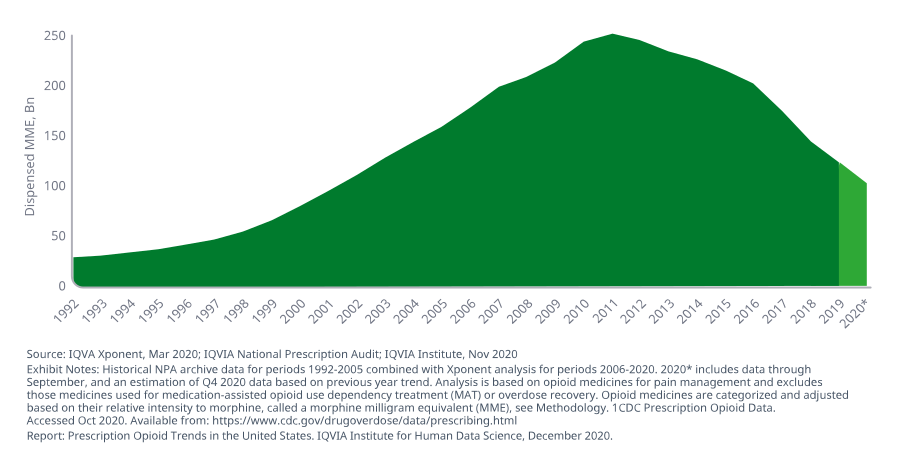
from https://www.iqvia.com/insights/the-iqvia-institute/reports/p...
And much like doctors, mechanics have a massive conflict of interest. If you're not careful, the mechanic will propose a bunch of unnecessary work on your car just to earn more money.
I'd say medical care is an exception where we try to mandate (by law) that they act in our best interest.
There's a big difference between trying to learn everything and about some specific issue. Every doctor would destroy anyone self-taught on general medical knowledge, of course, but in areas that are specifically relevant to that person - anyone of above average intelligence can definitely become more competent than an average doctor, just because the person with a problem is motivated to spend hours or even days finding relevant information. Then there's of course the whole area of surgery where self-treatment is borderline impossible - which is a major part of medical studies.
>For a lot of diseases there are no treatments without serious side-effects, and drugs to address those side-effects can have other side-effects and so on. A lot of symptoms are common to many illnesses, so you need a wide array of information to arrive at a correct differential diagnosis (quickly).
This describes an absolute best case and presents it as the average. Chances are if you go to a doctor with a viral infection you will get a prescription for antibiotics, an obvious absurdity. Why? Because a patient expects 'something', so doing that makes the uninformed patient happier - while in reality, at best it's minimally harmful.
This is so prevalent there are multiple studies about this, eg:
https://www.ncbi.nlm.nih.gov/pmc/articles/PMC5093394/
"More than half the GP respondents to the survey in Australia self-reported that they would prescribe antibiotics for an URTI to meet patient expectations. Our qualitative findings suggest that ‘patient expectations’ may be the main reason given for inappropriate prescribing, but it is an all-encompassing phrase that includes other reasons."
More than half! That's the actual quality of care that's being delivered, it's worse than doing nothing at all. Risk of side effects is completely ignored. Millions of people have allergy to amoxicillin, one of the most commonly prescribed one.
My opinion based on my experiences, experiences of others and studies like that - is that advice from an average doctor is completely worthless. Of course there are competent doctors - but there's a contradiction here: for any specific problem, the only way to determine competency is to become competent yourself, but the moment you do, you stop needing the advice. Therefore, as long as you're capable of doing research based on symptoms, and the situation isn't an emergency - going to a doctor is pointless. Yet the law system is doing everything it can to force me.
>Not to mention, while classes of life saving medications are highly addictive, so patient's access to them must be carefully managed to avoid making their lives even worse. Benzodiazepines, as in TFA, are a good example.
This is paternalism and it's abhorrent. In fact I have another related real life story: my grandma has extreme sleep problems and no OTC supplements helped. After some research I decided that etizolam is the safest and most likely to help drug - which turned out to be right, as it worked perfectly for over 2 years, along with a very strong increase in general mood (etizolam itself is mildly anxiolytic - but probably mostly due to more sleep) and mental capability. No side effects reported. Unfortunately it became a controlled substance here (even though in some countries it's a normal prescription drug - at least Japan and Italy) and she definitely didn't want to break any laws. As the daily dose was small (0.7mg before sleep - chosen experimentally as the minimum one that worked), there were no noticeable withdrawal symptoms. Went to a doctor, eventually got a prescription for zolpidem. Result: works for sleep, but also caused an enormous increase in depression symptoms and noticeable memory problems. Real life result from "managing access".
While I definitely agree with your general point, how does your brother know that they’re healthy or don’t need to take the medication? I’ve never had any discussion with a pharmacist (in the US or Canada) where I’ve revealed this information.
What I really needed was my father not being dead when it mattered.
"No medical history" doesn't mean shit either, it just means you have not yet seeked help. Most don't see mental health professionals at the first sign of issues, often they only do when things are starting to crumble. And that's my experience in a country with socialized healthcare, now translate that to the US where therapy is unaffordable to a large number of people.
A lot of people have conditions that medicine treats so well you wouldn't even know they had a condition at all.
I know many people who have taken antipsychotics, amphetamines, and statins for decades and it was perfectly fine for them. I also personally know some judgmental pharmacists too. All I'll say is, there's a reason pharmacists and doctors are distinct professions.
It's very likely. This actually has to be explained to a lot of people with chronic diseases like hypertension and type 2 diabetes. Way too many of them just stop taking their medication after their condition improves.
When I got an amphetamine prescription in uni (like everyone else), I felt like I was lucky to have a doctor that started me off on the lowest dose.
Everyone I knew was on a much higher dose than me just starting out. People would get a dual prescription of XR capsules + IR tabs when they need a bump. Then when they couldn't sleep, the doc would just add another pill to the mix. And not just a mild one, but an extreme one like Seroquel.
Your doctor just isn't a specialist, and certainly not someone specializing in you and your specific ailments despite what we seem to pretend in these threads. Best strategy is to be informed and meet them in the middle.
Health, and especially not mental health is very much not visible or even obvious. Just ask any disabled person that is not bound to a wheelchair 100 percent of the time.
All people who complete a doctorate program are entitled to be addressed as "doctor". This includes everything from a Ph.D. (the original "doctor"), to M.D.s and D.O.s (medical doctors), and yes, D.C.
The chiropractors aren't having folks call them doctor because they have the right to (as someone with a PhD would do). They are doing it to make folks think they are medical professionals in the same manner as an M.D.
In other words, posing as a medical doctor.
And this kills folks when you consider the sort of scam practices that a lot of chiropractors tend to practice. Honestly, I think it is too bad that we've decided to use the same word for all of these and I'd be happy to change things legally to protect folks from this sort of sham.
Well, we have three choices. Either:
1. We change this social norm
2. we come up with a better title for people who didn't get a degree in quackery from an online program, or
3. most people lose all trust in doctors.
Beyond old age, the vast majority of people are bad at taking care of themselves. So many people that it is not a moral issue. It is a systemic issue.
The problem is, you don’t need to take care of yourself, until you do. Society doesn’t prepare us for that. (I got to learn the hard way.)
All it takes is one accident or affliction to change this ability. Unresponsive due to a car accident, for example, or simply not having your list of information when you got rushed to the hospital. Confusion due to a high fever. A stroke due to an undiagnosed and hidden condition. Heck, simply age or winding up with a complicated health situation can do it.
In short: You really only can trust yourself if you have enough luck.
They’re called “teachers” because their degree qualifies them to teach medical students.
It has its origin in the medieval academic degree system.
But it’s not in any way about their instruction of patients.
God forbid your prescription runs out on a weekend or holiday when your doctor’s office is closed. And don’t even think about shopping around for multiple scripts because that’ll just label you as a drug addict. The only winning move is to take half-doses on down days and build up a small stash of emergency medication.
But for some reason the government (the FDA) and medical field in general cares about abuse a lot. In the past few weeks, Cerebral got labelled a pill mill by the FDA/execs and as a result almost all ADHD telemedicine patients are having a hard time getting prescriptions filled. Sending a prescription to multiple places sequentially (because they keep refusing to fill it) or calling a pharmacy in advance to ask if they'd fill the prescription runs the risk of being labelled a drug seeker, and any power-tripping retail pharmacist - who doesn't know anything about you at all - can just refuse to fill your prescription if they want. Asking your provider for a higher dose is also anxiety-inducing for similar reasons.
The worst part is, people with ADHD still build a dependence/tolerance on amphetamines/methylphenidate. So running out of your medicine is really disruptive - not only do your symptoms go untreated, but they become worse than they'd be if you were unmedicated for a long interval, plus you have to deal with things like not feeling fully awake, being hungrier, lethargic, sleeping more while your body adjusts back to being unmedicated. But for some reason that's acceptable as long as we prevent people from taking amphetamines for fun.
I got turned down for filling an Adderall prescription at a CVS because the pharmacist didn't like that I was paying in cash (credit card) as an uninsured uni student. Didn't offer to call my doctor's office to confirm the script. Just said oh, I don't like that you're paying in cash so I'm not going to fill this :).
I fortunately get 90-day prescriptions (how long will that last?) and every time I refill, I have anxiety throughout the whole process (the checkup, the pharmacy) until I have pills in hand. Every time I feel like it's going to be the day I somehow have to jump through more hoops like my friend who has to have his pills counted every two weeks for his painkillers.
I've been avoiding higher doses because this setup works well enough that I don't want to disrupt the status quo and I keep hearing from friends that build a dependence and even one who went off them entirely after adverse reactions on very high doses.
Fortunately I have a doctor who agreed this was a good idea and writes me prescriptions for different strengths.
My experience was that I had to ask my doctor to switch, but once I asked, they were happy to accommodate.
Personally, I have no difficulty tapering doses on the weekends, even pouring out half the capsule’s powder. I once asked my doctor if they could prescribe sixty 20mg pills instead of thirty 40mg pills. Half doses when I’m taking the day off, right?
Wrong. Insurance only fills 30 pills per month and they have to be of the same potency. Ironically, if you asked your doctor to give you the 70mg pills, you could dump the excess powder for an emergency reserve and end up with far more medication!
The rules are totally made up and there’s no actual reason for limits other than the projection of “being tough on drug abuse.”
Around here (US location) my medical professional friends are all hesitant to prescribe any controlled substances to more than a certain number of their patients for fear of getting flagged.
Whenever I read these stories of people receiving benzos and other scheduled substances for years with no oversight, I can’t tell if this is actually happening regularly somewhere or if we’re just reading a lot of exaggerated second-hand stories.
I know these things happen somewhere, sometimes but the insinuation that it’s just the norm in American medicine is baffling.
I saw multiple doctors for years about anxiety issues and the most I got prescribed was an antihistamine. I also suffer from chronic back pain due to a genetic issue and it's been pretty much impossible for me to get a prescription that does anything for it.
I don't think people are lying about their experiences, I'm just baffled as to where this is going on because it's been totally opposite to my experiences.
If therapy is part of the treatment plan, they're often referred down to a psychologist or therapist for that part of things. A psychiatrist can do therapy....but their hourly rate is a whole lot higher.
----------------
As to personal experience, my current psych (ADHD), requires a ~15min "medication management" session about 4x a year. It's not exactly a ton of oversight.
The couple previous psychiatrists I've had when I lived in other places were about the same way once we got past the initial phase.
It is worth noting that my prescription (+ it's effectiveness) has been generally steady for a long time and I don't exactly have a profile in terms of age/dosage/history that suggests abuse risk.
The idea that pharmacists have any meaningful diagnostic role in the US is risible.
I suspect pharmacists are the only people that some class of Americans can speak to about medical issues because they have an open storefront.
I don't know what pharmacists know about drugs, but they're useful people to speak to about insurance issues. They know the rules around age cutoffs for optional vaccines, which generics are in stock, when something will be denied by insurance, etc.
You could always request a more in-depth conversation if necessary.
Benzos are a completely different scenario because, unlike your ADHD medication, they’re not indicated for long-term use except in extraordinary circumstances. They can’t be compared to your long-term ADHD prescriptions.
I suspect there’s a lot of word of mouth references where patients are telling their friends which doctors prescribe which medications and giving guidance about what to say to get those prescriptions. This was definitely the case in the early opioid crisis years where the bulk of prescriptions were coming from a small number of doctors.
It’s benzodiazepines that are the problem. These should be reserved for short-term use in extraordinary circumstances, but a small number of doctors seem to hand them out too aggressively.
SSRIs and benzos are in entirely different risk categories. That’s why benzos are controlled substances and SSRIs are not.